Very Graphic and hot for the faint of heart, but it is what it is. Not all Muslims are this radical but a high enough percentage of them are (probably 10% to 25% support Jihad) and so that is why this clash of civilizations has been going of for 1,400 years and it will not end in either yours or mine lifetimes.
Re-post Amil Mani Freedom Imitative 15 Nov 2013
http://www.amilimani.com/islam-is-a-belief-of-blood/#sthash.QaYfbiZJ.dpuf
Peshawar Pakistan to Nairobi Kenya, from Damascus Syria to Benghazi Libya, Muslims are on a killing rampage. The civilized world is shocked and distressed. Some mutation seems to take place in the humanness of the person the minute he announces his subservience to Islam by reciting the Shahada: “I bear witness that there is no god but Allah and Muhammad is his messenger.” The individual becomes intolerant, violent and the shedding of blood becomes central to his life.
The Greek had their gods, so did the idolater Arabs before Muhammad appeared on the scene. Muhammad chose a minor idol as god and the only god and elected the name of Allah for him. According to Muhammad, Allah is not only the god; he is the all-everything god, embodying all imaginable attributes that were previously monopolies of different gods of the polytheists.
What in fact stands out as Allah’s dominating attribute, is his intolerant and violent nature. He is nothing like the all-merciful the Quran claims. But he certainly is the most wrathful. Since commissioning Muhammad as his emissary and giving him the manual of mayhem called the Quran, the world has never seen a day of peace. Apparently that’s just the way Allah likes it.
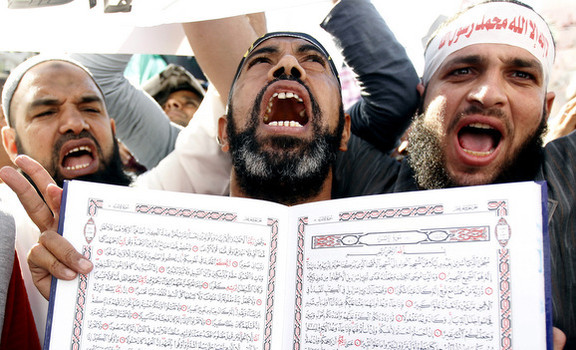
EGYPT“The religion of peace,” is in fact the religion of blood.
Distressed by the Muslims’ trouble-making and killing sprees, civilized nations are bending over backward in the hope of placating them and helping them join the family of humanity by admitting hordes of immigrants and affording them all manner of hospitality and assistance. All seems to no avail. Many of the new arrivals, deeply infected by the Islamic ethos, find it impossible to assimilate in the host countries. Instead, they strive to impose their defunct order that is the cause of their backwardness and inhumanity on the host people.
The non-Muslim world is at the end of its wits. No accommodation or kindness seems to stem the tide of Islamic violence. Countless numbers of proposals have been advanced in dealing with Islamic mayhem. Some feel that, in general, Muslims are law-abiding citizens of their adopted countries and it is a minority that is responsible for acts of atrocities. Thinking along these lines has prompted people to say that the solution to Islamic violence rests with Islamic leaders. That is, Islamic leaders should speak up and condemn jihad and jihadists.
To begin with, renouncing jihad violates the repeated commands of the Quran and the Hadith. No Islamic leader would dare to attempt that abrogation.
To propose that the solution to Muslims’ killings of non-combatant civilians, as jihadists do daily, rests with Muslim leaders declaring anyone who does such a thing goes to hell is a product of a wishful mind or an ignorant naive dreamer unfamiliar with the fundamental bases of Islamic violence. Here are a few fatal flaws in this proposal.
Muhammad is long dead. There is no one person, a pope-like figure in Islam and there has never been since Muhammad died. Immediately after Muhammad died, Islam became ‘ISLAMS’ and kept fractioning and continues to do so to this day. It is not too dissimilar to the death of the founder of a violent gang leader that spawns an entire group of contenders for the position that inevitably leads to infighting among the late gang leader’s top lieutenants.

Any Islamic leader worthy of his salt would neither dare nor want to issue such fatwa. It is like asking a slaveholder who is leading a very charmed life at the expense of slaves to free the slave and start working the cotton fields to earn his bread.
Furthermore, if this leader, who has bought into the system and has reaped the immensely-valued benefits of his position, were to in fact give it all up and come up with the suggested fatwa, he would be immediately defrocked if not lynched by his own followers as a heretic who had betrayed the explicit teachings of the holy Quran where the faithful are repeatedly urged to wage war against all Kafir (non-Muslim), civilians or not.
Islam is tantamount to violence. Violence is the lifeblood of Islam and it has been ever since the time of Muhammad in Medina by Muhammad’s own edict and conducts.
Without violence of all types, Islam would undergo a slow death. Violence is in the fabric of this cult. Take away violence and you shut down the blood supply from the body of ‘ISLAMS.’ Islam is violent, not only against non-Muslims, but it is also violent against its own numerous sects and offshoots. Even within every sect and offshoot violence in the most savage ways is practiced. Just to name some examples: public lashing, cutting off of hands for stealing even a morsel of bread, blinding convicts or hanging them, stoning the so-called adulteresses, castrating sexual offenders and hanging of homosexuals.
No fatwa of Islamic leader or leaders is forthcoming. The only answer to a cult born by violence seems to be death by violence, something like what is going on daily in Iraq and Syria and to some extent in other Muslim lands. The non-Islamic lands will do well to keep this cult of violence out of their countries and let them practice their systemic violence among their feuding sects in their own lands.
Western armchair theorizers and wishful thinkers need to take time and study the Islamic system in order to avoid making demands on Muslim leaders–demands that will never be met because they are completely unrealistic.

Muslim leaders advance to their positions of leadership in the Islam Inc.’s numerous subsidiaries by cleverly and ruthlessly navigating their way through the hierarchical labyrinth of cutthroat competition. Kissing up and the demonstrating of unconditional loyalty to the higher ups is required. Undeviating total devotion to the charter of the corporation as defined and promoted by the particular subsidiary, while vigilantly exploiting any opportunity for climbing up the next rung of the ladder of leadership are prime requisites of staying in the game.
The individuals who attain high leadership positions in Islam have invested their all with great acumen and gone through a tortuous ringer for years to attain their positions. They deeply covet that position and do absolutely nothing to rock the boat, so to speak.
The individual who ascends to a high leadership position, must craftily and successfully work his way through a labyrinth of high intrigues for many years. These leadership positions are greatly coveted and the person would hardly be inclined to do anything that would endanger his status. The slightest deviation by any of the Islamic high clergy entails tremendous risks. The late grand Ayatollah Ali Montazeri of Iran, for instance, who was initially tapped by Khomeini to become his successor, was disgraced and placed under house arrest for daring to voice his concerns about the Islamic government’s summary mass execution of political prisoners.

The profession of a clergy is to attract a select segment of men, men who have already significantly bought into the Islamic charter and its methods. As these men undergo formal indoctrination, a culling process takes place. Hundreds of thousands of these men, for a variety of reasons, do not advance very far. A great number of Muslims function in lower positions for the rest of their lives. They are the drones, so to speak. They loyally keep working the rank and file Muslim believers at villages and towns, making them toe the line and pay their tributes and cash to their parasitic handlers who continue their highly successful smoke and mirror charade. A significant number may leave the ordination altogether, for a variety of reasons, and begin earning their living like the rest of the people.
Another not unimportant complicating factor is that the Islamic leaders actually believe the entire Islamic package, as absurd as much of it may seem to non-Muslims. It is human nature to start believing even the most absurd after having it preached to you by higher authorities and you, yourself, had parroted them repeatedly to others.
Millions of Shiites, for example, pilgrimage to a well near the city of Qum in Iran to pay homage and tribute to the Shiite’s 12th imam, claimed to be hiding there for over a thousand years. No one forces these millions to believe this patently absurd assertion successfully hammered into their minds by the purveyors of the Islamic fraud, the high divines.
Interestingly enough, the new mullah president of the Islamic Republic of Iran, Hassan Rouhani, in a public speech proclaimed that Iran belongs to the same imam who is hiding in the well. This mullah Rouhani is now championing Iran’s standing down its nuclearization program? Be serious. This is the same fraud who bragged about how he fooled the West by pretending to negotiate while keeping the centrifuges spinning overtime to produce the needed material for the bombs.
Getting the nuclear bomb is the Holy Grail for the Shiites of the world. It is the bomb they intend to use, make no mistake about it, that would make the world a bloodbath, a pre-requisite condition of their promised savior, the imam in the well, to abandon his hideout, rise to the surface, defeat whatever is left of the non-Muslim world and establish Allah’s complete rule over the entire planet.

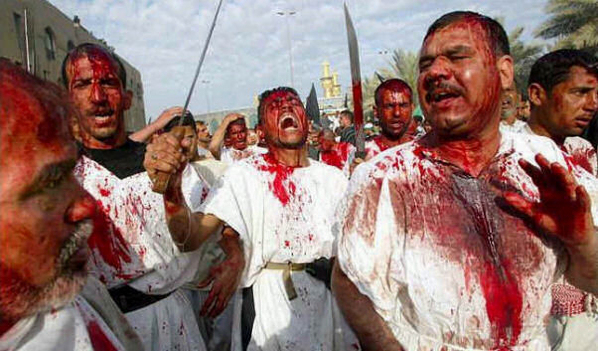
Islam is a belief of blood. It lives and thrives on blood. It can be animal blood, enemy blood or even it’s own blood. Consider the horrific practice of ghameh zani, (self-flagellation). Shiite faithful march en mass in public places, beating themselves with chains, cutting themselves with knives on their heads, torso and arms, causing blood to gush out and all this to commemorate religious historical events.
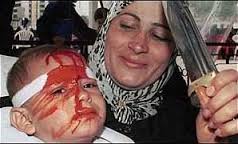
There once was a picture of a mother proudly holding up her baby boy who was slashed on the forehead during gameh zani. That picture is worth a million words to make the case that Islam is a belief of blood. Islam has got to have blood. When you mercilessly slash your own head and body to honor your belief of blood, you have no compunctions in shedding the blood of others, particularly when they are perceived as enemies of your sacred belief.
Amil Imani is the author of Obama Meets Ahmadinejad and Operation Persian Gulf.






 Centinel2012