Pitfalls in climate sensitivity estimation: Part 1


niclewis's avatarClimate Audit

A guest post by Nicholas Lewis

As many readers will be aware, I attended the WCRP Grand Challenge Workshop: Earth’s Climate Sensitivities at Schloss Ringberg in late March. Ringberg 2015 was a very interesting event, attended by many of the best known scientists involved in this field and in areas of research closely related to it – such as the behaviour of clouds, aerosols and heat in the ocean. Many talks were given at Ringberg 2015; presentation slides are available here. It is often difficult to follow presentations just from the slides, so I thought it was worth posting an annotated version of the slides relating to my own talk, “Pitfalls in climate sensitivity estimation”. To make it more digestible and focus discussion, I am splitting my presentation into three parts. I’ve omitted the title slide and reinstated some slides that I cut out of my talk due to the 15…

View original post 2,950 more words

Gordon Fulks, PhD Physics on a local Oregon goofy climate action plan


Worth reading

john1282's avatarJunkScience.com

Gordon and I have corresponded many times, and I follow his advocacy.

View original post 1,314 more words

The Obama climate monarchy


COP21 is only 7 months away!

Reading Thermometers Is Hard


No one as yet figured out how we went to the Moon without a cell and a tablet connected to the cloud?

Tony Heller's avatarReal Climate Science

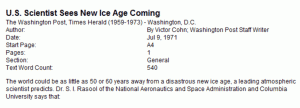
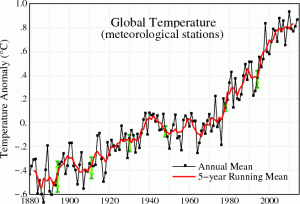
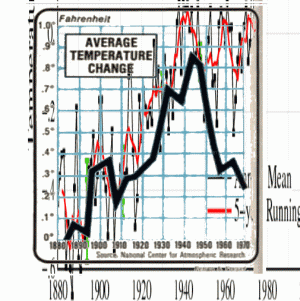
In the 1970’s, back when NASA was putting men on the moon – they simply didn’t know how to read thermometers correctly. Scientists thought that 1970 was cooler than 1900, and there was a big spike at 1940 – followed by rapid cooling.

ScreenHunter_8556 Apr. 12 11.05

ScreenHunter_8559 Apr. 12 11.33

NASA can no longer put men on the moon, but they can go back in time and reread thermometers from the 1970’s. They have since discovered that 1970 was much warmer than 1900, and that the scientists who put men on the moon were of inferior intellect to Mikey, Gavin, and Jim.

Fig.A (1)

The image below overlays the 1970’s graph on the current one. NASA time travel  has removed the blip, and saved us from the unpardonable sin of climate denial.

ScreenHunter_8558 Apr. 12 11.22

From: Tom Wigley <wigley@ucar.edu>
To: Phil Jones <p.jones@uea.ac.uk>
Subject: 1940s
Date: Sun, 27 Sep 2009 23:25:38 -0600
Cc: Ben Santer <santer1@llnl.gov>

It would be good to remove at least part of the…

View original post 64 more words

Sea Ice Extent – Day 101 – 6th Highest Global Sea Ice For This Day – Antarctic 1.4 million above ‘Normal’


Must be getting cold, how can that be?

sunshinehours1's avatarsunshine hours

6th Highest Global Sea Ice For This Day. 

Antarctic 1.4 million above the 1981-2010 mean. That is 22%!

Arctic has been rising for last 4 days and is higher than 2006 and 2007.

Global_Sea_Ice_Extent_Zoomed_2015_Day_101_1981-2010Antarctic_Sea_Ice_Extent_Zoomed_2015_Day_101_1981-2010Arctic_Sea_Ice_Extent_Zoomed_2015_Day_101_1981-2010

DataSouth / North

View original post

When The AMO Turns, Forget Global Warming


We are in for a cold spell …

A More Scientifically Correct View of Climate “Change”


Prof. Nir Shaviv gives a lecture on what is probably the real reason we have a variable climate.

Idiotic claim from WH science advisor John Holdren: ‘Finally, less energy can mean more employment.’


Good analysis and spot on!

Germany’s Leading Daily Calls For An End To Green Energy Subsidies! Calls Green Promises “A Fairy Tale”


The Germans are waking up to the fact that “Green Energy” is a disaster; they tried it and it just doesn’t work for a significant portion of Grid Power..

Scientists Say New Study Is A ‘Death Blow’ To Global Warming Hysteria


One more nail in the coffin of Al Gore and James Hansen.

Mountain★Republic's avatarMountain★Republic

A new study out of Germany casts further doubt on the so-called global warming “consensus”

Michael Bastasch | Daily Caller


new study out of Germany casts further doubt on the so-called global warming “consensus” by suggesting the atmosphere may be less sensitive to increases in carbon dioxide emissions than most scientists think.

A study by scientists at Germany’s Max Planck Institute for Meteorology found that man-made aerosols had a much smaller cooling effect on the atmosphere during the 20th Century than was previously thought. Why is this big news? It means increases in carbon dioxide emissions likely cause less warming than most climate models suggest.

What do aerosols have to do with anything? Well, aerosols are created from human activities like burning coal, driving cars or from fires. There are also natural aerosols like clouds and fog. Aerosols tend to reflect solar energy back into space, giving them a…

View original post 66 more words