
Part Six Anomalies
The IPCC, NASA NOAA and most scientists that study Climate change and Anthropogenic Climate Change use a system of measurement for Global temperatures that most of us are not familiar with called Anomalies. I’ve described this method in previous posts on my blog in this series but once more will not hurt. Basically, someone determines a Base period and then observations are measured against that base and therefore the result can be either higher or lower than the Base. The Base period should have some relevance to the subject but whether it does or not, it must be a constant or the system will not work.
NASA and NOAA work together on developing a Global temperature and when they set the system up they picked a period from 1951 through 1980. 30 years or 360 months, as their Base and when they did that they determined, obviously sometime after 1980, that the Global temperature was 14.0 degrees Celsius. Now this is important, there is no scientific reason to use that period and according to NASA it was because that is when most of the scientists at NASA and NOAA had grown up. A much better Base would have been the geological global mean estimated to be around 17.0 degrees Celsius but then all the values would be negative and that wouldn’t have looked good.
Now that they NASA and NOAA have their base they subtract it from the global temperature that they have calculated with their proprietary software. Keep in mind that there really is no Global temperature if for no other reason than the earth is a sphere and one side is always facing the sun (Hot) the source of all our energy and one side facing away from the sun (cold). Let’s do an example, for January 2015 NASA determined that the global temperature was 14.74 degrees Celsius so 14.74 minus 14.0 (the base) leaves .74 which they then multiple by 100 and that gives us an anomaly of 74. That value is published in many versions but we’re interested in a table called the Land Ocean Temperature Index LOTI and that table gives those values all the way back to January 1880. Most temperature data that comes from NASA or NOAA is in this anomaly format.
NOAA publishes the C02 information but they do not use this format they publish an actually value in this case CO2 in the atmosphere as parts per million volume (ppmv), for example the value for January 2015 was 399.96 ppmv. Sometimes the v is dropped so it would be 399.96 ppm. NOAA publishes the CO2 ppm value by month and they go back to March 1958 so there is not as much data to use in evaluations as with Global temperatures. In previous posts here, an equation was shown that will generate a curve that matches historical CO2 levels, present CO2 levels and CO2 levels as shown in IPCC reports such as the latest AR5. When we get to that part of this analysis we’ll show both and then drop the NOAA portions since it is for such a short period of time.
This completes the introduction and now we get to what we are going to do that’s different from previous Climate work by others. Basically we are going to convert CO2 levels to an anomaly using the same system that NASA uses for temperature. By doing that we’ll be comparing everything to the 1951 -1980 base period in the same kind of units. This should make any patterns or correlations more visible. We’ll start with showing the NASA Global temperature anomalies and then add on other items.
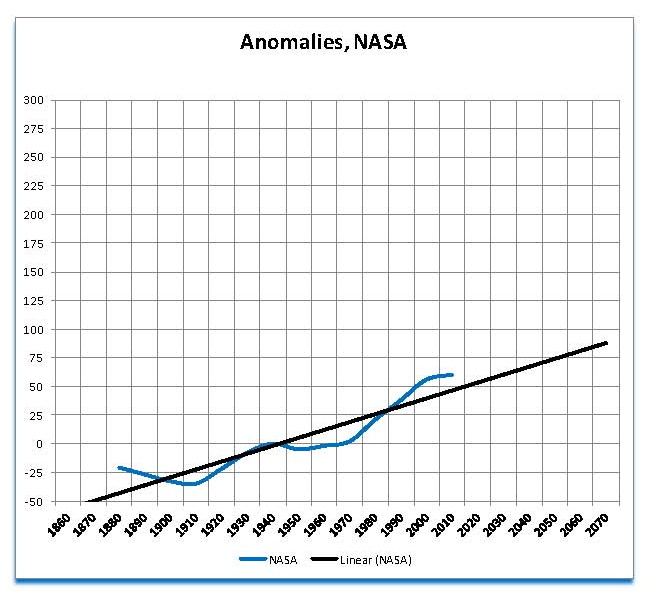
But first one other comment and that is we have had to make some adjustments in the NASA temperature data to make it more understandable. The first part is done by combining blocks of months and then taking an average. We are looking at climate changes not weather and so daily or even monthly movements do not mean anything. We picked ten years for a block for all the work here and we start with 1880 to 1899. This gives a smooth plot rather than the jagged ones that are normally seen and that makes it difficult to pick out climate from weather. Also in the case of NASA data we average 4 different current reports 2012.12, 2013.12, 2014.12 and 2015.01 the most current. This was done because of the process that NASA uses to determine the Global mean temperature creates some variation in the anomalies this averaging helps to minimize those variations. The following Chart was generated using this method. I have talked about this process in other posts here if the reader is interested.
The NASA global temperature anomalies using the method described here are shown in the blue plot on the Chart. We can see that there is a downward movement from 1880 to 1900 then an upward movement to 1940 then a downward movement to 1980 then a large upward movement to 2010. And lastly what looks like the beginning of another downward movement starting around 2010. In addition the entire series is moving up as shown by the black trend line.
There is no dispute on the patterns shown here the only issue is whether what this Chart shows is natural or manmade?
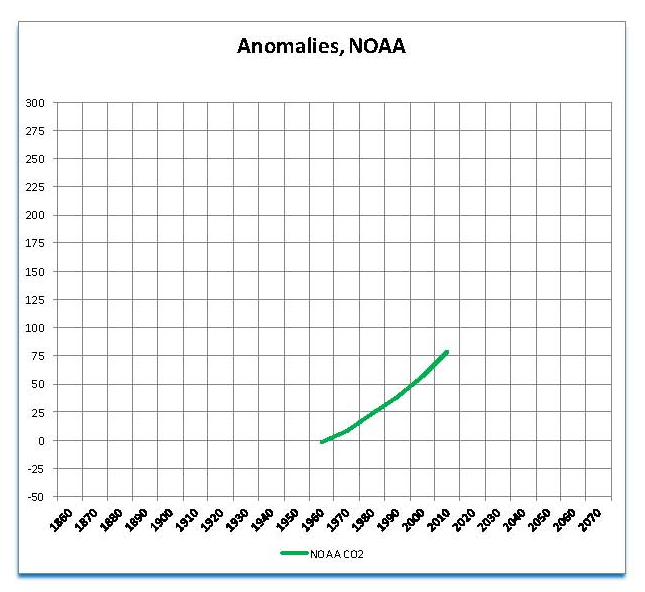
The next part of this analysis is looking at NOAA CO2 data in the same anomaly format and as previously stated there is much less information here than with Global temperatures. The first Chart shown below is a plot in Green of the CO2 data from NOAA and although most show this as a straight line, it is not it is a polynomial curve actually a logistic curve again as previously discussed here in Part Four. But first let’s look at just the NOAA data in anomaly format using the same base as the NASA Global temperatures, 1951 to 1980. The actual published NOAA CO2 plots in ppm are shown in Part Four
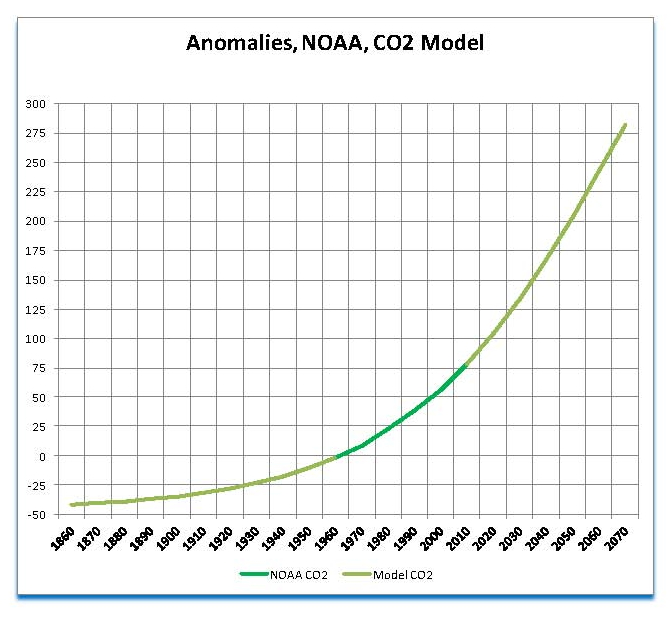
In the next Chart we’ll add the logistic curve to the actual NOAA data blocking out the common years in the CO2 model so you can see how the fit between the two data sets is very good. The actual NOAA is in green and the Modeled CO2 is in light green. Again as previously stated this logistics curve shows CO2 values that are in agreement with historical CO2 records, present CO2 and future projections of CO2 as published by the IPCC in their various assessments, the most current being AR5.
For the rest of this analysis we will use the logistic curve for CO2 and show it as a green plot labeled NOAA CO2 as there is no real difference.
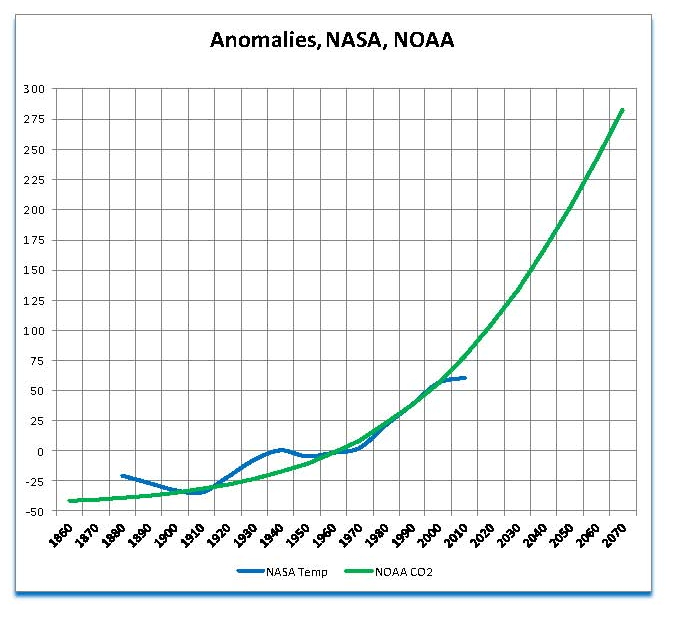
The next Chart shows the NASA Global Temperature and the NOAA CO2 anomalies combined. There does seem to be a relationship between the upward movement of CO2 and the upward movement in global temperature especially in the period from 1970 through 2000. We’ll continue this analysis to see if this apparent relationship is real or not.
The next thing to look at now that we have past temperatures and a reasonable forecast of CO2 is what the IPCC estimates, based on the anthropogenic theory, Global temperatures will be in the future. They make this harder than it needs to be by tying the projections to economic projections, but since none of the proposed CO2 reductions have come to pass we’ll use the one business as usual, since it is the most likely. The next Chart shows just the past NASA Global Temperatures and the IPCC estimates of what future Global temperatures will be. Keep in mind that we are showing Anomalies not actual Global Temperatures.
There can be no dispute that the IPCC projection does appear to follow the NASA trend from 1980 through 2000. This trend would make Global temperatures about 15.75 degrees Celsius by 2050. This can be calculated by adding to the base of 14.0 degrees Celsius the y axis value of 175 for 2050 after diving it by 100 to turn it back into degrees Celsius. Also we do not see any deviations its strictly a smooth upward plot not like the actual from the past.
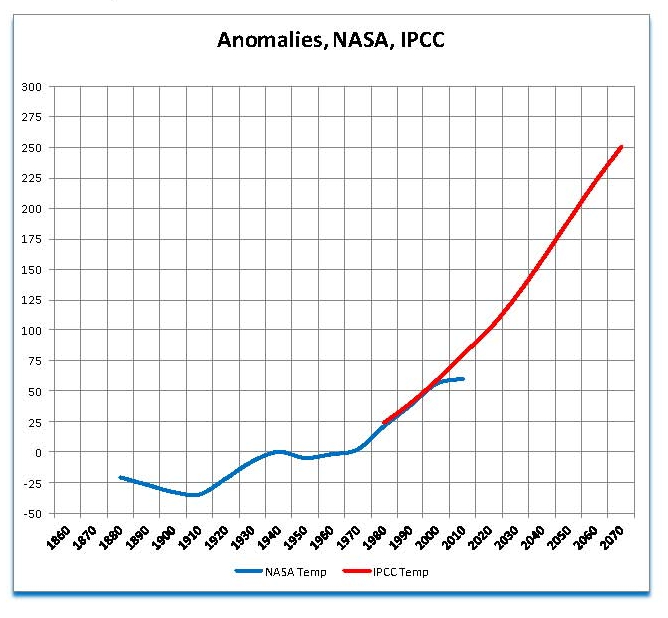
In the next Chart we’ll add back the NOAA CO2 plot and we’ll see that the IPCC projection and the CO2 projection are very close indicating that there is a very close relationship between the IPCC projection and the CO2 projection. Since the IPCC was chartered to show what the 1980 to 2000 trends would do IF THE RELATIONSHIP SHOWN THERE WAS VAILD this extension is of no surprise. This Chart is similar to the one shown in Part One that Hansen showed to Congress and is also widely used by the IPCC and NASA.

Now let’s zoom in and look at the 60 year period from 1960 through 2020 so we can see more detail; this is shown in the next Chart. There is a very clear and consistent relationship between all three measure NASA temperature, NOAA CO2 and the IPCC temperature projections using the Anomaly system from about 1975 through 2005. This is of no surprise as the IPCC developed their Global Climate Models, GCM’s, to show this. It was the prevailing view in the environmental movement, at that time, that there was a direct link between CO2 levels and Global temperature.
There is an obvious departure shown here between the correlation between CO2 and Global temperature. From 1880 to 1900 CO2 is below Global temperature then from 1910 to 1950 its above Global temperature; its only from 1975 to maybe 1995 the CO2 and NASA Global temperature growth rates match. That is only a 20 year out of 134 years where this is a match which is only 14.9%.
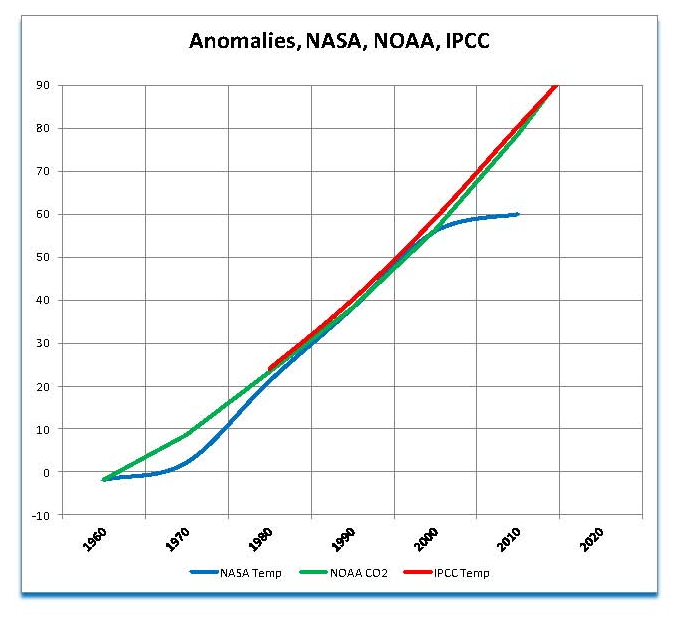
However, there is a developing problem as NASA Global temperatures are no longer following the IPCC projections even though CO2 is going up as expected. The current deviation is almost a quarter of a degree Celsius now which can be seen in the above Chart as the blue NASA plot is below the IPCC and NOAA plots by 20 units and if we divide by 100 that is .2 degrees Celsius.
Going back to the very first Chart in this series of the Global temperatures as calculated by NASA we saw that there appeared to be a pattern of ups and downs in the temperature and based on those ups and downs another down was due, and that is exactly what we see in the above Chart; the beginning of a down period.
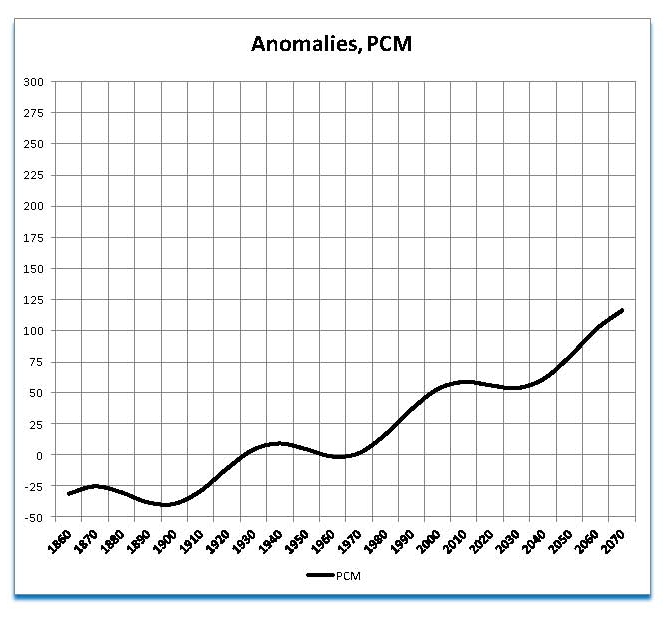
There are other theories about Climate Change one of which is based on variations in solar radiation which affects the Blackbody temperature and variation is the suns magnetic field which affects cloud formation and Albedo. We have also shown in Part Five that there are global movements in temperature that have been observed going back to the last Ice Age some 11,000 years ago, but especially in the past 4,000 years. Using modeling techniques and curve fitting an alternative Climate model designated PCM was developed in 2007 that has proved to be very accurate in projecting the Global temperature published in the NASA LOTI table.
This model is based on a long cycle of approximately 1000 years a short cycle of almost 70 years and a factor for CO2 using a sensitivity value under 1.0 degrees Celsius. Using the same method of looking at anomalies from the NASA base of 1951 to 1980 we have the following plot of the PCM model. We have the overall upward movement, and the cycle of ups and downs as was observed in the NASA Global temperature plot we first showed. So is this plot better than the IPCC’s plot at matching the NASA data?
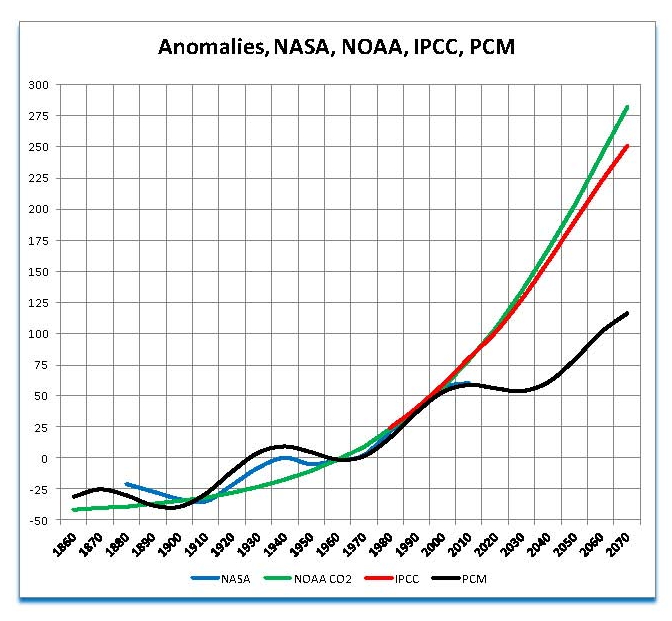
In the next Chart we add the PCM model to previous one showing NASA Temperature NOAA CO2 and the IPCC Temperature projection plots. Although we do not have a perfect match going all the way back to 1880 it is just as good for the period 1970 though 2000 as the IPCC. But more importantly it is significantly better that the IPCC from 200 to the present since is shows a slight down trend just as does the NASA data.
We’ll show one last Chart looking at the same 60 year period we used to look at the IPCC values close up. The next Chart adds the PCM model to that Chart and it’s very clear that the PCM model is significantly closer to that of the published NASA LOTI values for the entire period of NASA published Global temperatures. Although the PCM model does use a factor for CO2 it is not slowly dependant on CO2 for its projections; instead we have looked at past Global temperature movements and matched them with the more current CO2 sensitivity values found in the published papers and which was also previously shown in Part Three.

A model is only as good as its projections or forecasts so based on the above Chart it is beyond dispute that the PCM model is significantly better than that of the IPCC. Further, since the PCM projects cooling and the IPCC projects warming the disparity will only get worse and worse.
The next part will be a discussion of the logic and equations used to develop the PCM Global climate model
 Centinel2012