Posted originally on CTH on March 23, 2026 | Sundance
resident Donald Trump travelled to Memphis, Tennessee for a roundtable discussion on the DOJ task force operations. The beginning of the remarks touch on the Iran conflict. Video Below:
.


resident Donald Trump travelled to Memphis, Tennessee for a roundtable discussion on the DOJ task force operations. The beginning of the remarks touch on the Iran conflict. Video Below:
.
This is one of those small stories that carries the potential for significant domestic economic gains.

As many are aware, the U.S. imports a lot of softwood lumber from Canada. Combined with the energy products the lumber sector represents the top two U.S. imports from Canada. With Venezuela now potentially positioned to replace the former, USDA Rural Development now stimulates domestic lumber development potentially positioned to replace the latter.
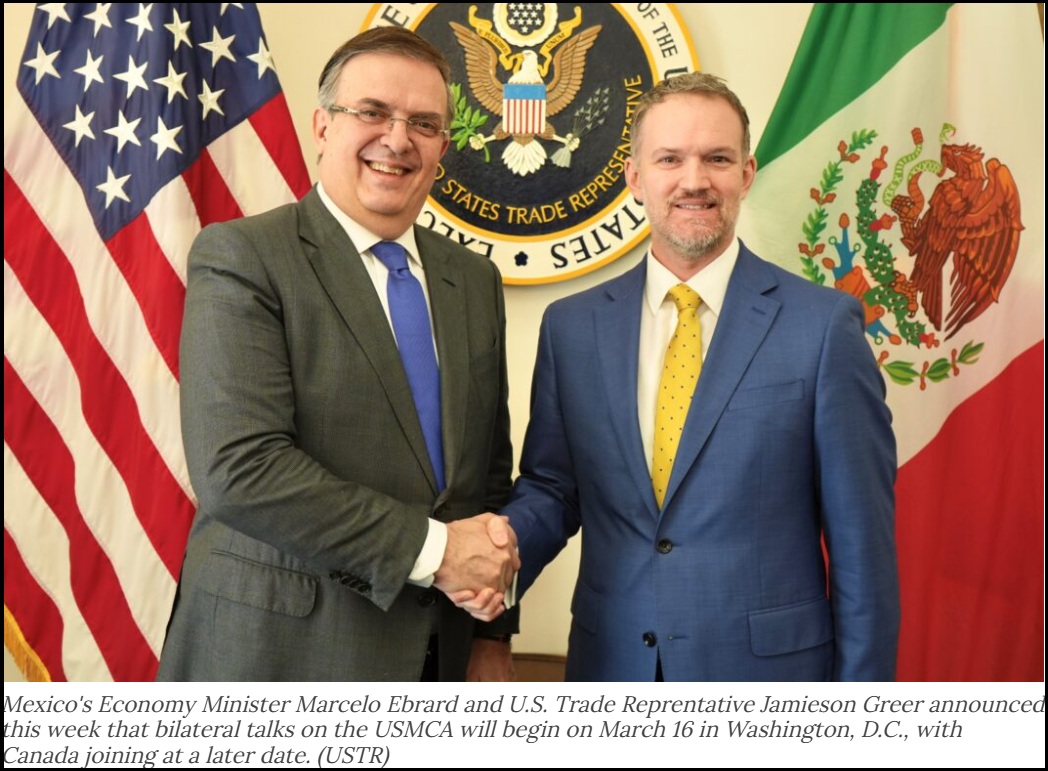
Taken as a whole, these two approaches significantly weaken the Canadian leverage that could be deployed in a Free Trade Agreement negotiation. Assuming, of course, the USMCA is dissolved in favor of two bilateral FTAs.
USDA Press Release – At the Advanced Bioeconomy Leadership Conference today, U.S. Department of Agriculture Administrator for the Rural Business and Cooperative Service J.R. Claeys announced the U.S. Department of Agriculture is guaranteeing $115.2 million across eight states through the Timber Production Expansion Guaranteed Loan Program (TPEP) to ensure sawmills and other wood processing facilities have the necessary funding to establish, reopen, expand, or improve their operations.
Today’s announcement includes recipients in the states of California, Idaho, Kansas, Louisiana, Maine, Oklahoma, Virginia, and Wisconsin.
These investments represent a commitment by the Trump Administration to expand American timber production by 25%, reduce wildfire risk, and save American lives and communities by strengthening domestic wood processing capacity.
“We cannot allow wildfires to devastate and destroy our rural communities,” said Administrator Claeys. “That’s why the USDA is taking bold action to stop the destruction of our forestlands by investing in sawmills and wood processing facilities that support sustainable timber harvesting. These actions strengthen local businesses, support rural prosperity, and create jobs for hardworking Americans.” (source)
This is not to say that expanded U.S. sawmill production would completely eliminate Canadian softwood lumber imports. However, it does create inventory and a stronger domestic supply chain that would diminish any applied leverage that Canadian trade negotiators would seek to deploy.
Without pipelines flowing East or West, Canada is stuck pumping their heavy oil south for processing. Nothing about that is likely to change in the next few years, even if Canada abandoned their climate change policy (highly unlikely).
Then comes the cross-border auto manufacturing industry, and the realization that -sans USMCA- both U.S. and Japanese automakers are likely to stick with the manufacturing center where their greatest customer base exists, the USA.
Now overlay softwood lumber, and you can see the top three economic dependencies of the U.S and Canada are slowly being uncoupled, simultaneous with the trilateral USMCA provisions being reviewed starting with the U.S. and Mexico having direct conversations.
We keep watching.

Video of the horrific crash has been released to the National Transportation Safety Board (NTSB) and the footage also found its way into social media. The Air Canada jet was landing when it hit an emergency firetruck that was crossing the runway. WATCH:
According to a CNN update, one of the flight attendants was thrown out of the plane during the incident and was found alive still strapped to her seat.
(VIA CNN) A flight attendant survived the deadly Air Canada plane crash after she was found outside the aircraft still strapped in her seat, a law enforcement source told CNN.
Two people — a pilot and a first officer — were killed in Sunday night’s crash, Air Canada said. But the airline said it could not confirm the exact number of injuries or deaths early this morning. (Live Updates)

President Trump delivers remarks and takes questions from reporters in Palm Beach, Florida, before boarding Air Force One en route to Memphis, Tennessee. President Trump emphatically stated that continued negotiations with ‘leadership’ within Iran continues and reaffirms the conditions for a cessation of hostilities.
The military leadership within the Islamic Revolutionary Guard Corps. (IRGC), do not recognize any political representation over their military control of Iran. This fracture within the political structure of Iran is what seems to create the conflict with U.S. negotiations with political entities the IRGC refuses to recognize.
President Trump is confident the presentation of terms now being discussed with Iranian political leadership will be agreeable to both Israel and U.S. interests. Additionally, President Trump discusses the issue and circumstances around former NTSC Director Joe Kent and his view on the controversy that have flowed since Kent’s resignation. WATCH:
.


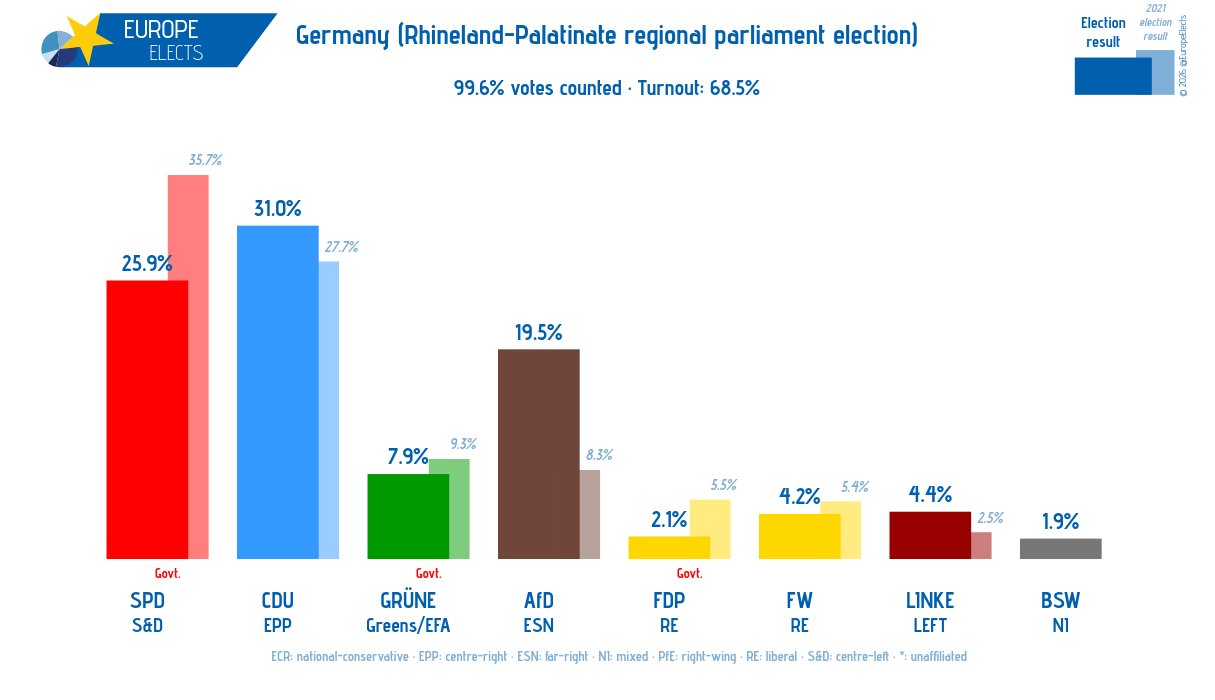
Chancellor Friedrich Merz’s conservative party the Christian Democratic Union (CDU) won the biggest portion of the election, defeating the Social Democratic Party (SPD) who lost ground in the western area bordering France. However, the biggest electoral gains were for the Alternative for Germany (AfD) party, with gains that more than doubled its previous vote share.
There is intense interest throughout Europe on the ideological shift in political sentiment mostly driven by economic concerns as well as rising nationalistic sentiment against the elitist minds in Brussels. Essentially those being ‘ruled’ are increasingly fed-up by those doing the ‘ruling.’ The AfD party is akin to the pragmatic MAGA base more focused on economic nationalism than all the nonsense associated with multiculturalism, green energy programs and terrible immigration policy.
The ideological battle within Europe is ongoing, with some gains by nationalist parties over the collective mindset of the European elites. However, the European Commission doesn’t just have a finger on the scales, they have full control over the mechanics of the elections themselves. Yes, AfD more than doubled their share of votes to 20%, but CDU at 31% and the socialists at 26% is akin to mainstream corporate republicans and progressives respectively controlling 57% of the support base.

The biggest election to be held in Europe in the last decade or more, is going to be the election in Hungary which takes place April 12, next month.
The European Commission is going all-in to try and manipulate the Hungarian voting base against Prime Minister Viktor Orban and the Fidesz party who is/are viewed by Brussels as standing in the way of their scheme to fund the ongoing war in Ukraine.
Orban’s reelection campaign has been under relentless assaults from restrictions on EU social media, to outright propaganda and financing for his opposition Péter Magyar and the Tisza party.
Prime Minister Orban is strongly supported by President Donald Trump and the Trump administration; however, the scale of opposition to both of them is intense.
Former leftist USAID Administrator Samantha Power spent time inside Hungary organizing the Tisza party to oppose Viktor Orban, and the totality of the European opposition to Orban cannot be underestimated.
Every element of every political construct within the Europe Union is aligned to try and defeat Orban and the Fidesz party. Additionally, the government of Ukraine is actively working all intelligence angles to defeat Orban due to the $90 billion EU loan scheme that Hungary is blocking.

Prime Minister Viktor Orban winning reelection this time in 2026 would be akin to Trump’s victory in 2016.
Do not underestimate the power of the U.K/European control system and the alignment of all their collective interests. Chancellor Friedrich Merz (Germany), President Emmanuel Macron (France), Prime Minister Keir Starmer (UK) along with the governing elites of Denmark, Finland, Sweden, Norway, Austria, Netherlands and many more, have all publicly taken positions against Hungary.
As we saw in Romania, Moldova and Georgia, it is not simply a matter of what the Hungarian voters want that will determine the outcome of the Hungarian election, the European Commission has many tools and techniques to shift the outcome.
This single small Hungarian election is the most critical election for the EU since Brexit.
There are trillions at stake!
The noise can seem overwhelming at times. There are those who say the U.S-Israeli joint military operation against Iran is a catastrophic miscalculation. There are those who say the operation is strategically succeeding. Many interests even appear to be cheering for the military operation to fail; others want the operation to escalate.
It is difficult to find pragmatic facts about the events without shaped information to promote specific narratives. However, accepting there is a psychological component to the information flow, it seems like the best option to listen to the experts who are conducting the operation.
Giving his first interview since Operation Epic Fury began, CENTCOM Commander Bradley Cooper outlines the current status of the conflict and the elements he notes are of most importance. According to Adm. Cooper, Iran is “operating in a sign of desperation… In the last couple of weeks, they’ve attacked civilian targets very deliberately, more than 300 times.”
“The Strait of Hormuz is physically open to transit,” he said. “The reason ships are not transiting right now is because the Islamic Republic is shooting at them with drones and missiles.” WATCH:
“I’d like everyone to note is I’ve watched this over the last week, this extraordinary contrast between the comfort and protection that you’re seeing with the senior generals in the Islamic Republic, at least those that are still alive, who are up in deep bunkers and facilities in and around Tehran. And contrast that with the soldiers who are down on the ground who are unprotected. The generals are protected. The soldiers are not protected.”
“They’re launching missiles and drones from populated areas and you need to stay inside for right now,” he said. “There will be a clear signal at some point, as the President has indicated, for you to be able to come out.”

The scene on the ground at LaGuardia airport are horrific as the nose of the Air Canada regional jet is completely destroyed. AP reports “two persons” were killed in the crash.
Apparently, an aircraft rescue and firefighting vehicle was crossing the runway at the same time the Air Canada plane was arriving. The New York Times has a live update feed with the following information:
[SOURCE] An Air Canada Express regional jet collided with a Port Authority fire truck at New York’s LaGuardia Airport, killing the plane’s two pilots and shutting down all flights at the airport, officials said Monday.
Forty-one passengers and crew members were taken to the hospital, Kathryn Garcia, the executive director of the Port Authority of New York and New Jersey, said at an early morning news conference. She said that 32 of them had been released, and that some of the others had been seriously injured.
The vehicle struck by an incoming plane at LaGuardia Airport was a Port Authority Aircraft Rescue and Firefighting vehicle that had been responding to a separate incident, the agency said in a statement. (source)
The X Account for LaGuardia Airport released the following statement:
At approximately 11:40 p.m. on Sunday, a Jazz Aviation flight operating on behalf of Air Canada was involved in an incident on Runway 4 at LaGuardia Airport in which the aircraft struck a Port Authority Aircraft Rescue and Firefighting vehicle that was responding to a separate incident.
Emergency response protocols were immediately activated. The Port Authority Police Department is on scene along with the agency’s Chairman and Executive Director. The airport is currently closed to facilitate the response and allow for a thorough investigation.
This is a developing situation based on preliminary information. The Port Authority Police Department is working closely with our airline partners as well as federal authorities and will provide additional updates as more details become available. (source)
.

Peter Thiel is well known for his PayPal startup and later Palantir tech investment. Most people now have a better understanding of exactly what Palantir software and AI interface are capable of. Palantir AI is now established as a core military system, and the suite of associated products have both military and commercial applications.
At its core, the Palantir product line is about interfacing AI with surveillance software; behavior stuff that permits surveillance and targeting systems through massive database cross referencing and actionable targeting. I’ll leave the rest of the explaining to those in the comments section who have followed the developing technology.
For his latest endeavor, Peter Thiel has now invested $2 billion in a New Zealand (think five-eyes) based company that assists cattle ranchers with their herds. “New Zealand-based Halter has secured funding at a $2 billion valuation from Peter Thiel’s Founders Fund, marking one of the highest-profile venture investments in agricultural AI to date. The startup, which manufactures AI-powered collars that autonomously manage cattle movement and behaviour, now operates across more than 5,000 farms globally.” (READ MORE) – AND WATCH:
Stay with me, this might start to sound odd.
Here’s the explanation of Halter, as it directly relates to the cattle and cow industry:
“Peter Thiel just bet $2 billion on a collar that wraps around a cow’s neck. The company is called Halter and it has a proprietary algorithm that runs the entire operation. They actually trademarked the name for it and called it the Cowgorithm and here’s how it works.
A farmer opens an app, taps a button, and 600,000 cows across three countries start walking toward the milking station on their own. No farm dogs, fences or physical labor, it’s just a solar-powered GPS collar sending sound and vibration cues to each animal.”
“The collar does more than move cows around. It monitors digestion, fertility cycles, and health patterns in real time, 24 hours a day, using machine learning trained on the behavior of hundreds of thousands of animals.
Halter was founded by a rocket engineer who built spacecraft at Rocket Lab before deciding that farming was the bigger unsolved problem. US ranchers alone have already used the technology to build over 11,000 miles of virtual fencing, roughly the full perimeter of the continental United States, saving an estimated $220 million in physical fencing costs.
Halter’s previous funding round valued the company at $1 billion. This new round, led by Thiel’s Founders Fund, doubles that valuation to $2 billion before the new money even hits the account. And they charge farmers between $5 and $8 per animal per month on a subscription model, meaning the more cows they collar, the more locked-in the revenue becomes.
The most powerful venture capitalist on earth just decided that the future of food and farming runs through an algorithm named after a cow.” (SOURCE)
Peter Thiel’s prior developmental products are all based around human behavioral sciences. Geolocation, predictive analysis, consumer patterns, behavior patterns, targeting, and the streamlined assembly of mass surveillance systems such as Palantir facial recognition software connected to identity tracking and tracing.
Why would Peter Thiel be shifting to animal behavioral sciences. Yes, there is a strong marketable product that could ultimately make cattle ranching and cow farming much more efficient and productive.
However, overlay the Halter system on cows with the Palantir system on people. Replace the cow with a human.
Let me explain what a $2 billion “cow collar” actually is 👇
They put an AI collar on a cow. It tracks location. Health. Movement. Behavior. Every second of every day.
A farmer opens an app. Draws a line on a map. That line becomes a fence.
No physical fence. No wall. Nothing visible.
When the cow gets close to the boundary.. the collar vibrates. The cow turns around. Within 10 days the animal doesn’t even test the boundary anymore. It just stays inside.
700,000 animals are already wearing them.
They called it a “cowgorithm.” They want you to laugh at it.
Now read the technology again without the word cow..
24/7 GPS tracking on every individual. Real time health and behavior monitoring. Invisible boundaries drawn from a phone. Movement controlled through vibration and sound. Subject learns compliance within days.
$2 billion. And guess who led the investment…
Peter Thiel. The same man who built Palantir. CIA backed surveillance from day one. The same man who just got a $10 billion Pentagon contract to run AI inside the military.
His entire career is building systems that track and control. Now he’s funding a collar that does exactly that.
They’re not investing in farming. The farming is the test. (SOURCE)
Where did the most aggressive testing of COVID-19 population control systems, and COVID-19 vaccination compliance take place? Australia and New Zealand. Five-Eyes countries.
Sound crazy?
So did this at the time:
h
Apparently, CNN needs to play the game of pretending that Customs and Border Protection (CBP) as well as Immigration and Customs Enforcement (ICE) do not already operate in U.S. airports.
Airports are border checkpoints, and the “customs” part of both ICE and CBP are functions that happen as part of regular duty for CBP and ICE officials.
As Tom Homan notes, CBP/ICE already exist in airports and can assist Transportation Security Administration (TSA) officials in various duties including, customs checks, routine security, entrance/exit security as well as baggage and pre-boarding security checkpoints that do not involve the use of x-ray and scanning machines. In fact, more than half the functioning work of TSA agents can easily be handled/supported by ICE/CBP agents.
But CNN needs to build a narrative, so the reality of simple explanations works against their interests. WATCH:
.

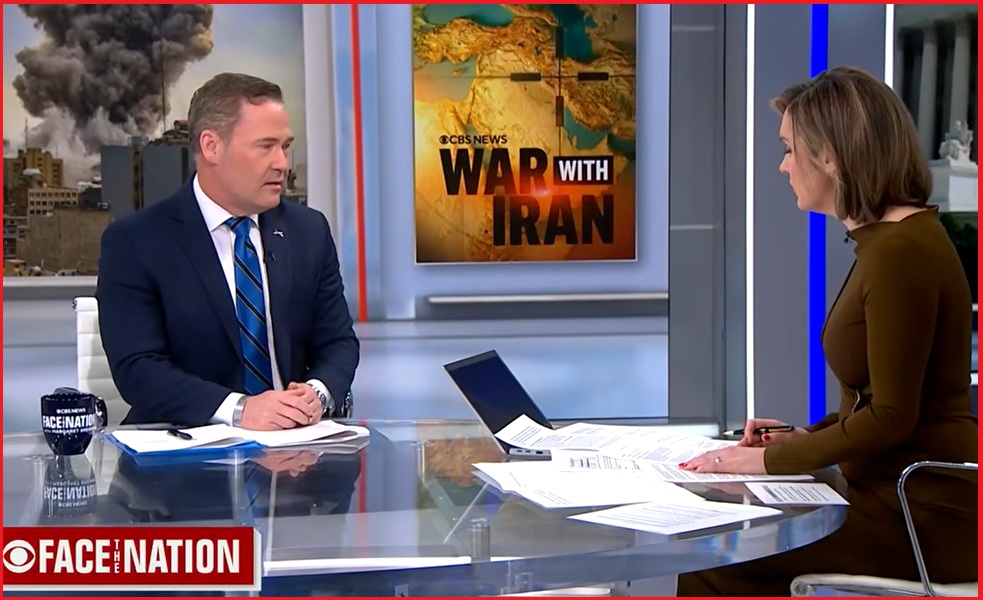
U.S. Secretary to the United Nations, Mike Waltz, appears on CBS to discuss the political angles to the U.S. military operation against Iran. There was some critical questioning about whether Iran was factually capable of sending a missile from Iran to the U.S. base at Diego Garcia in the Indian Ocean. Ambassador Waltz seems to question the reporting on their capabilities. Video and Transcript Below:
[Transcript] – MARGARET BRENNAN: That’s Charlie D’Agata reporting in Arad, Israel. We’re joined now by the U.S. Ambassador to the United Nations, Mike Waltz, and it’s good to have you here in person.
AMB. MIKE WALTZ: Thank you, Margaret.
MARGARET BRENNAN: So Ambassador, on Friday, the president tweeted, “The Hormuz Strait will have to be guarded and policed, as necessary, by other Nations who use it — The United States does not!” And then last night he threatened that if Iran doesn’t fully open the Strait of Hormuz within 48 hours from the time of his post, the US will “hit and obliterate” their power plants, starting with the “biggest one first.” So which is it, is the U.S. opening Hormuz by force or having others do it.
AMB. WALTZ: Well, I think it can be both. It’s not necessarily mutually exclusive. I am glad you are having NATO Secretary General Mark Rutte on. I think at his urging and his leadership, we have now seen Italy, Germany, France and a number of others commit to help with this effort.
MARGARET BRENNAN: –After combat operations end.
AMB. WALTZ: Particularly since, particularly since so much energy is going to Europe out of the strait. We just had the Japanese Prime Minister commit to portions of her navy and the Japanese navy, 80% of what is coming out of the Gulf is going to Asia. So we are seeing our allies come around as they should, but at the same time, the president is not going to stand for this regime, as it has threatened and tried for five decades to hold the world’s energy supplies hostage under its, its genocidal intent.
MARGARET BRENNAN: So some allies like the United Kingdom have talked about things like surveillance, anti-mining, anti-drone support for the United States. But in that appeal from the United States, I should say in the Strait of Hormuz, but not until active combat ends. To be clear, that is what we are talking about.
AMB. WALTZ: And the president has been clear too. He’s going to continue to pound Iran’s capabilities, its missile, its naval and its drone capability. Margaret, we have to take a step back. We have seen what it’s doing now in terms of attacking ports, airports, civilian infrastructure, hotels, resorts, and what it is trying to do to global energy supplies. One can only imagine if it had a nuclear umbrella. One could only imagine if Iran achieved its aim to test. Then you have Saudi Arabia wanting a nuclear program, then perhaps the UAE, Turkey or others. And when people ask why this matters to our security here at home, it should petrify every American that you could potentially have a nuclear Middle East awash in weapons.
MARGARET BRENNAN: Well, they are not enriching. They weren’t enriching leading up to this. This is what U.S. officials have testified to. But just on this point about what the president–
AMB. WALTZ: Well they couldn’t enrich because of Operation Midnight Hammer that obliterated their ability to enrich. They had every intent to continue.
MARGARET BRENNAN: They do have a nuclear power plant, Bushehr. It’s actually their largest energy plant. It’s a civilian site.
AMB. WALTZ: It is actually not their largest energy plant. It is about one, about one gigawatt. They have larger ones that are gas, fired outside of Tehran. But just case in point, yeah.
MARGARET BRENNAN: Okay, but- but in this case, in that clarification, the reason I am asking you is when the president says he is going to bomb energy infrastructure, civilian energy infrastructure, is he going to bomb a nuclear power plant, or is that off the table.
AMB. WALTZ: Well, I would never take anything off the table for the president, certainly not on national television. However, there are larger plants. There is one outside of Tehran. There are others outside of other cities that are gas fired, thermal powered. I think the important point here is to understand the IRGC, a declared terrorist organization, not only by us–
MARGARET BRENNAN: Yeah, in Europe too.
AMB. WALTZ: –but in a number of European countries, controls a huge swath of Iran’s critical infrastructure, their economy and certainly many of their governing institutions. And so to the extent we are degrading their military capability and their defense industrial base, all options should be on the table, and the president has made that very clear.
MARGARET BRENNAN: How do you ensure that this doesn’t constitute a war crime, which the UN Secretary General said an attack on energy infrastructure could be. How do you make sure this is not mass punishment for innocent civilians?
AMB. WALTZ: Well, I think you know, I would encourage and will encourage the Secretary General to point out the twenty to thirty thousand Iranians that the regime massacred at scale, the civilian infrastructure that they are attacking–
[CROSS-TALK STARTS]
MARGARET BRENNAN: –No one is endorsing that but how do you make sure this doesn’t hurt–
AMB. WALTZ: — And when you, but when have a regime that has its grips on so much critical infrastructure, that is using it to further not only the repression of its own people, to attack its neighbors, and in contravention of UN sanctions, to march towards a nuclear weapon, then that makes those legitimate targets.
[CROSS-TALK ENDS]
MARGARET BRENNAN: Okay, well, you know that in many of these places, water desalination is linked into that energy infrastructure, civilian infrastructure. This is why it is a question of it being a war crime.
AMB. WALTZ: I have no doubt that the president, the Pentagon, their team will ensure that what they target is geared towards the military infrastructure of Iran. But I have to tell you, they deliberately blend, have a long history, everything from hiding weapons under schools and hospitals to using power plants and other critical infrastructure to not only power their military but their civilian, and they deliberately blend in contravention of international law.
MARGARET BRENNAN: Let me ask you about what we saw overnight with these missile attacks. The Director of National Intelligence testified last week to Congress that Iran could not develop a militarily viable ICBM, intercontinental ballistic missile, before 2035 if it attempted to pursue that capability. Yesterday, the IDF said Israel said that Iran did fire an ICBM. Has this changed the U.S. assessment?
AMB. WALTZ: I am not familiar with the IDF assessment. I can tell you-–
MARGARET BRENNAN: They said what was fired at Diego Garcia and them was an ICBM.
AMB. WALTZ: I can tell you the UK just condemned the firing of an intermediate range ballistic missile at Diego Garcia, that same type of missile Iran has lied about in terms of its development, said they were not developing yet. They just lied. Yet they just did it. Not only could it hit Diego Garcia, it could hit capitals in Europe. And Margaret, the technology, the booster technology that Iran has been hiding behind its space program. I don’t think we are going to see Iranian astronauts on the moon anytime soon. That this space program has been hiding that technology. You have the re-entry technology to marry the two really does not take very much in terms of technological development. And we just have to you know, thank God the president is taking action now and stopping this march towards a fully fledged nuclear program, instead of waiting until after it’s developed, like we saw in North Korea under the Clinton administration say, surprise, we now have, a full program.
MARGARET BRENNAN: So a difference there in the assessments. But let me ask you about our polling.
AMB. WALTZ: It wouldn’t be the first time you have different intelligence assessments, by the way, by different intelligence communities.
MARGARET BRENNAN: Absolutely. The administration has not convinced, we’ve seen it in our polling, the majority of Americans that this war was necessary. Sixty six percent of Americans believe conflict with Iran is a war of choice. Sixty percent disapprove of the US taking military action against Iran. Fifty seven percent of Americans think the conflict is going very or somewhat badly. How do you tell the American people they’re wrong?
AMB. WALTZ: Well, I can. I could quote a whole slew of polls that show, for example, self-described MAGA Republicans give the president a 100% percent approval rating–
MARGARET BRENNAN: –his base is in there, absolutely–
AMB. WALTZ: A majority say the number one job of the commander in chief is to keep Americans safe. I can point here to an NBC poll, 90% of Republicans, broader Republicans, support Trump’s effort to destroy Iran’s nuclear capabilities. And I have to point out, no one should be surprised here. President Trump has said Iran cannot have a nuclear weapon 2016 campaign, 2020 campaign. Since 2024 he has said it seventy four times out in the public space.
MARGARET BRENNAN: But if he is going to commit any kind of ground troops or boots on the ground. Don’t you think he needs to persuade the majority of American people, not just his base?
AMB. WALTZ: I think the president will keep all options on the table to secure these objectives. And as a veteran, as a parent, I thank God he is not kicking the can like so many administrations have for fifty years, until this is a catastrophic problem where we have very limited options to deal with, much less an entire Middle East potentially awash in nukes.
MARGARET BRENNAN: Ambassador Walz, thank you for your time this morning.
AMB. WALTZ: All right, thank you.
[END TRANSCRIPT]
I have created this site to help people have fun in the kitchen. I write about enjoying life both in and out of my kitchen. Life is short! Make the most of it and enjoy!
De Oppresso Liber
A group of Americans united by our commitment to Freedom, Constitutional Governance, and Civic Duty.
Share the truth at whatever cost.
De Oppresso Liber
Uncensored updates on world events, economics, the environment and medicine
De Oppresso Liber
This is a library of News Events not reported by the Main Stream Media documenting & connecting the dots on How the Obama Marxist Liberal agenda is destroying America
Australia's Front Line | Since 2011
See what War is like and how it affects our Warriors
Nwo News, End Time, Deep State, World News, No Fake News
De Oppresso Liber
Politics | Talk | Opinion - Contact Info: stellasplace@wowway.com
Exposition and Encouragement
The Physician Wellness Movement and Illegitimate Authority: The Need for Revolt and Reconstruction
Real Estate Lending
 Centinel2012