NOAA/NCDC About To Get Ensnared In Their Tangled Web


When you start tell fibs it gets harder and harder to keep them all straight!

Tony Heller's avatarReal Climate Science

The Illinois State Climatologist says July was the coldest on record

The state climatologist says last month’s relative chilly temperatures tied the record for the coolest July in recorded Illinois history.  And as data are revised he says it’s likely this July will break the record.

July ties the record for coolest ever in Illinois – Consumer News – Crain’s Chicago Business

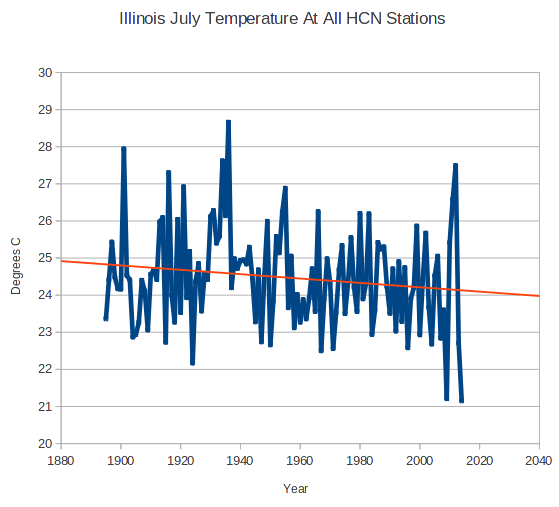
NCDC’s actual thermometer data shows that the state climatologist is correct, and that Illinois summers have been cooling since the 19th century.

ScreenHunter_1526 Aug. 02 07.12

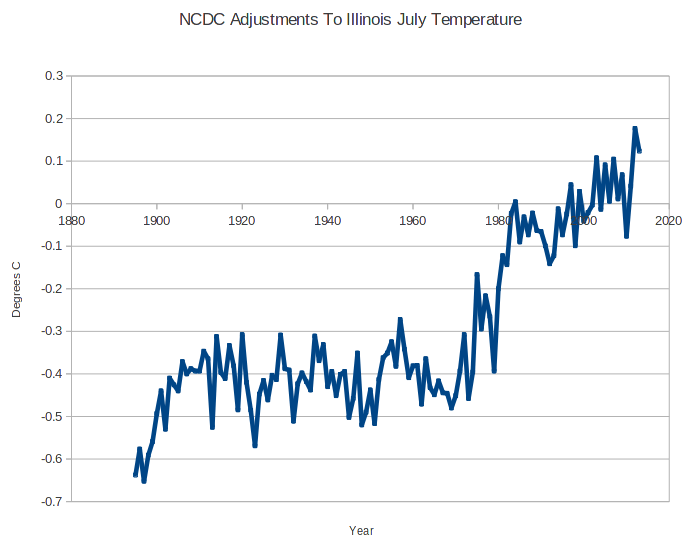
This puts NCDC in a very bad position, because they are massively altering Illinois July temperatures, to hide the cooling trend. How will they handle it?

ScreenHunter_1527 Aug. 02 07.20

View original post

Proof That US Warming Is Mann-Made


Correlation is proof we don’t need causation!

Tony Heller's avatarReal Climate Science

This post is not a joke, but is stunning.

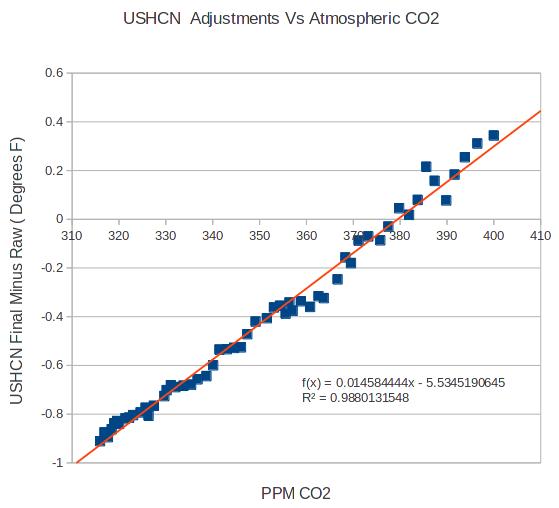
The graph below shows the relationship between atmospheric CO2 and the magnitude of USHCN data tampering. There is almost perfect correlation between the amount of CO2 in the atmosphere and how much cheating our friends at NCDC are doing with the US temperature record.

ScreenHunter_1618 Aug. 03 09.45

Raw: ftp://ftp.ncdc.noaa.gov/pub/data/ushcn/v2.5/ushcn.tavg.latest.raw.tar.gz
Final: ftp://ftp.ncdc.noaa.gov/pub/data/ushcn/v2.5/ushcn.tavg.latest.FLs.52i.tar.gz

Unbelievable. What on Earth are these guys up to? Perhaps I have it backwards. Maybe data tampering drives CO2?

“Our algorithm is working as designed”

– Recent NCDC press release

“If the facts don’t fit the theory, change the facts”

– Albert Einstein.

View original post

Progress At NASA Over The Past 45 Years


NASA as we knew it back then is long gone … 😦

Tony Heller's avatarReal Climate Science

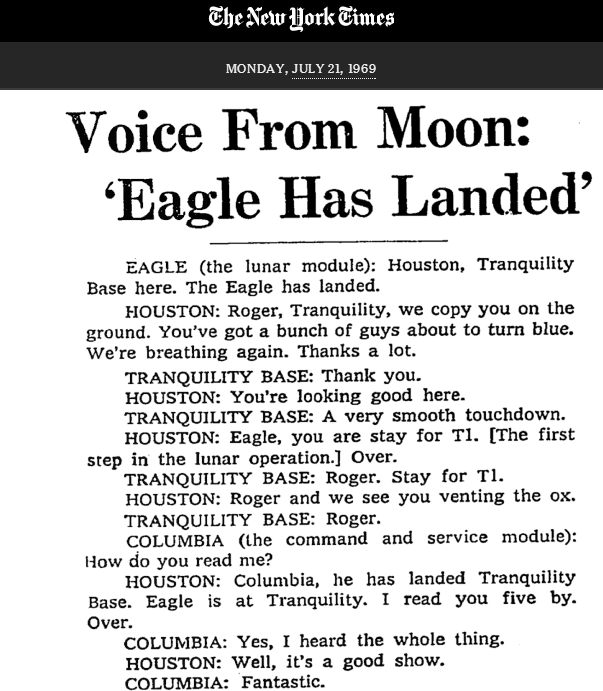
Forty-five years ago NASA could send people to the moon. They can’t do that any more, but they can generate fraudulent climate data much faster than previous generations could have ever dreamed of.

ScreenHunter_1651 Aug. 04 06.24

View original post

Progressives don’t let facts get in their way!


Leaked Memo Gives Away Dems’ ‘Extreme Weather’ Talking Points

Re-Post from the Daily Caller News Foundation by Michael Bastasch 4:38 PM 08/01/2014
Email Michael Bastasch

Democrats are working hard to convince the public that regulations to limit carbon dioxide emissions are necessary to avoid economic and ecological catastrophe, according to a memo obtained by The Washington Post.

The memo from Senate Budget Committee Chairman Patty Murray, a Washington Democrat, tells members how to talk about global warming’s budgetary impact. The memo details how “disaster relief; transportation and infrastructure; national security and agriculture” will all be affected by global warming, reports the Post.

“Climate change, if left unaddressed, will both weaken economic growth and impose additional direct budgetary costs on the federal government,” Murray wrote in the memo sent out Friday. “As a result, climate change poses an increasing threat to the federal government’s already challenging long-term fiscal outlook.”

Murray’s memo puts a lot of focus on budgetary impacts due to “extreme weather” — a major talking point of President Obama during his second term. Murray argues that global warming will increase extreme weather events, like hurricanes and droughts, therefore increasing disaster relief, infrastructure and other types of spending.

“Without action, climate change will undoubtedly affect our country’s ability to produce goods and services, costing jobs and weakening growth,” Murray wrote. “These effects are already being felt due to events such as Hurricane Sandy—which was estimated to have caused $65.7 billion in economic damage—as well as the massive droughts gripping parts of the country.”

Democratic claims that “extreme weather” was becoming more common as carbon dioxide levels increase have been disputed by scientists who say the data tells a different story.

“It is misleading and just plain incorrect to claim that disasters associated with hurricanes, tornadoes, floods or droughts have increased on climate timescales either in the United States or globally,” University of Colorado climate scientist Dr. Roger Pielke said in his testimony before the Senate Environment and Public Works Committee last year. “It is further incorrect to associate the increasing costs of disasters with the emission of greenhouse gases.”

“Hurricanes have not increased in the U.S. in frequency, intensity or normalized damage since at least 1900,” Pielke added. “The same holds for tropical cyclones globally since at least 1970.”

But Democrats have not relented in their push to convince the public that extreme weather will continue to get worse. The Murray memo cites reports by the Risky Business group and the White House Council of Economic Advisors, both of which argue global warming will put high costs on the economy if nothing is immediately done to tackle the issue.

The Risky Business report says that sea level rises could cause up to $507 billion in property damages by 2100 and that farmers in some states could could see crop yields declines by up to 70 percent. The Risky Business group is co-chaired by billionaires Tom Steyer, former New York City Mayor Michael Bloomberg and former Treasury Secretary Hank Paulson.

Read more: http://dailycaller.com/2014/08/01/leaked-memo-gives-away-dems-extreme-weather-talking-points/#ixzz39NrGSDth

The End of Science and the Begining of total Thought Control


Scientific Pretense vs. Democracy

Arrogance and intolerance in the name of superior expertise are antithetical to popular governance and the requirements of honest argument. But that hasn’t stopped them from becoming a central feature of our political life.

Re-Post from The American Spectator By From the April 2009 issue

“We will restore science to its rightful place…”

—Barack Obama

Unpacked, this sentence means: “Under my administration, Americans will have fewer choices about how they live, and fewer choices as voters because, rightfully, those choices should be made by officials who rule by the authority of science.”

Thus our new president intends to accelerate a trend a half-century old in America but older and further advanced in the rest of the world. There is nothing new or scientific about rulers pretending to execute the will of a god or of an oracle. It’s a tool to preempt opposition. The ruler need not make a case for what he is doing. He need only reaffirm his status as the priest of a knowledge to which the people cannot accede. The argument “Do what we say because we are certified to know better” is a slight variant of “Do what we say because we are us.”

An Old Story

THE FRENCH REVOLUTIONARY INTELLECTUALS and merchants who founded the modern state spoke of political equality. But they knew that if the masses governed, they might well have guillotined them rather than nobles and priests. And so they set up, and Napoleon perfected, a system of government that consisted of bureaucracies. In practice and in theory, the bureaucracies defined the modern state in terms of efficient administration, which they called scientific. In 19th-century France, Prussia, and their imitators, the state set standards for schools, professions, and localities. While elected assemblies might debate abstractions, they did not deal with the rules by which people lived. Political equality and self-rule were purely theoretical, while personal latitude was at the discretion of the bureaucracies. This is the continental model of the state, best explained by G. W. F. Hegel in The Philosophy of History and by Max Weber in his description of the Rechtsstaat, the “rational-legal state.” Access to this ruling class is theoretically equal, typically through competitive exams, and its rules should apply equally. Just as in the ancient Chinese imperial bureaucracy, decisions should be made by those who know and care best: the examination-qualified bureaucrats. In modern governance, in addition to embodying the state, the bureaucrats are supposed to be the carriers of the developing human spirit, of progress. Only in Switzerland and America did the theory and practice of popular government survive into the modern world. But note: they survived because they were planted on older, hybrid pre-Enlightenment roots.

Because the pretense of rare knowledge is the source of the modern administrative state’s intellectual and moral authority, its political essence is rule of the few, by their own authority, over the many. Ancient political theory was familiar with this category, distinguishing within it the rule of the moneymakers for the purpose of wealth, of the soldiers for glory, or of the virtuous for goodness. But modern thought has reduced government by the few to the rule of the experts. Expert in what? In bringing all good things, it seems. This was so when Mexico’s dictator Porfirio Diaz (1876–1911) justified his rule by claiming that he was just following the impartial advice of “los cientificos,” the scientists, about economics and public administration. Never forget that the one and only intellectual basis for Communist rule over billions of people since 1917 is the claim that Karl Marx had learned the secret formula for overcoming mankind’s “contradictions,” especially about economics. How many millions genuflected before the priests of “dialectical materialism”! To a lesser degree, the “brain trust” and “the best and the brightest” were important sources for the authority of the Franklin Roosevelt and John F. Kennedy administrations, respectively.

The scientific subject matter to which the rulers claim privileged access matters little. Three generations ago it was economics, in our time it includes everything from environmentalism to child rearing. But whether the objective be rainmaking, the avoidance of plague or falling skies, the fulfillment of fond wishes, or the affirmation of identity, the ruler’s incantations establish the presumption that he and his class know things that others do not or cannot know; that hence he and his class have the right to rule, while the rest must accept whatever explanations come from on high. In our time, such knowledge is called science, and claiming ownership of it practically negates political equality, if not human equality altogether. Claiming it is a political, not a scientific, act.

Knowledge and Equality

THE CLAIM THAT PUBLIC AFFAIRS (and as well many matters heretofore deemed private) are beyond the capacity of citizens to understand and too complex for them to administer, and hence that only certified experts may deal with them, must be cynical, at least to the extent to which those who make it realize that only theoretically does it transfer power to “the experts.” In practice, the power passes to those who certify the experts as experts. Surely, however, the polity’s ordinary members cease to be citizens.

Aristotle teaches that political relationships— that is, relationships among equals—depend on persuasion. Conversely, persuasion is the currency of politics only insofar as persons are equal. Whereas equals must persuade their fellows about the substance of the business at hand, despots, kings, or aristocrats exercise power over lesser beings by pointing to their status. But do those who rule on behalf of superior knowledge really know things that endow them with the right to rule? What might such things be? What subjects, what judgments, qualify as “science,” meaning matters so far beyond the horizon of ordinary human beings as to disqualify commonsense judgment about them? What can any humans know that the knowledge of it rightly places them in the saddle and others under it? What are the matters on which the public may have legitimate opinions, and on what matters are their opinions illegitimate, except when expressed by leave of certified experts? Moreover, how does one accede to the rank of expert? Must one possess a degree? But neither Galileo nor Isaac Newton had any, never mind Thomas Edison. Moreover, possessors of degrees do differ among themselves. Must one be accepted by other experts? By which ones? Note also that scientists are not immune to groupthink, to interest, to dishonesty, to mutual deference or antagonism, never mind to error.

The problem is patent: Because it is as plain in our America as in all places and at all times that some men do know the public business far better than others, it follows that the people in charge should be the ones who best know what they are doing. Hence, inequality of capacity argues for political inequality. To the extent that the matters to be decided rest on expertise, any nonexperts who claim a civil or natural right to refuse to follow the experts in fact abuse those rights. At most, nonexperts may choose among competing teams of experts.

But on what basis may they choose? If the questions that the experts debate among themselves are fundamentally comprehensible by attentive laymen, “science” would be about mere detail and citizens would be able to decide the big questions on the basis of equality. But if the “science” by which the polity is ruled disposes of essential questions, then citizenship in the sense of Aristotle and of the American Founders is impossible, and the masses should be mere faithful subjects. And if some voters dig in their heels or place their faith in scientists who are out of step with “what science says”—quacks, by definition— then they undermine the very basis of government that rests on expertise. Such inequality is compatible with some conceptions of citizenship, but not with the American or democratic versions thereof. Because Americans believe that “all men are created equal,” they tend to identify the concept of citizenship with that of self-government; the American commitment to equality means equality in the making of laws. Even more, it presumes laws under which persons may live as they wish, that the people have the final say on any restriction of that freedom, and that even popular assent—never mind scientific decision-making—cannot alienate the rights to “life, liberty, and the pursuit of happiness.”

Unlike Hegel and Napoleon, who saw nations as organisms to be organized scientifically, Americans view public life as an arena of clashing interests that must be adjusted to their general satisfaction. Hence from the American perspective, removing the polity’s business from the arena of politics to the cloisters of science just restricts the competition among the polity’s factions and changes its rules. Whereas previously the parties had to address the citizenry with substantive cases for their positions and interests, now translating those positions into scientific terms expressed by certified persons means that the factions must fight one another by marshaling contrasting scientific retinues, by validating their own and discrediting their opponents’ experts. It follows then that the modern struggle is over control of the process of accreditation, and that the arguments the masses hear must be mostly ad hominem, seldom ad valorem— not least because the experts deem the masses incapable and unworthy of hearing anything else.

Franklin Roosevelt’s “New Deal” revolutionized the relationship between ordinary Americans and their government by introducing a new kind of legislation: thenceforth, the people’s elected representatives would delegate to “independent” executive agencies the “quasi-legislative” and “quasi-judicial” power to invent and administer the rules in their field by which people would live. The citizen’s recourses against these powers are mostly theoretical. The notion that they are “independent” and rule by impartial expertise is on the level of stories about tooth fairies.

Scientific Pretense Comes to America

AMERICA GOT ITS FIRST straight dose of scientific governance in the 1950s. In 1954, the U.S. Supreme Court decided the case of Brown v. Board of Education—whether schools segregated by race fulfilled the 14th Amendment’s requirement for “equal protection of the laws” to all citizens—not by reference to any legal or political principle on which the general population might pronounce themselves (one such principle was available in Justice John Marshall Harlan’s dissent in Plessy v. Ferguson, the case that Brown overturned), but rather by reference to a “study” by sociologist Kenneth Clark concluding that “separate is inherently unequal.” This was a finding supposedly of fact, not of law. Whereas ordinary citizens were supposedly competent to agree or disagree with the legal and moral principles on either side of these cases, the Court decided Brown on a basis that could be contested only by sociologists as well credentialed and funded as Mr. Clark. Debates within the Court and in society at large subsequently have been focused not so much on what is lawful as on contending studies about the effects of competing policies.

The scientization of American political life was just beginning. Between the 1950s and 2000 social policy slipped away from voter control because the courts and the “independent agencies” took them over. Beginning in the 1970s, courts and agencies began to take control of economic life through the pretense of scientific environmental management.

In Massachusetts v. EPA (2007), the Court agreed with what it called predominant scientific opinion that human emissions of carbon dioxide cause “global warming” and hence ordered it to regulate those emissions—essentially America’s economy. The American people’s elected representatives had not passed and were not about to pass any law concerning “global warming.” No matter.

It should be superfluous to point out that “scientific” briefs submitted to courts, as well as the innumerable contacts between expert “independent” agencies and the interest groups in the fields they regulate, are anything but impartial, bloodless, disinterested, apolitical. But in fact the power of scientific pretense rests largely on the thin veil it casts over clashes of interest and political identity. Let us look further.

In his 1960 Godkin lectures at Harvard, C. P. Snow, who had been Britain’s civil service commissioner, told Americans that “In any advanced industrial society…the cardinal choices have to be made by a handful of men: in secret and, at least in legal form, by men who cannot have firsthand knowledge of what these choices depend upon or what their results may be.” In short, public figures must be figureheads for scientists who are formally responsible to them but whose minds are beyond common understanding and scrutiny. Snow concluded that society’s greatest need was for change, and that scientists were “socially imaginative minds.” While scientists should not administer, he said, they should be part of the Establishment, along with administrators. He illustrated this point by contrasting the clash in Britain between two scientists, Sir Henry Tizard, innovative, progressive, and very much a member of the administrative- scientific Establishment, and F. A. Lindemann, a scientist close to Winston Churchill but outside the Establishment. According to Snow, Lindemann polluted science and administration with politics, while Tizard’s contrary scientific and administrative opinions were supra-political. Tizard’s membership in the Establishment made them that. But in the same year, President Dwight Eisenhower’s farewell to the American people after eight years in the White House and a lifetime in the U.S. Army argued that government’s embrace of science would corrupt itself and science. Whereas Snow had taken pains to identify science with public policy and to call true scientists only those who got along with colleagues and especially with administrators, Eisenhower pointed to these things as subversive. His oft-cited warning about the dangers of a “military-industrial complex” was part of the address’s larger point: the danger that big government poses to citizenship:

…a government contract becomes virtually a substitute for intellectual curiosity. For every old blackboard there are now hundreds of new electronic computers. The prospect of domination of the nation’s scholars by Federal employment, project allocations, and the power of money is ever present and is gravely to be regarded. Yet, in holding scientific research and discovery in respect, as we should, we must also be alert to the equal and opposite danger that public policy could itself become the captive of a scientific technological elite.

The prospect against which Eisenhower warned has become our time’s reality. One accedes to the rank of expert by achieving success in getting grants, primarily from the government. Anyone who has worked in a university knows that getting government grants is the surefire way to prestige and power. And on what basis do the government’s grantors make the grants that constitute the scientific credentials? Science itself? But the grantors are not scientists, and they would not be immune to human temptations even if they were. Personal friendship, which C. P. Snow touted, is not nearly as problematic as intellectual kinship, professional and political partisanship. In sum, as Eisenhower warned, politicians are tempted to cast issues of public policy in terms of science in order to foreclose debate, to bring to the side of their interests expert witnesses whose expertise they manufactured and placed beyond challenge.

Power by Pretense

TESTIFYING TO A JOINT CONGRESSIONAL committee on March 21, 2007, former vice president Al Gore argued for taxing the use of energy based on the combustion of carbon, and for otherwise forcing Americans to emit much less carbon dioxide. Gore wanted to spend a substantial amount of the money thus raised to fund certain business ventures. (Incidentally or not, he himself had a large stake in those ventures.)

But, he argued, his proposal was not political, and debating it was somehow illegitimate, because he was just following “ science,” according to which, if these things were not done, Planet Earth would overheat and suffocate. He said: “The planet has a fever. If your baby has a fever, you go to the doctor. If the doctor says you need to intervene here, you don’t say, ‘Well, I read a science fiction novel that tells me it’s not a problem.’” But Gore’s advocacy of “solutions” for “global warming” was anything but politically neutral acceptance of expertise. As vice president until 2001, and afterward, he had done much to build a veritable industry of scientists and publicists who had spent some $50 billion, mostly in government money, during the previous decade to turn out and publicize “studies” bolstering his party’s efforts to regulate and tax in specific ways. Moreover, he claimed enough scientific knowledge to belittle his opposition for following “science fiction.” But Gore’s work was political, not scientific. Not surprisingly, some of his opponents in Congress and among scientists thought that Gore and his favorite scientists were doing well-paid science fiction.

Who was right? Gore’s opponents, led by Oklahoma senator James Inhofe, argued that the substance of the two main questions, whether the Earth was being warmed by human activities, and what if anything could and should be done about it, should be debated before the grand jury of American citizens. Gore et al. countered that “the debate is over!” and indeed that nonscientific citizens had no legitimate place in the debate. Yet he and like-minded citizens claimed to know enough to declare that it had ended. They also claimed that scientists who disagreed with them, or who merely questioned the validity of the conclusions produced by countless government science commissions to which Gore and his followers had funneled government money, and which they called “mainstream science,” were “deniers”—illegitimate. Equally out of place, they argued, were calls that they submit to tests of their scientific IQ. Whatever else one may call this line of argument, one may not call it scientific. It belongs to the genus “politics.” But, peculiarly, it is politics that aims to take matters out of the realm of politics, where citizens may decide by persuading one another, and places them in a realm where power is exercised by capturing the commanding heights of the Establishment.

Thus on July 28, 2008, Speaker of the House Nancy Pelosi explained to journalist David Rogers why she was right in forbidding Congress to vote on proposals by Republicans to open U.S. coastlines to oil drilling. Using fossil fuels, she explained, causes global warming. Forbidding votes that could result in more oil being used was her duty because, she said, “I’m trying to save the planet. I’m trying to save the planet.” No one would vouch for her scientific expertise. But she was surely saving an item in the agenda of her party’s constituencies, which rightly feared defeat in open debates and votes.

In the same way, in September 2008 Secretary of the Treasury Henry Paulson and chairman of the Federal Reserve Board Ben Bernanke told Congress and the country, backed by many in the banking business, that unless Congress authorized spending $700 billion to purchase the financial assets that the banks and investment houses considered least valuable, the entire financial system would collapse and the American people would lose their savings, jobs, homes, and so on, and that authorizing that money would avert the crisis. But none of those who proposed the expenditure explained why the failure of some large private enterprises and their subsequent sale at public auction would cause any of the abovementioned catastrophes. There was no explanation of how the money would be spent, how the assets to be bought would be valued, or why. The arguments were simply statements by experts in government as well as finance—whose repeated mistakes had brought about the failures that were at the center of contention, and whose personal interests were involved in the plan they proposed. The strength of their arguments lay solely in the position of those making them. They were the ones who were supposed to know. And when, a month later, the same Paulson, backed by the same unanimous experts, told the country that the $700 billion would be spent otherwise, and as they committed some $8 trillion somehow to shore up the rest of the economy, the arguments continued to lie in the position of those making them, combined with the clamor of those who would benefit directly from the government’s outlays. In practice, expertise—or science—has come to be defined by a government job or commission. Truth and error are incidental.

The confluence of political agendas with the attempt to describe political choices as scientific rather than political, and the attempt to delegitimize opponents as out of step with science, is clear in the 2005 book by journalist Chris Mooney, The Republican War on Science. Typically, Mooney disclaims substantive scientific judgment and claims only the capacity and right to discern the “credibility” of rival scientists and their claims. Note well, however, that propositions or persons are credible—that is, worth believing—only to the extent that they are correct substantively. Arguments such as Mooney’s, Paulson’s, Pelosi’s, and Gore’s most certainly aim to convince citizens about certain substantive propositions, but—and this is key—they do so indirectly, by pretending that they find certain propositions credible and others not. Credible are the ones of which they approve, coming from persons the places of which they approve: the government bureaucracies or universities. Judgments of authoritative provenance, they argue, need not refute the opposition’s arguments, or even refer to their substance because science— meaning the Establishment—supposedly has settled the arguments intellectually to its own satisfaction, the only satisfaction that matters. Mooney writes that because “American democracy… relies heavily on scientific technical expertise to function [public officials] need to rely on the best scientific knowledge available and proceed on the basis of that knowledge to find solutions.”

Modern Republicans, he argues, have put themselves “in stark contrast with both scientific information and dispassionate, expert analysis in general.” Caught in the confluence of corporate interests and conservative ideology, primarily religion, Republicans have “skewed science” on every important question of the day, from stem cell research to “global warming, mercury pollution, condom effectiveness, the alleged health risks of abortion, and much else.” They have “cherry picked” facts and, most ominously, even cited scientists to back them up. Mooney worries: “If the American people come to believe they can find a scientist willing to say anything, they will grow increasingly disillusioned with science itself.”

Against the Grain

THAT WORRY IS SERIOUS. Convincing people that what you may teach your children, what taxes you should pay, must be decided by the “scientific” pronouncements of members of a certain class challenges the American concept of popular government all too directly. To succeed, any attempt to impose things so contrary to American life must overcome political hurdles as well as human nature itself.

Government by scientific pretense runs against the grain of politics in two ways: First, since those who would rule by scientific management eschew arguments on the substance of the things, instead relying on the cachet of the scientists whose mere servants they pretend to be, their success depends on maintaining a pretense of substantive neutrality on the issues—the pretense that if “science” were to pronounce itself in the other direction, they would follow with the same alacrity. But this position is impossible to maintain against the massive evidence that those who hawk certain kinds of social or environmental policies in the name of science are first of all partisans of those policies, indeed that these policies are part of the identity of their sociopolitical class.

Second, it is inherently difficult for anyone who fancies himself a citizen to hear from another that he is not qualified to disagree with a judgment said to be scientific. Naturally, he will ask: If I as a layman don’t know enough to disagree, what does that other layman know that qualifies him to agree? Could it be that his appeal to science is just another way of telling me to shut up because he is better than I, and that he is justifying his presumption by pointing to his friends in high places?

The most important claims made on behalf of science often run against human nature, none more so than its central claim about the nature of humanity. On December 20, 2005, deciding the case of Kitzmiller v. Dover Area School District, federal district court judge James Jones prohibited the Dover, Pennsylvania, schools from teaching the possibility that human beings are the result not of chance but of “intelligent design.” To partisan applause, he ruled that science had shown, proved, that all life, including human life, is the result of chance, that it is meaningless, that entertaining the possibility of the opposite is religion, and that doing so in a public school amounts to the “establishment of religion,” and hence is prohibited by the First Amendment.

Leave aside the absurdity of maintaining that the authors of the U.S. Constitution entertained any part of this reasoning. Consider: since everyone knows that nobody really knows how life, particularly human life, came about (cf. the legal meaning of the word “knowledge”), any attempt to impose as official truth the counterintuitive proposition that human life is meaningless discredits itself. It is impossible to suppress the natural reaction: “How the hell do they know?”

Human nature rebels especially violently against those who pretend to special knowledge but who then prove inept, whose prescriptions bring misery. When politicians lay out their reasons why something should or should not be done, when the public accepts those reasons, and then the ensuing measures bring grief, the public’s anger is tempered by its own participation in the decision, and is poured out on the ideas themselves as well as on the politicians who espoused them. But when the politicians make big changes in economic and social life on the basis of “science” beyond the people’s capacity to understand, when events show them to have been wrong, when those changes impoverish and degrade life, then popular anger must crash its full force only on those who made themselves solely responsible. The failed sorcerers’ apprentices’ excuse “science made me do it” will only add scorn to retribution.

Wind Turbines & White Elephants


The Real Inconvenient Truth
Re-Post from Not A lot of People Know That blog July 27, 2014

By Paul Homewood

With thanks to  Peter Austin and Paul, who compiled the lists.

Following the story about the Welsh Govt’s £48K wind turbine in Aberystwyth, which has only produced £5 worth of electricity in the last five years, readers have sent me some more examples of wasted money.

1) Dover

Dover Express report:

THE much-trumpeted £90,000 wind turbine installed outside the council offices has generated just a tenth of the energy it should have done, the Express can reveal.

The 17-metre machine, erected outside the Dover District Council headquarters in Whitfield, was supposed to generate 45,000 kW hours per year, producing 7 per cent of the electricity used in the offices.

But the Express can reveal that just 22,080 kWhrs has been generated in total since November 2007 – less than 4,500 kWhrs per year.

Critics have called the project a “white elephant”, but the authority has defended the scheme and said it has “raised the profile” of renewable energy by educating people across the district.

At 15 pence/KWh, the value of electricity produced is just £675 pa. Assuming (very generously!) no maintenance or interest charges, the payback is 133 years!

Interestingly, the paper reports:

Responding to a Freedom of Information Act request about costs and savings six months after the grant-funded turbine was installed, DDC said at the time: “It should save 45,000 kWhrs per year, producing 7 per cent of the electricity used in the offices.”

But, this week, it appeared to backtrack from the numbers, saying the 45,000 kWhrs figure was the upper limit it could generate and was only achievable with constantly favourable wind speeds and direction.

A spokesman said: “The 45,000 kWhrs quoted is the optimum generation – in order to achieve this, the wind speed would always need to be at the maximum speed that the turbine could operate safely in, and the wind direction would always have to be favourable

Confusion between capacity and output is commonplace. Did the council get its sums wrong in the first place? Or did they knowingly waste £90K of ratepayers money, just to “raise the profile of renewable energy?

2) Derby

We then have the story from the Derby Telegraph of two turbines owned by Severn Trent Water, which have yet to produce any power, despite being ready last December.

The reason? They interfere with the radar at nearby East Midlands Airport.

They are now waiting for the airport to install new radar equipment to “ensure that the airport can operate safely”. I wonder who will pay for that?

3) Milton Keynes

It gets worse, as the Milton Keynes Citizen reports!

Three costly wind turbines built in the grounds of a school are now to be dismantled – after allegedly generating just £3.67 worth of electricity in NINE years.

Milton Keynes Council paid £170,000 for the giant turbines at Oakgrove School at Middleton .

But shortly after the school opened in 2005, the structures were switched off for health and safety reasons due to a manufacturing defect.

A source told the Citizen: “It all seems to be an extraordinary waste of money. None of it is the fault of the school itself – they’ve just been stuck with these huge things that have proved useless.”

The turbines were provided by a German company which has since gone into liquidation, leaving the council unable to get compensation

4) Hinckley

The Hinckley Times have the story of the £40K turbine at North Warwickshire and Hinckley College, which has used more electricity than it has generated.

An eco-friendly wind turbine installed to save energy at a Hinckley college has been labelled a “disaster” after revelations it has expended more power than it has produced.

In its three year lifespan the 31.5ft turbine – thought to have a price tag of around £40,000 – has turned only 8% of the time and has not created electricity but used enough to run an energy hungry household for two years.

When installed on the roof of the new North Warwickshire and Hinckley college campus on Lower Bond Street in September 2011, education chiefs lauded it as part of their commitment to embed sustainability across all college activities and a weapon in the fight to cut carbon emissions by 35% within four years.

But since its set up the vertical axis blades of the turbine have only been spinning for 8% of the time and only been working for 38% – during the remaining 62% of the time, because of its settings, conditions have been ‘unsuitable’ – ie the wind at 5m/s, a fresh breeze – has been deemed too strong and it switches off.

This means the device has used 497 kHw more than it has made – enough to run a fridge for a year, a microwave daily for half-an-hour for two years and a tumble drier daily for six months.

Figures from the college show (based on the average price of a kHw at 17p) the turbine has used £1,730 worth of electricity, twice the annual bill of a high energy usage household.

But what the hell? As was the case in Dover, it is apparently OK to waste taxpayers’ money, just to promote “sustainability”.

Andy Crowter, group director of facilities and estates at North Warwickshire and Hinckley College, said:

”The turbine is not there primarily to create income but to promote sustainability – one of the most important challenges facing the UK. The turbine is a symbol of the college’s awareness of its environmental responsibilities, an icon of good practice to its students and recognition of the college’s award winning Carbon Reduction Plan. “

5) Canada

And it’s not just in Britain, as the National Post report:

Several Prince Edward Island rinks that were convinced to make the expensive conversion to wind power, but never saw the promised savings, are now trying to get rid of the trouble-plagued turbines and win compensation for their troubles.

“We went into debt to purchase this windmill on the promise that it would make us money and it would help us with our power costs,” said Tom Albrecht, vice-president of the South Shore Actiplex in Crapaud, P.E.I., which spent $70,000 and received another $230,000 from the federal and provincial governments to install a turbine.

“The bottom line is buy us out and give us our money back.”

Last week, the Wind Energy Institute of Canada apparently decided to shut down turbines at at least some of the rinks, as it worked through technical problems, according to Darin Craig, past president of the South Shore Actiplex board.

6) Whitfield

The Council at Whitfield, Kent have scrapped the turbine only installed in 2007, as Kent Online report:

The wind turbine at the district council offices at Whitfield, fitted in 2007, is to be scrapped.

“With time and use, the turbine developed a fault in 2012.A council spokesman said: “The turbine was important as not only did it generate renewable energy, but it helped to raise the profile of environmental matters, and was used for educational purposes.

“The turbine was assessed for repairs, but as well as the cost of the repairs, it was clear that the industry and technology had developed, and that the company who supplied the turbine had ceased trading, causing difficulties regarding the availability of parts and servicing arrangements.

“It was considered that the repair costs and ongoing maintenance issues meant that it was no longer viable and sustainable to keep the turbine.

Once again we see the words “raise the profile”.

7) Huddersfield

Five years after installing two turbines on the Civic Centre roof at a cost of £100K, Huddersfield Council are to take them back down, as the Huddersfield Examiner explain:

THE Civic Centre turbines are to be taken down.

Kirklees Council last night announced that the landmark windmills will be removed – five years after they cost £100,000 to install.

One of the 27-feet turbines has been broken for the past 16 months.

Kirklees installed the two windmills in July, 2006, to raise awareness of renewable energy among the thousands of motorists who drive along the ring road every day.

But yesterday officials admitted defeat and said the turbines would be taken down – and new ones installed at a windier location.

A council spokesman said: “It had become clear that carrying out repairs was not the most effective or value-for-money option, so the council has now found a different way of solving the problem.

“We have reached an agreement with the turbine suppliers Proven Energy, who will remove both turbines from the Civic Centre roof over the coming months and will provide the council with two new turbines, free of charge and with longer warranty periods than the current turbines.

“The council’s plan is to locate the new turbines in an open location where the energy generated will be greater than at their current site.”

The spokesman added: “Having one of the current turbines out of action gave us the chance to re-assess the situation. We have come up with the most common sense, effective way forward.

“The new location is yet to be finalised, but we are working with Proven Energy to find a site within the council’s ownership.”

The six-kilowatt windmills cost £101,000 to buy and install in 2006.

Kirklees came up with £70,000 and a Government grant covered the rest.

In 2008 the turbines brought £2,078 into council coffers, but cost £6,431 to maintain and repair.

Although Proven Energy will arrange for the turbines to be taken down and replaced, it hardly seems likely they will be doing this out of goodwill. Meanwhile, Huddersfield ratepayers can feel satisfied that their money has gone to “raise awareness of renewable energy”.

8) Wotton

The Gazette have the story of this wind turbine, that had to be removed for being too noisy:

A SCHOOL in Wotton has been forced to remove its controversial wind turbine after receiving a noise abatement notice.

Blue Coat Primary School’s prized 15-metre turbine was taken down in August after standing unused for a number of months.

Robert Weaver, environmental health officer at Stroud District Council, said: “As soon as it was operational, it was giving out unacceptable levels of noise at quite a lot of dwellings nearby, as well as some quite far away.”

The school had been warned when it was granted planning permission in 2009 that if noise were to become an issue the turbine may have to be decommissioned.

Specialist engineers had worked with the school over a period of about eight months to try to reduce noise, but modifying the blade tips and even shortening the blades themselves had little effect.

Simon Weston, chairman of governors at Blue Coat School, said the school had taken a reluctant but pragmatic decision that they had reached the end of the road after the physical adaptations to the turbine provided no improvement to the noise.

Wotton resident Michael Toft, 61, who lives just 100 metres from the school, said he was relieved that the threat of permanent noise intrusion in his house and garden had been removed.

He said: “The turbine wasn’t just noisy in high winds. It had a whole repertoire of sound effects, ranging from an inexorable swishing in light winds, through to chuffing like a never-arriving steam train in moderate winds, with the piece de resistance being a full-blown impression of a helicopter hovering over the field outside our garden when the wind was strong.”

He added: “On a visual note, I don’t think it’s right that structures like this should be sited prominently on skylines within the Cotswolds AONB.”

The school is now hoping to pass the turbine on to be used elsewhere, as the equipment is entirely functional.

Grant-funded, largely from the public sector, the turbine was part of the school’s renewable energy drive. Solar panels are also installed on site.

It was hoped that the turbine would engage children at Blue Coat with energy issues, as well as reduce the school’s carbon footprint and electricity bills.

Cllr Dennis Andrewartha, executive member for planning for Stroud District Council, said: “We explored every possibility to see if the school’s wind turbine could stay up and generate power but ultimately it was too noisy and affected too many residents.

“Since it went up we have had around 40 complaints about the noise nuisance and our officers have been out to assess the problem a number of times. We are great supporters of green energy so it was with reluctance that we had to see this wind turbine come down.”

Mr Weston added: “We still take environmental education seriously. It’s nice to have practical things you can point at, but certainly our interest in making it [renewable energy] an important part of the curriculum is ongoing.”

Since when was “renewable energy” an “important part of the curriculum”? More to the point, if the noise was so bad 100 metres away, what damage has been to done to children’s health at the school itself, who would be exposed to it for several hours every day?

9) Exeter

At the home of the Met Office, Exeter City Council will probably never recoup the cost of their Civic Centre turbines, as the Express & Echo report:

THE money Exeter City Council spent on installing wind turbines at its city centre base is unlikely ever to be recouped in energy savings, the Echo can reveal.

The authority invested £5,000 putting three wind turbines on the roof of the Civic Centre in 2007.

But it could take up to 50 years for the turbines to match that sum in savings. And as the average shelf-life of a turbine is understood to be 20-25 years, it is likely to have been a loss-making enterprise.

The city council has defended the outlay and revealed savings made through a number of other green initiatives are more considerable.

But campaigners for lower taxes have criticised the move as a “PR project” which was not a serious effort to save money.

The turbines were aimed at helping the council meet its Government-set target of reducing CO2 emissions and it was one of the first local authorities to take the step.

A council spokesman said it was not possible to quantify what the turbines were powering but added: “We estimate the energy produced saves the council in excess of £100.”

However, Maurice Spurway, spokesman for Exeter Friends of the Earth, said: “There are some occasions when it is more important to focus on the message of reducing carbon dioxide emissions than the economy of it.

“Survival of the planet is more important and reducing CO2 as we progress towards the 22nd century is crucial, so anything which has been done in this direction is the right thing to do.

10) Greenock

Up in Scotland, Inverclyde Academy were reported in 2011 to be ready to scrap their turbine, installed just three years earlier;

Inverclyde Academy was hailed as the first school in the UK to have one of the 50-kilowatt wind turbines when the building opened to pupils in December 2008.

The turbine is meant to provide 15 to 25 per cent of the school’s annual energy requirement.

But the turbine hasn’t generated any power for more than a year.

It has been plagued by technical problems, including a faulty gearbox, and its manufacturer has gone bust.

Now Inverclyde Council says if the turbine cannot be repaired, it may have to be taken away.

11) Portland

Down in Dorset, another turbine installed at a Primary School has had to be shut down as it was killing too many seabirds, as the Dorset Echo relate:

A £20,000 wind turbine brought in to make a Portland primary school more environmentally friendly has been turned off because it was killing seabirds.

Headteacher Stuart McLeod, of Southwell Community Primary School, said they ‘tried everything’ to solve the problem but had no choice but to shut it down.

In the past few months the nine metre high generator has taken the lives of 14 birds – far higher than the manufacturer’s estimate of one per year.

The wind turbine was installed at the school around 18 months ago, thanks to grant funding, to provide six kilowatts of power an hour.

Mr McLeod said: “We’ve got the ideal location for wind power but unfortunately seagulls kept flying into it.

I guess that really taught the kids to be “environmentally conscious”!

12) Climping, West Sussex

Despite being on the coast, this turbine at the Climping Village School had to be shut down, because it was not producing enough power. From the Bognor Regis Observer:

A WIND turbine has been removed from Climping’s village school because it generated too little power.

The 9m-high turbine was installed at St Mary’s Primary School in 2005 as part of an experiment to see if the winds along the coast would make it sustainable.

The pilot project was designed to test wind energy technology, reduce school energy costs and provide an educational tool for pupils.

But a West Sussex County Council spokesman said: “The decision to remove the turbine has been taken because of a series of factors, but mainly because the system has not performed well.

“Energy-saving costs at the school of £550 between April 2011 and March 2012 were not enough to cover the costs of maintaining and insuring the turbine. The company which manufactured and installed the turbine has also gone into liquidation.”

The turbine’s cost was mainly covered by external grants and the county council met the short-term running costs. It was considered unsustainable for the school to take on these costs.

Yet another company gone into liquidation.Take the grant money and run!

There are no doubt hundreds of other examples up and down the country. A lot of pain and wasted money could have been avoided if attention had been paid to this study from Southampton University back in 2009:

The final report demonstrated conclusively that micro-wind turbines installed on buildings performed very poorly, some consuming more power than they generated. Even at the best sites in exposed and windy rural areas, annual yields were far lower than the estimates predicted by industry. None of the devices mounted on buildings would pay for themselves within the expected life of the turbines.

But when it’s not your money you’re spending, then what the hell?

Get Ready for the New England Power Shortage


The Grid almost went down last winter and this summer is colder than normal if it get as cold as last winter or colder — well be prepared!

Governors are already meeting in emergency session.

Re-Post from The American Spectator By 7.18.14

UPI
In 1980, under the first administration of Governor Jerry Brown, California decided it wasn’t going to build any more power plants but would follow Amory Lovins’ “soft path,” opting instead for conservation and renewable energy. By 2000, with the new digital economy sucking up electricity, a drought in the Pacific Northwest cut hydropower output and the state found itself facing the Great California Electrical Shortage.

You know what happened next. For weeks the Golden State struggled to find enough electricity to power its traffic lights. Brownouts and blackouts cascaded across the state while businesses fired up smoke-belching diesel generators to keep the lights on. Governor Gray Davis finally got booted out of office but the state didn’t rescue itself until it threw up 12,000 megawatts of new natural gas plants.

At that point California officials decided that the whole thing had been engineered by Enron and other out-of-state merchant providers and the charges and lawsuits flew. No Democrat ever learned a lesson. The state is now 60 percent dependent on natural gas for its electricity — twice the national average — and its electric bills are almost twice that of surrounding states. Industry is headed for the door.

So how have California’s liberal counterparts on the East Coast managed to avoid the same fate? You’d think a region that could produce Elizabeth Warren and Bernie Sanders plus legions of college students trained to hate fossil fuels would have no trouble pursuing the same green dreams. Well, it’s about to happen. In the next few years New England will be facing a full-scale power shortage.

Last week the governors of the six New England states met in an emergency session at Bretton Woods, New Hampshire, to discuss what to do about the pending crisis. Significantly, they asked the premiers of five of Canada’s provinces to attend. That makes sense because if the region is going to get electricity from anywhere it is probably going to be from north of the border.

In a hell-bent campaign to rid itself of any form of dirty, messy “non-renewable” energy, New England has been closing down coal and oil plants for the last decade. In 2000, 18 percent of New England’s electricity came from coal and 22 percent from oil. Today it’s 3 percent coal and 1 percent oil. Meanwhile, natural gas — the fuel that everybody loves until you have to drill for it — has risen from 15 percent to a starkly vulnerable 52 percent, just behind California.

There’s only one problem. New England doesn’t have the pipelines to bring in the gas. Nor is anyone going to allowed to build it, either. Connecticut and Massachusetts are only a short distance from eastern Pennsylvania, where fracking for natural gas has leapfrogged the Keystone State into third place for overall energy production. Yet a proposal by Sempra Energy of Houston to expand its existing pipeline from Stony Point, New York, has already met fierce resistance from people who want nothing more to do with fossil fuels and construction is highly unlikely.

It’s not as if it’s not needed. Last winter, when record low temperatures hit, there just wasn’t enough gas to go around. Utilities that service home heating have long-term contracts and get first dibs. You can’t stockpile gas the way you stockpile coal, so power plant operators were left bidding against each other for what was left. Prices skyrocketed from $4 per mBTU to an unbelievable $79 per mBTU and electricity prices spiked to ten times their normal level. Just to put things in perspective, during the first four months of last winter, New England spent $5.1 billion on electricity. In the whole of 2012, it had spent only $5.2 billion.

And that’s just the beginning. New England is now limping along with 33,000 megawatts of electrical capacity, which barely meets its needs. At one auction last winter, the New England Independent Systems Operator, which manages the grid, came up 145 megawatts short — an almost unheard of occurrence. Yet in the next two years the region will be closing down 1/10th of its capacity in a bid to rid itself of anything that does not win favor with environmentalists. First to go will be the last of four coal plants at Salem Harbor, which can no longer meet the EPA’s new regulatory requirements. Next Brayton Point, the largest remaining coal plant, will be retired for the same reason. Finally, a continual barrage of protests and legislative attacks has persuaded Mississippi-based Entergy to close the Vermont Yankee Nuclear Station and “let the Yankees freeze in the dark,” as they used to say in Texas and Louisiana. The reactor provided 75 percent of Vermont’s electricity and 4 percent of the power for the region, carbon-free.

“It’s going to be very tricky for New England over the next three to four years,” says Gordon van Welie, CEO of the Independent Systems Operator of New England, which run the grid. Van Welie begged the region not to close down Vermont Yankee and Brayton Point, but who listens to anyone who understands electricity anymore? Interestingly, New England only got through last winter by regularly importing 1,400 megawatts from Indian Point, the two nuclear plants on the Hudson in neighboring New York. Says New Hampshire energy consultant William P. Short III, “Without Indian Point, New England would have been toast.” As you might expect, New York Governor Andrew Cuomo and most of the state’s Democratic politicians are trying to close down Indian Point as well.

Naturally, all this is falling hardest on people who hold blue-collar jobs. The Gorham Paper and Tissue Company in New Hampshire was forced to reduce production and lay off workers in the depths of last winter. The Great Northern Paper Co. in Maine laid off 200 workers and closed down for four months. In fact, if you want to know why we have “income inequality” and a “disappearing middle class,” look no further than the class warfare being waged on American industry by upper-educated elites snugly ensconced in the digital economy or sitting in Washington writing regulations telling everybody else what to do. “We’re going to have an economy that operates only nine months of the year,” complains Maine Governor Paul LePage, the only Republican in the region.

So where will New England be getting its electricity? Almost daily the newspapers are filled with stories about how the region is “going green” and about to enter the delightful world of “clean energy.” It’s sheer fantasy. No one has the slightest notion of what it would entail. You would have to cover half of the Green Mountains with windmills to recover the power lost at Vermont Yankee and even then it would only work when the wind is blowing. Almost as soon as the news came about the closing of Vermont Yankee, one company proposed building a power plant that burned wood in the wilds of western Massachusetts. However, someone soon discovered that burning wood produces smoke and carbon dioxide as well. It was quickly shouted down. It’s probably just as well. At one point Massachusetts drew up plans to harvest wood for electricity and discovered it would soon strip the state of its forests.

So the only “clean energy” left in New England these days is hydroelectricity — generated in Canada. The Canadians are indeed developing huge dams in James Bay and are eager to sell to Americans. But that means building transmission lines down from the north and everyone is opposed to that as well. Northeast Utilities, which services much of New England, has been trying to build a Northern Pass transmission corridor since 2009 but environmental groups insist the lines be buried underground. Two documentary films — a standard item these days — have already been made opposing the project. Meanwhile, environmentalists have become so ambitious and well funded that they have bought up land and property rights in northern New Hampshire just to block its path. Plans to bury just eight miles of the 187-mile route have ballooned costs from $200 million to $1.4 billion and the project is years from completion — if ever.

So what is likely to happen? Another cold winter is certain to bring skyrocketing prices and possible brownouts. New Englanders already pay 45 percent higher electric bills than the rest of the country and that figure can only grow. The first region of the country to industrialize is about the drive away the last of its blue-collar workshops.

One thing the region will not run short of, however, is political bluster. When the New England States Committee on Electricity (NESCOE) tried to broker a deal to have ratepayers finance a collectively owned gas pipeline, the volunteer organization was lambasted for “conspiring with industry to produce profits” and “failing to consider all the renewable alternatives.” When the crisis finally arrives this winter or next, you can be sure Vermont’s socialist Senator Bernie Sanders will be at the head of the pack, braying that the whole thing has been caused by “speculators.”

LIBERALISM, GLOBAL WARMING, ISLAM, AND THE OBAMA ADMINISTRATION


That sums it up — can;t say much more!

The Green Cheese Guys


Hey I bet that our Pres is one of those followers of the Moon landing conspiracy theories — A moon walk denier!

Tony Heller's avatarReal Climate Science

President Obama says these climate skeptic astronauts are like people who “believe the moon is made out of cheese.

This might come as a surprise to Harrison Schmitt (top left) who is the only scientist to have walked on the moon – during a time when Obama was busy smoking choom.

ScreenHunter_1342 Jul. 26 13.49ScreenHunter_1341 Jul. 26 13.48ScreenHunter_1340 Jul. 26 13.47

ScreenHunter_1339 Jul. 26 13.47ScreenHunter_1337 Jul. 26 13.46

View original post

Roy Spencer does psychoanalysis on warmers


Roy Spencer is a genius !

john1282's avatarJunkScience.com

From the desk and brain of the great Roy Spencer, a new mathematical formula that will help you gain a clear understanding of the climate change and warming crusaders. How to predict temps based on other political and economic factors.

View original post 361 more words