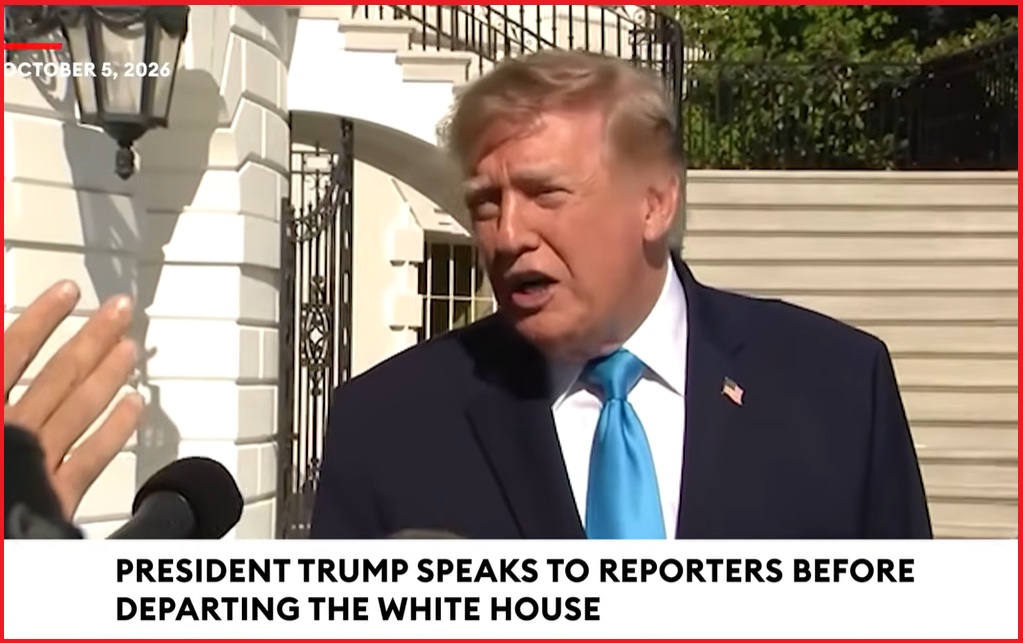
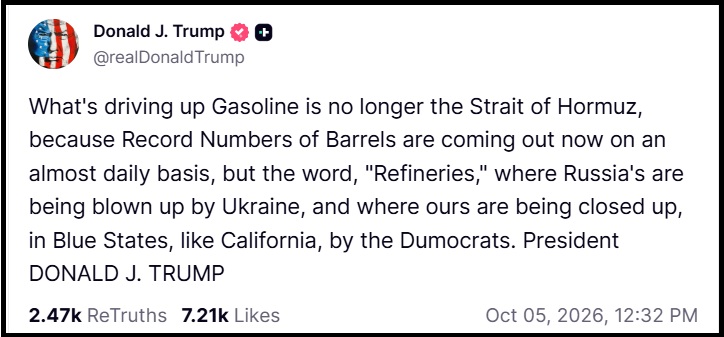
BANNON: Of All The Truth Social Posts President Trump Has Put Out, People Should Take This Very Seriously. The Iranians Have Reportedly Frozen All Diplomatic Channels And Indirect Talks After The Statement


Posted originally on Rumble on Bannon War Room on: April 7, 2026

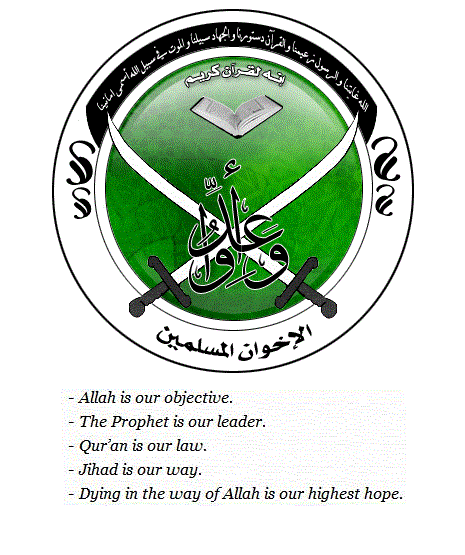
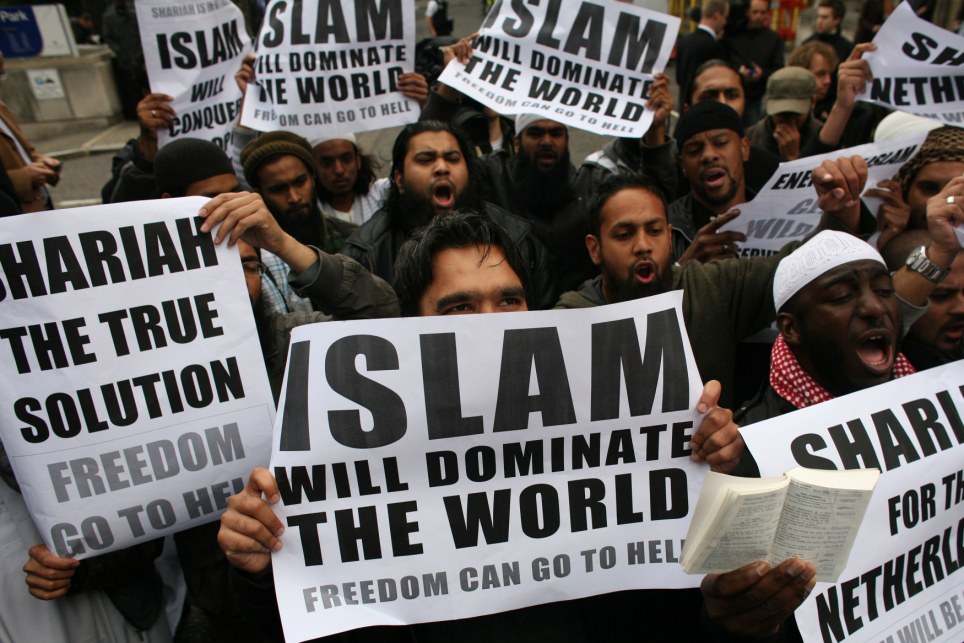
Gaffney: If Texas falls to Islam the rest of the nation is gonna fall for sure, it must not happen.


Posted originally on Rumble on Bannon War Room on: April 7, 2026

Egypt Goes Dark Amid Energy Crisis


Posted originally on Apr 8, 2026 by Martin Armstrong |  

Egypt Experiences a Nation-Wide Blackout - Scoop Empire

Egypt is now offering a real-time example of what happens when an energy crisis moves from theory into reality, and it is not unfolding in some distant or abstract way but directly in the daily life of one of the most populated nations in the Middle East. Cairo, a city historically known for its nightlife and constant activity, is now being forced into darkness as the government imposes strict measures to conserve energy following the fallout from the Iran war.

Businesses are being ordered to shut down early, public lighting has been reduced, and what was once a 24-hour economy is now being artificially curtailed to cope with soaring fuel costs and disrupted supply chains.

The scale of the shock is significant because Egypt is not a major oil producer capable of insulating itself from global disruptions, but rather a country heavily dependent on imported energy. The government has confirmed that its energy import bill has more than doubled since the war began, forcing authorities to raise fuel prices, increase transportation costs, and even slow state-backed projects to manage the financial strain. This is precisely how an energy crisis spreads through an economy, beginning with supply constraints and then rippling outward into inflation, reduced activity, and ultimately social pressure.

What is unfolding in Cairo is not just about dimmed streetlights or earlier closing times, it is a form of economic contraction imposed by necessity. Shops, cafes, and restaurants are now required to close as early as 9 p.m., cutting off peak business hours in a culture where much of economic and social life traditionally occurs late at night. This has immediate consequences as businesses lose revenue, workers lose hours, and entire sectors begin to slow down. The government has even introduced reduced working hours and remote work policies to limit energy consumption, which further highlights how deep the problem has become.

Egypt was already dealing with a weakened currency and inflation running above 13%, and now it is being hit with an external shock that it cannot control. This combination is extremely dangerous because it reduces the government’s ability to respond while increasing pressure on the population. Tourism, one of Egypt’s primary sources of foreign currency, is already showing signs of slowing, and if that continues, it will further strain an already fragile balance of payments.

Egypt is simply one of the first visible cracks in the system. Countries that rely on imported energy are all facing similar pressures, but Egypt’s scale and economic structure make the impact more immediate and more visible.

This is where the broader picture becomes clear. The energy crisis is not something that hits everywhere at once. It moves unevenly, affecting the most vulnerable economies first, particularly those dependent on imports and exposed to global price shocks. Egypt is now showing what that looks like in practice, where an external geopolitical conflict translates directly into domestic restrictions, economic slowdown, and rising costs of living.

Categories:Uncategorized

The Oil That Is Already on the Water Is the Only Thing Buying Time


Posted originally on Apr 8, 2026 by Martin Armstrong |  

Strait Hormuz 1

The problem with an oil crisis is that the public never feels it all at once because oil does not move by magic. It moves by ship, and ships move slowly. That delay is precisely why people are still underestimating what lies ahead. Before this war shut the Strait of Hormuz, roughly 20.7 to 20.9 million barrels per day of crude, condensate, and petroleum products were moving through that chokepoint, including about 14.7 million barrels per day of crude and condensate and another 6.1 million barrels per day of petroleum products. The IEA now says the war has created “the largest supply disruption in the history of the global oil market,” with flows through Hormuz plunging from around 20 million barrels per day to a trickle, Gulf producers cutting output by at least 10 million barrels per day, and nearly 20 million barrels per day of crude and product exports disrupted.

People keep looking at gasoline prices and assume the worst has already been discounted. It has not. What is cushioning the system right now is the oil that was already loaded before the crisis fully shut traffic down. Reuters reported that Iran alone exported about 13.7 million barrels of crude after the February 28 attacks, while Kpler estimated about 16.5 million barrels in the first eleven days of March, which means cargoes already on the water have been acting as a temporary buffer. The IEA also noted that observed global oil stocks were 8.21 billion barrels in January and that about 25% of that total was “oil on water,” or roughly 2.05 billion barrels floating in transit or storage at sea. That is the bridge the world has been living off, but bridges end.

The transportation lag is what masks reality. Tankers from the Persian Gulf do not teleport into refineries. Cargoes from the Gulf to Japan typically take about 20 to 30 days, and cargoes from the Gulf to Europe via the Suez Canal take about 19 days under normal conditions. If ships are forced around the Cape of Good Hope, the Persian Gulf to Amsterdam-Rotterdam-Antwerp route stretches to nearly 35 days. Even product cargoes from the U.S. Gulf Coast to Chiba, Japan face additional delays depending on whether they use Panama, Suez, or the Cape. In other words, there is always a lag between disruption at sea and pain on land, which is why the last normal shipments are still being burned through now.

The market has already started telling you this in the only language that matters, which is the price for prompt physical barrels. Reuters reported today that European and Asian refiners are paying near $150 a barrel for some immediate-delivery crude grades, with North Sea Forties hitting $146.09. Brent futures only tell part of the story because the real panic is in physical cargoes needed now. Dated Brent is trading almost $20 above June Brent futures, while European jet fuel has been near $226.40 a barrel and diesel around $203.59. That is what happens when refiners suddenly have to replace missing Gulf barrels with cargoes from the North Sea, West Africa, Brazil, or the United States. Everyone begins bidding for the same limited replacement supply.

Crude Oil Production

This is where the public still does not grasp the supply chain. Energy sits beneath everything in the economy. It is not just the price at the pump. The Middle East exported more than $10 billion of kerosene tailored for aircraft engines last year, and Reuters Breakingviews noted that much of it is now inaccessible. Heavy Gulf crudes also yield different product slates than American barrels. A barrel of WTI produces significantly more heavy naphtha, while heavier Middle Eastern crude yields more asphalt and ship fuel. That means even if you find replacement crude, you do not necessarily replace the same downstream products. Trucking, aviation, manufacturing, farming, shipping, chemicals, plastics, packaging, fertilizer, all of it sits on top of energy and all of it feels the mismatch.

The shipping side is getting worse, not better. The EIA said March tanker rates for VLCCs from the Middle East to Asia reached their highest level since at least November 2005 after the Strait closed on March 2. It also said vessels that had already loaded crude and became confined in the Gulf reduced effective global tanker availability, pushing rates higher everywhere else. Reuters then showed the second-round effect: availability of VLCCs on the U.S. Gulf Coast halved to 10 from 20 in a month, net vessel availability there fell 41%, and freight for Suezmaxes and Aframaxes surged to as much as $300,000 a day from an average of about $60,000 over the previous five months. That is the hidden tax of an oil shock. When voyages take longer and insurance costs explode, you need more ships just to move the same amount of crude, and there are not enough ships to do it.

The IEA has been blunt that this is not some replay of 1973 in miniature. Fatih Birol said this oil and gas crisis is worse than 1973, 1979, and 2022 together, and Reuters reported his warning that April’s disruptions would be roughly double those of March. The agency already coordinated the release of 400 million barrels from emergency reserves last month, yet it is still warning that shortages of diesel and jet fuel are moving from Asia toward Europe in April and May. That is the key point. The crisis does not end when futures stop screaming. It progresses as inventories are drawn down, ships arrive late, and the last pre-war cargoes are consumed.

This is why I have always said energy is foundational. You can pretend inflation is under control, you can manipulate statistics, and you can lecture the public about temporary volatility, but none of that changes the physical chain. If roughly one-fifth of the world’s seaborne oil system is disrupted, then the entire globe is forced to compete for what remains. Once those final shipments are exhausted and the slower replacement routes fail to keep up, this energy crisis will move from headline risk to economic reality. That is when the public finally realizes that oil is not just another commodity. It is the base layer under the entire economy.

Poland Considers Using Gold to Fund Defense as War Pressures Rise


Posted originally on Apr 8, 2026 by Martin Armstrong |  

gold reserve fort knox

Poland represents a critical development in the evolving role of gold because it illustrates how quickly central bank strategy can shift from accumulation to utilization when geopolitical pressures intensify. Over recent years, Poland has been one of the most aggressive buyers of gold, adding more than 80 tonnes and increasing its total reserves to approximately 570 tonnes, positioning itself as a major holder within Europe as it sought to strengthen its financial security amid rising regional tensions.

Now, however, discussions have emerged about using gold profits to support defense spending, with the central bank governor suggesting that unrealized gains on gold, estimated at around 197 billion zloty or roughly $53.7 billion, could be tapped to finance military expenditures. There have also been proposals to monetize gold reserves in a way that could generate up to $13 billion, potentially through partial sales or financial instruments, with the option to rebuild reserves later.

This shift highlights a fundamental reality about gold that is often overlooked, which is that it is not simply a passive store of value but an active strategic asset that can be deployed when needed. Poland accumulated gold as a hedge against systemic risk, and now it is considering using that hedge as a financial resource in response to escalating security concerns.

Nations often build gold reserves during periods of relative stability and then draw upon them during times of crisis, whether for war financing or economic stabilization. Poland’s position underscores the broader theme that gold is not separate from the financial system but deeply embedded within it as a final layer of security that becomes increasingly important as geopolitical and economic pressures mount.

Trump Backs Down Again.


Posted originally on Apr 7, 2026 by Martin Armstrong |  

2026_04_07_19_30_24_Trump_willing_to_delay_Iran_war_deadline_again_as_Tehran_refuses_to_back_down

Trump’s constant threat of ending the Persian Civilization is just over the top. Why should Iran agree to anything when this is Netanyahu’s War who has refused to accept a ceasefire anyway and is intent on destroying the Iranian government? The Strait of Hormuz is the only card they have to play. For 40 years+, Netanyahu has preached the destruction of Iran.

Netanyahu 2012 UN Speech Bomb

In 2012, Netanyahu stood before the United Nations trying to get a war going with Iran. This has been his life’s mission.

Back in 2002, he used the same argument to invade Iraq. He swore Saddam head Weapons of Mass Destruction. The computer does not show this is ending. So buckle up. Trump has to back away from Netanyahu. I fear he will not.

Trump to End Civilization? It Maybe the West’s!


Posted originally on Apr 7, 2026 by Martin Armstrong |  

Trump End Civilization 4 7 26
2026_04_06_21_36_32_Netanyahu_warned_Trump_against_ceasefire_in_Sunday_call_report_The_Times_of_
netanyahu phones trump 1

President Trump is captured by Netanyahu and if he carried out this threat at 8PM tonight, it would violate every foundation of international law. He will not only isolate the United States as is taking place with Israel, but he will undermine the entire Republican Party. You do not destroy civilian targets in time of war. Netanyahu is a ruthless war monger who will destroy Israel under the pretense of saving it. Netanyahu cannot be trusted whatsoever. I am about to release a special report on The Fate of Israel and it does not look pretty. He called Trump to complain about a ceasefire. He wants total war and nothing less.

Israel the Fate April 2026
Netanyahu Obsession With Iran

Netanyahu’s obsession with the destruction of Iran is insane for all the gains of Israel with the Abraham Accords are going to be worthless. What he has done with Gaza is no different from what is intended for Iran and Lebanon. He has Trump in the palm of his hand and has been manipulating US foreign policy to serve his personal agenda. Trump does not realize it yet, but the US has lost the Middle East. Even Saudi Arabia has not just formed the Middle East NATO with Turkey and Pakistan, but they have also linked up with China.

AE Equity War Index M 3 19 26

Our War Model projected this would start in February with a Directional Change in March escalating into April with a Panic Cycle in July. I fear that President Trump is captured by Netanyahu who only looks at his personal agenda like Zelensky who has been attacking Russian oil production and attempting to sabotage the pipelines to Hungary rejecting Trump lifting sanctions on Russian oil to offset the damage from the Middle East.

CRUDE W Array 4 7 26
NatGas W Array 3 21 26

The Islamic Revolutionary Guard Corps said if the US crossed red lines, Tehran’s response would be “beyond the region” and that oil and gas supplies to the US and partners would be disrupted for years to come. Our computer models show that Trump is NOT going to end the Persian Civilization. We see that their threat to disrupt energy for years to come should not be taken lightly. We showed a Panic Cycle this week in Natural Gas for this week since March and this will extend into next week. Crude oil will indeed be disrupted and this appears to be escalating into the end of April.

Iran Russia China

“Let us wait twenty minutes; when the enemy is making a false movement we must take good care not to interrupt him.” That is attributed to Napoleon from the 1805 Battle of Austerlitz. That has become over time: Never interrupt your enemy when he’s making a mistake. If I were Russia and China, I would hope Trump carries out his threat and I would assist Iran in bringing down Asia and the West to their knees cutting off all energy. That would leave both Europe and Asia vulnerable where they could even be conquered. Our computer is showing sharp rise in volatility in China this week and we have an important shift in global trend next week. We will address these issues in upcoming Private Blog Posts.

Chinese_Yuan_Spot W 4 7 26
Russian_Ruble W Array 4 7 26

The Selective Targeting of Christianity Is No Accident


Posted originally on Apr 7, 2026 by Martin Armstrong |  

Christianity represents one of the last pillars of resistance to centralized authority. Christianity has become the only religion that can be openly mocked and ridiculed in mainstream culture without consequence, and anyone who refuses to see that pattern is simply ignoring reality. There is no equal treatment here, and the idea that this is about “creative freedom” collapses the moment you ask why the same standards are never applied across the board.

Entertainment has now crossed into territory that is not satire but outright provocation, targeting Christian symbols, clergy, and beliefs in ways that would trigger immediate cancellation if directed at any other religion. You are allowed to mock Christianity because it has been deemed politically safe to attack, and that designation comes from the very institutions that claim to defend tolerance. The hypocrisy is staggering, but it serves a purpose.

This ties directly into what I have warned about repeatedly, which is that governments will always move to eliminate competing sources of authority when they are trying to consolidate power. Christianity historically shaped the moral, legal, and cultural framework of Western civilization, and that independence from the state makes it a threat in a world where governments are expanding control over every aspect of life. When you want to reshape society, you first have to dismantle the institutions that people look to for guidance outside of government.

America's Proclivity For Extremism Has Religious Roots | TIME

The push toward what is being labeled as “woke” ideology is not simply a cultural trend, it is being reinforced at every level, from education to corporate policy to media, and now increasingly through government alignment. Compliance is no longer optional, and those who refuse are marginalized or silenced. Christianity stands in direct opposition to many of these imposed narratives, which is precisely why it is being singled out. It is far easier to force conformity when you remove or weaken the belief systems that encourage independent thought and moral accountability beyond state-defined standards.

Look at the timing of these cultural attacks as well, because they rarely occur in isolation. When religious leaders speak out on geopolitical issues, including war and humanitarian crises, the response is not to engage with their arguments but to undermine the institution itself through parallel cultural messaging. Discredit the messenger, and you no longer have to address the message. This is a tactic that has been used throughout history, and it is being deployed again in a modern context through media and entertainment.

Anti-Christian Bigotry Is Surging in UK and US

There is also a far more dangerous layer to this that people are ignoring, and it ties into the broader expansion of surveillance and digital control. Governments are already moving toward systems that monitor financial transactions, online behavior, and even speech, and once those systems are fully integrated, the ability to enforce ideological compliance becomes unprecedented. If you can track what people believe, what they say, and what they spend, you can control behavior in ways that were never possible before. Undermining Christianity is part of that process because it removes a competing moral authority that cannot be easily controlled or rewritten.

The pattern is clear when you step back and connect the dots. Christianity is being isolated as the acceptable target because weakening it makes it easier to reshape society in alignment with centralized control. This is not about protecting other religions, it is about eliminating resistance. Once you remove the foundational belief systems that guided Western civilization, you create a vacuum that can be filled with whatever ideology those in power choose to promote.

People need to understand that this is not random, and it is not harmless. It is part of a broader shift toward control that is being implemented gradually so that it is not immediately recognized. By the time most people realize what has happened, the infrastructure will already be in place, and reversing it will not be simple. The real question is not why Christianity is being targeted, but whether anyone is willing to acknowledge what that targeting is intended to achieve.

President Trump Postpones “Civilization” Ending Attack on Iran Contingent Upon Hormuz Strait Opening


Posted originally on CTH on April 7, 2026 | Sundance |

President Trump has announced a two-week delay in destroying Iran, based on a reciprocal agreement to open up the Strait of Hormuz for shipping.   (VIA TRUTH SOCIAL)

“Based on conversations with Prime Minister Shehbaz Sharif and Field Marshal Asim Munir, of Pakistan, and wherein they requested that I hold off the destructive force being sent tonight to Iran, and subject to the Islamic Republic of Iran agreeing to the COMPLETE, IMMEDIATE, and SAFE OPENING of the Strait of Hormuz, I agree to suspend the bombing and attack of Iran for a period of two weeks. This will be a double sided CEASEFIRE!

The reason for doing so is that we have already met and exceeded all Military objectives, and are very far along with a definitive Agreement concerning Longterm PEACE with Iran, and PEACE in the Middle East. We received a 10 point proposal from Iran, and believe it is a workable basis on which to negotiate.

Almost all of the various points of past contention have been agreed to between the United States and Iran, but a two week period will allow the Agreement to be finalized and consummated. On behalf of the United States of America, as President, and also representing the Countries of the Middle East, it is an Honor to have this Longterm problem close to resolution. Thank you for your attention to this matter!” President DONALD J. TRUMP

Acting Attorney General Todd Blanche Holds a Press Conference


Posted originally on CTH on April 7, 2026 | Sundance

During an appearance at the Hudson Institute, U.S. Trade Representative Jamieson Greer is asked to summarize the administration’s approach to upcoming USMCA (CUSMA) renegotiations.

USTR Greer emphasized the focus is on outcomes in review of the USMCA, not focusing on the previous trade structure itself. The results carry more weight than reviewing what was intended.  On June 1st Greer anticipates telling congress that the U.S. intends withdrawal, pending unilateral negotiations with both Canada and Mexico to resolve conflict.

Greer describes two different protocols within any negotiation to deal with the structural differences between both Canada and Mexico.  Those differences include a completely different import/export profile with each country, different sectors of goods, difference in the wage rates within each country and a structural difference in the way each country is establishing their own, independent free trade agreements with other third-party countries.  These baselines form the reason to tell congress of the dissolution, and on July 1st inform both Canada and Mexico about it.

In the interim, the points of conflict are currently being negotiated with Mexico toward resolution.  The same negotiation is expected later between the U.S. and Canada; however, it sounds like that engagement will take place after congress is informed of the points of conflict.  WATCH (prompted):

.