Democrat Senator Ruben Gallego Urges President Trump to Renegotiate USMCA


Posted originally on CTH on March 12, 2026 | Sundance

It is transparently obvious now that Canada is going to rely on UniParty (Corporate) opposition to President Trump in the dissolution of the USMCA (CUSMA) in favor of two distinctly different bilateral trade agreements; one with Canada and one with Mexico.

A bilateral trade negotiation between the United States and Canada would be devastating to the interests of the Canadian government.  Particularly after the Venezuela operation and new strategic relationship with the United States, Canada has almost zero points of leverage to negotiate anything similar to their current exploitative trade position.

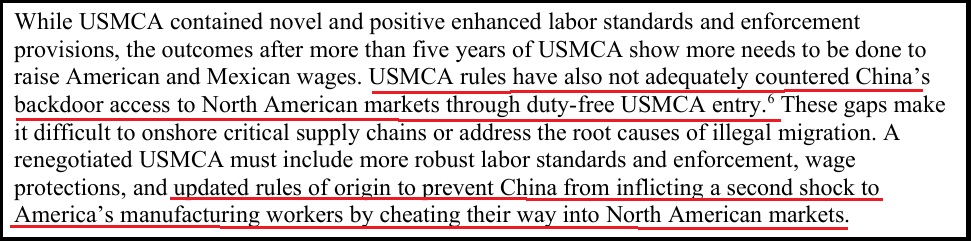
Canada is going to rely on congress to stop Trump from forcing reciprocity in the bilateral discussions. However, as a positive indicator that President Trump will factually have congressional support for the elimination of the USMCA, Democrat Senator Ruben Gallego has written a letter to President Trump requesting a comprehensive review. [LETTER HERE]
[SOURCE]

This is a key Senate democrat who notes the problem.  One of Gallego’s top points of concern is the loophole that Canada uses to assemble Chinese component parts into finished goods for tariff free distribution into the United States.

Ever since President Trump won the 2024 election, Mexico has been taking proactive independent action to block Chinese component goods. But Canada has done the opposite and begun to enhance their trade relationship with China to take even more Chinese component and finished goods.

Gallego writes to U.S. Trade Representative Jamieson Greer from the position of wanting to increase wages and enhance jobs in both Mexico and the USA, growing both economies. However, Gallego’s advocacy simultaneously bolsters why the USMCA should be dissolved and also puts Canada at a distinct disadvantage.

MEXICO – Mexico’s President Claudia Sheinbaum told reporters during her morning news briefing on Wednesday that her U.S. counterpart, Donald Trump, is open to doing away with the U.S.-Mexico-Canada trade agreement (USMCA) and replace it with individual trade deals with each country.

[…] “There might be revisions that create bilateral deals instead of involving the three countries because some things are more important between Mexico and the United Sates or between Canada and the United States,” said Sheinbaum. “Not everything has to be trilateral.”

Mexico’s president said the subject was brought up by Trump during a Tuesday phone conversation. […] According to Sheinbaum, her country is ready to consider possible changes. (read more)
Just like the original NAFTA dissolution, if Senate democrats agree the USMCA is structurally flawed then Canada will lose its only hope to retain the trilateral agreement.

It appears that some Senate democrats like Gallego recognize this issue and support the need for exceptional change.

There is a significant difference between Mexico and Canada as it pertains to trade.  Two distinctly different bilateral trade agreements would be the best outcome for the USA.

Team Mexico have already been holding bilateral discussions with USTR Jamieson Greer, and I suspect the broad outlines of a free trade agreement between the U.S and Mexico have already been agreed.

While Mexico has been working diligently for 16 months to get into alignment with the USA on a new free trade agreement, Canada has been doing everything possible to retain their “elbows up” position in opposition to the USA.  This will not work out well for Canada.

“The key thing that has struck me, and I think it has struck all Canadians, is so many of these guys in the Trump administration, frankly, they just hate Canada,” said Brian Clow, former Prime Minister Justin Trudeau’s deputy chief of staff who led Canada-U.S. affairs. {source}
“Canada joining at a later date”? 😂🤣😂
Canada and Europe Strengthen Trade Ties as Global Economy Fragments


Posted originally on Mar 9, 2026 by Martin Armstrong |  

EU-Canada relations

Canada and the European Union agreed to modernize their existing trade agreement while launching negotiations for a new digital trade pact. On the surface, this appears to be another routine trade update between two long-standing partners. In reality, it reflects a much deeper shift underway in the global economy as nations begin quietly restructuring trade relationships in response to rising geopolitical tension and economic uncertainty.

The agreement expands cooperation under the Comprehensive Economic and Trade Agreement, the free-trade pact originally signed between Canada and the European Union in 2016. That deal already removed roughly 98% of tariffs between the two economies and significantly expanded market access for businesses on both sides of the Atlantic. Now both governments are attempting to update the framework to address new issues such as digital commerce, cross-border data flows, and cybersecurity rules as global trade increasingly moves online.

What makes the timing particularly interesting is the strategic motivation behind the move. Canadian officials have openly stated that they want to reduce dependence on the United States. At present, nearly 70% of Canadian exports still go to the US, leaving the Canadian economy highly exposed to shifts in American policy. Europe, facing its own economic decline, is also seeking to diversify trade.

The modernization of the agreement also includes new mechanisms for resolving investment disputes and simplifying regulatory barriers that can make cross-border trade more complicated than tariffs themselves. Negotiators are also launching talks on Canada’s first digital trade agreement with the European Union, which will set rules governing electronic transactions, data transfers, and emerging technologies such as artificial intelligence and digital services.

Governments around the world are attempting to build regulatory frameworks around digital infrastructure, financial technology, and online communication under the banner of security and consumer protection. I have often warned that once governments gain centralized authority over financial and digital systems, the potential for broader control over economic activity and information flow increases. What begins as a framework to facilitate digital commerce can easily evolve into a system where regulators exert increasing influence over how information and financial activity move across borders.

What we are witnessing is the gradual fragmentation of the global economy into competing regional alliances. For decades, politicians promoted the concept of a fully globalized trading system. But as geopolitical tensions rise and governments increasingly weaponize trade policy, nations are beginning to look for partners they consider politically reliable rather than simply economically efficient.

Mexico and USA Begin Bilateral Preparations to Dissolve USMCA Without Canada


Posted originally on CTH on March 8, 2026 | Sundance

One of the most curious aspects to the predictable USMCA review, ie. dissolution, has been the incapacity of the Canadian government or trade delegation to accept the United States is going to create two distinctly different bilateral trade agreements and eliminate the trilateral USMCA.

For 16 months the Canadians have refused to fathom the reality of what is going to happen this year.

The Canadians just cannot believe it is possible they will be forced to negotiate a free trade agreement without the cover of a multilateral construct. It has been remarkable to watch their dissonance.

Last week President Donald Trump and Mexican President Claudia Sheinbaum held a phone call. At the conclusion of the call, Sheinbaum publicly asserted the reality the Canadians just refuse to accept.

MEXICO – Mexico’s President Claudia Sheinbaum told reporters during her morning news briefing on Wednesday that her U.S. counterpart, Donald Trump, is open to doing away with the U.S.-Mexico-Canada trade agreement (USMCA) and replace it with individual trade deals with each country.

[…] “There might be revisions that create bilateral deals instead of involving the three countries because some things are more important between Mexico and the United Sates or between Canada and the United States,” said Sheinbaum. “Not everything has to be trilateral.”

Mexico’s president said the subject was brought up by Trump during a Tuesday phone conversation. […] According to Sheinbaum, her country is ready to consider possible changes. (read more)

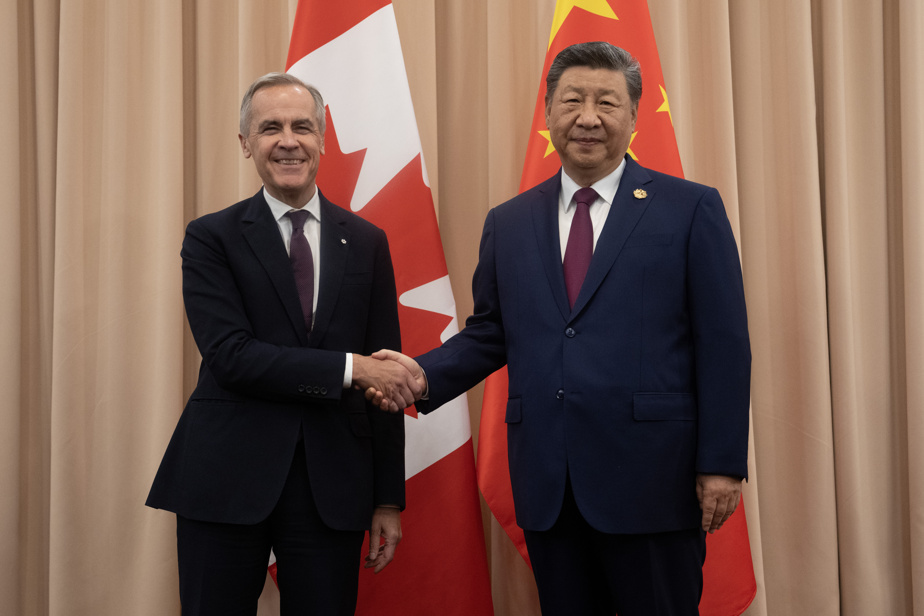
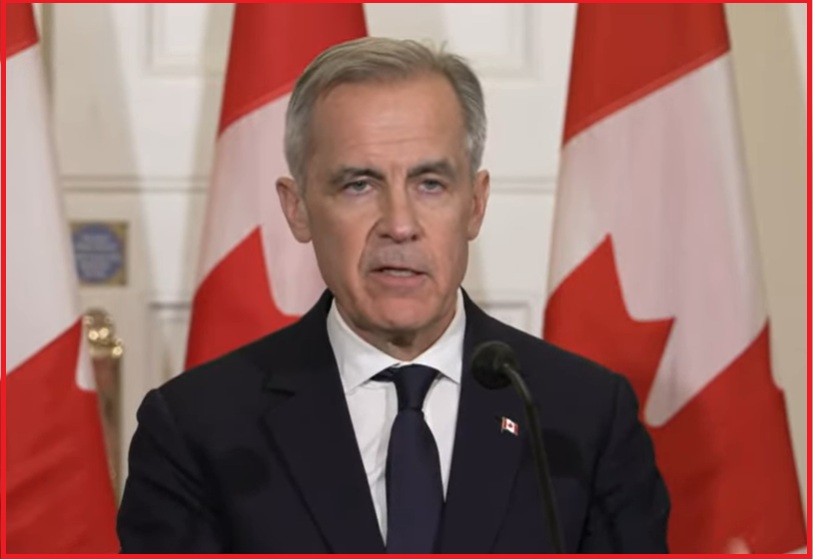
Canadian Prime Minister Mark Carney finally started to realize President Trump was likely to ignore Canada and begin direct discussions with Sheinbaum. So, Carney went to Mexico to try and get assurances from Sheinbaum that Mexico would not proceed without Canadian interests in mind.

Essentially, Carney wanted Sheinbaum to be on his team.  However, as diplomatically noted in the phone call with President Trump, President Sheinbaum politely rejected the Canadian partnership. [Insert Trump’s position toward Mexican cartels as an overriding thought]

The Canadians have been talking to U.S. media looking for sympathetic ‘Orange man bad’ coverage.  However, within the contacts between Canadian government officials and U.S. corporate allies, the sentiment from team Trump is very clear:

“The key thing that has struck me, and I think it has struck all Canadians, is so many of these guys in the Trump administration, frankly, they just hate Canada,” said Brian Clow, former Prime Minister Justin Trudeau’s deputy chief of staff who led Canada-U.S. affairs. {source}

It’s not hatred, it’s annoyance.

Years of compounding parasitic annoyances and sanctimonious, ‘holier-than-thou’ pontifications from the arrogant and uppity Canadian government.

The only time Canada has been honest with themselves and with President Trump was when Justin Trudeau was exiting office and admitted Canada cannot function without all of the one-way benefits it receives from the USA {GO DEEP}.

That’s it. That’s the only time Canada has ever been honest about the nature of the economic relationship.  A time when Trudeau had already quit and would not be around to deal with the consequences.  However, the level of Canadian arrogance is not only visible to President Trump, even the Japanese can see it.

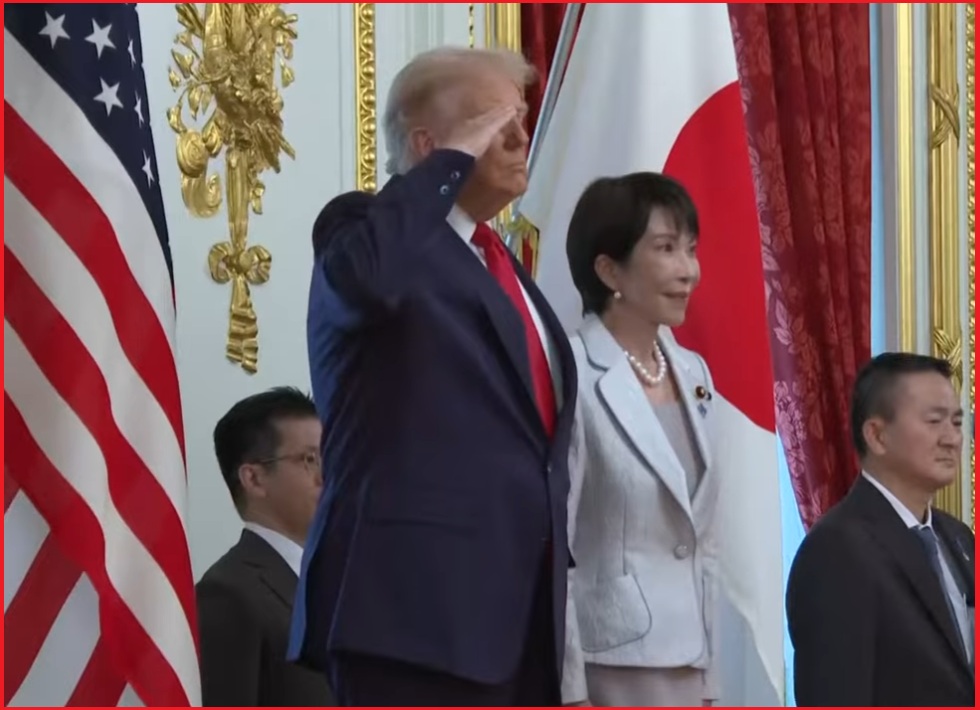
Remember that very close relationship between Japanese Prime Minister Sanae Takaichi and President Trump.  That professional, personal and respectful relationship is going to become strategically important this year.

Japan’s economic and trade representatives have told the Canadians that if the USMCA is dissolved, and if Canada no longer has the same trade access current available in the trilateral format, then Japan would rethink its entire investment portfolio in Canada, specifically the auto sector.

In essence, specifically as it pertains to the auto industry, Japan is saying if the USMCA is gone, Japan may pull all their cross-border manufacturing out of Canada and transfer it to the United States.

Prime Minister Mark Carney was recently questioned about the statements from Japan and he waxed nonsensically [SEE HERE] about how Canada would use Chinese BYD electric autos to replace lost Toyota manufacturing.

It’s a hot mess for Canada and getting worse.

Last Friday, Canada’s worst nightmare began unfolding:

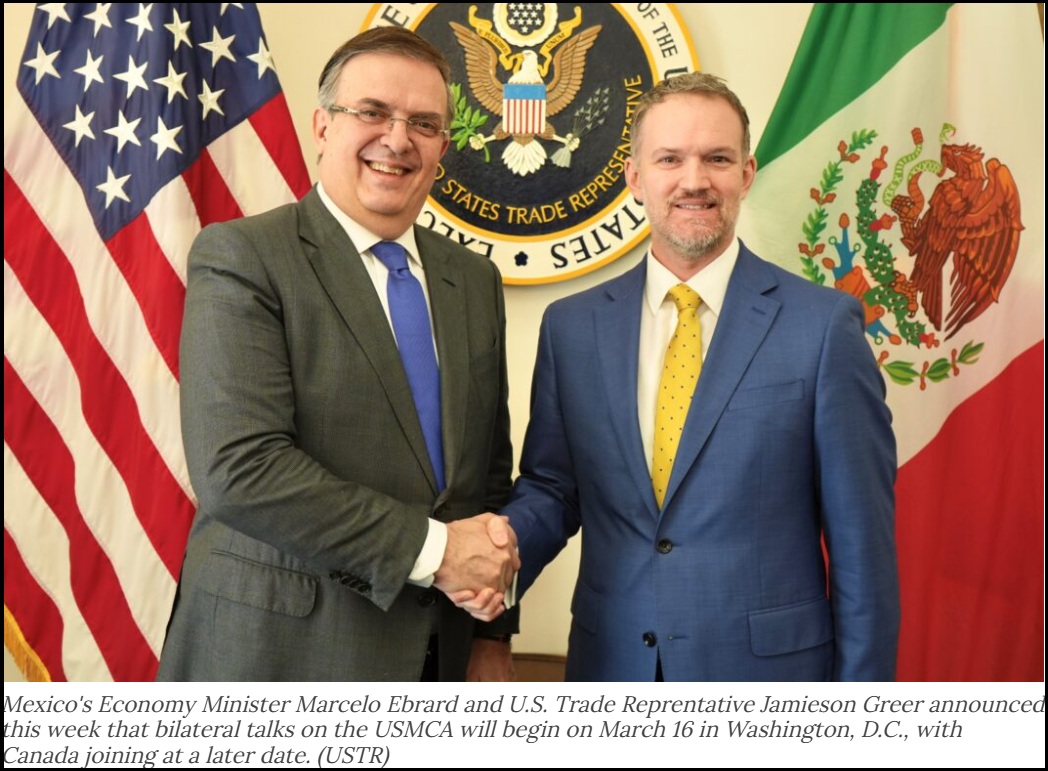
WASHINGTON – Today, U.S Trade Representative Jamieson Greer and Mexican Secretary of Economy Marcelo Ebrard announced the first round of bilateral discussions in preparation for the Joint Review of the United States–Mexico–Canada Agreement (USMCA).

The ministers instructed negotiators to begin a scoping discussion on the necessary measures to ensure the benefits of the Agreement accrue primarily to the parties, including by reducing dependence on imports from outside the region, strengthening rules of origin, and enhancing the security of North American supply chains.

Ministers expect negotiators to hold the first meeting the week of March 16 and meet regularly thereafter as part of the Joint Review. [LINK]

Right there, you can see the exact same thing that took place in early 2017, when President Trump began organizing a bilateral trade discussion with Mexico only, in advance of his preferred approach to dissolve NAFTA and use two distinctly different bilateral trade agreements to replace it.  USTR Robert Lighthizer was working with Mexico only.

USTR Jamieson Greer, the studious protege’ of Lighthizer, now has the task of organizing the USA and Mexico while delaying any substantive contact/discussions with Canada until President Trump is ready to drop the hammer.

I can assuredly say President Trump wants everything outlined and in place for a U.S-Mexico deal before he announces the dissolution (joint review withdrawal) to end the USMCA.

There is little to no chance President Trump wants to renew a trilateral trade agreement that allows Canada to keep exploiting their market access to the U.S. without accepting reciprocity.

Remember, Canada’s main export is energy, and Trump has diminished that leverage through the Venezuela operation. Perhaps another ‘ah-ha’ moment for deep weed walkers.  Yes, in addition to giving China a body blow, taking control of Venezuela oil and minerals also weakens the leverage position of Mark Carney.  Can you see it now?

Canada has one key card they can leverage, congress.

Prime Minister Mark Carney is counting on the UniParty in Washington DC to stand in his corner against President Donald Trump and block any attempt to end the USMCA.  However, this is not going to be a surprise to President Trump, because Justin Trudeau did the same thing in 2018 when he coordinated his approach toward NAFTA through then Speaker of the House, Nancy Pelosi.

As I have said with great eagerness, it is going to be a lot of fun to watch this unfold.

Joyful Video of President Trump Inviting USA Gold Medal Hockey Teams to State of Union Address


Posted originally on CTH on February 23, 2026 | Sundance 

The video of President Trump’s locker room phone call with the USA men’s hockey team is pure American.  The joy and spirit of the moment captured in the voice of President Trump and the cheerful celebration of the world’s greatest hockey team.  Lots of good stuff.

FBI Director Kash Patel was in the locker room holding the phone.

.

Canada to Provide Express Entry to Trained Foreign Military Personnel


Posted originally on Feb 20, 2026 by Martin Armstrong |  

I have warned many times that immigration policy is increasingly being shaped by political ideology rather than long-term social cohesion and economic stability. The report that Canada is considering an express entry pathway for highly trained foreign military personnel raises very serious questions that go far beyond labor shortages or skills-based immigration. When governments begin fast-tracking individuals with military training into civilian society under expedited frameworks, this is no longer just an economic policy — it becomes a national security and social stability issue.

Historically, successful immigration systems were built around assimilation, economic contribution, and cultural integration. Governments are struggling to build their militaries amid recruitment shortages. Their solution is to import “skilled” fighters as we move closer to global conflict. Military personnel will be included among other high-skilled occupations since the demand far exceeds the available domestic supply.

The larger concern is assimilation and demographic shifts. I have repeatedly stated that social stability depends on shared legal, cultural, and institutional norms. When immigration policy accelerates without equal emphasis on integration, fragmentation follows. Europe has already demonstrated this lesson in multiple countries where rapid demographic policy shifts created long-term social divisions and rising political polarization. Canada is not immune to those same cyclical forces simply because it has historically maintained a more structured immigration system.

There is also the geopolitical layer that cannot be ignored. We are entering a period of rising global volatility into the 2026–2032 window, according to the cyclical models. During such phases, governments increasingly prioritize security, institutional resilience, and strategic labor pools. Policies targeting military-trained migrants may be framed as skills-based immigration, but they also reflect a broader shift toward state planning in response to global uncertainty.

HowEmpiresDie

Look at Russia. Putin turned to Kim Jong-un in a desperate plea to recruit more men. Impoverished nations are willing to import anything, including humans. Canada’s announcement alludes to the government’s importance of rapidly building the armed forces. Canada was so focused on forcing their own men and women to take the COVID vaccines a few years back that they pushed away contenders. What could go wrong if a nation opens its borders to trained mercenaries who may have an allegiance to a foreign government? Ancient Rome too relied on non-Roman recruits, but that was merely one aspect of the collapse.

I have explained in my writings on the Fall of Rome and How Empires Die that empires always turn to external manpower when domestic demographics weaken, and the population no longer supports the state financially or militarily. Hiring outsiders, expanding bureaucracy, and increasing control are all late-cycle responses to declining confidence in the system itself.

Canada Completes Construction of Nuclear Power Plant


Posted originally on Feb 18, 2026 by Martin Armstrong |  

Nuclear energy: appetite growing but challenges remain | Netzeroinvestor

What you are looking at with Canada completing the roughly $9.4 billion Darlington nuclear refurbishment early and under budget is something that completely contradicts the prevailing political narrative about energy policy in the West. The final 878-MW unit is now preparing to return to commercial operation, marking the end of a decade-long rebuild of the four-reactor complex, finished four months ahead of schedule and about $110 million under budget.

A massive nuclear infrastructure project in a Western country was delivered ahead of schedule and under budget. That alone tells you this was treated as a strategic national priority rather than a political talking point.

The refurbishment extends the plant’s operational life by decades and secures over 3,500 megawatts of reliable baseload electricity into at least the mid-2050s. This is the key difference between energy policy driven by engineering reality versus ideological policy driven by climate politics and bureaucratic regulation. Nuclear provides stability. Wind and solar provide volatility unless backed by baseload power.

From a cyclical perspective, this fits directly into what I have written in my reports on energy, sovereign debt, and industrial competitiveness. Nations that secure long-term, reliable energy sources maintain industrial strength. Nations that deliberately dismantle baseload energy in favor of politically fashionable policies inevitably face rising costs, deindustrialization, and declining confidence.

Canada’s approach here is pragmatic. The project began back in 2016 as a long-term refurbishment of all four CANDU reactors, replacing major components and effectively giving the facility another generation of operational life. This is not simply maintenance — it is strategic infrastructure renewal.

Compare this to Europe. The EU has been shutting nuclear plants, imposing Net Zero mandates, and then wondering why industrial production is collapsing and energy costs remain structurally elevated. Energy policy is not separate from economic performance. It is the foundation of it. Germany is the perfect case study of how abandoning nuclear in favor of ideology undermines industrial competitiveness.

What is even more significant is the timing. This project comes as global electricity demand is rising due to electrification, AI infrastructure, and reindustrialization trends. Governments are beginning to realize that intermittent energy cannot sustain modern economies or military readiness. Baseload power is not optional in a geopolitical cycle turning toward fragmentation and potential conflict.

The fact that this refurbishment is being called one of the world’s largest nuclear life-extension projects also signals something deeper: nuclear is returning as a strategic asset. Historically, during periods of geopolitical tension and rising sovereign risk, governments shift toward energy security. That is exactly what the model has been projecting into this 2026–2032 window of rising volatility.

Canadian Prime Minister Pitching Global Trade Rules Agreement to Combat Trump – Connecting Trans-Atlantic to Trans-Pacific


Posted originally on CTH on February 17, 2026 | Sundance 

There is an awful lot to unpack in this seemingly obscure article talking about Canadian Prime Minister Mark Carney and a new trade approach he is pitching to Pacific/Asia and Atlantic/European nations. [Story Here]

Before getting to the substance of the outline, something important needs to be shared for context.

Do you remember the 2014, 2015 and 2016 top story conversations and debates over the Transpacific Partnership trade deal known as TPP?

You might also remember the Transatlantic Trade and Investment Partnership trade deal known as TTIP.

The TPP (Pacific) and TTIP (Atlantic) were two major multinational trade deals negotiated between 2013 and 2016. While both sparked plenty of debate, most of the spotlight was on the TPP, the Trans-Pacific Partnership.

Hillary Clinton was in favor of TPP as were most of the traditional republican field of candidates in ’15/’16.  However, Donald Trump was strongly against TPP and pledged to exit out of any negotiations and scrap the U.S. participation if he was to win the 2016 election.  Some of you may begin to remember this.

Donald Trump agreed with our position, that TPP was being falsely sold as a beneficial 12-nation massive trade agreement between the USA and pacific rim countries including Australia and Southeast Asia nations.

With the history of NAFTA behind us, we could see two major issues with TPP:  #1: It was structured with a back door to let China into the deal. And #2) it was created to ensure the USA remained a “service driven economy.”

Supporters of TPP and TTIP claimed this multinational trade deals would create smooth supply chains and align on ‘rules of origin.’ They believed TPP would benefit companies and lead to cheaper products. Critics, however, argued that the agreements were designed to exploit the U.S. consumer market and prevent the country from ever regaining a strong manufacturing base.

I share those reminders to set up the big 800-lb gorilla question.

If the TPP was such a great trade deal for all parties involved, why didn’t the group finalize it after the USA withdrew? It’s been a decade, so why haven’t the TPP nations completed their trade agreement?

The honest answer reveals the undiscussed lie.

Both TPP and TTIP were constructed and designed to keep exploiting the U.S. consumer market. That’s it. That was the entire purpose of TPP (Asia) and TTIP (Europe). Corporations and lobbyists like the U.S. Chamber of Commerce wrote the TPP language to maximize corporate profits. That was the purpose of it.

Take the U.S.A. out of the TPP trade agreement and the purpose/benefit no longer exists.  Without the host, there is no need for a feeding agreement between parasites.  That’s why a decade has passed and TPP/TTIP went nowhere.

All of that said, suddenly with President Trump positioning to eliminate the USMCA trade agreement, Canadian Prime Minister Mark Carney wants to go back to the TPP/TTIP “Rules of Origin” trade framework in order to create an insurance policy against the end of the trilateral USMCA trade agreement.

Now, here is where it gets really interesting.  There is no way for Canada to remain in the USMCA and simultaneously commit to a trade agreement with different rules of origin.   This means that for Carney to accomplish what he’s reportedly aiming for, the dissolution of the UMCA would already need to be in the works.

USMCA Article 32.10 – Non-Market Country FTA (key provisions):

“A Party intending to negotiate a free trade agreement with a non-market country shall inform the other Parties at least three months prior to commencing negotiations and, upon request, provide information regarding the objectives of those negotiations.

A Party that enters into a free trade agreement with a non-market country shall provide the other Parties with the full text of the agreement prior to signing.

If a Party enters into a free trade agreement with a non-market country, the other Parties may terminate this Agreement on six months’ notice and replace it with a bilateral agreement.” [SOURCE]

The Canadian proposal violates the central tenet of the USMCA. Carney’s proposal can only move forward if the Canadian government has already accepted that the USMCA trade agreement will come to an end.

WASHINGTON – The European Union and a 12-nation Indo-Pacific bloc are opening talks to explore proposals to form one of the largest global economic alliances, multiple people with knowledge of the talks told POLITICO.

Canada is spearheading the discussions after Prime Minister Mark Carney called on middle powers to buck trade war coercion last month, days after Trump threatened to raise tariffs on Denmark’s European allies if it didn’t cede Greenland.

Ottawa is “championing efforts to build a bridge between the Trans-Pacific Partnership [CPTPP] and the European Union, which would create a new trading bloc of 1.5 billion people,” Carney told world leaders and the global business elite in Davos.

The middle powers are taking action. The EU and CPTPP are starting talks this year to strike an agreement to intertwine the supply chains of members like Canada, Singapore, Mexico, Japan, Vietnam, Malaysia and Australia with Europe.

It would bring nearly 40 nations on opposite sides of the globe closer together with the aim of reaching a deal on so-called rules of origin.

These rules determine the economic nationality of a product. A deal would allow manufacturers throughout the two blocs to trade goods and their parts more seamlessly in a low-tariff process known as cumulation. (read more)

In practice, a multilateral trade agreement with “Rules of Origin” involving many countries doesn’t really matter to the USA since our trade deals are bilateral. Other parties can set whatever terms they like, but if they want access to the U.S. market, that’s where we lay out our own specific terms on a one-to-one basis.

The same thing cannot be said for Canada, who is intentionally planning to remain a deindustrialized economy.  Canada will import component goods for assembly in Canada, but they will not fabricate much.

Prime Minister Mark Carney is strategically planning to keep Canada dependent on cheap foreign imports.

Canadians Embrace Cheap Chinese Electric Vehicles


Posted originally on CTH on February 17, 2026 | Sundance 

While the government of Canadian Prime Minister Mark Carney has inked a trade agreement with China to accept cheap imported vehicles in exchange for Beijing purchasing some agricultural products, President Trump has promised those cheap Chinese EVs will never cross the border into the USA.

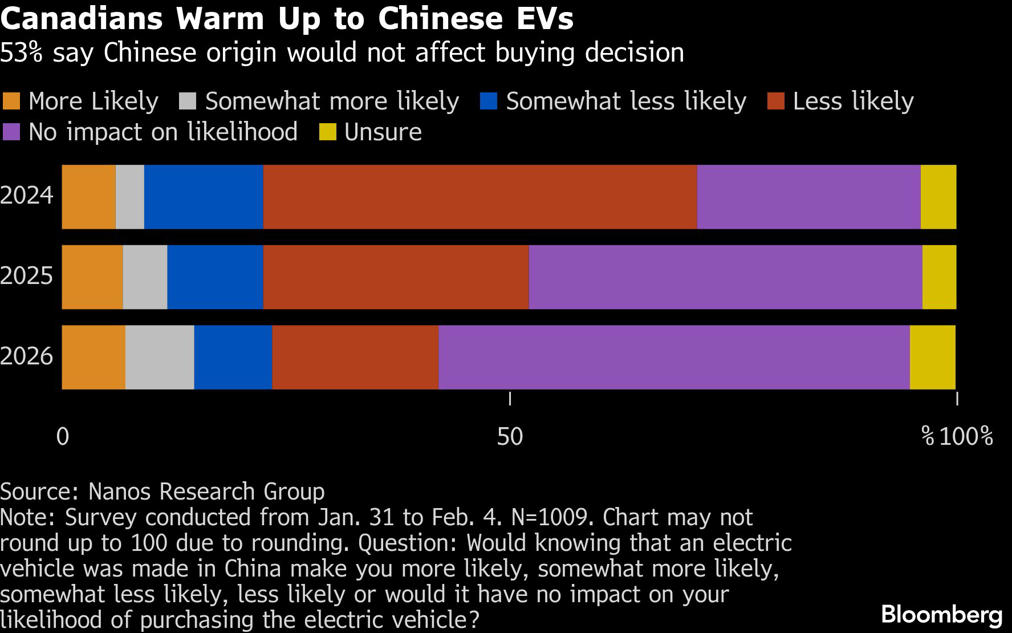
The Canadian polling on the issue has done a remarkable chang in the past few years.  Now, the majority of Canadians are willing to purchase cheap Chinese EVs. As outlined by Bloomberg, “More than half of Canadians, or 53%, say that knowing an EV was made in China would have no effect on their purchasing decision, according to a new poll by Nanos Research Group for Bloomberg News.”

Approximately 50,000 Chinese electric vehicles will enter the Canadian market in the first year. “The pact with China includes a provision that part of the quota will be reserved for electric vehicles priced at C$35,000 ($25,700) or less, the government has said.” {SOURCE}

The Canadian government wants a Chinese auto manufacturer, any Chinese auto manufacturer, to build factories in Canada to produce these electric vehicles.  Canada wants the jobs and economic activity because Canada is currently bleeding jobs and economic activity due to the trade conflict with the U.S.

Building cheap Chinese EVs in Canada might help offset a few thousand job losses, but building Chinese EVs in Canada only further ensures there will not be a substantive trade agreement between the USA and Canada once the USMCA (CUSMA) is dissolved.  [More on that coming]

Meanwhile, Chinese EV company Build Your Dream (BYD) has announced they sold 4.6 million vehicles worldwide last year, far surpassing Tesla and even surpassing all of the Ford global auto manufacturing.  BYD is now the sixth largest auto manufacturing company in the world.

[Auto News] […] The 2025 sales figures place BYD at sixth largest among global automakers, meaning Ford slipped to seventh in total global deliveries. Toyota remains the dominant global seller with sales exceeding 10 million units followed by Volkswagen Group, Hyundai Motor (including Kia and Genesis), General Motors, and Stellantis.

BYD’s sixth position in the global automotive sales index is particularly notable for an auto maker that focuses almost exclusively on new energy vehicles (NEVs) — a category that includes battery-electric vehicles (BEVs) and plug-in hybrid vehicles (PHEVs). (more)

CTH previously outlined the specific explosion in BYD auto sales HERE.  Europe, Russia, Asia and Australia are flooded with cheap Chinese EVs particularly from the BYD brand.  Canada is now opening themselves to face the same issue.

School Shooting in Tumbler Ridge, British Columbia Leaves 10 Killed, Including Shooter – The “Gender” of Shooter Creating Angst


A horrific school shooting in Canada has resulted in the death of 10 people. Seven people at the school, two people in a residence nearby and the shooter. The details are starting to come out, but for some reason there is a concerning aspect to the “gender” of the shooter.

The Associated Press describes the situationVANCOUVER, British Columbia (AP) — A shooting at a school in British Columbia left eight dead including a woman whom police believe to be the shooter, while two more people were found dead at a nearby home, Canadian authorities said Tuesday.

The Royal Canadian Mounted Police said more than 25 people are injured, including two who were airlifted to hospital with life-threatening injuries, after the shooting at Tumbler Ridge Secondary School.” (more)

BBC SUMMARIZESPolice say an attacker killed nine people before taking their own life on Tuesday. – Six victims were found dead inside Tumbler Ridge Secondary school, while a seventh person died on the way to hospital. The body of the attacker was also found at the school. – Two more people were found dead inside a residence nearby. – Police described the suspect as a “female in a dress with brown hair” in an active shooter alert sent to the community. – At least two other people were taken to hospital with serious or life-threatening injuries following the attack, and as many as 25 people were being treated for non-life-threatening injuries, police said. – Canada’s Prime Minister, Mark Carney, said he is “devastated” by the shooting and that his government “stands with all British Columbians as they confront this horrible tragedy.” – The PM cancelled his upcoming trip to the Munich Security Conference in response to the shooting. (link)

If this information is correct and the shooter was a trans, I can only imagine the level of political correctness that will follow from Canada about the shooting.

Canada is the global woke central. February 11, 2026 | Sundance

President Trump Threatens Blockade of Almost Completed Michigan-Ontario Bridge


Posted originally on CTH on February 9, 2026 | Sundance 

Writing on a Truth Social post earlier this evening, President Trump is threatening to block the U.S. side of a new bridge that links Detroit, Michigan to Ontario, Canada:

(Truth Social) – “As everyone knows, the Country of Canada has treated the United States very unfairly for decades. Now, things are turning around for the U.S.A., and FAST! But imagine, Canada is building a massive bridge between Ontario and Michigan. They own both the Canada and the United States side and, of course, built it with virtually no U.S. content. President Barack Hussein Obama stupidly gave them a waiver so they could get around the BUY AMERICAN Act, and not use any American products, including our Steel.

Now, the Canadian Government expects me, as President of the United States, to PERMIT them to just “take advantage of America!” What does the United States of America get — Absolutely NOTHING! Ontario won’t even put U.S. spirits, beverages, and other alcoholic products, on their shelves, they are absolutely prohibited from doing so and now, on top of everything else, Prime Minister Carney wants to make a deal with China — which will eat Canada alive. We’ll just get the leftovers! I don’t think so.

The first thing China will do is terminate ALL Ice Hockey being played in Canada and permanently eliminate The Stanley Cup. The Tariffs Canada charges us for our Dairy products have, for many years, been unacceptable, putting our Farmers at great financial risk. I will not allow this bridge to open until the United States is fully compensated for everything we have given them, and also, importantly, Canada treats the United States with the Fairness and Respect that we deserve. We will start negotiations, IMMEDIATELY. With all that we have given them, we should own, perhaps, at least one half of this asset. The revenues generated because of the U.S. Market will be astronomical. Thank you for your attention to this matter!” ~PRESIDENT DONALD J. TRUMP

The USMCA renegotiation plan likely plays a big part in this announcement.  Don’t react, just watch.