Posted originally on the CTH on April 3, 2024 | Sundance
Before getting into the weeds, here’s the big picture baseline. All
documents and records created within the executive branch are created for the benefit of the head of the Executive Branch, the president.
There is no entity, organization, assembly, institution, person or individual, above the President of the United States. The president holds absolute power and absolute immunity. Everyone within the executive branch works at the pleasure of the president, and all work products are created for his administration. This is the plenary power of the president.
The entire documents case in Florida rests on the principle that another entity supersedes the president within the executive branch. Some unknown, unnamed bureaucracy can override the president and decide for themselves what would be called a “presidential record” and what would be called “classified information.”
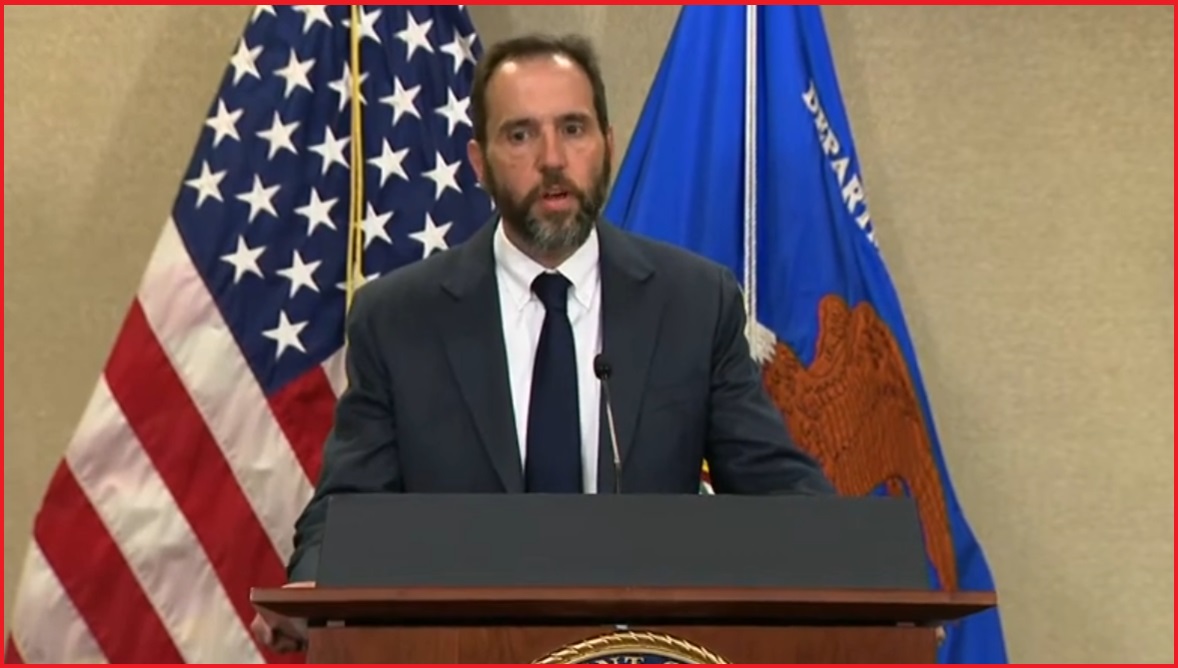
Jack Smith, Norm Eisen (pictured left, red tie) and Andrew Weissmann each argue that some other entity rests atop the president and can make this decision.
Judge Aileen Cannon has not determined which constitutional argument is correct, and has told the parties to create jury instructions both ways. The Lawfare crew of Smith, Eisen and Weissmann are going bananas.
[…] Cannon’s first scenario would allow the jury to make a factual determination about whether a former president deemed a record to be personal or official under the PRA. That is nonsensical – presidents are not allowed to designate official records as personal ones, so there is no factual issue for a jury to resolve.
A different set of laws govern the classification process and the rules for handling highly sensitive classified documents — not the PRA. They include Executive Order 13526. One of the authors of this column (Eisen) helped write that executive order. The 11th Circuit has already established that those rules fully apply to former presidents.
Cannon seems to think that the PRA somehow supersedes the executive order and the rest of federal law pertaining to the handling of classified materials. It does not. On the contrary, the PRA defines “personal records” as “all documentary materials … of a purely private or nonpublic character which do not relate to or have an effect upon the carrying out of the constitutional, statutory, or other official or ceremonial duties of the President.” That cannot possibly include highly classified battle plans, nuclear secrets and the other official documents at issue in this criminal prosecution.
That rules out Cannon’s first hypothetical. But as Smith points out in his filing, the second alternative is just as bad. She made up a legal standard, asking both sides to assume that Trump could have deemed a record personal by simply not including it with the records transmitted to the National Archives and Records Administration at the end of his term. If this were true, the mere fact that Trump took the documents with him from the White House would inherently turn them into personal records.
Of course, Trump leaped at this interpretation, fashioning proposed jury instructions that would inevitably result in his acquittal. But, as Smith noted, this approach has no basis in the law — or the facts. Even Trump himself does not seem to have considered classified documents personal after he left the White House, as evidenced in an audio recording CNN obtained last year in which Trump, during a conversation at his Bedminster, New Jersey, estate in 2021, discussed documents remaining classified even though he took them with him upon leaving office. Smith hits this point hard, arguing that Trump’s position that records are personal was “invented” when the controversy over the documents began to emerge in February 2022, over a year after Trump left the White House. (read more)
Posted originally on the CTH on April 2, 2024 | Sundance
According to those in political circles who are instructed by the intelligence community, funding for Ukraine is the highest national priority. As an outcome we see all the DC politicians and beltway pundits pushing the same story, funding for Ukraine is the highest priority.
The key politicians within the dynamic exist inside information silos, essentially control mechanisms, where the intelligence community (IC) constructs reality by briefing the politicians about what is going on in the world. The IC tells the politicians what is happening, defines the importance and instructs the politicians on the priorities. The IC is never challenged because ultimately the IC has “seven ways to Sunday” to target the politicians if any non-compliance is identified.
Speaker Mike Johnson is one of the “gang-of-eight” members within the legislative branch. The Go8 are briefed and controlled by the IC, using the exact same intelligence given to the President. Speaker Johnson has the funding of Ukraine as his top priority, because the IC officials who set priorities have told him it must be. WATCH (prompted):
.
(Via Fox News) – […] “When we return after this period, we’ll be moving a product. But it’s going to, I think, have some important innovations,” Johnson told Fox News’ “Sunday Night in America with Trey Gowdy.”
Both the House and Senate are currently on the second week of a two-week recess, when lawmakers are working in their home districts. The House is back on Tuesday, April 9.
Johnson said he has been “working to build consensus” on a supplemental national security and foreign aid package, though he signaled it would look different from prior attempts. He said the House would “be moving it right after the district work period.”
It comes after Republicans killed a $118 billion package with aid for Ukraine, Taiwan, Israel and the U.S. border earlier this year, arguing it did not go far enough to tackle the ongoing border crisis. Senate Majority Leader Chuck Schumer, D-N.Y., and President Biden have been pressuring Johnson to take up a slimmer $95 billion package without border measures.
“We’ve been trying to use that as the only leverage we have to force change on the border. We’re still trying to force the president to use his executive authority, and most of the American people know that he has that authority. He’s not using it,” Johnson argued.
On Ukraine specifically, he said, “There’s a lot of things that we should do that make more sense and I think we’ll have consensus around.”
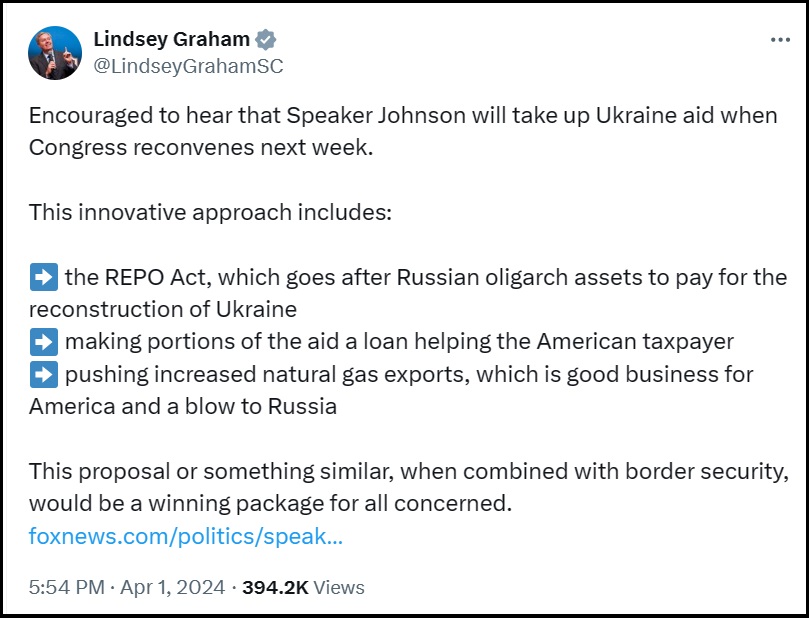
Johnson highlighted three details specifically – the first being the REPO Act introduced in the House last year by Foreign Affairs Chairman Michael McCaul, R-Texas, and Rep. Marcy Kaptur, D-Ohio, which would liquidate seized Russian assets and send that as assistance to Ukraine.
The speaker also pointed out that former President Trump recently floated the idea of aid to Ukraine in the form of a loan, though he did not mention specific terms save for Kyiv paying Washington back if they win the war against Russia.
[…] Johnson described the third proposal, “And then, you know, we want to unleash American energy. We want to have natural gas exports that will help unfund Vladimir Putin’s war effort there.” (read more)
Latest US POLLING – […] “poll shows that two years after Russia’s initial invasion, the Ukraine war has become a partisan dividing line: Majorities of Democrats think it’s extremely or very important to prevent Russia from seizing more Ukrainian territory, to negotiate a permanent ceasefire between the two countries, help Ukraine regain its land and provide general aid to its military, while less than half of Republicans and Independents agree.” (read more)
I have created this site to help people have fun in the kitchen. I write about enjoying life both in and out of my kitchen. Life is short! Make the most of it and enjoy!
This is a library of News Events not reported by the Main Stream Media documenting & connecting the dots on How the Obama Marxist Liberal agenda is destroying America








 Centinel2012