Posted originally on CTH on March 23, 2026 | Sundance
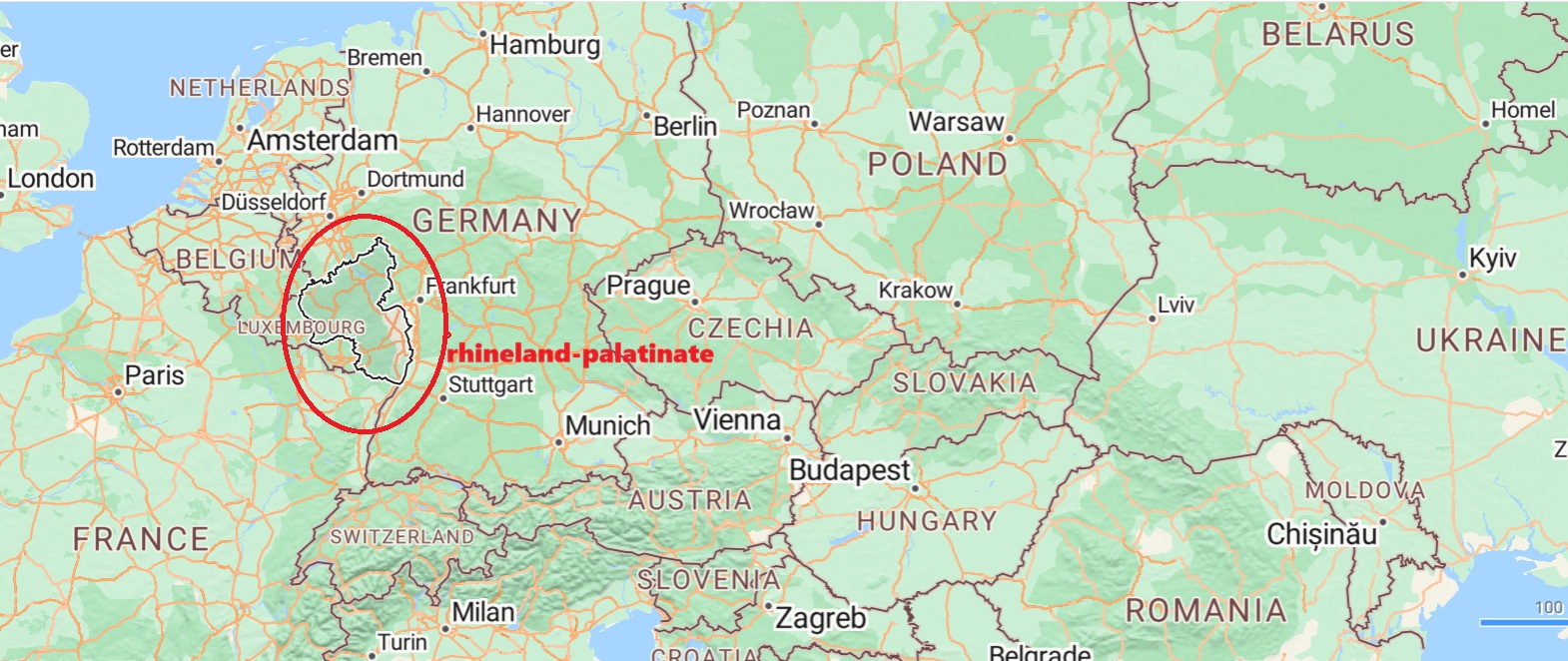
Within Germany the Rhineland-Palatinate regional parliament electionwas held yesterday. The region is the heart of the German industrial sector and home to the massively important auto-manufacturing sector.
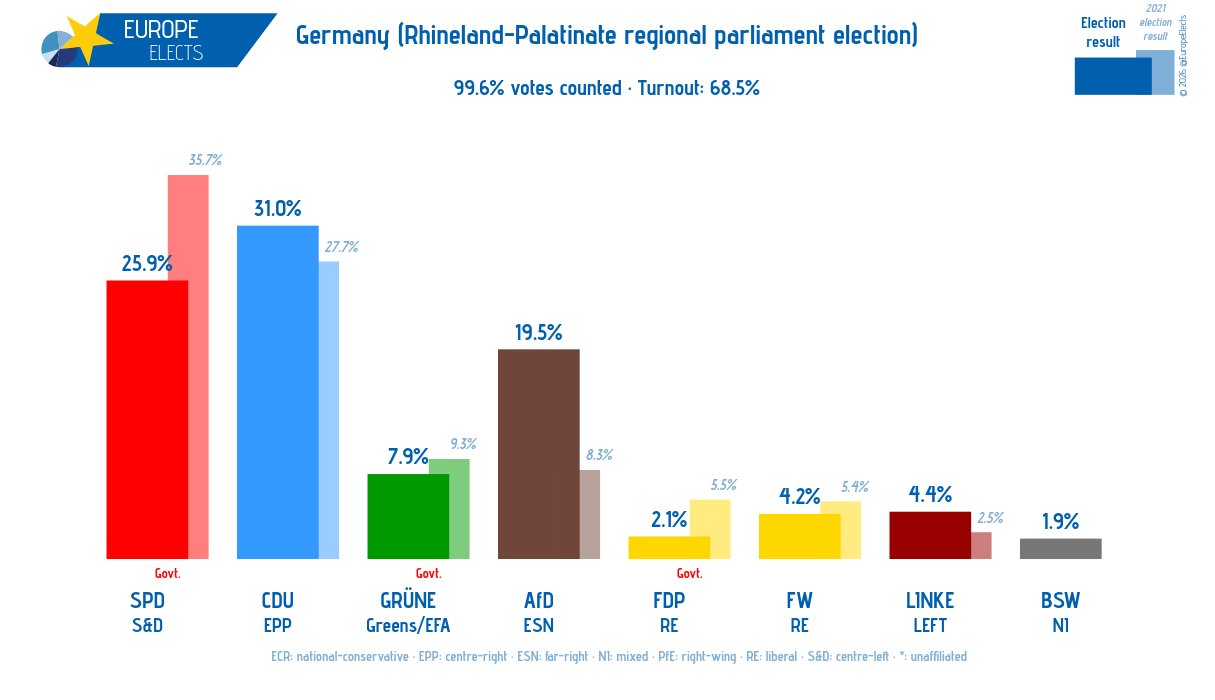
Chancellor Friedrich Merz’s conservative party the Christian Democratic Union (CDU) won the biggest portion of the election, defeating the Social Democratic Party (SPD) who lost ground in the western area bordering France. However, the biggest electoral gains were for the Alternative for Germany (AfD) party, with gains that more than doubled its previous vote share.
There is intense interest throughout Europe on the ideological shift in political sentiment mostly driven by economic concerns as well as rising nationalistic sentiment against the elitist minds in Brussels. Essentially those being ‘ruled’ are increasingly fed-up by those doing the ‘ruling.’ The AfD party is akin to the pragmatic MAGA base more focused on economic nationalism than all the nonsense associated with multiculturalism, green energy programs and terrible immigration policy.
The ideological battle within Europe is ongoing, with some gains by nationalist parties over the collective mindset of the European elites. However, the European Commission doesn’t just have a finger on the scales, they have full control over the mechanics of the elections themselves. Yes, AfD more than doubled their share of votes to 20%, but CDU at 31% and the socialists at 26% is akin to mainstream corporate republicans and progressives respectively controlling 57% of the support base.
The biggest election to be held in Europe in the last decade or more, is going to be the election in Hungary which takes place April 12, next month.
The European Commission is going all-in to try and manipulate the Hungarian voting base against Prime Minister Viktor Orban and the Fidesz party who is/are viewed by Brussels as standing in the way of their scheme to fund the ongoing war in Ukraine.
Orban’s reelection campaign has been under relentless assaults from restrictions on EU social media, to outright propaganda and financing for his opposition Péter Magyar and the Tisza party.
Prime Minister Orban is strongly supported by President Donald Trump and the Trump administration; however, the scale of opposition to both of them is intense.
Former leftist USAID Administrator Samantha Power spent time inside Hungary organizing the Tisza party to oppose Viktor Orban, and the totality of the European opposition to Orban cannot be underestimated.
Every element of every political construct within the Europe Union is aligned to try and defeat Orban and the Fidesz party. Additionally, the government of Ukraine is actively working all intelligence angles to defeat Orban due to the $90 billion EU loan scheme that Hungary is blocking.
Prime Minister Viktor Orban winning reelection this time in 2026 would be akin to Trump’s victory in 2016.
Do not underestimate the power of the U.K/European control system and the alignment of all their collective interests. Chancellor Friedrich Merz (Germany), President Emmanuel Macron (France), Prime Minister Keir Starmer (UK) along with the governing elites of Denmark, Finland, Sweden, Norway, Austria, Netherlands and many more, have all publicly taken positions against Hungary.
As we saw in Romania, Moldova and Georgia, it is not simply a matter of what the Hungarian voters want that will determine the outcome of the Hungarian election, the European Commission has many tools and techniques to shift the outcome.
This single small Hungarian election is the most critical election for the EU since Brexit.
Posted originally on CTH on March 7, 2026 | Sundance
We like the deep weeds, most do not. The geopolitical ramifications of the U.S. confrontation with Iran are vast and complicated; however, to encapsulate one of the most interesting dynamics consider this ‘tldr’ statement to open the discussion with your friends: Right now, Russia is like Amazon during COVID-19.
What follows is not me saying President Trump and President Putin are holding nightly conversations, discussing steps or details, or even obliquely coordinating measures as Trump eliminates the generational threat posed by Iran.
However, I am saying that given the nature of all contact and communication between Trump and Putin, including extensive contacts by their representative emissaries, both Putin and Trump are well aware of each downstream effect from the Iranian confrontation.
Two days after the U.S./Israel began Operation Epic Fury, President Vladimir Putin said Russia should consider shutting down oil and liquified natural gas (LNG) shipments to the EU in advance of the previously scheduled April deadline date when the EU would stop purchases.
♦ First, remember ‘force majeure’ contract nullification is in place for every producer, supplier and transporter in the middle east. Second, with shipments from the Gulf of Oman greatly reduced, LNG prices along with oil prices are increasing rapidly. The result – ships filled with oil and LNG currently on the water are diverting in real time as international bidding for the content of the ships take place.
If Putin stops selling LNG to Europe, and Europe cannot get LNG from the Gulf of Oman, and China/Asia are LNG dependent (not exporting), then where is Europe going to get the LNG to replace what Russia will no longer provide?
Answer: The United States, and to a lesser extent, Norway.
[SIDENOTE: now does President Trump continuously smacking Great Britain about shutting down their North Sea oil and gas operations take on context? Geopolitical foresight? I digress. END SIDENOTE]
The European Commission’s decision to phase out and ultimately stop purchasing Russian oil/gas was made in 2025 prior to the Iran conflict triggering. Europe’s replacement plan included increased LNG purchases from the U.S., Norway and middle east; the latter supply option is now void.
Europe’s decision to stop buying oil/gas from Russia puts them in a very precarious position. The supply option for Europe is suddenly very limited, and Putin’s statement about stopping the flow early was obviously made with this understanding in mind.
Answer: The United States, and to a lesser extent, Norway.
[SIDENOTE: now does President Trump continuously smacking Great Britain about shutting down their North Sea oil and gas operations take on context? Geopolitical foresight? I digress. END SIDENOTE]
The European Commission’s decision to phase out and ultimately stop purchasing Russian oil/gas was made in 2025 prior to the Iran conflict triggering. Europe’s replacement plan included increased LNG purchases from the U.S., Norway and middle east; the latter supply option is now void.
Europe’s decision to stop buying oil/gas from Russia puts them in a very precarious position. The supply option for Europe is suddenly very limited, and Putin’s statement about stopping the flow early was obviously made with this understanding in mind.
[Go back to the sidenote above. Without question President Trump already knew that an LNG supply restriction from the middle east would disproportionately hurt Europe. Both President Trump and President Putin would understand this geopolitically obvious fact/reality.]
If Europe now has to purchase more LNG from America (at higher prices) President Trump’s leverage over Europe increases. If both oil and LNG prices increase substantially, the price of oil/LNG currently on the water increases.
[SIDENOTE #2 – Previously the EU confiscated their holdings of the Russian Sovereign Wealth Fund, value €210 billion held in Euroclear and another €50 billion from other G-7 countries; total €260 billion. From those seized assets the EU created a €90 billion loan scheme to Ukraine with no repayment mechanism, because the EU predicts Russia will be forced to pay reparations for war and the negotiated settlement will deduct the €90 billion loan scheme from the balance.
Hungary, a Trump ally, is currently blocking the transfer of funds; but this payment scheme -created by the EU holding the assets- underpins why the EU will not permit the conflict to end without their approval. END SIDENOTE]
♦ To increase distribution of oil/gas “currently on the water” President Trump and Secretary Bessent have dropped the sanctions against Russian oil and LNG. India and Southeast Asia, not coincidentally both with new U.S. free trade agreements, are suddenly bidding customers for previously sanctioned oil/gas.
Here it is important to note that ‘sanctioned’ oil and gas sales were done in the transactional currencies of the selling and buying country (see BRICS). However non-sanctioned oil/gas, traditional OPEC market oil/gas products, are bought and sold using petrodollars. If Russia is suddenly allowed to sell to OPEC market customers, then petrodollars will likely back the transaction. Who wins, Putin (higher prices) & Trump (leverage and petrodollar). Who loses, the EU.
Now, you know how much I love timelines to explain things…. So consider:
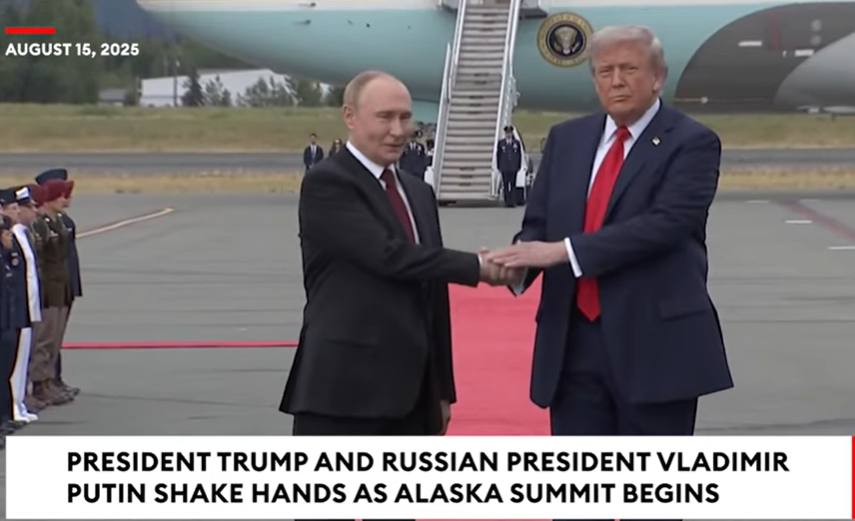
On August 15, 2025, Vladimir Putin and President Trump met in Alaska. One of the key points that followed the meeting was both Trump and Putin discussing a realignment of strategic interests surrounding energy development.
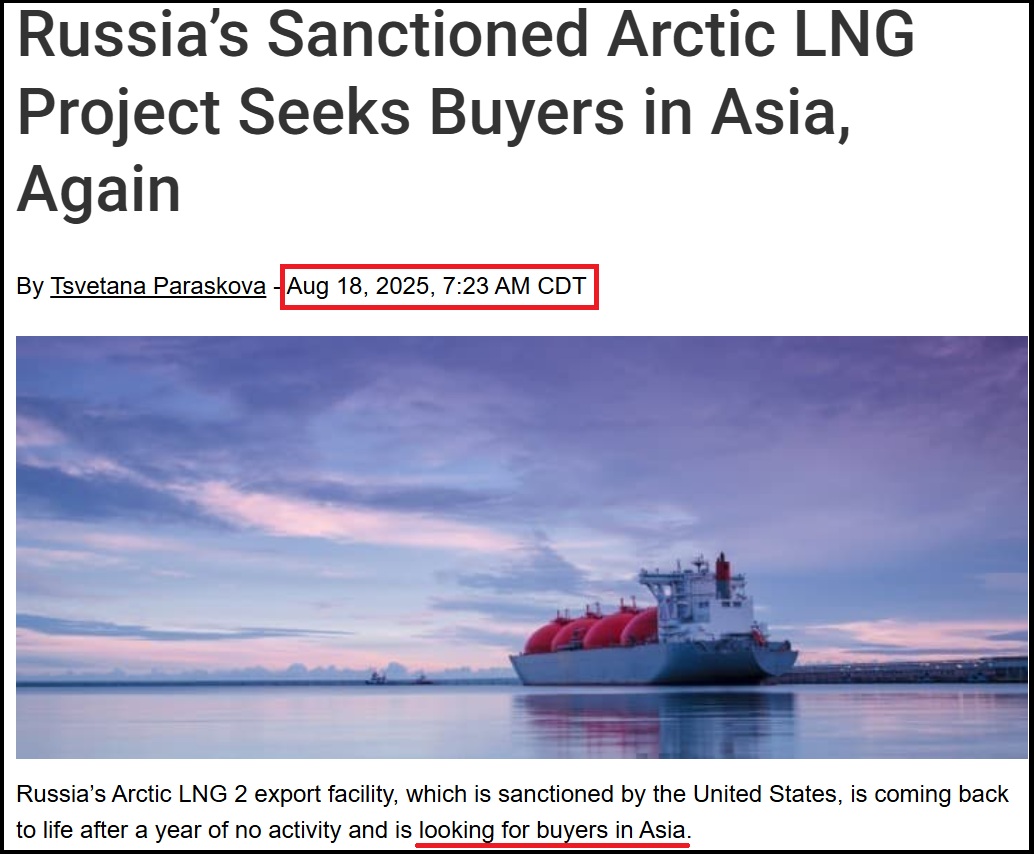
On August 18, 2025, three days after the Alaska meeting:
Two days ago, Treasury Secretary Scott Bessent announced the easing of sanctions against Russian oil/LNG exports, specifically toward Asia in order to relieve some of the global supply constraints. {SOURCE} Yesterday, Moscow announced the redirection of Russian oil/LNG exports to Asia {SOURCE}.
“Our companies are considering opportunities, without waiting for further restrictions from Europe, to conclude new long-term contracts with our partners and redirect some of the gas from Europe to other countries, including India, Thailand, the Philippines and the People’s Republic of China,” Russian Deputy Prime Minister Alexander Novak said.
♦ Before February 28, European Title Transfer Facility (TTF) liquified natural gas traded around 35 euros per megawatt hour. As of March 6, TTF settled at 52.81 euros, a 50 percent monthly surge in the value of LNG to Europe.
Asian Japan Korea Marker (JKM) spot cargoes, the benchmark LNG price assessment, are trading above $20 per million BTU, with Bangladesh paying $28.28 for emergency deliveries.
The difference between Russia selling LNG to hostile Europe or selling Russian LNG to friendly Asia at post gulf crisis premiums is the widest it has been since the post pandemic (2022) ‘Build Back Better” energy crisis.
Russia supplied 13.8 million tonnes of LNG to Europe in 2025. The EU is phasing Russian gas out: short-term contracts banned beginning in April, full LNG ban by year end 2025, pipeline gas fully banned by 2027.
Russia is not fighting the EU bans; Russia is finding new customers at higher prices. Every tonne Russia redirects to Asia before the EU ban was scheduled to begin creates a potential long-term contract at a premium price with a buyer who will not legislate Russia out of the relationship.
Qatar and all shippers and suppliers declared force majeure after Iranian drones struck Ras Laffan facility on March 2, 2026. Approximately 20% of global LNG went offline. Asian buyers are now bidding against Europe for every tanker “on the water.” Russia has a lot of supply on the water and the ability to put a lot more into the market quickly.
Hormuz is closed, at least temporarily, through forced reinsurance withdrawal triggered by the U.K (Lloyds insurance market). And Russia, the one major energy exporter whose supply chains run through neither the Gulf nor the Strait, is the only non-western producer that can deliver to Asia without navigating a war zone.
Right now, Russia is to energy supplies for Asian customers as Amazon was to U.S. consumers during COVID. Both selling to an isolated and captive customer base, who were regulated out of options.
SUMMARY:
(1) Upon reelection President Trump told all U.S. energy providers to “drill baby drill” and maximize energy production. Trump then deregulated the industry for maximum efficiency: Secretaries Burgum (Interior), Wright (Energy) and Zeldin (EPA).
(2) Trump then meets with Putin in Alaska Aug 15, 2025. Three days later, Aug 18, 2025, Putin restarts Russia’s flagship Arctic project, the LNG export facility via the Northern Route to Asia.
(3) President Trump then signs contracts with Finland for the urgent start of Arctic icebreaking ship manufacturing in the USA and emphasizes the prior conversation about taking over Greenland which infuriates the Danes and EU.
(4) President Trump then triggers the Venezuela operation, captures Nicholas Maduro and -in addition to other benefits- forms a new strategic oil development relationship with the interim Venezuela government. Russia stays silent.
(5) President Trump then triggers Operation Epic Fury against Iran; completely changing the geopolitical landscape that surrounds energy partnerships. Energy flows through the Gulf of Oman are impacted.
(6) President Trump then removes specific sanctions against Russia permitting Russian oil and LNG to be sold (in petrodollars) into the Asian market. Meanwhile, the European Union is forced to increase LNG purchases from the United States.
Sure, it could all be just coincidence… or not. One thing is certain, the FIVE-EYES opposition do not think all of this downstream benefit that flows to Russia and the USA is coincidental. The FIVE-EYES opposition see all of this as a strategic realignment between the USA and Russia, and they are going to do everything in their power to stop it.
Now does this sudden news story make sense?
You see that "WP" on the end of it? That's Washington Post.
WaPo is the outlet for the direct CIA shaping narratives. There is usually no truth to the statements as narrated.
The CIA, like the other members of the 5 eyes, wants maximum conflict with Russia at all times. https://t.co/kjiTTlar6A
(Reuters) – “Russia is ready to divert oil to India to offset Middle East supply disruptions, with about 9.5 million barrels of Russian crude in vessels near Indian waters and able to arrive within weeks, an industry source with direct knowledge told Reuters. The source declined to say where the non‑Russian fleet cargoes were originally headed but said they could deliver to India within weeks, giving refiners rapid relief.”
Posted originally on CTH on March 6, 2026 | Sundance
The origin of the latest development goes back several weeks.
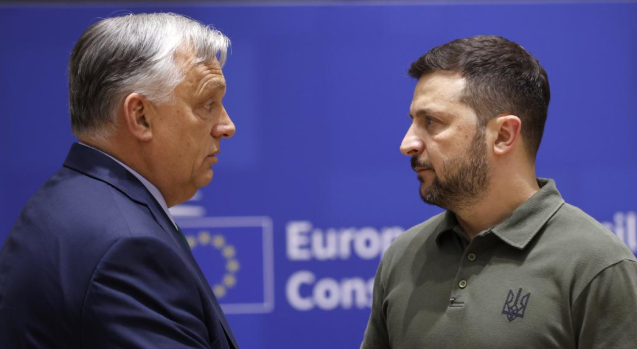
Ukraine (Zelenskyy) was angry at Hungary (Orban) for blocking the €90 billion EU loan (a loan with no payback clause) which was backed by confiscated Russian sovereign wealth funds. A splendidly European financial scheme.
To get back at Viktor Orban, Volodymyr Zelenskyy destroyed an oil/gas pipeline hub in Ukraine that transferred Russian oil to Hungary and Slovakia (Robert Fico).
Hungary and Slovakia were furious, and Zelenskyy said repairs were too complicated to be easily fixed. Viktor Orban and Robert Fico then doubled down on blocking Ukraine funds and Ukraine’s assentation to the EU.
When Zelenskyy was questioned about Hungarian or EU inspectors visiting the site to evaluate the repairs, Zelenskyy said they would not be allowed access.
Zelenskyy further noted when he was told Patriot Missiles were in short supply, he did not get to visit the inventory; implying his lies were similar to lies told by the United States.
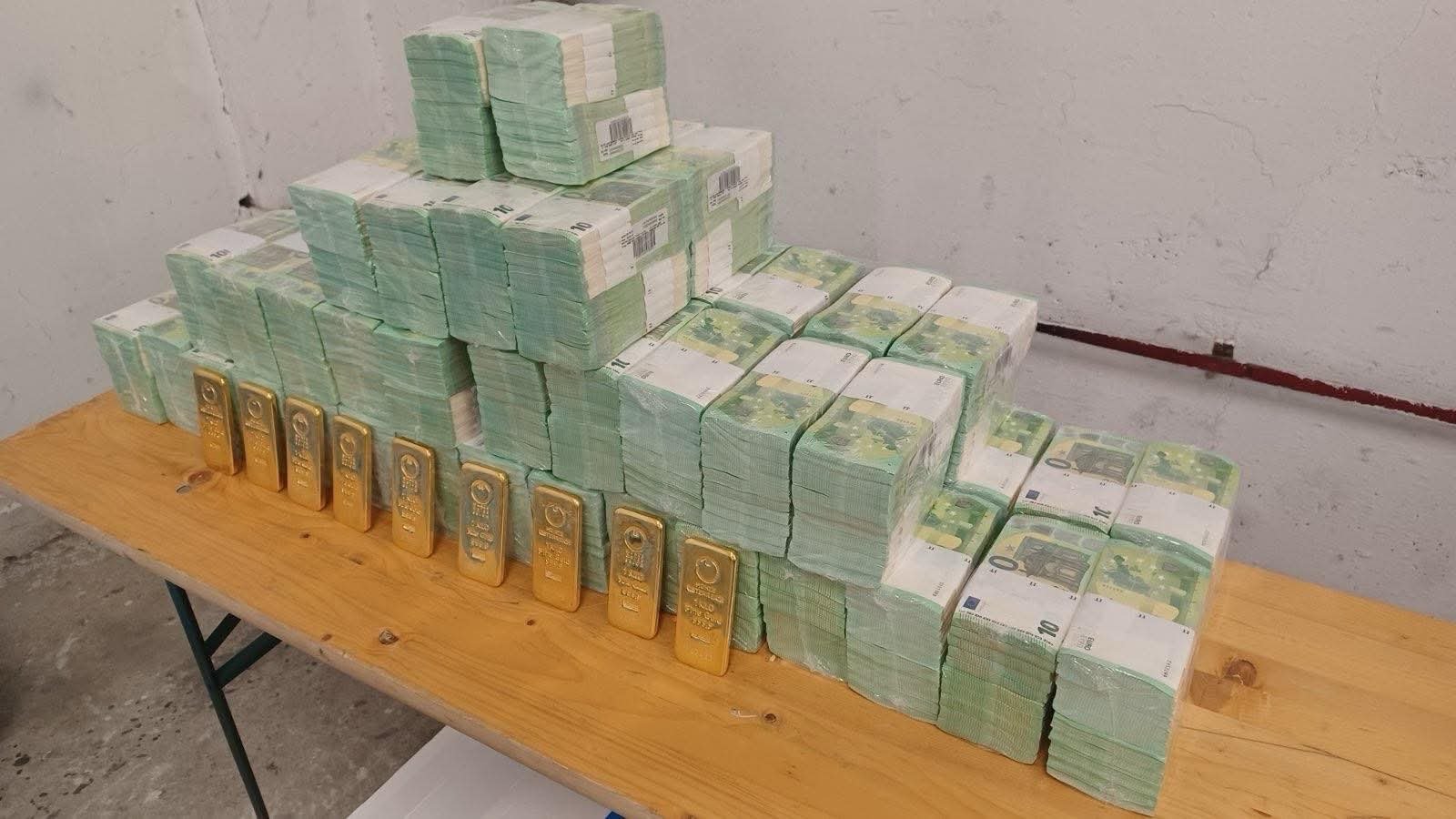
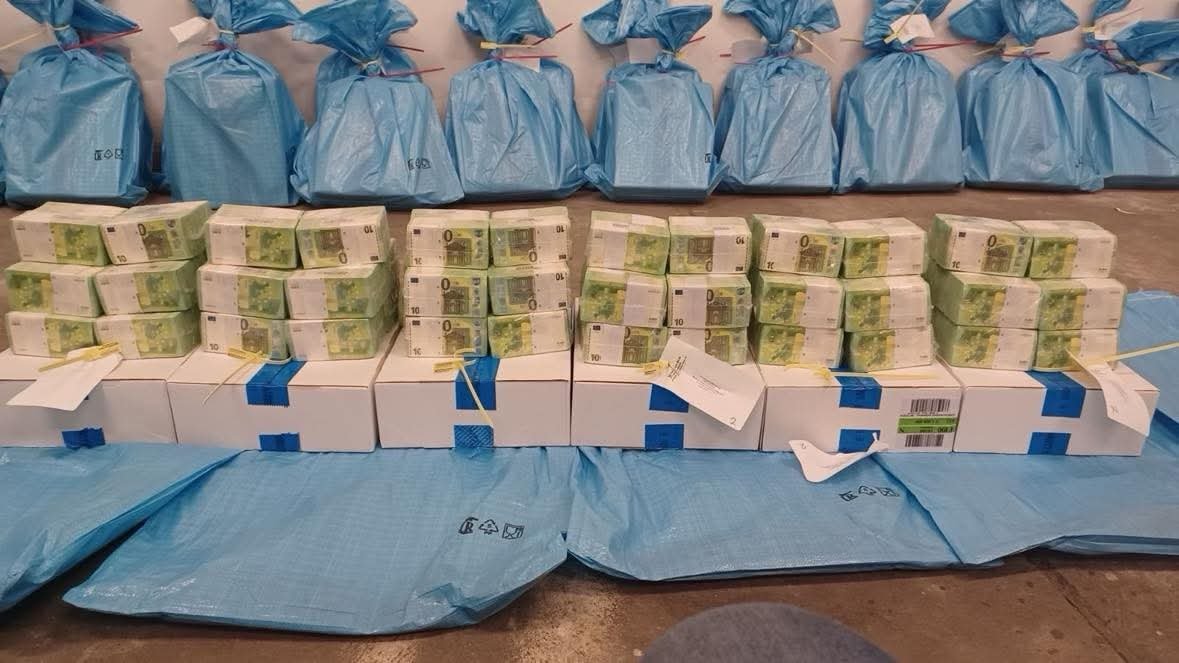
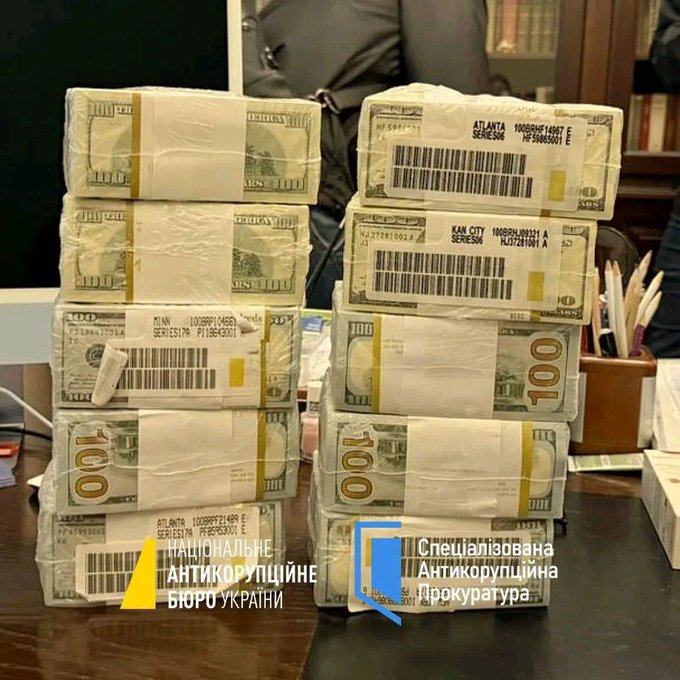
Two days ago, Hungary then intercepted two Ukraine vans carrying $40 million in cash dollars, €35 million in cash Euros, and 9 kg of gold – presumably a money laundering transfer intended to fund Zelenskyy and his intelligence chiefs.
Hungarian Foreign Minister Péter Szijjártó stating that “since January, $900 million and €420 million in cash, as well as 146 kilograms of gold, have been transported across Hungary.”
The shipment apprehended by Hungary included 40 million U.S. dollars as well as 35 million euros and 9 kilograms (19.8 pounds) of gold — worth around $1.5 million at current prices — according to a separate statement by Oschadbank.
Hungary’s National Tax and Customs Administration confirmed Friday that it had detained the Ukrainian citizens and seized the two armored cash-transport vehicles. It added it was conducting criminal proceedings on suspicion of money laundering. {LINK}
Upon hearing of the intercept yesterday, a highly angered Volodymyr Zelenskyy then threatened to send Ukraine “special military operators” to the home of Viktor Orban to extract revenge.
Zelenskyy’s threat caused the European Commission to issue an unusual rebuke of the Ukraine dictator.
“Specifically in relation to the comments made by President Zelenskyy, we are very clear as the European Commission that that type of language is not acceptable. There must not be threats against EU member states,” Commission deputy chief spokesperson Olof Gill told reporters Friday, in a rare condemnation of the leader in Kyiv. {link}
Zelenskyy, with pants down and visibly on fire, now missing all the money/gold, retreats from the originating position that started this mess and says he will repair the oil transfer station he destroyed, if Hungary will permit Ukraine to get the €90 billion loan (not a loan) from the Russian sovereign wealth fund.
[…] After his emotional outburst on Thursday, Zelenskyy said he was ready to repair and restart the pipeline in a month if the EU officially requests it and promises Orbán will unblock the €90 billion loan.
Ukraine is expected to run short of funds by the end of March as it resists Russia’s full-scale invasion, and EU leaders have pledged to cover Kyiv’s financial needs for the next two years — a pressure point the Commission sees as partly explaining Zelenskyy’s anxiety over the veto and potentially prompting his remarks.
Speaking from the podium in the Commission’s Brussels headquarters, Gill urged both sides to cool it. {LINK}
Then…
Trying to give diplomatic western impressions but stuck with the Ukraine Nazi mentality at the forefront and visible, Volodymyr Zelenskyy angrily says he will help U.S. allies with anti-drone technology and strategy, but only if the United States will provide him with Patriot Missile batteries.
[…] ““Our appeal is very simple: we would like to quietly obtain, – from countries we can name and countries we cannot name, – obtain a deficit for ourselves, those Patriot missiles and give them the equivalent number of interceptors. Yesterday I had consultations with everyone: the Commander-in-Chief, the Chief of the General Staff, the Minister of Defense, our military, management, intelligence, and so on. We clearly understood how much we need and how much we can additionally produce very quickly if we have this kind of dialogue with our partners. Aside from that, we will definitely provide expertise — specifically in protecting civilians and oil infrastructure, which, as you can see, affects the entire world. We will definitely provide our expertise.
Posted originally on CTH on February 25, 2026 | Sundance
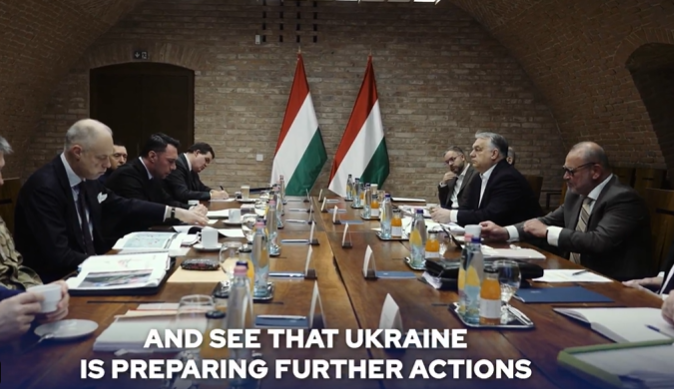
The collective war being carried out by Ukraine and Brussels against Hungarian energy systems is escalating. Hungarian Prime Minister Viktor Orban is now putting military defenses and security forces around critical infrastructure.
ORBAN: We will not give in to blackmail! I have ordered increased security for critical energy infrastructure.
The Ukrainian government is exerting pressure on the Hungarian and Slovak governments through an oil blockade. They will not stop there, as they are preparing further actions to disrupt Hungary’s energy system. Hungary cannot be blackmailed!
We will not give in to blackmail ❗️
I have ordered increased security for critical energy infrastructure.
The Ukrainian government is exerting pressure on the Hungarian and Slovak governments through an oil blockade. They will not stop there, as they are preparing further… pic.twitter.com/bulICvhy1m
Posted originally on CTH on February 21, 2026 | Sundance
The European Union has a major targeting effort against Hungarian Prime Minister Viktor Orban, an ally of President Trump who does not support giving additional funding to the Ukraine war effort. Hungary is having national elections in April.
Previously, USAID Administrator Samantha Power spent considerable time in Hungary organizing activist groups to conduct operations against the government {2023 – Go Deep}. Last week a German based NGO called Democracy Reporting International, won a ruling from a Berlin judge to force the X platform to turn over data related to support for Viktor Orban and the government of Hungary.
All of this opposition to Prime Minister Orban seems to be coordinated by quasi government agencies on behalf of Brussels and their interventionist intentions. We may remember it was also information from German intelligence, that was behind the nullification of the Romanian first-round election {GO DEEP}.
However, Viktor Orban is fighting back and refusing to approve the funding of the Ukraine war despite the massive pressure campaign from inside the European Union.
💶 If the war ends, funding ends. Ukraine’s plan: make sure the war doesn’t stop.
🇭🇺🇨🇿🇸🇰 Thankfully, common sense still prevails in Hungary, the Czech Republic, and Slovakia. We will not risk our families’ future by sending € billions to fund someone else’s war.
As noted by Hungarian Minister Zoltan Kovacs, “Many have asked how Hungary can block the €90 billion Ukrainian war loan if we are not participating in it. clarified that the loan does not affect Hungary and does not entail any financial commitment for us. As Hungary is not part of the cooperation, in most of the decision-making procedures we do not even vote. However, he pointed out that for the scheme to function, the EU’s seven-year budget guarantee rules must be amended – and this requires the approval of all 27 member states, not only the financing member states. We are now blocking this decision, without which the war loan cannot be disbursed.”
(Via Politico) – A court in Germany on Tuesday ordered Elon Musk’s social media site X to hand over data related to the upcoming election in Hungary to researchers for scrutiny.
The court in Berlin ruled in favor of rights group Democracy Reporting International in its bid to access data to research influence campaigns and disinformation in the election. The group took its case to court after X in November refused its data access requests.
The European Union’s rules for social media platforms, the Digital Services Act, obliges big online platforms like X to grant external researchers access to data to scrutinize how platforms handle risks, including election interference. The European Commission in December fined X €40 million for breaching that obligation, as part of a €120 million levy. (read more)
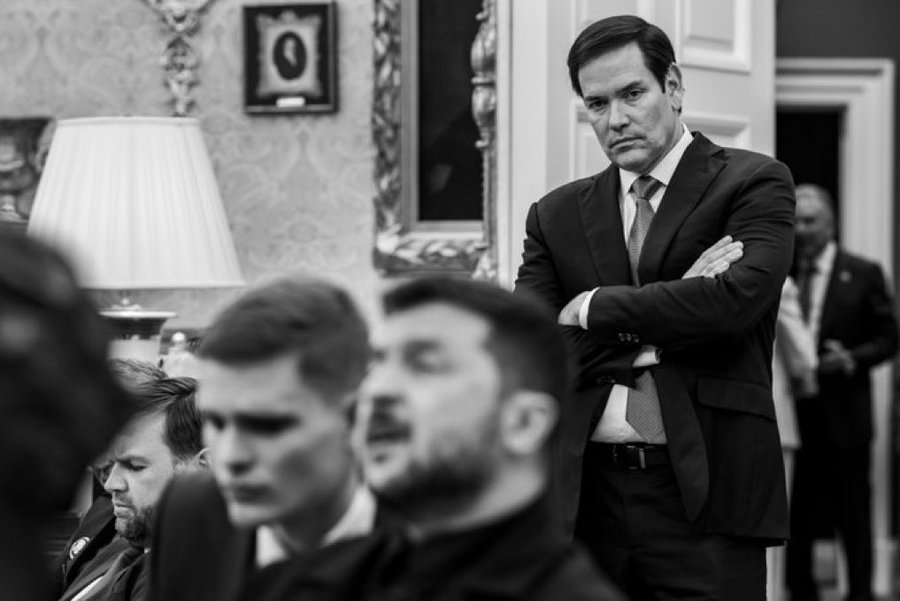
This effort against PM Orban by the European Union is part of the reason why Secretary of State Marco Rubio was so strong in his words of appreciation and support for Orban during his recent visit to Budapest.
RUBIO:“The President has an extraordinarily close relationship to the prime minister. He does. And it has had tangible benefits in our relationship. I’m not going to speculate about the future. What happens in this country is up to the voters of this country to determine and decide, and we love the people of Hungary. But I’m not – but there’s no reason to sugarcoat it. I’m going to be very blunt with you. The prime minister and the President have a very, very close personal relationship and working relationship, and I think it has been incredibly beneficial to the relationship between our two countries.” {Source – Transcript}
Posted originally on CTH on February 16, 2026 | Sundance
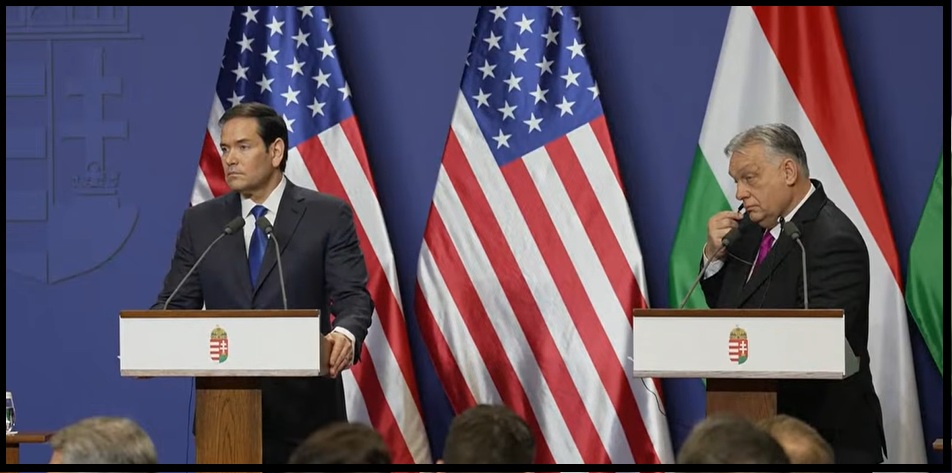
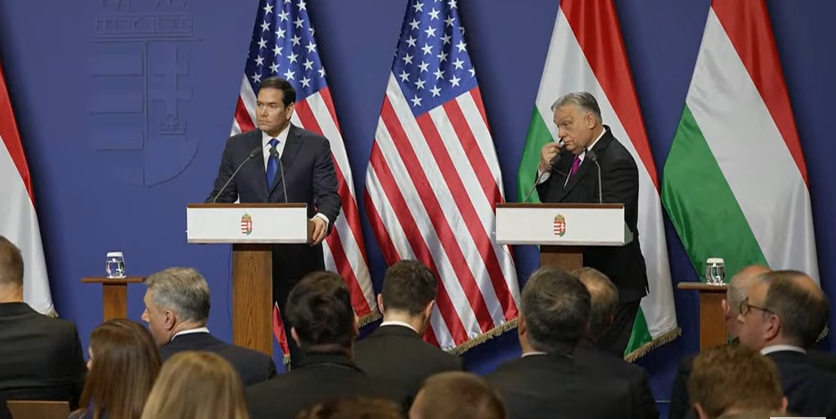
Secretary Marco Rubio went out of his way in this joint presser to emphasize the personal relationship between Hungarian Prime Minister Viktor Orban and U.S. President Donald Trump. Orban is facing a serious election challenge this April and all of the EU/NATO systems are actively trying to create pressure points to remove him.
Secretary Marco Rubio is in Budapest today for meetings with Prime Minister Viktor Orbán and his government to include the signing of a civilian-nuclear cooperation agreement heralded by the Trump administration. Hungary is one of the few voices within the European Union who is pushing back against Brussels efforts to go to war against Russia.
Prime Minister Orban has been very critical of Ukraine, openly stating his opposition to EU membership for the embattled country. In response President Zelenskyy has weaponized Ukraine’s geographical stewardship of oil and gas pipelines to shut down Hungarian energy and drive-up prices. VIDEO:
[Transcript] – MODERATOR: (Via interpreter) Good morning, ladies and gentlemen. May I extend my most cordial welcome to all of you, and may I extend my most special welcome to His Excellency Mr. Marco Rubio, Secretary of State of the United States of America, at the press conference and signing ceremony organized on the occasion of his visit to Hungary. Let me also extend my warm welcome to Mr. Viktor Orban, Prime Minister of Hungary, members of the U.S. and Hungarian delegations, and all our esteemed guests.
At today’s event, the agreement between the Government of the United States of America and the Government of Hungary to facilitate cooperation on the civilian nuclear program in Hungary will be signed. The signatories to the agreement on behalf of the United States of America, Secretary of State Marco Rubio, and on behalf of Hungary, Minister for Foreign Affairs and Trade Mr. Peter Szijjarto.
MODERATOR: (Via interpreter) Thank you very much, gentlemen. And now, may I invite Prime Minister of Hungary Viktor Orban to deliver his statement.
PRIME MINISTER ORBAN: (Via interpreter) Good morning, distinguished ladies and gentlemen, distinguished Mr. Secretary of State. This week starts well. It’s only Monday, and we are already over friendly and very serious discussion with the Secretary of State arriving from the United States of America. We agreed upon this visit with the President of the United States on our visit to the U.S. last November, and I’d like to deliver my heartfelt thanks to Secretary of State to – for visiting Hungary and therefore doing a privilege to Hungary.
We reviewed and overviewed our bilateral relationships. There is a new U.S. President, so I am also adapting to the new expressions. A new golden age has set upon us concerning the relationship between the United States and Hungary. We operate with understatements in the Hungarian language and Hungarian politics, but the situation is that I cannot remember – although for 30-odd years I have been present in politics – when the last time it was that the relationships between the two nations were at such a high level, so balanced and so friendly. So, my heartfelt thanks goes to President Trump.
Perhaps the last time we were near this, when President Bush visited us prior to the change of the political regime, which visit greatly contributed to us doing away with the communists and the Warsaw Pact. Since then, we had better and worse periods in the U.S.-Hungarian relationships, but we’ve never been to this high a level.
Since last year’s January, 17 U.S. investments have been decided upon here in Hungary. This is a decade-long record. And Hungarians can once again travel to the U.S. without a visa – thank you very much, Mr. Secretary of State. Hungary was invited to the Peace Council. The first inauguration meeting will take place in Washington, D.C., this Thursday, perhaps where I shall represent Hungary. And we entered into agreements of key importance in the fields of energy, including oil, gas, and nuclear energy. And these agreements, with the exception provided by the President of United States of America which allows for the use of Russian gas and oil here in Hungary, jointly contribute to the fact that Hungary can continue to remain secure on the aspect of energy supply and that we shall be able to supply households and the industry with cheap energy in an international comparison. And we also discussed the refinery in Serbia, how that can be purchased – NIS – how NIS can be purchased by MOL, the Hungarian oil company.
As for me, I assured Secretary of State Mr. Rubio that Hungary continues to support, regardless of European conflicts (inaudible), Hungary shall continue to support the efforts of peace of the U.S. in Ukraine. The current President of the United States did the most in international politics in order to ensure peace in the Russia-Ukrainian war. And I must reiterate, although everybody knows, that if Donald Trump had been the president of the United States, this war would never have broken out. And if he were not the President now, then we would not even stand a chance to put an end to the war with peace. So, thanks goes to the United States President for his efforts in favor of peace.
Hungary remains ready that if there is a peace summit, that we provide a venue for that here in Budapest, and I assured Mr. Rubio that Mr. Trump has a live invitation to Hungary. Thank you very much, Mr. State Secretary, for the opportunity to enter into discussions today.
MODERATOR: (Via interpreter) Thank you very much, Mr. Prime Minister. Now, may I invite Secretary of the United States of America Marco Rubio to make a statement?
SECRETARY RUBIO: Well, thank you, Mr. Prime Minister, for welcoming us here today. It’s an honor to be with you in this incredibly gorgeous city. It’s my first time being here, and it’s phenomenal, even to be in this hall where – and the history behind it and everything that’s going on here.
The second is the relationship – you talked about the golden age, which is not an exaggeration. The relationship between the United States and Hungary today is as close as I can possibly imagine it being. And it’s not just close rhetorically; it’s close in action and things that are actually happening. And I think some evidence of that is here today in the agreement that we’ve just signed that builds on a historic meeting that we had in November at the White House, that you had with the President and that I happened to be – have the honor to be present and be a part of.
The signed agreement we’ve had today is one that we hope will be many in the years to come in areas of collaboration. You spoke about the 17 investments. To those who think that Hungary is being isolated, that’s an example of the fact that that’s not the case – that under the prime minister’s leadership, in fact, there is a growing number of American companies, as evidenced by the 17 that have already arrived, who want to invest in your economy and want to be a part of what’s happening here and are excited about it – because you have strong leadership, because you have leadership that we know are going to protect investments and allow it to continue to be a place that’s friendly for business, and be competitive with rules that are competitive that allow businesses to grow and prosper in comparison to other places. And there are so many other areas that we can work together on, especially on energy, but just so many areas of common interest.
But I have to say this because it’s important to understand. We are entering this golden era of relations between our countries, and not simply because the alignment of our people, but because of the relationship that you have with the President of the United States. I don’t think it is any mystery – and should not be a mystery to anyone here – how the President feels about you, how he interacted with you in his first term as President, and now in his second term as President that relationship’s grown even closer. And it’s important to understand how important the relations between leaders are to the relations between countries. There is – we are – at the end of the day, we are still human, we are still people, and that person-to-person connection that you’ve established with the President has made all the difference in the world in building this relationship and in hopefully growing this relationship even more.
It is the kind of thing that I think, for example, I can say to you with confidence that President Trump is deeply committed to your success because your success is our success, because this relationship we have here in Central Europe through you is so essential and vital for our national interests in the years to come – that if you face financial struggles, if you face things that are impediments to growth, if you face things that threaten the stability of your country, I know that President Trump will be very interested because of your relationship with him and because of this importance of this country to us, to finding ways to provide assistance if that moment ever were to arise, and obviously with regards to finances and the like.
I also think it’s the reason why, in your visit in November, you saw an extension of – and a suspension of the imposition of sanctions and allowed to move forward on energy. It was because of that personal relationship. It’s because we want you to continue, because we want this economy to prosper, we want this country to do well. It’s in our national interest. Especially as long as you’re the prime minister and the leader of this country, it’s in our national interest that Hungary be successful. It helps America, and obviously it helps you.
So, it’s an honor to be with you here today. We have a lot that we can continue to work on. We also want to thank you, and I want to thank you, on behalf of the President of the United States, for the indispensable role you’ve played on the Board of Peace. Not everyone’s on the Board of Peace, and not everyone – for different reasons they can be participants or not be participants, but you are, and you’ve been there from the very first day. And again, a testament to the personal relationship between President Trump and Prime Minister Orban that I think speaks volumes. The role you play geopolitically, the role you play even outside of this region in affairs involving the Middle East, is invaluable and indispensable, and we are very appreciative of it.
And that’s why after traveling to Munich for the Security Conference, I wanted to make sure we paid a visit here to continue to build on this relationship and to signal very clearly that not only are we in a golden age, but we haven’t even scratched the surface of what we can achieve together as a people – as peoples, as nations, and as leaders. And so I thank you for the opportunity to be with all of you here today, and thank you for the very warm invitation and the very important conversations that we had where we touched on a bunch of subjects and a bunch of topics that I think will be of great interest back in Washington when I return. Thank you.
MODERATOR: (Via interpreter) Mr. Secretary of State, thank you very much. We have some time for questions. Hungarian Television gets the floor.
QUESTION: (Via interpreter) Good morning. I am Laszlo Meszaros. Volodymyr Zelenskyy, president of Ukraine, is constantly attacking Prime Minister Viktor Orban for not supporting the accession of Ukraine. What is your take on this political action, this political attack against a NATO and EU member-state?
PRIME MINISTER ORBAN: (Via interpreter) And who is the question addressed to?
QUESTION: (Via interpreter) Both of you. Both of you, naturally.
PRIME MINISTER ORBAN: (Via interpreter) I don’t wish to drag Secretary of State into Hungarian internal political issues.
(In English) So if you allow me, I start to answer first to this question.
(Via interpreter) The Ukrainians and their president obviously have entered into the Hungarian election campaign. For a while, I was thinking whether we should take that on the wrong note or not. I mean, with such brutal openness entering into the election campaign of another country is not very frequent. You don’t see that often. But then again, I realized it was understandable, because the Hungarian elections is the most important to Hungarian people but it has an impact beyond Hungary as well. And the Ukrainians quite justly believe that what government Hungary shall have is significant to them. And there are only two options.
One is what you knew well – that is the option of the Hungarian people who, at a vote – vote 2025, clearly stated that they would not undertake the Ukraine acceding to the European Union because that would drag us into a war and ruin our economy. And you can also know that we shall not provide money for Brussels in order for them to send that to Ukraine.
The other option, which is a real option, and the Ukrainians would favor that – and with common sense you can realize that if a government arrived which would want or which will accept Ukraine becoming a member of the European Union, they obviously want a government which will take a part in the financial burden of Ukraine – in other words, send money to Ukraine. And for the Ukrainians it does matter what the outcome of the elections will be, therefore they decided to participate in the campaign. And since we stand on the ground of common sense, we must not be surprised at that. We must adapt to it, and we must acknowledge that the Ukrainian president and Ukraine will be an active participant of this election, and we have to prevail against them too. That is our reality. Anything else attached to that – the future of the war, the funding of the war – are beyond the framework of this press conference. I will not go into detail.
I would only return to a single aspect, that this is an election. As an election, people decide. And for Ukraine, it does matter what the outcome of the decision is, and therefore, they put their full weight and weaponry in participating in the Hungarian campaign. We know full well that they fund – finance our opponents. We know how that happens. This is a well-known, written fact.
But once again, we must not be outraged, but we must acknowledge that this campaign in Hungary also has an international dimension – in other directions, too, but in the Ukrainian direction. That is why it’s an important international event, not only for Hungarians, but as the example of the Ukrainians shows, it’s important for other greater nations. That’s how you have to win elections. We have won elections in many ways. Now, we shall win this way.
SECRETARY RUBIO: My only comment is the United States interest is to see the war end, and we want to do what we can to make it end. We’re the only nation on Earth that apparently can get both sides to the table to talk. I’m not here to insult anybody, but the United Nations hasn’t been able to do it. There’s no other country in Europe that’s been able to do it. The United States has been successful at being able to get both sides to talk. I mean, for the first time in a number of years, you have – truly have, at a technical level, military officials from both sides sat down last week in the Middle East. And we’ll restart those talks again in Geneva later this week. I think that’s a very positive thing.
That said, all we are trying to do is play a role, if it’s possible, in reaching a deal. We’re not seeking to impose a deal on anybody. We’re not trying to force anyone to take a deal they don’t want to take. We just want to help them, because we think it’s a war that’s incredibly damaging. We think it’s a war that’s incredibly destructive. We think it’s a war that never should have happened and should end as soon as possible. That’s how the President feels, and the President’s invested a tremendous amount of time and political capital in trying to serve a useful purpose. Usually, in my time observing geopolitics, when a president tries to engage himself in peacemaking and in ending wars, that’s usually applauded.
So, this is one of the few times, for a lot of different reasons – I don’t know what they may be, but maybe I can speculate what they are – where people actually criticize a President trying to end a war. Usually when you’re trying to end wars, the international community applauds you. This is one of the few wars I’ve ever seen where some people in the international community condemn you for trying to help end a war. But that’s what we’re trying to do. That’s what we’re going to continue to do as long as our role is, and our engagement is, a positive one.
And, hopefully, the war will end – the sooner, the better. It should have ended a long time ago. It should have never actually happened. This war should have never happened. This war would have never happened if Donald Trump had been president of the United States at the time it began. But that’s what happened, and so now here we are. So, we’re going to continue to do everything we can to try to bring it to an end. And if we can be successful at it, I think the world will be a better place. And if we can’t, then unfortunately the suffering and the dying and the killing will continue, and that’s not good for anybody, but that’s where we find ourselves. So hopefully we can stop it, but let’s see.
MODERATOR: Next is CBS News. Please, Olivia.
QUESTION: Thank you very much. Budapest is, in fact, beautiful. Mr. Secretary, on the notion of a golden age, why isn’t the United States conditioning deeper cooperation with Budapest on Hungary reducing its extensive and ongoing, deepening cooperation with China, which is a strategic rival for the United States?
Secondly, if, despite President Trump’s endorsement and your visit here, Prime Minister Orban does not succeed and loses the April election, does the U.S. commit to working with his challenger constructively? Prime Minister Orban, do you commit to accepting electoral defeat if it happens?
And to both of you, president – I mean, sorry, Prime Minister Orban has said that the exemption that Hungary has been granted for Russian energy purchases is indefinite. The U.S. has said it was for one year. Which one is it? Thank you.
SECRETARY RUBIO: All right, well, let me start by answering that question. First of all, let me – so everybody can be very clear, I’ve made this point repeatedly. I’ll make it again. Under President Trump, it is our expectation that every nation on Earth is going to act in their national interest. That’s what nations are supposed to do. If the prime minister of Hungary does not act in the national interest of Hungary, he won’t be prime minister for long; but who’s going to act in the national interest of Hungary if their prime minister doesn’t do it? If your government is not acting in your national interest, then who will? By the way, we feel the same way about America.
So, in those instances in which our national interest and some other country’s national interests are aligned, that is an opportunity for extraordinary partnership. And we have many, many areas where our national interests are aligned. Where they’re not aligned or where we have some differences, that’s where that – alignment and the other issues, that’s where this relationship, that’s where these deep ties to one another are so important, because that’s where you can find accommodation. That’s where you can hear each other out. That’s where maybe you can work together on.
But we’re not asking any country in the world to isolate themselves from anybody. We understand that every country in the world has to deal with the reality of their geography, of their economy, of their history, and of the challenges of their future. We will obviously share with partners and friends concerns we may have about certain things. But as an example, the United States – you mentioned China as an example. Okay. We have trade and relations with China. The President of the United States is going to travel in April to China. Why? Because China is a big country. It’s got a billion-something people, second largest economy in the world. They have nuclear weapons. It would be crazy – okay, it’s insane for the United States and China not to have relations and interact with one another.
Now, two big countries like this, do we have differences? We absolutely do, and we’ll have to manage those differences. And some of those differences are things – we’ve spoken very frankly and clearly and repeatedly about the fact that it is not good for the world – it’s not good for anybody – to rely on one country or one economy for 90 percent of anything, especially things like critical supply chains. This is a reality. We want to diversify supply chains around the world. We’ve spoken clearly about it. That’s not an anti-China thing. That’s just the reality that over-dependence on one source is not good, and especially when there’s been a willingness in the past to use it as leverage against each other.
But we expect – we pursue these things within the context of the U.S. national interest. And that’s why we met with the Chinese in South Korea earlier in the year and were able to reach an understanding on some trade matters. That was a mutual interest between us and them. So, geopolitics is difficult because it requires a little bit of maturity and seriousness, okay? It requires a little bit of seriousness about these things have real implications, and the balancing of relations between nation-states requires maturity and seriousness.
So, our relationship here, you asked the last question about it. Look, I’m just telling you guys what it is, okay? The President has an extraordinarily close relationship to the prime minister. He does. And it has had tangible benefits in our relationship. I’m not going to speculate about the future. What happens in this country is up to the voters of this country to determine and decide, and we love the people of Hungary. But I’m not – but there’s no reason to sugarcoat it. I’m going to be very blunt with you. The prime minister and the President have a very, very close personal relationship and working relationship, and I think it has been incredibly beneficial to the relationship between our two countries.
QUESTION: The sanctions waiver, sir? Is it a year?
SECRETARY RUBIO: What’s that? I’m sorry.
QUESTION: The sanctions waiver on Russian energy purchases?
SECRETARY RUBIO: Yeah, but here’s the way I would couch that. Those sanctions waivers happened, as much as anything else, because of the relationship between the prime minister and the President. And so I think all I can tell you is that’s the – that relationship and the importance of that relationship, and the importance of that relationship to our bilateral relationship, underpins the decision the President made and, I think, will continue to underpin it as long as that relationship is a factor in our bilateral relations.
PRIME MINISTER ORBAN: Thank you very much, Your Excellency. So, to answer to your question, for those who are relatively young, it’s difficult to know the Hungarian modern political history. But if you look at it carefully, you see that I’m not just registered as the longest-serving prime minister in Europe, which means 20 years, but I’m the longest-serving leader of the opposition with 16 years. So, I spent 16 years as leader of opposition. What does it mean? It means that sometimes I lose, sometimes I win. So don’t afraid what will be if we are not winning, because it’s regularly happened here at least four times already. So, there is no need to be afraid what will happen in Hungary.
The Hungarian democracy is very strong, and the government of this country is very strongly believe on democracy and competitiveness and competition in politics as well, as we have done in the last 35 – 35 years. So, our record is very strong on the governmental side and on opposition side as well. So, a government will be created after the election in Hungary based on the intention of the Hungarian people, and Hungary as a country will remain strong anyway.
MODERATOR: (Via interpreter) Thank you very much. Now Index is up next.
QUESTION: Good morning. I’m Balazs Karóczkai from Index. I will ask my question in English because I think it’s easier for you. So —
SECRETARY RUBIO: (Inaudible) in English than in Hungarian, absolutely. You can ask it in Spanish, and that’s – maybe Italian I might be able to pick it up too, but —
QUESTION: Unfortunately, my Spanish is not so good.
SECRETARY RUBIO: (Laughter.) Okay.
QUESTION: So, Mr. Prime Minister, you mentioned the invitation of President Trump. I have a question for both of you. Is there – have been any discussion regarding a potential visit by President Trump? And if so, when might it take place, and will it be a peace summit? And a brief question is: Have there been any progress toward new Hungarian-U.S. tax treaty? Because the last one is terminated on two years ago. Thank you.
SECRETARY RUBIO: Yeah. On the visit, I don’t have any news for you on it today other than I know the President would love to come and I know the President would love to be here. Obviously, like any world leader, there’s a lot of balancing going on, but we’ll see what happens. I mean, the President has made very clear his feelings about the prime minister, both on a personal and on a political level in terms of the relationship and the impact it’s had on us. And so, I’m certainly here today because I wanted to make sure that, having been in Munich for the Security Conference, being so close by, we saw an opportunity to be here today and build on that historic gathering that we had. I don’t have any updates for you on the tax treaty per se today, but we may soon. It’s something we’ll look at.
PRIME MINISTER ORBAN: (Via interpreter) And if you’ll allow it, I’ll answer in Hungarian. So, in Hungarian, all I’d like to say is that it’s not worth planning in the distant future in current politics. I mean, the fact that this Thursday we will meet in Washington, D.C., with the President of the United States was not in our calendar two weeks ago. What I’m trying to say is that events take place and the current of international politics is that significant changes can take place in three or four days. For instance, when the first meeting was called for the establishment of the Board of Peace in Sharm El-Sheikh, you could only know that three or four days in advance.
So, in international politics, it is not long-term planning, but short-term response is what is a real virtue. And the Americans are very good at that. So, the fact that we don’t know anything for certain now does not mean that it will not happen. In fact, it might mean the exact opposite. The less we know anything certain about something, the more possible it might happen. Thank you.
MODERATOR: (Via interpreter) Thank you. And the last question is for Reuters.
QUESTION: Thank you, Mr. Secretary. Good to see you. Mr. Prime Minister. Just two questions, Mr. Secretary. Iran is pursuing a nuclear agreement with the U.S. that it says would deliver economic benefits for both sides. Is that acceptable for the U.S., even if it doesn’t cover Tehran’s ballistic missile program?
Recently a U.S. immigration judge has ruled that there were no grounds to deport Tufts University student who wrote an op-ed on Gaza. A second judge said using deportation as a threat violated the First Amendment rights of people like her because those rights apply to foreigners. What is your response to that?
And, Mr. Prime Minister, I just wanted to follow up on the China angle. Secretary just spoke about balancing relationships. You’ve been pushing a lot for more Chinese investments in Hungary. How will you make sure that that does not create a problem in your relationship with Washington? Thank you.
SECRETARY RUBIO: Yeah, on the two questions you asked, first of all, on the particular case of the student, look, my job at the State Department is if I identify someone who I believe is present – someone who’s not – who’s a visitor, a guest to the United States, and we identify that their presence in our country poses a threat to our foreign policy, to our national security, we’re going to take that person’s visa away. We’re going to take their visa away. That’s what we’re going to do. We’ve done that – in a lot of cases over the last year, we’ve done it.
Fact is that visas are not a right. I’ve said this repeatedly. I don’t know why it’s so hard for some to comprehend it, so let me repeat it again. A visa – no one’s entitled to a visa. There is no constitutional right to a visa. Okay, a visa is a permission to enter our country as a visitor. If you enter our country as a visitor, and as a visitor in our country – be it a student, a tourist, a journalist, whatever you want to be – and you undertake activities that are against the national interest and national security of the United States, we will take away your visa. In fact, if we knew you were going to do it, we probably wouldn’t have given you your visa.
That’s what we do. The decision to remove someone from our country after we take away our visa, that belongs to other agencies of our government. As far as judges are concerned, judges – that’s a different branch of government. They’re not going to tell us how to conduct the foreign policy of the United States. If they have an issue with the process by which someone was removed, then obviously that’s an issue for other agencies in our government that are involved in enforcing that. All I can opine to you on is the – is taking away someone’s visas. And no judge is going to tell the Executive Branch how to conduct foreign policy because that’s not up to judges. That’s up to the Executive Branch.
On your first question about Iran, look, doing a deal with Iran is not easy. I said it yesterday; I’ll repeat it again today. I mean, we have to understand that Iran ultimately is governed and its decisions are governed by Shia clerics – radical Shia clerics, okay? These people make policy decisions on the basis of pure theology. That’s how they make their decisions. So, it’s hard to do a deal with Iran. We’ve always said it’s hard, but we’re going to try. That’s what the President is trying. I’m not going to prejudge those talks. I’m certainly not going to negotiate with Iran here in front of the press and on the stage. Our negotiators are on their way there now. They’ll have meetings. We’ll see what happens.
We’re hopeful there’s a deal. The President always prefers peaceful outcomes and negotiated outcomes to things. He’s a President that’s shown his willingness to talk to anyone and meet with anyone. And I think if there’s an opportunity here to diplomatically reach an agreement that addresses the things we’re concerned about, we would be very open and welcoming to that. But I don’t want to overstate it either. It’s going to be hard. I mean, we’re dealing – it’s been very difficult for anyone to do real deals with Iran because we’re dealing with radical Shia clerics who are making theological decisions, not geopolitical ones. But, let’s see what happens. I hope it works out; we all hope it works out.
PRIME MINISTER ORBAN: (Via interpreter) I can answer in Hungarian, right? There is a fact that we must take into consideration in every international relationship of ours as an (inaudible), and that is that we are members of NATO. This means that in the field of security issues, that determines the boundaries of cooperating with others. In fact, in security issues, Hungary only cooperates with NATO member-states. Anything beyond that, including commerce, trade, we are in favor of cooperating with as many entities as possible. And if our cooperation does not – is not liked by any of our partners, disliked by them, they will indicate that to us. And if they do so, we shall discuss the matter.
I have been working together with Americans for over 30 years now. President Bush, Sr., was the first president I met. I don’t know how many I’ve met since, and I do have an experience pertaining to Americans. It is best if you share with them everything openly and clearly. We play with open cards – open, visible cards. Our partnership is built upon clear speech, and if we do not like anything, we tell our partner. And if the Americans don’t like anything, they will share that with us.
And I can report to you that since there is a new President, there is not one single point of conflict. I have never come across any of those in the field of our cooperation with the United States. That was not the case, previously. When we had a Democrat administration, we had multiple conflicts. We still openly represented our position, but we could not cooperate with that administration. We can with the current one.
But one thing has unchanged: Hungarians always say what they want, for what reason, what they object against, what they can support, and what they ask. We are a reliable partner because we are open. We are in favor of open, clear speech. And as I observe the current President of the United States, he represents the same school. He is very straightforward. He says what is the interest of the United States of America. There are no taboo issues. We can discuss any issue, including the issue of China and any other issue. And I think that is to the best.
MODERATOR: (Via interpreter) Mr. Secretary of State, Mr. Prime Minister, thank you very much. This concludes our press conference. Thank you very much for being with us today. I wish you a pleasant remaining part of the day. Goodbye.
Posted originally on Feb 10, 2026 by Martin Armstrong |
Hungary’s Viktor Orban declared that anyone attempting to dismantle his nation’s energy supply is an “enemy.” “Anyone who says this is an enemy of Hungary, so Ukraine is our enemy,” he said. Furthermore, Orban believes it is not in his nation’s best interest to permit Ukraine to join the European Union. “Hungarians should not want military or economic cooperation with Ukrainians, because they are dragging us into war.”
Orban’s comments are not some sudden outburst of nationalist rhetoric. It is the inevitable consequence of Europe’s self-inflicted energy war and the refusal of Brussels to confront economic reality. Hungary, like Slovakia, was built on the assumption of stable, inexpensive Russian oil and gas. Entire industrial systems, pricing structures, transportation networks, and household energy models were engineered around that reality for decades.
When Brussels decided it could simply erase Russian energy from the European economy by decree, it condemned countries like Hungary and Slovakia to economic stress that Western Europe is insulated from. Germany can pretend to moralize while subsidizing collapse; smaller states do not have that luxury.
Ukraine’s push to terminate Russian energy transit through its territory was celebrated politically, but economically, it was devastating for Central Europe. Slovakia lost critical transit revenues overnight, while Hungary was forced into higher-cost alternatives. Ukraine’s actions, combined with EU sanctions, have directly threatened Hungary’s economic stability.
The European Union created this conflict by pretending that energy is merely a moral issue rather than the foundation of modern civilization. You cannot shut down reliable supply chains and replace them with slogans, windmills, and press conferences. Energy shortages translate directly into inflation, declining real wages, collapsing manufacturing, and rising civil unrest. That is precisely what we are witnessing across Europe.
Posted originally on CTH on January 27, 2026 | Sundance
The headline is the reality of the thing.
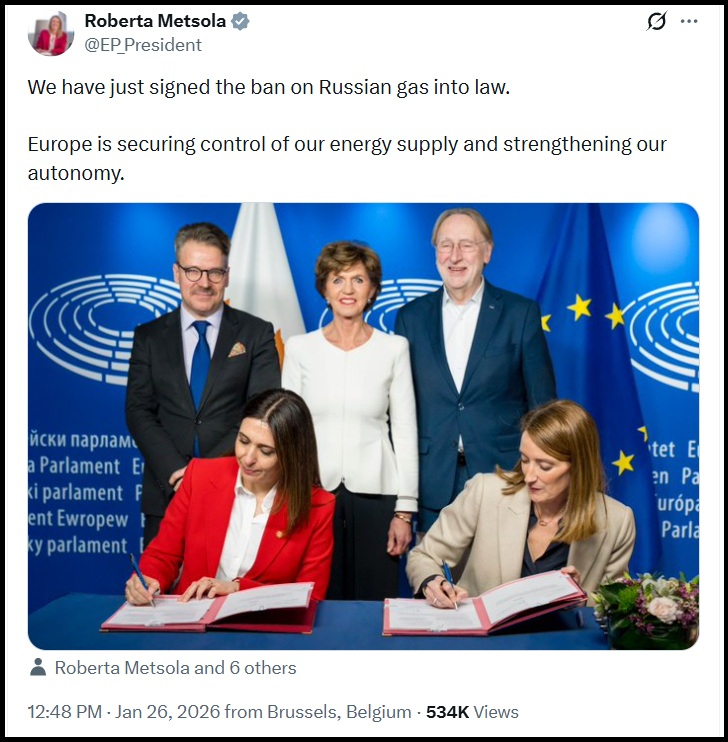
In order to make themselves feel better, the European Union is now banning the EU countries from purchasing discounted Russian oil and gas directly. Instead, the EU will force their assembly to purchase Russian oil and gas from India at a premium. The EU is still buying Russian oil and gas; however, paying more, they believe, will work out better for them in the long-term. Go figure.
The actual target of this oil and gas ban is the nation of Hungary, who as a landlocked nation is dependent on the gas from Russia. The EU ban expressly hurts the position of Hungary because Hungarian Prime Minister Viktor Orban has refused to kneel to the dictates of Brussels.
Prime Minister Orban has vowed to sue the European Parliament over the ban. The lawsuit will likely be supported by other EU countries who understand the stupidity of paying India for what amounts to a brokerage fee to deliver the same oil and gas.
🇺🇸🇪🇺🇷🇺🇮🇳 "We have put 25% tariffs on India for buying Russian oil. Guess what happened last week? Europeans signed a trade deal with India. Russian oil goes into India, the refined products come out, and Europeans buy the refined products."
Posted originally on CTH on November 14, 2025 | Sundance
Hungarian Prime Minister Viktor Orban has had enough. The European Union is consistently targeting him for his position against the Russia-Ukraine conflict, and western elements of the intelligence apparatus have been trying to undermine Orban’s government for years.
Against the most recent revelations of direct corruption connected to the government of Ukraine President Volodymyr Zelenskyy, Orban says, “enough.”
Prime Minister Orban – “The golden illusion of Ukraine is falling apart. A wartime mafia network with countless ties to President [Zelensky has been exposed. The energy minister has already resigned, and the main suspect has fled the country.
This is the chaos into which the Brusselian elite want to pour European taxpayers’ money, where whatever isn’t shot off on the front lines ends up in the pockets of the war mafia. Madness.
Thank you, but we want no part of this. We will not send the Hungarian people’s money to Ukraine. It can be put to far better use at home: this week alone we doubled foster parents’ allowances and approved the 14th month’s pension.
Anyhow, after all this, we certainly won’t give in to the Ukrainian president’s financial demands and blackmail. It’s high time Brussels finally understood where their money is really going.” [SOURCE]
PM Orban and President Donald Trump are allies and personal friends. No doubt they both spoke about this.
Posted originally on CTH on November 7, 2025 | Sundance
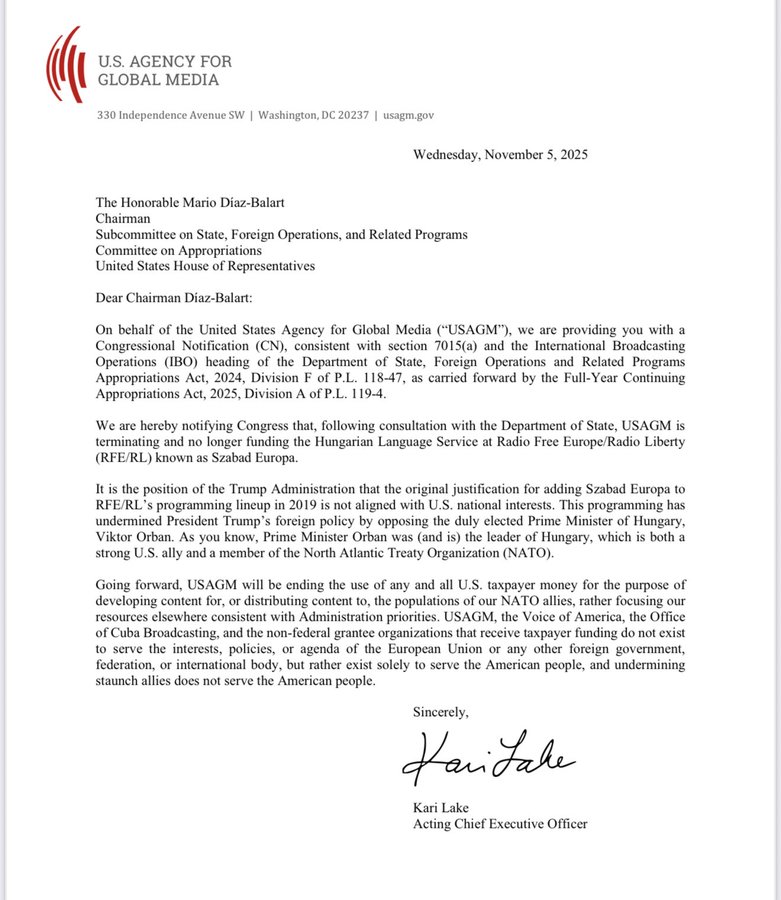
Acting Director of the U.S. Agency for Global Media, Kari Lake, has notified congress that she is ending the taxpayer-funded EU/Globalist operation known as Szabad Europa. This is the Hungarian Language Service at Radio Free Europe/Radio Liberty, funded by the U.S. State Dept and USAID, which has been attacking and trying to destabilize Hungary’s government led by Prime Minister Viktor Orban.
Acting Director Kari Lake sends a Congressional Notification to House and Senate Appropriations Committees, House Foreign Affairs, and Senate Foreign Relations:
“It is the position of the Trump Administration that the original justification for adding Szabad Europa to RFE/RL’s programming lineup in 2019 is not aligned with U.S. national interests. This programming has undermined President Trump’s foreign policy by opposing the duly elected Prime Minister of Hungary, Viktor Orban. As you know, Prime Minister Orban was (and is) the leader of Hungary, which is both a strong U.S. ally and a member of the North Atlantic Treaty Organization (NATO).”
Mrs Lake goes on to note the U.S taxpayer-funded operations targeting NATO and EU allies will stop. This is a positive step toward removing the ability of the USG shadow operators to control EU election outcomes. Brussels will have to pay for their own EU influence operations.
In early April 2022, Hungarian Prime Minister Viktor Orban was overwhelmingly reelected {LINK}, despite the massive efforts against him by the European Union, western and euro-centric multinational globalists. As a result of the victory, Brussels was furious at the Hungarian people. Associated Press – […] “Orban — a fierce critic of immigration, LGBTQ rights and “EU bureaucrats” — has garnered the admiration of right-wing nationalists across Europe and North America.” (link)
Within the statements reported from his 2022 victory speech, Prime Minister Orban warned citizens of the NATO and western allied countries about the manipulation of Ukraine and how he views the Zelenskyy regime: […] “while speaking to supporters on Sunday, Orban singled out Zelenskyy as part of the “overwhelming force” that he said his party had struggled against in the election — “the left at home, the international left, the Brussels bureaucrats, the Soros empire with all its money, the international mainstream media, and in the end, even the Ukrainian president.” (link)
That speech put Hungarian Prime Minister Viktor Orban in the crosshairs of the western alliance, specifically the EU and U.S. bureaucrats within the USAID who use their power, position and intelligence apparatus to manipulate foreign nations. A year later USAID Administrator Samantha Power showed up in Hungary openly discussing her seeding of the NGO’s and political activist systems in order to generate yet another color revolution. {Direct Rumble Link} – WATCH:
Samantha Power, the wife of Cass Sunstein, was well known as the Obama/Biden administration’s advance operative who used her position in U.S. government to influence activism in targeted nations. Hungary was then her target.
The World Economic Forum and NATO/Western Alliance cannot permit a nation to stand on principles of nationalism. Allowing a point of contrast that would showcase the weakness of globalism and multiculturalism, especially one with an open Christian perspective, was something the western control system just could not permit.
As a result, Samantha Power, the U.S. State Dept (USAID) and the CIA, began running an operation in Hungary, seeding the groundwork for the next color revolution. Their hubris was so strong, they didn’t even try to hide it.
The EU is going to have to try it alone next time.
I have created this site to help people have fun in the kitchen. I write about enjoying life both in and out of my kitchen. Life is short! Make the most of it and enjoy!
This is a library of News Events not reported by the Main Stream Media documenting & connecting the dots on How the Obama Marxist Liberal agenda is destroying America



 Centinel2012