President Trump Responds to the 91-Drone Attack on Putin’s Residence in Novgorod region


Posted originally on CTH on December 30, 2025 | Sundance

During an impromptu press availability beside Israeli Prime Minister Benjamin Netanyahu, President Trump responded to a question about a drone attack against the personal residence of Russian President Vladimir Putin.

President Trump noted that he was informed of the attack by President Putin during an early Monday phone call between the two leaders.

According to Russian media, confirmed by Russian foreign Minister Sergey Lavrov, Putin’s presidential residence in the Novgorod region, more than 400 kilometers (249 miles) northwest of Moscow, was targeted by 91 drones. Russia has vowed retaliation saying, “targets had already been selected.” President Trump’s response is prompted below:

Ukraine President Volodymyr Zelenskyy has denied the accusation that Ukraine carried out this particular attack.  The attack took place while Zelenskyy was in Florida meeting with President Trump.

In context, there have been several attacks against Russia timed with negotiations.  CTH has noted that each instance of closer agreement during Russia/Ukraine negotiations (Turkey) or U.S/Ukraine negotiations (Turkey and Paris) there have been attacks into Russia that seemed to carry a motive from an external third party.

U.S. media have said the attack on Putin may be a lie; however, with physical evidence from the defense operation, it is less likely Russia just made up the attack.  At this moment in the conflict, Putin doesn’t need domestic propaganda.

CONTEXT: British intelligence previously confirmed their participation in the successful Ukraine drone attack against long-range Russian bombers.  That operation, highly controversial at the time, was previously confirmed by President Trump saying the U.S. was not informed in advance.

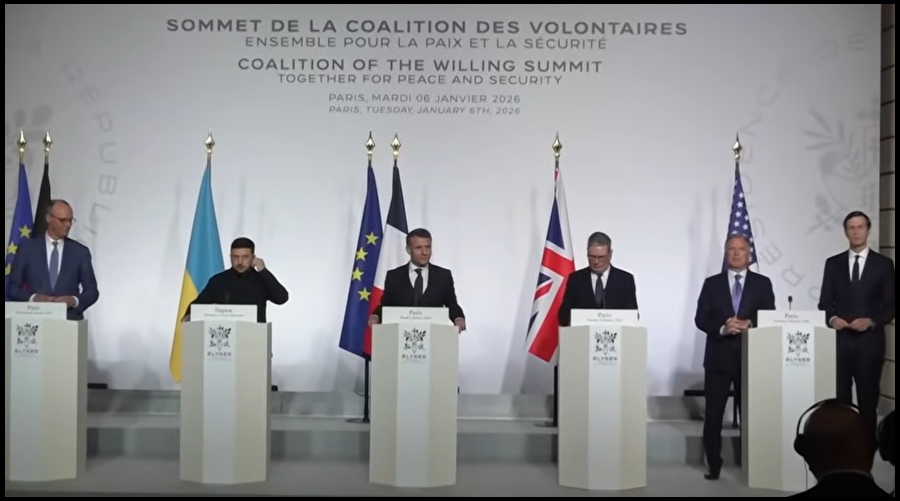
The “coalition of the willing” has also expanded.  Outside the Ukraine regime, the current group making up the “coalition of the willing” includes: the U.K, France, Germany, Canada and Australia.  It is worth noting the additions are all part of the British commonwealth (U.K, Canada, Australia).

Most observers note that Ukraine President Zelenskyy is not an independent actor in the warfare decisions as carried out from within Ukraine itself. In fact, British intelligence has now replaced U.S. intelligence for providing the majority of the satellite guidance systems, targeted systems and missile operations.  German and French intelligence have been closely coordinating with the U.K. on behalf of European Union stakeholders.

Europe, specifically the British MI6 intelligence service, have recently espoused their #1 priority is to defeat Russia using the proxy that Ukraine provides.

So, with full context applied it is entirely likely that both Vladimir Putin and Volodymyr Zelenskyy are not lying.

The most likely scenario is that U.K elements inside Ukraine again used the opportunity of the Trump-Zelenskyy negotiation meeting to carry out the attack against Russian President Putin.  The motive is obvious.

Beyond the ideological component, the economies of the U.K/EU are now increasingly dependent on their defense spending as was recognized yesterday with the severe contraction of the German economy in almost all sectors except those supported by defense spending.

An end to the Russia/Ukraine conflict is against the interests of the “coalition of the willing.”   Additionally, an ancillary motive for the U.S. group who support the EU effort is to keep President Trump bogged down.

(Bloomberg) — President Donald Trump’s campaign to end the war in Ukraine faced new complications on Monday when Vladimir Putin said he would revise his country’s negotiating position after the Russian leader claimed Ukrainian drones targeted his residence.

Putin told Trump of his decision in a call Monday, according to the Kremlin, even as Kyiv cast the Russian allegations as a fabrication aimed at derailing the peace process.

Trump addressed the dispute while speaking to reporters in Florida, saying that Putin had told him about the purported attack during their discussion. The US president, seeming to side with Putin, said he was “very angry.”

“It’s one thing to be offensive, because they’re offensive,” Trump told reporters in Florida. “It’s another thing to attack his house. It’s not the right time to do any of that.”

Ukrainian President Volodymyr Zelenskiy has dismissed the Russian claims as a “new lie” and warned that Moscow could be using it as an excuse to prepare an attack on government buildings in Kyiv.

Putin said Moscow intends to work closely with the US on peace efforts but would reconsider a number of previously reached agreements, Kremlin aide Yuri Ushakov told Russian newswires. Ushakov added that Putin assured Trump that Moscow would look to continue working with American partners to achieve peace and that the two leaders agreed to maintain their dialogue. (more)

I suspect the British did it.

Memos of Conversations Between George W. Bush and President Vladimir Putin Are Released


BUMPED Due to Importance:

Posted originally on CTH on December 29, 2025 | Sundance |

Following a series of FOIA lawsuits, memos from conversations between Russian Federation President Vladimir Putin and former US President George W. Bush have been released online by the National Security Archive. [Original Source Here]

I know it’s Christmas, but bookmark or review as time allows, because the content is very interesting and very important. As early as 2001 and 2008, President Putin clearly told President Bush of his opposition to Ukraine’s accession to NATO, along with other key positions.

Despite what popular media might say, these are NOT full transcripts. Rather, they are memos containing quotes from both leaders as they discuss geopolitical relations between the U.S. and Russia. [SOURCE HERE]

♦ June 16, 2001 – Memorandum of Conversation. Subject: Restricted Meeting with Russian President Vladimir Putin. [LINK HERE] In this first personal meeting at the Brno Castle in Slovenia Vladimir Putin and George W. Bush express respect for each other and desire to establish a close relationship. Putin tells Bush about his religious beliefs and the story of his cross that survived a fire at his dacha. In a short one-on-one meeting they cover all the most important issues of U.S.-Russian relations such as strategic stability, ABM treaty, nonproliferation, Iran, North Korea and NATO expansion. Bush tells his Russian counterpart that he believes Russia is part of the West and not an enemy, but raises a question about Putin’s treatment of a free press and military actions in Chechnya. Putin raises a question of Russian NATO membership and says Russia feels “left out.” [READ MEMO HERE]

♦ September 16, 2005: Document 2 – Memorandum of Conversation. Subject: Vladimir Putin, President of the Russian Federation: [LINK HERE] Putin meets the U.S. President in the Oval Office for a plenary that covers mainly issues of nonproliferation and U.S.-Russian cooperation on Iran and North Korea. The conversation shows impressively close positions on Iran and North Korea, with Putin presenting himself as an eager and supportive partner. Bush tells Putin “we don’t need a lot of religious nuts with nuclear weapons” referring to Iran. Putin said that Ukraine’s accession to NATO would, in the long term, create a field of conflict between Russia and the United States, adding that internal divisions within Ukraine could lead to its fragmentation. [READ MEMO HERE]

♦ April 6, 2008 – Document 3: Memorandum of Conversation. Subject: Meeting with President of Russia [LINK HERE] This is the last meeting between Putin and Bush, taking place at Putin’s residence in Bocharov Ruchei in Sochi on the Black Sea. The tone is strikingly different from the early conversations, where both presidents pledged cooperation on all issues and expressed commitment to strong personal relationship. This meeting takes place right after the NATO summit in Bucharest where tensions flared about the U.S. campaign for an invitation to Georgia and Ukraine to join NATO. Turning to conversations in Bucharest, Putin states his strong opposition to NATO membership for Ukraine and Georgia and says that Russia would be relying on anti-NATO forces in Ukraine and “creating problems” in Ukraine “all the time,” because it is concerned about “threat of military bases and new military systems being deployed in the proximity of Russia.” Surprisingly, in response, Bush expresses his admiration for the Russian president’s ability to present his case: “One of the things I admire about you is you weren’t afraid to say it to NATO. That’s very admirable. People listened carefully and had no doubt about your position. It was a good performance.” [READ MEMO HERE]

2001 –  Putin raises a question of Russian NATO membership and says Russia feels “left out.”

As noted by The Islander (Via Twitter) –  “The 2001 Memo That Should Have Ended the Cold War 2.0 and Instead Helped Write the Preface to Ukraine. There are documents that don’t merely record history, they expose it. This is one of them.

June 2001. A “restricted meeting” between President George W. Bush and President Vladimir Putin. Not a podium performance, not a television soundbite, not a speech crafted for domestic applause. A private conversation, the place where empires are supposed to speak plainly, where leaders test ideas that could reroute decades.

And what does the memo show?

Putin raises the idea that Russia could eventually join NATO. He says Russia feels “left out” by NATO enlargement. He points to an older fact most Western publics were never meant to internalize: the Soviet Union applied to join NATO in 1954. He argues the reasons for rejection no longer apply. He suggests, almost clinically, that perhaps Russia could be an ally — “European and multi-ethnic,” comparable in character to the United States.

Read that again slowly.

Because the propaganda version you’ve been fed for years requires amnesia: it requires you to believe Russia woke up one morning and decided to be “a threat,” as if geopolitics is a mood swing and security architecture is irrelevant.

But here is the declassified record: Russia was probing for an exit ramp. A pathway into a shared system. A new security architecture. A post–Cold War settlement that could have turned the 1990s from a hollow victory lap into a durable peace.

And it didn’t happen.

Not because it was impossible. Not because Russia “never wanted it.” Not because “the West tried everything.”

It didn’t happen because NATO, as an institution, does not know how to live without a frontier. It does not know how to justify itself without an adversary. It does not know how to maintain internal cohesion without a map that points east and says: there.

The 1954 Ghost: the offer the West never wanted to remember

The most important part of this memo is not the 2001 line, but the 1954 reference.

Because it collapses the morality play.

If the Soviet Union, a state the West defined as the existential enemy, floated the notion of joining NATO in 1954, that means something profound: the idea of Russia being inside the European security architecture is not a “Putin-era trick.” It is a recurring historical proposal, returning whenever Moscow believes there may be a rational way to avoid permanent confrontation.

And what happened then? It was refused.

Which is exactly the point: NATO was never simply a “defensive alliance.” Even in 1954, It was a structure. A protection racket. A way to organize Europe under an American strategic roof and to keep it there. If Russia enters that roof as an equal, the architecture changes. Budgets decrease, with less money for the MIC. Threat perceptions change. The entire postwar hierarchy changes.

So the West did what empires do when presented with a peace that would reduce their leverage:

It smiled, took notes, and kept moving.

“Join NATO” was never a plea, it was a test.

Some people still misunderstand the early Putin posture. They interpret it as naivete, or worse, submission.

Wrong.

This was not Russia begging to be absorbed. The consistent theme in contemporaneous accounts is conditionality, that Russia could consider joining if treated as an equal partner, but not as a defeated province invited into the emperor’s club after proving it can submit.

That distinction matters.

Because it reveals the real incompatibility:
•Russia wanted a security system where it is a partner of European security, not an object to be managed.
•The Atlantic system wanted Russia as a managed periphery, permanently “integrating,” permanently reforming, permanently conceding, never truly sovereign in security decisions.

You can’t fuse those visions. One side must yield.

So the Atlantic system chose the only thing it has ever really chosen, expansion.”

A quarter century has passed since that original outreach by Russian Federation President Vladimir Putin in 2001.  It was rejected by President George W Bush and all presidents thereafter.  In 2025, we are in the phase of consequence.

This public release just happened on December 23, 2025.

Perhaps, just perhaps, this release can change the conversation in the United States.  Perhaps, just perhaps, President Trump, Secretary Rubio and Emissary Witkoff can reverse the course, and change the arc of history toward peace and a strategic alliance.

The timing of the release inspires hope, but the opposition to peace is extreme.

Recap Video of Zelenskyy Sunday at Mar-a-Lago


Posted originally on CTH on December 28, 2025 | Sundance 

President Donald Trump is ducking and weaving through the minefield of geopolitical politics, managing a proxy war he did not create that was organized by a corrupt U.S. State Dept./CIA and globalist agenda.

Trump wants the war to end; he wants the U.S. out of it; he wants peace with a fundamental reset of the entire European dynamic, and he wants a strategic relationship with the Russian Federation.  However, every element in the proverbial ‘West’ wants exactly the opposite.

Washington DC – the majorities in both parties, most of the European Union and the ‘Western’ military industrial complex stand in opposition to President Trump’s objective.  The value of the dollar rests on his ability to navigate this complex geopolitical dynamic.  The ‘stakeholders’ are against him.  Trump has few allies. This is the challenge.

Do not diminish the scale of the challenge without consideration for the scale of opposition.  Russian President Vladimir Putin knows exactly what President Trump is up against; we would be wise to watch with similar patience.

Volodymyr Zelenskyy has been convinced by European leaders, NATO and the Intelligence Community that he has the upper hand. President Trump has only his wits, a strategic perspective and us.

Let Trump be Trump. He’ll figure it out.

President Trump and President Zelenskyy Deliver Remarks Following Bilateral Discussions


Posted originally on CTH on December 28, 2025 | Sundance

President Trump stated earlier today he held a 2-hour phone call with Russian President Vladimir Putin as ongoing discussions with Ukraine President Volodymyr Zelenskyy continue.

President Trump suggested a few more weeks would be needed to iron out the remaining, critical sticking points. When asked if he and Zelenskyy had agreed on what would happen in the Donbas region, President Trump said the “word ‘agreed’ is too strong.” “I would say not ‘agreed’ but we’re getting closer to an agreement on that,” Trump said.

“Some of that land is maybe up for grabs, but it may be taken over the next period of a number of months,” Trump said. “And you’re better off making a deal now.” WATCH:

.

Zelenskyy will Meet with President Trump on Sunday in Mar-a-Lago


Posted originally on CTH on December 26, 2025 | Sundance 

Representatives from Zelenskyy’s public relations and media team have confirmed to various news outlets the Ukraine President will be meeting with President Donald Trump in Mar-a-Lago on Sunday to discuss the latest five segment draft document organized by negotiators.

The meeting between Zelenskyy and President Trump comes after several days of negotiations between the Ukrainian delegation, Trump Emissaries Steve Witkoff and Jared Kushner over the Christmas holiday.

(VIA UPI) Former Defense Minister “Rustem Umerov reported on his latest contacts with the American side,” Zelensky wrote. “We are not losing a single day. We have agreed on a meeting at the highest level — with President Trump in the near future. A lot can be decided before the New York.”

CNN reported that Zelensky told reporters he couldn’t say whether he’d leave the meeting with a deal in place. Negotiators will “finalize as much as we can,” he said.

Unnamed Ukrainian officials confirmed to Axios the meeting would take place Sunday at Trump’s private Mar-a-Lago estate.

The meeting will come one week after Russian negotiators and U.S. officials Steve Witkoff and Jared Kushner met in Miami to hammer out details on a peace plan. Zelensky on Wednesday unveiled a 20-point peace plan agreed upon during that meeting, which would provide strong NATO-style security concessions for Ukraine in exchange for land concessions to Russia. (more)

According to Politico: – […] “The 20-point plan that we worked on is 90 percent ready. Our task, to make sure that everything is 100 percent ready. It is not easy and no one says that it will be 100 percent right away, but nevertheles we must bring the desired result closer with each such meeting, each such conversation,” Zelenskyy told journalists.

He added that the meeting will focus on security guarantees, management of the Zaporizhzhia nuclear power plant, and territorial control of Donbas, the eastern territories claimed by Moscow.

“First of all, we are working on several documents every day, there are five of them now. We want to talk about a few nuances on security guarantees … In my opinion, I see now that the agreement between us and the United States is almost ready,” Zelenskyy said, adding that he is ready to sign a bilateral agreement depending on how the meeting goes.

The 20-point plan will be a four-party agreement between Ukraine, U.S., Russia and Europe, he added. European leaders might join the meeting online, Zelenskyy said.

Zelenskyy’s announcement came after Thursday talks with U.S. lead negotiator Steve Witkoff and Trump’s son-in-law Jared Kushner, which the Ukrainian president called a “good conversation” and said yielded “timing on how to bring a real peace closer.

Contacts between Ukrainian and U.S. officials have intensified as prospects for a possible peace deal grow in the war-torn country, which has been resisting Russian aggression for nearly four years.

The updated 20-point draft peace plan that Zelenskyy unveiled on Wednesday includes the possibility of creating a special demilitarized economic zone in some areas of Donbas. (read more)

I would not hold out too much hope on this specific set of proposals from Zelenskyy because it still calls for the frontlines in Donetsk, Luhansk, Zaporizhzhia and Kherson regions to form the de facto border, while Russia will pull out of Ukraine’s Dnipropetrovsk, Mykolaiv, Sumy, and Kharkiv regions.

Despite the U.S. intelligence community, NATO forces and mercenaries assisting on the ground in Ukraine and generating successful counterattacks against Russian positions, there is no indication that Russia is willing to cede ground already under their control.

Memos of Conversations Between George W. Bush and President Vladimir Putin Are Released


Posted originally on CTH on December 25, 2025 | Sundance

Following a series of FOIA lawsuits, memos from conversations between Russian Federation President Vladimir Putin and former US President George W. Bush have been released online by the National Security Archive. [Original Source Here]

I know it’s Christmas, but bookmark or review as time allows, because the content is very interesting and very important. As early as 2001 and 2008, President Putin clearly told President Bush of his opposition to Ukraine’s accession to NATO, along with other key positions.

Despite what popular media might say, these are NOT full transcripts. Rather, they are memos containing quotes from both leaders as they discuss geopolitical relations between the U.S. and Russia. [SOURCE HERE]

♦ June 16, 2001 – Memorandum of Conversation. Subject: Restricted Meeting with Russian President Vladimir Putin. [LINK HERE] In this first personal meeting at the Brno Castle in Slovenia Vladimir Putin and George W. Bush express respect for each other and desire to establish a close relationship. Putin tells Bush about his religious beliefs and the story of his cross that survived a fire at his dacha. In a short one-on-one meeting they cover all the most important issues of U.S.-Russian relations such as strategic stability, ABM treaty, nonproliferation, Iran, North Korea and NATO expansion. Bush tells his Russian counterpart that he believes Russia is part of the West and not an enemy, but raises a question about Putin’s treatment of a free press and military actions in Chechnya. Putin raises a question of Russian NATO membership and says Russia feels “left out.” [READ MEMO HERE]

♦ September 16, 2005: Document 2 – Memorandum of Conversation. Subject: Vladimir Putin, President of the Russian Federation: [LINK HERE] Putin meets the U.S. President in the Oval Office for a plenary that covers mainly issues of nonproliferation and U.S.-Russian cooperation on Iran and North Korea. The conversation shows impressively close positions on Iran and North Korea, with Putin presenting himself as an eager and supportive partner. Bush tells Putin “we don’t need a lot of religious nuts with nuclear weapons” referring to Iran. Putin said that Ukraine’s accession to NATO would, in the long term, create a field of conflict between Russia and the United States, adding that internal divisions within Ukraine could lead to its fragmentation. [READ MEMO HERE]

♦ April 6, 2008 – Document 3: Memorandum of Conversation. Subject: Meeting with President of Russia [LINK HERE] This is the last meeting between Putin and Bush, taking place at Putin’s residence in Bocharov Ruchei in Sochi on the Black Sea. The tone is strikingly different from the early conversations, where both presidents pledged cooperation on all issues and expressed commitment to strong personal relationship. This meeting takes place right after the NATO summit in Bucharest where tensions flared about the U.S. campaign for an invitation to Georgia and Ukraine to join NATO. Turning to conversations in Bucharest, Putin states his strong opposition to NATO membership for Ukraine and Georgia and says that Russia would be relying on anti-NATO forces in Ukraine and “creating problems” in Ukraine “all the time,” because it is concerned about “threat of military bases and new military systems being deployed in the proximity of Russia.” Surprisingly, in response, Bush expresses his admiration for the Russian president’s ability to present his case: “One of the things I admire about you is you weren’t afraid to say it to NATO. That’s very admirable. People listened carefully and had no doubt about your position. It was a good performance.” [READ MEMO HERE]

2001 –  Putin raises a question of Russian NATO membership and says Russia feels “left out.”

As noted by The Islander (Via Twitter) –  “The 2001 Memo That Should Have Ended the Cold War 2.0 and Instead Helped Write the Preface to Ukraine. There are documents that don’t merely record history, they expose it. This is one of them.

June 2001. A “restricted meeting” between President George W. Bush and President Vladimir Putin. Not a podium performance, not a television soundbite, not a speech crafted for domestic applause. A private conversation, the place where empires are supposed to speak plainly, where leaders test ideas that could reroute decades.

And what does the memo show?

Putin raises the idea that Russia could eventually join NATO. He says Russia feels “left out” by NATO enlargement. He points to an older fact most Western publics were never meant to internalize: the Soviet Union applied to join NATO in 1954. He argues the reasons for rejection no longer apply. He suggests, almost clinically, that perhaps Russia could be an ally — “European and multi-ethnic,” comparable in character to the United States.

Read that again slowly.

Because the propaganda version you’ve been fed for years requires amnesia: it requires you to believe Russia woke up one morning and decided to be “a threat,” as if geopolitics is a mood swing and security architecture is irrelevant.

But here is the declassified record: Russia was probing for an exit ramp. A pathway into a shared system. A new security architecture. A post–Cold War settlement that could have turned the 1990s from a hollow victory lap into a durable peace.

And it didn’t happen.

Not because it was impossible. Not because Russia “never wanted it.” Not because “the West tried everything.”

It didn’t happen because NATO, as an institution, does not know how to live without a frontier. It does not know how to justify itself without an adversary. It does not know how to maintain internal cohesion without a map that points east and says: there.

The 1954 Ghost: the offer the West never wanted to remember

The most important part of this memo is not the 2001 line, but the 1954 reference.

Because it collapses the morality play.

If the Soviet Union, a state the West defined as the existential enemy, floated the notion of joining NATO in 1954, that means something profound: the idea of Russia being inside the European security architecture is not a “Putin-era trick.” It is a recurring historical proposal, returning whenever Moscow believes there may be a rational way to avoid permanent confrontation.

And what happened then? It was refused.

Which is exactly the point: NATO was never simply a “defensive alliance.” Even in 1954, It was a structure. A protection racket. A way to organize Europe under an American strategic roof and to keep it there. If Russia enters that roof as an equal, the architecture changes. Budgets decrease, with less money for the MIC. Threat perceptions change. The entire postwar hierarchy changes.

So the West did what empires do when presented with a peace that would reduce their leverage:

It smiled, took notes, and kept moving.

“Join NATO” was never a plea, it was a test.

Some people still misunderstand the early Putin posture. They interpret it as naivete, or worse, submission.

Wrong.

This was not Russia begging to be absorbed. The consistent theme in contemporaneous accounts is conditionality, that Russia could consider joining if treated as an equal partner, but not as a defeated province invited into the emperor’s club after proving it can submit.

That distinction matters.

Because it reveals the real incompatibility:
•Russia wanted a security system where it is a partner of European security, not an object to be managed.
•The Atlantic system wanted Russia as a managed periphery, permanently “integrating,” permanently reforming, permanently conceding, never truly sovereign in security decisions.

You can’t fuse those visions. One side must yield.

So the Atlantic system chose the only thing it has ever really chosen, expansion.”

A quarter century has passed since that original outreach by Russian Federation President Vladimir Putin in 2001.  It was rejected by President George W Bush and all presidents thereafter.  In 2025, we are in the phase of consequence.

This public release just happened on December 23, 2025.

Perhaps, just perhaps, this release can change the conversation in the United States.  Perhaps, just perhaps, President Trump, Secretary Rubio and Emissary Witkoff can reverse the course, and change the arc of history toward peace and a strategic alliance.

The timing of the release inspires hope, but the opposition to peace is extreme.

U.S. Intelligence Refutes Media Report from Anonymous U.S. Intelligence


Posted originally on CTH on December 20, 2025 | Sundance 

As we noted yesterday {GO DEEP}, the second recent example surfaced where deep state bureaucrats in the intelligence apparatus are manufacturing false intelligence reports to shape public perceptions.

In the current example, media are claiming Vladimir Putin intends to invade Europe per U.S. intelligence officials, and President Trump is ignoring their warnings.   Director of National Intelligence Tulsi Gabbard refutes the claims.

[SOURCE]

As noted by DNI Gabbard, there is no intelligence analysis that indicates Russian President Vladimir Putin has any intention to take larger territory in Ukraine beyond the Donbas region where the self-described “special military operation” is underway.  Who would know, if not Tulsi Gabbard – the head of all U.S. intelligence.

Russia does not need to invade Europe, when you accept that borderless Europe is importing its own destruction via unfettered migration patterns.  As the Russian Federation president has noted, why would he want to take an adversarial position toward Europe, while Europe is voluntarily destroying itself [see video below].  Putin is not incorrect.

Watch this entire video to understand the perspective of Vladimir Putin.

This 5 minute segment is worth your time.

EU Desperate to Find a Way to Use Frozen Russian Assets to Fund Ukraine


Posted originally on CTH on December 18, 2025 | Sundance 

Volodymyr Zelenskyy is huddled with European Leaders at the European Council meeting in Brussels.  The key effort by the assembly is how to use frozen Russian assets to give money to Ukraine.

The EU itself does not want to lend Ukraine money directly because people within each nation of the EU assembly do not support giving Ukraine more money.  The issue reflects a political disconnect where the EU leaders want to give money that the EU citizens do not support giving.

As a result, the only viable option is for the EU to find a mechanism where seized Russian assets can be disbursed or used as collateral for payments to Ukraine.  However, some member states like Hungary, Italy and Belgium are refusing to cooperate with the seizure of the Russian sovereign wealth fund.  The problem for Zelenskyy and his friends is simply that without money wars cannot continue.

As noted by Decentralized Media: “What is unfolding in Europe reads less like miscalculation and more like controlled demolition operation. The freezing—and now effective seizure—of Russian-linked assets at Euroclear is not simply a sanction gone too far. It is a deliberate trigger in a broader effort to collapse the European Union’s existing financial architecture and, with it, the London-centered banking cartel that has dominated global capital flows for decades.

That process accelerates the moment Donald Trump removes the United States as the EU’s financial backstop.

Trump’s decision to defund and condition U.S. support for Ukraine did not merely pressure Kyiv. More importantly, his insistence on pursuing a negotiated settlement between Ukraine and Russia threatened to end the war on terms that would devastate European interests. It forced Europe to confront a war it could not afford and a system it could no longer sustain. Without Washington underwriting the conflict, Brussels faced a stark choice: accept a negotiated peace and a financial reckoning or prolong the war long enough to extract what value it could from the system before collapse.

Europe chose the latter.

The Russian assets frozen in 2022 were never meant to be spent. They were never supposed to survive a peace deal. They were leverage—political theater designed to signal resolve while assuming eventual American rescue. But when Trump pulled the plug, those frozen funds became the only available war chest. The moment Europe reached for them; the collapse became inevitable. (read more)

President Trump has told the EU the frozen Russian assets should be used as part of the negotiation for a ceasefire.  If the EU announces permanent confiscation of the assets the leverage is lost.

The EU could borrow the needed money against the security of the EU budget and then lend the money to Ukraine.  However, such a move requires unanimity among the 27 EU countries, Hungary and Italy already said they would veto it.

If the EU is not going to accept peace, the only option they have left is to collateralize the Russian assets and loan the money to Ukraine.

Russian President Vladimir Putin Responds to Zelenskyy and EU During Remarks to Defense Ministry


Posted originally on CTH on December 17, 2025 | Sundance 

During a speech to the Russian Defense Ministry, Russian Federation President Vladimir Putin responded to the generally-public-outline of the Zelenskyy-EU plan to end combat operations against Russia.

Remarkably, President Putin began his statement by thanking North Korean Chairman Kim Jong-un for sending supportive troops to assist the Russian army in the Donbas region.  Putin held a moment of silence for the fallen soldiers from the DPRK.

The entire speech transcript IS HERE.  Below I am pulling out the excerpt that specifically pertains to the current line of conflict in Ukraine and the position of Russia as it pertains to a cessation of hostilities.

VLADIMIR PUTIN – […] “Today, we can see that the geopolitical situation remains tense throughout the world, and even critical in some regions. NATO countries are actively building up and modernizing their offensive forces, and creating and deploying new types of weapons, including in outer space.

Meanwhile, people in Europe are being indoctrinated with fears of an inevitable confrontation with Russia, with claims that preparations must be made for a major war. Various figures who have held or continue to hold positions of responsibility appear to have simply forgotten what that responsibility entails.

They are whipping up hysteria, guided by momentary, personal or group political interests rather than the interests of their people. I have said many times that this is a lie and an irrational narrative about an imaginary Russian threat to European countries. But they are doing this deliberately.

The truth is that Russia has always, until the last possible moment tried, even in the most complicated circumstances, to find diplomatic solutions to differences and conflicts. Responsibility for the failure to use these chances lies squarely with those who believe that they can use the language of force with us.

We continue to call for developing mutually beneficial and equal cooperation with the United States and European countries, and for creating a joint security system in the Eurasian region. We welcome nascent progress in our dialogue with the new US administration, which cannot be said of the current leaders of the majority of European countries.

At the same time, we realize that our Armed Forces remain the key guarantor of Russia’s sovereignty and independence in any international situation. As I have stated, we must work consistently to strengthen them.

What I would like to emphasize here are the objectives to be set in the area of military development, taking into account the dynamics of the situation along the line of contact, among other factors.

First. The goals of the special military operation will undoubtedly be achieved. We would prefer to accomplish this and address the root causes of the conflict through diplomatic means. However, if the opposing side and its foreign patrons refuse to engage in substantive dialogue, Russia will achieve the liberation of its historical lands by military means. The task of creating and expanding a security buffer zone will also be carried out consistently.

Second. Work on modernizing the Armed Forces must continue at a rapid pace and to a high standard, primarily within the framework of the new State Armament Programme for 2027˗2036, which is currently under development.

As I have repeatedly emphasized, the experience gained during the special military operation, emerging trends in combat tactics, and rapidly developing military technologies must be fully taken into account.

Key areas of the state programme include air and missile defense systems, command and control systems, electronic warfare capabilities, and unmanned aerial vehicles (UAVs) operating in all environments.

Of course, improving our strategic nuclear forces remains a priority. As before, they will play a decisive role in deterring aggression and maintaining the global balance of power.” (READ MORE)

Zelenskyy and EU Leaders Release Official Position and Joint Statement Following Berlin Negotiations – USA Did Not Sign


Posted originally on CTH on December 16, 2025 | Sundance

Before getting to the details as released for media consumption, three facets deserve emphasis.

(1) The primary objective of Ukraine/EU has been a publicity campaign to retain influence and support. (2) U.S. Emissaries Witkoff and Kushner are silent on the announced negotiated result. (3) Ukraine’s lead negotiator Rustem Umerov notes, “There is a lot of noise and anonymous speculation in the media right now. Please don’t fall for rumors and provocations. The American team led by Steve Witkoff and Jared Kushner are working extremely constructively to help Ukraine find a way to a peace agreement that lasts.”

I would overlay that within the weeks of discussions it is easy to spot distance between Umerov and Zelenskyy, specifically as it pertains to the influence of the EU Leadership group.  Meaning, Zelenskyy is a puppet for the EU team, whereas Umerov appears more pragmatic and seemingly more focused on the interests of Ukraine.

Additionally, despite the violence and death in the war, Ukraine President Volodymyr Zelenskyy continues to say he is in no hurry to end the bloodshed.  This becomes more important to recognize when you look at the post-Berlin comments from Zelenskyy himself.

First, to the outcome of the negotiations as expressed by the EU Leadership team.

This is their official joint statement on their position within the framework.  Again, not signed or accepted by the U.S delegation. [SOURCE]

The Leaders welcomed significant progress on President Trump’s efforts to secure a just and lasting peace in Ukraine. They also welcomed the close work between President Zelenskyy’s and President Trump’s teams as well as European teams over the recent days and weeks. They agreed to work together with President Trump and President Zelenskyy to get to a lasting peace which preserves Ukrainian sovereignty and European security. Leaders appreciated the strong convergence between the United States, Ukraine and Europe.

Leaders agreed that ensuring the security, sovereignty, and prosperity of Ukraine was integral for wider Euro-Atlantic security. They were clear that Ukraine and its people deserved a prosperous, independent, and sovereign future, free from fear of future Russian aggression.

Both the US and European leaders committed to work together to provide robust security guarantees and economic recovery support measures for Ukraine in the context of an agreement on ending the war. This would include commitments to:

♦ Provide sustained and significant support to Ukraine to build its armed forces, which should remain at a peacetime level of 800,000 to be able to deter conflict and defend Ukraine’s territory.

♦ A European-led ‘multinational force Ukraine’ made up from contributions from willing nations within the framework of the Coalition of the Willing and supported by the US. It will assist in the regeneration of Ukraine’s forces, in securing Ukraine’s skies, and in supporting safer seas, including through operating inside Ukraine.

♦ A US led ceasefire monitoring and verification mechanism with international participation to provide early warning of any future attack and attribute and respond to any breaches along with a deconfliction mechanism to work on mutual deescalatory actions that can be taken to benefit all parties.

♦ A legally binding commitment, subject to national procedures, to take measures to restore peace and security in the case of a future armed attack. These measures may include armed force, intelligence and logistical assistance, economic and diplomatic actions.

♦ Invest in the future prosperity of Ukraine, including making major resources available for recovery and reconstruction, mutually beneficial trade agreements, and taking into account the need for Russia to compensate Ukraine for the damage caused. In this vein, Russian sovereign assets in the European Union have been immobilised.

♦ Strongly support Ukraine’s accession to the European Union.

The leaders expressed their support for President Zelenskyy and agreed to support whatever decisions he ultimately makes on specific Ukrainian issues. They reaffirmed that international borders must not be changed by force. Decisions on territory are for the people of Ukraine, once robust security guarantees are effectively in place. They agreed that some issues would need to be resolved in the final stages of negotiations. They underlined that they would support President Zelenskyy to consult his people if needed.

They were clear that as in any deal, nothing is agreed until everything is agreed and that all parties must work intensively towards a solution that could assure a lasting end to the fighting.

They were also clear that any deal should protect the long-term security and unity of the Euro-Atlantic and the role of NATO in providing robust deterrence. They stated that any elements affecting the EU and NATO will be discussed among EU and NATO members respectively.

It is now incumbent upon Russia to show willingness to work towards a lasting peace by agreeing to President Trump’s peace plan and to demonstrate their commitment to end the fighting by agreeing to a ceasefire. Leaders agreed to continue to increase pressure on Russia to bring Moscow to negotiate in earnest.

They all committed to work on rapid further progress in the coming days and weeks to jointly conclude and endorse an agreement for a lasting peace. They reaffirmed their strong support for President Zelenskyy and the people of Ukraine in their fight against Russia’s illegal invasion and in delivering a just and lasting peace.

This statement remains open for other countries to join. [SOURCE LINK]

As noted in the position of the “EU Leadership,” under their plan the Russian sovereign wealth fund will be permanently confiscated by the EU and distributed according to their stakeholder interests.   Ukraine President Zelenskyy later stated he expects to receive $40 to $45 billion euros per year from these confiscated assets.

There are two scenarios: 1 – if the war ends, the funds will go toward rebuilding the country; 2 – if aggression continues, Ukraine expects €40–45 billion annually for defense and security.

Here, in his words to the media after the Berlin conference, is where you need to read between the lines for Zelenskyy’s mindset.  Notice he is already positioning a continuance of the conflict, “if aggression continues….”

To the issue of permanent confiscation of a captured sovereign wealth fund.  Think about the ramifications here, not just to Russia but to the international monetary system.  The Russian sovereign wealth fund is not the money of Vladimir Putin; it is the investment fund belonging to the people of Russia.

This precedent, if carried out, means all nations with sovereign wealth funds (Japan, Asia countries, Saudi Arabia, et al) will now look upon those funds as “at risk” investments forever.  If the U.S/EU assembly can simply confiscate the EU/USD-based wealth of a sovereign nation, then all nations are at risk of a similar outcome based on the ideological alignment of the control group.  Western asset holdings will forever be viewed through this political prism.

Next, Zelenskyy expects to receive all the Russian funds, or €40 to 45 billion annually from the Russian account holders in the EU if the fight continues.

Presumably this Russian money would be used to continue the Ukraine graft and conflict if the USA refuses to send more money.  This is a core element behind what Zelenskyy then said to reporters.

Here are Zelenskyy’s words as quoted and summarized (I have verified by reviewing 3 sources from the media team). The emphasis is mine:

– The U.S. wants a quick end to the war; for us, quality matters. If speed and quality coincide, we’re fully on board, Zelenskyy said.

– Neither de jure nor de facto will we recognize Donbas as Russian.

– Zelensky confirmed talks with Trump and European leaders. According to him, the unity of Ukraine, the U.S., and Europe was demonstrated.

– Today or tomorrow we will finalize the documents. Then, in the coming days, the U.S. will hold consultations with the Russians, followed by consultations with the U.S. President. After that, our teams will meet in the U.S. soon—possibly even over the weekend.

– “I believe we are very close to strong security guarantees. Where there is a Fifth Amendment, as in NATO—meaning a mirror of Article 5 for all Alliance members.

– Ukraine supports the idea of a Christmas truce.

– A reparations loan or other use of frozen Russian assets is a financial guarantee of Ukraine’s security. There are two scenarios: 1 – if the war ends, the funds will go toward rebuilding the country; 2 – if aggression continues, Ukraine expects €40–45 billion annually for defense and security.

– In the first version of the peace plan there were certain points I don’t want to comment on, but importantly, they are no longer there.

– The U.S. is seeking compromise approaches and proposes a free economic zone format, but this does not mean Russian control. At the same time, the President acknowledged that the issue of territories remains one of the key questions, and there is still no consensus.

– “I am ready for elections. If we reach certain sensitive issues and decide elections are needed—if there is a ceasefire, there will be elections.” {SOURCE}

The second point by Zelenskyy is factually stunning. “Neither de jure nor de facto will we recognize Donbas as Russian.” Not within law, nor within a matter of fact, will Zelenskyy recognize the Donbas region as Russian territory.

If accurate and not just PR, Ukraine will not concede the Donbas region to Russia.  This is the context behind all other points on regional geography or territories.  Zelenskyy will not give Putin the Eastern Ukraine region which Russia currently occupies.

In a very real and pragmatic way this position can make all of the negotiated ceasefire talks, entirely moot.  This is also why this appears to be the emphasis: “U.S. officials said that territorial questions — including Donbas — will ultimately be resolved directly between Ukraine and Russia, at the highest political level, essentially leaving the territorial question for the final stage of discussions. {Source}

I’m not sure how the Ukraine-U.S-EU-Russia negotiations can frame all other aspects while simultaneously leaving out the part of territorial concessions until later.

As noted by the official statement from EU Leadership, “as in any deal, nothing is agreed until everything is agreed.”  Perhaps this is how they are structuring momentum; keep focused on the small things for agreement, until you hit the wall of major disagreement at the end.  This would not be beginning with the end in mind.

I’m not sure who the U.S. officials are in these points being relayed by (pro-Ukraine) media, so take this stuff with a grain of salt, because, well… World War Reddit:

STRATEGY ON RUSSIA: U.S. officials say President Trump is focused on reaching a conclusion to this conflict that truly stops Russia from moving west: “Under President Bush – Russia moved West, under President Obama – Russia moved West, under President Biden – Russia moved West. President Trump really wants to see this seeded as an agreement that ends that for good. That’s really what we’re trying to find a way to bring there.” {Source}

American officials say that President Trump’s focus is on robust security guarantees for Ukraine and Europe, while also rebuilding economic and political relations with Russia: “President Trump’s focus on this deal has been, number one, we need to make sure that there’s very, very robust security so that the war really ends and this will not happen again. Number two, how we make sure we deal with all the economic issues for Ukraine, so they have a bright and prosperous future. But also that Russia gets back into the global economy, so that they have incentive not to go back to war in the future, and hopefully they get focused on a different project, which is really the economy and being part of the global world, which is possible.” {SOURCE}

U.S. officials say the parties plan to meet again this weekend, likely somewhere in the United States—possibly Miami—where working groups, including military representatives, will review maps and outstanding issues. They believe roughly 90 percent of the issues between Ukraine and Russia have already been resolved, with a few remaining points still to be worked out. As additional information is gathered, the sides will compare remaining positions, including European views on territorial issues.

U.S. officials say there has been clear and acknowledged progress in narrowing the gaps between Ukraine and Russia. “We’ve identified multiple possible solutions to help bridge those gaps, which we’re proposing to the parties. We broke into a working group today focused specifically on this issue, and within about an hour we produced a three-page draft outlining the key points. As we worked through it, we realized that on roughly 90 percent of the issues there was consensus and unanimity of opinion. That reflects a real good-faith effort”, – Americans said {SOURCE}

Zelenskyy’s public statements seem to change based on his audience.

As you can see below, Zelenskky’s wording is fraught with passive-aggressive context and manipulative structure.   “If these meetings had taken place earlier”…. blah blah blah.  The U.S. team has literally been immersed in discussions with the Ukraine delegation for months.

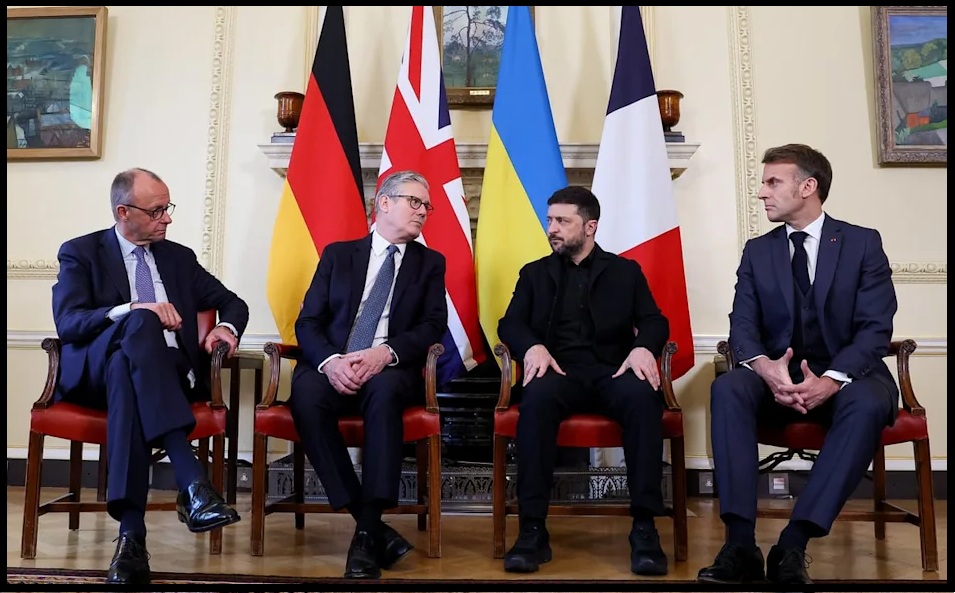
If there was anything missing in the U.S-Ukraine discussions before, it was/is not an issue of availability from the U.S. side.  The only thing that recently changed substantively is Zelenskyy hiding behind the skirt of Merz, Starmer, Macron and Von der Leyen (EU Leaders) to frame his talking points, AND this newly expressed zero-sum position that none of the Donbas will be conceded.

Just as a reminder: Zelensky and David Arakhamia, Ukraine’s initial negotiator, refused to sign the Istanbul ceasefire and peace agreement because, as they said, “we would have to give up NATO, and that requires changing the Constitution, which is impossible.” This was after Zelenskyy received direct pressure from British Prime Minister Boris Johnson to stop negotiating with Russia.

Now, as it turns out, what they said was “impossible” is entirely possible – just as it has always been possible to hold elections during a war.  Zelensky’s decisions in 2022/2023 had nothing to do with a genuine position of the state, or best interests for Ukraine.  Zelenskyy’s position was driven by a desire for control, power and profit at the cost of the lives and fate of millions of Ukrainians.

Now, Zelenskyy wants a structural security guarantee that creates a de facto NATO alignment.  Essentially, all of the NATO security benefits, NATO recognition, NATO protection, NATO tools, and yet not officially a NATO member.

In addition, Zelenskyy demands full expedited entry into the European Union.

So, to summarize the position of Zelenskyy that is supported by the EU Leaders.  (1) No concession on Donbas. (2) De facto NATO protection and membership. (3) EU membership and (4) Ukraine control of the Russian sovereign wealth fund.

To the folks in the administration who read here:  Please accept that ¹Zelenskyy (et al) is manipulating you into a very narrow gauntlet in order to use the USA clout to achieve an objective that is not part of the administration goal.

Begin with the end in mind and now modify the approach.  Tackle the issue of territorial concessions and watch all of these endless discussions collapse upon their own weight because they are missing the foundational block.  Russian Federation President Vladimir Putin is not going to retreat from Eastern Ukraine; any more than President Trump would give Texas to Mexico.

[¹There’s also a better than average likelihood, Zelenskyy is in alignment with a genuine EU/Nazi mindset. Which, of course, was the reason Obama/DoS selected him in the first place.]