Posted originally on CTH on March 16, 2026 | Sundance
Moments ago, President Donald Trump took questions from the assembled press pool during a lunch with the Trump-Kennedy Center board members.
The full video is below the fold. However, the shorter segment of media questions and answers is highlighted in this video. President Trump was asked about countries willing to support the military escort request through the Strait of Hormuz. President Trump noted an announcement of supporting countries will be forthcoming.
President Trump also noted the biggest beneficiary of the oil from Iran is China, and he would expect those nations who are dependent on the stability of that oil flow to rise in support of the escorts. WATCH:
Posted originally on CTH on March 16, 2026 | Sundance
CENTCOM Commander Admiral Brad Cooper provides an update on the latest military engagements during Operation Epic Fury. Commander Cooper highlights video footage and captured images of Iranian war infrastructure to show the before and after results of U.S. strikes. WATCH:
Posted originally on CTH on March 15, 2026 | Sundance
World War Reddit works both ways. In Ukraine the manipulation was to give the illusion of success for Zelenskyy. In Iran the manipulation is to give the illusion of failure for Trump.
The bottom line in both scenarios is the illusion being disconnected from reality.
[Truth Social] – “Iran has long been known as a Master of Media Manipulation and Public Relations. They are Militarily ineffective and weak, but are really good at “feeding” the very appreciative Fake News Media false information. Now, A.I. has become another Disinformation weapon that Iran uses, quite well, considering they are being annihilated by the day.
They showed phony “Kamikaze Boats,” shooting at various Ships at Sea, which looks wonderful, powerful, and vicious, but these Boats don’t exist — It’s all false information to show how “tough” their already defeated Military is!
The five U.S. Refueling Planes that were supposedly struck down and badly damaged, according to The Wall Street Journal’s false reporting, and others, are all in service, with the exception of one, which will soon be flying the skies. Buildings and Ships that are shown to be on fire are not — It’s FAKE NEWS, generated by A.I.
For instance, Iran, working in close coordination with the Fake News Media, shows our great USS Abraham Lincoln Aircraft Carrier, one of the largest and most prestigious Ships in the World, burning uncontrollably in the Ocean. Not only was it not burning, but it was also not even shot at — Iran knows better than to do that! The story was knowingly FAKE and, in a certain way, you can say that those Media Outlets that generated it should be brought up on Charges for TREASON for the dissemination of false information!”
“The fact is, Iran is being decimated, and the only battles they “win” are those that they create through AI, and are distributed by Corrupt Media Outlets. The Radical Leftwing Press knows this full well, but continues to go forward with false stories and LIES. That’s why their Approval Rating is so low, and I can win a Presidential Election, IN A LANDSLIDE, getting only 5% positive Press — They have no credibility!
I am so thrilled to see Brendan Carr, the Chairman of the Federal Communications Commission (FCC), looking at the licenses of some of these Corrupt and Highly Unpatriotic “News” Organizations. They get Billions of Dollars of FREE American Airwaves, and use it to perpetuate LIES, both in News and almost all of their Shows, including the Late Night Morons, who get gigantic Salaries for horrible Ratings, and never get, as I used to say in The Apprentice, “FIRED.” Thank you for your attention to this matter!” President DONALD J. TRUMP
Posted originally on CTH on March 15, 2026 | Sundance
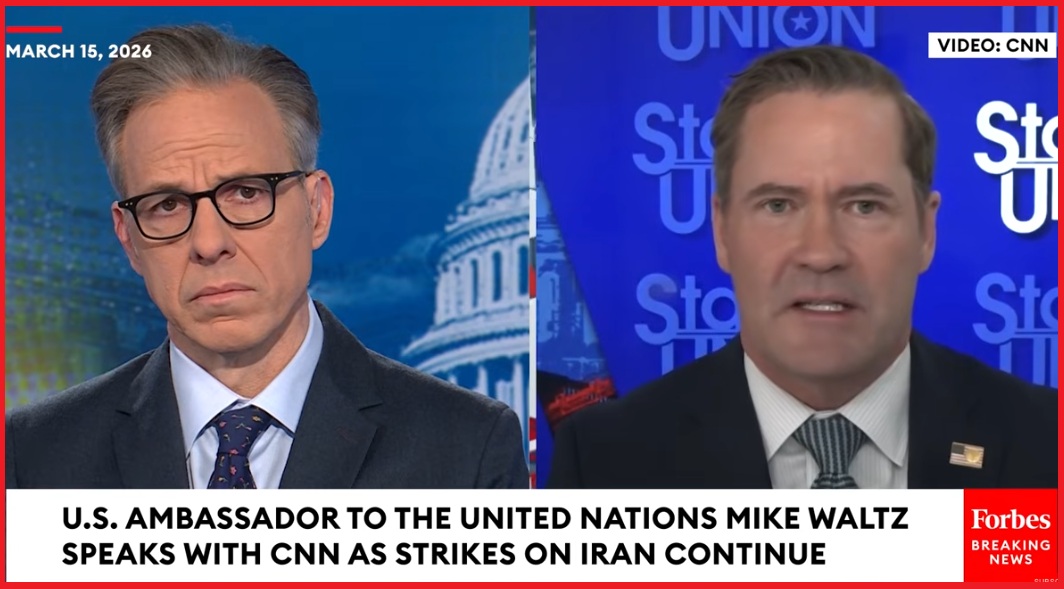
Perhaps the Ellison effect is actualizing inside CNN, but the insufferable furrowed brows of Jake Tapper were unusually non-combative today as he interviewed U.N Ambassador Mike Waltz while discussing Iran. [Video and Transcript Below]
[Transcript] – Joining us now to discuss, the U.S. ambassador to the United Nations, Mike Waltz, a former Green Beret who served in Afghanistan and the Middle East.
Ambassador Waltz, thank you so much for joining us.
The president just said that the U.S. has beaten and completely decimated Iran, both militarily, economically, and in every other way. Help us understand what that means, that Iran has been beaten. Does that mean that U.S. service members will soon be coming home?
MIKE WALTZ, U.S. AMBASSADOR TO THE UNITED NATIONS: Well, Jake, let’s just unpack that for a moment.
Militarily, the U.S. military has decimated Iran’s air force, their air defenses, their missile capability, their missile production capability. This has been a dominant victory, the likes of which we haven’t seen in modern American military history, economically, the maximum pressure campaign that President Trump put in place his first term and reinstituted the second — as the second major item, executive order that he signed this term.
Their currency is tanking. Their foreign reserves are completely depleted. And that’s why you saw the most recent uprising. You saw the uprising based on economic terms. And then, diplomatically, we just saw this week at the U.N. Security Council 135 nations — Jake, it was a U.N. record — 135 nations side with the Gulf Arab countries and condemn the GCC — excuse me — with the Gulf Arab countries, the GCC countries, and condemn Iran for its atrocious attacks on civilian infrastructure, ports, airports, hotels, resorts. And, as I pointed out at the Security Council, I don’t see how the regime argues that those are military targets. They are clearly not, and they are clearly deliberately targeting civilian infrastructure.
And I have got to tell you, this shoot-in-all-directions strategy that Iran has taken on is backfiring. They have never been more diplomatically isolated. Just one more point. Russia and Iran had an opportunity to veto that measure, and they stood back and did not. They abstained.
So, with friends like those, I think Iran is going to stay incredibly isolated.
TAPPER: You said Russia and Iran abstained. I assume you meant Russia and China abstained.
WALTZ: Excuse me, Russia and China. That’s right.
TAPPER: Yes. Yes.
So, is he willing, the president, to accept an end to the war that leaves whatever of the regime is left still in place, the new ayatollah as supreme leader? Because it sounds like — the way you describe it, it sounds like President Trump, with the exception of the stranglehold that the Iranians have of the Strait of Hormuz, it sounds like everything has been achieved pretty much, with the possible exception of a new regime, which was not one of the specific goals.
WALTZ: Well, the president has said he’s not happy with this new nominated Mojtaba Khamenei, who, by many accounts, is an incredibly hardline individual, a hardline cleric.
We will see if he’s actually really in charge. As Secretary Hegseth said, he was wounded during the initial strikes. And it’s unclear that he really has control of the country, if he’s even alive at this point.
So, look, I will leave it to the president where he decides and when he decides and on what terms he decides as commander in chief to end hostilities. But I think the important point here is, the United States has never been in such a position of strength and the Iranian regime has never been in such a position of weakness when it comes to its options.
TAPPER: Despite U.S. strikes on military targets on Iran’s key oil hub of a Kharg Island Friday night, Iran says that oil production on the island is proceeding normally.
If Iran does not reopen the Strait of Hormuz, is President Trump prepared to target those oil facilities, which, as you know, handle 90 percent of Iran’s crude oil exports? And, if so, are you worried that that could risk even more of an escalation when it comes to the Strait of Hormuz? WALTZ: Well, President Trump is not going to take any options off the
table, Jake, and he pointed out in his TRUTH where he announced the military infrastructure strikes on Kharg, which, by the way, they use to project their fast boats, drones and other types of attacks on — into the Gulf, that he deliberately hit the military infrastructure only for now.
And I would certainly think he would maintain that optionality if he wants to take down their energy infrastructure. But we have to take a step back, Jake. I mean, look at what they’re doing to global energy supplies. Look at what they’re trying to do in terms of constraining the world’s economy with drones and boats.
One could only imagine if they had a nuclear arsenal or if they had a nuclear weapon. That’s what many of these Gulf Arab countries have woken up to, that they now realize, and why they have been so supportive and are standing with us as we seek to ensure this regime can never have a nuclear weapon, which President Trump has been consistent about for 10 years.
TAPPER: If not longer.
WALTZ: Yes.
TAPPER: President Trump said that the Navy, the U.S. Navy, is going to begin escorting tankers through the Strait of Hormuz and that will begin very soon. And he said — quote — “Many countries will be sending warships to keep the strait open and safe” — unquote.
The administration has been talking about potential Navy escorts for more than a week now. Shipping executives tell CNN that all their requests for escorts have, as of now, been rebuffed. President Trump said — quote — “Hopefully, China, France, Japan, South Korea, the U.K. and others will send ships to the area” — unquote.
Is he hoping that those countries are going to send ships or have they committed to sending ships? And how soon will those naval escorts be ready?
WALTZ: Well, I will leave those conversations to him. The conversations are ongoing.
I think there’s an important point that’s getting kind of missed in the conversation, that 80 percent of the oil coming out of the Gulf heads to Asia. Only about 7, 8 percent heads to the Western Hemisphere. And thank God for President Trump’s energy dominance agenda, everything from opening up ANWR, new pipeline in Alaska, incentivizing fracking, what we’re going to see come out of Venezuela and Guyana in the coming months and years.
This is why we have to be energy-independent. And I have to just say it’s a little rich coming from the progressive left, who has literally been at war against oil, literally were putting policies in place to drive up the price of oil in order to force Americans to buy E.V.s and go to wind and solar, are now suddenly celebrating it or decrying the lack of it.
Like I said, it’s a little bit rich. We have the energy dominance in place. But, to your point on escorts, look, back, in the ’80s, under the tanker wars then, the last time Iran tried to constrain global energy supplies, you had French, United Kingdom, even Soviet Union forces in there escorting their tankers out that were heading to their markets.
And I think that’s what President Trump is calling upon the world, saying the entire world is affected. Iran can’t hold your economies hostage. And we certainly welcome, encourage, and even demand their participation to help their own economies.
And, meanwhile, the U.S. military will continue to pound the Iranian military, their missile, boat and drone forces to keep the straits open.
TAPPER: Sources tell CNN that Russia has been providing Iran with intelligence to help Iran better target U.S. service members. You said in an interview last week that President Trump will — quote — “deal with it accordingly.”
Here’s what President Trump had to say about this on Friday.
(BEGIN AUDIO CLIP)
BRIAN KILMEADE, FOX NEWS ANCHOR: Do you think Putin is helping them?
TRUMP: I think he might be helping him a little bit, yes, I guess. And he probably thinks we’re helping Ukraine, right? China would say the same thing. You know, it’s like, hey, they do it and we do it, in all fairness. They do it and we do it.
(END AUDIO CLIP)
TAPPER: Do you see an equivalence between the U.S. helping Ukraine defend itself and Russia helping Iran target U.S. service members?
WALTZ: Well, Jake, we have known that Russia and Iran have this symbiotic, have this strategic partnership for some time now.
I will tell you what Russia has lost out of this. They have lost their biggest manufacturer of the Shahed drones. Russia’s been licensing those drones for quite some time and hitting Ukraine with it, all the more reason why we need to defang this regime and all the more reason that they cannot have a nuclear weapon.
And I will just point out too, because a lot of critics out there are making hay of this, it was President Trump that put sanctions on Russia’s largest oil producer, Rosneft. He also put sanctions on Lukoil. The Biden administration did not do that for many years.
They only did a kind of a pinprick action at the very end of the administration. He also took tough action on India. And now he’s put a temporary pause on that in order to calm energy markets. I think these are all pragmatic, commonsense approach — approaches,
while we deal with the Iranian regime.
TAPPER: But, surely, surely Russia helping Iran target our service members is upsetting and distressing, and action needs to be taken.
WALTZ: Well, I’m not going to get into leaked assessments of what intelligence is being provided or not. I just can’t and won’t do that.
But I will tell you, if they are doing it, it certainly hasn’t been affected — or effective, excuse me, because the Iranian air force, air defenses, missile forces, and Navy have been completely decimated.
TAPPER: All right, Ambassador Mike Waltz, thank you so much. Appreciate your time today, sir.
Posted originally on CTH on March 15, 2026 | Sundance
The Panicans will be greatly disappointed by the foresight and economic planning a proactive White House deployed before the confrontation with Iran began. [Video and Transcript Below]
White House National Economic Council Director Kevin Hassett, leaves CBS’s Margaret Brennan stuttering to respond to the insight presented. As noted in the interview, proactively the Trump administration planned to mitigate any oil disruption for the U.S, undertaking a series of moves before Operation Epic Fury began.
Iran thinks “that they’re going to harm the U.S. economy and get President Trump to back down,” Hassett says. “There couldn’t be anything that was a stupider thing to say because the bottom line is that our economy has got all this momentum in the world and we’ve got lots and lots of oil,” he continued.
Then highlighting how the strength of the U.S. position actually ends up with leverage in trade negotiations, Hassett notes, “we have lots of trading partners that are more on the hook from imported oil from these guys.” Which draws attention to President Trump’s statement yesterday saying, in essence, ‘come guard your oil shipments while we kill bad guys’. WATCH:
[Transcript] – MARGARET BRENNAN: We go now to President Trump’s top economic adviser, Kevin Hassett. Good morning to you.
KEVIN HASSETT, DIRECTOR NATIONAL ECONOMIC COUNCIL: Good morning.
MARGARET BRENNAN: The IDF spokesperson said this morning that Israel’s combat operations will go through the beginning of April. Is that also the U.S. timeline? And if so, how much will this conflict cost the economy if it goes on another three and a half weeks?
HASSETT: Right. Well, one of the things that we’ve been briefed on almost every day is what’s going on and what the president is being briefed on with regard to the Iran war. And as of yesterday this story was- the message was that people, the defense- Department of War believed that it would take four to six weeks to complete this mission and that we’re ahead of schedule. So we are a couple of weeks in and I think that should give you some clarity about when we expect that the president will decide that we’ve achieved his objectives. The other thing I can say is that you can also look at futures markets, which are interesting because you’ve cited over and over the spot price of gasoline, which, of course, is affected right now by the disruption of the strait, but if you look at the futures prices, they are expecting a rapid, rapid end to the situation and much, much lower prices. In fact, I don’t think I’ve seen a sort of future price path with such a steep decline in all my years watching futures.
MARGARET BRENNAN: We will talk about the oil trade later on in the program, as those markets prepare to open later today, but the International Energy Agency called this the largest supply disruption in the history of the global oil market. So I’m not sure how much past charts are a future indicator here, but the president is calling on other countries now to send ships to help protect the Strait of Hormuz. You just heard Iran’s foreign minister saying Tehran has been approached by other countries about negotiating their way through strait. If that kind of negotiation happens, are Americans just going to get cut out here?
HASSETT: Well, first of all, you have to understand that America is not going to have its economy harmed by what the Iranians are doing. The bottom line is that in the ’70s we didn’t produce much oil, but now we do. So, America is in a very strong position. They think that they’re going to harm the U.S. economy and get President Trump to back down. There couldn’t be anything that was a stupider thing to say because the bottom line is that our economy has got all this momentum in the world and we’ve got lots and lots of oil. We have lots of trading partners that are more on the hook from imported oil from these guys. And as we can see, it’s completely unacceptable that a government that would, you know, murder 40,000 of their people just a few months ago would be blackmailing countries to let stuff through. President Trump thinks that is unacceptable and for the global economy we need to fix it and we are going to fix it fast.
MARGARET BRENNAN: Okay. It is a global market, but I take your point there is supply of course, there’s refining, there’s other interruptions to the ability to access oil and gas. But gas prices themselves are up more than 20% since this conflict has begun. Jet fuel prices are leading airlines to raise ticket prices quickly. That’s not my opinion, that’s the United Airlines CEO who just said that. The American Farm Bureau warned of supply chain shocks when we already have record high input prices. So can you give us some kind of projection here on how this will impact consumer prices and for how long?
HASSETT: For sure. And I want you to know that this is something that the government has been studying for decades. And even myself, when I first came in as Chairman of the Council of Economic Advisers one of the first assignments I got from General Mattis was to study what happens if there are oil disruptions. And so we know how to minimize- minimalize the impact of this disruption. Now, you can’t make it completely go away but you can minimal-ize it. And so we are increasing the amount of permits that we’re giving to Venezuela, we’re getting new sources of fertilizer from Morocco and from Venezuela and other places to make sure that our farmers have the fertilizer they need. And we’re even thinking ahead about the jet fuel problem which is really mostly a problem for jet fuel coming from Asia. And we have been in discussions to make it easier for foreign ships to go from the Gulf of America over to the west coast to make sure that we don’t have a disruption from jet fuel as well. And so, we are looking at every scenario, and we’ve got a plan for each scenario.
MARGARET BRENNAN: Okay. Are you going to trigger those things and make them operational or are you just looking at them? And how do you prevent food prices from also going up?
HASSETT: Right. Well, the big problem right now would be energy prices and we’re watching and monitoring closely. We’re looking at things every day and seeing how quickly we progress. The bottom line is again, that the reason why futures markets for oil are dropping down towards 60 and even below 50 in the long run is that we expect that if Iran stops being this disruptive terrorist force in the Middle East that there will be a boom in oil production and industrial production. But think about the harm- the harm that this evil government has done to their own people. Back in the ’70s before the revolution, Iran was the 17th largest economy in the world, now it’s something like the 50th.
MARGARET BRENNAN: No one’s going to defend the regime’s human rights record on this program.
HASSETT: They’ve run- they’ve run their country into the ground- but the point is that- I wanted to just say that the countries around them, they also suffer from the risk of having them go nuts and attack them. And so we expect that the global economy is going to have a big positive shock as soon as this is over and we’re still being briefed that it would be four to six weeks from the beginning and that we are ahead of schedule.
MARGARET BRENNAN: A big positive shock, four to six weeks. So this a April 9th scenario you’re talking about? You are going to see some kind of boost–
HASSETT: The president will decide.
MARGARET BRENNAN: –even–
HASSETT: The president will decide if they no longer have the capability of blackmailing us and harming our neighbors. And once he decides that, then he will call an end to the war.
MARGARET BRENNAN: That’s a pretty broad definition.
HASSETT: Well, we’ve destroyed their navy, we’ve destroyed their air force and so on and so I think we are well on the way.
MARGARET BRENNAN: Well tell me how much is this war going to cost? Because I know the Pentagon briefed it’s going to be about $11.3 billion. Do you need to ask congress for more money to pay for what you’re doing?
HASSETT: I think right now we’ve got what we need, whether we have to go back to congress for more is something that I think that Russ Vought and OMB will look into, but the latest number, you said 11.3, the latest number I was briefed on was 12, and so it’s consistent. So this is something that we’ve got the weapons that we’ve already got in place to do this and so we are not necessarily going to need any kind of supplemental.
MARGARET BRENNAN: More than that was spent in just the first week of the war, you know that. It was over five billion just in munitions. You’re solid on the 12?
HASSETT: I said $12 billion–
MARGARET BRENNAN: –For six weeks of war?
HASSETT: No, I’m sorry. The 12 billion was what I was briefed has been spent so far.
MARGARET BRENNAN: Gotcha. Kevin Hassett. Thank you very much. We we will be right back with a lot more ‘Face the Nation’
Posted originally on CTH on March 15, 2026 | Sundance
Some additional contexts not included in the British-centric financial review below.
(1) Japanese Prime Minister Takaichi Sanae will be at the White House next week. This meeting was scheduled several weeks before Operation Epic Fury began. The timeline continues to indicate that President Trump’s primary geopolitical focus is on China, not necessarily the U.K-EU angle, although that is a materially significant overlay.
(2) “A major U.S. weapons package for Taiwan worth about 14 billion dollars is awaiting approval from Donald Trump and could be announced after his planned visit to China later this month, according to sources familiar with the discussions. The proposed deal would be the largest U.S. arms sale ever to Taiwan and comes as military tensions between China and the self-ruled island continue to rise.” {SOURCE}
.
Heavenly Father, we ask for You to protect our leadership’s intent through value-driven stewardship. Keep arrogance and pride far from the heart of our leadership and help them to listen well. Dear God, we ask that You provide spiritual protection and intellectual discernment; provide calm through troubled waters, and space for wisdom to enter the hearts and minds of our national leadership keeping their bold influence aligned with Christ’s example. ~ Amen
Posted originally on CTH on March 14, 2026 | Sundance
President Trump’s latest two messages via Truth Social present an interesting geopolitical approach with multiple enmeshed aspects.
First, some background context is needed. Treasury Secretary Scott Bessent and USTR Jamieson Greer are in Paris to meet with Chinese government officials ahead of a scheduled meeting between Chairman Xi Jinping and President Trump.
The main objective of the pre-summit assembly before President Trump goes to Beijing, is to hammer out the actionable agreement details that can be signed off by Xi and Trump. Bessent and Greer are looking to put a deal together with their Chinese counterparts so that Trump and Xi can announce mutually beneficial outcomes during their summit.
Second, President Trump has already indicated the March 31/April 1 meeting with Xi will be all business. The traditional pomp and splendor will not be present, and Trump will only be visiting Beijing – no sidelines.
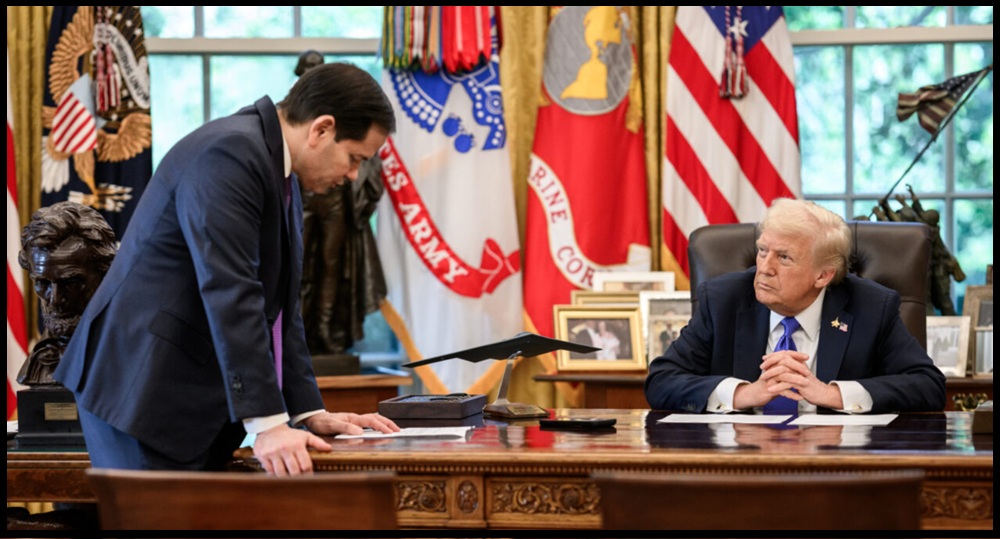
Third, Secretary Rubio will be accompanying Trump on this trip to Beijing, which might seem ordinary were it not for the fact that in 2020 China sanctioned and banned Rubio from entering China for criticizing Xinjiang and Hong Kong.
Fourth, there are rumors that President Trump is going to announce a significant weapons deal with Taiwan at some point immediately following the trip. If those rumors are true, it would be a top priority for the Chinese advance team in Paris to stop that from happening.
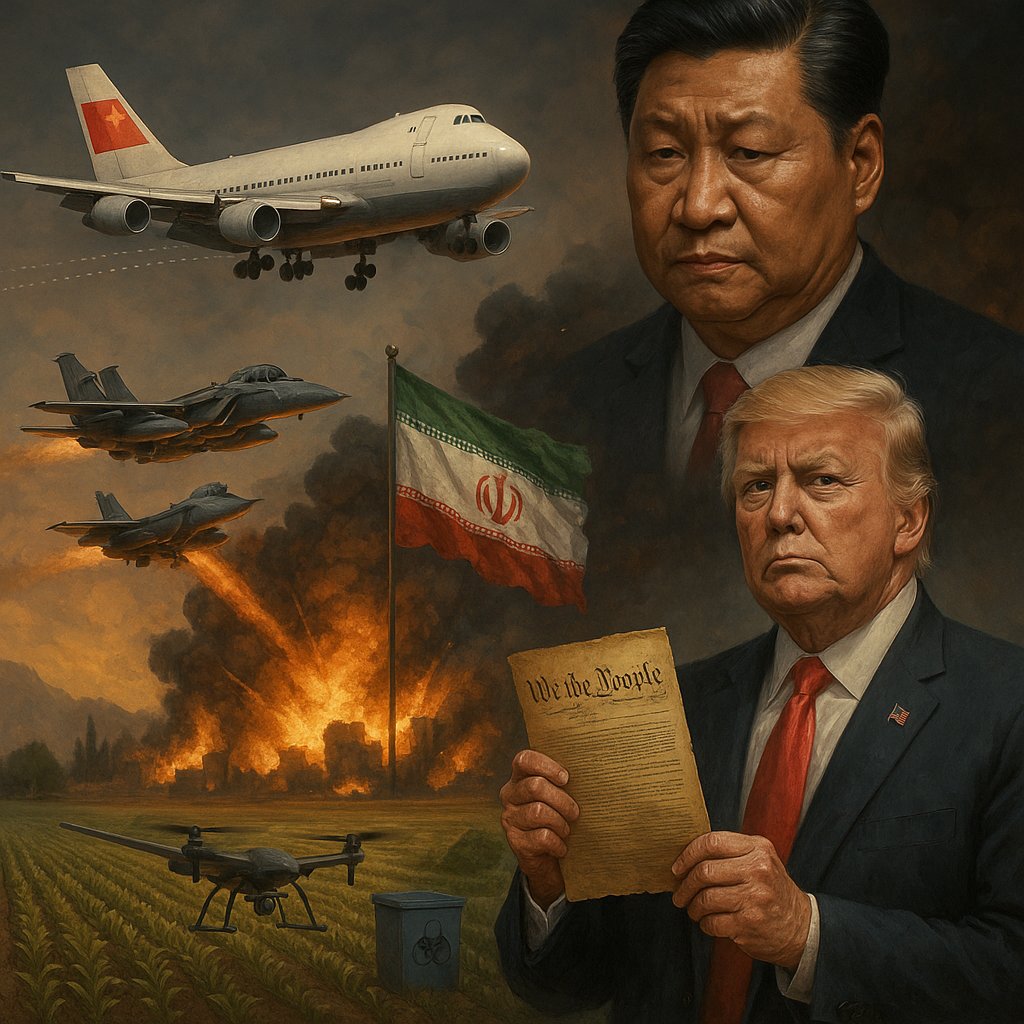
Regardless of what happens in the next few weeks, President Trump will be meeting with Chairman Xi with full Eagle eye confrontation toward the returning dragon stare. There will be no panda mask on this trip whatsoever; this face to face is an apex predator showdown, while the world watches intently.
Everything President Trump does between now and his arrival in Beijing, should be contemplated through this adversarial position. With strong moves in Venezuela and Iran President Trump has already pulled Chairman Xi into the jianshu circle, showing the soul of his blade.
Chairman Xi does not have anything resembling a retreat position. He has a highly focused domestic audience, and the eyes from the Great Hall of the People will be watching intensely.
In the next two weeks we will likely see critical probes of both Trump and Xi’s wills surface in ancillary stories connected to each stakeholder, most likely swirling around the Iran conflict. Do not be surprised if we see all of the advanced USA influence purchasing by China now activated with very specific anti-Trump narratives.
That is the context for President Trump to call out many of the oil dependent countries:
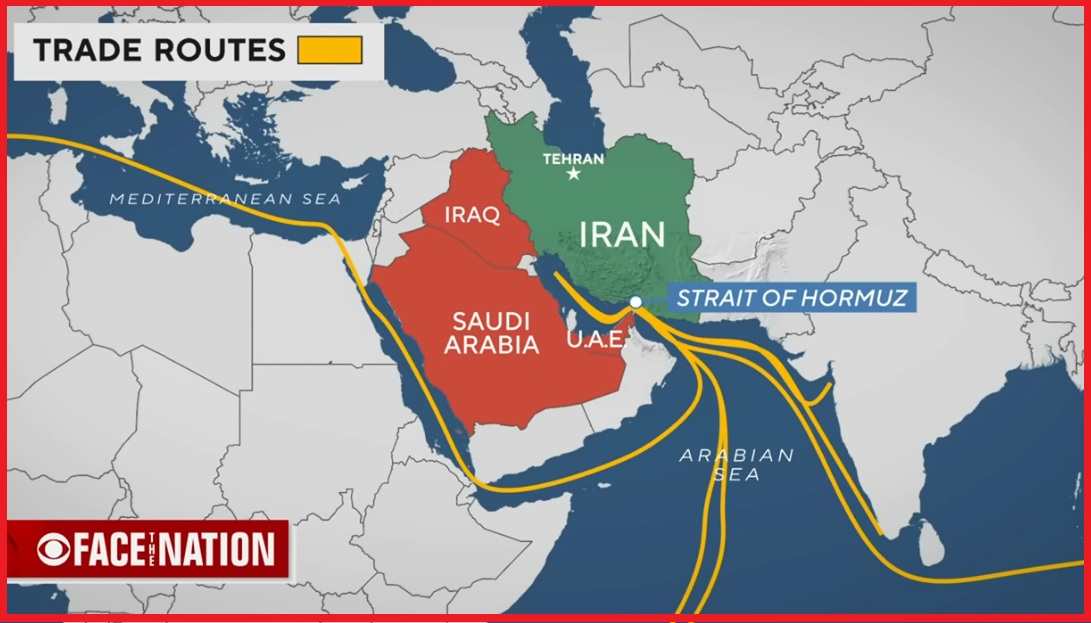
TRUTH SOCIAL – “Many Countries, especially those who are affected by Iran’s attempted closure of the Hormuz Strait, will be sending War Ships, in conjunction with the United States of America, to keep the Strait open and safe. We have already destroyed 100% of Iran’s Military capability, but it’s easy for them to send a drone or two, drop a mine, or deliver a close-range missile somewhere along, or in, this Waterway, no matter how badly defeated they are.
Hopefully China, France, Japan, South Korea, the UK, and others, that are affected by this artificial constraint, will send Ships to the area so that the Hormuz Strait will no longer be a threat by a Nation that has been totally decapitated. In the meantime, the United States will be bombing the hell out of the shoreline, and continually shooting Iranian Boats and Ships out of the water. One way or the other, we will soon get the Hormuz Strait OPEN, SAFE, and FREE! President DONALD J. TRUMP
There is a significant overlay here.
First, any nation that sends supportive military ships into the Strait of Hormuz is openly taking a position against the Iranian regime. China cannot take that position, and President Trump knows it – so he’s calling out the dragon’s alignment for the world to see.
…. If you get oil from the region, come protect your ships while I kill the bad guys…
Remember, Japan has a very limited military, and their post-World War II constitution was blocking them from building one. Changing that position was the goal of Japanese Prime Minister Shinzo Abe, a friend of Trump, and he was traveling throughout Japan with that message when he was assassinated. That objective now falls to the protege’ of Abe, Prime Minister Sanae Takaichi.
Japan is included on that list of countries specifically to antagonize the dragon, with President Trump saying I have a strong industrial friend in your back yard.
For the rest, notice the countries Trump did not name: India, Thailand, Vietnam, Philippines or any of the Asian countries that are dependent on oil from the middle east. Trump is not asking the dependency allies of the United States to participate. Instead, President Trump is calling upon the fake-ally countries that oppose the United States but hide behind a friendly smiling mask.
This is a bold underline for President Trump’s former statement where he publicly doubted the NATO allies would ever come to assist the USA (ie. Greenland), even though they are dependent on the security the USA provides.
In this Iranian conflict, the Europeans are dependent on oil from the middle east, but they will not put their military into the fight even if it secures their own economic future. Opening the Strait of Hormuz benefits the Europeans, but they only want to pontificate grand prose about it; similar to how they pontificated about the threat Iran presented, then lost their supportive tongue when Trump finally did something about it.
A few hours later, President Trump drives home the point:
TRUTH SOCIAL – “The United States of America has beaten and completely decimated Iran, both Militarily, Economically, and in every other way, but the Countries of the World that receive Oil through the Hormuz Strait must take care of that passage, and we will help — A LOT! The U.S. will also coordinate with those Countries so that everything goes quickly, smoothly, and well. This should have always been a team effort, and now it will be — It will bring the World together toward Harmony, Security, and Everlasting Peace!”President DONALD J. TRUMP
Now we wait to see who steps up.
Spoiler Alert – ¹No one will!
¹And that’s the point Trump is making.
I also concur with this point:
Shanaka Anslem Perera: “The coalition call is not about Iran. Iran’s military is destroyed. The coalition call is about the world that emerges after Iran. If America escorts the tankers alone, the Strait reopens under American control and dollar pricing survives. If a coalition escorts them, the Strait reopens under international consensus and the yuan-for-Hormuz proposal dies. If nobody escorts them, the Strait stays closed and China’s shadow fleet is the only commerce moving through it.”
Posted originally on CTH on March 14, 2026 | Sundance
While the original focus was on questions about the Iran war, at the tail end of an impromptu presser yesterday, President Trump was asked about Mexican President Claudia Sheinbaum and the status of U.S. national security.
President Trump said he was very disappointed that President Sheinbaum refused his offer of assistance in eliminating the cartels in Mexico. Ultimately culminating in the statement, “the cartels are running Mexico.”
Considering everything President Trump is doing to secure the Western Hemisphere objective, it must be very frustrating to eliminate various narcotraffickers, human smugglers and transnational agents of chaos, and yet still have one of the closest geographic nations unwilling to address the biggest criminal elements near our borders.
The bilateral USMCA discussions between the U.S. and Mexico are ongoing, I think we can expect this element of friction and ultimately leverage to be present in the overall outcome.
Personally, I think if the government of Cuba flips, there will be exceptional pressure on Mexico to finally address the issue.
Posted originally on CTH on March 14, 2026 | Sundance
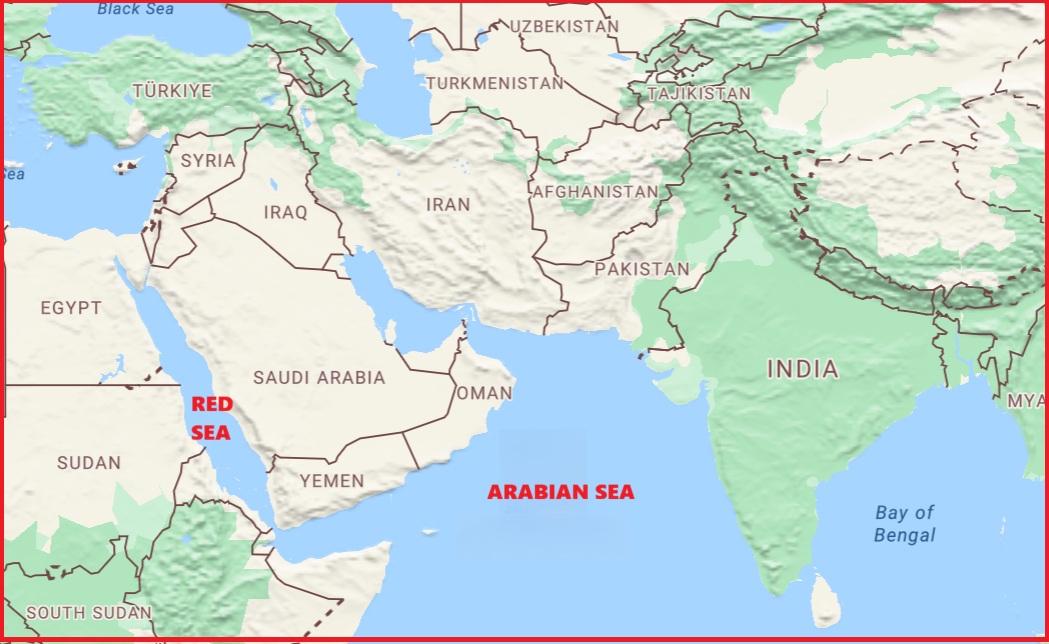
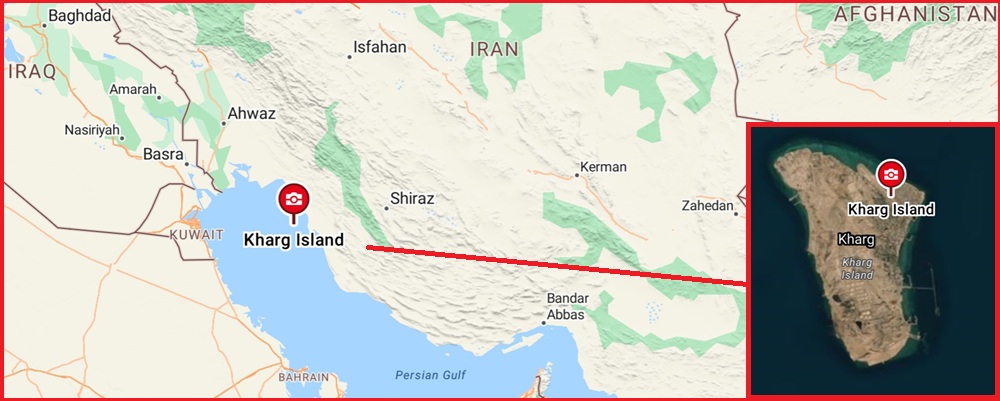
Kharg Island is a small coral island in Iran in the northern Persian Gulf. It is 34 miles (55 km) northwest of the port of Bushehr and vital to Iran’s oil industry.
The oil processing facilities at Kharg Island are a foundational component of Iran’s economy. Roughly 90 percent of Iran’s crude is processed at Kharg Island, and any disruption to its oil processing could cripple Iran’s economy.
President Trump announced:“Moments ago, at my direction, the United States Central Command executed one of the most powerful bombing raids in the History of the Middle East and totally obliterated every MILITARY target in Iran’s crown jewel, Kharg Island. Our Weapons are the most powerful and sophisticated that the World has ever known but, for reasons of decency, I have chosen NOT to wipe out the Oil Infrastructure on the Island. However, should Iran, or anyone else, do anything to interfere with the Free and Safe Passage of Ships through the Strait of Hormuz, I will immediately reconsider this decision.”
“During my First Term, and currently, I rebuilt our Military into the Most Lethal, Powerful, and Effective Force, by far, anywhere in the World. Iran has NO ability to defend anything that we want to attack — There is nothing they can do about it! Iran will NEVER have a nuclear weapon, nor will it have the ability to threaten the United States of America, the Middle East or, for that matter, the World! Iran’s Military, and all others involved with this Terrorist Regime, would be wise to lay down their arms, and save what’s left of their country, which isn’t much! Thank you for your attention to this matter.”
Posted originally on CTH on March 13, 2026 | Sundance
Speaking via phone, President Trump gave a lengthy interview to Brian Kilmeade on Fox Radio. Within the interview President Trump is highly focused on national security interests. WATCH:
I have created this site to help people have fun in the kitchen. I write about enjoying life both in and out of my kitchen. Life is short! Make the most of it and enjoy!
This is a library of News Events not reported by the Main Stream Media documenting & connecting the dots on How the Obama Marxist Liberal agenda is destroying America



 Centinel2012