Posted originally on CTH on December 9, 2025 | Sundance
President Trump sat down for an extensive interview with Dasha Burns of Politico. Despite the ideological outlook of Politico, the interview itself was remarkably absent of combative antagonism. The result is a good review of the current positions of President Trump as they relate to the rest of the world.
The Ukraine-Russia conflict is the immediate issue that is discussed within the interview. President Trump answers some direct questions about who is currently most responsible for continuing the conflict and is asked his opinion directly on Ukraine not holding elections.
President Trump notes Russian President Vladimir Putin is in the strongest position within the conflict and carries the strongest leverage into any ceasefire negotiations. Trump also frames the need for the bloodshed to end with a much greater sense of urgency than any of the EU leaders or Zelenskyy. Additionally sharing the opinion that Ukraine needs to have an election to showcase the will of the Ukrainian people in the leadership of Volodymyr Zelenskyy. WATCH:
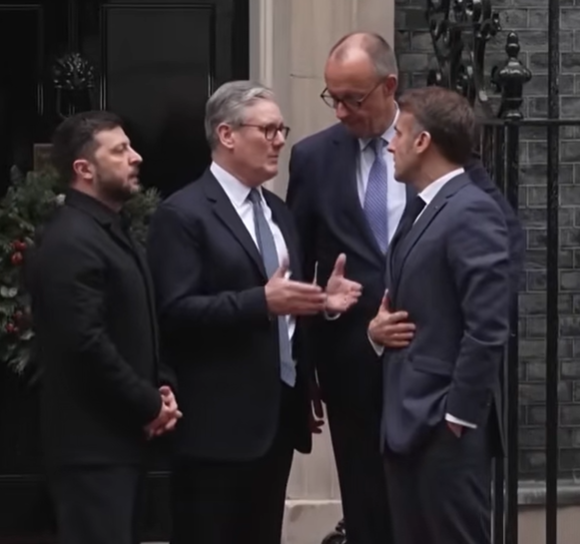
Yesterday, Ukraine President Volodymr Zelenskyy traveled to London to meet with British PM Keir Starmer, German Chancellor Friedrich Merz and French President Emmanuel Macron.
As expected, part of the Zelenskyy meeting with the “coalition of the willing” included a briefing by Ukraine negotiator Rustem Umerov, the secretary of Ukraine’s National Security and Defense Council, who held detailed consultations for three days last week in Miami with Trump’s envoys Steve Witkoff and Jared Kushner.
President Zelenskyy then departed London traveling with his media entourage to Brussels for the next round of discussions with the European Union stakeholders, financiers and politicians. During the trip Zelenskyy told his media stenographers, “Under our laws, under international law — and under moral law — we have no right to give anything away. That is what we are fighting for.”
The U.K, France and Germany support Zelenskyy’s position that he is not going to concede any territory to the Russian Federation, specifically the 30% of the Donbas area in Eastern Ukraine currently at the heart of the physical conflict.
The 30% issue surrounds the Donetsk region in Ukraine, which includes the cities of Kramatorsk and Sloviansk. Russia is currently pushing deep into fortified Ukraine resistance in this region with a population of around 100,000. Zelenskyy claims losing this area would allow Putin to invade the Dnipropetrovsk, Zaporizhzhia and Kharkiv regions.
Historically, this Donbas area was part of a brutal long-term Ukraine civil war between the pro-Russia eastern Ukrainian citizens and the pro-EU western aligned Ukrainian army. Russia’s current position is for Ukraine to cede the entire Donbas to Russia as part of the ceasefire agreement, or Russia will continue forward conflict military operations until successful.
Seeing things through the pragmatic prism of inevitability, President Trump’s view appears to be that this Donbas area will be lost to Russia one way or the other. So, the best scenario to stop the killing is for Ukraine to give up this territory as part of the ceasefire terms. Zelenskyy, with support of the EU, France, Germany and U.K says a firm “no.”
Politico reports that Zelenskyy said in August of this year “it would take Russia four-years to fully occupy the Donbas,” subsequently a lot of killing would take place during this process. President Trump is trying to stop the brutal “killing” part of that dynamic by getting the negotiation to the point of concession, but the EU team view any land area concession as positive affirmation for Russia to continue threatening Europe.
♦ On the ‘Security Guarantee‘ issue, this is where a quagmire is presented by European leaders.
From a pragmatic standpoint a European demilitarized zone, stood up and supported by EU military forces would appear to be the best solution. However, the “coalition of the willing” say they are willing to put security troops into Ukraine, but only if the USA will defend them if attacked by Russia. In essence, quasi-NATO forces on a non-NATO country, that if attacked would draw the entirety of NATO into the conflict, including the United States.
The U.K, France, Germany and EU Commission want a security structure similar to NATO for Ukraine that legally binds the United States to defend their interests if the ceasefire does not hold. President Trump has rejected this construct as yet another way for Europe to pull the U.S into a conflict zone that is not in our vital national security interests.
The ceasefire proposal structured by Trump, Witkoff and Kushner – seemingly supported by Russia, does not permit Ukraine to join NATO; however, EU membership is entirely up to the EU and people of Ukraine to decide. If Ukraine joins the EU, then EU forces alone should provide the security guarantee, not NATO which includes the U.S. and Canada.
(Washington Post) […] Zelensky said Ukraine will not surrender its territory in the eastern Donbas region — not to hasten peace talks, not to satisfy Washington’s push for compromise and not under pressure from Moscow’s continuing military onslaught.
Ukraine and Europe have insisted that a ceasefire be declared along current battle lines, but Russia has refused. Putin has claimed, illegally, to have annexed four entire regions of Ukraine (in addition to Crimea, which Russia seized in 2014) — far more territory than his military forces have been able to occupy.
Some Ukrainian officials held out hope that the negotiations could still bear fruit.
The proposal “is closer to be doable for Ukraine, but not easy and not finished,” said a senior Ukrainian official familiar with recent discussions, who spoke on the condition of anonymity because they were not authorized to comment publicly. (read more)
President Zelenskyy, whose term in office has long expired, departed London with his EU media entourage heading to Brussels. The collective group is trying to figure out how to keep America tied to their stakeholder interests in Ukraine.
The European leaders are manufacturing a construct that is not supported by the vast majority of the citizens within the EU, even within Ukraine itself. Meanwhile back in the USA, congress (House and Senate majorities) supports the position of Ukraine and the EU against the interests of President Trump and the voting majority.
There are trillions at stake.
The ruling class is supporting Zelenskyy, while the killing of the non-ruling class continues on the fields of Ukraine.
Posted originally on CTH on December 8, 2025 | Sundance
President Trump holds a roundtable discussion with Agriculture Secretary Brooke Rollins and various farm state senators as he outlines $12 billion in support and subsidy for American farmers.
With energy prices lowered, the costs for natural gas, fertilizer, diesel and gasoline prices have fallen; however, food costs have remained high. President Trump announced with Brooke Rollins an initiative to help support American farmers with the intended objective to lower production costs from the field that will hopefully transfer to the fork.
Secretary Rollins and President Trump announce a $12 billion bridge subsidy to assist farmers with proactive planning for the 2026 planting season. The money is coming from revenue generated by tariffs, and row crop farming will be the first subsidies delivered. WATCH (media questions begin at 31:40):
The House Armed Services Committee has released the full text of the National Defense Authorization Act for 2026 [SEE TEXT HERE]. The massive bill consists of 3,086 pages, making the fiscal year 2026 NDAA longer than the manuscript of War and Peace. Most people will never read it, so a 24-page Summary Version is Here.
The FY 2026 NDAA authorizes $892.6B for defense, which includes $153B for procurement, $142B for Research and Development, and $235B for military personnel. The legislation: Codifies 15 Trump EOs on military reform, border security, and DEI elimination. Boosts shipbuilding, aircraft, munitions, funds Taiwan aid and Israel programs, reforms acquisitions, enhances border support including $900M for counter-narcotic operations and includes a 3.8% pay raise and quality-of-life improvements.
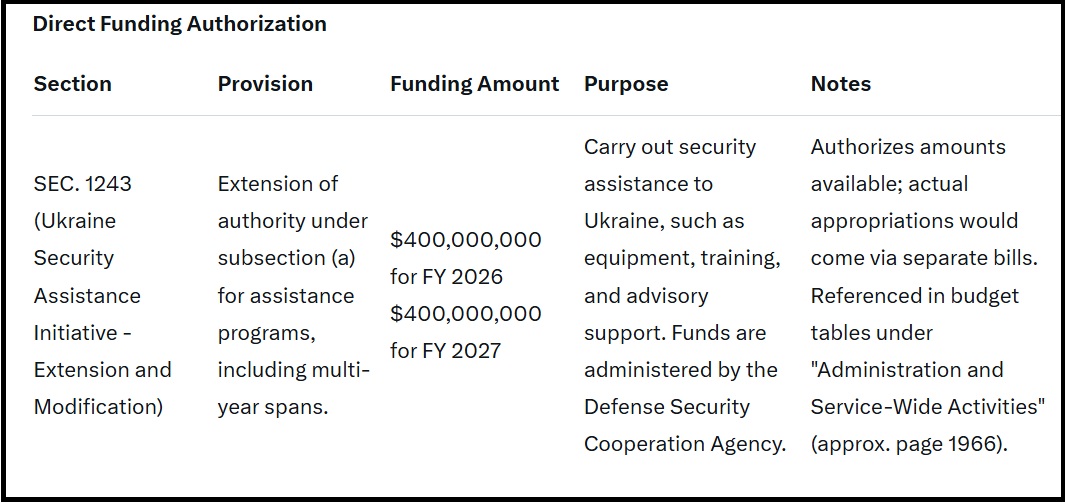
There is a $400 million authorization for Ukraine support, however, the amount is ‘authorized’ not ‘appropriated’ – which would have to come in a separate spending bill.
Other Ukraine-Related Provisions (No Specific Funding). These sections emphasize oversight, reporting, and strategic support but do not authorize new funding:
SEC. 1244 (Military Intelligence Support for Ukraine): Directs the provision of military intelligence to Ukraine but without dollar figures.
SEC. 1245 (Report Relating to Allied and Partner Support to Ukraine): Requires the Secretary of Defense to report on U.S. and allied contributions, including unobligated balances in the USAI account and plans for using funds to bolster Ukraine’s defense. Covers bilateral aid, Jumpstart/PURL initiatives, and deterrence against Russia.
SEC. 1246–1250: Broader provisions on NATO’s eastern flank, Baltic security, U.S. basing/training in NATO countries, and European deterrence reports. These indirectly support Ukraine via enhanced regional posture but lack Ukraine-specific funding.
No other sections in the amendment (e.g., those on Indo-Pacific, cyber, or appropriations for unrelated programs) mention Ukraine funding. The total direct authorization for Ukraine in FY 2026 appears to be $400 million under USAI, building on prior years’ initiatives. This is an authorization bill, so final funding levels depend on the appropriations process and conference reconciliation between House and Senate versions.
Posted originally on CTH on December 7, 2025 | Sundance
Secretary of Treasury Scott Bessent appears on CBS’s Face the Nation for an inflation and affordability debate with narrative engineer Margaret Brennan.
The primary narrative can be seen in Brennan’s emphasis of the new democrat catch phrase “affordability.” Having gaslit the American electorate over the issues of Joe Biden’s economic/energy policy which created record inflation, the same media who ran cover for Joe Biden have switched during the Trump administration to calling the subsequent high costs an “affordability” crisis.
In essence, Biden’s economic, energy and monetary policies drove 2021/2022 inflation to record levels, this made all prices rise massively. Those high prices are now the “affordability problem.” WATCH:
[Transcript] – MARGARET BRENNAN: Good morning and welcome to ‘Face The Nation.’ We have a lot of news to get to, and we begin with the Secretary of the Treasury, Scott Bessent. Good to have you here.
TREASURY SECRETARY SCOTT BESSENT: Morning, Margaret.
SEC. BESSENT: Mr. Secretary, a lot of people are out there holiday shopping. Here is how the President described back in April, what to expect from this season.
[SOT]
PRESIDENT DONALD TRUMP: Maybe the children will have two dolls instead of 30 dolls, you know. And maybe the two dolls will cost a couple of bucks more than they would normally.
[END SOT]
MARGARET BRENNAN: Was the President’s prediction then, correct?
SEC. BESSENT: Margaret, it’s actually been a very strong holiday season, and the- you know, we’ve seen across all the income cohorts thus far. And so there’s nothing to say that there are two dolls instead of 30 dolls.
MARGARET BRENNAN: The President was wrong to predict lower numbers of purchases and higher prices?
SEC. BESSENT: The economy has been better than we thought. We’ve had the 4- 4% GDP growth in a couple of quarters. We’re going to finish the year, despite the Schumer shutdown, with 3% real GDP growth.
MARGARET BRENNAN: Well, the maker of Tonka Trucks, their CEO, said it’s going to cost 40 bucks for their toys right now because of tariffs and inflation, it was 30 bucks the year before that, 25. Prices in the toy space are accelerating, and people are feeling that.
SEC. BESSENT: Well, Margaret inflation is a composite number, and it’s roughly the same year over year. And if we were to look at all imported goods, imported goods inflation is below the inflation number.
MARGARET BRENNAN: The inflation number, you mean the–
SEC. BESSENT: The PC- the PCE number which is about 2.9%. Imported goods inflation is about 1.8. It’s the service economy that’s generating inflation, which actually has nothing to do with tariffs.
MARGARET BRENNAN: But when we hear from for example, the President, when he says that affordability is a con job by Democrats, that seems to just not be resonating with consumers that have been polled by CBS. 60% of Americans polled by this network told us President Trump makes prices and inflation sound better than they really are, and his approval rating in the economy is now down to 36% in our latest poll. On inflation, approval is even lower, 32%. Don’t you need to show that you feel the pain?
SEC. BESSENT: Well, Margaret, I think the President’s frustrated by the media coverage of what’s going on–
MARGARET BRENNAN: This is the polling of average Americans.
SEC. BESSENT: –No, no- yeah, but I think the average Americans, they are hearing a lot from media coverage. And I will tell you that affordability has two components, there is inflation, and then there is real incomes. Real incomes are up about 1% and what we’re not going to do is say that Americans don’t know what they’re feeling. We’ve been working on it every day. I was on your show on March talking about affordability. The- we’ve made a lot of gains, but remember, we’ve got this embedded inflation from the Biden years, where mainstream media, whether it’s Greg Ip at the Wall Street Journal, toxic Paul Krugman at New York Times or former Vice Chair, Alan Blinder, all said it was a vibecession. The American people don’t know how good they have it. Now, Democrats created scarcity, whether it was in energy or over regulation, that we are now seeing the- this. affordability problem, and I think next year we’re going to move on to prosperity.
MARGARET BRENNAN: You do think there is an affordability problem?
SEC. BESSENT: Sorry?
MARGARET BRENNAN: You do believe there’s an affordability problem?
SEC. BESSENT: Oh, I think the Biden administration created a terr–
MARGARET BRENNAN: No, but now we’re nearly 12 months in, you said the President would own the economy at this point.
SEC. BESSENT: I said that the Biden administration created the worst inflation in 50 years, and maybe for working Americans, the worst inflation of all time. And we have pulled that number down- that Strategas research does something called the common man index. Under Biden, the accumulated inflation number, as measured by CPI, was about 20%. Their index showed 35. This year for the first time, the common man index is below the inflation index because the basket of goods for working Americans, food, gasoline, rent is coming down. So I wrote an essay March 12, 2024, and it talked about the three I’s, immigration, interest rates and inflation. Immigrant- mass, unfettered immigration, depressed wages caused housing prices to go up. President has closed the border that is fixed. Interest rates have come down. The bond market just had the best year since 2020 and now we are working on inflation, and I expect inflation to roll down strongly next year.
MARGARET BRENNAN: Well, I mean, grocery prices are up nearly 3% compared to last September. The President seems to be acknowledging that grocery prices, or at least beef prices, are a challenge, because he put out this order just yesterday saying they’re going to investigate corporate price gouging for high beef prices. Isn’t suing the food companies the same thing the Biden administration did, and it didn’t really work? How is this any different?
SEC. BESSENT: Well, nothing- nothing the Biden administration did worked–
MARGARET BRENNAN: So why are you doing it?
SEC. BESSENT: Because this isn’t the same thing. If they- if they had done this, if they’d done it properly, we’d be in a different spot. And like, beef is one component. Thanksgiving Turkey was down 16%.
MARGARET BRENNAN: Well, I know you are working on the trade front, and for American farmers and the prices that they are experiencing, that they’re feeling a pinch about not having a market to sell into, necessarily.
SEC. BESSENT: Not- not anymore.
MARGARET BRENNAN: Well, the agricultural Secretary just said that the President is going to announce a bridge payment for farmers this week to give them short term relief while you’re working on these- finalizing these trade packages. There are these low crop prices, and the soybeans in particular, I know you spoke with China’s Vice Premier Friday. Are they going to speed purchasing up?
SEC. BESSENT: Well, they’re not going to speed purchasing up. They’re in the cadence that we agreed to. Soybean prices are up about 12 or 15% since the agreement with the Chinese. They are going to buy 12.5 million metric tons. But Margaret, I’m involved in the agricultural industry. I run a soybean farm, and I can tell you–
MARGARET BRENNAN: You own one, you invest in it.
SE. BESSENT: Sorry?
MARGARET BRENNAN: You own or invest in–
SEC. BESSENT: –People in my family go out and work on it. I actually just divested it this week as part of the- my ethics agreement, so I’m out of that business. But I probably know more about any Treasury Secretary than- about agriculture since the 1800s and I can tell you that what farmers need is certainty, and we have put that in place with this trade deal. 12 and a half million metric tons this year, 25 million metric tons for the next three years, for soybeans, also sorghum, the- and lumber.
MARGARET BRENNAN: So those purchases, just to clarify, those will be this year, because I heard you say this past week that some of the purchases wouldn’t take place until February.
SEC. BESSENT: Well, for the- for the season, so the crop year.
MARGARET BRENNAN: The season year?
SEC. BESSENT: Yep.
MARGARET BRENNAN: Okay. But why- if everything’s fine, then why do farmers need a bridge payment from the Agricultural Department?
SEC. BESSENT: Sorry?
MARGARET BRENNAN: Why would farmers need a bridge payment from the Agriculture Department, then?
SEC. BESSENT: Because these prices haven’t come in, because the Chinese actually used our soybean farmers as pawns in the trade negotiations. And we are going to create this bridge because, again, agriculture is all about the future. You’ve got to start financing for planning next year when things will be very good.
MARGARET BRENNAN: I want to ask you about something that was announced this past week, the Trump accounts, and building on this concept so parents, as I understand, are going to be able to open these accounts via the Treasury for their kids, their tax deferred investment vehicles to U.S. citizen children under 18, get $1,000 from the government for babies born between 2025 and 2028. So there are going to be restrictions on what the money can be used for college tuition or their first house, is that right?
SEC. BESSENT: No, it is- the federal government for children born in the period you just described, is going to put $1,000 into these Trump accounts, it will be invested in a widely diversified, low cost index, and then it will be available–
MARGARET BRENNAN: In the stock market, in an exchange traded fund or mutual fund.
SEC. SCOTT BESSENT: So in essence, it is a trust fund. It is a piece of the American economy for every child, and they will be able to take it out when they’re 18, or they can convert it to a more IRA-type program and keep it for their retirement.
MARGARET BRENNAN: So there won’t be the restrictions I mentioned there about how they use the money?
SEC. BESSENT: No.
MARGARET BRENNAN: Okay, so there was also a broadening of this- this past week, with the Dell Foundation making a significant investment in the American children. So how is this going to work? Why structure it this way, instead of a savings account, for example?
SEC. SCOTT BESSENT: Well, a savings account just gets interest. This is the compounding power of the stock market. As Warren Buffett says, don’t- don’t bet against the American stock market, don’t bet against the economy. And this is going to bring a whole group of new investors into the market. We’re going to couple it with a big amount of financial literacy, so that children understand what they own. The incredible gift by Michael and Susan Dell will be the- is a program that philanthropists’ foundations can do to top up these accounts. And we are expecting, we’re already at- Treasury is already in discussions with foundations, with major philanthropists to top up these accounts. It could either be for all children, or you can specify it by zip code, a school district, or you can do what the Dells did, and say that it will be- won’t apply to the zip codes of the top 20% of earners.
MARGARET BRENNAN: And more information is going to be coming out on how to use this and access it?
SEC. SCOTT BESSENT: Yes, in the coming weeks, we’ll do that, and then the official kickoff will be July 5.
MARGARET BRENNAN: Before I let you go, I want to ask you about this massive fraud out in Minnesota, and the state welfare program has been under federal investigation since all the way back in 2022. The President told you, though, this week, to look into Somalis who, quote, ripped off that state for billions of dollars. He said they contribute nothing. What exactly are you investigating?
SEC. SCOTT BESSENT: Well, Margaret, to be clear, the initial fraud that was discovered by the IRS for which I’m the Acting Commissioner- is discovered by IRS Criminal Investigations Unit. This was not an endogenous thing that the state of Minnesota decided. We had to go in and clean up the mess for them, and this is part of the continued cleanup. A lot of money has been transferred the- from the individuals who committed this fraud, including those who donated to the government- Governor, donated to Representative Omar and donated to AG Ellison, but they’ve been transferred to something called MBs–
MARGARET BRENNAN: Mortgage backed securities, what–?
SEC. BESSENT: Sorry?
MARGARET BRENNAN: Transferred to what?
SEC. BESSENT: These are money- the- bureau services, and they are wire transfer organizations that are outside the regulated banking system, and that money has gone overseas, and we are tracking that- the- both to the Middle East and Somalia to see what the uses of that have been.
MARGARET BRENNAN: Okay, but you have no evidence of that money being used to fuel terrorism, which is what some conservative writers are alleging?
SEC. SCOTT BESSENT: That’s why it’s an investigation. We started it last week. We’ll see where it goes. But I can tell you that, you know, it’s terrible. You know, Representative Omar tried to downplay it. Said, oh, it was very- the- it was very tough to know how this money should- should be used. She was gaslighting the American people.
MARGARET BRENNAN: Well, we’ll talk to her.
SEC. BESSENT: Yeah. But, you know, when you come to this country, you got to learn which side of the road to drive on. You got to learn to stop at stop signs, and you got to learn the- not to defraud the American people.
MARGARET BRENNAN: Well, there are plenty of- plenty of criminal behavior from communities well beyond the immigrant community, but we’ll talk about this with Representative Omar shortly. Thank you, Mr. Secretary.
Posted originally on CTH on December 7, 2025 | Sundance
President Donald Trump and First Lady Melania Trump attend the Kennedy Center Honors. During the arrival ceremony President Trump answered questions on the red carpet from the assembled press pool.
.
Sylvester Stallone is one of the honorees and gave some strong remarks about his relationship to President Trump. Below:
Posted originally on CTH on December 7, 2025 | Sundance
Via White House – “On December 7, 1941, a peaceful Sunday morning on the Hawaiian island of Oahu was shattered by an unprovoked attack by the naval and air forces of the Empire of Japan on the United States Pacific Fleet at Pearl Harbor and the aircraft and hangars at Kaneohe, Ford Island, Barbers Point, and Hickam Field. The surprise offensive claimed the lives of 2,403 American service members and civilians and propelled our Nation into the Second World War.
The Japanese mission was designed to cripple our military assets and obliterate the American spirit, but instead, the fatal attacks rallied our shattered citizenry and fueled our resolve. Young men from every corner of our country put their lives and futures on hold and were thrust into bloody and brutal battles of historic consequence that would forever change the world. Although untested in battle, these patriots, still reeling from horror and disbelief, united in a singular mission: to defeat tyranny. The exceptional courage and immeasurable sacrifices of the Greatest Generation secured our way of life and the blessings of freedom for future generations.”
“In the decades since the “date which will live in infamy,” the aggressor has become our loyal ally and trusted friend. Japan is one of our closest security partnerships, and our military forces work together every day to defend our common interests. We are united by commerce, history, culture, and mutual respect. Our strong alliance is a testament to the transformational power of peace, diplomacy, and democracy.
The lessons learned 84 years ago on that fateful day still resound with America’s exceptional fighting force. We must remain ever vigilant and prepared to annihilate any foe who dares to threaten our liberty. This annual day of remembrance must be held in the highest esteem and reverence as we honor the Americans who laid down their lives to defend our homeland on the island of Oahu and in the battles of World War II.
The Congress, by Public Law 103-308, as amended, has designated December 7 of each year as “National Pearl Harbor Remembrance Day.”
NOW, THEREFORE, I, DONALD J. TRUMP, President of the United States of America, by virtue of the authority vested in me by the Constitution and the laws of the United States, do hereby proclaim December 7, 2025, as National Pearl Harbor Remembrance Day. I encourage all Americans to observe this solemn day and to honor our military, past and present, with appropriate ceremonies and activities. I urge all Federal agencies and interested organizations, groups, and individuals to fly the flag of the United States at half-staff in honor of those American patriots who died as a result of their service at Pearl Harbor.
IN WITNESS WHEREOF, I have hereunto set my hand this fifth day of December, in the year of our Lord two thousand twenty-five, and of the Independence of the United States of America the two hundred and fiftieth.”
In addition to setting the priorities for the United States focus, the report details the Trump administration perspective on the world as broken down into specific regions. The report is a brutally honest review of the current state of geopolitical benefits, risks and threats as they pertain to vital U.S. interests.
In addition to outlining a critically renewed focus on the Western Hemisphere, the Trump administration also notes the practical position of Europe, as it pertains to NATO and dependency on the U.S.A.
In a brutally honest review of the situation, the Trump administration notes Europe is increasingly losing their own identity. The fear the Europeans express about being vulnerable to Russian strength is hypocritical, in the sense that in practical outcomes the EU is purposefully weakening itself and simultaneously demanding assistance against their own weakness.
[PAGE 25] – American officials have become used to thinking about European problems in terms of insufficient military spending and economic stagnation. There is truth to this, but Europe’s real problems are even deeper.
Continental Europe has been losing share of global GDP—down from 25 percent in 1990 to 14 percent today—partly owing to national and transnational regulations that undermine creativity and industriousness. But this economic decline is eclipsed by the real and more stark prospect of civilizational erasure.
The larger issues facing Europe include activities of the European Union and other transnational bodies that undermine political liberty and sovereignty, migration policies that are transforming the continent and creating strife, censorship of free speech and suppression of political opposition, cratering birthrates, and loss of national identities and self-confidence.
Should present trends continue, the continent will be unrecognizable in 20 years or less. As such, it is far from obvious whether certain European countries will have economies and militaries strong enough to remain reliable allies. Many of these nations are currently doubling down on their present path. We want Europe to remain European, to regain its civilizational self-confidence, and to abandon its failed focus on regulatory suffocation.
This lack of self-confidence is most evident in Europe’s relationship with Russia.
European allies enjoy a significant hard power advantage over Russia by almost every measure, save nuclear weapons. As a result of Russia’s war in Ukraine, European relations with Russia are now deeply attenuated, and many Europeans regard Russia as an existential threat.
Managing European relations with Russia will require significant U.S. diplomatic engagement, both to reestablish conditions of strategic stability across the Eurasian landmass, and to mitigate the risk of conflict between Russia and European states.
It is a core interest of the United States to negotiate an expeditious cessation of hostilities in Ukraine, in order to stabilize European economies, prevent unintended escalation or expansion of the war, and reestablish strategic stability with Russia, as well as to enable the post-hostilities reconstruction of Ukraine to enable its survival as a viable state.
The Ukraine War has had the perverse effect of increasing Europe’s, especially Germany’s, external dependencies. Today, German chemical companies are building some of the world’s largest processing plants in China, using Russian gas that they cannot obtain at home.
The Trump Administration finds itself at odds with European officials who hold unrealistic expectations for the war perched in unstable minority governments, many of which trample on basic principles of democracy to suppress opposition. A large European majority wants peace, yet that desire is not translated into policy, in large measure because of those governments’ subversion of democratic processes. This is strategically important to the United States precisely because European states cannot reform themselves if they are trapped in political crisis.
Yet Europe remains strategically and culturally vital to the United States. Transatlantic trade remains one of the pillars of the global economy and of American prosperity. European sectors from manufacturing to technology to energy remain among the world’s most robust. Europe is home to cutting-edge scientific research and world-leading cultural institutions. Not only can we not afford to write Europe off—doing so would be self-defeating for what this strategy aims to achieve.
American diplomacy should continue to stand up for genuine democracy, freedom of expression, and unapologetic celebrations of European nations’ individual character and history. America encourages its political allies in Europe to promote this revival of spirit, and the growing influence of patriotic European parties indeed gives cause for great optimism.
Our goal should be to help Europe correct its current trajectory. We will need a strong Europe to help us successfully compete, and to work in concert with us to prevent any adversary from dominating Europe.
America is, understandably, sentimentally attached to the European continent — and, of course, to Britain and Ireland. The character of these countries is also strategically important because we count upon creative, capable, confident, democratic allies to establish conditions of stability and security. We want to work with aligned countries that want to restore their former greatness. (continue reading)
Russian Federation President Vladimir Putin does not see a strong Europe; instead, he sees a continent destroying itself and creating vulnerabilities that can easily be exploited.
President Trump is attempting to stop the inevitable conclusion, the outcome created throughout history, when a strong nation state is positioned right next to a vulnerable, fat, lazy and weak-minded coalition of states.
Europe would be wise to listen to President Trump now, because the American people are not willing to put our blood on the line again to protect the EU – ultimately from itself.
Posted originally on CTH on December 6, 2025 | Sundance
President Trump presented the Kennedy Center Award to the 2025 recipients from the Oval Office. The awards were presented to George Strait: Renowned country music star known as the “King of Country,” with over 60 number one hits and 120 million records sold. Michael Crawford: Actor and singer famous for his role as the Phantom in “The Phantom of the Opera.” Sylvester Stallone: Iconic actor known for his roles in the “Rocky” series and other major films. Gloria Gaynor: Celebrated singer best known for her anthem “I Will Survive.” and KISS: Legendary rock band known for their theatrical performances and iconic music.
The President placed around each honoree’s neck a new medal that was designed, created and donated by jeweler Tiffany & Co., according to the Kennedy Center and President Trump.
It’s a gold disc, etched on one side with the Kennedy Center’s image. The honoree’s name appears on the reverse side, with the date of the ceremony. The medallion hangs from a navy blue ribbon and replaces a large rainbow ribbon decorated with three gold plates that rested on the honoree’s shoulders and chest. WATCH:
I have created this site to help people have fun in the kitchen. I write about enjoying life both in and out of my kitchen. Life is short! Make the most of it and enjoy!
This is a library of News Events not reported by the Main Stream Media documenting & connecting the dots on How the Obama Marxist Liberal agenda is destroying America