ISIS Daesh Summary Executions in Syria (Video)


Beware America this could be coming here

ISIS Formally Issues a ‘..Declaration of the Islamic Khilafah..’


They may not pull this off but this is very serious stuff

The Rise of ISIS [SPECIAL REPORT] (Video)


A must watch video to understand what ISIS is and wants to be!

The ISIS vers Obama, Round Two goes to the ISIS


Without allies against ISIS, US finds itself in the same camp as Iran, its sworn enemy

Re-posted from The Jerusalem Post  By Zini Mazel Last updated 06/29/2014 14:08

An extremist Islamic state is coming into being in the heart of the Mideast. It will become a bastion of terrorism unleashing its attacks against neighbors and sending its faithful on operations in Europe and the US.
From the start of the so called Arab spring, America has time and time again initiated moves which set it at odds with its traditional allies in the Middle East, to the extent that today it can only watch impotently developments in the region.

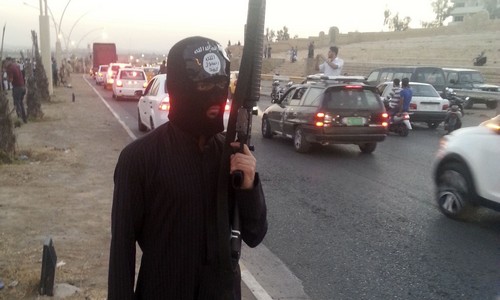
Iraq is a case in point. ISIS – the Islamic State in Iraq and Syria – is a jihadist terrorist organization that has already taken large areas in Syria and made significant gains in Iraq. It is now in the process of setting up a hard-core Islamic state in the heart of the Middle East.

Washington, apparently taken completely by surprise, finds itself in the same camp as Iran, its sworn enemy. Obviously it is to be deplored that Arab countries in the region are unequal to the task of overcoming an organization numbering no more than a few thousand terrorists. On the other hand, since the end of the WWII these countries have squandered their efforts and their resources in internecine warfare and in the conflict with Israel, secure in the knowledge that the US or the Soviet Union would come to the rescue if needed.

The greatest world power thus finds itself not only without a viable course of action in Iraq, but without the allies that might have made such a course possible.

Washington seems to have grasped the extent of its predicament. Secretary of State John Kerry has been making the rounds of Arab states to see whether he can cobble together a coalition to act in Syria and Iraq. He came to Cairo bearing gifts, and pledged to unfreeze speedily the dispatch of Apache helicopters badly needed by Egypt to fight jihadist terrorists in the Sinai Peninsula.

That freeze, together with most of America’s military aid, had been intended to “punish” the Egyptian people and the army that had dared to topple a “democratically elected president.”

Washington has yet to understand that truly democratic elections in the Middle East – except in Israel – will entail a profound cultural evolution enshrining the rights of the individual, gender equality, and tolerance towards minorities.

No amount of pressure will change the reality in Egypt. Kerry promised to unfreeze the supply of all military aid, though he hinted that Cairo should progress toward greater democracy. It will not help to bridge the gap between the two countries, since the leaders of Egypt as well as most Egyptians are deeply offended by what they see as an undeserved snub.

Having gotten rid of the Muslim Brotherhood they thought that America would applaud and offer them help. There are signs that Washington has grasped at last the importance of Egypt as a stabilizing factor in the region.

Unfortunately, it was not the only miscalculation of America’s foreign policy. Washington had offended long-time allies, such as Saudi Arabia, a staunch friend since 1940. Riyadh is still bitter at what it perceives as American treachery in entering secret negotiations with Tehran on Iran’s nuclear program.

In Syria, America could not decide on a course of action. Not only it did not contribute to the fall of Assad, it did not back the moderate Sunni elements that were fighting the dictator, and thus indirectly contributed to the rise of ISIS.

Washington also lost influence in Libya, after leading from behind the European efforts to topple Muammar Gaddafi and is now watching helplessly as the country is plunged into chaos. Granted, Arab states are no poster for democracy and their people generally dislike the West and the United States, but a great power must act according to its own interests and cannot afford to be sanctimonious.

Washington also cannot afford a direct intervention in Iraq. This would entail a considerable war effort stretching from Syria to Iraq and guerrilla operations for which the Americans have no stomach. The human and material price would be too high, and there is no way that a compromise could be achieved between Sunnis and Shi’ites.

There might be a temporary respite for the Shiite government – leading to an increased Sunni hostility to the US, but there can’t be any hope of restoring unity to Iraq. During his recent visit, Kerry repeated that Washington was urging the ruler of Baghdad to form a national unity government with the Sunnis. Something akin to treating a terminal disease with placebos.

Unfortunately, America’s ill-advised policy after conquering Baghdad in 2003 is at the root of today’s problem. The Iraqi Army was disbanded, the civil service dissolved, and the power – held for so long by the Sunni minority – handed over to the Shi’ites, who promptly initiated discriminatory measures against the Sunni minority while moving closer to Shia Iran, the enemy of the West.

Disgruntled Sunnis took to terrorism – first against American troops and then against the Shi’ite population, while some joined the ranks of al-Qaida. The world can only look on while both factions are locked in mortal combat with no issue in sight.

Obama has withdrawn American soldiers from Iraq; had they stayed they would have given ISIS a real fight. On the other hand, he was only fulfilling a pledge made by former president George W. Bush.

Besides, who would have thought that a regular army with hundreds of thousands of soldiers trained by American experts would disintegrate when faced by a few thousands terrorists, however well organized? Though Nouri al-Maliki, head of the Iraqi government, is primarily to blame for having gone too far against the Sunni population, the Americans planted the seeds in 2003.

ISIS is not operating in a vacuum. It is being reinforced by embittered Sunnis and by Beduin tribes recruited in the past by the Americans to combat al-Qaida, something they did with notable success. It is true that not all the population – Sunni and Shia – is engaged in the fighting. There is no civil war yet, but the country is divided de facto. ISIS has taken over the main Sunni centers in the North and the Center and will undoubtedly meet with stiff resistance if and when it tries to progress in the Shia concentrations to the south.

However, it is hard to see Maliki being able to dislodge ISIS from its newly conquered territories. A brutal, extremist militant Islamic state is coming into being in the heart of the Middle East. It will become a bastion of terrorism unleashing its attacks against neighboring countries and sending its faithful on operations in Europe and the United States.

The disintegration of the Ottoman Empire after World War I led to the arbitrary creation of artificial entities; boundaries were drawn with no ethnic or tribal considerations with bitter enemies condemned to live together. These countries are today paying the price of constant squabbling and lack of economic progress.

From Libya to Somalia, Sudan, Syria, Iraq, and Yemen (with Lebanon not far behind) Muslim states can no longer ensure personal security and basic services to their peoples – who often resort to flight, leading to an unprecedented number of refugees.

Can something still be done to reverse that relentless trend? It is highly doubtful.

America, having painted itself into a corner, will watch helplessly as chaos spreads and threatens the West.

The writer, a fellow of the Jerusalem Center for Public Affairs, is a former ambassador to Romania, Egypt, and Sweden.

Florida Senate Democrats Vote Against a Bill to Protect Women From Sharia Law


ANY FORM OF SHARIA LAW IS A VERY REAL PROBLEM AND MUST BE STOPPED IT GOES AGAINST EVERYTHING WE BELIEVE IN IN AMERICA

The ISIS Guide to Building an Islamic State


Obama plays golf while ISIS stands at Jordanian and Saudi borders.


The ISIS moves faster than Obama or Kerry

http://www.debka.com/

The Jordanian air force hit ISIS contingents, Monday night, June 23, as they drove into into the kingdom through the Turaibil border crossing which they seized Saturday, debkafile’s military sources report. The jets destroyed 4 Islamist State of Iraq and Levant (ISIS) armored personnel carriers, which were already on the move. Also Monday, ISIS completed its capture of the strategic Tal Afar and its environs in northern Iraq, capping its conquest in the last two weeks of Nineveh Province and Mosul, all but one town (Ramadi) of the western Anbar Province, and Iraq’s key border posts in the north, west and southwest. Jordan called up military reserves Sunday, after discovering that its capital Amman was to be the Islamist organization’s next prey.

Instead of making straight for Baghdad, ISIS turned west and south for what it saw as softer targets, deploying two forces for shooting into Jordan – one from Syria, for which they also captured Al Walid, through which to head into the kingdom from the north; and one pointing from Turaibil (which the Jordanians call Karame) and aiming for the eastern Jordanian towns of Zarqa, Irbid and Amman. By seizing Turaibil, the Islamists were able to cut off the main Iraqi-Jordanian artery for trade and travel between the two countries. They may have been stopped for now by the Jordanian air strike, espcially if there is a follow-up. Their capture of the key town of Rutba Saturday is seen by Western military sources tracking the Iraqi conflict as marking out the Islamists’ next target. That force split in two – one heading southwest toward the Saudi Arabia border and the other heading west to Jordan. Sunday, June 22, the Islamists put on the world web a new site called “ISIS in Saudi Arabia.”

debkafile’s military and intelligence sources report that the US and Israel have laid on a battery of advanced intelligence-gathering measures in the last few hours, including military satellites, drones and reconnaissance planes for keeping track of the Islamist fighters’ rapid advance. A 500-km broad expanse of desert separates the Iraqi border from Amman which would be no picnic for the ISIS to navigate without discovery. However, they were counting on al Qaeda cells planted in most Jordanian towns to help them make their way across. It is important to remember that the US and Israel are both bound by military pacts to defend the throne of the Hashemite King Abdullah II. As for Iraq’s southwestern neighbor, Saudi Arabia, our sources report that the main topic of conversation between King Abdullah bin Abdulaziz and Egyptian President Abdel Fattah El-Sisi Saturday, June 21 at Cairo airport, was the Iraq crisis and the threat the Islamist extremists threat present to the two kingdoms.

The Saudi king made it his business to stop over briefly at Cairo airport on the way to his summer palace in Morocco, and invite the Egyptian president aboard his plane for that conversation. He wanted to hear El-Sisi promise to reward the oil kingdom and Gulf emirates for the generous financial aid they bestowed on him with a pledge of Egyptian military commando units to the rescue in the event of an al Qaeda invasion. Interestingly, the Saudi monarch’s companion on the royal flight – he also took part in the conversation with El-Sisi – was Prince Bandar bin Sultan, who five months ago was relieved of his posts as Director of General Intelligence and senior strategist of the Saudi campaigns in Syria and Iraq, the first of which failed in its goal to unseat Bashar Assad.

It looked very much as though the king had a change of heart and decided to restore Bandar to his inner circle of advisers under the looming threat of ISIS and its lightening advances in Iraq. That threat also drove US Secretary of State John Kerry to pay an unannounced visit to Baghdad Monday, June 23, after discussing the Iraqi crisis in Cairo with the Egyptian president. His arrival was accompanied by further rapid ISIS territorial gains in Iraq and actions to consolidate its grip. After talking to Prime Minister Nouri Al-Maliki, Kerry said at the US embassy that US support will be “intense, sustained, and effective” – provided Iraq’s leaders came together to form a government representing the rival sects.

debkafile adds: Kerry canvassed Shiite, Sunni and Kurdish leaders for a consensual candidate to lead a government representing all of Iraq’s sects and communities. He had in mind a Shiite prime minister able to gain the endorsement of Grand Ayatollah Ali Sistani. Secretary Kerry planned to visit Irbil Tuesday for talks on this and on Kurdish military aid against the ISIS offensive with the heads of the autonomous Kurdish region. However the Kurds wanted first to hear what they will get from Baghdad for sending their pershmerga militia to fight the Islamists in northern Iraq. Since Maliki is the object of Kerry’s maneuvers to replace him, he is not ready to offer the Kurds any concessions at this point. So Kerry’s Iraq mission has so far struck a high wall.

The jihadi menace reaches a high water mark


Re-Blog from Power Line Posted on June 23, 2014 by Paul Mirengoff in Iraq

“From the ruins of the Obama Administration’s Middle East strategy, the most powerful and dangerous group of religious fanatics in modern history has emerged in the heart of the Middle East.” So says Walter Russell Mead, the distinguished historian of American foreign policy (who reportedly has said he voted for Barack Obama in 2008).

The fanatical group in question is, of course, ISIS. According to Mead, who cites analysts at the Brookings Institution and the Washington Institute, ISIS is more radical, better organized, and better financed than al-Qaeda. It commands the loyalty of thousands of dedicated fanatics, including many with Western and even U.S. passports. And it now controls some of the most strategic territory at the heart of the Middle East.

Given these advantages, Mead concludes that ISIS is “much better positioned to launch attacks in the U.S. and Europe than any of its predecessors.” And though it is preoccupied for the moment in Syria and Iraq, when the dust settles ISIS’s desire to attack the U.S. and Europe will likely be at least as great as that of its predecessors who did attack us.

How did ISIS attain its current status? It flourishes in Iraq because President Obama pulled our troops out. Without our influence and presence in Iraq, the military rotted and ISIS filled the vacuum. ISIS flourishes in Syria in part because Obama dithered (to use Mead’s word) over aiding its rivals in the Syrian opposition.

What can be done now? It’s not clear that anything much can be done in Iraq. Obama likes to talk about “exit strategy.” But the issue now is reentrance strategy. Obama does not seem to have left us with a viable one in Iraq. I assume this was deliberate. In any case, there may be no exit from our exit strategy.

What happens next? Mead says we should watch two developments. First, will ISIS’s momentum carry forward when it reaches the Shia districts of Iraq? It may. According to Mead, the “militias and parade groups currently marching around Baghdad and thumping their chests may not be very effective in the field, and it is not yet clear whether the Iraqi Army will fight any better on Shia home turf than it did in the north and the west.” After all, “the Sunni crushed the Shia in Iraq for decades and there is no law of nature that says they can’t do it again.”

But even if ISIS halts or is halted before it reaches the Shia districts of Iraq, it will still control a large swath of territory in Iraq and Syria. Barring a major rollback, the threat to the U.S. will remain significant.

This brings us to the second key development to watch, namely the political balance that emerges within ISIS held territory. Mead observes:

Tribal leaders, Baathist activists, other religious groups and their allies outnumber the true ISIS cadres by an immense factor. It is far from clear whether the rebel region in Syria and Iraq will be under one increasingly powerful and effective government or whether it falls apart into factionalism and internal power struggles.

For ISIS to impose real order and authority on the population under its military control, and to build up its forces from a guerrilla army to a force capable of imposing dictatorial religious rule on a large civilian population, would be a victory as difficult and in some ways more astonishing than the triumph of its forces on the ground.

Accordingly, Mead suggests that “the U.S. might do better to try to strengthen the non-ISIS components of the Sunni movements in Syria and Iraq than to look to Tehran and the Kremlin for help.”

Right now, though, it’s difficult to imagine that the U.S. has any credibility left with the Sunni movements in Syria and Iraq. We did, but Obama squandered it. Any fissure between ISIS and the Sunnis will have to increase significantly before the U.S. — presumably under a new president — is again taken seriously by Sunnis in Iraq and Syria.

As Mead says:

Rarely has an administration so trumpeted its superior wisdom and strategic smarts; rarely has any American administration experienced so much ignominious failure, or had its ignorance and miscalculation so brutally exposed. . . .

Six years into what the President and his supporters thought would be an era of liberal Democrats seizing the national security high ground from enfeebled, discredited Republicans, the outlook is much grimmer than the President’s team could have dreamed.

The jihadi menace reaches a high water mark

The Growing Salafi-jihadist movement


A current RAND report warns:

“The threat posed by this diverse set of groups varies widely, though several of these groups pose a substantial threat to the U.S. homeland or U.S. interests overseas. Some are locally focused and have shown little interest in attacking Western targets. Others, like al-Qaeda in the Arabian Peninsula, present an immediate threat to the U.S. homeland, along with inspired individuals like the Tsarnaev brothers—the perpetrators of the April 2013 Boston Marathon bombings.

“In addition, some Salafi-jihadist groups pose a medium-level threat because of their desire and ability to target U.S. citizens and facilities overseas, including U.S. embassies. Examples include Ansar al-Sharia Tunisia, al Shabaab, al-Qaeda in the Islamic Maghreb, and the various Ansar al-Sharia groups in Libya.

“The broad trends indicate that the United States needs to remain focused on countering the proliferation of Salafi-jihadist groups, which have started to resurge in North Africa and the Middle East, despite the temptations to shift attention and resources to the Asia-Pacific region and to significantly decrease counterterrorism budgets in an era of fiscal constraint.”

The current American administration of “progressive” ideological’s has no clue what this report says, and that is very bad for the rest of us!

This was found on the Christian Action Network

http://www.christianaction.org/news/2014/6/18/new-studies-assess-increased-terror-threat

The ISIS aquires US Amour


More Evidence of the Lack of US leadership

According to U.S. intelligence agencies the photos of the equipment transfers from Iraq to Syria were posted online by the ultra-violent terror group known as the ISIS that raided all the arms depots and vehicles belonging to Iraq’s Second Division, based in Mosul, which included a motorized brigade and several infantry brigades. The seized weapons are said to include tanks and helicopters but it’s not clear weather the ISIS has anyone capable of using these weapons. However there were also US Stinger missiles there and they could be used to take out Syrian military or civilian planes; as well as any other aircraft from other countries.

Pentagon spokesman Cmdr. Bill Speaks confirmed the weapons transfers and expressed concerns about the captured arms.

“We’re aware of reports of some equipment—namely Humvees—and the pictures that have been posted online,” Speaks said in an email. “We are certainly concerned about these reports and are consulting with the Iraqi government to obtain solid confirmation on what assets may have fallen into ISIL’s hands.”

Speaks added that the loss of the equipment to the terrorist group is “really a matter for the Iraqi government to speak to publicly” because “it is their equipment.” Really does that even matter!  That material, which we gave them, will eventually be used against us and it is this inept administration that allowed this to happen. Maybe Vice president Biden should have thought about this when he decided not to have a “Status of Forces Agreement” with Iraq.

The ISIS claims of setting up a Sunni based Caliphate will be an extremely powerful incentive to those with deep religious beliefs in advancing their goal of world domination. Further, the capture of a significant portion of Iraq and the “desertion” of the US trained Iraq military with embolden the ISIS and will surely enhance their recruiting efforts.

It can not be dismissed that this could lead to unrest in other parts of the global community.