Posted originally on CTH on February 20, 2026 | Sundance | 113 Comments
President Donald Trump delivers remarks and holds a media availability following the Supreme Court 6-3 decision on the meaning of the word “regulate.” WATCH:
.


President Donald Trump delivers remarks and holds a media availability following the Supreme Court 6-3 decision on the meaning of the word “regulate.” WATCH:
.

The latest data showing the US trade deficit widening sharply to about $70.3 billion should not be interpreted the way mainstream economists always frame it. They immediately jump to the conclusion that a rising trade deficit is a sign of economic weakness, when in reality it often reflects the opposite and represents strong domestic demand. According to the latest Commerce Department figures cited in financial reports, the gap widened as imports surged while exports lagged, driven in part by capital goods and technology demand.
A trade deficit is not occurring in isolation. If the United States imports more than it exports, the excess dollars do not vanish, rather, they return as capital investment into US assets, equities, real estate, and Treasuries. That capital inflow is precisely why the dollar can remain strong even while the trade deficit widens. America has been running trade deficits since the late 20th century, yet it remains the world’s primary capital destination.
Imports rose sharply, particularly in industrial supplies, technology equipment, and capital goods linked to AI infrastructure expansion. America is attracting global capital into productive, growing sectors. Historically, trade deficits expand during periods of investment booms because domestic demand outpaces supply.
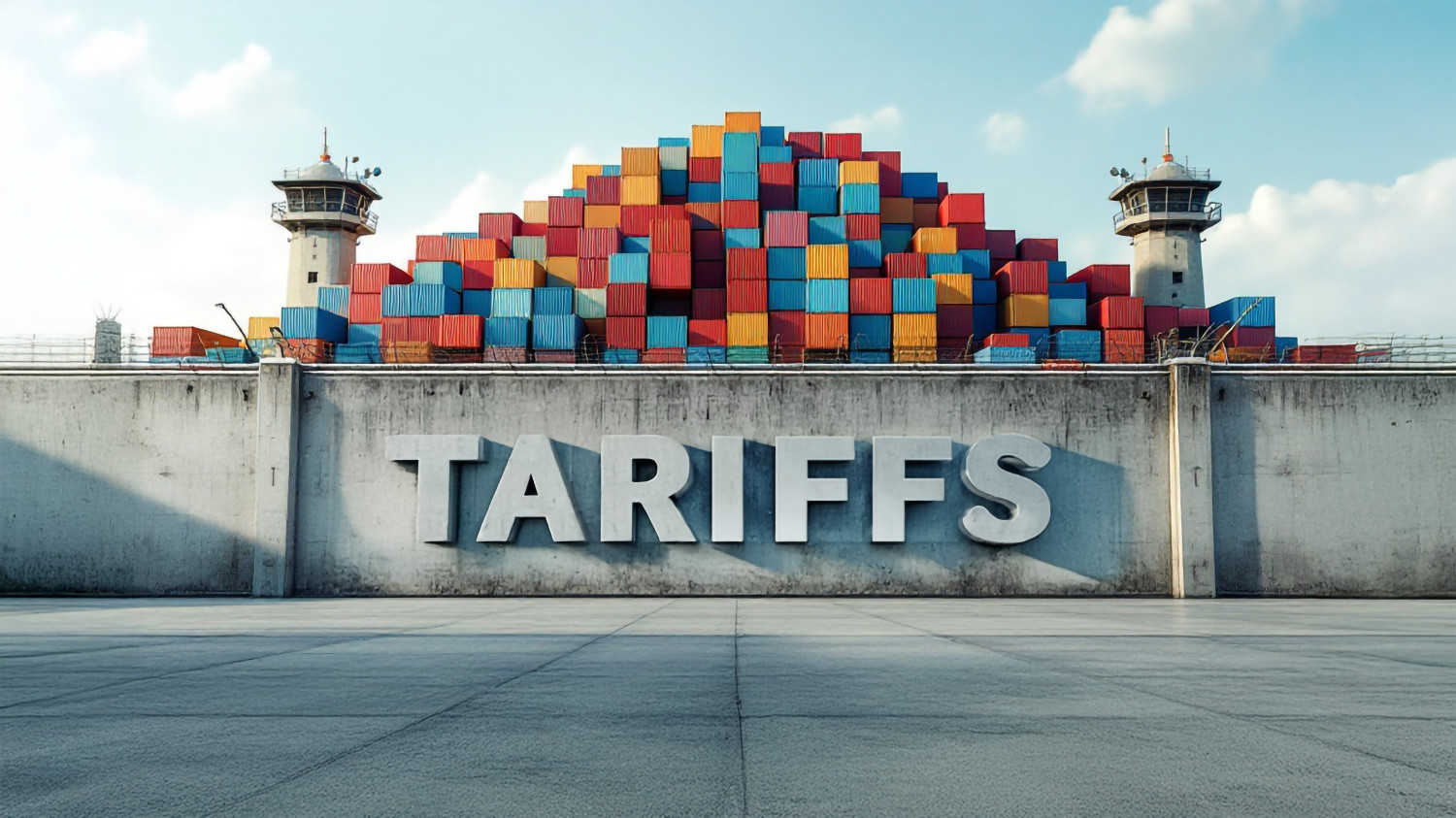
Even with aggressive tariff policies, imports continued rising, and the goods trade deficit reached record levels of around $1.24 trillion in 2025. Trade balances are driven more by capital flows and currency strength than by tariff policy alone. Global capital still viewing the United States as the safest destination amid geopolitical uncertainty in Europe and elsewhere. Capital always moves to the strongest legal and financial system, not the one with the best trade balance. This is why nations like Germany or Japan may run surpluses while still seeing capital volatility.
Countries that run chronic trade deficits are only in danger when capital stops flowing in. The key factor is CONFIDENCE. As long as global capital continues to view the United States as the primary safe haven during periods of geopolitical and economic instability, the trade deficit becomes a reflection of strength in capital attraction rather than weakness.
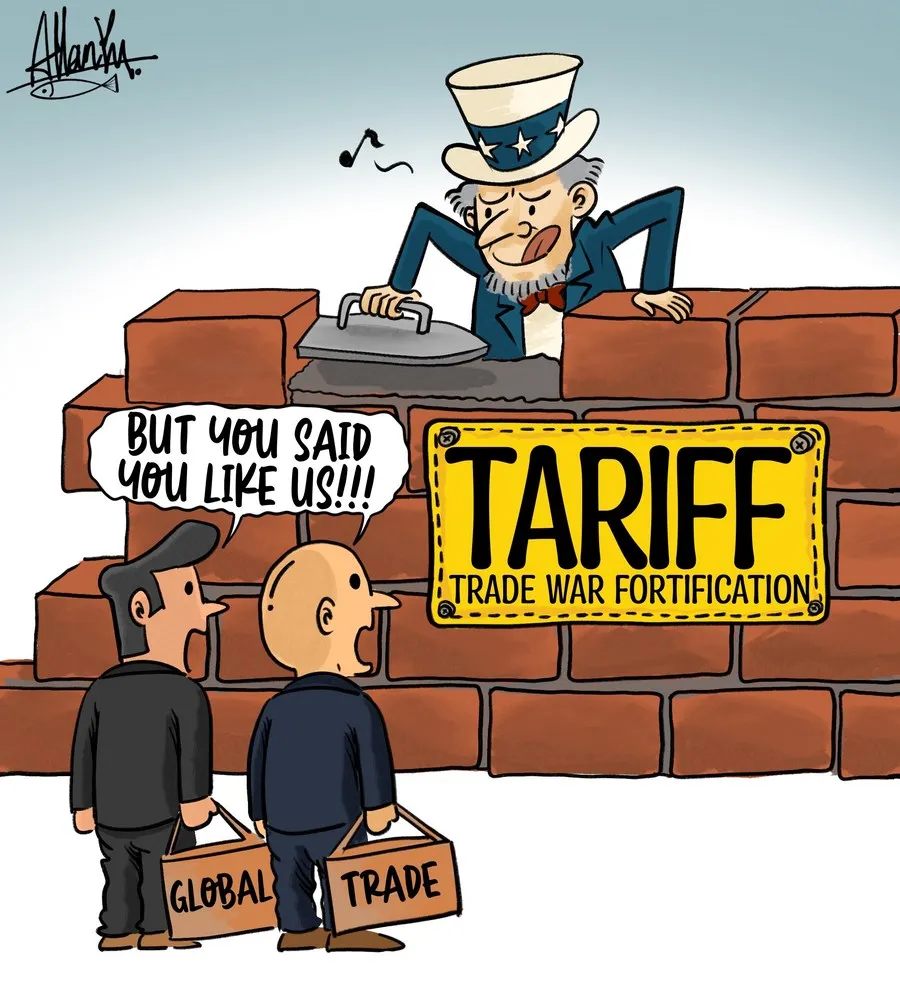
The President cannot unilaterally impose tariffs on antique objects (over 100 years old) if Congress has expressly exempted them. But there are narrow exceptions where a president might temporarily override tariff exemptions, depending on the statutory authority Congress has delegated (e.g., national security statutes like Section 232, emergency powers, sanctions, or trade remedies related to unfair practices).
The Constitution (Art. I, Sec. 8) gives Congress the power:
So tariffs are a legislative power, and antiques have historically been a category that Congress has intentionally exempted. Those of us buying antiquities at a European auction are being hit by tariffs in an entirely unconstitutional manner.
This means the default rule is:
If Congress exempted antiques, the President cannot override it on his own.
Personally, I intend to file for a Declaratory Judgment against Trump because his actions are wholly unconstitutional. The Trump administration used an executive order under the International Emergency Economic Powers Act (IEEPA) to impose sweeping import tariffs on a wide range of goods — including antiques, decorative arts, and certain historical/cultural objects.
Cultural Property News
Under this new regime, items classified under the tariff heading for “antiques” (e.g. Chapter 9706 of the Harmonized Tariff Schedule) are reportedly no longer automatically duty-free as “informational materials.” As a result, many in the art, antiques, and cultural-heritage trade have reported that antiquities — previously exempt — are now being charged tariffs when imported into the U.S. If the same ancient coin is sold in NYC, there is no tariff. If it is sold in London, then Trump demanded tariffs. Tariffs are a Marxist Communist tool and is intended to support domestic jobs from being undercut by foreign. Yet antiquities do not involve modern labor competition.
Why that matters — and why it’s controversial
Historically, U.S. trade law has often treated fine art, paintings, sculpture, and certain expressive/cultural works as “informational materials,” giving them some protection from import duties, especially under tools like IEEPA that were designed for sanctions, not general tariffs.
By using IEEPA (an emergency/sanctions statute) to impose broad import tariffs on essentially all imported goods — including antiques and cultural objects — the Trump administration effectively attempted to sweep aside the traditional distinction/exemption and totally disregard Congress entirely.
Trump is Using Drugs to Justify Using IEEPA
The official “fact sheet” accompanying the February 2025 executive-orders states that the “extraordinary threat posed by illegal aliens and drugs, including deadly fentanyl” constitutes a national emergency under IEEPA. Under that emergency, the administration imposed — or attempted to impose — tariffs: e.g. 25% tariffs on imports from Mexico and Canada; 10% (or more) on China.
Global Trade & Sanctions Law
That marked a dramatic departure: prior to 2025, NO U.S. president had used IEEPA to impose economy-wide tariffs on major trading partners for drug / immigration reasons. That said — whether this unilateral tariff-imposition is lawful remains deeply contested.
As of mid-2025, a major ruling from the United States Court of International Trade found that the executive-order tariffs exceeded the president’s authority under IEEPA, because IEEPA was not intended to grant broad tariff powers. The court held that traditionally only Congress has the constitutional power to regulate tariffs, and that invoking IEEPA to impose sweeping tariffs — including on antiques, art, and cultural goods — may violate that separation of powers.
Therefore: some of the “art and antiquities tariffs” under Trump may be overturned, depending on further court rulings (or how customs enforcement proceeds), meaning the longer-term status of these tariffs — and exemptions — remains uncertain. Antique dealers, collectors, and museums importing “decorative arts, antiques, and cultural objects” are now — at least until the courts fully resolve the issue — facing tariffs where they historically did not.
Whether a given object is exempt depends heavily on classification (paintings/sculpture vs mixed-material antiques), as well as origin, provenance, and how customs officials interpret the rules under the new tariff regime. Because of legal uncertainty and swift regulatory shifts, many in the art world report disruption, delays, and extra costs. So: Yes, Trump did try to include antiquities in tariff coverage, even though traditionally many cultural-heritage imports had exemptions. But that move is now being challenged legally — and some courts have already deemed parts of it unlawful.
The Supreme Court heard oral arguments on November 5th, 2025, and it is to decide the legality of the tariffs imposed under the International Emergency Economic Powers
Act (“IEEPA”). Respondents insisted the Court of International Trade (“CIT”) had exclusive jurisdiction over such challenges, but the federal district court disagreed.
No Article II tariff power exists that Trump can invoke. The Constitution gives the tariff power to Congress, and only Congress can authorize the President to “lay and collect Taxes, Duties, Imposts, and Excises.” U.S. Const., art. I, § 8.
Trump points to IEEPA. See, e.g., Executive Orders 14298, 14266, 14259, 14257, 14256, 14245, 14232, 14231, 14195, 14194, 14193. He has done so to impose specific tariffs on some of the
Nation’s largest trading partners. E.g., Executive Orders 14193 (Canada), 14194 (Mexico), 14195 (China). He has done so to impose reciprocal rates on other countries to improve America’s balance-of-payments. Executive Order 14257. And he has done so to impose a more-or-less universal floor tariff of ten percent on all foreign goods sold in the United States. Id. Some of those tariffs have been altered or held in abeyance (for now), but not all. What certainly hasn’t changed is the President’s claim that IEEPA gives him a free hand to tariff.
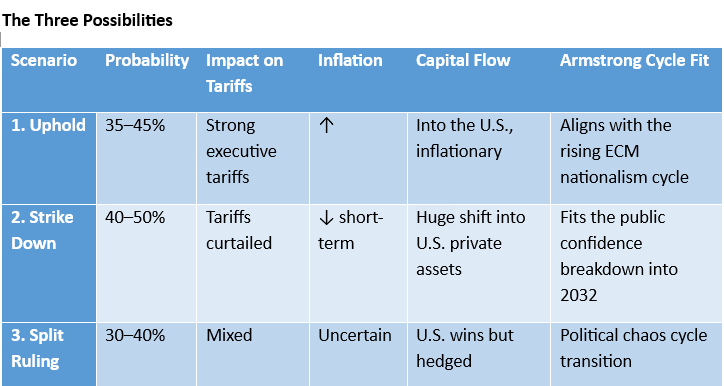
We will see how the court will rule. There are three possibile outcomes. If we were to rule by strict construction, I would strike it down as an abuse of power. Because Trump is citing “extraordinary threat posed by illegal aliens and drugs, including deadly fentanyl” as the national security issue to justify using the IEEPA, I do not see how that justies tariffs on any product from Europe, not to mention antiquities.
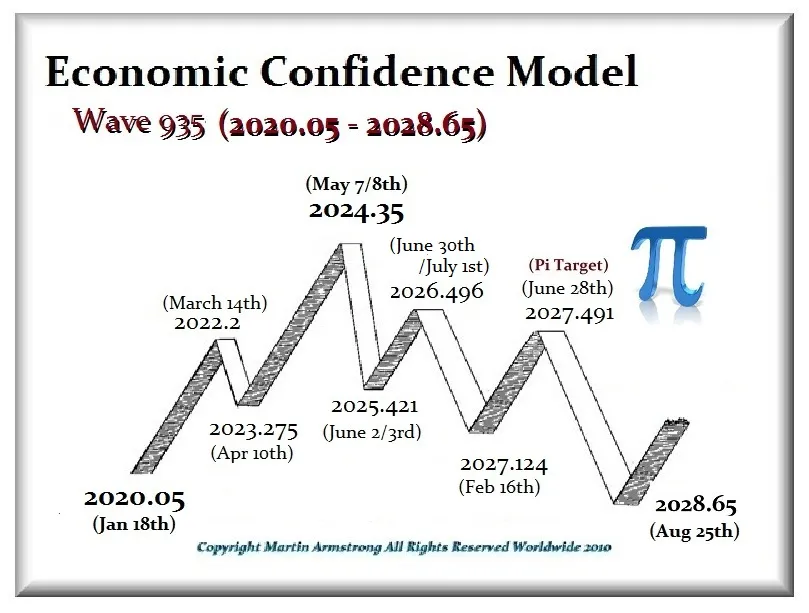
Trump’s tariffs coming on the downside of the ECM is in line with the recession our model has forecast from 2024 into 2028. These tariffs on top of the stupid sanctions on Russia which will result in higher food costs in addition to energy, does not paint a pretty picture for the world economy into 2028 which will be aggravated by the rising Sovereign Debt Crisis.
President Donald Trump has proposed a $2,000 tariff “dividend” to every American. Reminiscent of the stimulus checks provided during COVID-19, the payment comes at a time of low public confidence in government and government policy.
Tariffs generated $151 billion between April and October, according to the Committee for a Responsible Federal Budget. Treasury Secretary Scott Bessent believes duty collections will reach half a trillion per year.
This does not simply mean that the US federal government has a few extra billion lying around to disperse to the public. America has over $37 trillion in debt that is expanding by the second. Tariffs are an indirect tax paid by consumers through higher prices, not a penalty absorbed solely by foreign producers. A “dividend” payment to Americans would offset that indirect tax. This is not inflationary in itself, rather, it is merely shifting money from importers and consumers back to individuals. It’s a redistribution, not a monetary expansion.
“The $2,000 divided could come in lots of forms,” Treasury Secretary Scott Bessent said. “It could be just the tax decreases that we are seeing.” Also reminiscent of the COVID stimulus checks, these payments likely would not go to Americans earning over a certain threshold. The US does not need to stimulate spending at this time. Consumer spending remains high amid inflation. Consumer sentiment is low, but that does not correlate with spending; however, it does correlate with confidence.
The nation recently witnessed the celebration of a socialist politician, Zohran Mamdani, who became the mayor of NYC through free offerings. The public has its hand out and is waiting for the government to fix the cost-of-living crisis. The premise is more of a political stimulus rather than a monetary one.
The public always demands government do something, and politicians respond with short-term gimmicks to preserve power. But the underlying problem is systemic. We’re witnessing the end of Keynesian economics. The idea that government can endlessly manage the economy through fiscal manipulation is dying.
I have created this site to help people have fun in the kitchen. I write about enjoying life both in and out of my kitchen. Life is short! Make the most of it and enjoy!
De Oppresso Liber
A group of Americans united by our commitment to Freedom, Constitutional Governance, and Civic Duty.
Share the truth at whatever cost.
De Oppresso Liber
Uncensored updates on world events, economics, the environment and medicine
De Oppresso Liber
This is a library of News Events not reported by the Main Stream Media documenting & connecting the dots on How the Obama Marxist Liberal agenda is destroying America
Australia's Front Line | Since 2011
See what War is like and how it affects our Warriors
Nwo News, End Time, Deep State, World News, No Fake News
De Oppresso Liber
Politics | Talk | Opinion - Contact Info: stellasplace@wowway.com
Exposition and Encouragement
The Physician Wellness Movement and Illegitimate Authority: The Need for Revolt and Reconstruction
Real Estate Lending
 Centinel2012