Representative Don Bacon Says if Trump Left NATO “There Would Be a Civil War in The Republican Party”


Posted originally on CTH on March 18, 2026 | Sundance 

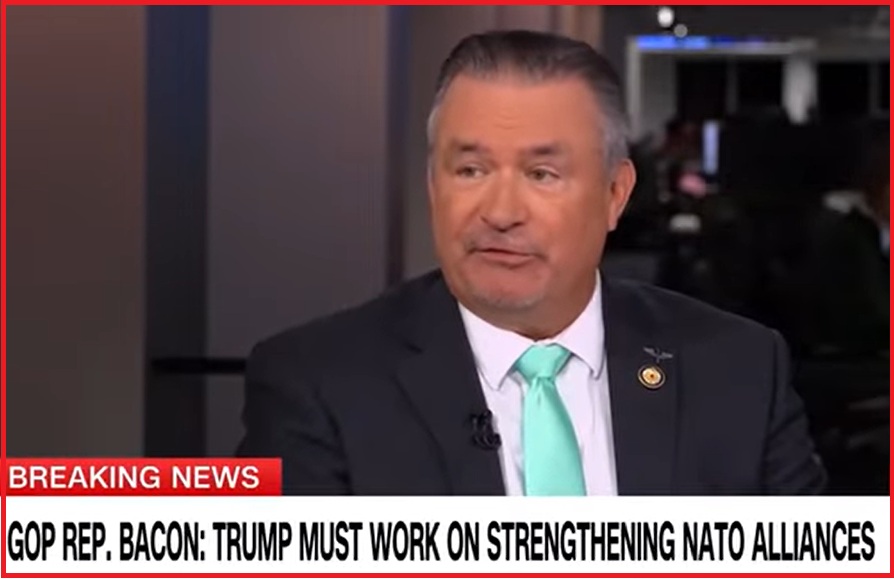
Representative Don Bacon is openly and publicly in opposition to every President Trump policy.  Bacon is a ‘professional republican’, a traditional DeSantis republican.

Appearing on CNN the Nebraska Republican says if President Trump were to leave NATO, “there would be a civil war in the republican caucus.”  WATCH (prompted):

.

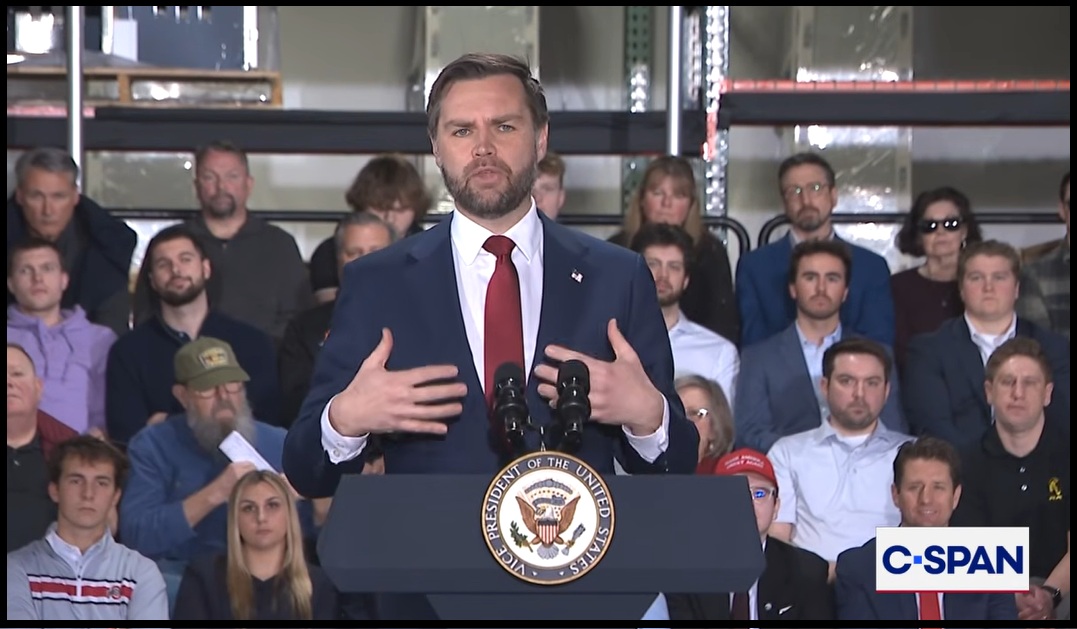
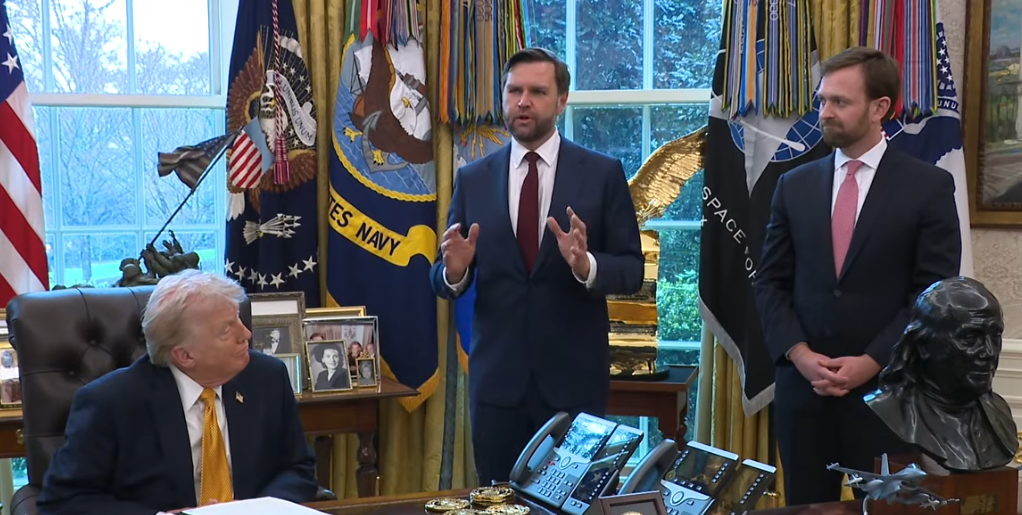
Vice President JD Vance Responds to Question About Joe Kent Resignation


Posted originally on CTH on March 18, 2026 | Sundance

Vice President JD Vance was asked about NCTC Director Joe Kent resigning from his position over a disagreement surrounding the Iran conflict.

This could have been a challenging question for Vance to answer because both Vance and Kent are funded and supported by the same ideological donor, Billionaire Peter Thiel.  [FYI Tucker is also in this stable] Thiel is a libertarian minded billionaire within Big Tech and not necessarily an ideological fan of Donald Trump or MAGA.  Palantir is one of Thiels companies with CEO Alex Karp running it.  Palantir is a major contractor within the national security apparatus.

JD Vance adroitly navigates the answer by saying once the President makes a decision, the role of all subordinates is to get behind that decision, and never openly compromise your leadership.

“It’s one thing to have a disagreement of opinion…That said, whatever your view is, when president of the United States makes a decision, it’s your job to help make that decision as effective and successful as possible…If you are on the team and you can’t help implement the decisions of his administration, he has the right to make those decisions, then it’s a good thing for you to resign. And I think that’s exactly right. It’s fine to disagree, but once the president makes a decision, it’s up to everybody who serves in his administration to make it as successful as possible.” WATCH:  

.

It’s obvious Team Thiel didn’t agree with the policy decision to attack Iran, that’s more of a neocon Team Ellison/Adelson policy move.  However, JD Vance is very correct in how the Team Thiel horses within the administration should respond to the decision in trying to make it as successful as possible.

Thiel <-> Musk <-> Ellison

President Trump Establishes the Task Force to Eliminate Fraud


Posted originally on CTH on March 16, 2026 | Sundance 

Earlier today, President Donald J. Trump signed an Executive Order creating the Task Force to Eliminate Fraud, which will advise the President and coordinate government-wide efforts to combat widespread fraud, waste, and abuse in Federal benefit programs. [Executive Order Here]

According to the White House – The Vice President will serve as Chair of the Task Force, the Chairman of the Federal Trade Commission will serve as Vice Chairman, the Assistant to the President for Homeland Security will serve as Senior Advisor, and an Executive Director will manage daily operations. Relevant cabinet secretaries and heads of government agencies will serve as Task Force members.

The Order directs the Task Force, on behalf of the President, to coordinate a comprehensive national strategy to stop fraud, waste, and abuse across Federal benefit programs, including housing, food, medical care, and cash assistance administered with State and local partners, in order to protect these benefits for eligible Americans.

The Task Force will coordinate measures to improve eligibility verification, implement pre-payment controls, detect high-risk fraud trends, and disrupt and dismantle fraud networks and the mechanisms through which fraud is committed.

The Task Force will also coordinate development of minimum anti-fraud requirements to prevent exploitation of taxpayer-funded benefits, including proof of identity and documentation requirements, risk controls, and audit and remedial actions, while each member agency’ works to develop a measurable implementation plan.

The Task Force will provide frequent updates to the President regarding its work. (read more)

President Trump Answers Media Questions During Roundtable Luncheon


Posted originally on CTH on March 16, 2026 | Sundance 

Moments ago, President Donald Trump took questions from the assembled press pool during a lunch with the Trump-Kennedy Center board members.

The full video is below the fold. However, the shorter segment of media questions and answers is highlighted in this video. President Trump was asked about countries willing to support the military escort request through the Strait of Hormuz. President Trump noted an announcement of supporting countries will be forthcoming.

President Trump also noted the biggest beneficiary of the oil from Iran is China, and he would expect those nations who are dependent on the stability of that oil flow to rise in support of the escorts. WATCH:

.

The full event video is below.

President Trump Calls on Oil Dependent Nations to Send Military Ships to Backstop Security in Hormuz


Posted originally on CTH on March 14, 2026 | Sundance 

President Trump’s latest two messages via Truth Social present an interesting geopolitical approach with multiple enmeshed aspects.

First, some background context is needed.  Treasury Secretary Scott Bessent and USTR Jamieson Greer are in Paris to meet with Chinese government officials ahead of a scheduled meeting between Chairman Xi Jinping and President Trump.

The main objective of the pre-summit assembly before President Trump goes to Beijing, is to hammer out the actionable agreement details that can be signed off by Xi and Trump.  Bessent and Greer are looking to put a deal together with their Chinese counterparts so that Trump and Xi can announce mutually beneficial outcomes during their summit.

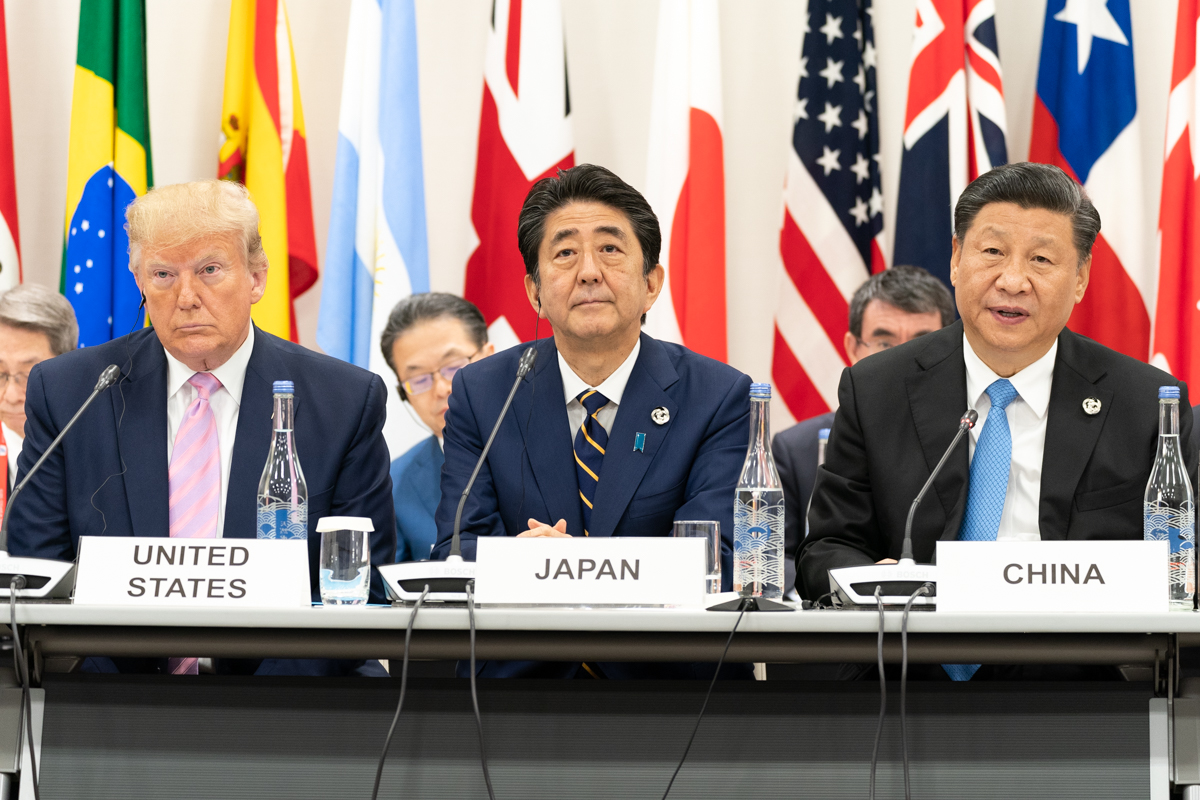
Second, President Trump has already indicated the March 31/April 1 meeting with Xi will be all business. The traditional pomp and splendor will not be present, and Trump will only be visiting Beijing – no sidelines.

Third, Secretary Rubio will be accompanying Trump on this trip to Beijing, which might seem ordinary were it not for the fact that in 2020 China sanctioned and banned Rubio from entering China for criticizing Xinjiang and Hong Kong.

Fourth, there are rumors that President Trump is going to announce a significant weapons deal with Taiwan at some point immediately following the trip.  If those rumors are true, it would be a top priority for the Chinese advance team in Paris to stop that from happening.

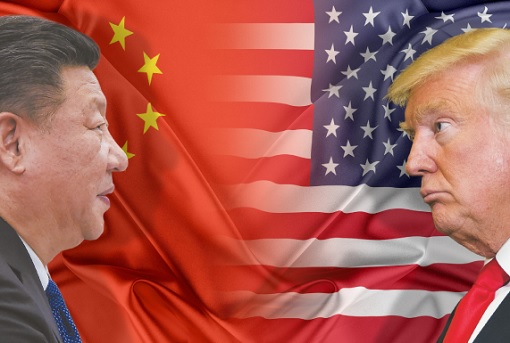
Regardless of what happens in the next few weeks, President Trump will be meeting with Chairman Xi with full Eagle eye confrontation toward the returning dragon stare.  There will be no panda mask on this trip whatsoever; this face to face is an apex predator showdown, while the world watches intently.

Everything President Trump does between now and his arrival in Beijing, should be contemplated through this adversarial position.  With strong moves in Venezuela and Iran President Trump has already pulled Chairman Xi into the jianshu circle, showing the soul of his blade.

Chairman Xi does not have anything resembling a retreat position. He has a highly focused domestic audience, and the eyes from the Great Hall of the People will be watching intensely.

In the next two weeks we will likely see critical probes of both Trump and Xi’s wills surface in ancillary stories connected to each stakeholder, most likely swirling around the Iran conflict. Do not be surprised if we see all of the advanced USA influence purchasing by China now activated with very specific anti-Trump narratives.

That is the context for President Trump to call out many of the oil dependent countries:

TRUTH SOCIAL – “Many Countries, especially those who are affected by Iran’s attempted closure of the Hormuz Strait, will be sending War Ships, in conjunction with the United States of America, to keep the Strait open and safe. We have already destroyed 100% of Iran’s Military capability, but it’s easy for them to send a drone or two, drop a mine, or deliver a close-range missile somewhere along, or in, this Waterway, no matter how badly defeated they are.

Hopefully China, France, Japan, South Korea, the UK, and others, that are affected by this artificial constraint, will send Ships to the area so that the Hormuz Strait will no longer be a threat by a Nation that has been totally decapitated. In the meantime, the United States will be bombing the hell out of the shoreline, and continually shooting Iranian Boats and Ships out of the water. One way or the other, we will soon get the Hormuz Strait OPEN, SAFE, and FREE! President DONALD J. TRUMP

There is a significant overlay here.

First, any nation that sends supportive military ships into the Strait of Hormuz is openly taking a position against the Iranian regime.  China cannot take that position, and President Trump knows it – so he’s calling out the dragon’s alignment for the world to see.

…. If you get oil from the region, come protect your ships while I kill the bad guys…

Remember, Japan has a very limited military, and their post-World War II constitution was blocking them from building one.  Changing that position was the goal of Japanese Prime Minister Shinzo Abe, a friend of Trump, and he was traveling throughout Japan with that message when he was assassinated.  That objective now falls to the protege’ of Abe, Prime Minister Sanae Takaichi.

Japan is included on that list of countries specifically to antagonize the dragon, with President Trump saying I have a strong industrial friend in your back yard.

For the rest, notice the countries Trump did not name: India, Thailand, Vietnam, Philippines or any of the Asian countries that are dependent on oil from the middle east.   Trump is not asking the dependency allies of the United States to participate. Instead, President Trump is calling upon the fake-ally countries that oppose the United States but hide behind a friendly smiling mask.

This is a bold underline for President Trump’s former statement where he publicly doubted the NATO allies would ever come to assist the USA (ie. Greenland), even though they are dependent on the security the USA provides.

In this Iranian conflict, the Europeans are dependent on oil from the middle east, but they will not put their military into the fight even if it secures their own economic future.  Opening the Strait of Hormuz benefits the Europeans, but they only want to pontificate grand prose about it; similar to how they pontificated about the threat Iran presented, then lost their supportive tongue when Trump finally did something about it.

A few hours later, President Trump drives home the point:

TRUTH SOCIAL – “The United States of America has beaten and completely decimated Iran, both Militarily, Economically, and in every other way, but the Countries of the World that receive Oil through the Hormuz Strait must take care of that passage, and we will help — A LOT! The U.S. will also coordinate with those Countries so that everything goes quickly, smoothly, and well. This should have always been a team effort, and now it will be — It will bring the World together toward Harmony, Security, and Everlasting Peace!” President DONALD J. TRUMP

Now we wait to see who steps up.

Spoiler Alert – ¹No one will!

¹And that’s the point Trump is making.

I also concur with this point:

Shanaka Anslem Perera“The coalition call is not about Iran. Iran’s military is destroyed. The coalition call is about the world that emerges after Iran. If America escorts the tankers alone, the Strait reopens under American control and dollar pricing survives. If a coalition escorts them, the Strait reopens under international consensus and the yuan-for-Hormuz proposal dies. If nobody escorts them, the Strait stays closed and China’s shadow fleet is the only commerce moving through it.”

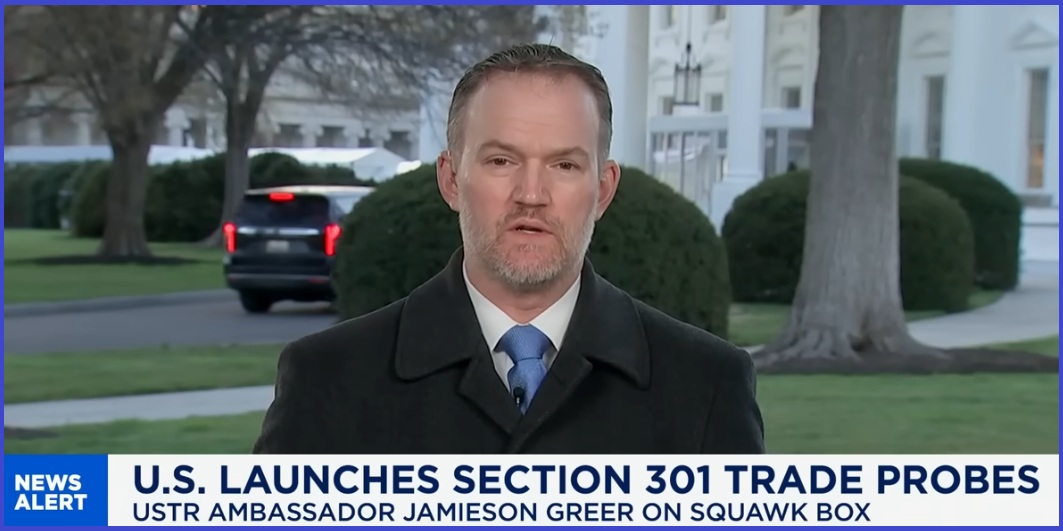
Ahead of Paris Meeting with Chinese Trade Officials, USTR Jamieson Greer Discusses Goals and Objectives


Posted originally on CTH on March 13, 2026 | Sundance 

U.S. Trade Representative Jamieson Greer and U.S. Treasury Secretary Scott Bessent are traveling to Paris this weekend to meet with the Chinese trade officials.  This meeting is in advance of President Trump’s visit to China for direct face-to-face discussions with Chairman Xi Jinping.

Given the recent events in Venezuela and Iran a lot of groundwork must be taking place for the Trump-Xi meeting.  Multiple Chinese interests have been impacted directly.  USTR Jamieson Greer discusses those preparatory issues as well as the recent announcement for Section 301 investigations and tariffs.  WATCH:

.

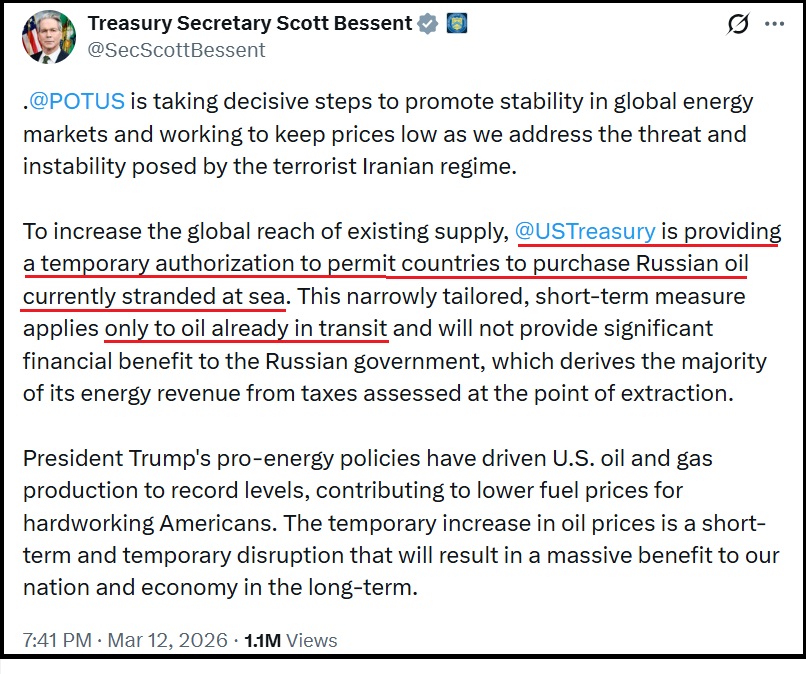
Secretary Bessent Announces “Narrowly Tailored, Short Term Sanction Relief” for Russia


Posted originally on CTH on March 13, 2026 | Sundance |

Trump, you magnificent bastard, I read your book!’

President Trump and Treasury Secretary Scott Bessent are facing mounting criticism for creating a window for Russia to sell oil and gas to the global market via “narrowly tailored, short-term” sanction relief.  However, few people are putting the issue into context, and the background here is exceptionally interesting.

According to the terms announced by Secretary Bessent, the license to sell applies solely to Russian crude or petroleum products loaded onto vessels as of March 12 and is valid through midnight Washington time on April 11. [Treasury Notice Here – OFAC Technical Details Here]

[source]

The sanction relief license to sell will be done in globally recognized petrodollars and applies only to preexisting oil and petroleum products that are already in transit at sea.  However, here’s where it gets very interesting and the ramifications are significant.

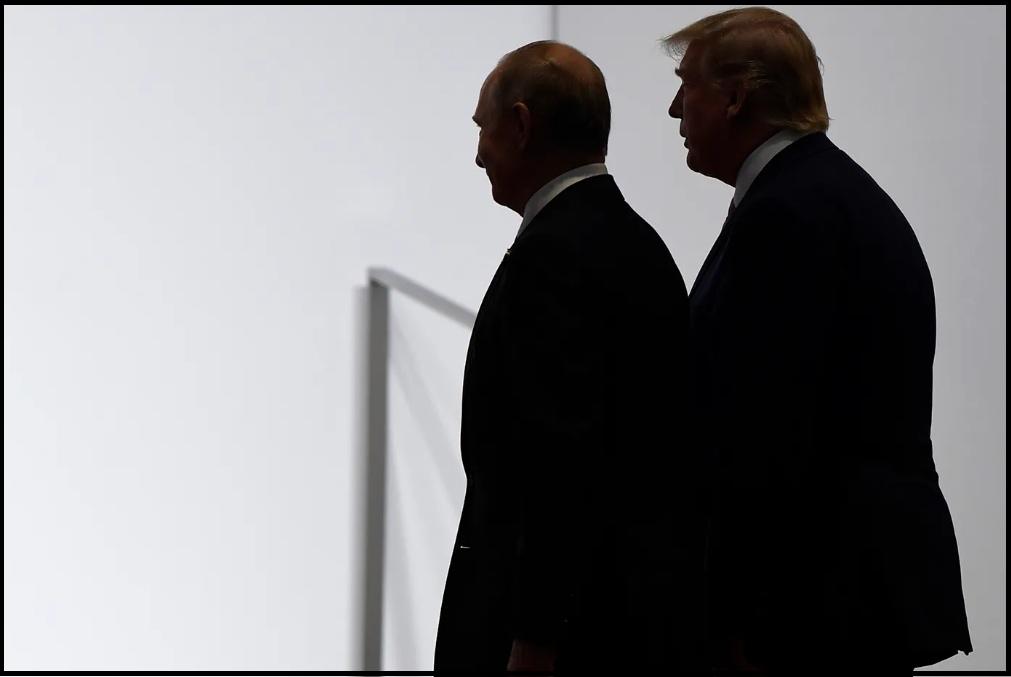
Immediately following the Alaska summit between Russian President Vladimir Putin and President Trump, Russia restarted Arctic-2 LNG terminals and began increasing oil production for storage on ‘floating platforms.’  President Trump met with Putin on August 15, 2025, and the curious increase in Russian production began on August 18, 2025.

In the past six months Russia has been pumping sanctioned oil and gas and storing it on ships and mobile sea platforms, seemingly (at the time) with no customers.  Suddenly, against the background of the Iran conflict, all of that previously stored ‘on the water‘ production, now worth double, is authorized for global sale (in petrodollars).

Either Russian President Putin is the luckiest guy in the world, or Russia knew something.

In 2025 what Russia did following the Alaska summit did not make sense; now it does and the ramifications are stunning.

President Trump was looking for a way to organize a strategic partnership with Russia on the issue of energy production but was hampered by the preexisting sanction regime and strong opposition from domestic and international politics.

The ‘coincidental’ timing’ of Trump meeting with Putin and then subsequently Russia producing massive amounts of oil and gas for storage on the water suddenly starts to take on an entirely new light.  Did Putin know something was coming, something that would eventually make the Russian over production and ‘on the sea’ storage worth billions.

The implications here are quite remarkable; however, they simultaneously explain most of the behaviors since the Iran confrontation began.

Media reports highlight that Vladimir Putin was asked about a previous joint agreement for military support between Iran and Russia and why Russia did not respond when Iran was attacked.  Foreknowledge would explain that reaction.

Additionally, the Russian Federation president never responded to the Trump operation to take down Venezuelan dictator Maduro and seize control over Venezuela’s oil production.

If there was some discussion inferring that a ‘limited sanction relief’ protocol might be possible, that would explain why Russia began storing oil and gas at sea.

This fact pattern would also indicate that President Trump’s decision toward Iran was made at least six months ago, with a set of geopolitical events planned between the Alaska summit and the eventual confrontation with Iran.

TIMELINE: Trump and Putin meet. Three days later Russia begins pumping oil/gas and storing it at sea. President Trump then triggers the Venezuela western hemisphere security operation; Russia stays silent.  President Trump then triggers the confrontation with Iran; Russia rejects involvement. And then two weeks after the Iran confrontation begins, Trump removes sanctions on Russian oil/gas “in transit” at sea.

Suddenly all of the Russian produced and stored product ‘on the water’ has greater value and new customers.

Just a coincidence?  No way.

The United States needs the oil/gas market stability that Russia can provide.

Venezuela was/is to Trump as Ukraine was/is to Putin.

We’ll keep watching.

Enjoy the rest of your day.

.

.

USTR Greer Announces Launch of Sec 301 Trade Investigations into 16 Economies Including the EU


Posted originally on CTH on March 12, 2026 | Sundance 

When the Supreme Court made their ridiculous decision to nullify the import tariffs under the International Emergency Economic Powers Act (IEEPA) use, the high court noted several alternate approaches would not be legally problematic.  One of those approaches would be the use of Section 301 trade tariffs.

Yesterday USTR Jamieson Greer quietly announced that a Section 301 review would be taking place for the following countries: China, the European Union, Singapore, Switzerland, Norway, Indonesia, Malaysia, Cambodia, Thailand, Korea, Vietnam, Taiwan, Bangladesh, Mexico, Japan, and India.”

♦ Section 301 tariffs are a trade enforcement mechanism established under the Trade Act of 1974. They allow the U.S. government to impose tariffs on imports from countries that are found to be engaging in unfair trade practices. The Office of the United States Trade Representative (USTR) conducts investigations to determine if a country is violating trade agreements, and if so, it can impose tariffs as a corrective measure {SOURCE}

USTR PRESS RELEASE – WASHINGTON — Today, United States Trade Representative Jamieson Greer announced the initiation of investigations regarding the acts, policies, and practices of various economies under Section 301(b) of the Trade Act of 1974 relating to structural excess capacity and production in manufacturing sectors.

The investigations will determine whether those acts, policies, and practices are unreasonable or discriminatory and burden or restrict U.S. commerce. The economies subject to these investigations are: China, the European Union, Singapore, Switzerland, Norway, Indonesia, Malaysia, Cambodia, Thailand, Korea, Vietnam, Taiwan, Bangladesh, Mexico, Japan, and India.

“The United States will no longer sacrifice its industrial base to other countries that may be exporting their problems with excess capacity and production to us. Today’s investigations underscore President Trump’s commitment to reshore critical supply chains and create good-paying jobs for American workers across our manufacturing sectors,” said Ambassador Greer.

“The Trump Administration’s reindustrialization efforts continue to face significant challenges due to foreign economies’ structural excess capacity and production in manufacturing sectors. Across numerous sectors, many U.S. trading partners are producing more goods than they can consume domestically. This overproduction displaces existing U.S. domestic production or prevents investment and expansion in U.S. manufacturing production that otherwise would have been brought online. In many sectors, the United States has lost substantial domestic production capacity or has fallen worryingly behind foreign competitors.” (read more)

Additionally, Section 232 [Steel and Aluminum examples] of the Trade Expansion Act of 1962 (19 U.S.C. §1862, as amended) authorizes the President to impose trade restrictions—such as a tariff or quota—if the Secretary of Commerce determines, following an investigation, that imports of a good “threaten to impair” U.S. national security. {SOURCE}

Section 232 is currently covering all the steel and aluminum import tariffs.

Section 122 of the Trade Act of 1974 allows the U.S. president to impose tariffs of up to 15% to address “large and serious” balance-of-payments deficits. This authority can be exercised without prior congressional approval for a limited duration of 150 days. After this period, any tariffs must be extended by Congress. {SOURCE}

Section 122 has already been deployed to retain the “baseline reciprocity tariffs.”

USTR Greer is now walking through the process of deploying Section 301 and will eventually become the legal underpinning to replace Section 122 and retain all tariff status without congressional extension needed.   Most of this is technical and legal compliance as several of the aforementioned nations have already finalized free trade agreements.

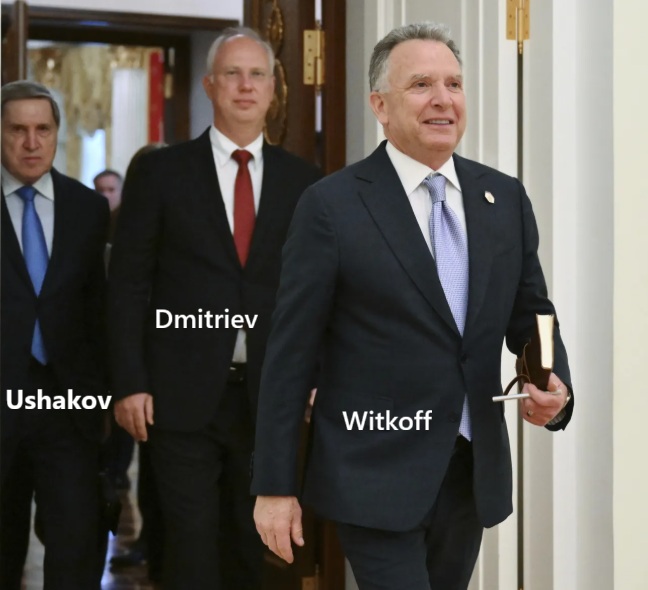
Witkoff and Kushner Meet Russian Delegation in Florida – Reports Indicate Discussions of Strategic Economic Cooperation on Oil


Posted originally on CTH on March 12, 2026 | Sundance 

The fact that Team Russia and Team USA would be discussing a strategic economic alliance on the issue of energy is not a surprise to those who watched both President Putin and President Trump outline that same content discussion in Alaska last August.  However, given the current conflict with Iran and the escalating oil price issue, Russia and the USA discussing Russian oil capacity and U.S. sanctions therein takes on a new angle.

It has been obvious that domestic U.S. politics, in combination with the Russia-Ukraine war, has impeded President Trump from organizing a strategic reset with Russia pulling away from historic conflicts.  However, CTH is also clear-eyed on the longer-term ramifications for Eastern Europe when contrast with Putin’s ambitions to fix what he perceives as prior Russian Federation mistakes regarding the West (more on that at the end).

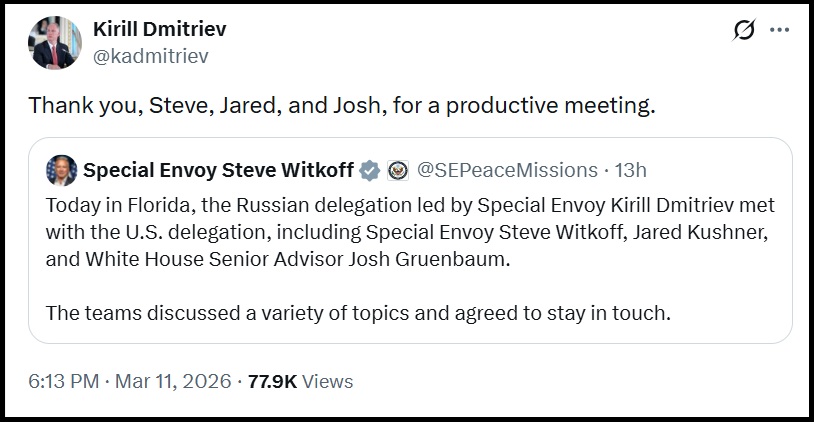
As noted in social media exchanges from Witkoff and Dmitriev, the discussion was productive.

[SOURCE]

All indications of this meeting give the appearance of less focus on progress in the Ukraine-Russia conflict, and a higher focus on current economic conditions -created by the Iran conflict- that could be enhanced with cooperation between the U.S. and Russia. {GO DEEP BACKGROUND}

According to Kirill Dmitriev, Russian special presidential envoy for investment and economic cooperation with foreign countries and director general of the Russian Direct Investment Fund (RDIF), relayed through the Russian News Agency (TASS), “he visited the US upon orders from Russian President Vladimir Putin, taking part in a meeting of the heads of a working group on economic cooperation between the two countries.”

According to the envoy, the meeting addressed both promising projects that can help restore Russia-US relations and the current crisis on global energy markets.

The US is becoming increasingly aware of the role of Russian oil and gas in ensuing the stability of the world economy, as well as of the [in]effectiveness of sanctions against Russia, Dmitriev said after the meeting. (source)

“We discussed promising projects that could contribute to the restoration of Russian-American relations and the current crisis on global energy markets,” Dmitriev also wrote in a Telegram post.

“Today, many countries, primarily the United States, are beginning to better understand the key, systemic role of Russian oil and gas in ensuring the stability of the global economy, as well as the ineffectiveness and destructive nature of sanctions against Russia.”

With the strong likelihood that Russia’s restart of their flagship LNG terminal Arctic-2 was directly related to the August summit in Alaska {SEE HERE}, there is already a baseline established for strategic cooperation.

President Trump would have no problem with Russia introducing millions of barrels of oil into the global market given the issues created by conflict in/around the Strait of Hormuz.  However, obviously the issues for streamlined Russia oil exports surround (1) preexisting sanctions, (2) domestic U.S. anti-Russia politics and (3) the political and economic position of the anti-Russia European Commission leadership.

As we previously outlined with the Liquified Natural Gas (LNG) benefit, Russia previously extracted, liquified and pumped massive amounts of LNG into floating storage platforms from Arctic-2.  Those LNG supplies doubled and tripled in value in a few days once Qatar shut down their production facilities and are now being sold to various Asian countries.

Europe has a massive energy problem with severely low LNG storage rates and now a shortage of oil, with EU gasoline prices rising much higher & faster than the rest of the world.  Europe is facing a severe energy crisis overall and now their preexisting economic troubles are being amplified.

More than ever Europe needs the Russian oil/gas, but ridged ideologues will never compromise on their anti-Russia position.  They have even steeper sanctions against Russian oil/gas scheduled to trigger at the end of this month.

It will be interesting to see how President Trump navigates the potential benefit from Russian energy products into the global market against the backdrop of all the geopolitical angst and political opposition against Russia.

…. AND that brings me to a point of discussion that I’ve had with a few dialed-in people.

When you look at the long term, and when you overlay the mindset of Russian President Vladimir Putin, almost everyone in Russia/Eastern Europe who evaluates the future can see the potential for Putin to exploit the EU’s self-created economic vulnerabilities for his own expansionist objectives.

Yes, some elements of the U.S. banter about further Russian expansion are not propaganda.  Most of it is, but there is an element to the future forecast -beyond the Ukraine conflict- that could see Russia in a much stronger position, and the EU in a position of significant weakness.

The MAGA-minded European and Russian people, the ones who have strong wisdom on the issues, can all see a specific set of dominos falling that could place Putin in a position to recapture the remaining pro-Russian geographies in Europe back into an expanded Russian Federation.

Given the highly unstable mindset and friction points within European leadership, that would be a very bad combination to contemplate.

A strategic USA reset with the Russian Federation is a reasonable and pragmatic goal.  There is no reason for America and Russia to be in conflict or opposition and pulling Russia away from a relationship with China has massive benefits for both countries.

The Russian people are not affectionate toward China at all, not even a little bit.  In reality, China is a necessary ally for Russia but not a choice they would select if other options were available and variables were changed.  The Russian people are exceptionally independent, incredibly strong and brutally proud; however, they are also more Western-minded (European, without self-flagellation) than Eastern-minded (Asian).

Here’s where/why Trump is being careful and pragmatic.  President Trump doesn’t want to see an outcome where Russia is eventually stronger than Europe.  There’s not enough frictionless history between the USA and Russia to trust Putin when he says the Federation has no plan to expand into Europe.

The USA can/should be strategic allies with Russia. However, it would be much better if a strong Europe existed at the same time.  Hence, Vice President Vance and Secretary of State Rubio continuing to emphasize that Europe needs to stop cowering in politically correct wokeness.  The EU is destroying itself at the same time Russia is getting stronger.

.

Last point, the Lyndon LaRouche team, Promethean Action PAC, are very happy with the ongoing fracture of the USA away from the UK/EU group.  However, be cautious around Political Action Committees who say, “President Trump needs people to understand what he is doing” and we are here as his official policy interpreters.

Remember, President Trump doesn’t need policy interpreters.

President Trump Notes Briefing on Iranian Sleeper Cells that Entered During Biden Open Border Era


Posted originally on CTH on March 12, 2026 | Sundance

During an impromptu press availability last night, President Trump was asked about potential Iranian sleeper cells or groups sympathetic to Iran that are active on U.S. soil.

Obviously, the threat from groups and individuals sympathetic to Iran creates an increased need for the Dept of Homeland Security and FBI to operate enhanced domestic surveillance, an unfortunate outcome that further enhances the need for FISA(702) authorities.

When this potential terror threat is combined with the millions of people who crossed the U.S. southern border during the Biden administration, the Palantir project within Customs and Border Protection (CBP), Immigration Customs Enforcement (ICE), the need for rapid and aggressive deportation tracking and the Dept of Homeland Security (DHS), we can reasonably be assured that domestic surveillance will expand.

On the positive side of the issue, recent reports highlight Iranian citizens helping U.S/Israeli drones to target Iran regime officers on the streets in Tehran which has caused the regime police to withdraw from roadblocks and checkpoints.  [Well-sourced data here] This type of operation empowers the voices of the citizen opposition to organize.  WATCH:

.