Posted originally on Mar 16, 2026 by Martin Armstrong |
The press is reporting that Venezuela is opening its mining sector to American companies, allowing foreign investment to extract gold, diamonds, and rare earth minerals after the National Assembly approved the first step in rewriting the country’s mining laws. The reform extends mining concessions from 20 to 30 years and allows international arbitration in disputes, clearly designed to attract Western capital that had previously been locked out under the old socialist system.
The real story is rare earth minerals and the global race to secure them. Washington has already authorized transactions involving Venezuelan gold through the state mining company Minerven and is working to bring American mining firms into the country. The move comes after the United States began reopening Venezuela’s oil sector to American companies as well, signaling that the real objective is securing access to resources that have become strategically vital.
The deeper issue is that the United States does not control the resources it needs to maintain its technological and military dominance. Rare earth minerals are essential for missiles, fighter jets, radar systems, electronics, and advanced manufacturing. As I have explained before, America’s defense supply chain depends on materials it does not control. That is a serious vulnerability in any geopolitical confrontation.
China dominates the global rare earth supply chain, accounting for the majority of production and refining. In fact, China supplied about 71% of U.S. imports of rare earth compounds and metals in recent years and controls much of the processing capacity for these materials. These minerals are not just another commodity. They are the foundation of modern industrial technology, electric vehicles, renewable energy systems, and the entire defense sector.
This is why Washington has been quietly pursuing mineral deals around the world. The United States has already secured preferential access to Ukraine’s mineral resources, which include significant deposits of graphite, titanium, lithium, and rare earth metals. Ukraine holds roughly 5% of the world’s critical raw materials, making it strategically important in the mineral race. The mineral agreement between Washington and Kyiv was never just about economic reconstruction. It was about securing long-term access to materials needed for modern industry and military technology.
Japanhas also been drawn into this geopolitical struggle. After China restricted rare earth exports in the past, Tokyo began aggressively diversifying its supply chain and securing new mineral partnerships to reduce dependence on Beijing. The entire world is now scrambling to secure access to the materials that underpin modern technology.
Venezuela now enters that equation. The country is believed to possess significant untapped mineral deposits. If these resources are opened to Western investment, it will provide another potential supply source outside of China’s control. That is why this move is important. It is not about reviving Venezuela’s economy. It is about the strategic mineral competition that is quietly reshaping global politics.
Behind every war and every geopolitical confrontation lies the same fundamental issue – resources. Oil dominated the last century. Rare earths and critical minerals will dominate the next. The United States understands that its technological future depends on securing these materials, and that explains the sudden interest in places like Ukraine and now Venezuela.
The public hears about democracy, sanctions, and diplomacy. But the real game is being played beneath the surface. Control the resources and you control the future of industry, defense, and economic power. Venezuela’s coerced decision to open its mineral wealth is just another move on that global chessboard.
Posted originally on CTH on March 13, 2026 | Sundance |
‘Trump, you magnificent bastard, I read your book!’
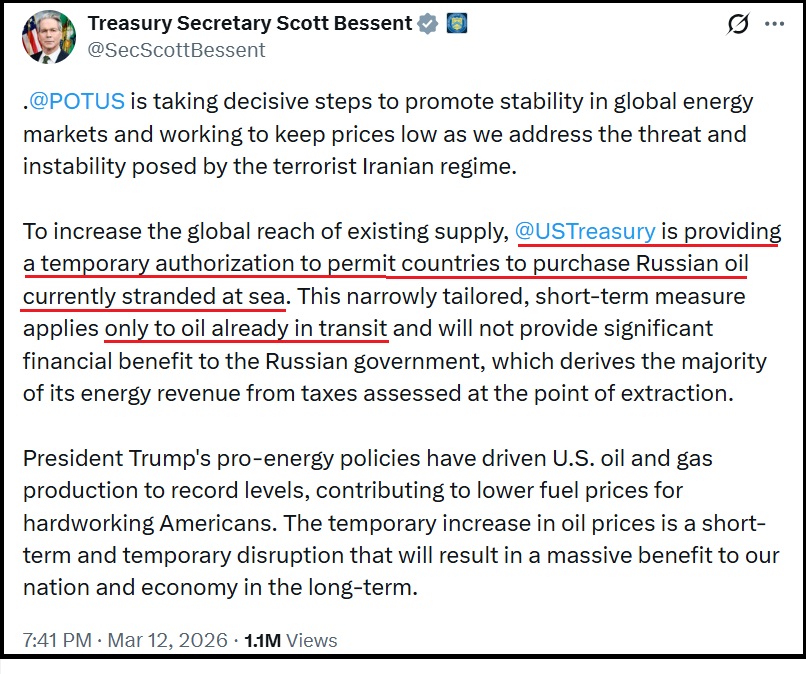
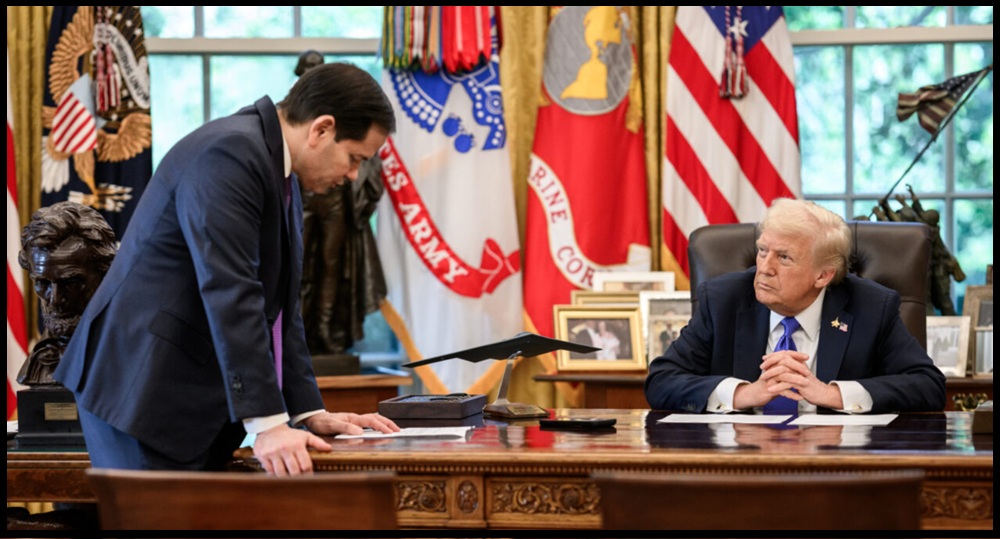
President Trump and Treasury Secretary Scott Bessent are facing mounting criticism for creating a window for Russia to sell oil and gas to the global market via “narrowly tailored, short-term” sanction relief. However, few people are putting the issue into context, and the background here is exceptionally interesting.
According to the terms announced by Secretary Bessent, the license to sell applies solely to Russian crude or petroleum products loaded onto vessels as of March 12 and is valid through midnight Washington time on April 11. [Treasury Notice Here – OFAC Technical Details Here]
The sanction relief license to sell will be done in globally recognized petrodollars and applies only to preexisting oil and petroleum products that are already in transit at sea. However, here’s where it gets very interesting and the ramifications are significant.
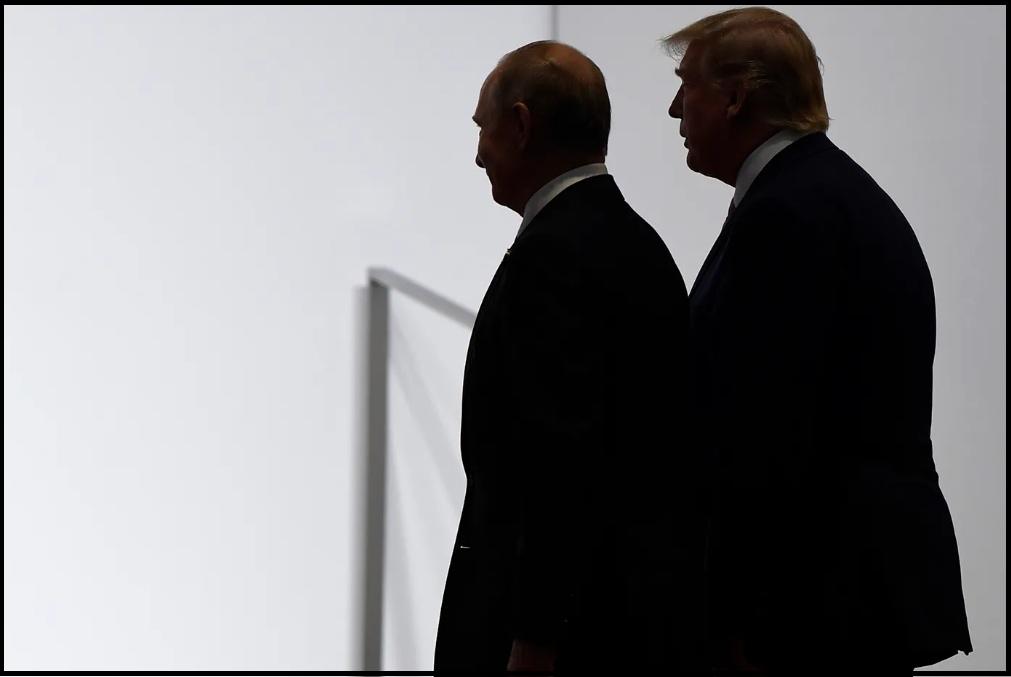
Immediately following the Alaska summit between Russian President Vladimir Putin and President Trump, Russia restarted Arctic-2 LNG terminals and began increasing oil production for storage on ‘floating platforms.’ President Trump met with Putin on August 15, 2025, and the curious increase in Russian production began on August 18, 2025.
In the past six months Russia has been pumping sanctioned oil and gas and storing it on ships and mobile sea platforms, seemingly (at the time) with no customers. Suddenly, against the background of the Iran conflict, all of that previously stored ‘on the water‘ production, now worth double, is authorized for global sale (in petrodollars).
Either Russian President Putin is the luckiest guy in the world, or Russia knew something.
In 2025 what Russia did following the Alaska summit did not make sense; now it does and the ramifications are stunning.
President Trump was looking for a way to organize a strategic partnership with Russia on the issue of energy production but was hampered by the preexisting sanction regime and strong opposition from domestic and international politics.
The ‘coincidental’ timing’ of Trump meeting with Putin and then subsequently Russia producing massive amounts of oil and gas for storage on the water suddenly starts to take on an entirely new light. Did Putin know something was coming, something that would eventually make the Russian over production and ‘on the sea’ storage worth billions.
The implications here are quite remarkable; however, they simultaneously explain most of the behaviors since the Iran confrontation began.
Media reports highlight that Vladimir Putin was asked about a previous joint agreement for military support between Iran and Russia and why Russia did not respond when Iran was attacked. Foreknowledge would explain that reaction.
Additionally, the Russian Federation president never responded to the Trump operation to take down Venezuelan dictator Maduro and seize control over Venezuela’s oil production.
If there was some discussion inferring that a ‘limited sanction relief’ protocol might be possible, that would explain why Russia began storing oil and gas at sea.
This fact pattern would also indicate that President Trump’s decision toward Iran was made at least six months ago, with a set of geopolitical events planned between the Alaska summit and the eventual confrontation with Iran.
TIMELINE: Trump and Putin meet. Three days later Russia begins pumping oil/gas and storing it at sea. President Trump then triggers the Venezuela western hemisphere security operation; Russia stays silent. President Trump then triggers the confrontation with Iran; Russia rejects involvement. And then two weeks after the Iran confrontation begins, Trump removes sanctions on Russian oil/gas “in transit” at sea.
Suddenly all of the Russian produced and stored product ‘on the water’ has greater value and new customers.
Just a coincidence? No way.
The United States needs the oil/gas market stability that Russia can provide.
Venezuela was/is to Trump as Ukraine was/is to Putin.
Posted originally on CTH on March 8, 2026 | Sundance
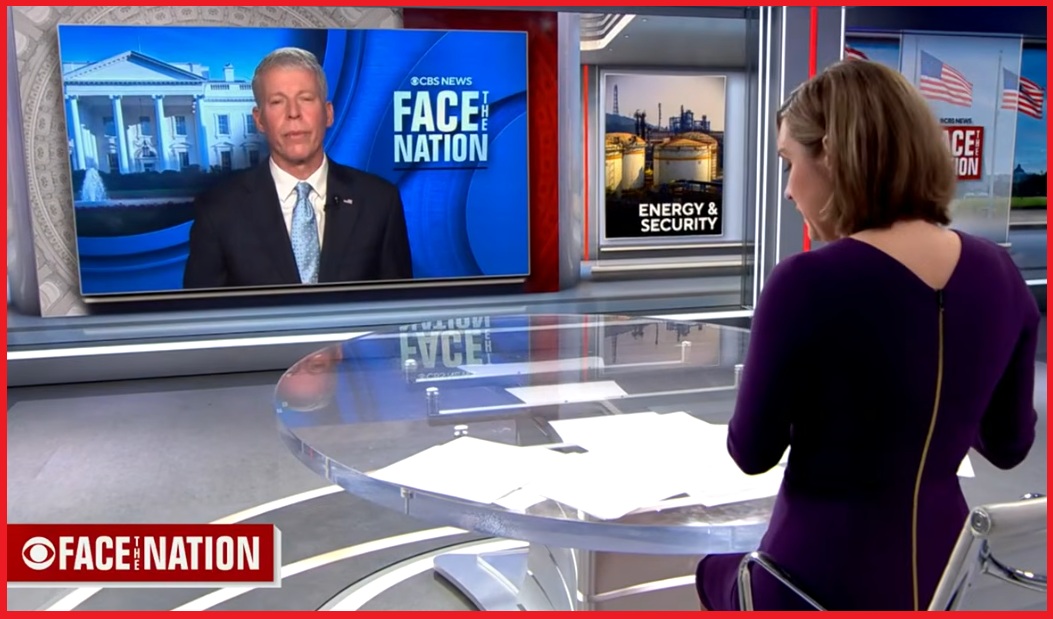
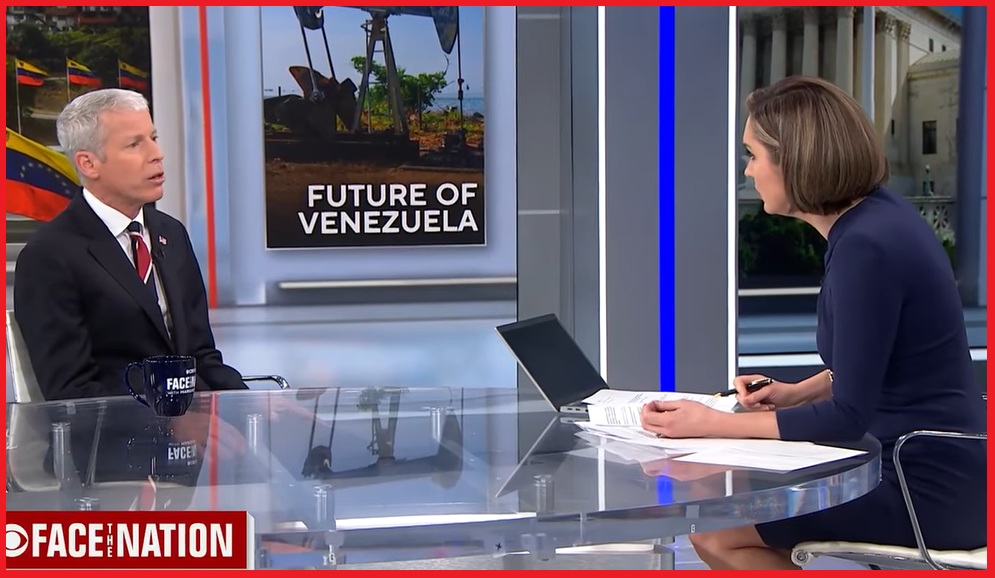
Energy Secretary Chris Wright appears on Face the Nation to push back against the narrative engineering of CBS’s Margaret Brennan. The video and transcript are below.
[Transcript] – MARGARET BRENNAN: We turn now to Energy Secretary Chris Wright, who joins us this morning from Denver. Good morning to you.
SECRETARY OF ENERGY CHRIS WRIGHT: Thanks for having me Margaret.
MARGARET BRENNAN: So 50,000 U.S. troops deployed, six Americans that we know of so far killed in action, civilians stranded. We look at our polling, Mr. Secretary, and we see that this is an unpopular war among the majority of Americans. More than half of them, 56% disapprove. When you speak to energy executives about the scope and duration of American involvement, what do you tell them? How long?
SEC. WRIGHT: I tell them that for 47 years, Iran is warg- waged war against the United States, and they’ve- throughout that 47 years, they’ve tried to undermine the energy development and energy infrastructure of all their neighbors, as they’re doing right now, and it’s time to put it to an end. So yes, we have a, we have a temporary period of elevated energy prices, but it will not be long. In the worst case, this is weeks, this is not months, and it leads to a much better place. It leads to an Iran that’s defanged, that can’t threaten its neighbors, can’t threaten American soldiers and can’t continue to drive up energy prices by making a mess of the Middle East. They can move to commerce, not conflict.
MARGARET BRENNAN: Well, but you have the moment we are in right now, and as you know, gasoline prices up 14% in the past week. According to AAA, reports the national average is $3.45. We’ve seen oil prices spike. How high do you think oil and gas are going to go?
SEC. WRIGHT: They shouldn’t go much higher than they are here because the world is very well supplied with oil. There’s no energy shortage at all in the Western Hemisphere.
MARGARET BRENNAN: Right.
SEC. WRIGHT: The United States is a net exporter of oil, a large net exporter of natural gas. But refineries in Asia and Europe are seeing an interruption from the normal crude flows. But there is massive energy stores around the world. What you’re seeing is emotional reactions and fear that this is a long term war. This is not a long term war–
MARGARET BRENNAN: –But–
SEC. WRIGHT: –It’s a temporary movement.
MARGARET BRENNAN: Sorry, go ahead, temporary movement.
SEC. WRIGHT: No, I’m saying look, we’ve seen previous administration have done everything they could. They begged, bartered and bribed the Iranian government to stop its nefarious activity, stop its murderous behavior, and it simply hasn’t worked, and now, they’re, they’re expanding missile and drone program that are rapidly growing to protect their desire to build a nuclear weapon. We’re going to cross the threshold where we can’t put them back in the box. Now is the time to end their risk to America and the world.
MARGARET BRENNAN: But as you know, when I ask you about energy prices, this is not a supply problem. You said there’s plenty of supply. The head of the International Energy Agency said, lot of oil, logistics are the problem. It’s dislocation. It’s a serious problem. So what he’s referring to there is being able to actually move it around. I know you said there’s, there’s one vessel that’s gone through the Strait of Hormuz. 20 million barrels per day typically go through it. When do you get back to that level?
SEC. WRIGHT: Oh, I think it will be relatively soon. Of course, I don’t know exactly. All of our military assets right now are focused on ending Iran’s ability to kill their neighbors, threaten American soldiers and threaten ship traffic in the Strait of Hormuz, but that’s going swimmingly well. Their missile launches are down 90%, the drone launches are down over 80% I think in the relatively near term, you’re going to see their capacity so low that we’ll see more normal ship traffic return to the Strait of Hormuz.
MARGARET BRENNAN: So you don’t think Navy escorts of vessels are necessary?
SEC WRIGHT: They might be. They might be. The U.S. is here to do everything we can to keep world oil markets supplied. Yes, if they have some residual–
MARGARET BRENNAN: –When will you make that decision?
SEC. WRIGHT: We’re, we’re in engagement right now with people that want to get tankers moving out of the Gulf. And so, yes, there could be there- early tankers probably will involve some direct protection by the U.S. military, but most important is to defang their ability to threaten these ships.
MARGARET BRENNAN: So the president had said he was open to tapping the American stockpile of oil, the Strategic Petroleum Reserve, but I saw you on other networks this morning, kind of throwing cold water on the idea. You referred to it as depleted. Are you saying America doesn’t have adequate stockpiles?
SEC. WRIGHT: No. America still has over 400 million barrels of oil in our strategic petroleum reserve, and, of course, robust production. We’re, we’re, more than happy to use that if it’s needed. But as you said earlier, it’s a logistics issue. Where do they need oil? They need oil at refineries in Europe and in Asia. And that’s why we took a very pragmatic step. There’s over 100 million barrels of floating Russian crude waiting in line to deliver to China. That’s going to be sold, it’s going to be refined, but that could be one or two months from now. So in a pragmatic way, with no change in U.S. policy towards Russia, we told the Indians, bring that into your refineries. You know, if you, if you’re feeling a shortage of crude, prices are being bid up, draw down that Russian crude stocks that are sitting right offshore.
MARGARET BRENNAN: Yeah. So on that point, the U.S. has temporarily suspended some sanctions to make that Russian oil, you say was already going to be sold anyway, make it available. But doesn’t Russia still financially benefit from that? Why isn’t the U.S. seizing those Russian tankers if they are our adversary?
SEC. WRIGHT: Because right now, because right now, we’re worried about Iran and fixing a 47-year problem there, and we’re worried about American consumers. We want to stop the rise in–
MARGARET BRENNAN: –Russia was helping Iran–
SEC. WRIGHT: –gasoline and diesel prices. Well, there’s been rumors of that. We don’t know if that’s true or not. Certainly, they’ve gotten a strong message from us. But this is oil already on the ocean–
MARGARET BRENNAN: –These Iranian drones have Russian parts in them. The Russians have been buying Iranian drones. That is very well documented, and CBS has confirmed and reported that there was sharing of intelligence. Russia providing intel to target Americans. So how is Russia not part of this?
SEC. WRIGHT: Look, Russia, Russia is expert at causing trouble around the world, so I’m not saying they’re not. I’m saying I don’t- if they’re helping Iran, it’s not working very well, but we’re not helping Russia by just accelerating the sale of their oil to stop the rise of energy prices and keep European and Asian refineries in oil. We’re just doing pragmatic things to get through a short period that will bring in an era of even lower energy prices because a major energy producing region of the world, the Middle East, will no longer have a strong, powerful Iran that can threaten their neighbors, that can threaten the United States of America and was not far away from a nuclear bomb. That’s an–
MARGARET BRENNAN: –How much–
SEC. WRIGHT: –unacceptable scenario. That’s the risk to energy prices was not doing anything.
MARGARET BRENNAN: So when the Qataris say you could see $150 barrel in oil, that’s something America could stomach? President Trump wouldn’t say, I’m done with this war because I can’t stand the political pressure and the American people saying I don’t like what I’m paying at the pump?
SEC. WRIGHT: No, the president’s going to continue to stay focused on ending a 47-year conflict, stay focused on growing the global energy supply. This is actually part of that effort. It does involve a temporary impediment to energy production, but on the other side, it will allow much more energy production and much lower energy prices. But this is not a long term conflict. Most presidents have just thought, they’ll kick the can down the road. The risk is simply too great to kick that increasingly dangerous can down the road.
MARGARET BRENNAN: Yeah.
SEC. WRIGHT: President Trump’s bold leadership is enough’s enough. We’re going to put it to an end.
MARGARET BRENNAN: I want to ask you about Venezuela. The U.S. deposed Maduro. He’s sitting in a prison. Just this past week, though, we had the interior secretary visiting Venezuela and sitting across from Maduro’s Chief thug, Diosdado Cabello. This is someone who has a $25 million bounty on his head. He ran the prisons, he ran the militias. He was treated as a counterpart to an American official. Is this the same playbook the Trump administration is going to run in Iran, that you will deal with the same regime you’ve been telling me is terrible to deal with for 47 years?
SEC. WRIGHT: We don’t know what the regime will be in place at the, at the end of this conflict, but we do know that regime will not have a massive weapons arsenal, that that regime will no longer be a massive threat to Americans and to the Middle East and to global oil supplies. President Trump is using bold leadership. We can’t change the world at a blink of an eye, but we can steer it in massively positive directions, and yes, Venezuela is a great example of that. Crime in the nearby Trinidad and Tobago has plummeted already from our actions in Venezuela, and President Trump’s insistence that he’s going to work with that our neighbors to reduce drug trafficking in the Western Hemisphere. Leadership takes- involves risks, but if you want to drive improvement, you’ve got to be confident, you’ve got to have the right agenda, and you’ve got to have the courage to do it. This president does.
MARGARET BRENNAN: Energy Secretary Wright, thank you for your time this morning. Face the Nation will be back in a minute. Stay with us.
Posted originally on CTH on March 7, 2026 | Sundance
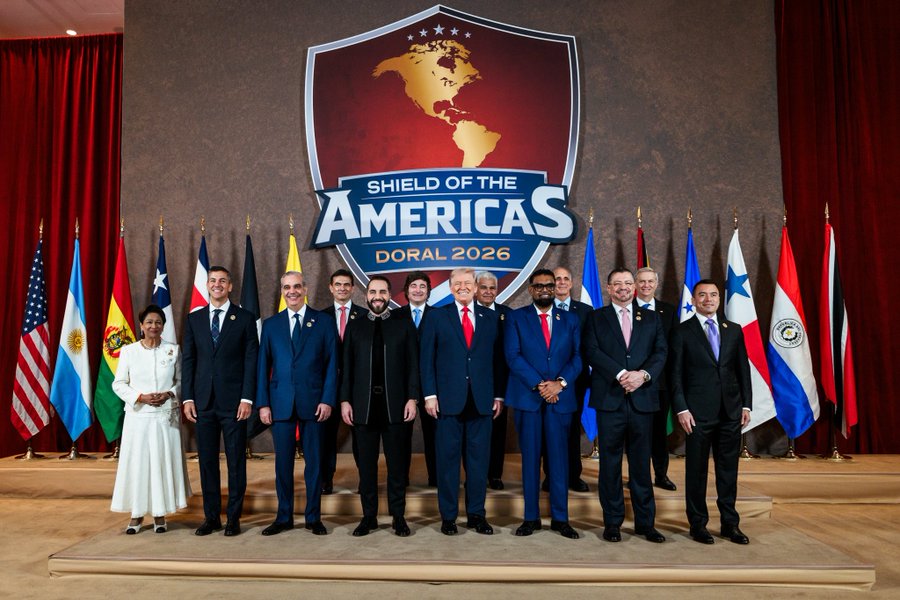
[Full Backstory Here] – President Trump secured the border, began repatriation efforts, targeted narcotraffickers, confronted narco-terrorists, targeted Mexican drug cartel leadership, leveraged the DOJ to indict regional actors, pushed China out of control in the Panama Canal, took out Nicholas Maduro, took control of Venezuela oil production – both for the security of the U.S. and benefit of the Venezuelan people, removed the discounted oil benefit for China and reasserted stability in the Western hemisphere.
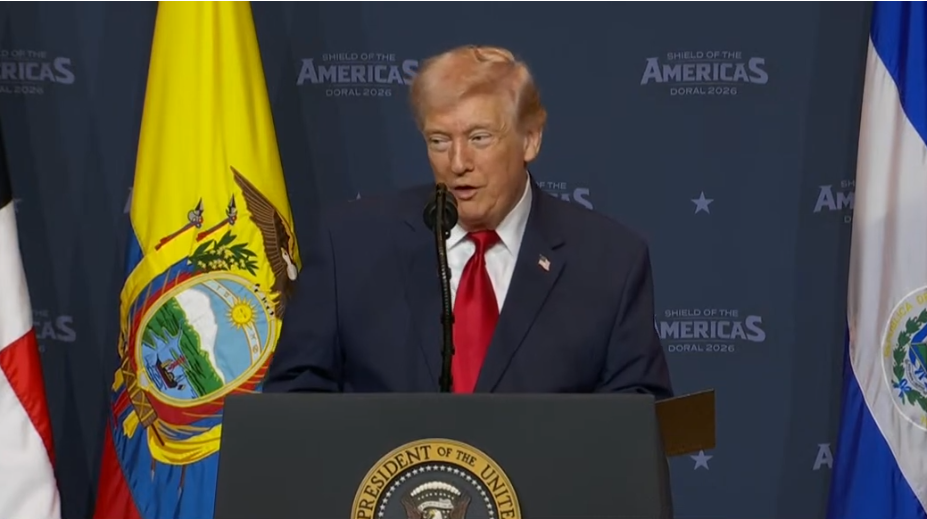
Then, with all that in place, he turned toward Iran…. but, proactively planned for a ‘Shield of the Americas Summit’ before the Iran operation began and scheduled it for today while Operation Epic Fury continues. WATCH:
Posted originally on CTH on March 5, 2026 | Sundance
An interesting reaction from Beijing highlights an evaluation of risk from the lack of oil flowing from Iran.
According to most evaluated data, China was buying more than 80% of Iran’s shipped oil. That’s according to data from 2025 as analyzed by Kpler and published in January by Reuters.
Iranian oil always had limited buyers due to U.S. sanctions. However, China purchased on average 1.38 million barrels per day of Iranian oil last year, according to Kpler. That represented about 13.4% of the total 10.27 million bpd of oil it imported by sea.
With President Trump previously cutting of discounted oil from Venezuela, two things unfolded. First, the Venezuela oil was no longer sold with non-petrodollar currencies; Venezuela oil is now being sold on the standard oil market. Secondly, with the Venezuela oil disrupted China would become even more dependent on Iranian oil shipments if they wanted to retain the discounted rate.
How big is the financial difference?According to Reuters, “Iranian Light crude has traded at around $8 to $10 a barrel below ICE Brent on a delivered basis to China since December.” … “That means Chinese refiners save about $8 to $10 a barrel if they buy Iranian Light rather than non-sanctioned oil.”
Additionally, as noted before Operation Epic Fury began, “Iran has a record amount of oil on the water, equivalent to around 50 days of output, as China has bought less because of sanctions and Tehran seeks to protect its supplies from the risk of U.S. strikes, Kpler said.”
Buying discounted oil from Venezuela, Iran and Russia resulted in billions of dollars saved by China. The only production venue not currently disrupted would be purchases from Moscow. This increases the dependency, but the purchase price may no longer carry any discounted value, at least not at the previous rate.
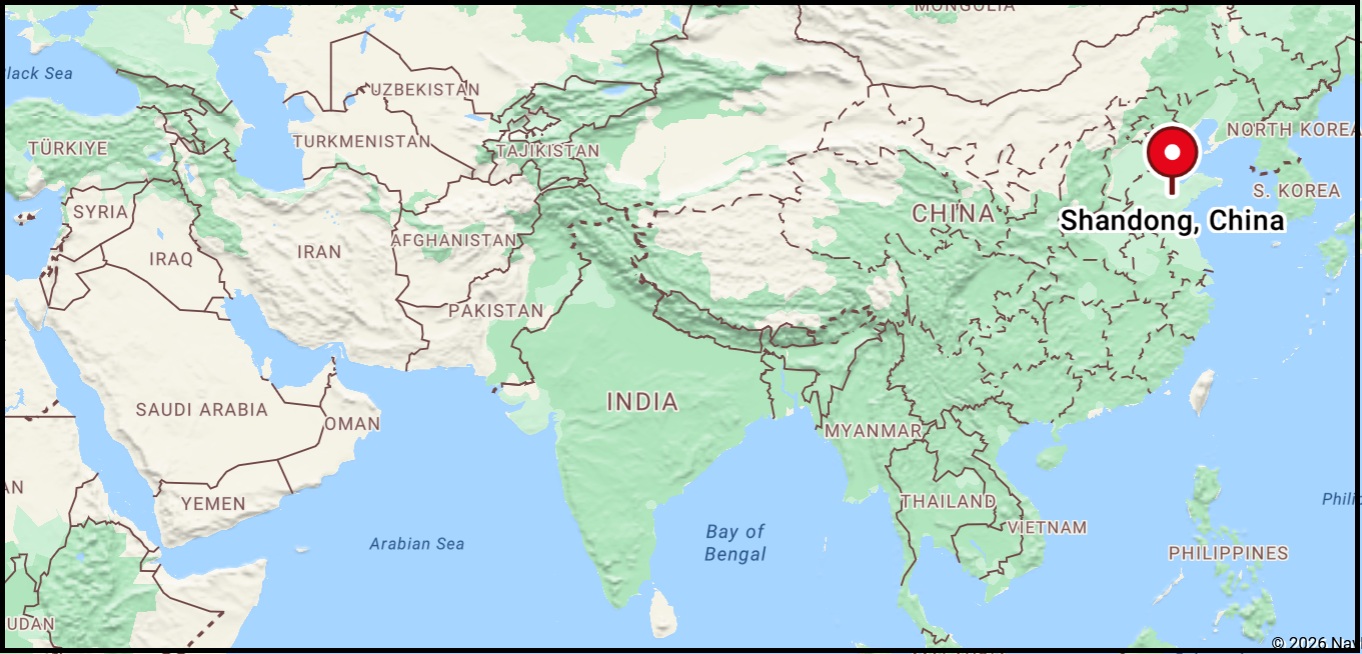
India was purchasing a significant amount of Russian oil for its own refinery use and sale back into the global market. China and India would now be bidding for what is likely a more valuable Russian export. No more discounts put the “teapot” refining operations in Shandong, China, into a squeeze. This also highlights the decision by China to limit refined exports.
[VIA NBC] – China’s government has told the country’s largest oil refiners to suspend exports of diesel and gasoline as an escalating conflict in the Persian Gulf disrupts the arrival of crude from one of the world’s largest producing regions.
Officials from the National Development and Reform Commission, the country’s top economic planner, met refinery executives and verbally called for a temporary suspension of refined product shipments that would begin immediately, according to people familiar with the matter. They asked not to be named, as the discussions are not public.
The refiners were asked to stop signing new contracts and to negotiate the cancellation of already-agreed shipments. The people said. An exception was made for jet and bunker fuel held in bonded storage and supplies to Hong Kong and Macau, they added.
[…] China has a vast refining sector, but much of its production is funnelled to serve domestic demand, meaning it is not a critical supplier. Across Asia, it ranks third for seaborne exports, behind South Korea and Singapore. However, Beijing’s precautionary curbs reflect efforts across the import-dependent region to prioritise domestic needs as the crisis in the Middle East deepens. (read more)
Posted originally on CTH on February 25, 2026 | Sundance
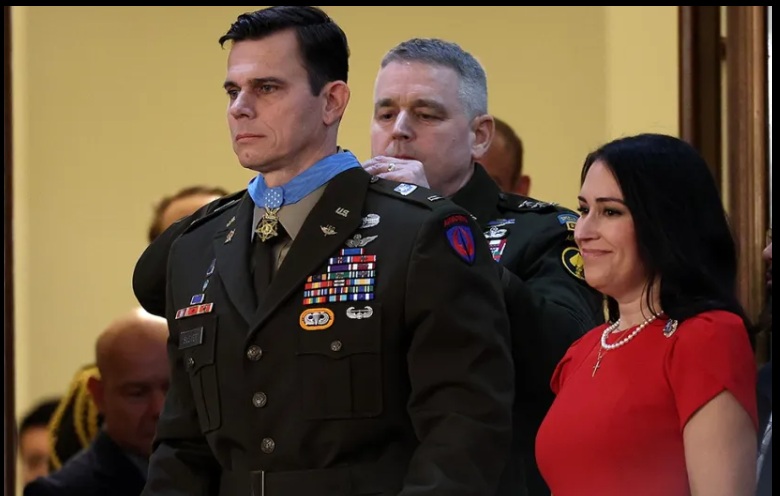
During the State of the Union address, President Trump surprised the audience with the introduction of helicopter pilot Eric Slover who was severely wounded in his legs during the successful raid in Venezuela to capture Nicholas Maduro.
Chief Warrant Officer 5 Eric Slover was repeatedly struck in the leg and hip by hostile fire as he was preparing to land. As his helicopter approached the target area, Venezuelan defense systems opened fire, and Slover was struck four times in the leg. The Chinook was also hit, but still flyable.
So, he kept flying. “One bullet after another. He absorbed four agonizing shots, shredding his leg into numerous pieces,” President Trump noted. Despite his wounds, Slover brought the aircraft and his team back to safety. Slover maintained control of the aircraft despite his wounds, executed the insertion, and ensured his crew successfully executed their objectives. He then piloted the aircraft back to the USS Iwo Jima. Within three hours, another team of helicopters would exfiltrate the assault team.
Slover is still recovering from his wounds and was standing with the assistance of a walker when he received the award. A total of seven Americans were wounded in the operation.
Posted originally on CTH on February 5, 2026 | Sundance
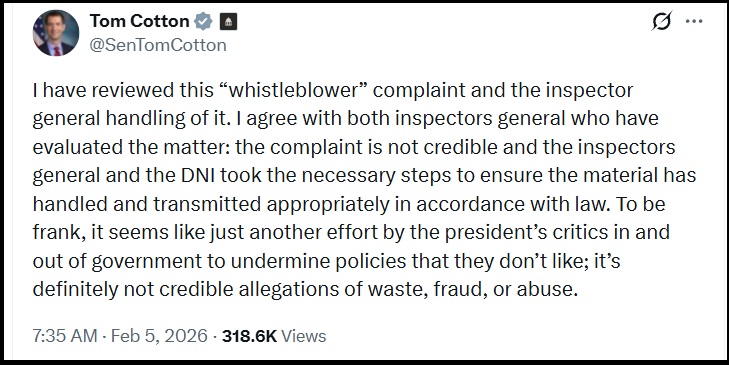
Senate Select Committee on Intelligence Chairman, Tom Cotton, outlines via his X account that he has reviewed the intelligence community whistleblower complaint being used in a ridiculous effort to impeach DNI Tulsi Gabbard and finds it “not credible.”
The entire construct of this CIA-NIC ‘whistleblower’ operation is transparent. We have outlined the basic parameters of the entire fiasco {GO DEEP}. The intelligence community/Lawfare operation is a replay of the 2019 intelligence community/Lawfare operation used to frame Donald Trump during the 2019 impeachment effort.
Even setting aside the insufferable politics of it all, our national enemies must be laughing at us and how easy it is to identify the background of the super-secret, classified and “highly sensitive” national security information regarding Venezuela that underpins the baseline for the CIA-NIC effort.
If a simple website can put it together, then certainly our enemies know our own intelligence community is leveraging the rules and regulations around CIA assets to frame domestic political lawfare operations.
It is stunningly embarrassing on a national level.
Dear Senator Tom Cotton, you are Chairman of the Senate Select Committee on Intelligence. You are a member of the Gang of Eight. You have all the clearances.
Please take a few hours and go to the House Select Committee on Intelligence (HPSCI) scif; sit down with the October 2019 deposition from ICIG Michael Atkinson and read it.
Access should not be a problem with HPSCI Chairman, Representative Rick Crawford, also being a fellow Arkansan.
Read how then ICIG Atkinson gained authority to change the CIA whistleblower rules to facilitate the false claim by CIA National Intelligence Council, Russia desk analyst Eric Ciaramella.
Look at how Ciaramella coordinated with then HPSCI Chairman Adam Schiff, while former AAG of the NSD, Mary McCord, was working as staff on the background structure of the Trump impeachment operation.
Remind yourself of the context. In 2019, ICIG Atkinson was Mary’s former office counsel in the NSD (2016). They worked together on the Trump surveillance in 2016 (Page FISA) and then again in 2019 on the pathway to create an anonymous CIA whistleblower complaint.
What you will notice from that 2019 deposition is the similarity to the whistleblower complaint pathway and IC operation you just reviewed today.
Ciaramella was one of the key authors of the 2017 ICA from his office desk inside the CIA (per Brennan’s instructions to the NIC). Ciaramella was also the anonymous CIA whistleblower in the Trump impeachment 2019. See the issue?
Then ask yourself, if we the ordinary American people can see this stuff and put it together… then what exactly does that say about the SSCI role in oversight?
Posted originally on CTH on February 1, 2026 | Sundance
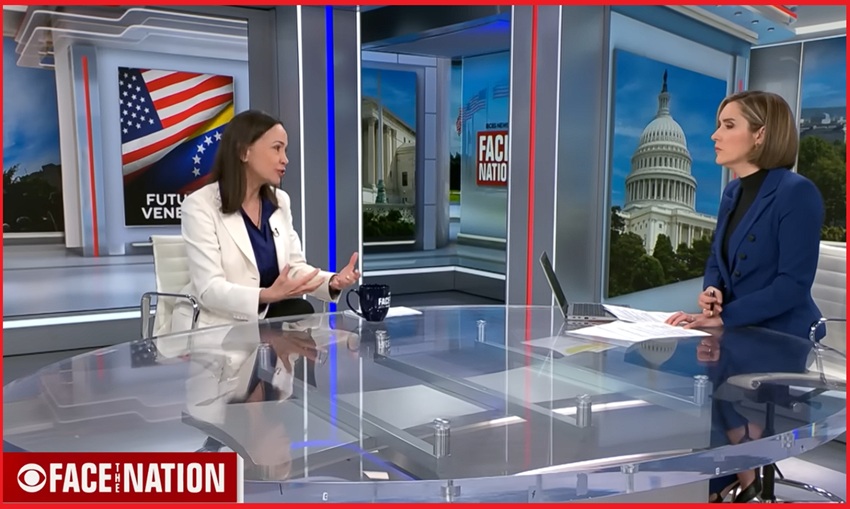
President Trump and Secretary Rubio are walking carefully through a process to keep Venezuela stable and authentic to the true intents of the Venezuelan people. Toward that end, both Trump and Rubio have been very careful with Maria Corina Machado, the exiled opposition leader who claims to be the legitimate voice of the people.
Machado is loved by the United Nations, the American leftists and DC control agents. However, to avoid Machado becoming Venezuela’s Zelenskyy, President Trump and Secretary Marco Rubio are working through a three-stage process that would culminate in secure national elections to coincide with Maria Machado’s return. If she wins the hearts and minds, she will have legitimacy.
If you listen carefully to her phrases and omissions, you can clearly see where the trepidation from Trump and Rubio comes from. There are a lot of platitudes and pretenses within Venezuelan politics. Video and Transcript Below:
[TRANSCRIPT] – MARGARET BRENNAN: And we’re joined now by Venezuelan opposition leader María Corina Machado, and it is amazing to see you here in person after so long.
MARÍA CORINA MACHADO: Likewise. Thank you very much.
MARGARET BRENNAN: You met with Secretary of State Marco Rubio this past week. He said the U.S. now does not intend to have any military action or presence inside Venezuela, except for maybe at a reopened embassy there. Is that a good idea to take that military pressure off when the Maduro regime is effectively still in place?
MACHADO: Well, first of all, I have to say that on behalf of the Venezuelan people, we’re very, very grateful to the American people, and the first hand- first and foremost, to President Trump, to the secretary of state, and also to your leaders in Congress. I mean, the- the degree of support and care that we’ve felt in this fight at this moment is enormous, and I think it is clear on the- on the behalf and well being of the American people, but also of the Venezuelan people, and I would say the whole hemisphere. I do not think that the pressure is being taken away. Actually, everything Delcy Rodríguez is currently doing is because she’s complying with instructions she’s getting from the United States, and important steps are being taken. So I think that the message has been delivered, and so far, we’re seeing the results in the actions taken by the regime, and also in the mood and energy that is growing within the Venezuelan population.
MARGARET BRENNAN: Are you, or is anyone in your movement, in touch with Delcy Rodríguez, who’s the acting president of Venezuela now?
MACHADO: No, not directly.
MARGARET BRENNAN: No. Why not?
MACHADO: Well, we had offered, since we won the election by a landslide, that we were willing to- to agree in the terms of a negotiated transition, they refused. On the contrary, they decided to unleash the- the- the most cruel, brutal repression wave. There are- as you know, there have been thousands of political prisoners, and they had not demonstrated any willingness to- to stop this cruelty, until January 3rd arrived and- and happened when it happened. So it sent a clear message to them, and they’re starting to realize that things have changed for good. So eventually they might understand or- and even very soon, that it is in their best interest to- to accept that transition is unstoppable.
MARGARET BRENNAN: A transition that you hope involves a democratic election at some point. Did Secretary Rubio give you any kind of timeline for the American plans?
MACHADO: What I do have very clear is that the end result is the same. What we want, what the Venezuelan people have voted and struggled and fight for with huge cause and sacrifice, and what the United States government and President Trump also desires. It is a very complex process. I mean, this is a criminal structure that has intertwined with the enemies of the West, Russia, Iran, China, Cuba, extremist terrorist organizations such as Hezbollah, Hamas, the cartels, the guerrilla, all in association with the Maduro regime and Delcy Rodríguez and others. So it’s a process of dismantling this structure in the- in a way that it’s most orderly under control possible in the short term. And yes, the end game has to be, or the end step has to be, a electoral process in which we can have legitimate power. So I’m talking about a legitimate national assembly, governors, mayors and certainly president.
MARGARET BRENNAN: But for the people in Venezuela still living under that regime, what has actually changed for them, and do they have the patience to wait for what you’re talking about, which is basically just hoping that the Rodríguez government does what Donald Trump tells them to do?
MACHADO: Well, it’s more than hoping. We’re seeing the results, the actions. Are we there yet? Not. And- and I think it’s a good point, what you mentioned, patience. How much patience can the Venezuelan people have? Because, I mean, there were over 1,000 political prisoners on January the 1st. Still, there are over 700. Not one military prisoner, political prisoner has been liberated. There are men and women that have been in prison for years. Even the three police of the Policía Metropolitana have 23 years in prison, and they have not been liberated- released yet.
MARGARET BRENNAN: And Secretary Rubio has said it’s not happening as fast as America wants it to.
MACHADO: Absolutely. And in- in our case, we want that to happen immediately. Imagine, you know, the mothers of- of- of many of these innocent prisoners have been in vigils for over 23 days and nights. This is something that was unthinkable, Margaret, before January 3rd, and it shows that Venezuelan people are getting more and more empowered, more and more confident that this process will eventually lead to a- to a legitimate government based on the will of the people, but certainly we need to move there and leave evidence that there’s no way back.
MARGARET BRENNAN: Yeah, well, President Trump has talked a lot about Venezuela’s oil and its natural resources. Do you support the law that was just passed that allows the Venezuelan Government to privatize the oil industry?
MACHADO: Well, first of all, I do not recognize the National Assembly as a legitimate power. It has not been recognized by the Venezuelan people, not even by the American- by the U.S. government.
MARGARET BRENNAN: Not legally, but effectively they–
MACHADO: Yeah, but whatever comes from that National Assembly has no legality. So- because this is an illegitimate power. So certainly, these so-called reforms introduce positive signs in terms of what we, the Venezuelan people, want in the future. We don’t want socialism. We don’t want the state owning every single, you know, facility or production center. We want private property, but that requires rule of law, long term guarantees for foreign investment, for local investment. But one thing that is the most important of all, in my opinion, you need to have people, talent, specialized, professional, willing to work and develop these enterprises. What happened with the Venezuelan specialized talent? It was forced to flee the country, almost a third of our population, and these are people that are working all around the world. So imagine if a Venezuelan engineer working in Ghawar, the- the largest oil field in Saudi Aramco, would he leave his job and go back to Venezuela, where Delcy Rodríguez, who is part of the cartel, is in- and who originally fired him is in power? Of course, not.
MARGARET BRENNAN: Well, you raised this point, but President Trump just said on camera that United States is going to start peeling back some of these sanctions so that Americans can travel back to Venezuela. He’s lifted the air restrictions–
MACHADO: –Well, I think–
MARGARET BRENNAN: –is it safe to go?–
MACHADO: I think it is important to take steps. I think these are signals directed to several actors. First and foremost, to the regime, saying this is going to move forward. There is no way back. And- and- and the regime knows that no American citizen or Venezuelan citizen is going to go back to a country that’s still under the power of Maduro regime and the cartel. That’s not going to happen. But- but these kinds of actions, I think, give the correct signals in terms that this is going to move ahead. And I do trust the president in what he has said regarding how much he cares about the Venezuelan people, that’s something that I think it was quite significant in our conversation.
MARGARET BRENNAN: If you return to Venezuela now, would you be imprisoned, and has the American government said that they will protect you, they will guarantee your safety?
MACHADO: Well, you know, things are changing very fast in Venezuela. If they had captured me before I left, I probably would have been disappeared or worse. Right now, I don’t think they would dare to kill me because of the United States presence and pressure and actions. I don’t know how much possibility of moving I would have inside Venezuela, certainly they would be very afraid, because the- the regime knows the connection, the intimate connection we have, you know, the Venezuelan people and- and the leadership that won the election, the legitimate government.
MARGARET BRENNAN: You won that election along with Edmundo González at the top of that ticket, even the Trump administration recognized it. Secretary Rubio testified that to Congress, but then the president of the United States stood up there and said to the public that even though you had won that election, you didn’t have the public support. And I wonder if you can understand why they made that calculation, that you and your party who won an election couldn’t be that transitional government that would do all the things you’re talking about?
MACHADO: Well, Margaret, I will concentrate in what he told me in a private conversation, looking each other in the eyes, and I, and I truly believe he understands the nature of this regime. They all know that Delcy Rodríguez is a communist that no one can trust. Not even, you know, the people surrounding her right now does. I mean these are individuals that have strong ties with Russia, Iran, China, Cuba. I mean, she is doing what she’s doing because United States is putting enough pressure for them to understand that she has no other option. If that, if that pressure were taken away, she would turn around and go back to where loyal- her loyalty is with these regimes are the enemies of America. So no one is naive here. I think she’s doing part of the dirty job of dismantling her own regime and entourage, but that’s a- there’s a limit to it. For what you said before, you know, people have to be taken account on- of. They have to be involved. And the Venezuelan people, 90% of our people want the same. Not only this regime to go immediately, but we want to live in a country with human dignity, with solidarity, with justice, with freedom. This is all about bringing our kids back home, having our families together. It’s about saving lives.
MARGARET BRENNAN: What role would you want in a future Venezuelan government? Because even President Trump says you may have a role in the future. Would you run for president?
MACHADO: I will be president when the time comes. But it doesn’t matter. That should be decided in elections by the Venezuelan people. I wasn’t allowed to run in the last election, as we mentioned before, because Maduro was afraid to running against me, and he thought Edmundo was not a threat, because nobody knew who he was. And in less than three months, we managed to put the whole country supporting him, because this is- this is matter of freedom. I mean, this is a spiritual fight, an existential fight for Venezuela. Unlike other diasporas, and I want to stress this, our people around the world, here in the United States, want to go back. Go back and live in a country where they’re safe, but most of all, where there is a future in freedom and democracy. So if we want those hundreds of thousands and millions of Venezuelan to go back, we need to have a secure and precise timeline through which this transition will advance.
MARGARET BRENNAN: And we don’t know when yet–
MACHADO: Not yet–
MARGARET BRENNAN: –from the Trump administration at all.
MACHADO: Not yet. But I’m sure there is, and the secretary of state and many other members of the government, by instructions of the president, a clear willingness to move as fast as possible within, you know, control and order and understanding the complexity of such a criminal structure, but understanding that the voice of the people is what brings legitimacy to this process.
MARGARET BRENNAN: Before I let you go. You know, the last time we spoke, you had made this daring, covert escape by land, sea and air from Venezuela to go and receive that Nobel Peace Prize in Oslo. You’ve kept those details private, you said, for safety reasons, but you did say you broke your back, you talked about being lost at sea, that you feared that you might lose your life at one point. After all of that, why did you give your Nobel Peace Prize to President Trump after you’d already dedicated it to him?
MACHADO: Look, I think this is a matter of justice, and it’s a matter of what’s in the superior interest of our country. We the Venezuelan people, are truly grateful for what he has done, and we’re confident in what he will do in the- in the days, weeks and months to come.
MARGARET BRENNAN: You believe he supports you.
MACHADO: I do. Because it is- it has to do first and foremost with you, the American people, and how dismantling this criminal structure not only saves millions of Venezuelan lives, it also saves lives in the Americas. And once Venezuela is free, then the Cuban regime will follow. The Nicaraguan regime will follow, even the Iranian regime that has turned Venezuela into its safe haven and satellite only three hours away from Florida. I mean, this has huge consequence for the Western Hemisphere, for United States. So I think this is a win-win situation for investment, for business opportunity, for security reasons, and certainly for migration tensions and crisis. So Venezuela will be free, and I know I will host you soon in a wonderful country that is very grateful to yours.
MARGARET BRENNAN: María Corina Machado, thank you very much for your time today. We’ll be right back.
Posted originally on CTH on January 28, 2026 | Sundance
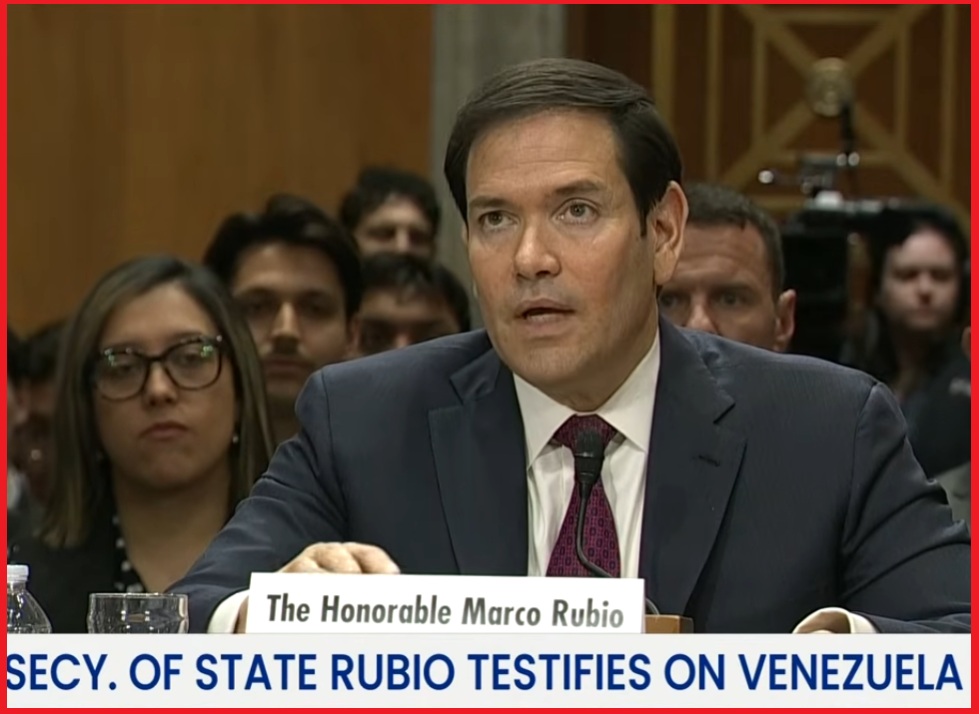
Secretary of State Marco Rubio appears today before the Senate Foreign Relations Committee to outline the current situation with U.S. policy toward Venezuela against the background of Nicholas Maduro being captured by the U.S. Dept of Justice. In essence, Western Hemisphere policy.
The Senate has been fraught with anxiety over the Trump administration focusing on the American continent and strengthening the U.S. position in the region. Stability in the Americas is against the interests of the corporate and banking benefactors who pay for control of Senate seats and use their influence therein.
Having come from the Senate, after fulfillment of his fourteen-year corporate obligations, Secretary of State Rubio acutely understands the voices behind those on the panel delivering the questions. Rubio outlines the goals and objectives of the Venezuelan operation by speaking directly to the concerns of the banking and financial community; in addition, he answers the questions posed by the performance actors put in place by the corporate strategists.
Video is prompted to 14:33 to cut out the narrative engineered talking points from the chair and vice-chair. Secretary Rubio outlines the BIG PICTURE. WATCH:
Posted originally on CTH on January 11, 2026 | Sundance
Energy Secretary Chris Wright appears on Face the Nation to discuss the current and future plans for oil production in Venezuela, while explaining how the current mechanism to sell the oil is operating.
[Transcript] – MARGARET BRENNAN: This morning, President Trump vowed that Venezuela now has the military protection of the US. This comes just one week after he said the US would run that country. Meanwhile, Venezuelan opposition leader Maria Corina Machado is expected to travel to Washington to meet with President Trump this week. For his part, Mr. Trump and his team met with dozens of US oil executives late last week, urging them to commit $100 billion to boost oil production there. Joining us now to discuss it all is the United States Secretary of Energy, Chris Wright, good to have you here in person.
SECRETARY CHRIS WRIGHT: Thanks for having me, Margaret.
MARGARET BRENNAN: Before I ask you about Venezuela, very quickly, these protests in Iran, not this country reliant on oil to keep its government-controlled economy afloat. The President has been briefed on military options. What is the US willing to do to help?
SEC. CHRIS WRIGHT: Certainly the President has been very outspoken about wanting to have freedom and rule of law and capitalism and great relations with the United States return. So we’ll see. I think his moral support has been strong. Certainly, he’s taken a strong stance against the mullahs in Iran in disabling their nuclear program. I think the people in Iran are rising up because they feel there’s a strong America that has their back. I won’t go into the specifics there, but we wish them well, and we’d love to see a free and democratic Iran again.
MARGARET BRENNAN: Will there be more interdictions of vessels carrying Iranian oil? Any more activity on that front?
SEC. CHRIS WRIGHT: I won’t reveal any change in position there.
MARGARET BRENNAN: Okay, let me ask you about Venezuela,
SEC. CHRIS WRIGHT: Yes.
MARGARET BRENNAN: where you have been very focused and very central to the President’s policy. The President said that Venezuela now has the United States, the most powerful military in the world, to protect them. To protect them, we will. Is the United States military providing security guarantees for American companies?
SEC. CHRIS WRIGHT: We’re not doing that right now, but what we, what he means, is we’re changing the game for what’s happening in the ground in Venezuela. Venezuela has purchased $20 billion of Russian weapons. They got Cuban mercenaries there. They supply oil to Cuba. They, they harbor the Hezbollah’s headquarters for the Western Hemisphere. Venezuela has been a very dangerous, very destabilized place going down the tubes. And with the United States influence now by controlling the sale of their oil and therefore the flow of funds into the country, we think we’re going to, we will see relatively rapid change, improvement on the ground in Venezuela. This is a process. We’re only eight days into the process, but it’s off to a strong start.
MARGARET BRENNAN: Well, it’s off to a quick start. You had the oil executives at the White House just Friday. That the President, excuse me, the State Department yesterday had a security alert I want to ask you about because it specifically cited the risk to Americans in Venezuela, and it said armed militias are setting up roadblocks, searching vehicles for evidence of US citizenship or support for the US. The man who runs those militias is Diosdado Cabello, who is the Minister of the Interior. Is he ordering the hunting of Americans?
SEC. CHRIS WRIGHT: Not that we are aware of, but we should be cautious. Look, this is, as they say, eight days into a change into a change of leadership there. The interim authorities are trying to establish power. Collectivos have been running wild over, over Venezuela for, for over a decade. So, yeah, you’re not going to–
MARGARET BRENNAN: Right. Well he controls them.
SEC. CHRIS WRIGHT: He does.
MARGARET BRENNAN: So is he safe in his position? Because right now the administration seems to be working with him.
SEC. CHRIS WRIGHT: We need to work with the people that have the guns today to ultimately move the country to a representative government and a better station. But what you’ve got to prevent in the mean term is a collapse of the nation. And I think the strong moves we’re making right now is to influence the people with the guns today, which is part of a process.
MARGARET BRENNAN: And you’re not concerned he’s going to undermine the more business minded President Delcy Rodriguez?
SEC. CHRIS WRIGHT: Oh, of course we’re worried about things like that. We need to get stability among the leadership in Venezuela. So yes, of course we’re concerned about those things.
MARGARET BRENNAN: So tell me broadly, is the Trump administration’s goal here to acquire the state oil company, PDVSA, and to run it. Are you going to put Americans on the board? How is this going to work?
SEC. CHRIS WRIGHT: Well, again, it’s a process. The first thing to do is to reduce the damage to the United States, the inflow of guns and criminals and immigrants and drugs into the United States, the destabilizing of a key part of the Western Hemisphere. We need to stop that. That’s why we’ve entered into Venezuela. Certainly, part of the way to improve Venezuela and to improve the Western Hemisphere and improve the lives of Americans is to get their very corrupt 25 years in decline, oil industry back going again.
MARGARET BRENNAN: Does that mean the United States government is going to run it? The president says we’re going to run the country. Are we running this as like as an American state owned oil company essentially?
SEC. CHRIS WRIGHT: No. Today we are running the sale of their crudes. You know, we have a quarantine around their ability to ship oil outside of Venezuela. All of that goes through American crude marketers, and then that crude goes out into the market. We collect those funds and bring them back to Venezuela to better the lives of Americans and Venezuelans. But in the long run, what will happen with Venezuelan oil resources? Yeah, of course, quite likely you’ll see American companies’ expanded presence there. You’ll see growing production. Of course, you’re going to see more American involvement in there. But exactly how that’s going to work, that’s going to unfold over time.
MARGARET BRENNAN: So back in November, us, Judge backed a bid by an American hedge fund to purchase Citgo Petroleum. The Treasury still has to approve that deal. The hedge fund is actually run by a big Trump donor, Paul Singer. Do you want to preserve Venezuelan ownership of Citgo? Do you want to have America have a financial stake in it, like Trump bought a big portion of an intel company, do you want to own portions of oil companies?
SEC. CHRIS WRIGHT: Again, that’s going to be up to American businesses. That’s certainly a very real possibility. The Citgo sale is part of, is part of bringing redress to creditors of the United States for the Venezuelan Government. And of course, one, one of the capital providers in that transaction is a hedge fund provider you just mentioned. There’s lots of American investors and American refining entrepreneurs that are involved in that so to take Venezuelan owned refineries that are in the United States and legally through an auction process, transfer them to American owners and American entrepreneurs in the refining business. I think that’s fantastic.
MARGARET BRENNAN: There’s concern about corruption here, though. Will there be Americans installed on these boards? And how do you respond to these allegations that some Trump donors are going to get preferential treatment?
SEC. CHRIS WRIGHT: I can assure you that is absolutely not the case. Absolutely not the case. Think of what President Trump has done for the American oil and gas industry. He’s driven down the price of oil. He’s dramatically reduced–
MARGARET BRENNAN: There’s an over supply of oil. And now you’re going to put more on the market.
SEC. CHRIS WRIGHT: Exactly. That’s not- That’s not good for American oil and gas companies.
MARGARET BRENNAN: Because it makes it less profitable for them to actually go and invest in drill, baby, drill.
SEC. CHRIS WRIGHT: Exactly. Democrats and President Biden are fantastic for American oil and gas companies because they try to restrict the supply to something that’s essential to life, which only has one possible impact, which is to drive up prices and grow profitability. So President Trump is no, is no helper to the oil and gas industry. And certainly there’s no corruption, preferential placement of people. There’s none of that. I can assure you of that. I’m in the center of this.
MARGARET BRENNAN: How are you going to decide the contracts? Is the Treasury going to approve the Citgo dominance there in that–
SEC. CHRIS WRIGHT: That went through a large auction to buy it.
MARGARET BRENNAN
Are you going to brief to Congress the decisions you’re making about which firms get access?
SEC. CHRIS WRIGHT: Absolutely. All that was an auction open to all American firms. There were many bidders, including the coalition of bidders you mentioned. We want those assets to get as much money as possible, to go back to the creditors of the Venezuelan Government. And we want American refinery assets owned by Americans that are going to increase the throughput, drive down the price of gasoline in America.
MARGARET BRENNAN: Okay. So Secretary Rubio said there’s a three point plan, stabilize, rehabilitate, transition. This sounds indefinite, even when you heard some of those oil executives, Chevron’s leadership, they’re already in Venezuela, we should say, said it will take 18 to 24 months to even increase oil production by 50%. So how long is this American involvement? Because he’s saying there, it’s at least a year and a half, two years.
SEC. CHRIS WRIGHT: They’ve been there for 100 years, and likely, Chevron’s going to be there 50 years from now.
MARGARET BRENNAN: But the United States government, how long does that role continue?
SEC. CHRIS WRIGHT: You heard the third part of Rubio’s question, which is transition. We want to bring a representative government to the people of Venezuela. I think then you’ll see the full sovereignty back to the government of Venezuela. We don’t have a legitimate government of Venezuela today. We’d like to move and get there, but America–
MARGARET BRENNAN: Is there a timeline?
SEC. CHRIS WRIGHT: 25 years, this country has gone in decline. President Trump out of the box, creative intervention has allowed us to change the game. But, yeah, I don’t know the timeline of that. It’s not weeks, it’s more months. Could be a year or two could be more.
MARGARET BRENNAN: Okay. Secretary Wright, thank you for your time today.
I have created this site to help people have fun in the kitchen. I write about enjoying life both in and out of my kitchen. Life is short! Make the most of it and enjoy!
This is a library of News Events not reported by the Main Stream Media documenting & connecting the dots on How the Obama Marxist Liberal agenda is destroying America



 Centinel2012