Fast Food Restaurants Abandon Value Customers


Posted originally on Feb 7, 2024 By Martin Armstrong 
mcdonalds

Fast food establishments originated as the cheap, quick alternative to a proper meal. Value customers earning under $45,000 annually were the target demographic until recently when inflationary pressures caused food prices to skyrocket. Minimum wage requirements, wage increases, and price gauging have all contributed to the rising costs and a drastic shift in the customer base. Fast food establishments are admitting that they are losing their value customer base amid record profits.

McDonald’s most recent earnings report surpasses EPS estimates by $0.12, with the stock rising over 11% in the past three months and 10.92% in the past year. The company admitted during its last earnings call that they are losing value customers as it is simply cheaper for consumers to cook at home. CEO Chris J. Kempczinski stated last year that the chain restaurant is now targeting middle- and higher-income consumers who, in turn, can no longer afford the higher-end establishments. “It’s clear that consumers continue to be more discriminating about what and where they spend,” he stated after the Q3 earnings announcement.

McDonald’s announced that prices are expected to rise 10% at a time when food prices are up 6.2%. CEO Kempczinski called this an opportunity for fast food to target new customers while providing bundled deals and smaller serving sizes to retain value customers, who are no longer needed as the main consumer base. The price of menu items varies by state, and a Big Mac combo could cost up to $18 in some areas.

The Economist established the Big Mac index in 1986 to establish a somewhat humorous gauge to determine purchasing power between nations. According to data from January 2024, Switzerland hosts the most expensive Big Macs in the world at around 8.17, compared to 5.87 in the EU and 5.69 in the US. Again, this is not meant to be a real gauge of PPP but an interesting comparison between nations.

Every fast food establishment, from Wendy’s, IHOP, Burger King, Chipotle, etc., is raising prices amid inflation, increased taxation, and minimum wage hikes. Yet the majority of establishments are posting record earnings each quarter and profiting big time on the middle class. Consumers are simply accepting high prices as the new norm and cannot differentiate price gouging from necessary increases due to inflation. The convenience of a meal on the go is now a luxury that the people who are preparing the food can no longer afford.

McDonald’s Bets on China


Posted originally on Jan 18, 2024 By Martin Armstrong 

mcdonalds

My humorous post about McDonald’s celebrating Davos with the McKlaus bug burger deluxe was a pretend advertisement, for now, but McDonald’s is a World Economic Forum partner. This is relevant as McDonald’s is the second-largest private employer in the world. Their chains run across 100 countries, in nearly 40,000 stores, serving about 69 million customers daily. The yellow arches may be one of the first images that come to mind when you think of capitalism and the United States in general, but the company has set its sights on the nation that will replace America as the world’s financial capital.

CEO Chris Kempczinski has said that the Israel-Palestine war had a “meaningful business impact” as people on both sides are boycotting the restaurant chain, with most believing the establishment is pro-Israel. Less than half of their locations are located in the US, and although their business is performing well in America, the fast-food chain is betting on the future of China.

McDonald Buddist

McDonald’s plans to expand by 10,000 new restaurants by 2027, with one-third of those establishments opening in China. The company expanded its dealings in China from 20% to 48% in November 2023 after purchasing shares owned by investment firm, the Carlyle Group. Their analytics found China to be the fastest-growing consumer economy, but it was not always this way. Due to low demand, McDonald’s was forced to sell off nearly 80% of its Chinese interests in 2016.

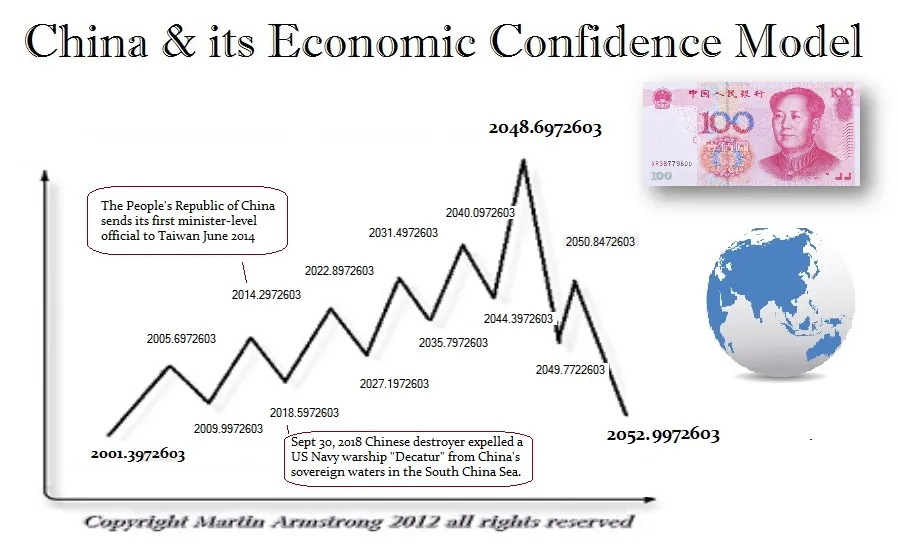
ECM China 2 2048

So, what was happening in China during 2016? In 2016, China’s growth dropped to 6.7%, marking the slowest pace of growth in 25 years. Fixed asset investment was no longer coming from the private sector, posing a challenge to the economy’s growth and development. The government’s attempts to inject funds into the economy through various means, including easing credit in the real estate sector, did not yield the desired results. This raised concerns about the effectiveness of the stimulus measures. China also faced challenges related to a weak banking system, overreliance on fixed investment and government support for state-owned firms, and increasing debt levels.

Additionally, the world could not see China as anything but a Communist nation. Corporations and institutions see it otherwise; they see the lucrative business potential and a growing middle class eager to spend. Hence, they are heavily investing in future business ventures there.

China’s economy turned around in 2017, as predicted by our computer. Large-scale capital investment, financed by large domestic savings and foreign investment, and rapid productivity growth helped the economy recover. These two factors appeared to have gone hand in hand, with consumption being a major growth driver, contributing 58.8% to GDP growth in 2017.

China on the Rise

The 2018 special report, “China on the Rise,” further explains how Socrates has been honing in on China, whose economy is expected to surpass that of the United States by 2032. With special attention to the Chinese yuan and Shanghai composite, this report examines how, when, and why China will become the new financial capital of the world.

China now has a growing middle class with some expendable income. Big corporations like McDonald’s see China as the next big opportunity, as our computer has been outlining for some time.