A fifteen year argument is finally over…. We win. Most CTH readers probably don’t even remember the reason for the name: “The Last Refuge” upon this little corner of the internet. However, for well over a decade we have tried to share the truth behind the financial mechanisms that run Washington DC; and the primary machine has always been a completely corrupt, deceptive and anti-American U.S. Chamber of Commerce.
Against the entirety of the conservative media; and against the entirety of every organized group that ever attended CPAC; this website has attempted to educate people about the genuinely fraudulent purposes of the U.S. CoC and their President Tom Donohue. I have written hundreds of articles over the years outlining “there are trillions at stake” and the elements of importance behind that statement. Every single mainstream conservative voice has denied the truth; and likely most of them are probably on the CoC payroll.
Every former administration took massive payments from the CoC and allowed the Chamber to write trade agreements language for decades. The CoC business model was to take payments from Wall Street multinationals and then write the agreements to their benefit. Politicians were paid to keep quiet and support the CoC. The chamber is the largest lobby organization in DC. The chamber spends more money on influence than any other lobbying group by a massive amount. The CoC is at the heart of DC corruption.
President Trump knew about the CoC business model; that’s why he never allowed them a seat at the ‘America First’ table. That was the original source of our support for candidate Donald Trump. And now, after a decade of our trying to highlight the CoC scheme and the reason for it; yesterday, the U.S. Chamber dropped their pretense and admitted they were now supporting democrats because the CoC effort can only succeed by destroying Main St.
WASHINGTON DC – The U.S. Chamber of Commerce is poised to endorse nearly two dozen freshmen House Democrats for reelection, triggering a revolt within the right-leaning organization and drawing fierce push-back from the group’s powerful GOP donors.
The decision represents a sharp departure for the traditionally conservative Chamber, which has spent over $100 million backing Republican candidates during the past decade, and it threatens to further complicate the party’s prospects in the November election while driving a split in the business community.
Chamber leaders — including President Suzanne Clark, Chief Executive Officer Tom Donohue and Executive Vice President Neil Bradley — have been pushing the proposal ahead of a Thursday committee vote to finalize a slate of 2020 endorsements.
But the group’s donors and members are up in arms, with some threatening to pull funding and others openly venting their frustration. Some are raising the prospect that Chamber board members will quit in the weeks to come.
[…] The internal fight is just the latest headache for the Chamber, which for decades was regarded as a giant in the lobbying world. The group has recently generated headlines for its frosty relationship with the White House and alleged lavish spending on private jets.
The clash also provides a window into a growing rift in the business community over its place in the Donald Trump-dominated Republican Party, which has at times embraced policies the corporate world opposes. While the Chamber has almost exclusively endorsed Republicans over the past decade, it has collided with the president over everything from tariffs to immigration. (read more)
The CoC was never a “right wing organization”, nor was it a “republican organization”; it was always a multinational globalist organization structured to support Wall Street and destroy Main Street. It was always a feature, not a flaw…. but no-one would believe it.
Well, now… believe it.
Tom Donohue and Suzanne Clark – U.S. Chamber of Commerce
If you understand the basic elements behind the new dimension in American economics, you already understand how three decades of DC legislative and regulatory policy was structured to benefit Wall Street and not Main Street. The intentional shift in monetary policy is what created the distance between two entirely divergent economic engines.
REMEMBER […] there had to be a point where the value of the second economy (Wall Street) surpassed the value of the first economy (Main Street).
Investments, and the bets therein, needed to expand outside of the USA. hence, globalist investing.
However, a second more consequential aspect happened simultaneously. The politicians became more valuable to the Wall Street team than the Main Street team; and Wall Street had deeper pockets because their economy was now larger.
As a consequence Wall Street started funding political candidates and asking for legislation that benefited their interests.
When Main Street was purchasing the legislative influence the outcomes were -generally speaking- beneficial to Main Street, and by direct attachment those outcomes also benefited the average American inside the real economy.
When Wall Street began purchasing the legislative influence, the outcomes therein became beneficial to Wall Street. Those benefits are detached from improving the livelihoods of main street Americans because the benefits are “global”. Global financial interests, multinational investment interests -and corporations therein- became the primary filter through which the DC legislative outcomes were considered.
As an outcome of national monetary policy blending commercial banking with institutional investment banking something happened on Wall Street that few understand. If we take the time to understand what happened we can understand why the Stock Market grew and what risks exist today as trade policy is reversed to benefit Main Street.
Instead of attempting to put Glass-Stegal regulations back into massive banking systems, the Trump administration created a parallel financial system of less-regulated small commercial banks, credit unions and traditional lenders who can operate to the benefit of Main Street without the burdensome regulation of the mega-banks and multinationals. This really is one of the more brilliant solutions to work around a uniquely American economic problem.
[You saw direct evidence of this at work with the Paycheck Protection Program (PPP) in the COVID rescue package. Small and medium lenders were responsive to Main Street and the large institutional (Big Bank) lenders were not.]
♦ When U.S. banks were allowed to merge their investment divisions with their commercial banking operations (the removal of Glass Stegal) something changed on Wall Street.
Companies who are evaluated based on their financial results, profits and losses, remained in their traditional role as traded stocks on the U.S. Stock Market and were evaluated accordingly. However, over time investment instruments -which are secondary to actual company results- created a sub-set within Wall Street that detached from actual bottom line company results.
The resulting secondary financial market system was essentially ‘investment markets’. Both ordinary company stocks and the investment market stocks operate on the same stock exchanges. But the underlying valuation is tied to entirely different metrics.
Financial products were developed (as investment instruments) that are essentially wagers or bets on the outcomes of actual companies traded on Wall Street. Those bets/wagers form the hedge markets and are [essentially] people trading on expectations of performance. The “derivatives market” is the ‘betting system’.
♦Ford Motor Company (only chosen as a commonly known entity) has a stock valuation based on their actual company performance in the market of manufacturing and consumer purchasing of their product. However, there can be thousands of financial instruments wagering on the actual outcome of their performance.
There are two initial bets on these outcomes that form the basis for Hedge-fund activity. Bet ‘A’ that Ford hits a profit number, or bet ‘B’ that they don’t. There are financial instruments created to place each wager. [The wagers form the derivatives] But it doesn’t stop there.
Additionally, more financial products are created that bet on the outcomes of the A/B bets. A secondary financial product might find two sides betting on both A outcome and B outcome.
Party C bets the “A” bet is accurate, and party D bets against the A bet. Party E bets the “B” bet is accurate, and party F bets against the B. If it stopped there we would only have six total participants. But it doesn’t stop there, it goes on and on and on…
The outcome of the bets forms the basis for the tenuous investment markets. The important part to understand is that the investment funds are not necessarily attached to the original company stock, they are now attached to the outcome of bet(s). Hence an inherent disconnect is created.
Subsequently, if the actual stock doesn’t meet it’s expected P-n-L outcome (if the company actually doesn’t do well), and if the financial investment was betting against the outcome, the value of the investment actually goes up. The company performance and the investment bets on the outcome of that performance are two entirely different aspects of the stock market. [Hence two metrics.]
♦Understanding the disconnect between an actual company on the stock market, and the bets for and against that company stock, helps to understand what can happen when fiscal and monetary policy is geared toward the underlying company (Main Street MAGAnomics), and not toward the bets therein (Investment Class).
The U.S. stock markets’ overall value can increase with Main Street policy, and yet the investment class can simultaneously decrease in value even though the company(ies) in the stock market is/are doing better. This detachment is critical to understand because the ‘real economy’ is based on the company, the ‘paper economy’ is based on the financial investment instruments betting on the company.
Trillions can be lost in investment instruments, and yet the overall stock market -as valued by company operations/profits- can increase.
Conversely, there are now classes of companies on the U.S. stock exchange that never make a dime in profit, yet the value of the company increases. This dynamic is possible because the financial investment bets are not connected to the bottom line profit. (Examples include Tesla Motors, Amazon and a host of internet stocks like Facebook and Twitter.) It is this investment group of companies that stands to lose the most if/when the underlying system of betting on them stops or slows.
Specifically due to most recent U.S. fiscal policy, modern multinational banks, including all of the investment products therein, are more closely attached to this investment system on Wall Street. It stands to reason they are at greater risk of financial losses overall with a shift in fiscal policy.
That financial and economic risk is the basic reason behind Trump and Mnuchin putting a protective, secondary and parallel, banking system in place for Main Street.
Big multinational banks can suffer big losses from their investments, and yet the Main Street economy can continue growing, and have access to capital, uninterrupted.
Bottom Line: U.S. companies who have actual connection to a growing U.S. economy can succeed; based on the advantages of the new economic environment and MAGA policy, specifically in the areas of manufacturing, trade and the ancillary benefactors.
Meanwhile U.S. investment assets (multinational investment portfolios) that are disconnected from the actual results of those benefiting U.S. companies, and as a consequence also disconnected from the U.S. economic expansion, can simultaneously drop in value even though the U.S. economy is thriving.
Several Asian news outlets are now confirming that Japanese Prime Minister Shinzo Abe is likely to step down from his position due to a mounting health concern.
PM Abe is one of the strong nationalist politicians who align with the MAGA agenda of President Donald Trump. Both leaders were friends even before President Trump stepped into politics. Abe is a good friend to the White House and one of the key elements of the Indo-Pacific policy initiatives. His support & leadership will be missed on the international stage. Expect further details later today. No doubt he and President Trump have talked.
Osaka – Prime Minister Shinzo Abe is expected to step down as prime minister amid speculation over his health, NHK reported Friday, throwing the political center of Nagatacho in turmoil over the question of who will take over.
Abe is expected to speak to reporters at 5 p.m.
Abe’s health has been the subject of intense speculation since he underwent an examination at Tokyo’s Keio University Hospital on Aug. 14, and then returned for a followup exam on Monday.
The recent developments followed reports that his condition had declined since July and then worsened in early August. That fueled fears within Abe’s ruling Liberal Democratic Party that he may not be able to carry on, instigating speculation as to who could succeed him.(link)
Keep Your Jackass and Rino, We have a Lion defending America
The Washington establishment has failed us. They cared more about looking good in Paris, France than looking good in Paris, Texas.
For too many decades American citizens suffered as the Washington elite became richer and more condensing to we, the people. The jackasses and rinos grew fat and sassy in Congress and lined their pockets with easy cash from soulless corporation lobbyists.
Americans watched as their jobs were sent overseas, their cities and roads crumbled, and their taxes rose.
The borders were open and illegal aliens were treated better than citizens. The American dream became an empty promise.
The Swamp mouthed banal platitudes every four years as they pandered for votes. Secure in another election, the politicians went back to ignoring the voters until the next election arose.
America was floundering.
The jackass and rinos ate well at the corruption table.
Yet.
Something happened. Something new, yet familiar, something that had almost been forgotten.
Make America Great Again.
A roar echoed throughout the land.
An American Lion rose.
A lion hearted, fearless man who stood up for America and shouted, NO MORE!
President Donald Trump accepts the republican nomination for President on the final night of the RNC convention. In his remarks our president outlined his objectives and priorities for the next four years.
White House domestic policy advisor Ja’Ron Smith speaks about the priorities of President Trump on the final night of the Republican National Convention.
The Republican National Committee holds the fourth and final night the 2020 convention in Charlotte, North Carolina. [RNC Convention Website Here] For evening #4 the theme is “Land of Greatness.” President Trump will deliver his nomination acceptance speech. Follow the convention via a series of links to multiple media resources.
Earlier today President Trump and Vice-President Mike Pence traveled to FEMA headquarters or a briefing on response efforts to Hurricane Laura.
[Video and Transcript Below]
.
[Transcript] – ADMINISTRATOR GAYNOR: So, sir, again — Mr. President, Mr. Vice President, Secretary Wolf, welcome to FEMA and welcome to the initial brief for Hurricane Laura. And, sir, I’ll defer to you if you have any opening comments, and then we’ll move to the Secretary to get kicked off.
THE PRESIDENT: Well, I just wanted to say that all Americans are thinking of the great people of Texas, Louisiana, Arkansas, Mississippiti [sic] — Mississippi, and all of those incredible states that are affected. It’s covered a big range of territory — probably more than almost anyone that we can think of. It covered a lot, and it went very deep into the country and is going deep into the country. It continues.
When Hurricane Laura made landfall near Cameron, Louisiana, it was the most powerful hurricane to strike Louisiana coast in 150 years. Think of that. It was a category four and very close to a category five. For a while, it was a category five. But with a maximum sustained wind of 150 miles an hour — and I saw last night it was up to 185 miles per hour, and I had never seen that before. While initial reports of the coastal storm surge were not as bad as predicted, we’re still learning a lot about the storm, and we’ll find out. We’ll be reporting to you over the last — over the next couple of days.
I’ve signed emergency declarations for Texas, Louisiana, Arkansas, and Mississippi. FEMA is on the ground. They’ve been assisting in the search-and-rescue efforts, delivering life-saving supplies, helping restore power to over 600,000 — is that a correct statement? — 600,000 households and businesses that lost power in Texas and Louisiana, in particular.
I’ve spoken to all the governors, and we’ve worked everything out for the federal government to be very, very efficient and be very aggressive in getting everything back and going, and going as it should.
So I just want to thank Pete and all of the people at FEMA. I want to thank Chad Wolf. I want to congratulate him on his nomination. Fantastic. I hope that goes very quickly. It should go very quickly. You’ve done a fantastic job.
And with that, maybe I’ll have Chad say a few words. And then, Pete, you can say something. And we’ll take some questions. Please.
ACTING SECRETARY WOLF: Well, Mr. President, Mr. Vice President, again, thank you for being here at FEMA’s National Response and Coordination Center. The situation on the ground, as we’ve heard, is both fluid and challenging, but again, your entire administration has been preparing for this storm, and we are responding.
As you indicated, Mr. President, it’s one of the strongest hurricanes to ever hit this part of the country, but the experience, skill, and expertise of the entire DHS response and relief efforts have been mobilized, are in the field today responding.
I think you’ve heard Administrator Gaynor — I know the Vice President — time and time again: The best response to a disaster is one that is locally executed, state managed, and federally supported. And, thankfully, we have very strong partners, both with Governor Abbott and Governor Edwards, in this fight to respond.
Mr. President, you acted quickly to authorize emergency disaster declarations for Texas, Louisiana, and Arkansas, which has allowed the federal government to prepare and now respond to the hurricane. So thank you for that as well.
A successful response involves an all-of-government approach, and so FEMA is leading that approach, and your Coast Guard pre-positioned assets, pre-positioned its people, and are responding today. They’re up in the air; they’re conducting search-and-rescue assessments and other types of assessments.
We’ve also deployed Customs and Border Protection air assets as well, along with DOD, Army Corps of Engineers — again, a whole-of-government response.
I know Administrator Gaynor will be down in the area starting tomorrow, and I will likely be down there this weekend as well. So, again, Americans are resilient people, and DHS is prepared to help our fellow Americans in the path of the hurricane to recover and to respond.
So thank you again for being here today and showing your support to the men and women of FEMA.
THE PRESIDENT: Thank you. Great job.
Pete?
ADMINISTRATOR GAYNOR: Thank you, Mr. Secretary.
Sir, we’re going to go to Dr. Neil Jacobs; he’s the Secretary of Commerce for Environmental Observation and Prediction, from NOAA.
Neil.
DR. JACOBS: Mr. President and Mr. Vice President, thank you for being here today, and a big thanks to FEMA and DHS for all their support in collaboration with us. I really wanted to thank the folks at the Weather Service and the National Hurricane Center for the fantastic and tremendous work they’ve done in predicting this and also their collaboration with the state and local emergency managers.
I also wanted to mention the Hurricane Hunter flights flying into the storms, collecting data. At any given time, we had three different planes rotating and also a lot of help with the Air Force; they also are sending planes into the storm to collect data.
The models and the observations have been hugely beneficial this season, very much thanks to the Weather Research and Forecasting Innovation Act that you signed into law in 2017.
We did have to evacuate one forecast office. They’ve relocated the forecasting services to Brownsville, Texas. And we’ve pre-deployed emergency response aircraft to do aerial surveys and high-resolution photos, as well as the Coast Survey; the navigation response teams are pre-deployed to Galveston and Stennis.
At this point, I’d like to turn it over to the Hurricane Center director, Ken Graham, for his update on the storm.
THE PRESIDENT: Could I ask you: What’s the level of danger for — you say three planes flying into the storm. What’s the level of danger for the planes, the pilots, flying into a storm of this magnitude, where you had up to 185, and even beyond, winds? What — what is that level?
DR. JACOBS: So we have — we have two P3s, which fly at lower altitude into the actual storm, and then we have a Gulfstream that flies high altitude above the storm.
I’ve actually done one of those flights myself; it’s quite bumpy. But, actually, the stronger the storm, so I’m told by the pilots, it’s less bumpy than the weaker storms because the convection is more organized, so they’re flying into a stiff wind, but it’s not quite as bumpy. But, believe me, it’s a lot bumpier than your average commercial flight. (Laughter.)
THE PRESIDENT: It’s great. Thank them for me, too.
DR. JACOBS: Yes, sir.
ADMINISTRATOR GAYNOR: Ken Graham, I think it’s on you.
MR. GRAHAM: Okay, got it. Thank you very much. And, Mr. President and Mr. Vice President, thank you for this opportunity to brief you today. I did want to say we appreciate the relationship we have with FEMA. We actually have FEMA, the Hurricane Liaison Team, embedded with us here at the Hurricane Center, so it’s just a great partnership that we work these big events.
So I did want to start off with the latest information on Hurricane Laura. It just became a tropical storm, 70 miles an hour, on the latest update. It’s still moving north at 15 miles an hour.
So we look at this satellite here. The NOAA satellite is one of the tools that we use to really keep an eye on these systems. Like, this landfall, as you said, Mr. President, was at 1:00 a.m. at 150 miles an hour near Cameron, Louisiana.
And it’s interesting, if you look back at the three-day forecast: The point that we made landfall was very close to the three-day forecast on the track. So a very good forecast track. And we continue to move northward through Louisiana, even seeing some impacts in Arkansas.
And Hurricane Laura brought that eyewall of 150-mile-an-hour winds. But not only that — the heavy rainfall, and also the southerly flow that comes out of the Gulf of Mexico, piles up that water. So we did see the storm surge in these areas, and also tornadoes in these dangerous rain bands that circle around the storm. So we have tornadoes, we have the heavy rain, and we have all those impacts associated with this — this hurricane.
So what’s next? This is our latest forecast that we have. You still have those tropical storm force winds well away from the center. So there’s quite a few people that still feel the impacts from that rain and also from those winds. A tropical storm still getting into Arkansas. So if you combine the winds and that rain, those folks are going to still see some of those impacts.
So that’s the latest information. As we continue to move up — even by Friday, we’ll be getting into portions of Kentucky and West Virginia and Virginia throughout the weekend. So we’ll be keeping a very close eye on this.
But I wanted to take the time to echo what Dr. Jacobs said. They’re heroes, Mr. President. They — we try to get everybody away from the coastline, to get away from the dangers of these hurricanes. And the women and the men of the Hurricane Hunters both at NOAA and also the Air Force, they go straight for the danger and they fly these systems. That data gets into the models; it really helps us here at the Hurricane Center with our watches and warnings and the forecast. We just couldn’t do it without them.
So, anyway, appreciate the support. I wanted to give you the latest information on Hurricane Laura, now Tropical Storm Laura.
THE PRESIDENT: Thank you very much. Great job. Thank you.
ADMINISTRATOR GAYNOR: Thanks, Ken. Sir, we’re going to go to some brief slides. And the first slide is really to highlight our federal partners and our private and non-profit partners. So I’ll just give it a second to catch up here.
But this is not just FEMA doing this; this is our great partners, like DOD, National Guard, EPA, SBA — you name it. There are people in this building, or virtual because of COVID, that are supporting these efforts. And again, like the Secretary mentioned, a whole-of-government response when it comes to this hurricane and any other natural disaster that we may see in the future.
And next slide. Slide four, please.
So just a taste of some of the resources that we have on the ground, in response for this hurricane. So from FEMA staff that are here in this building, that are embedded with governors and their emergency operation centers in multiple states; Army Corps of Engineers with their power and roof teams that are on the ground, doing assessments; urban search-and-rescue teams. There’s an urban search-and-rescue team, sir, from Indianapolis. Indiana Task Force One is out there today doing assessments.
Communications teams: We have mobile emergency response units out there that give extra capacity to locals that may have lost their communications.
Our other great partner is utility crews from all across the country. Ten thousand crewmembers out there right now, and doing the restoration where they can, where it’s safe. But again, can’t do it without them.
Red Cross doing sheltering. Salvation Army doing feeding. DOD and National Guard providing helicopters and high-water vehicles. And I could go on and on about the team that is assembled to respond to and recover from this disaster and, again, any other disaster that we may face.
Sir, we have a couple of pictures that we’d like to share with you from the field, and my Assistant Administrator for Response and Recovery, Dave Bibo, will help us kind of go through this.
But we want to give you a taste of — we’ve been on the ground since daylight, about six hours so far, doing assessments. It’ll probably take the rest of the day and maybe even tomorrow to kind of see the size and scope and impact of Laura.
But we just wanted to share some pictures. And, Dave, if you could take us through some of these shots.
MR. BIBO: Yes, sir. Sir, one of the ways that we gather information before our people are out on the ground is we do social listening and identify photographs or videos from social media to get the task forces — for instance, like Indiana Task Force One and others — that are deployed ideas about where to go to check on — check on people.
And so you’ll see, as we go through a few of these photographs, sir, that some of them are from social media, some of them are from our personnel on the ground, and the one that you saw just a moment ago — if we can go back — control room. The red and white there is a — is a communication tower, so pretty significant damage there on the left. And then Lake Charles, on the right, which is in Calcasieu Parish, which is one of the areas of significant impact.
Next slide. Some trees down across roadways, and you can see the power — power lines down, which is going to be a major focus of effort for us for the foreseeable future.
Next slide. Roadways overtopped with water, which — dewatering them and then making sure that they’re safe for passage will also be a focus for us and one of the ways that FEMA provides assistance to states after disasters.
Next slide. And, here, you actually see we had a team that was forward-deployed overnight. They rode out the storm in Lake Charles, which is in Calcasieu Parish. Our FEMA Regional Administrator, MaryAnn Tierney, from FEMA Region 3, was deployed there, and she’s assisting a resident with a roof that had come off of the property, which is going to be a common site for damage because of the wind speed, and we will be seeing a lot of that.
The Administrator mentioned we’ve actually forward-deployed plastic sheeting, and we’ll work with the Corps of Engineers in the coming days, as well as the state, to provide support to folks whose roofs have been damaged.
Next slide. And there, sir, you can see the actual roof that was ripped off of the residence.
Next slide. There’s a chlorine fire in Lake Charles that is a focus of our attention to support the state of Louisiana with. And the fire services are working that now.
Next slide. And some additional residence damage, and in the coming days, we anticipate that we’ll provide support for folks who’ve had their homes impacted, subject to your approval.
Next slide. Some significant wind damage there. You can really see the ferocity of the — of the wind impact.
THE PRESIDENT: Yeah, that’s really — it’s amazing.
MR. BIBO: Next slide. Lake Charles, again. Another communications tower, as well as an office building downtown. And significant glass damage that we’re seeing widespread from the wind, as well.
THE PRESIDENT: How many buildings are like that building?
MR. BIBO: That’s — that one has been popping up a lot, Mr. President. We haven’t — haven’t seen a lot of high-rise buildings like that, but we have seen extensive glass damage.
THE PRESIDENT: You don’t want to use that glass contractor, right?
MR. BIBO: Sir.
THE PRESIDENT: They didn’t do too good a job.
MR. BIBO: Next slide. And, sir, looking ahead to the next 72 hours — just an idea, in partnership with the state of the priorities that we have: getting the debris off the roads and the roads cleared; that lets the task forces do their work to make sure that people are safe. Making sure that people have a safe place to sleep if their homes have been damaged. And the American Red Cross and others play a major role in that. Power restoration: As the storm proceeds north, the power crews come in behind and begin restoration and will proceed north through Louisiana and Arkansas and others. Search and rescue underway.
We’ve had good news with healthcare facilities so far, sir. They’re operating on generator power, and so far, so good, on that front. And, of course, keeping our people safe in the field.
ADMINISTRATOR GAYNOR: Yes, sir. Before, sir, I turn it over — back over to yourself and the Vice President, our messaging today will continue to be to the residents that are impacted: Keep your family safe. Wait for the all clear. You know, heed the directions of your local emergency manager, your local elected officials. If you don’t have to go out, don’t go out. If you put you — if you put yourself out there just to go sightseeing, you put at risk other first responders that you take away from something maybe more important.
So again, stay home and pay attention to the — to the warnings that your local is giving — given to you. Stay out of the water; it’s dangerous. “Turn around, don’t drown” is our motto in these things. So, again, please don’t go out sightseeing.
Stay away from power — downed power lines. I know that residents are eager to get out there with a chainsaw and start clearing debris. And, in that, may be live wire. So again, be safe; keep your family safe.
And then, lastly, again, heed the direction of your local emergency managers, your local elected officials. They know best. So, stay tuned to that.
And so that’s going to be our message for this couple of days so we prevent injuries and deaths following the storm. And, again, you’ll see that problem will slightly spike up because that’s what happens on these big storms.
THE PRESIDENT: Thank you very much, Pete.
ADMINISTRATOR GAYNOR: And, sir, I’ll — I’ll defer to —
THE PRESIDENT: Yeah, I just wanted to say Mike did a fantastic job last night, and I think you deserve the honor of making your statement right now. You’ve made a big statement last night; let’s make a smaller one now.
THE VICE PRESIDENT: Well, thank you, Mr. President. Thank you, Mr. President. And I know I speak for you when I express our admiration for the team here — the Department of Homeland Security, FEMA, NOAA, this interagency effort.
This is — was a serious storm. And, Mr. President, from this weekend, when you signed an emergency disaster declaration for Louisiana and Texas, this team forward-deployed resources.
We were ready for the worst. But, by all accounts from the experts, it sounds like while this was obviously a major storm with devastating impacts, it was not as bad as it could have been.
And the fact that while we grieve the loss of a young girl in Louisiana — and her family has our sympathies — this is a real tribute to first responders and to the people of Louisiana and Texas, who — who really put safety first.
But, Mr. President, I just would encourage people to keep — keep the people of Louisiana and Texas — and now Arkansas, where you’ve signed an emergency declaration as the tropical storm moves north — keep them in your prayers, but also keep in mind organizations like Red Cross that are also on the ground, that are providing assistance and support to all of the efforts for families.
But, Mr. President, you often say, in moments like this, that people can be assured that — that we will be with them. We were there to respond, rescue. And at your direction, with the resources that you’ve deployed, Mr. President, we’ll make sure that we’re with the people in Louisiana and Texas and any other areas of the country impacted by the storm until we bring everyone back, as you often say, bigger and better than ever before.
So thank you, Mr. President. And again, I want to echo your thanks and admiration for this team and all the — all the first responders and state and local authorities that are represented here.
THE PRESIDENT: It’s great, Mike. Thank you very much.
Any questions concerning the hurricane? Yeah, please.
Q Mr. President, will you be visiting the Gulf Coast? And if so, when?
THE PRESIDENT: Very shortly. We’ll be doing tonight — in fact, I was actually prepared to postpone the speech tonight and make it on Monday. I was going to Texas. I was going to Louisiana, maybe Arkansas. Looks like Arkansas — I just spoke to the governor — it’s going to be in pretty good shape, but they’ll need some help.
But now, it turned out, we got a little bit lucky. It was very big, it was very powerful, but it passed quickly. And so everything is on schedule. We’ll probably be going on Saturday or Sunday, and we’ll be heading to Texas and Louisiana, and maybe an additional stop. So that’ll either be on Saturday, a little bit in the afternoon, or Sunday. And we’ll be ready — I think you’ll be prepared by that time.
But I just want to thank all of the people from FEMA in particular, and all law enforcement and everyone else, locally, because they’ve done a fantastic job. So we’ll be going Saturday or Sunday.
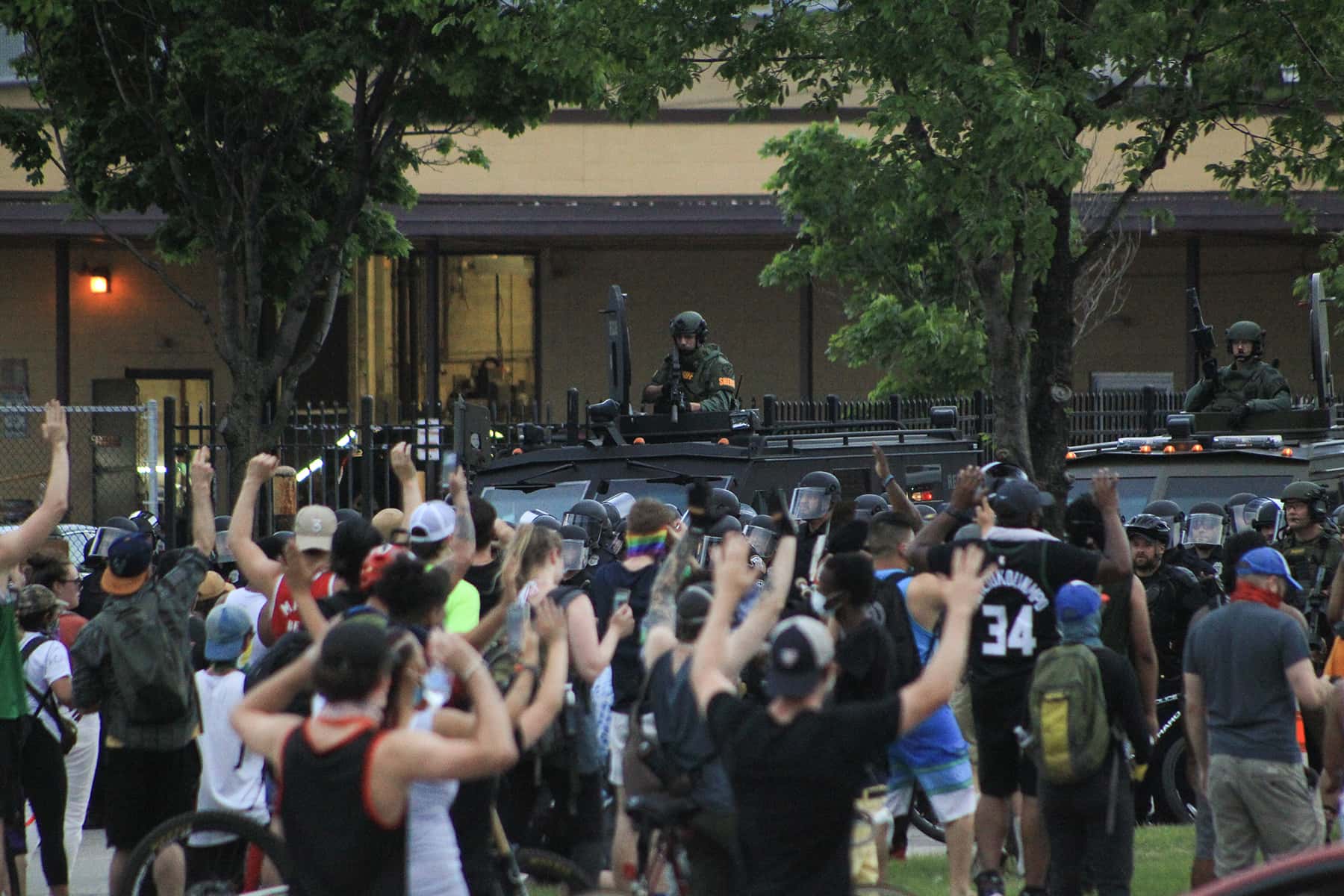
Q Mr. President, could you also comment on what’s going on in Wisconsin and the NBA response to the violence?
THE PRESIDENT: Yeah. I can tell you that Wisconsin — I appreciate the governor calling and saying he wanted National Guard. As you know, last night was very quiet; the night before wasn’t. And the reason it wasn’t: They didn’t have proper protection.
But I respect the governor’s decision to get that protection. The National Guard did a fantastic job. Mark Meadows is here. We called up the National Guard, we sent it out, and they did a fantastic job last night. We had virtually no incident.
Portland should do the same thing. These are all Democrat- run cities that should do this as they did, really, in Wisconsin. So it went very, very smooth. We had a relatively small force. We can be much larger. If necessary, we’ll move a very large force there. But we didn’t need too much, and it worked out very well in Wisconsin.
And all I ask is that these cities that are having difficulty — if they call us, if they request that we send the National Guard, they will be there instantaneously. And we will put out the fire. We will put out the flame. We will put out the — the vandalism, because the vandalism and the looting is ridiculous to allow this to happen. I don’t know how they can possibly do it and why they do it. I don’t understand, because all they have to do is call. They can call me. They can call Mike. They can call any one of us. We’ll have the National Guard there, and we will stop the violence very quickly.
Chad, I think you might want to say something about that.
ACTING SECRETARY WOLF: Absolutely, Mr. President. I think what we’ve seen across the country, particularly in Portland and other cities, is when the capacity outstrips what the state and local law enforcement can do, they need to pick up the phone and they need to request help. In those cities that do that, we see the violence curbed and reduced almost immediately.
So I would encourage other states — or, sorry, other cities that are targets and that are experiencing this violence, particularly Portland — the governor needs to send in the National Guard, needs to step up and ask for help if they need it. It’s over three months of violent activity in Portland, and it needs to come to an end.
THE PRESIDENT: They could solve that problem so easily and so quickly. And it seems such a shame that for politi- — I guess political reasons, I don’t know. It can’t be good for them politically. But these — let’s call them Democrat governors, or, frankly, we’ll respond to a mayor also if they need help. But Portland is a great example. It’s been going on for 90 days, and we could put it out in one hour. All they have to do is ask us to come, and we will be there with the National Guard.
We actually sent Homeland Security officers in to protect the courthouse because they were unable to protect the courthouse. And as soon as they got there, the courthouse was protected, but we’d like to go a big step further than that. And we could fix the problem very quickly, but they have to call us, and they have to — we have to respond to their call. That’s the way it works.
Q And your reaction, sir, to the NBA protest yesterday against another shooting of a black man by police?
THE PRESIDENT: I don’t know much about the NBA protest. I know their ratings have been very bad because I think people are a little tired of the NBA, frankly. But I don’t know too much about the protest.
But I know their ratings have been very bad, and that’s too — that’s unfortunate. They’ve become like a political organization, and that’s not a good thing. I don’t think that’s a good thing for sports or for the country.
Q Mr. President, you have a large storm; you have the fallout from these police shootings. Is tonight an appropriate time to have a political celebration?
THE PRESIDENT: Very appropriate. The country is doing very well, economically. We’re on a “V.” It could even be a super “V.” We set a record last quarter on jobs. The job numbers were, as you know, over 9 million jobs. That’s a record in the history of our country.
I think we’re going to have a GDP that’s going to be mindboggling. Now, that’ll be announced, interestingly, just before the election. So that’ll be very interesting. But the Fed, as you know, the Atlanta — I guess it was the Atlanta Fed announced that they projected a 26 percent GDP. There’s never been any such thing anywhere in the world as a 26 percent GDP.
So we’re doing very well. We’re coming back. And that’s despite the fact that great places like North Carolina, Pennsylvania, Michigan are shut down unnecessarily at this point. It’s crazy what they’re doing. But they’re doing it, I think, for political reasons because they’d like their number to be as low as possible. And, actually, I think they’re making a tremendous mistake.
And you have to remember: The shutdown, what we did initially, was a — was a very, very important thing. Otherwise, you’d have millions of people dead. You would have millions of people. And then we learned and we watched, and we watched closely. And now we have vaccines coming very soon. We have therapeutics. It’s been incredible, what’s taken place.
But I have to say, they should open up their states. Let them open. Let them open safely and carefully. Open up their schools. Let them play football. It’s got to open up.
And we had a great number of doctors, as you know, in the office yesterday — the world’s leading experts on this. And there’s great danger to shutdowns, and that’s in the form of suicides, in the form of alcoholism and drug use, and so many other things are caused. It’s a bigger problem.
So whether it’s North Carolina, Pennsylvania, or Michigan, or others, they should open up, and we have to get on with it. We have to get on with it. It’s very sad. It’s very dangerous what they’re doing actually. And they’re doing it —
Q Mr. President, have you seen the video of the shooting death of Jacob Blake?
THE PRESIDENT: — and they’re doing it for political reasons.
So we have tremendous passion for this country. We love our country, and we want our country to do well. And I’ll see you all tonight. Thank you very much.
First Lady Melania Trump delivers a terrific speech from the Rose Garden at the White House to close out the second night of the Republican National Convention.
A recent New York Timesarticle by Jeremy W. Peters claims it is a “fact” “that black people suffer disproportionately from police brutality.” He also asserts that President Trump’s rejection of this accusation is “racially inflammatory” and “racially divisive.” To the contrary, comprehensive facts show that this allegation against police is false. Furthermore, this deception has stoked racial divides and driven people to despise and even murder police officers.
In an interview with CBS News that is slated to air in full tonight, reporter Catherine Herridge asked Trump, “Why are African-Americans still dying at the hands of law enforcement in this country?” He responded that this is a “terrible question” and that “more white people” are killed by police than black people.
CBS News, the New York Times, and many other media outlets are criticizing Trump’s response because blacks are a much smaller portion of the U.S. population than whites. Thus, the odds of being killed by police are higher for each black person than each white person. This frequent argument is highly misleading because it omits facts that are vital to this issue. As detailed in a 2018 paper in the journal Social Psychological and Personality Science:
“The most common means of testing for racial disparity in police use of deadly force is to compare the odds of being fatally shot for blacks to the odds of being fatally shot for whites.”
That logic is flawed because it relies upon the false assumption that white and black people commit life-threatening crimes at the same rates.
The rational way to analyze this issue is to compare the odds of being fatally shot to each race’s “involvement in those situations where the police may be more likely to use deadly force.”
Based on four different national datasets on “murder/nonnegligent manslaughter, violent crime, and weapons violations,” “in nearly every case, whites were either more likely to be fatally shot by police or police showed no significant disparity in either direction.”
The facts about murder and police killings underscore this reality. Black people represent about 13% of the U.S. population, at least 53% of murder offenders, and roughly 33% of people killed by police.
The Supreme Court’s 1985 ruling in Tennessee v. Garner forbids police from using lethal force except in situations where there is a genuine risk of “death or serious physical injury.” In 2015, the Washington Post found that over the prior decade an average of about five police officers per year were indicted for violating this standard, and only one per year was convicted.
Likewise, a study conducted by the left-leaning Center for Policing Equity reveals that police are 42% less likely to use lethal force when arresting black people than when arresting whites. Yet, the authors of this study buried that data on the 19th page of a 29-page report and wrote an overview that gives the opposing impression.
Taken together, the facts above disprove the claim that “black people suffer disproportionately from police brutality.” Yet, media outlets routinely ignore these facts or report them in isolation so that their implications are obscured. Meanwhile, they widely spread the counterfactual message that has inspired racial strife, hatred of the police, and slayings of officers. For example:
Before Ismaaiyl Brinsley murdered New York City policemen Rafael Ramos and Wenjian Liu in 2014, he posted on Instagram: “I’m Putting Wings On Pigs Today. They Take 1 Of Ours….. Let’s Take 2 of Theirs #ShootThePolice, #RIPErivGardner and # This may be my final post.”
During a 2016 Black Lives Matter protest in Dallas, TX in which the crowd chanted “Hands up, don’t shoot,” Micah Johnson killed five police officers. During standoff negotiations, he said he wanted to kill white people, especially white officers. All of the policemen he murdered were white.
Ten days later, Gavin Eugene Long shot six Baton Rouge, Louisiana police officers, killing three of them. His suicide note stated: “I must bring the same destruction that bad cops continue to inflict upon my people,” meaning people of color.
Beyond this, the Times and other media outlets that propagate those racially provocative falsehoods are accusing people who challenge them of stirring racial hostilities.
There are more than 800,000 sworn law enforcement officers in the U.S., and they commit roughly one murder per year. This amounts to an annual murder rate of 0.13 per 100,000—or about 38 times lower than the general U.S. murder rate of 5.0 per 100,000. Police are vetted for criminality, and thus, they should be much less likely to commit murder than the average person. However, police are also faced with life-threatening situations more often than the general public, and this opens doors for violent tendencies to emerge.
Regardless, it is irrational to accuse police or any other group of people of brutality or systemic racism based on the actions of an infinitesimal portion of them. Yet, the media and activists repeatedly do this, even though it is a hallmark tactic of racists and demagogues.
15 THOUGHTS ON “BLACK PEOPLE DO NOT SUFFER DISPROPORTIONATELY FROM POLICE BRUTALITY”
I would like to send you some studies that appear to provide evidence that appears to substantiate significant disparities in the use of force against African Americans. If you would kindly provide me an email I can use I would happy to send these to you for your comment. I would send you the actual studies, not the citations or mere references (with 1 exception.).
1. A Multi-Level Bayesian Analysis of Racial Bias
in Police Shootings at the County-Level in
the United States, 2011–2014
2. An Empirical Analysis of Racial Differences in Police Use of Force,
Roland G. Fryer, Jr.†
July 2017
3. Is There Evidence of Racial Disparity in Police Use of Deadly Force? Analyses of
Officer-Involved Fatal Shootings in 2015–2016
Joseph Cesario, David J. Johnson, William Terrill (abstract only)
4. Officer characteristics and racial disparities in fatal
officer-involved shootings
David J. Johnsona,b,1, Trevor Tressb, Nicole Burkelb, Carley Taylorb, and Joseph Cesariob (Heather MacDonald used this study as (among others?) for her editorial in the WSJ.
5. Correction for “Officer characteristics and racial disparities in
fatal officer-involved shootings,” by David J. Johnson, Trevor
Tress, Nicole Burkel, Carley Taylor, and Joseph Cesario, which
was first published July 22, 2019; 10.1073/pnas.1903856116 (Proc.
Natl. Acad. Sci. U.S.A. 116, 15877–15882).
6. Police, Race, and the Production of Capital Homicides
Jeffrey Fagan†
Amanda Geller*
Thank you for your considerations. I am very appreciative of the very fine work JustFacts does to bring a balanced and factual presentation of the evidences and arguments to the issues of our day.
Thank you for your kind words. Below are the key facts on these six studies. As you’ll see, they are either fatally flawed, inconclusive, or actually find that police are not more likely to use lethal force against minorities:
This study uses an incomplete, crowd-sourced dataset that records 16 cases of civilians being shot by police in Houston, TX and surrounding areas from 2011 to 2014. During this period, at least 177 such shootings occurred in Houston alone. In other words, the study’s data is so fragmentary that it is useless.
This study found that “on the most extreme use of force – officer-involved shootings – we are unable to detect any racial differences in either the raw data or when accounting for controls.” The author, Harvard professor Roland G. Fryer Jr., called this “the most surprising result of my career.”
On the other hand, the study did find that “blacks and Hispanics are more than 50 percent more likely to experience some form of force in interactions with police,” but this drops to 21.3% when controlling for factors like resisting arrest. Fryer theorizes there is a racial reason for this, but the remaining difference could be due to factors that the study did not control for, or it may be because police are more likely to forcibly restrain people in high-crime neighborhoods to prevent situations that require lethal force, regardless of race.
The paper is also marred and its credibility is undermined by this misleading claim: “The raw memories of these [racial] injustices have been resurrected by several high-profile incidents of questionable uses of force. Michael Brown, unarmed, was shot 12 times by a police officer in Ferguson, Missouri, after Brown fit the description of a robbery suspect of a nearby store.” Before the working draft of this paper was published in 2016, the Obama Justice Department proved in 2015 that the officer shot Brown in self-defense. On 9/12/16, I personally wrote to Fryer with documentation of that fact, and yet, he still submitted this paper for final publication with this falsehood in it.
This is the exact same study that I quote in the article above. Again, it found that “in nearly every case, whites were either more likely to be fatally shot by police or police showed no significant disparity in either direction.”
In the words of the study’s authors, this study found that “once crime rates were taken into account, civilians fatally shot by the police were not more likely to be black or Hispanic than white.” Furthermore, it showed that “white officers are not more likely to fatally shoot minority civilians compared to black or Hispanic officers.”
This study mentions earlier research about racial disparities in the death penalty, but the facts are that relative to the rates at which people of different races commit murder in the U.S., black people are less likely to be sentenced to death and executed than white people.
The study correctly points out that murders are less likely to be solved in minority neighborhoods and posits racial causes for this, but it also recognizes that this may be due to factors such as these:
• Minorities are more likely to be involved in murdering strangers than whites, and such murders are more difficult to solve.
• Police resources are stretched in minority neighborhoods due to high crime rates.
• Minorities are less likely to cooperate with murder investigations due to fear of reprisal and hostility towards police.
I have created this site to help people have fun in the kitchen. I write about enjoying life both in and out of my kitchen. Life is short! Make the most of it and enjoy!
This is a library of News Events not reported by the Main Stream Media documenting & connecting the dots on How the Obama Marxist Liberal agenda is destroying America


 Tom Donohue and Suzanne Clark – U.S. Chamber of Commerce
 President Trump and Treasury Secretary Mnuchin have already begun assembling and delivering a new banking system.


 Centinel2012
I would like to send you some studies that appear to provide evidence that appears to substantiate significant disparities in the use of force against African Americans. If you would kindly provide me an email I can use I would happy to send these to you for your comment. I would send you the actual studies, not the citations or mere references (with 1 exception.).
1. A Multi-Level Bayesian Analysis of Racial Bias
in Police Shootings at the County-Level in
the United States, 2011–2014
2. An Empirical Analysis of Racial Differences in Police Use of Force,
Roland G. Fryer, Jr.†
July 2017
3. Is There Evidence of Racial Disparity in Police Use of Deadly Force? Analyses of
Officer-Involved Fatal Shootings in 2015–2016
Joseph Cesario, David J. Johnson, William Terrill (abstract only)
4. Officer characteristics and racial disparities in fatal
officer-involved shootings
David J. Johnsona,b,1, Trevor Tressb, Nicole Burkelb, Carley Taylorb, and Joseph Cesariob (Heather MacDonald used this study as (among others?) for her editorial in the WSJ.
5. Correction for “Officer characteristics and racial disparities in
fatal officer-involved shootings,” by David J. Johnson, Trevor
Tress, Nicole Burkel, Carley Taylor, and Joseph Cesario, which
was first published July 22, 2019; 10.1073/pnas.1903856116 (Proc.
Natl. Acad. Sci. U.S.A. 116, 15877–15882).
6. Police, Race, and the Production of Capital Homicides
Jeffrey Fagan†
Amanda Geller*
Thank you for your considerations. I am very appreciative of the very fine work JustFacts does to bring a balanced and factual presentation of the evidences and arguments to the issues of our day.
Thank you for your kind words. Below are the key facts on these six studies. As you’ll see, they are either fatally flawed, inconclusive, or actually find that police are not more likely to use lethal force against minorities:
1) A Multi-Level Bayesian Analysis of Racial Bias in Police Shootings at the County-Level in the United States, 2011–2014
This study uses an incomplete, crowd-sourced dataset that records 16 cases of civilians being shot by police in Houston, TX and surrounding areas from 2011 to 2014. During this period, at least 177 such shootings occurred in Houston alone. In other words, the study’s data is so fragmentary that it is useless.
2) An Empirical Analysis of Racial Differences in Police Use of Force
This study found that “on the most extreme use of force – officer-involved shootings – we are unable to detect any racial differences in either the raw data or when accounting for controls.” The author, Harvard professor Roland G. Fryer Jr., called this “the most surprising result of my career.”
On the other hand, the study did find that “blacks and Hispanics are more than 50 percent more likely to experience some form of force in interactions with police,” but this drops to 21.3% when controlling for factors like resisting arrest. Fryer theorizes there is a racial reason for this, but the remaining difference could be due to factors that the study did not control for, or it may be because police are more likely to forcibly restrain people in high-crime neighborhoods to prevent situations that require lethal force, regardless of race.
The paper is also marred and its credibility is undermined by this misleading claim: “The raw memories of these [racial] injustices have been resurrected by several high-profile incidents of questionable uses of force. Michael Brown, unarmed, was shot 12 times by a police officer in Ferguson, Missouri, after Brown fit the description of a robbery suspect of a nearby store.” Before the working draft of this paper was published in 2016, the Obama Justice Department proved in 2015 that the officer shot Brown in self-defense. On 9/12/16, I personally wrote to Fryer with documentation of that fact, and yet, he still submitted this paper for final publication with this falsehood in it.
3) Is There Evidence of Racial Disparity in Police Use of Deadly Force? Analyses of Officer-Involved Fatal Shootings in 2015–2016
This is the exact same study that I quote in the article above. Again, it found that “in nearly every case, whites were either more likely to be fatally shot by police or police showed no significant disparity in either direction.”
4) Officer Characteristics and Racial Disparities in Fatal Officer-Involved Shootings
In the words of the study’s authors, this study found that “once crime rates were taken into account, civilians fatally shot by the police were not more likely to be black or Hispanic than white.” Furthermore, it showed that “white officers are not more likely to fatally shoot minority civilians compared to black or Hispanic officers.”
5) Correction for “Officer Characteristics and Racial Disparities in Fatal Officer-Involved Shootings”
This is merely a technical clarification of the study just above that changes none of its results.
6) Police, Race, and the Production of Capital Homicides
This study mentions earlier research about racial disparities in the death penalty, but the facts are that relative to the rates at which people of different races commit murder in the U.S., black people are less likely to be sentenced to death and executed than white people.
The study correctly points out that murders are less likely to be solved in minority neighborhoods and posits racial causes for this, but it also recognizes that this may be due to factors such as these:
• Minorities are more likely to be involved in murdering strangers than whites, and such murders are more difficult to solve.
• Police resources are stretched in minority neighborhoods due to high crime rates.
• Minorities are less likely to cooperate with murder investigations due to fear of reprisal and hostility towards police.