Posted originally on CTH on January 26, 2026 | Sundance
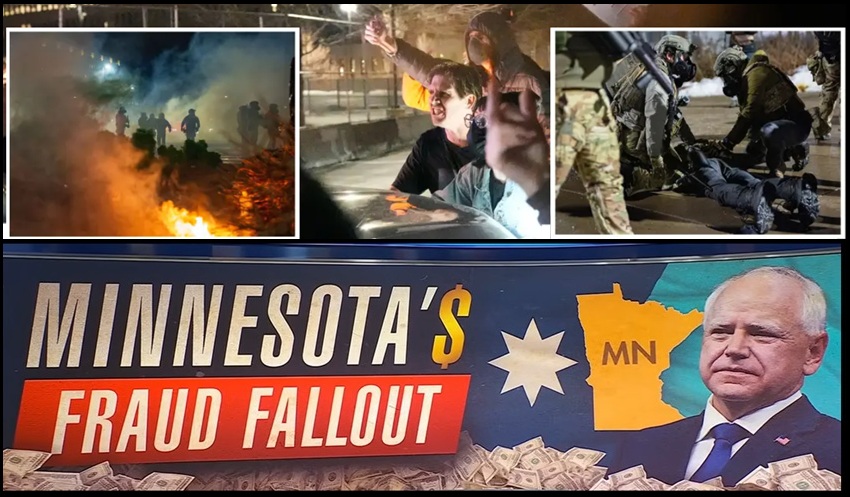
The violence in Minneapolis erupted when the scale of financial fraud was discovered. The administration of President Trump has begun to highlight this non-pretending reality.
On the surface it seems like ICE enforcement is the issue; however, in reality Governor Tim Walz and Mayor Jacob Frey have been leading a criminal syndicate, with the entire region engaged in money laundering and financial fraud.
State political leadership are involved. The local Minneapolis police are involved; the Minneapolis municipal leaders are involved; a large and dedicated segment of the migrant population is involved; corrupt judges and officers of the courts are involved; public and private sector agencies involved in fraudulent exploitation of benefits are involved, and the community activists -footsoldier communists- are engaged in the process of using civil unrest as cover.
As the violent insurgency escalates, President Trump has announced Border Czar Tom Homan is being sent to the region:
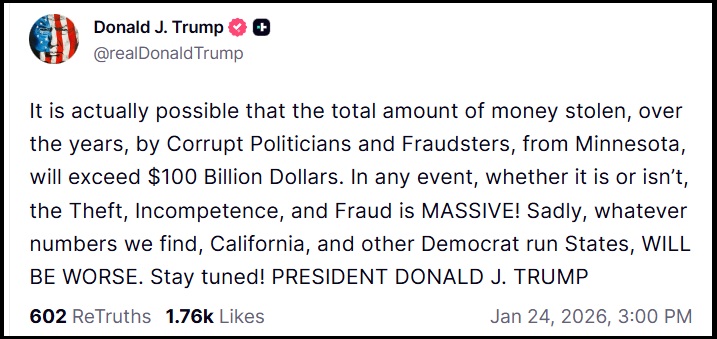
“I am sending Tom Homan to Minnesota tonight. He has not been involved in that area, but knows and likes many of the people there. Tom is tough but fair, and will report directly to me. Separately, a major investigation is going on with respect to the massive 20 Billion Dollar, Plus, Welfare Fraud that has taken place in Minnesota, and is at least partially responsible for the violent organized protests going on in the streets. Additionally, the DOJ and Congress are looking at “Congresswoman” Illhan Omar, who left Somalia with NOTHING, and is now reportedly worth more than 44 Million Dollars. Time will tell all. Thank you for your attention to this matter!” ~ President DJT
When we went to Iraq/Afghanistan, American political leadership said we were going to fight them “there” so that we didn’t need to fight them “here.” However, that same American political leadership then imported hundreds-of-thousands of them to here.
The communist-minded community activists have joined with the Antifa domestic terrorists and adopted the strategy of insurgencies. Former retired Green Beret Officer Eric Schwalm writing on X accurately draws attention to the similarity of action:
Eric Schwalm: “As a former Special Forces Warrant Officer with multiple rotations running counterinsurgency ops—both hunting insurgents and trying to separate them from sympathetic populations—I’ve seen organized resistance up close. From Anbar to Helmand, the pattern is familiar: spotters, cutouts, dead drops (or modern equivalents), disciplined comms, role specialization, and a willingness to absorb casualties while bleeding the stronger force slowly.
What’s unfolding in Minneapolis right now isn’t “protest.” It’s low-level insurgency infrastructure, built by people who’ve clearly studied the playbook.
Signal groups at 1,000-member cap per zone. Dedicated roles: mobile chasers, plate checkers logging vehicle data into shared databases, 24/7 dispatch nodes vectoring assets, SALUTE-style reporting (Size, Activity, Location, Unit, Time, Equipment) on suspected federal vehicles. Daily chat rotations and timed deletions to frustrate forensic recovery. Vetting processes for new joiners. Mutual aid from sympathetic locals (teachers providing cover, possible PD tip-offs on license plate lookups). Home-base coordination points. Rapid escalation from observation to physical obstruction—or worse.
This isn’t spontaneous outrage. This is C2 (command and control) with redundancy, OPSEC hygiene, and task organization that would make a SF team sergeant nod in recognition. Replace “ICE agents” with “occupying coalition forces” and the structure maps almost 1:1 to early-stage urban cells we hunted in the mid-2000s.
The most sobering part? It’s domestic. Funded, trained (somewhere), and directed by people who live in the same country they’re trying to paralyze law enforcement in.
When your own citizens build and operate this level of parallel intelligence and rapid-response network against federal officers—complete with doxxing, vehicle pursuits, and harassment that’s already turned lethal—you’re no longer dealing with civil disobedience. You’re facing a distributed resistance that’s learned the lessons of successful insurgencies: stay below the kinetic threshold most of the time, force over-reaction when possible, maintain popular support through narrative, and never present a single center of gravity.
I spent years training partner forces to dismantle exactly this kind of apparatus. Now pieces of it are standing up in American cities, enabled by elements of local government and civil society. That should keep every thinking American awake at night.
Not because I want escalation. But because history shows these things don’t de-escalate on their own once the infrastructure exists and the cadre believe they’re winning the information war.
We either recognize what we’re actually looking at—or we pretend it’s still just “activism” until the structures harden and spread.
Your call, America. But from where I sit, this isn’t January 2026 politics anymore. It’s phase one of something we’ve spent decades trying to keep off our own soil.” [source]
Posted originally on CTH on January 25, 2026 | Sundance
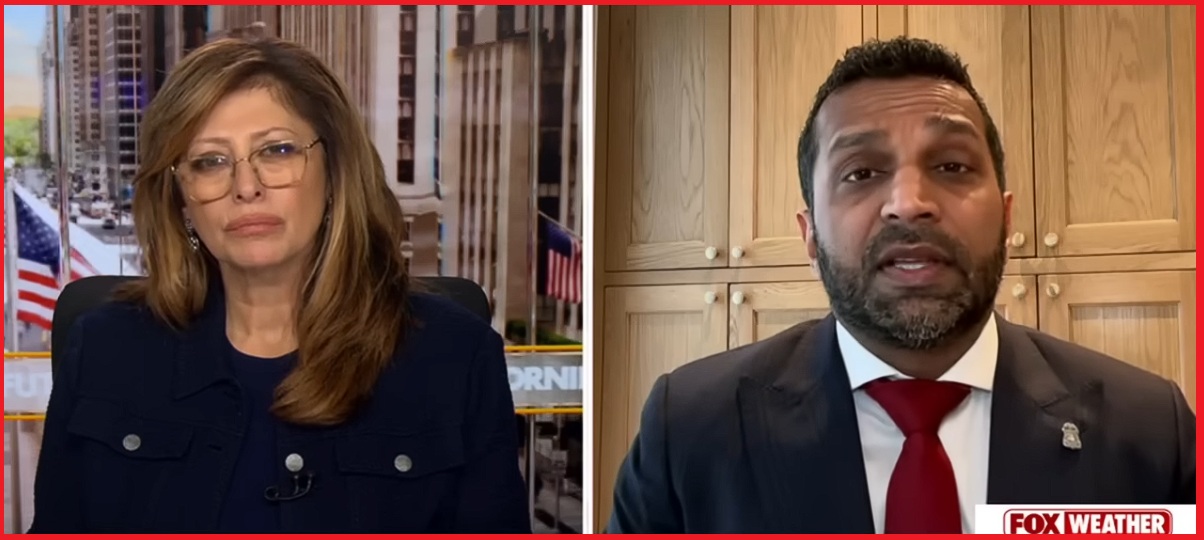
Kash Patel appears on Fox News with Maria Bartiromo to discuss ongoing matters of great importance to the FBI, including the chaos and insurrection efforts currently underway in Minneapolis, Minnesota.
Posted originally on CTH on January 25, 2026 | Sundance
It is rumored that President Trump is likely to invoke the Insurrection Act in Minneapolis, Minnesota, perhaps as early as Monday afternoon. This is potentially why the following statement has been released by President Trump:
(VIA Truth Social) – During the four years of Crooked Joe Biden and Democrat failed leadership, Tens of Millions of Illegal Alien Criminals poured into our Country, including Hundreds of Thousands of Convicted Murderers, Rapists, Kidnappers, Drug Dealers, and Terrorists.
I won the Election in a Historic Landslide, and Republicans won Majorities in both the House and Senate, in large part, because we pledged to SEAL THE BORDER, which we have done, and launch the largest Mass Deportation of Illegal Alien Criminals in American History. This Deportation effort is underway, and in Republican run Cities and States, these operations are going peacefully and smoothly, because Local Law Enforcement Officers are allowed to work with their federal counterparts.
For example, in the five Republican run States of Texas, Georgia, Florida, Tennessee, and Louisiana, ICE has arrested 150,245 Criminal Illegal Aliens over the past year — with ZERO protests, riots, or chaos. Why? Because Local Police and ICE are cooperating and working together.
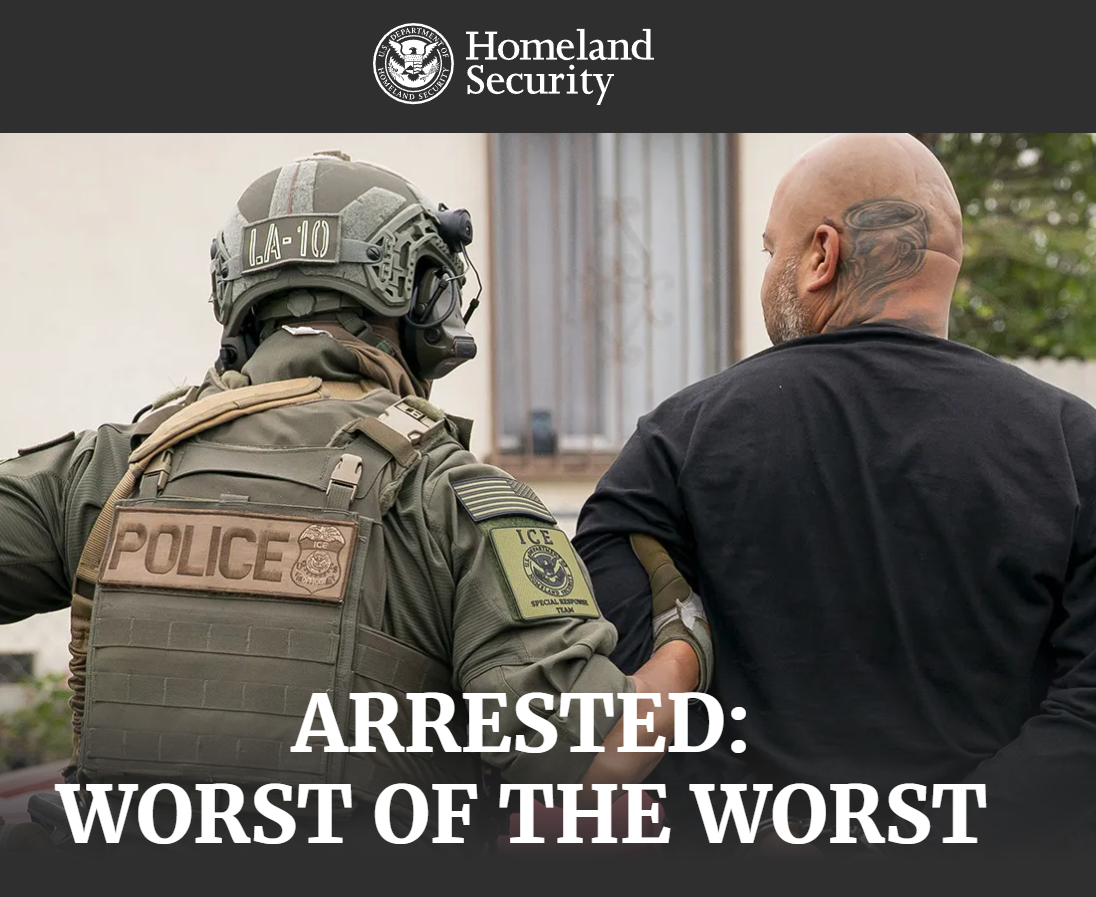
Meanwhile, Democrat run Sanctuary Cities and States are REFUSING to cooperate with ICE, and they are actually encouraging Leftwing Agitators to unlawfully obstruct their operations to arrest the Worst of the Worst People!
By doing this, Democrats are putting Illegal Alien Criminals over Taxpaying, Law-Abiding Citizens, and they have created dangerous circumstances for EVERYONE involved. Tragically, two American Citizens have lost their lives as a result of this Democrat ensued chaos.
That is why I am hereby calling on Governor Walz, Mayor Frey, and EVERY Democrat Governor and Mayor in the United States of America to formally cooperate with the Trump Administration to enforce our Nation’s Laws, rather than resist and stoke the flames of Division, Chaos, and Violence:
1. Governor Walz and Mayor Frey should turn over all Criminal Illegal Aliens that are currently incarcerated in their State Prisons and Jails to Federal Authorities, along with all Illegal Criminals with an active warrant or known Criminal History, for Immediate Deportation.
2. State and Local Law Enforcement must agree to turn over all Illegal Aliens arrested by Local Police.
3. Local Police must assist Federal Law Enforcement in apprehending and detaining Illegal Aliens who are wanted for Crimes.
4. Democrat Politicians must partner with the Federal Government to protect American Citizens in the rapid removal of all Criminal Illegal Aliens in our Country. Some Democrats, in places like Memphis, Tennessee, or Washington, D.C., have done so, resulting in safer streets for ALL.
In addition, I am hereby calling on the United States Congress to immediately pass Legislation to END Sanctuary Cities, which is the root cause of all of these problems. American Cities should be Safe Sanctuaries for Law Abiding American Citizens ONLY, not Illegal Alien Criminals who broke our Nation’s Laws.
All of these requests are rooted in COMMON SENSE, and will provide the best possible circumstances to, MAKE AMERICA GREAT AGAIN! The Trump Administration is standing by and waiting for ANY Democrat to do the right thing, and work with us on these important matters of MAKING AMERICA SAFE like it is in all sections of our Country where we are, together with Local Leadership, participating and involved.
Posted originally on CTH on January 25, 2026 | Sundance
Treasury Secretary Scott Bessent appears on ABC News with narrative engineer Jonathan Karl to discuss the outcomes of the Davos assembly, the Canadian trade conflict and the U.S-NATO deal over Greenland. Video and Transcript Below:
[Transcript] – KARL: I’m joined now exclusively by Treasury Secretary Scott Bessent, who is just back from Davos and joins us here in the studio.
Thank you for being here, Mr. Secretary. Let me start with the threat that the president made just yesterday to Canada. He said, if Canada makes a deal with China, it will immediately be hit with a one hundred percent tariffs against all Canadian goods. Why is Donald Trump threatening Canada again with another trade war?
SCOTT BESSENT, (R) UNITED STATES TREASURY SECRETARY: Well, Jonathan, good to be with you. And look, Prime Minister Carney went to — went to China, came back, dropped some industry specific tariffs on Chinese goods, and we have a highly integrated market with Canada, sometimes in autos, which he dropped the E.V. tariff, I believe, from a hundred percent to six percent.
The goods can cross across the border during the manufacturing process six times. And we can’t let Canada become an opening that the Chinese pour their cheap goods into the U.S. We have a USMCA agreement, but based on — based on that, which is going to be renegotiated this summer, and I’m not sure what Prime Minister Carney is doing here, other than trying to virtue-signal to his globalist friends at Davos.
I don’t think he’s doing the best job for the Canadian people.
KARL: But there’s confusion from President Trump on this. I mean, we heard from him just — I think it was nine days ago, eight or nine days ago. He had this to say about Canada negotiating with China.
(BEGIN VIDEO CLIP)
REPORTER: How do you see the deals — Canada and China just signed trade deals between the two partners?
DONALD TRUMP, PRESIDENT OF THE UNITED STATES: Well, that’s OK. That’s what he should be doing. I mean, it’s a good thing for him to sign a trade deal. If you can get a deal with China, he should do that.
(END VIDEO CLIP)
KARL: OK. So, he gives a green light to a deal with China just after they do it. And then nine days later, he’s saying that’s it, hundred percent tariffs.
BESSENT: Well, no, there’s possibility of hundred percent tariffs if they do a free trade deal. So, what —
KARL: So, it’s not now? It’s — this is if they go further than what’s already happening?
BESSENT: Well, it’s — if they go further, if we see that the Canadians are allowing the Chinese to dump goods. And Jonathan, just to be clear that the Canadians, a few months ago, joined the U.S. in putting high steel tariffs on China because the Chinese are dumping. The Europeans also have done the same thing. And it looks like that Prime Minister Carney may have done some kind of about-face.
KARL: You’ve got tariffs that have been in place since April. And the idea is to bring back manufacturing jobs, but in fact, every month, according to the data from the Fed, every month since April, we’ve actually had a decline in manufacturing jobs in the country.
BESSENT: Well, that — those are the manufacturing jobs. What we’re seeing is a burst in construction jobs because we’re seeing record number of factories construction. I was just in my home state of South Carolina a couple of months ago. There’s a rare earth magnets factory, 800 construction jobs. It could morph into 3,000 factory jobs.
I was just at the Boeing plant in Charleston. Thanks to President Trump’s constant push during the trade deals to sell more aircraft, Boeing is expanding their capacity there by fifty percent. So those will be construction jobs that morph into factory jobs. So, I could not be more upbeat about the prospects for manufacturing, for the economy in 2026.
KARL: And how do you explain what happened with Greenland? I mean, the president goes into Davos, not ruling out military force, talking about imposing tariffs on the Europeans who oppose us retaking Greenland. And now, suddenly, he’s OK with essentially, it seems like the same agreement that’s been in place since the ’50s.
BESSENT: Well, I think you haven’t seen the full agreement. Secretary General, Mark Rutte was a very good interlocutor between the Europeans and between President Trump. But look, a lot — a lot of things have changed up in Greenland. Jonathan, do you know what the Istanbul Bridge is?
KARL: Tell me.
BESSENT: A Chinese freight ship that, for the first time in October, came across the Arctic into the U.K. They are shortening their travel time. So, the Arctic is changing. Very important strategically for the U.S. to help control that.
KARL: OK. But again, it seems like we’re going to basically have the — I mean, Greenland’s not going to become part of the United States. We’re going to have the same access that we’ve had.
(CROSSTALK)
BESSENT: I promise you, the deal is not what we had before.
KARL: OK.
BESSENT: It is much more fulsome for the United States. And again, Jon, just to be clear, for 150 years, American presidents have had their eye on Greenland. We administered Greenland during World War II after the Danish were invaded by the Nazis.
KARL: Let me — let me ask you. Let me show you a photo that was posted by the French Defense Ministry yesterday showing coffins of French soldiers who died fighting alongside Americans in Afghanistan. And we also heard from the Italian prime minister, a good supporter of Donald Trump, Prime Minister Meloni, reacted to what the president had to say about European troops serving in Afghanistan, saying that she was astonished, and noted that 53 Italian service members were killed, more than 700 were wounded.
Does the president regret what he said about our NATO allies and their service in Afghanistan?
BESSENT: Jon, I was traveling. I haven’t seen any of that, but I can tell you that the president values NATO, and since his first term, he has worked hard to make sure that our NATO allies are pulling their fair share.
Just to be clear, since 1980, since 1980, the U.S. has spent $22 trillion more on defense than NATO. And now by President Trump getting our NATO allies, including Canada, who was very deficient in the funding, NATO is going to be stronger than ever.
KARL: But this is about sacrifice. Let’s play President Trump’s words so you understand exactly what they were talking about, what I’m talking about.
(BEGIN VIDEO CLIP)
DONALD TRUMP, PRESIDENT OF THE UNITED STATES: We’ve never needed them. We have never really asked anything of them. You know, they’ll say they sent some troops to Afghanistan or this or that, and they did. They stayed a little back little off the front lines.
(END VIDEO CLIP)
KARL: I mean, do you understand why our European allies, the ones you’re negotiating with, are insulted by that?
BESSENT: Again, I think President Trump is laser-focused on the strongest NATO possible, that he has worked to negotiate a settlement on Russia-Ukraine. The U.S. has made much bigger sacrifices than the European has — Europeans have. We have put 25 percent tariffs on India for buying Russian oil. Guess what happened last week? The Europeans signed a trade deal with India.
They — and just to be clear again, the Russian oil goes into India. The refined products come out, and the Europeans buy the refined products. They are financing the war against themselves. So, President Trump’s leadership, we will eventually end this Ukraine-Russia war.
KARL: And before you go, I know this is not your lane, but I got to ask you about what’s happened in Minneapolis. As a member of the — of the Trump cabinet, are you concerned to see another American citizen ends up dead, shot by federal law enforcement?
BESSENT: Jonathan, it’s a tragedy when anyone dies, but I can tell you the situation on the ground there is being stirred up by Governor Walz. I was out there two weeks ago. Governor Walz declined to provide a security detail for me to go into the Minnesota capital with the state police. So, he is fomenting the — he is fomenting chaos because there is substantial waste, fraud and abuse.
My job as Treasury secretary is to investigate that, and I think that, you know, this chaos that’s going on out there, and again, I am sorry that this gentleman is dead, but he did bring a nine-millimeter semi-automatic weapon with two cartridges to what was supposed to be a peaceful protest. I think that there are a lot of paid agitators who are ginning things up, and the governor has not done a good job of tamping this down.
KARL: Yes. I mean, as you know, he was an ICU nurse, worked for the Veterans Administration, and there’s no evidence that he brandished the gun whatsoever. In fact, it appears that —
BESSENT: He brought a gun.
(CROSSTALK)
KARL: He’d been disarmed before he was —
(CROSSTALK)
BESSENT: He brought a gun. Have you ever gone to a protest, Jonathan?
KARL: I mean, we do have a Second Amendment in this country that —
BESSENT: Jonathan, have you ever gone to a protest?
KARL: I mean —
BESSENT: Have you gone to a protest?
KARL: I mean, I’ve — no, actually, as a reporter covering it.
BESSENT: OK. I’ve been to a protest.
KARL: Yes.
BESSENT: Guess what? I didn’t bring a gun. I brought a billboard.
KARL: OK. Secretary Bessent, thank you for joining us.
Coming up, we’ll have the latest on the massive winter storm sweeping the country. We’re back in a moment.
Posted originally on CTH on January 25, 2026 | Sundance
Canadian Ambassador to the U.S., Kirsten Hillman, appears on CBS Face The Nation to discuss ongoing political and trade relations between Canada and the United States – Video and Transcript below.
During one segment of the interview, Ambassador Hillman is asked about the dissolution of the USMCA (CUSMA) trade agreement, and immediately Hillman falls back upon the same Justin Trudeau position of the government. The U.S. politicians will not allow President Trump to dissolve the USMCA.
“I think that we have to believe that our political leaders are going to be listening to the people in the constituencies for whom that instrument was drawn up, and they’re saying, this is vital to us, do no harm.”
Canada is counting on American political opposition to defend the economic interests of Canada. This is exactly the same position that former Canadian Prime Minister Justin Trudeau espoused in 2017 and 2018.
[Transcript] – So a lot is going on in the relationship between our two countries. We are so deeply integrated here on trade, you buy more from the U.S. than any other country. We have the world’s longest land border. We have shared defense interests through NATO, shared air defense with NORAD. Are we like in the middle of a divorce? Like, how do you describe the relationship?
AMB HILLMAN I- I- we’re not in the middle of a divorce, but we are in the middle of a change. There’s no question about it. I think that we are finding ourselves, quite frankly, in- in a situation where some of the foundations that have governed our relationship for a long time, that you know, integrated supply chains are good, that working together on strategic issues is- are important, that looking out for each other in important ways is- is a number one priority. I think in some quarters, Canadians feel that those foundations are being tested. We will adapt. We will make it through, I have no doubt about that, but it’s yeah, it’s a complicated time.
MARGARET BRENNAN
Well, you know, Canada had agreed to join this Board of Peace that President Trump announced out at Davos, and then overnight Thursday, the president disinvited Canada. Is this kind of public snub interfering in the relationship, and- and what does that indicate to you about what this Board of Peace is that Canada had said it did want to be a part of?
AMB HILLMAN
So we had expressed an interest in the Board of Peace a number of weeks ago, and essentially, a Board of Peace that is seeking to find peace, in particular, in Gaza and stability, is something that Canada was very much supportive of. The- the parameters of that Board of Peace had just really started to come out and- and our government was considering it, but hadn’t- hadn’t really made a decision. But I think that- that honestly, I think that the most important thing to say here, from the perspective of Canada, is that we have always and will always be promoting peace and stability and human rights around the world. We’ll do it with our allies in various fora, at NATO, at the U.N. bilaterally with like minded countries. So we’re not going to change that and- and we will give it our all in- in any fora that- that is available to us.
MARGARET BRENNAN
It- It’s kind of now described as an alternative to the United Nations. Is that something you’re comfortable with?
AMB HILLMAN
Well, we are deep supporters of the United Nations. We feel that it’s, you know, it’s not perfect, no large institution is, but having a place where the whole world can get together and express their views on issues that are important to the globe is vital. And as I say, NATO is vital, and we work with our EU counterparts and EU-Canada, you know, security discussions and in- in various other configurations. So probably all of these different fora are- are essential. The Board of Peace has yet to be fully, I think, understood, and we’ll see- we’ll- we’ll see where that goes, but the outcomes are what matter to Canada.
MARGARET BRENNAN
So your prime minister gave a national address on Thursday, and I understand he denounced authoritarianism and exclusion. He did not mention President Trump by name, but he did rebuke the claim that Trump made at Davos, that Canada lives because of the United States. You’re talking about what people receive at home, everyone has local politics, so when something like that is said, do you fear that this is starting not just a spat, but this is like a generational split between our two countries, like, how are people receiving this at home?
AMB HILLMAN
Look, I think Canadians- Canadians know that Canada lives because of Canadians, because what Canadians do for Canada, and right now, that’s where we’re trying to focus our attention. By doing what- you know, focusing our attention on what we can control as a nation for ourselves and our own economy and our own security and our own relationships around the world. The United States is always going to be a vital partner. Geography, as you said in your opener, 5,500 miles of border, deep ties, millions of Canadians and Americans that work together every day, that- that you know, do research and study and have families across the border so that- that is there, and that is something that I actually think brings strength to the relationship at times where, you know, in other- at other levels, and maybe at the political level, it- it’s more complicated.
MARGARET BRENNAN
It’s very complicated. I mean, it- it’s almost unthinkable that a phrase like authoritarianism and exclusion that that could be thought to be referring to the leader of the president of the United States?
AMB HILLMAN
Well, I think that there are concerns globally for- by our government, that we have institutions and norms, rules that have governed our countries, yours, mine, and all like minded countries for generations that are really being tested, really being tested. And- and I think what matters is how we react in the face of these tests, and for us, for our country, for our prime minister, you know, there are important implications for our country. And he’s- he’s trying to articulate a vision. And I think he is articulating a very strong vision for how we must adapt. And again, it’s- it’s about being pragmatic and principled, and that’s- that’s what we’re going to continue to be.
MARGARET BRENNAN
You have had a long career here in the United States, deeply involved with trade in particular. You helped to negotiate that free trade deal known as USMCA during the first Trump administration. President Trump was asked about it, January 13. He said, I really don’t care in terms of renewing it, there’s no real advantage. We don’t need Canada products here. Is that free trade deal doomed?
AMB HILLMAN
No, it is not doomed. That is my view. All three countries, Canada, the U.S. and Mexico did broad consultations, national consultations, with their business communities in particular, on what- how that agreement works for them. And really without exception, the American comments back were sure we’d like to maybe update this or change this a little bit, but job number one is to do no harm to this agreement, which is the economic foundation of our continental partnership and leads to very important U.S. competitiveness, and Canadian and Mexican competitiveness vis-a-vis other parts of this world. So I think there’s- I think that we have to believe that our political leaders are going to be listening to the people in the constituencies for whom that instrument was drawn up, and they’re saying, this is vital to us, do no harm.
MARGARET BRENNAN
So do you think there’s a bilateral trade deal here? Is that what the Trump administration is going for, rather than the three way deal or–
AMB HILLMAN
I- you know, I think- I- I- we hear- we hear that sometimes, we hear different things. It is important to remember that even within that agreement, there are a lot of bilateral elements, but there is- there are advantages to doing things trilaterally. There’s a lot of supply chain movement that happens between our three countries. And if you, if you break it into two, you could have different rules and disconnects there that are inefficient for business. So we’re driven- look, Canada will be driven by what the best thing to do is, as I say, for the companies and constituencies that are relying on that agreement to create jobs.
MARGARET BRENNAN
Because you heard the commerce secretary say at Davos, you know, globalism isn’t working. I mean, these free trade deals are part of that globalism. And it was just a week ago, your prime minister was in Beijing, and he described Canada’s relationship with China as more predictable than its relationship with the United States. He really meant more predictable than the Trump administration’s United States.
AMB HILLMAN
Look, there’s no question that the last number of months have been unpredictable for us in our relationship with the United States. You know, we have a trade agreement that had us virtually tariff free between our two countries, and now we have very serious tariffs on steel, aluminum, autos, lumber, and that’s causing a lot of challenges within our country. There are people that are losing their jobs. There are industries that are being reoriented, and it’s very difficult. So that is seen as, yes, unpredictable.
MARGARET BRENNAN: But fortress North America had been an idea. I mean, the treasury secretary talked about it, that the United States, Mexico, Canada, we could stand up together, you know, have shared values, and stand up to China. That seems dead, if Canada is really describing a new alliance here with Beijing.
AMB HILLMAN: Well, I think- I think we have to put this in perspective. The- the agreement that we did with China a few weeks ago was a very focused and surgical agreement that was largely, or almost exclusively, designed to de-escalate some tariff escalation that had happened over the past year and a bit. So over the past year and a bit, China had put very punitive tariffs on Canadian agricultural products and fish and seafood, shutting Canadians out from one of their primary markets, if not for some of them, their primary market. And so we went to Beijing to re-establish market access for our farmers and our fishers. It’s exactly what the U.S. administration did in October when they re-established market access for U.S. soy farmers, and in exchange, rolled back some tariffs and fees. So this is a very pragmatic, very focused approach. I think it’s important to put it in context.
MARGARET BRENNAN: But even Ontario’s premier said this is letting Chinese “spy cars” into your country. I think he means electric vehicles that will be cheaply made in China. Are you worried about becoming too beholden to China and its cheap manufacturing?
AMB HILLMAN: No, we’re not, because, we- the- the auto side of this agreement was again to take us back to 2023, we had the importation of vehicles made in China. Many of those were Teslas, as a matter of fact, and we’ve gone back and stuck to the level of 2023 for those imports. So this isn’t a revolutionary new thing. This is really just trying to roll back or de-escalate what had been escalated over the past year and a bit.
MARGARET BRENNAN
Well, the treasury secretary is saying that Albertans are going to have a referendum on succeeding from Canada. He seems to be urging that. What do you make of this–
AMB HILLMAN: Well–
MARGARET BRENNAN: –and comments like that?
AMB HILLMAN: I think it’s important to let Albertans and Canadians manage their own very delicate domestic, you know, politics themselves. I think that that’s probably wise counsel. Having grown up in Alberta, you know, it’s a- it’s a- it’s a province that has lots of strong views about the way in which it interacts with the rest of the country, as do other parts of our nation. And those are important debates to be had, but they’re debates for our country to have within its own citizenry.
MARGARET BRENNAN: It seems to be stirring the pot there a bit, but I want to ask you what your prime minister said at Davos. He got a standing ovation for this speech. He described a ruptured global order, the end of a nice story, and the beginning of a new brutal reality, which he described as a predatory one. Take a listen.
MARK CARNEY, PRIME MINISTER OF CANADA: Stop invoking rules-based international order as though it still functions as advertised. Call it what it is: a system of intensifying great power rivalry, where the most powerful pursue their interests using economic integration as coercion.
[SOUNDS ON TAPE ENDS]
MARGARET BRENNAN: He said, if you’re not at the table, then you’re on the menu. What does this new world order look like?
AMB HILLMAN
Well, that’s a good question. I mean, I think he laid out in his- his discussion, his speech, his- his view of what is happening in our world. And it’s- it’s a world in which rules that governed every player in the globe, every country were maybe not perfectly abided by, as he said, maybe not always exactly exercised as one would hope, but still were sufficient to form the basis of the prosperity, the stability, the predictability that we all used to maximize peace and stability and- and maximize economic reality. So we’re moving away our economic benefits, and we’re moving away from that, and we have to- countries like ours, have to figure out what that means for us. I think that what it does mean for us is that we can’t walk away from our principles. We can’t walk away from our belief in rules that are to be abided by by everyone if they commit to them. But at the same time, we have to be pragmatic and we have to look inward to control what we can within our own economies to be as resilient as we possibly can within our own economies, and part of that means engaging pragmatically with a broad array of countries around the world, in trade agreements, in investment relationships and in partnerships.
MARGARET BRENNAN: Sounds like Canada is picking off our friends.
AMB HILLMAN: You know, I- no, I think Canada is trying to make sure that it is the most resilient it can be for our own benefit.
MARGARET BRENNAN: I’m being told that President Trump posted on social media just a few moments ago that Canada is against the Golden Dome over Greenland and has voted against it to choose to be closer to China. That’s how it was described to me. Yet President Trump had previously talked about Canada participating in this Golden Dome project, which isn’t yet built, but it’s supposed to be missile- layered missile defense, as I understand it. Do you know what he’s talking about, that Canada has rejected being involved?
AMB HILLMAN: No, I’m afraid I don’t, but what I can say about the Golden Dome is this, Canada is- is investing over $80 billion over the next five years in our defens-, in our defense systems, and a big part of that is Arctic defense. And a big part of our Arctic defense investments are something called over-the-horizon radar, which is a system that allows us to see the threats that are coming into the Arctic before they arrive. So that is part- and when we have talked to the president about protecting our hemisphere, we have talked about ways in which our different capabilities can work together so that we have eyes on the region and we cooperate in a way that protects both of our countries.
MARGARET BRENNAN: So the president has described that as Canada wanting to plug in to the system. As you understand it, that’s the better description, your own system that would coordinate?
AMB HILLMAN: Right. Much as we do across all sorts of defense systems, where we’re interoperable. We- we work together. We make our investments that make sense for Canada and defending our territory and defending our sovereignty, but we work with the Americans and- and other allies to maximize the benefits of those.
MARGARET BRENNAN: So in- in short, you do think there needs to be more focus on Arctic defense, but you’re on board to help do that?
AMB HILLMAN: We’re deeply committed to Arctic defense. Absolutely.
MARGARET BRENNAN: I need to ask you about NATO, because you’re also a partner at NATO. The only time that NATO’s Article 5 was ever invoked, and you know this, was after the 9/11 attacks on this country. That collective defense clause, an attack on one is an attack on all, meant that Europe and Canada, they sent troops right alongside American troops on the battlefield in Afghanistan. Here’s what President Trump said.
[SOUND ON TAPE BEGINS]
PRESIDENT DONALD TRUMP: We’ve never needed them. We have never really asked anything of them. You know, they’ll say they sent some troops to Afghanistan, or this or that. And they did. They stayed a little back, little off the front lines.
[SOUNDS ON TAPE ENDS]
MARGARET BRENNAN
He was speaking about all NATO troops. But we did check and about 40,000 Canadians deployed to Afghanistan between 2001 and 2014. 158 were killed, 635 wounded in action. What is a remark like that do to people at home?
AMB HILLMAN: You know, I think what’s most important is that we know what our Canadians have done, and I know that your American armed forces are deeply respectful and deeply appreciative of having stood side by side with Canadians in those very, very treacherous and difficult fights. We know that to be true. They know that to be true, and that’s what matters.
MARGARET BRENNAN: Ambassador, thank you for your time as it wraps up here in Washington.
AMB HILLMAN: Thank you for having me.
MARGARET BRENNAN: Great to have you. We’ll be back in a moment.
Posted originally on CTH on January 25, 2026 | Sundance
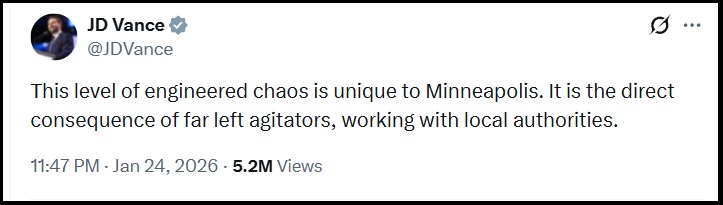
Last week CPB commander Greg Bovino was asked what makes Minneapolis different from other cities where ICE enforcement operations have taken place. Bovino noted in the Minneapolis region there is no separation between the extremists on the ground and the people in local government. Today, Vice President JD Vance concurs and expands on that sentiment:
What Vice-President Vance says here is very important. The regional government is a stakeholder in maintaining the chaos on the streets. Why? Because for two decades a cancer of rampant financial fraud has been permitted to spread throughout the Minneapolis region and has now reached the stage of visible metastasis.
Shortly after the George Floyd incident, some of us started looking into a background issue where it seemed like local police and Floyd had a knowledgeable relationship with each other prior to the encounter on the street. The initial contact between Floyd and police was about Floyd passing off a counterfeit $20 bill to a business that was not part of the approved money laundering operation.
When you follow that trail, you end up in a really weird place where it seemed like millions of counterfeit dollars were entering the country through Mexico, going by rail into the U.S. mainland and then transitioning through the Minneapolis region. I stopped researching it {SEE HERE} when I discovered that Floyd and police officer Chauvin were friends, and worked together at one of the laundry businesses; a nightclub.
ICYMI: CBP officers discovered $900,000 in counterfeit US currency in a commercial rail shipment in International Falls, MN. The counterfeit currency was seized and will be turned over to @SecretService. Details: https://t.co/2xX7nd34Xxpic.twitter.com/eCi8WjN1so
The corrupt activity in the Minneapolis area has been going on for around two decades. There are two basic components, local financial fraud and govt financial fraud. The local fraud represented millions and involved counterfeit goods/money and laundering operations. The government assisted financial fraud represents billions and involves abuses of federal tax monies.
After 20 years of this activity almost all elements of the economic and social structure are now compromised. As we have seen in the last several weeks, the HHS/CMS fraud is extensive and that illegal activity is impossible to exist without the knowledge, aid and assistance of the regional and municipal government officials.
Fraudulent day cares, fraudulent healthcare services, fraudulent transport companies, fraudulent “Health Outreach Workers” and various governmental offices all involved in bilking taxpayers for billions upon billions. At the same time there is a massive money laundering operation in the underground economy.
After two decades of this unchecked corruption, there’s no way to guess how much of the regional economic activity is actually dependent on the financial fraud. My best estimate is that over fifty percent of all economic activity -in the entire region- is based on fraud.
The Immigration and Customs Enforcement actions are the surface level issue for the regional and state government. However, it is the widespread financial fraud that turns the activity of the leftist agitators on the street into a useful tool for the regional officials to manipulate in order to hide the true financial fraud that surrounds the area.
The “local authorities” are working with the “far left agitators” because the Minneapolis region is a network of codependent fraud.
The police are compromised. The judges and courts are compromised. The local municipal officials are compromised. The mayor’s office is compromised, and the corruption issue spreads out to the state level when Governor Tim Walz previously shut down audits of the financial crimes and then state officials ignored whistleblowers.
All of the private and public institutions -within the system of regional and state government- are connected to a statewide network of financial fraud, from counterfeit money laundering to exploitation of federal government benefits; it is all connected to the same network of fraud.
It was the ease and ability to conduct fraud that attracted the Somali migrants and the criminal aliens. These people came for the money. ICE coming to arrest the aliens has put a spotlight on the reason why they aggregated in the Minneapolis region.
How this can be corrected is anyone’s guess.
Follow the money trail and you will discover this real reason for the state and local officials to support the anarchy in the streets. They all want the federal government to leave.
Posted originally on CTH on January 24, 2026 | Sundance
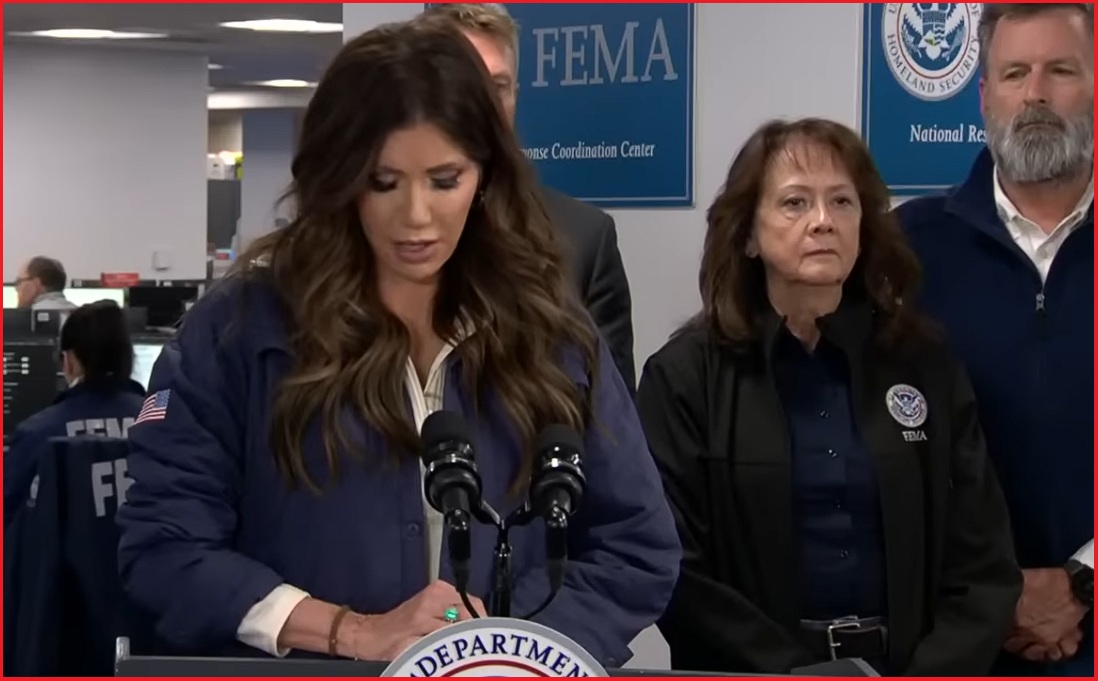
Dept of Homeland Security Secretary Kristi Noem holds a press conference from the FEMA Coordination Center to discuss the ongoing weather and storm emergency along with information about ongoing DHS efforts to handle the Minnesota insurrection effort. WATCH:
Dept of Homeland Security Secretary Kristi Noem holds a press conference from the FEMA Coordination Center to discuss the ongoing weather and storm emergency along with information about ongoing DHS efforts to handle the Minnesota insurrection effort. WATCH:
Posted originally on CTH on January 24, 2026 | Sundance
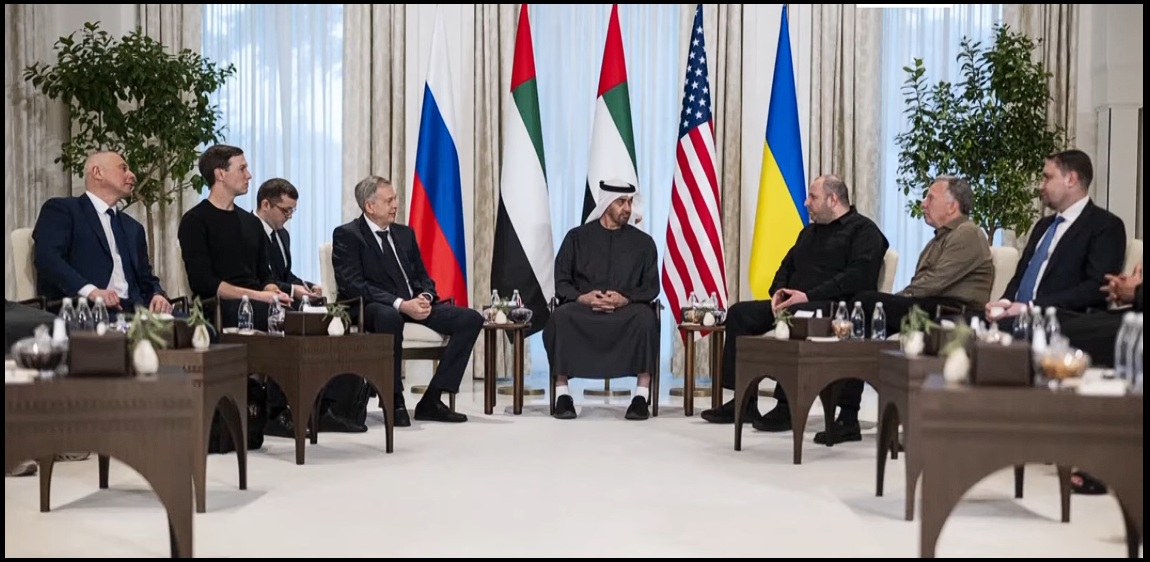
The bad news is that nothing much visible has changed in language or action from the negotiations. The good news is that for the first time military leadership from Russia, Ukraine and the USA joined with the diplomatic negotiators. This could indicate they are trying to work out the details on just how a ceasefire could be executed.
For the first time a trilateral discussion was held between the warring parties of Ukraine and Russia with the U.S. team working as an intermediary. The venue was the UAE acting as neutral turf for the discussion. According to Ukraine President Zelensky, the meeting in the Emirates was the first time representatives from Ukraine, Russia, and the United States were engaged in a trilateral format since the full-scale war began.
Steve Witkoff and Jared Kushner traveled to the UAE meeting after three hours of discussions with Russian Federation President Vladimir Putin in Moscow. Zelensky noted the arrangements were coordinated by the American side, describing the meeting as one of several unexpected diplomatic initiatives that emerged during negotiations.
ZELENSKYY – Our delegation delivered a report; the meetings in the UAE have concluded. And this was the first format of this kind in quite some time: two days of trilateral meetings. A lot was discussed, and it is important that the conversations were constructive.
The negotiations also involved military representatives from all three sides. From our side, today’s participants included Rustem Umerov, Kyrylo Budanov, Andrii Hnatov, Davyd Arakhamiia, Sergiy Kyslytsya, and Vadym Skibitskyi. From the American side, the participants were Steve Witkoff, Jared Kushner, Dan Driscoll, Alexus Grynkewich, and Josh Gruenbaum. The Russian side was represented by members of their military intelligence and armed forces.
The central focus of the discussions was the possible parameters for ending the war. I highly value the understanding of the need for American monitoring and oversight of the process of ending the war and ensuring genuine security.
The American side raised the issue of potential formats for formalizing the parameters for ending the war, as well as the security conditions required to achieve this.
As a result of the meetings held over these days, all sides agreed to report back in their capitals on each aspect of the negotiations and to coordinate further steps with their leaders. The military representatives identified a list of issues for a potential next meeting. Provided there is readiness to move forward – and Ukraine is ready – further meetings will take place, potentially as early as next week. I expect a personal briefing from the delegation upon its return.
I am grateful to the United Arab Emirates, and personally to the President of the Emirates, for their mediation and their readiness to host further meetings.
Ukraine is working for peace and security. Thank you to everyone who is helping. (link)
Ukrainian President Volodymyr Zelenskyy stunned the World Economic Forum by revealing European leaders privately urged him not to mention long-range weapons like Tomahawks. Zelenskyy said Europe’s fear of offending allies, internal rivalries, and silence are allowing Russia to keep striking Ukraine—and could soon threaten NATO itself.
Posted originally on CTH on January 24, 2026 | Sundance
More violence erupts in Minneapolis, Minnesota at the epicenter of where criminal leftists, illegal aliens and regional fraud operations -supported by political leadership- remain under scrutiny.
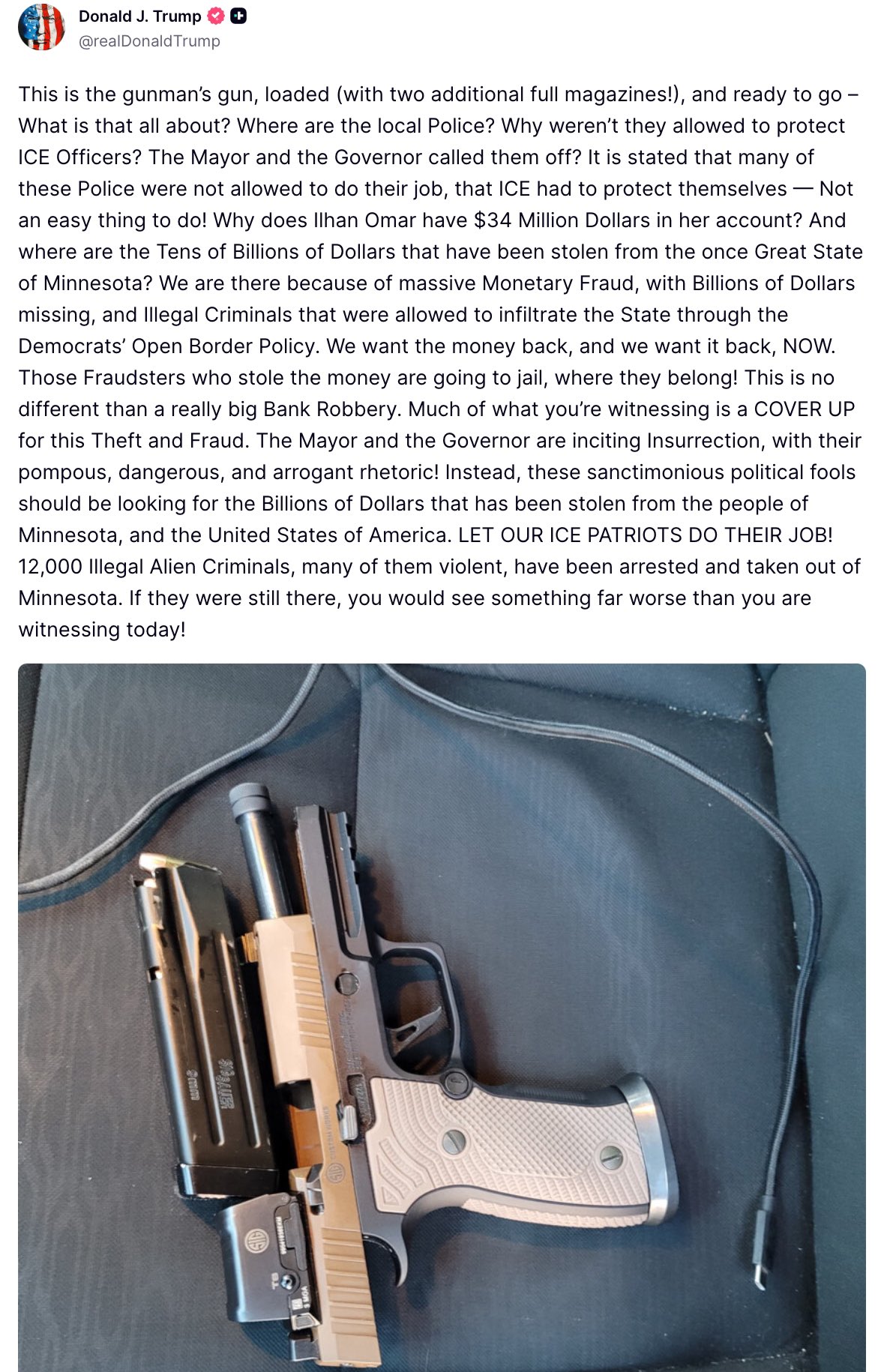
From DHS – “At 9:05 AM CT, as DHS law enforcement officers were conducting a targeted operation in Minneapolis against an illegal alien wanted for violent assault, an individual approached US Border Patrol officers with a 9 mm semi-automatic handgun. The officers attempted to disarm the suspect, but the armed suspect violently resisted. More details on the armed struggle are forthcoming.
Fearing for his life and the lives and safety of fellow officers, an agent fired defensive shots. Medics on scene immediately delivered medical aid to the subject but was pronounced dead at the scene. The suspect also had 2 magazines and no ID—this looks like a situation where an individual wanted to do maximum damage and massacre law enforcement.” VIDEO:
“About 200 rioters arrived at the scene and began to obstruct and assault law enforcement on the scene, crowd control measures were deployed for the safety of the public and law enforcement. This situation is evolving, and more information is forthcoming.” (more)
President Donald Trump delivered a brutally honest Truth Social message noting the motives behind the local and state officials who are desperate to keep themselves protected from their involvement in criminal fraud of taxpayer funds.
In the surface this looks like an immigration and customs enforcement operation; however, just below the surface is a large criminal network operating in coordination with state and municipal leadership. This is why the Mayor and Governor are trying desperately to keep riots on the streets.
This criminal underworld is exactly why Minnesota Governor Tim Walz was selected to be Kamala Harris’ 2024 vice-presidential nominee by former AG Eric Holder.
Posted originally on CTH on January 23, 2026 | Sundance
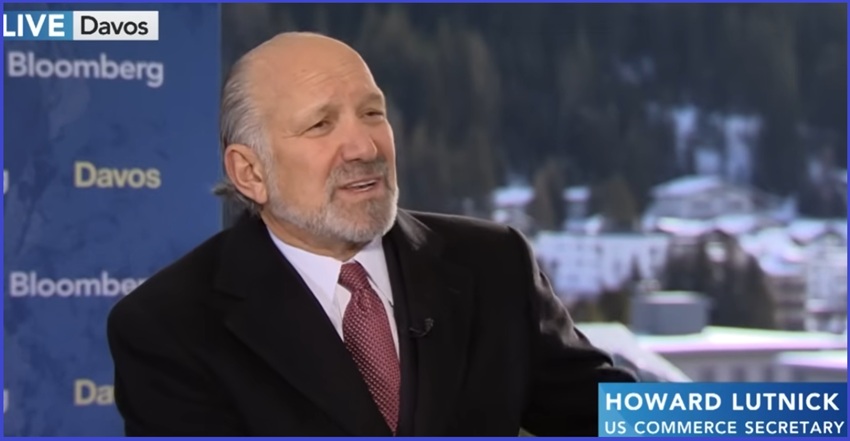
Hilarious Bloomberg interview with Commerce Secretary Howard Lutnick. The topics are European trade and politics combined with the overlay of Canadian trade and politics. The Bloomberg panelists question Lutnick about the similar “feelings” of the Europeans and Canadians, as it pertains to the outcome of trade discussions. It’s the feelings that make things difficult to negotiate.
Secretary Lutnick doesn’t dismiss the narrative but deconstructs the substance of the topic brilliantly. Lutnick notes the ridiculous nature of the Canadian trade position and their decision to go running to China because their feelings are hurt. Lutnick then affirms the USMCA is going to be dissolved mid-summer and fall of this year.
As we noted at the end of last year, splitting the USMCA into two bilateral trade deals, one for Mexico and one for Canada, will be one of the most interesting and long-term economically significant moves in U.S. trade history. It is going to be a lot of fun to watch these negotiations, and the pre-positioning gives us a preview of what is to come.
Mexico is doing everything almost perfectly in preparation for their bilateral deal. Canada is doing exactly the opposite and positioning themselves for the worst possible outcome of a deal with the USA. The disparity in approaches is so different, even now it is remarkable to watch. PROMPTED:
(VIA BLOOMBERG) – […] Canada has “the second-best deal in the world” with its access to the US market, Lutnick said, behind only Mexico. The Commerce chief also indicated that Canada’s tilt toward China could become an issue in talks over revamping the US-Mexico-Canada trade agreement known as USMCA.
If Ottawa opts to import Chinese electric vehicles and other trade-strengthening steps with Beijing, “do you think the president of the United States is going to say you should keep having the second-best deal in the world” during USMCA talks, Lutnick questioned.
[…] Canada’s Finance Minister Francois-Philippe Champagne told reporters in Quebec City that every Group of Seven nation is charting its own strategic path forward with China, and Canada is no different.
“We’ll continue to work hand in hand with our US partner,” he said. “At the same time, I think Canadians have understood by now that diversification is key. We need to be more resilient.”
Mexico’s President Claudia Sheinbaum said separately Thursday that her nation will work to maintain the USMCA trade deal despite recent disputes between Carney and US President Donald Trump. Speaking at her daily press briefing, she also said she would try to talk with Carney.
Next week, Mexico’s Economy Minister Marcelo Ebrard will travel to Washington for trade talks, Sheinbaum also said, speaking in Puebla, Mexico. (read full article)
Having travelled to regions of the world in discussions with people who factually determine economic outcomes, it is clear that every single policy shift undertaken by the Canadian government of Mark Carney is exactly the opposite of what is needed. In the next 24 months, the lifestyle of every Canadian will forever change.
President Trump is reestablishing an entirely new economic, trade and finance system. The era of the Marshal Plan is over; it has been factually deconstructed in the past 12 months.
Canadians and Europeans are desperately trying to offset the ramifications, hold on to their economic benefits and find a new mechanism to afford the domestic indulgences now eliminated by President Trump and the absence of money.
The EU and Canada have chased ‘climate change’ and ‘green energy’ schemes into a dead end of economic crisis. German Chancellor Merz has admitted the problem to the world. The direct and collateral damage is generational, and only just now beginning to surface.
When combined with their intransigent resistance to adapt to President Trump’s global economic and trade reset, core issue “reciprocity”, this reality takes both economies down a path that becomes a self-fulfilling prophecy.
Choosing to embrace China in lieu of modifying bilateral trade agreements with the USA is a short-sighted fool’s errand. Unfortunately, with political calculations each entity, Canada and/or the EU collective, are pandering to their “feeling” base out of an unwillingness to change trade behavior as demanded by Trump.
From Ottawa to London, to Paris, Berlin and Brussels the geopolitical landscape is changing permanently as President Donald Trump resets their global trade relationship to the United States.
President Trump is leveraging the largest consumer market in the world to the benefit of the customer; that’s America. Trump’s direct and specific intent is transactional, to rebuild an industrial and self-sufficient nation that is the envy of the world.
For several generations, Canada and the EU have exploited their biggest customer and taken the U.S. for granted. Both the EU and Canadian economies are stalled and soon to be shrinking. The USA economy will easily grow above 5% GDP and Mexico is likely to be the biggest beneficiary of their proactive positioning.
It’s not about ‘feelings’ it is just the cold reality of the economics.
I have created this site to help people have fun in the kitchen. I write about enjoying life both in and out of my kitchen. Life is short! Make the most of it and enjoy!
This is a library of News Events not reported by the Main Stream Media documenting & connecting the dots on How the Obama Marxist Liberal agenda is destroying America