Tag Archives: biocontainment units
White House Coronavirus Task Force Briefing – 5:00pm ET Livestream…
March 15, 2020
The White House COVID-19 task force led by Vice President Mike Pence will be holding an update on coronavirus mitigation efforts at 5:00pm. Livestream Links below:
UPDATE: Video Added
WH Livestream Link – Fox10 Livestream Link – PBS Livestream Link
.
.
Illinois Governor J.B. Pritzker Orders Forced Closure of All Restaurants and Bars – March 16th through March 30th…
March 15, 2020
Based on increasingly panicked statements from local officials, yesterday it became more likely that government officials were going to take extreme measures.
Moments ago Illinois Governor J.B. Pritzker held a press briefing and announced the mandatory closure of all restaurants and bars across the entire state.
“I am ordering all bars and restaurants in the state of Illinois to close to the public as of the close of business, Monday night, March 16th through March 30th.
We are working with restaurant owners and food delivery services across the state to see if restaurants can safely keep their kitchens open so the restaurants can keep the food delivery to people at their homes. Additionally, we are allowing drive-through and curbside pick-up for restaurants to serve the public through this period”… (link)
President Trump and VP Pence Hold Conference Call With U.S. Grocers and Suppliers…
March 15, 2020
Earlier this afternoon President Trump and Vice-President Mike Pence held a teleconference with a who’s-who of executives within the U.S. grocery supply chain.
[Per the White House] “Today, President Donald J. Trump held a telephone call with more than two dozen grocery store and supply chain executives from across the country. The President thanked them for the work they have already done to meet the needs of the public and for their continued commitment to the communities they serve.”
“All of the executives are working hand-in-hand with the Federal Government, as well as State and local leaders, to ensure food and essentials are constantly available. The President reminded the participants that this is an all-of-America approach and each of their stores and the stores they support can help Americans feel calm and safe when shelves are stocked with the items they need.”
“Supply chains in the United States are strong, and it is unnecessary for the American public to hoard daily essentials. The President thanked the executives for their close partnership and pledged to stay in close communication.” (read more)
Trump Administration: President Donald J. Trump, Vice President Mike Pence, Secretary Steven Mnuchin, Department of the Treasury; Secretary Sonny Perdue, Department of Agriculture; Larry Kudlow, Assistant to the President and Director of the National Economic Council; Tim Pataki, Deputy Assistant to the President and Director of the Office of Public Liaison
External Participants:
♦ Dave Clark, Senior Vice President, World Wide Operations, Whole Foods Market
♦ Mark Clouse, CEO, Campbell Soup Company
♦ Brian Cornell, CEO, Target
♦ Mike Duffy, CEO, C & S Wholesale Grocers
♦ Randy Edeker, Chairman, CEO, and President, Hy-Vee
♦ Geoff Freeman, President and CEO, Consumer Brands Association
♦ Greg Ferrara, President and CEO, National Grocers Association
♦ Grant Haag, President and CEO, Winco Food
♦ Jeff Harmening, CEO, General Mills, Inc.
♦ Jason Hart, CEO, Aldi USA
♦ Kevin Holt, CEO, Ahold-Delhaize USA
♦ Kevin Hourican, President and CEO, Sysco
♦ Anthony Hucker, President and CEO, Southeastern Grocers
♦ Craig Jelinek, CEO, Costco
♦ Todd Jones, CEO, Publix Super Markets
♦ Laura Karet, President and CEO, Giant Eagle, Inc.
♦ Rick Keyes, CEO, Meijer
♦ Donnie King, Group President and Chief Admin Officer, Tyson Food
♦ David MacLennan, Chairman and CEO, Cargill, Inc.
♦ Rodney McMullen, CEO and Chairman of the Board, The Kroger Co.
♦ Doug McMillon, CEO, Walmart
♦ Miguel Patricio, CEO, The Kraft Heinz Company
♦ Gregg Roden, Senior Vice President, PepsiCo North America Supply Chain
♦ Vivek Sankaran, President and CEO, Albertson’s
♦ Leslie Sarasin, President and CEO, Food Industry Association
♦ Steven Spinner, Chairman and CEO, United Natural Foods, Inc.
♦ Peter Van Helden, CEO, Stater Bros. Markets
♦ Todd Vassos, CEO, Dollar General Corporation
♦ Rob Vitale, President and CEO, Post Holdings, Inc.
♦ Colleen Wegman, CEO, Wegmans
Fox News Chris Wallace Claims: Americans Returning from Europe are Carrying the Coronavirus….
March 15, 2020
Dr. Anthony Fauci appears on Fox News to discuss the latest administration efforts to mitigate the impacts of the coronavirus. As soon as the interview begins Fox News Chris Wallace makes a startling claim about Americans returning from abroad:
“You can see them here, in close proximity, coming back from Europe, some of them carrying the coronavirus“…
Really? Chris Wallace criticizes the administration over every granular word assembly; yet, amid his pathological need to hype fear and panic, Wallace seemingly has no self-awareness about his own statements. Again, more ridiculousness.
If taken at its purest presentation (and it shouldn’t be)…. If what Wallace claims is correct, doesn’t the appearance of infected people at U.S. airports by itself explain the need for the screening he is criticizing?
.
Additionally, it is becoming increasingly clear Dr. Fauci has entered a psychological phase where he’s become addicted to his own sense of importance. His need to appear on all media everywhere, is now a detriment to the administration effort.
.
.
Sunday Talks: Steven Mnuchin -vs- Jonathan Karl – Coronavirus as an Economic Contagion….
March 15, 2020
Treasury Secretary Steven Mnuchin appears on ABC news where Jonathan Karl demands the U.S. Treasury Secretary should collapse the economy. Pathetic and desperate Mr. Karl wants a recession almost as much as he wants the job to replace Stephanopoulos.
This interview is a case study in TDS. The media are addicted to selling a resistance narrative. Coronavirus is to media like crack cocaine is to an addict.
Instead of taking the opportunity with the Treasury Secretary to explain what measures are in place to help businesses deal with financial assistance, and have Mnuchin outline what procedures are in place for them to follow, the media waste ten minutes constructing their anti-Trump narrative for an audience. It is ridiculous.
Now Is Not The Time to Forcibly Close Restaurants – There are Interim Alternatives…
March 15, 2020
Right now, today, the retail food supply-chain is trying to recover from previous panic buying. Across the nation grocery stores are wiped out. Warehouses are emptying trying to replenish the stores. The upstream suppliers are trying to resupply the warehouses.
Supermarkets are closing early and opening late while trying to stem panic and fulfill customer demand. Now is exactly the wrong time to limit food choices and push more people into those retail food stores.
No advance notice. No time to prepare or plan… just an immediate order.
Imagine what will happen tomorrow morning in Ohio and Illinois at grocery stores.
Notice these orders from short-sighted governors are in effect almost immediately. Meaning no-one has had the time to prepare for this type of a disruption in the total food supply chain.
These governors do not have any experience, policy framework, or previously established state-wide systems (having been tested through experience) for a process of rapid food distribution as a result of a state emergency. They are flying by the seat of their pants, and taking advice from the wrong people with the wrong priorities and the wrong frame-of-reference.
A government cannot just shut down 30 to 50 percent of the way civil society feeds themselves, without planning and advanced preparation for an alternative. Those who AREthe alternative, the retail food grocers, need time to prepare themselves (and their entire logistical system) for the incredible impact. Without preparation this is a man-made crisis about to get a lot worse.
Some states have emergency food distribution and contingency plans. Those states are hurricane prone states; and those states have experienced the intense demand on the food distribution system when restaurants are closed and people in society need to eat.
Those states have, by necessity, developed massive logistical systems to deal with the food needs of their citizens. These current short-sighted states are not those prepared states.
Any governor who shuts down their restaurant industry without a civil contingency plan is being incredibly, catastrophically, reckless. It really is a terribly dangerous decision.
Any policy that drives more demand, when demand is already outpacing supply, is a bad policy. This is the food supply chain we are talking about. This is not arbitrary stuff being discussed. This supply chain is critical.
People freak out about access to food.
For the past 20 to 30 years there have been exhaustive studies on the growth of the restaurant sector. It has been well documented that as the pace of society increased, as efficiencies and productivity increased; and as less of the population learned how to cook and prepare meals; approximately 30% of retail food growth dropped.
Multiply the impact of lower food shopping over all those years. More Americans eat at restaurants now. Depending on the area, there are estimates that fifty percent of all food consumed is from “dining out” or “food consumed outside the home.”
Most of the current panic shopping is because people are preparing by buying weeks worth of food products. Closing restaurants will only magnify that panic shopping.
If state officials are going to make these decisions, they need to coordinate closely with the retail grocers and food outlets in their states. The decision to shut down restaurants must be very closely coordinated and timed with a civil society need for alternatives. Those providing the alternatives need time… not much time…. but they need time.
This is exactly the wrong time to shut restaurants and put additional pressure on a national food supply chain that is trying to meet overwhelming demand.
Either these officials are intentionally trying to create civil unrest, or they are just inexperienced politicians without the ability to think through the logical conclusions to their mandated orders. I’m not sure which it is. However, regardless of intent or stupidity, these types of knee-jerk decisions will harm more people than the virus itself.
Drive-thru and curbside services will not work. Yes, McDonalds and similar do and can provide drive-thru services… but they are not designed for exclusive “drive-thru” services. Approximately eight percent of all daily fast-food comes from McDonalds imagine a line of cars a mile long for a drive-thru hamburger. Then imagine that car, after waiting four hours in that line, orders a month’s worth of hamburgers…. and then that supply chain collapses…. See, it ain’t that simple.
These decisions create the snow-ball effect…
Most restaurants are not not set-up for immediate delivery…. Yes, all of these challenges can and will be overcome; restaurants will limit their curbside products, fast food will put a limit on orders, kitchens will modify to adjust to the work-flow, etc. However, it takes a time to prepare for these necessary shifts and changes.
A more prudent step would be for state officials to provide mitigation directives, simple and prudent changes, during a phase that allows restaurants to adapt:
- Position all tables 6 feet apart.
- Provide single use condiments and utensils.
- Provide disinfecting wipes at the front door and on tables.
- Limit the opportunity for virus spread by modifying the consumer engagement.
These types of dining out measures can be prudent and allow for the mitigation of the virus without spreading wide-scale panic that only worsens the issues for alternative options.
Arbitrarily shutting down restaurants, effective immediately, is not a good idea and will only increase the panic and anxiety…. Then again, maybe that’s the goal.
Escalating Quickly: Hoboken NJ Announces City-Wide Enforced Coronavirus Curfew – All Citizens Must Stay in Their Homes 10pm to 5am…
March 14, 2020
Telling people to remain calm and simultaneously forcing people to remain in their homes would seem to be a contradiction in messaging; potentially only worsening the panic. However, this is one of those, “well, yes it’s unconstitutional except when….” moments, that may have rather profound consequences.
The Democrat mayor of Hoboken New Jersey has announced a mandatory curfew between 10pm and 5am where all residents are not permitted to exit their residence; and all bars must close due to the coronavirus.
I don’t know if this is the first ‘mandatory’ coronavirus curfew, or even how such an effort could feasibly be enforced, but it’s likely not going to be the last:.
New Jersey – 10:45pm ET – Hoboken Mayor Ravinder Bhalla announced a citywide curfew will be in effect starting Monday. The curfew also places major restrictions on bars and restaurants.
The curfew will be in effect from 10 p.m.- 5 a.m.starting on Monday, and until further notice. Residents will be required to stay home, except for emergencies, or if needed at work by their employer.
As of 11 a.m. Sunday, bars that do not serve food will not be permitted to operate at all. All other bars and restaurants are no longer permitted to serve food within the establishment, and can only sell takeout or delivery. (read more)
Empty Shelves? – Understanding Supply Chains, Logistics, and Recovery Efforts…
March 14, 2020
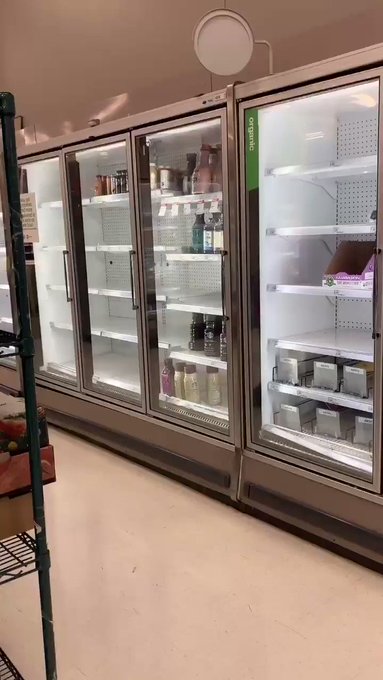
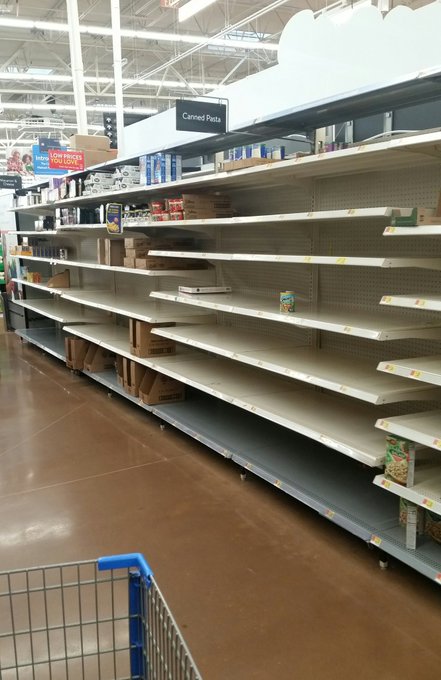
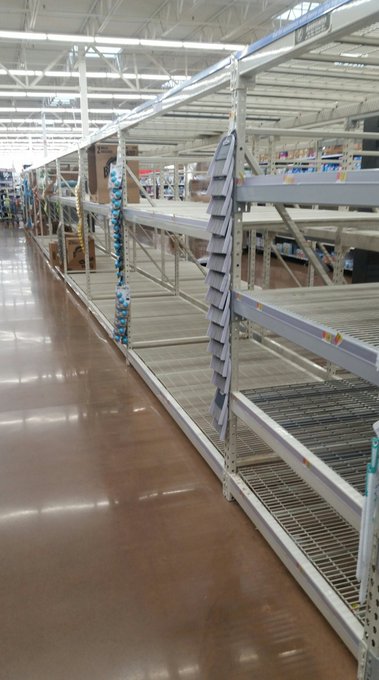
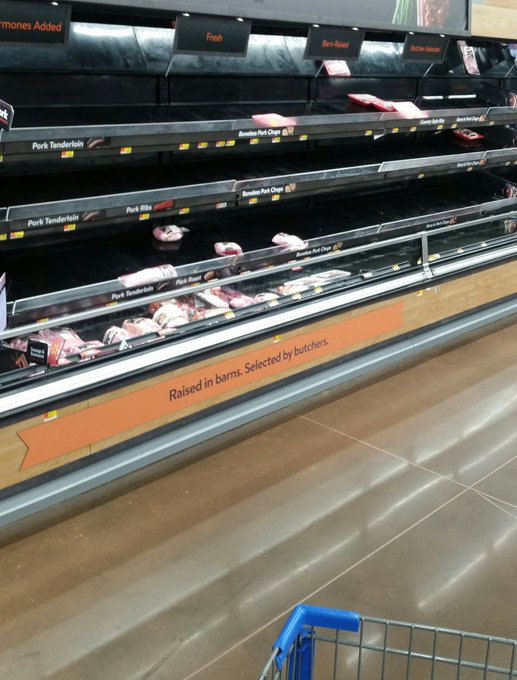
By now everyone is familiar with the abundant pictures on social media of empty shelves in local stores. Having some familiarity with the supply chain might help people to understand some of the challenges; and possibly help locate product. (Pics from Twitter)
There are essentially two types of distribution centers within the retail supply chain for most chain markets, food stores and supermarkets. The first type is a third party, or brokered, distribution network. The second type is a proprietary, company owned, distribution center. Knowing the type of distribution helps to understand what you can expect.
If your local retail store is being replenished from a third party distribution center, you can expect greater shortages and longer replenishment times; we will see entire days of empty shelves in these stores. However, if your local retail store owns their own warehouse and distribution network, the replenishment will be faster. In times of rapid sales, there is a stark difference.
These are general guidelines: An average non-perishable distribution center will replenish approximately 60 stores. Those 60 stores will generally not extend beyond 100 miles from the distribution center. The typical company owned warehouse will have approximately 20 tractors (the semis) delivering trailers of goods to those sixty stores.
In this type of network… On a typical day a truck driver will run three loads. Run #1 Delivery-Return; Run #2 Delivery-return, Run #3 Delivery Return. End shift.
If every tractor is operating that’s a maximum capacity of 60 trailers of merchandise per day. Many stores receiving more than one full trailer.
A typical store, during a non-emergency, will receive 1 full trailer of non-perishable goods three to five times per week. However, under current volume the purchased amount of product is more than triple normal volume. It is impossible to ship 180 trailers of merchandise daily to sixty stores with 20 fixed asset tractors. This is where the supply chains and logistics are simply incapable of keeping up with demand.
Thinking about distribution to a 100 mile radius. The stores closest to the distribution center will be delivered first, usually overnight or very early morning (run #1). The intermediate stores (50 miles) will be delivered second, mid-morning (run #2). The stores furthest from the distribution center will be delivered third, late afternoon (run #3).
So if you live close to a distribution center, your best bet is early morning. If you live in the intermediate zone, late morning to noon. If you are in the distant zone in the evening.
The current problem is not similar to a holiday, snow event or hurricane. In each of those events typical store sales will double; however, during holidays or traditional emergencies the increase in product(s) sold is very specific: (a) holiday product spikes on specific items are known well in advance and front-loaded; and (b) snow/hurricanes again see very specific types of merchandise spikes, with predictability.
In the current emergency shopping pattern the total business increase is more than triple, that’s approximately 30% more than during peak holiday shopping. Think of how busy your local store is on December 23rd of every year. Keep in mind those customers are all purchasing the same or similar products. Now add another 30%+ to that volume and realize the increases are not specific products, everything is selling wall-to-wall.
Perishable and non perishable products are selling triple normal volume. This creates a replenishment or recovery cycle that is impossible to keep up with. The first issue is simply logistics and infrastructure: ie. warehouse (selectors, loaders), and distribution (tractors, trailers, drivers). The second issue is magnifying the first, totality of volume.
A hurricane event is typically a 4 or 5 day cycle. A snow event might be 2 days. The holiday pattern is roughly a week and all the products are well known. However, the type of purchasing with coronavirus shopping is daily, everything, with no end date.
Once the store is wiped out, a full non-perishable recovery order might take four tractor-trailers of merchandise. In our common example, if every store needed a full recovery order that would be 240 tractor-trailers (60 stores x 4 per store). This would need to happen every day, seven days a week, for the duration of the increase. [And that is just for the non perishable goods]
That amount of increase is a logistical impossibility because: (a) no warehouse can hold four times the amount of product from normal distribution; (b) the inbound supply-chain orders to fill the distribution center cannot simply increase four fold; and (c) even with leased/contracted drivers doubling the amount of tractors and trailers, there’s still no way to distribute that much product.
Instead what we see are priorities being assigned to specific types of product that can be shipped to maximize “cube space” in outbound trailers going to stores. A distribution center can send 100 cases of canned goods (one pallet) in the same space as 15 cases of paper towels or toilet tissue (one pallet). So decisions about what products to ship have to be prioritized.
Club stores (ex. BJ’s, SAM’s, or Costco) can ship bulk paper goods faster because they do not carry a full variety of non-perishable items. The limited selection in Club stores naturally helps them replenish; they carry less variety. Meanwhile the typical supermarket distribution center has to make decisions on what specific goods to prioritize.
Nationally (and regionally) the coronavirus shopping panic is far outpacing the supply chain of every retailer. Instead of a weeks worth of food products, people are now trying to purchase a months worth. Every one day of coronavirus sales is equal to three or four normal days.
To try and get a handle on this level of volume we will likely see changes in operating hours. Expect to see stores closing early or limiting the amount of time they are open every day…. the reason is simple: (1) they don’t have the products to sell over their normal business hours; and (2) they need to move more labor into a more compact time-frame to deal with the increases in volume.
VP Mike Pence Coronavirus Task Force Press Briefing – 12:00pm ET Livestream…
March 14, 2020
Following a 10:00am meeting with President Trump and the COVID-19 task force members, Vice-President Mike Pence will be holding a press briefing at noon.
UPDATE: Video Added (Just Hit Play)
WH Livestream Link – NBC Livestream Link – USA Today Livestream Link
.
.
.