President Trump Remarks Honoring Reverend Bill Graham – Capitol Hill Rotunda Ceremony…


Reverend Bill Graham is honored today during a ceremony at the Capitol Hill Rotunda:

[Transcript] U.S. Capitol, Washington, D.C. – 11:21 A.M. EST

THE PRESIDENT: Thank you, Speaker Ryan and Leader McConnell. And, most importantly, thank you to the entire Graham family for honoring us with your presence here today. Thank you.

In the spring of 1934, Billy Graham’s father allowed a group of Charlotte businessmen to use a portion of the family’s dairy farm to gather for a day of prayer.

On that day, the men prayed for the city. They prayed that, “Out of Charlotte, the Lord would raise up someone to preach the Gospel to the ends of the Earth.”

We are here today, more than 80 years later, because that prayer was truly answered.

Billy Graham was 15 years old at the time. Just a few months later, he accepted Jesus Christ as his Lord and Savior.

That choice didn’t just change Billy’s life — it changed our lives. It changed our country, and it changed, in fact, the entire world.

The North Carolina farm boy walked out of those fields, into a great and beautiful history. Starting at a small Bible school in Florida, he soon led a nationwide revival — from a large tent in Los Angeles, to 100,000 people in a single day at Yankee Stadium, to more than 2 million people at Madison Square Garden, over 16 weeks in 1957.

And I remember that, because my father said to me, “Come on, son” — and, by the way, he said, “Come on, mom. Let’s go see Billy Graham at Yankee Stadium.” And it was something very special.

But Americans came in droves to hear that great young preacher. Fred Trump was a big fan. Fred Trump was my father.

In London, Tokyo, Seoul, Bogota, Moscow, New Delhi, Saigon, Johannesburg, and scores of other places all over the world, Reverend Graham shared the power of God’s word with more than 200 million people, in person, and countless others through television and radio where people loved to watch and listen.

In 1978, with the support of the Catholic Bishop who would soon become Pope John Paul II, Reverend Graham went to Poland and spoke of the meaning of the cross to a people suffering under the soulless oppression of communism.

Billy Graham carried his message around the world, but his heart, as Franklin will tell you, was always in America.

He took his message to the poorest places, to the downtrodden and to the brokenhearted, to inmates in prison, and to the overlooked and the neglected. He felt a great passion for those that were neglected.

Everywhere he went, Reverend Graham delivered the same beautiful message: God loves you. That was his message. God loves you.

We can only imagine the number of lives touched by the preaching and the prayers of Billy Graham –- the hearts he changed, the sorrows he eased, and the joy he brought to so many. The testimony is endless.

Today, we give thanks for this extraordinary life. And it’s very fitting that we do so right here in the Rotunda of the United States Capitol, where the memory of the American people is enshrined.

Here in this room, we are reminded that America is a nation sustained by prayer. The painting to my left is of the pilgrims as they embarked for America, holding fast to the Bible and bowing their heads in prayer.

Along these walls, we see the faces of Americans who prayed as they stood on the Lexington Green, who prayed as they headed west, prayed as they headed into battle, and prayed as they marched for justice, and always marched for victory.

Around us stand the statues of heroes who led the nation in prayer during the great and difficult times, from Washington to Lincoln to Eisenhower to King.

And, today, in the center of this great chamber lies legendary Billy Graham, an ambassador for Christ who reminded the world of the power of prayer and the gift of God’s grace.

Today we honor him as only three private citizens before him have been so honored.

And like the faithful of Charlotte once did, today we say a prayer for our country, that all across this land the Lord will raise up men and women like Billy Graham to spread a message of love and hope to every precious child of God.

Thank you. God bless you. And God bless America. Thank you very much.

END – 11:28 A.M. EST

Billy Graham’s message to us


Eternal rest grant unto him, oh Lord.

Stella’s Place

As you may know, Billy Graham left this world today at age 99 years. He died at 8 a.m. EST at his home in Montreat, North Carolina. A counselor to many famous and powerful men and women, his message was always the same, to everyone.

According to Reuters,

In a rare trip away from his home in his later years, Graham had celebrated his 95th birthday on Nov. 7, 2013, at a hotel in Asheville, North Carolina, where some 800 guests, including Republican politician Sarah Palin, business magnates Rupert Murdoch and Donald Trump and television hostess Kathie Lee Gifford paid tribute.

The celebration featured a video of a sermon that his son Franklin said was Graham’s last message to the nation. Graham had been working for a year on the video, which was aired on Fox News. In it, he said America was “in great need of a spiritual awakening.”

View original post 41 more words


Heaven: The Message from Billy Graham


We never know what we truly believe until it’s a matter of life and death. Billy Graham, along with a firefighter and a young woman forced to face the reality of death, share the Gospel message, and what really happens when we die.

Recorded by Billy Graham Evangelistic Association in 2014:

Billy Graham Memorial HERE

Remember That You Are Dust, And To Dust You Shall Return


Traditionally, Ash Wednesday and Lent are associated with Catholicism, but that no longer holds true. More Christians are taking advantage of the “forty days” (it’s really 46) today prepare for Easter.

Lent is a time to fast, pray, give alms. Many Catholics will give something up. Sweets, alcohol, meat, cursing, something that is supposed to be sacrificial and difficult. We perform acts of penance, and frequently take part in public prayer, such as the Stations of the Cross, which most parishes will have weekly, often before a Lenten meal.

All this is meant to spiritually lead us into the desert, to prepare us to really be able to celebrate on Easter Sunday with a cleansed heart, open totally to Jesus in the Resurrection. It should also open us to our fellow men on this journey, particularly those in need.

If you have never thought much about Ash Wednesday and Lent, I invite you to consider making it a part of your life for the next six weeks. It’s one of the best things you can do for yourself as a Christian.

Should you wish to participate in an Ash Wednesday service, you do not have to be Catholic. You will be welcome at any parish, and you can receive the ashes. As the priest, deacon, or perhaps layperson makes the cross on your forehead they will say “Remember that you are dust, and to dust you shall return” or “Repent, and believe in the Gospel.”

The Real Mardi Gras


 Debauchery. Bacchanalia. Floats, costumes, beads and masks, and lots of drinking and partying. That’s what we think of when we hear the term Mardi Gras, or Fat Tuesday.

There is a lot more behind it. Also called Shrove Tuesday, it marks the last day of the liturgical calendar before Lent begins. After Catholicism spread throughout Europe, many cultures celebrated the final day before Lent began in ways unique to that individual  culture. eggs, and milk were finished off in one day, giving rise to the term Fat Tuesday. In Poland, such things as lard, sugar, eggs, and fruit were forbidden during Lent, and the beloved  pączki became a special treat for Fat Tuesday, and in Detroit they still sell many thousands of them to long lines of people.

Many people, Catholic and non Catholic alike celebrate Mardi Gras. Have a great day, but spare a thought to tomorrow.

No matter what church you attend, Lent is a custom, an observance, that you can use to prepare you to meet Christ renewed on Easter Sunday, with a deeper and more tested faith. Perhaps a faith better prepared to go into the world and share, model, and live the teachings.

By the way, I am sure most of you have seen us Catholics sporting the cross on our foreheads, traced in ashes blessed on Palm Sunday of the preceding year. Every parish will have one or more services to distribute ashes, and you do not have to be Catholic to attend and receive the ashes, should you so choose.

The Feast Of Epiphany


On January 6 Christians celebrate the Feast of the Epipany of our Lord. The word epiphany comes from the Greek word epiphainen and means “to manifest” or “to reveal.”

According to the Catechism of the Catholic Church:

The Epiphany is the manifestation of Jesus as Messiah of Israel, Son of God and Saviour of the world. the great feast of Epiphany celebrates the adoration of Jesus by the wise men (magi) from the East, together with his baptism in the Jordan and the wedding feast at Cana in Galilee.

In the magi, representatives of the neighbouring pagan religions, the Gospel sees the first-fruits of the nations, who welcome the good news of salvation through the Incarnation.

The magi’s coming to Jerusalem in order to pay homage to the king of the Jews shows that they seek in Israel, in the messianic light of the star of David, the one who will be king of the nations.

Their coming means that pagans can discover Jesus and worship him as Son of God and Saviour of the world only by turning towards the Jews and receiving from them the messianic promise as contained in the Old Testament.

The Epiphany shows that “the full number of the nations” now takes its “place in the family of the patriarchs”, and acquires Israelitica dignitas (is made “worthy of the heritage of Israel”) [CCC 528]. Taken from a post on NCR here.

Epiphany is celebrated on January 6. In the United States it is observed on the first Sunday after January 1, this year on January 7.

The magi, also known as the Wise Men and the Three Kings, although the number was never specified in the Bible, came seeking the King because of a widespread belief that a universal king would come from the nation of Israel.

Gospel MT 2:1-12
When Jesus was born in Bethlehem of Judea,
in the days of King Herod,
behold, magi from the east arrived in Jerusalem, saying,
“Where is the newborn king of the Jews?
We saw his star at its rising
and have come to do him homage.”
When King Herod heard this,
he was greatly troubled,
and all Jerusalem with him.
Assembling all the chief priests and the scribes of the people,
He inquired of them where the Christ was to be born.
They said to him, “In Bethlehem of Judea,
for thus it has been written through the prophet:
And you, Bethlehem, land of Judah,
are by no means least among the rulers of Judah;
since from you shall come a ruler,
who is to shepherd my people Israel.”
Then Herod called the magi secretly
and ascertained from them the time of the star’s appearance.
He sent them to Bethlehem and said,
“Go and search diligently for the child.
When you have found him, bring me word,
that I too may go and do him homage.”
After their audience with the king they set out.
And behold, the star that they had seen at its rising preceded them,
until it came and stopped over the place where the child was.
They were overjoyed at seeing the star,
and on entering the house
they saw the child with Mary his mother.
They prostrated themselves and did him homage.
Then they opened their treasures
and offered him gifts of gold, frankincense, and myrrh.
And having been warned in a dream not to return to Herod,
they departed for their country by another way.

He Is Risen


GospelMT 28:1-10

After the sabbath, as the first day of the week was dawning, Mary Magdalene and the other Mary came to see the tomb.
And behold, there was a great earthquake; for an angel of the Lord descended from heaven, approached, rolled back the stone, and sat upon it.
His appearance was like lightning and his clothing was white as snow.
The guards were shaken with fear of him and became like dead men.
Then the angel said to the women in reply, “Do not be afraid!
I know that you are seeking Jesus the crucified.
He is not here, for he has been raised just as he said.
Come and see the place where he lay.
Then go quickly and tell his disciples, ‘He has been raised from the dead,
and he is going before you to Galilee; there you will see him.’
Behold, I have told you.”
Then they went away quickly from the tomb, fearful yet overjoyed, and ran to announce this to his disciples.
And behold, Jesus met them on their way and greeted them.
They approached, embraced his feet, and did him homage.
Then Jesus said to them, “Do not be afraid.
Go tell my brothers to go to Galilee, and there they will see me.”

It Is Finished. Good Friday


Today we observe Good Friday, the day of the death of Jesus. Many Christian Churches have different ways of observation, to prepare us for the coming resurrection of the Lord on Easter Sunday. Today, the sacrifices we have made during Lent culminate in our internalization of the great offering of Christ’s life. If we have been diligent in our Lenten preparations, Good Friday hits us with a power and force that brings us, literally and figuratively, to our knees with the grasp of what Jesus poured out for us. It becomes personal, a tiny sliver of the cross is buried in our heart. And so each year, we find that we give ourselves over to Christ just a little more through this time of penance and reflection. 


The Easter Triduum, the marking of the days of Jesus’ passion and resurrection, the  most important time of the church year, begins with the evening Mass of Holy Thursday, reaches its high point in the Easter Vigil, and closes on Easter Sunday evening. After preparing during the days of Lent, we celebrate these holiest of days in the Church year.

From John, Chapter 19:

Then Pilate tried to release him, but the Jewish leaders told him, “If you release this man, you are no friend of Caesar’s. Anyone who declares himself a king is a rebel against Caesar.

At these words Pilate brought Jesus out to them again and sat down at the judgement bench on the stone paved platform. It was now about noon of the day before Passover.

And Pilate said to the Jews, “Here is your King!”

“What? Crucify your king?” Pilate asked. “We have no King but Caesar,” the chief priests shouted back.

So they had him at last, and he was taken out of the city, carrying his cross to the place known as “The Skull,” in Hebrew, “Golgotha.” There they crucified him and two others with him, one on either side, with Jesus between them. And Pilate posted a sign over him reading “Jesus of Nazareth, the King of the Jews.” The place where Jesus was crucified was near the city; and the signboard was written in Hebrew, Latin, and Greek, so that many people read it.

Then the chief priests said to Pilate, “Change it from ‘The King of the Jews’ to ‘He said, I am King of the Jews.’ ”

Pilate replied, “What I have written, I have written. It stays exactly as it is.”

When the soldiers had crucified Jesus, they put his garments into four piles, one for each of them. But they said, “Let’s not tear up his robe,” for it was seamless. “Lets throw dice to see who gets it.” This fulfilled the scripture that says, “They divided my clothes among them, and cast lots for my robe.” So that is what they did.

Standing near the cross were Jesus’ mother, Mary, his aunt, the wife of Cleopas, and Mary Magdalene. When Jesus saw his mother standing there beside me, his close friend, he said to her, “He is your son.”

And to me he said, “She is your mother.” And from then on, I took her into my home.

Jesus knew that everything was now finished, and to fulfill the scriptures said, “I’m thirsty.” A jar of sour wine was sitting there, so a sponge was soaked in it and put on a hyssop branch and help up to his lips.

When Jesus had tasted it, he said, “It is finished,” and bowed his head and dismissed his spirit.

Today we would like to invite you to share with us your reflections, your thoughts, your favorite readings on Good Friday. We sincerely hope that you will join in this conversation as a sharing of our common faith, an active searching, united in asking in this small way for God’s blessing upon His world this Easter Triduum. So many of us see change as something that is all or nothing. We postpone the changes we need to make in our lives to improve our relationship with God because we aren’t mentally “ready” to make that leap. In reality, our path to God is made in tiny steps, small differences, the little things that take us one step closer in faith.

We ask you to join us, help us, take that step. Together and seperately, may we aid each other through our words and prayers, to make this Good Friday an opening for the light that is Christ to penetrate our darkness.

I would also like to share a paragraph from The Catechism of the Catholic Church.

In Her Magisterial teaching of the faith and in the witness of her saints, the Church has never forgotten that “sinners were the authors and the ministers of all the sufferings the Divine Redeemer endured.” Taking into account the fact that our sins affect Christ himself, the Church does not hesitate to impute to Christians the gravest responsibility for the torment inflicted upon Jesus, a responsiblity with which they have all too often burdened the Jews alone.

]

THE SILK ROAD EXHIBIT


NOTES ON THE SILK ROAD EXHIBIT

By Tabitha Korol August 2014

“Traveling the Silk Road,” at the Cleveland Museum of Natural History, appears to be a small section of a larger, global exhibition, “1001 Inventions,” which, accompanied by an award-winning film, professes to be a revelation of a thousand years of scientific and cultural achievements by the Muslim world, with a nod to some contributing faiths and cultures. However, these faiths and cultures were victims of Muslim jihadists who, following in Mohammed’s footsteps, invaded the “infidel” world for more than 1400 years, enslaving, slaughtering, and plundering. Their greatest achievement was their ability to expropriate every creative, innovative, groundbreaking device of Islam’s victims and, defying all logic, fraudulently claim each as their own.

The Silk Road exhibit is a betrayal of its name and deception to the tourists, individuals, schoolteachers and students. Some of the visitors are of those cultures whose contributions were formidable, but were given scant recognition or complete disregard, thereby denying them the knowledge and sense of pride to be had upon learning that their heritage contributed to the growth of civilization along the early trade routes. This Islamic presentation allowed about 20 percent to China.

Islam’s growth in both religious adherents and these “achievements” emanated from their invasions into foreign lands, enforcing their will under penalty of death, and booty acquired from the invaded and enslaved cultures (the worst, the black African trade, was excluded). Slavery, including sexual slavery, is justified in the Qur’an and practiced in many countries, to this day.

Islam is socialism, and socialism is antithetical to creativity. Islam is based on envious hatred of what is noble, the aspirations and outstanding creative individuality in all fields of human endeavor. Muslims are enraged that a small Israel could smash the rocket launchers and their terror tunnels of Gaza, for example. They resent and hate human excellence, yet they take ownership of the ingenuity of others out of envy and deceit to entice.

The museum exhibit is just such an example of Muslims’ adopting achievements of others for their own acclaim, because they have produced nothing of value in 1400 years of existence. The majority of the Islamic world is illiterate, violent combatants who commit atrocities beyond the Western imagination – although we are beginning to learn of what these people are truly capable.

DEFINING THE SILK ROAD

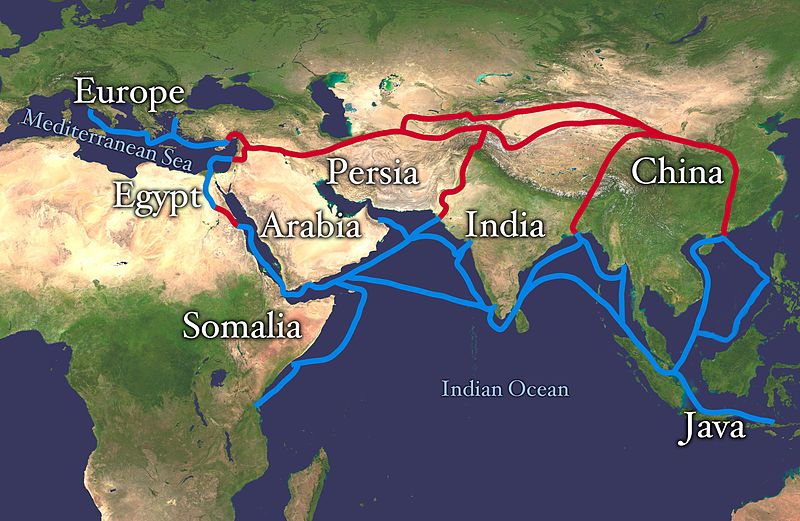
The Routes Network ofChang’on-Cianshan Corridor, Eurasia

Silk 01

A vertical screen hangs at the entrance:

Silk 01a

WHAT WASN’T SAID:

1. That this was an Islamic exhibit.

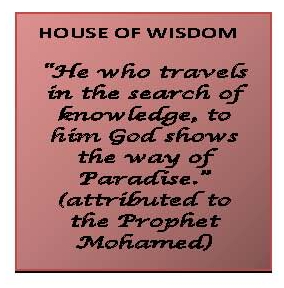
2. that Islam provides a martyr’s way to Paradise, which includes destruction, slavery, suicide and genocide, and looting.

3. That Islamic countries lead the world in illiteracy.

FACTS:

1. The most prominent reward promised Islamic Martyrs are the 72 Dark-Eyed Virgins in Paradise. A Palestinian religious leader explained, “…the purpose of authentic Islam is to fill Muslims with desire for Paradise” – the anticipation and love of death. He [Muhammad] said (in a Hadith, Islamic tradition): “[There is] a palace of pearls in Paradise and in it seventy courts of ruby… And in each court [there are] seventy houses of green emerald stone. In every house, seventy beds. On every bed, seventy mattresses of every color and on every mattress a woman.” (Hadith)

2. Sahih al-Bukhari HadithHadith 1.35 Narrated by Abu Huraira The Prophet said, “The person who participates in (Holy battles) in Allah’s cause and nothing compels him to do so except belief in Allah and His Apostles, will be recompensed by Allah either with a reward, or booty (if he survives) or will be admitted to Paradise (if he is killed in the battle as a martyr).” http://www.inthenameofallah.org/Shaheed%20OR%20Martyr.html

EXHIBIT SIGN:

Silk 02

HISTORIC BACKGROUND:

Ancient Chinese guarded the silk production secret for centuries. Ottoman Turks and Persians fought over it; English and French competed to restrict its markets, but every culture was touched by silk. It was found aboard medieval Viking ships sailing out of Constantinople, as kerchiefs from India and as silk bandanas brought by pirates and worn by American cowboys. Damask silk of Damascus, Syria, was actually from China. Martha Washington wore a dress of Virginia silk to George’s inauguration, and Native Americans learned silk embroidery to decorate traditional apparel.

WHAT WASN’T SAID:

1. That the Persian and Babylonian Jews pioneered the intercontinental trade and the Silk Road.

2. It is likely that “Arab traders” is an all-encompassing term to include all the people, religions and cultures that existed in the Middle East, that the Muslims captured and made their own. In fact, the Arab ethnic groups included Lebanese, Syrians, Emiratis, Qataris, Saudis, Bahrainis, Kuwaitis, Iraqis, Omanis, Jordanians, Yemenis, Sudanese, and Egyptians. These were not all Arab, in fact; neither were they of the same original religion; the exhibit is misleading.

FACTS:

1. Intercontinental trade was pioneered by Persian Jews who forged the “Silk Route” to the heart of China in the fifth century BCE. Augustus, first Roman emperor, is said to have commissioned “the first travel guide” from Isidore of Charax (a Greco-Roman geographer of the 1st century BC and 1st century AD). Centuries later, while the Europeans were still deep in the Dark Ages, Persian Radhanite scholar/travelers (medieval Jewish merchants who traded between the Christian and Islamic worlds, 500-1000 AD) pioneered land and sea trade routes to the Far East. “These merchants speak Arabic, Persian, Roman, Frankish, Spanish, and Slavonic,” wrote Ibn Khurdadhih in the ninth century CE, “They travel from East to West and from West to East by land as well as by sea.” They also spoke Hebrew and Aramaic.

2. The Silk Route was pioneered by Babylonian Jews in the fifth century BCE. The Kaifeng, China synagogue complex was erected in 1163 to serve a community of three thousand worshipers, and to accommodate Jewish trader-travelers who came across Asia with their caravans.


Silk Road #2, Spices


Cinnamon, Cassia (the bark from which cinnamon is made), jade, camphor, and many other Chinese products were greatly in demand in the West. The earliest reference in any literature to the oriental products, cinnamon and cassia, occurs in Exodus 30:23: Moses is instructed to take “principal spices, of pure myrrh five hundred shekels, and of sweet cinnamon (kinamon besem) half so much.” In 30:24 he is likewise instructed to take “of cassia (kiddah) five hundred shekels.”]

1. Herodotus (485-425 BCE) stated that Kinnamomon (Greek) came from Canaan (3.111); the word in Exodus for cassia, kiddah, appears in Greek as Kitto. Another Biblical word, kes’iah (Psalms 45.9), became the Greek 2 The transcription of Aramaic words into the Greek language identifies the merchants who first brought these spices in the 5th c. BCE from the Orient to the Mediterranean.

2. Linen fabrics (Byssus) were as marketable in China as silk fabrics were in the west. One of the earliest centers of industrial weaving of fine linen fabrics was the city of Beth She’an. The Bible informs us that Beth She’an (“Scythopolis” by the Greeks), was a Canaanite town that fell to the forces of David. By the 3rd c. BCE, the Jews of Beth She’an achieved world fame as producers of fine fabrics. The Jerusalem Talmud refers to “the fine linen vestments which come from Beth She’an.”

3. Beth She’an is described as a city that supplies textiles to the world in the Latin Descriptus Orbis, 4th The superiority of the textiles and clothes made by Jews in Beth She’an was affirmed by Roman Emperor Diocletian, in 296 CE. The edict listed Judaic glassware (by Jews of Judah) and vitri Alessandrini (by Jews of Alexandria). Hadrian also asserted that Jews were the glassmakers of Alexandria.

4. Rabbi Chiyya bar Abba, a famous sage is named in the Bible, was involved with trading goods of glassware, flax, and linen along the Silk Route into China.

5. The tradition of travel and trade expanded into a world-girdling network of Jewish trade under the Rhadanites. Ibn Khurdadhibih, an Arab chronicler of the ninth century, wrote that “these merchants speak Arabic, Persian, Roman, Frankish, Spanish and Slavonic. They travel from East to West, and from West to East by land as well as by sea.” They also spoke Hebrew and Aramaic. The routes radiated out from the Jewish centers of population in the agricultural and industrial heart of Babylonia to Europe, North Africa, India, and China.