Posted originally on CTH on March 17, 2026 | Sundance
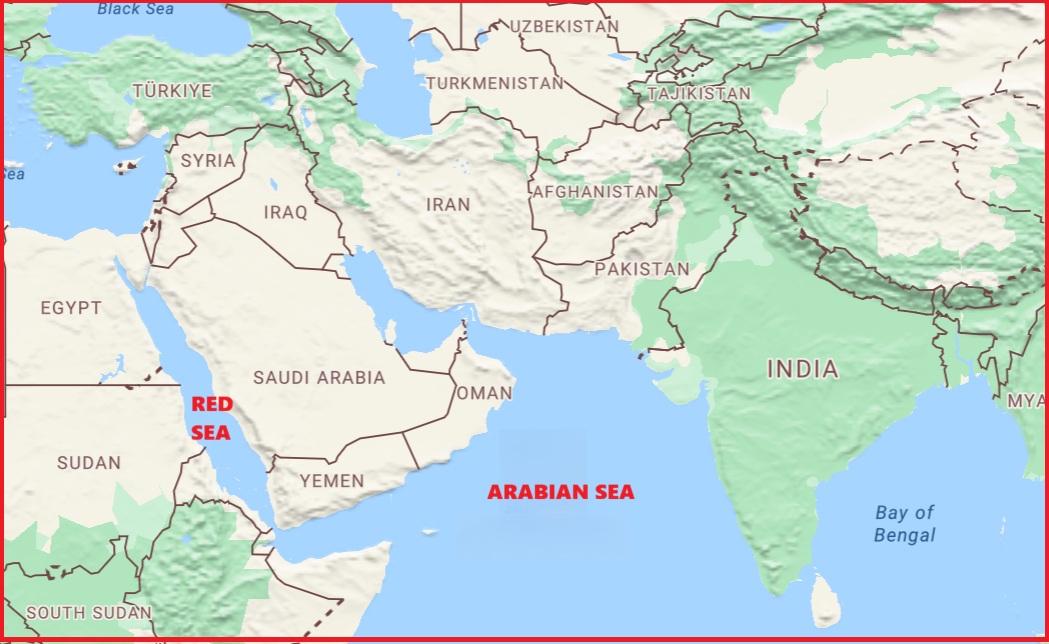
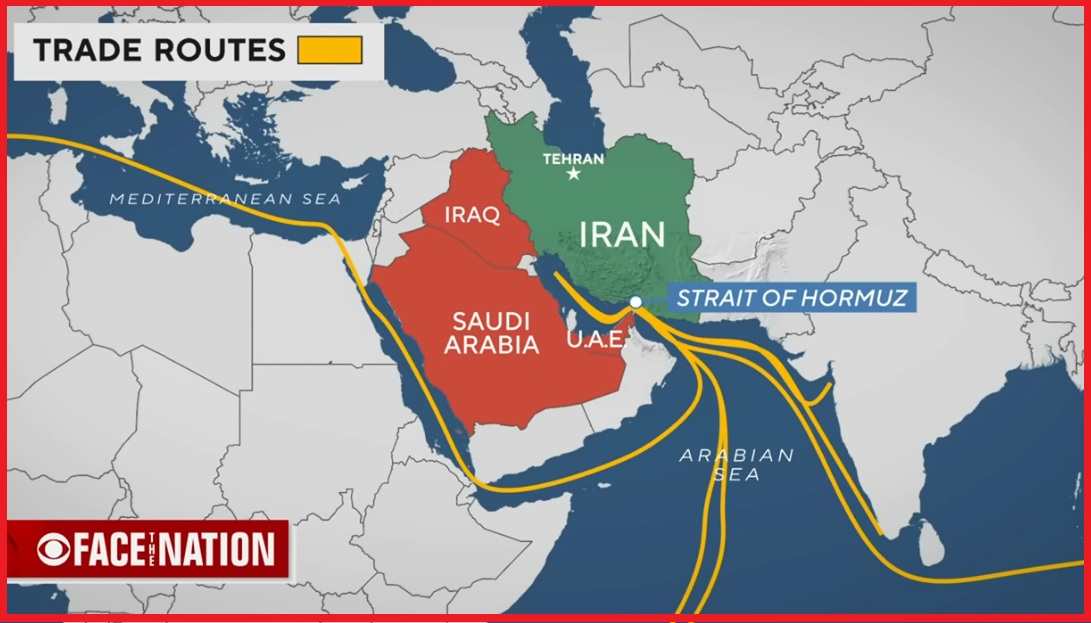
The EU has balked at the request of President Trump to support military escorts for EU oil shipments through the Strait of Hormuz destined for European Ports. However, it is the position of German Chancellor Fredrich Merz which really highlights the arrogance of the issue.
Germany has deactivated its nuclear reactors and decided not to purchase Russian oil/gas. As a consequence, the German industrial economy is contracting; the German auto industry is collapsing; German manufacturing plants are closing – and mass layoffs have been announced.
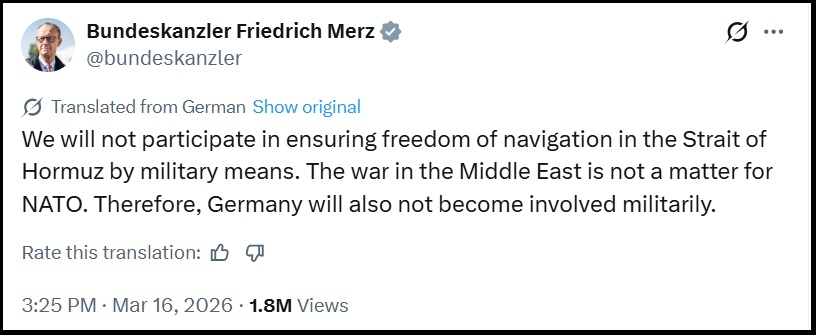
Into this self-created dynamic, Germany has become dependent on (1) Oil and Gas from the middle east, and (2) LNG from the USA. Germany is a completely dependent nation on the issue of energy production. Yet, this is Germanys position:
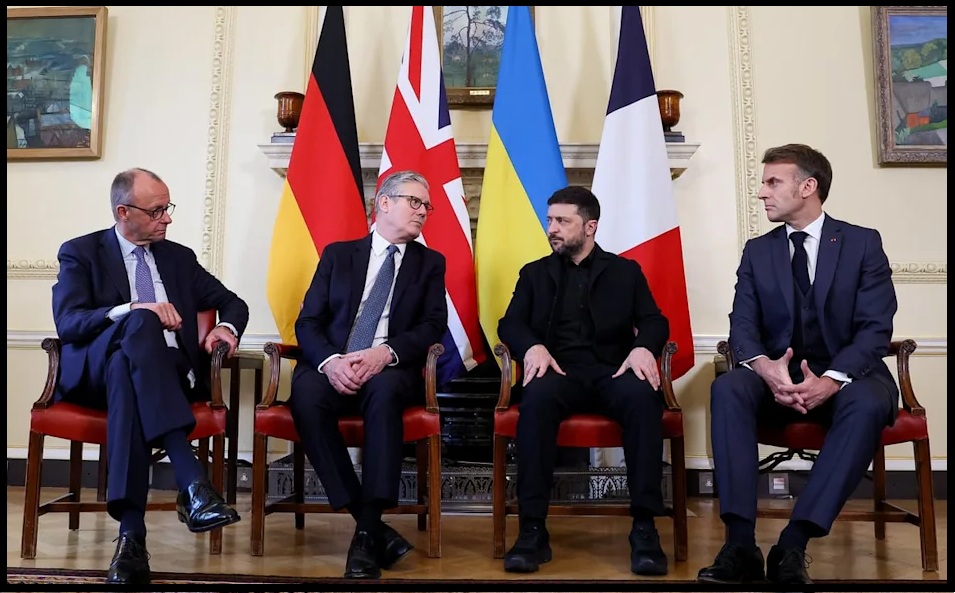
Setting aside for a moment that “the middle east is not a matter for NATO,” while reminding ourselves Ukraine is also not a NATO member state – yet Germany is supporting the pro-war ‘coalition of the willing,’ President Trump previously pointed out that NATO would never come to the aid of the USA when the Greenland Arctic Security debate was going on.
The EU in general, and Germany specifically, is essentially proving President Trump’s point. However, as a result of intentional migration, Germany has over five million Muslim residents now residing inside the country. We should consider that this overlay is also part of their internal political consideration.
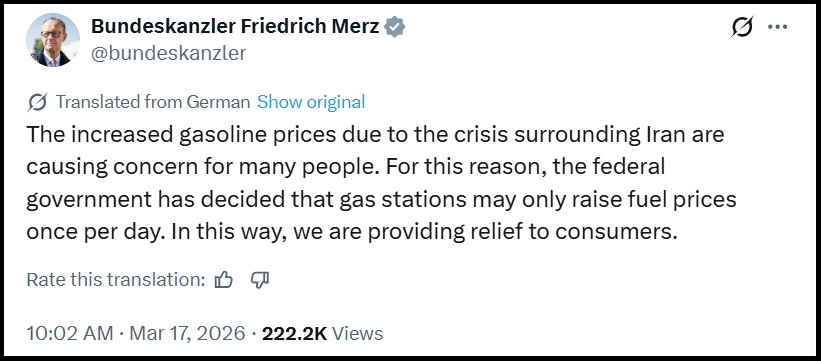
What Chancellor Merz said next is almost too European to be real, but it is:
The German government destroyed affordable energy for Germans. The German government refuses to escort their own equity stakes to mitigate energy costs for Germans. Now the German government will limit the price increases to once per day to provide relief to Germans.
Seriously folks, you cannot make this stuff up.
The tectonic plates are shifting, and we are bearing witness to old geopolitical structures collapsing as the ground beneath them moves.
When history is written it will reflect that President Trump didn’t destroy NATO – he simply removed the mask.
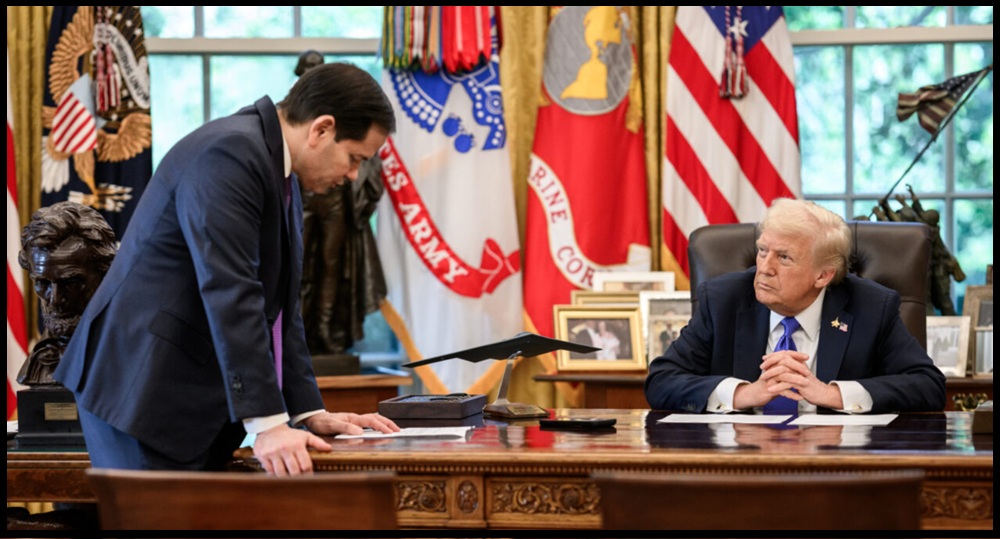
PRESIDENT TRUMP – “The United States has been informed by most of our NATO “Allies” that they don’t want to get involved with our Military Operation against the Terrorist Regime of Iran, in the Middle East, this, despite the fact that almost every Country strongly agreed with what we are doing, and that Iran cannot, in any way, shape, or form, be allowed to have a Nuclear Weapon.
I am not surprised by their action, however, because I always considered NATO, where we spend Hundreds of Billions of Dollars per year protecting these same Countries, to be a one-way street — We will protect them, but they will do nothing for us, in particular, in a time of need.
Fortunately, we have decimated Iran’s Military — Their Navy is gone, their Air Force is gone, their Anti-Aircraft and Radar is gone and perhaps, most importantly, their Leaders, at virtually every level, are gone, never to threaten us, our Middle Eastern Allies, or the World, again! Because of the fact that we have had such Military Success, we no longer “need,” or desire, the NATO Countries’ assistance — WE NEVER DID! Likewise, Japan, Australia, or South Korea.
In fact, speaking as President of the United States of America, by far the Most Powerful Country Anywhere in the World, WE DO NOT NEED THE HELP OF ANYONE! Thank you for your attention to this matter.”
Posted originally on CTH on March 16, 2026 | Sundance
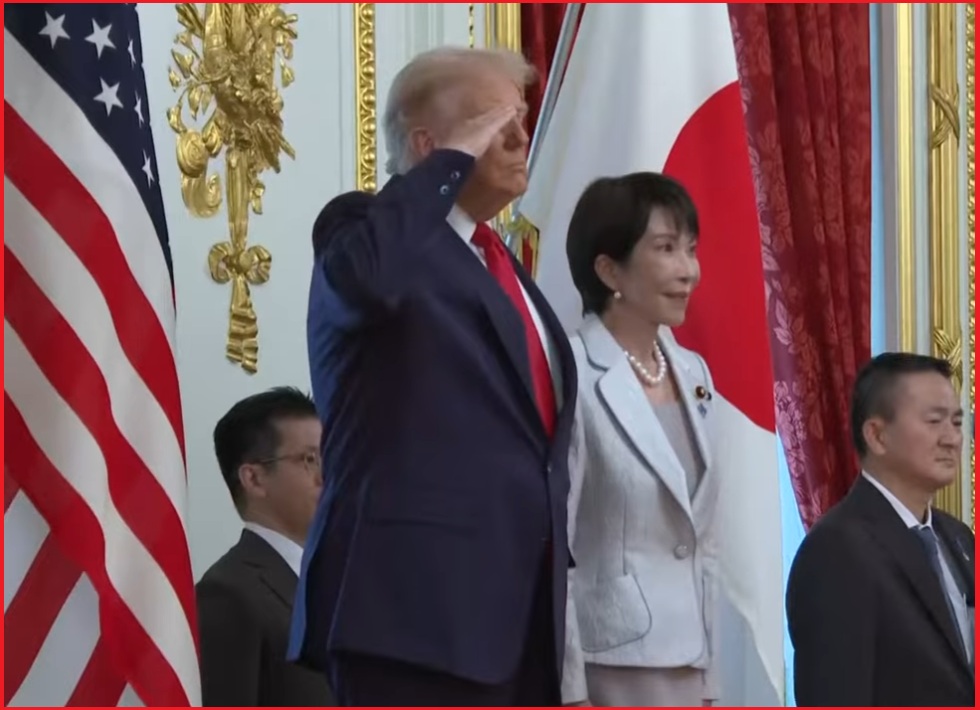
Responding to questions about whether Japan would send military ships to the middle east to participate in escorts through the Strait of Hormuz, Japanese Prime Minister Sanae Takaichi noted the current constitution blocks Japan from conducting overseas military operations.
Exactly as we outlined when President Trump first made the request via Truth Social {SEE HERE} Prime Minister Sanae Takaichi may want to support the request, but Japan’s post WWII constitution about military operations doesn’t permit it.
Japan’s military can be constitutionally defensive only.
While an argument might be made that escorting oil destined for eventual arrival in Japan may technically squeeze within a narrow interpretation of ‘defense’, considering the operation would take place far from Japan a highly conservative Sanae Takaichi is not going to try and thread that precarious needle.
TOKYO, March 16 (Reuters) – Japan has no plan to dispatch naval vessels to escort vessels in the Middle East, Prime Minister Sanae Takaichi said on Monday, after U.S. President Donald Trump called on allies to protect tankers traversing through the Strait of Hormuz.
“We have not made any decisions whatsoever about dispatching escort ships. We are continuing to examine what Japan can do independently and what can be done within the legal framework,” Takaichi told parliament.
Trump’s call in a social media post for U.S. allies, including Japan, to help protect oil and gas shipments through the strategic waterway puts Tokyo in a difficult position because while it relies heavily on Middle East energy its war-renouncing constitution limits the scope of overseas military operations it can conduct.
Japan’s Maritime Self-Defense Force has conducted anti-piracy operations in waters near the Middle East, but those missions were policing operations rather than combat missions against state actors. Japan can deploy its military overseas to respond to what it determines to be an existential threat to the nation, but that would be politically difficult and a high legal threshold for Takaichi’s government to justify.
Takaichi will travel to Washington this week for talks with Trump that she said will cover the conflict with Iran.
“I would like to engage in solid discussions based on Japan’s views and position regarding the need for early de-escalation,” she told lawmakers. (link)
Posted originally on CTH on March 16, 2026 | Sundance
Moments ago, President Donald Trump took questions from the assembled press pool during a lunch with the Trump-Kennedy Center board members.
The full video is below the fold. However, the shorter segment of media questions and answers is highlighted in this video. President Trump was asked about countries willing to support the military escort request through the Strait of Hormuz. President Trump noted an announcement of supporting countries will be forthcoming.
President Trump also noted the biggest beneficiary of the oil from Iran is China, and he would expect those nations who are dependent on the stability of that oil flow to rise in support of the escorts. WATCH:
Posted originally on CTH on March 15, 2026 | Sundance
The Panicans will be greatly disappointed by the foresight and economic planning a proactive White House deployed before the confrontation with Iran began. [Video and Transcript Below]
White House National Economic Council Director Kevin Hassett, leaves CBS’s Margaret Brennan stuttering to respond to the insight presented. As noted in the interview, proactively the Trump administration planned to mitigate any oil disruption for the U.S, undertaking a series of moves before Operation Epic Fury began.
Iran thinks “that they’re going to harm the U.S. economy and get President Trump to back down,” Hassett says. “There couldn’t be anything that was a stupider thing to say because the bottom line is that our economy has got all this momentum in the world and we’ve got lots and lots of oil,” he continued.
Then highlighting how the strength of the U.S. position actually ends up with leverage in trade negotiations, Hassett notes, “we have lots of trading partners that are more on the hook from imported oil from these guys.” Which draws attention to President Trump’s statement yesterday saying, in essence, ‘come guard your oil shipments while we kill bad guys’. WATCH:
[Transcript] – MARGARET BRENNAN: We go now to President Trump’s top economic adviser, Kevin Hassett. Good morning to you.
KEVIN HASSETT, DIRECTOR NATIONAL ECONOMIC COUNCIL: Good morning.
MARGARET BRENNAN: The IDF spokesperson said this morning that Israel’s combat operations will go through the beginning of April. Is that also the U.S. timeline? And if so, how much will this conflict cost the economy if it goes on another three and a half weeks?
HASSETT: Right. Well, one of the things that we’ve been briefed on almost every day is what’s going on and what the president is being briefed on with regard to the Iran war. And as of yesterday this story was- the message was that people, the defense- Department of War believed that it would take four to six weeks to complete this mission and that we’re ahead of schedule. So we are a couple of weeks in and I think that should give you some clarity about when we expect that the president will decide that we’ve achieved his objectives. The other thing I can say is that you can also look at futures markets, which are interesting because you’ve cited over and over the spot price of gasoline, which, of course, is affected right now by the disruption of the strait, but if you look at the futures prices, they are expecting a rapid, rapid end to the situation and much, much lower prices. In fact, I don’t think I’ve seen a sort of future price path with such a steep decline in all my years watching futures.
MARGARET BRENNAN: We will talk about the oil trade later on in the program, as those markets prepare to open later today, but the International Energy Agency called this the largest supply disruption in the history of the global oil market. So I’m not sure how much past charts are a future indicator here, but the president is calling on other countries now to send ships to help protect the Strait of Hormuz. You just heard Iran’s foreign minister saying Tehran has been approached by other countries about negotiating their way through strait. If that kind of negotiation happens, are Americans just going to get cut out here?
HASSETT: Well, first of all, you have to understand that America is not going to have its economy harmed by what the Iranians are doing. The bottom line is that in the ’70s we didn’t produce much oil, but now we do. So, America is in a very strong position. They think that they’re going to harm the U.S. economy and get President Trump to back down. There couldn’t be anything that was a stupider thing to say because the bottom line is that our economy has got all this momentum in the world and we’ve got lots and lots of oil. We have lots of trading partners that are more on the hook from imported oil from these guys. And as we can see, it’s completely unacceptable that a government that would, you know, murder 40,000 of their people just a few months ago would be blackmailing countries to let stuff through. President Trump thinks that is unacceptable and for the global economy we need to fix it and we are going to fix it fast.
MARGARET BRENNAN: Okay. It is a global market, but I take your point there is supply of course, there’s refining, there’s other interruptions to the ability to access oil and gas. But gas prices themselves are up more than 20% since this conflict has begun. Jet fuel prices are leading airlines to raise ticket prices quickly. That’s not my opinion, that’s the United Airlines CEO who just said that. The American Farm Bureau warned of supply chain shocks when we already have record high input prices. So can you give us some kind of projection here on how this will impact consumer prices and for how long?
HASSETT: For sure. And I want you to know that this is something that the government has been studying for decades. And even myself, when I first came in as Chairman of the Council of Economic Advisers one of the first assignments I got from General Mattis was to study what happens if there are oil disruptions. And so we know how to minimize- minimalize the impact of this disruption. Now, you can’t make it completely go away but you can minimal-ize it. And so we are increasing the amount of permits that we’re giving to Venezuela, we’re getting new sources of fertilizer from Morocco and from Venezuela and other places to make sure that our farmers have the fertilizer they need. And we’re even thinking ahead about the jet fuel problem which is really mostly a problem for jet fuel coming from Asia. And we have been in discussions to make it easier for foreign ships to go from the Gulf of America over to the west coast to make sure that we don’t have a disruption from jet fuel as well. And so, we are looking at every scenario, and we’ve got a plan for each scenario.
MARGARET BRENNAN: Okay. Are you going to trigger those things and make them operational or are you just looking at them? And how do you prevent food prices from also going up?
HASSETT: Right. Well, the big problem right now would be energy prices and we’re watching and monitoring closely. We’re looking at things every day and seeing how quickly we progress. The bottom line is again, that the reason why futures markets for oil are dropping down towards 60 and even below 50 in the long run is that we expect that if Iran stops being this disruptive terrorist force in the Middle East that there will be a boom in oil production and industrial production. But think about the harm- the harm that this evil government has done to their own people. Back in the ’70s before the revolution, Iran was the 17th largest economy in the world, now it’s something like the 50th.
MARGARET BRENNAN: No one’s going to defend the regime’s human rights record on this program.
HASSETT: They’ve run- they’ve run their country into the ground- but the point is that- I wanted to just say that the countries around them, they also suffer from the risk of having them go nuts and attack them. And so we expect that the global economy is going to have a big positive shock as soon as this is over and we’re still being briefed that it would be four to six weeks from the beginning and that we are ahead of schedule.
MARGARET BRENNAN: A big positive shock, four to six weeks. So this a April 9th scenario you’re talking about? You are going to see some kind of boost–
HASSETT: The president will decide.
MARGARET BRENNAN: –even–
HASSETT: The president will decide if they no longer have the capability of blackmailing us and harming our neighbors. And once he decides that, then he will call an end to the war.
MARGARET BRENNAN: That’s a pretty broad definition.
HASSETT: Well, we’ve destroyed their navy, we’ve destroyed their air force and so on and so I think we are well on the way.
MARGARET BRENNAN: Well tell me how much is this war going to cost? Because I know the Pentagon briefed it’s going to be about $11.3 billion. Do you need to ask congress for more money to pay for what you’re doing?
HASSETT: I think right now we’ve got what we need, whether we have to go back to congress for more is something that I think that Russ Vought and OMB will look into, but the latest number, you said 11.3, the latest number I was briefed on was 12, and so it’s consistent. So this is something that we’ve got the weapons that we’ve already got in place to do this and so we are not necessarily going to need any kind of supplemental.
MARGARET BRENNAN: More than that was spent in just the first week of the war, you know that. It was over five billion just in munitions. You’re solid on the 12?
HASSETT: I said $12 billion–
MARGARET BRENNAN: –For six weeks of war?
HASSETT: No, I’m sorry. The 12 billion was what I was briefed has been spent so far.
MARGARET BRENNAN: Gotcha. Kevin Hassett. Thank you very much. We we will be right back with a lot more ‘Face the Nation’
Posted originally on CTH on March 14, 2026 | Sundance
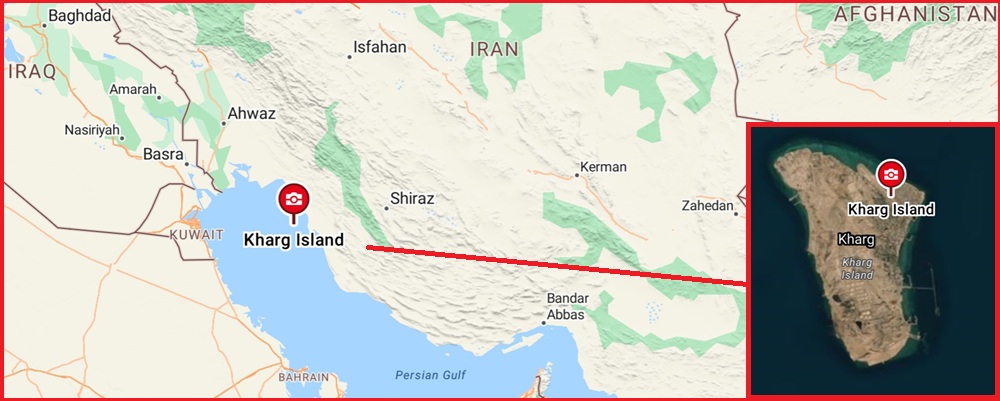
Kharg Island is a small coral island in Iran in the northern Persian Gulf. It is 34 miles (55 km) northwest of the port of Bushehr and vital to Iran’s oil industry.
The oil processing facilities at Kharg Island are a foundational component of Iran’s economy. Roughly 90 percent of Iran’s crude is processed at Kharg Island, and any disruption to its oil processing could cripple Iran’s economy.
President Trump announced:“Moments ago, at my direction, the United States Central Command executed one of the most powerful bombing raids in the History of the Middle East and totally obliterated every MILITARY target in Iran’s crown jewel, Kharg Island. Our Weapons are the most powerful and sophisticated that the World has ever known but, for reasons of decency, I have chosen NOT to wipe out the Oil Infrastructure on the Island. However, should Iran, or anyone else, do anything to interfere with the Free and Safe Passage of Ships through the Strait of Hormuz, I will immediately reconsider this decision.”
“During my First Term, and currently, I rebuilt our Military into the Most Lethal, Powerful, and Effective Force, by far, anywhere in the World. Iran has NO ability to defend anything that we want to attack — There is nothing they can do about it! Iran will NEVER have a nuclear weapon, nor will it have the ability to threaten the United States of America, the Middle East or, for that matter, the World! Iran’s Military, and all others involved with this Terrorist Regime, would be wise to lay down their arms, and save what’s left of their country, which isn’t much! Thank you for your attention to this matter.”
Posted originally on CTH on March 13, 2026 | Sundance
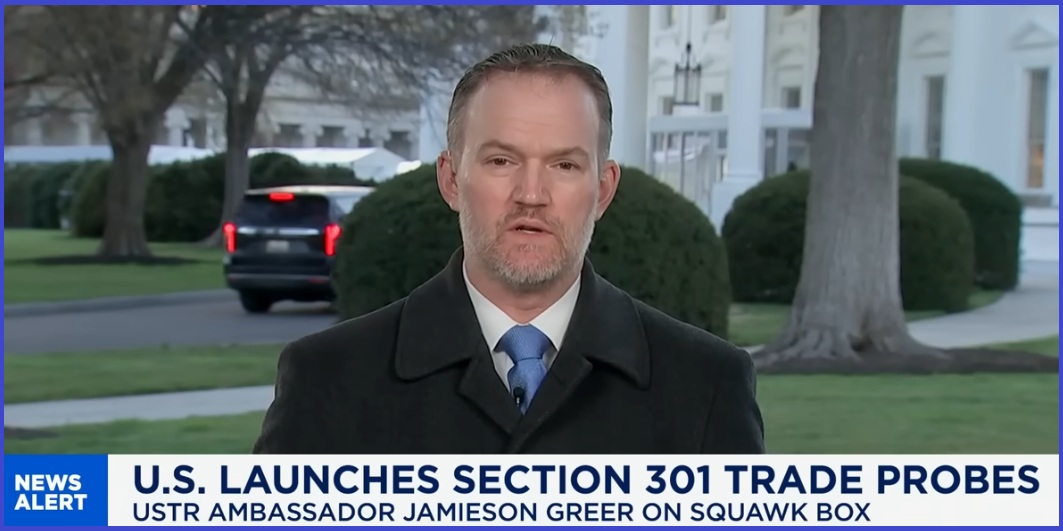
U.S. Trade Representative Jamieson Greer and U.S. Treasury Secretary Scott Bessent are traveling to Paris this weekend to meet with the Chinese trade officials. This meeting is in advance of President Trump’s visit to China for direct face-to-face discussions with Chairman Xi Jinping.
Given the recent events in Venezuela and Iran a lot of groundwork must be taking place for the Trump-Xi meeting. Multiple Chinese interests have been impacted directly. USTR Jamieson Greer discusses those preparatory issues as well as the recent announcement for Section 301 investigations and tariffs. WATCH:
Posted originally on CTH on March 13, 2026 | Sundance
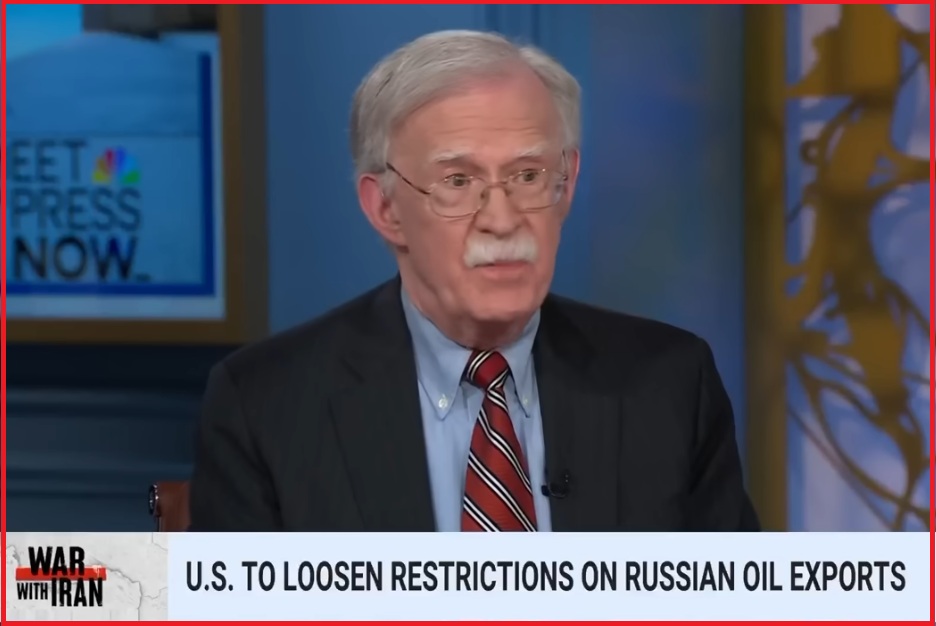
While under federal indictment for improper retention, holding and releasing classified intelligence, John Bolton appears on NBC News to complain about how President Trump is conducting the war against Iran.
It is hilarious to see Bolton pontificate, with all the customary arrogant self-assurances, that President Trump did not plan for a scenario where the oil flows through the Strait of Hormuz would be disrupted, while simultaneously proclaiming President Trump is giving Russian President Vladimir Putin a gift with the lifting of oil/gas sanctions to support the global market.
His insufferable ignorance is laughable. John Bolton just cannot hear himself. Trump didn’t plan for the oil shortage, but Trump lifted Russian oil sanctions. Say that again slowly John, while looking in the mirror. Trump didn’t plan for an oil shortage, but Trump planned to lift Russian oil sanctions. Slow it down and repeat as needed, until the ah-ha moment sinks in.
Consider that President Trump did actually plan for the Strait of Hormuz to be closed; perhaps even planned for a long time for the issue {GO DEEP}. And planned, well in advance, for an offset to deliver massive amounts of oil even with the Strait of Hormuz closed.
Give his narrow and stale globalist mind a little longer than normal to see the strategy; give him quiet time in a room with no windows to contemplate the outcomes he is witnessing; and we might even sell tickets to see the moment his ancient neocon brain explodes.
Posted originally on CTH on March 13, 2026 | Sundance |
‘Trump, you magnificent bastard, I read your book!’
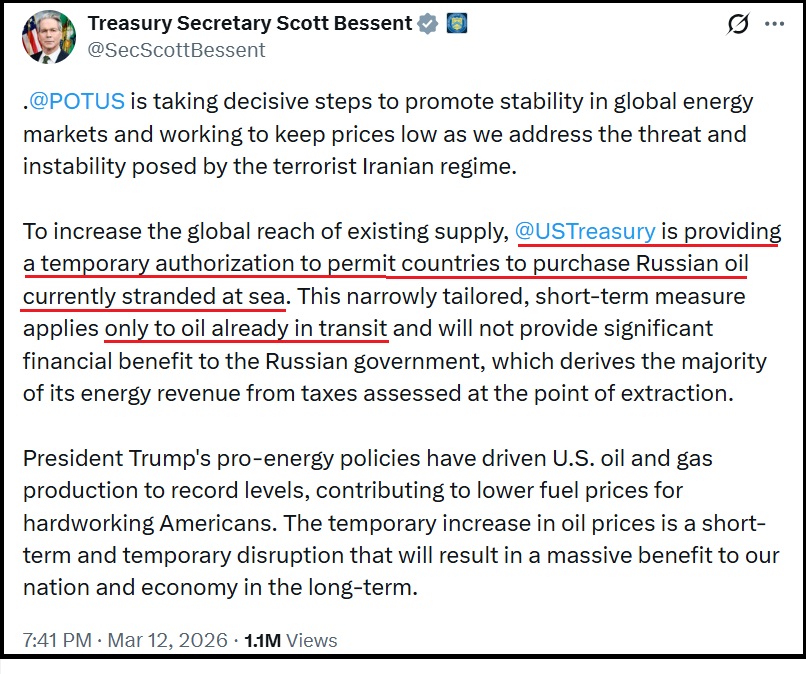
President Trump and Treasury Secretary Scott Bessent are facing mounting criticism for creating a window for Russia to sell oil and gas to the global market via “narrowly tailored, short-term” sanction relief. However, few people are putting the issue into context, and the background here is exceptionally interesting.
According to the terms announced by Secretary Bessent, the license to sell applies solely to Russian crude or petroleum products loaded onto vessels as of March 12 and is valid through midnight Washington time on April 11. [Treasury Notice Here – OFAC Technical Details Here]
The sanction relief license to sell will be done in globally recognized petrodollars and applies only to preexisting oil and petroleum products that are already in transit at sea. However, here’s where it gets very interesting and the ramifications are significant.
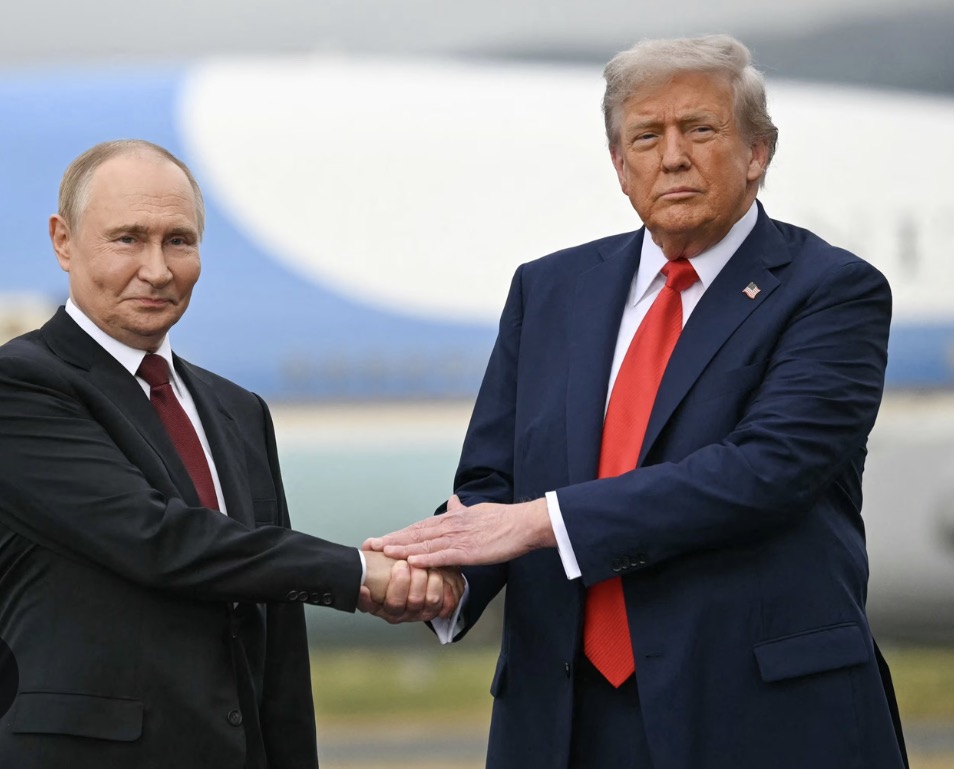
Immediately following the Alaska summit between Russian President Vladimir Putin and President Trump, Russia restarted Arctic-2 LNG terminals and began increasing oil production for storage on ‘floating platforms.’ President Trump met with Putin on August 15, 2025, and the curious increase in Russian production began on August 18, 2025.
In the past six months Russia has been pumping sanctioned oil and gas and storing it on ships and mobile sea platforms, seemingly (at the time) with no customers. Suddenly, against the background of the Iran conflict, all of that previously stored ‘on the water‘ production, now worth double, is authorized for global sale (in petrodollars).
Either Russian President Putin is the luckiest guy in the world, or Russia knew something.
In 2025 what Russia did following the Alaska summit did not make sense; now it does and the ramifications are stunning.
President Trump was looking for a way to organize a strategic partnership with Russia on the issue of energy production but was hampered by the preexisting sanction regime and strong opposition from domestic and international politics.
The ‘coincidental’ timing’ of Trump meeting with Putin and then subsequently Russia producing massive amounts of oil and gas for storage on the water suddenly starts to take on an entirely new light. Did Putin know something was coming, something that would eventually make the Russian over production and ‘on the sea’ storage worth billions.
The implications here are quite remarkable; however, they simultaneously explain most of the behaviors since the Iran confrontation began.
Media reports highlight that Vladimir Putin was asked about a previous joint agreement for military support between Iran and Russia and why Russia did not respond when Iran was attacked. Foreknowledge would explain that reaction.
Additionally, the Russian Federation president never responded to the Trump operation to take down Venezuelan dictator Maduro and seize control over Venezuela’s oil production.
If there was some discussion inferring that a ‘limited sanction relief’ protocol might be possible, that would explain why Russia began storing oil and gas at sea.
This fact pattern would also indicate that President Trump’s decision toward Iran was made at least six months ago, with a set of geopolitical events planned between the Alaska summit and the eventual confrontation with Iran.
TIMELINE: Trump and Putin meet. Three days later Russia begins pumping oil/gas and storing it at sea. President Trump then triggers the Venezuela western hemisphere security operation; Russia stays silent. President Trump then triggers the confrontation with Iran; Russia rejects involvement. And then two weeks after the Iran confrontation begins, Trump removes sanctions on Russian oil/gas “in transit” at sea.
Suddenly all of the Russian produced and stored product ‘on the water’ has greater value and new customers.
Just a coincidence? No way.
The United States needs the oil/gas market stability that Russia can provide.
Venezuela was/is to Trump as Ukraine was/is to Putin.
Posted originally on CTH on March 12, 2026 | Sundance
When the Supreme Court made their ridiculous decision to nullify the import tariffs under the International Emergency Economic Powers Act (IEEPA) use, the high court noted several alternate approaches would not be legally problematic. One of those approaches would be the use of Section 301 trade tariffs.
Yesterday USTR Jamieson Greer quietly announced that a Section 301 review would be taking place for the following countries: China, the European Union, Singapore, Switzerland, Norway, Indonesia, Malaysia, Cambodia, Thailand, Korea, Vietnam, Taiwan, Bangladesh, Mexico, Japan, and India.”
♦ Section 301 tariffs are a trade enforcement mechanism established under the Trade Act of 1974. They allow the U.S. government to impose tariffs on imports from countries that are found to be engaging in unfair trade practices. The Office of the United States Trade Representative (USTR) conducts investigations to determine if a country is violating trade agreements, and if so, it can impose tariffs as a corrective measure {SOURCE}
USTR PRESS RELEASE – WASHINGTON — Today, United States Trade Representative Jamieson Greer announced the initiation of investigations regarding the acts, policies, and practices of various economies under Section 301(b) of the Trade Act of 1974 relating to structural excess capacity and production in manufacturing sectors.
The investigations will determine whether those acts, policies, and practices are unreasonable or discriminatory and burden or restrict U.S. commerce. The economies subject to these investigations are: China, the European Union, Singapore, Switzerland, Norway, Indonesia, Malaysia, Cambodia, Thailand, Korea, Vietnam, Taiwan, Bangladesh, Mexico, Japan, and India.
“The United States will no longer sacrifice its industrial base to other countries that may be exporting their problems with excess capacity and production to us. Today’s investigations underscore President Trump’s commitment to reshore critical supply chains and create good-paying jobs for American workers across our manufacturing sectors,” said Ambassador Greer.
“The Trump Administration’s reindustrialization efforts continue to face significant challenges due to foreign economies’ structural excess capacity and production in manufacturing sectors. Across numerous sectors, many U.S. trading partners are producing more goods than they can consume domestically. This overproduction displaces existing U.S. domestic production or prevents investment and expansion in U.S. manufacturing production that otherwise would have been brought online. In many sectors, the United States has lost substantial domestic production capacity or has fallen worryingly behind foreign competitors.” (read more)
Additionally, Section 232 [Steel and Aluminum examples] of the Trade Expansion Act of 1962 (19 U.S.C. §1862, as amended) authorizes the President to impose trade restrictions—such as a tariff or quota—if the Secretary of Commerce determines, following an investigation, that imports of a good “threaten to impair” U.S. national security. {SOURCE}
Section 232 is currently covering all the steel and aluminum import tariffs.
Section 122 of the Trade Act of 1974 allows the U.S. president to impose tariffs of up to 15% to address “large and serious” balance-of-payments deficits. This authority can be exercised without prior congressional approval for a limited duration of 150 days. After this period, any tariffs must be extended by Congress. {SOURCE}
Section 122 has already been deployed to retain the “baseline reciprocity tariffs.”
USTR Greer is now walking through the process of deploying Section 301 and will eventually become the legal underpinning to replace Section 122 and retain all tariff status without congressional extension needed. Most of this is technical and legal compliance as several of the aforementioned nations have already finalized free trade agreements.
Posted originally on CTH on March 12, 2026 | Sundance
It is transparently obvious now that Canada is going to rely on UniParty (Corporate) opposition to President Trump in the dissolution of the USMCA (CUSMA) in favor of two distinctly different bilateral trade agreements; one with Canada and one with Mexico.
A bilateral trade negotiation between the United States and Canada would be devastating to the interests of the Canadian government. Particularly after the Venezuela operation and new strategic relationship with the United States, Canada has almost zero points of leverage to negotiate anything similar to their current exploitative trade position.
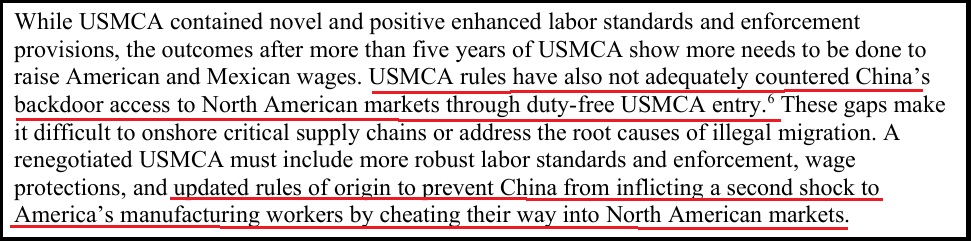
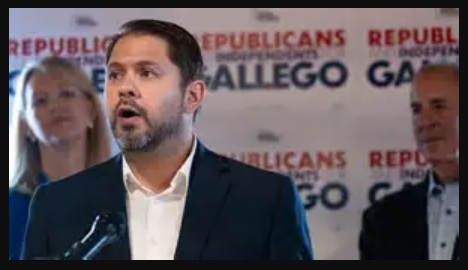
Canada is going to rely on congress to stop Trump from forcing reciprocity in the bilateral discussions. However, as a positive indicator that President Trump will factually have congressional support for the elimination of the USMCA, Democrat Senator Ruben Gallego has written a letter to President Trump requesting a comprehensive review. [LETTER HERE]
This is a key Senate democrat who notes the problem. One of Gallego’s top points of concern is the loophole that Canada uses to assemble Chinese component parts into finished goods for tariff free distribution into the United States.
Ever since President Trump won the 2024 election, Mexico has been taking proactive independent action to block Chinese component goods. But Canada has done the opposite and begun to enhance their trade relationship with China to take even more Chinese component and finished goods.
Gallego writes to U.S. Trade Representative Jamieson Greer from the position of wanting to increase wages and enhance jobs in both Mexico and the USA, growing both economies. However, Gallego’s advocacy simultaneously bolsters why the USMCA should be dissolved and also puts Canada at a distinct disadvantage.
MEXICO – Mexico’s President Claudia Sheinbaum told reporters during her morning news briefing on Wednesday that her U.S. counterpart, Donald Trump, is open to doing away with the U.S.-Mexico-Canada trade agreement (USMCA) and replace it with individual trade deals with each country.
[…] “There might be revisions that create bilateral deals instead of involving the three countries because some things are more important between Mexico and the United Sates or between Canada and the United States,” said Sheinbaum. “Not everything has to be trilateral.”
Mexico’s president said the subject was brought up by Trump during a Tuesday phone conversation. […] According to Sheinbaum, her country is ready to consider possible changes. (read more)
Just like the original NAFTA dissolution, if Senate democrats agree the USMCA is structurally flawed then Canada will lose its only hope to retain the trilateral agreement.
It appears that some Senate democrats like Gallego recognize this issue and support the need for exceptional change.
There is a significant difference between Mexico and Canada as it pertains to trade. Two distinctly different bilateral trade agreements would be the best outcome for the USA.
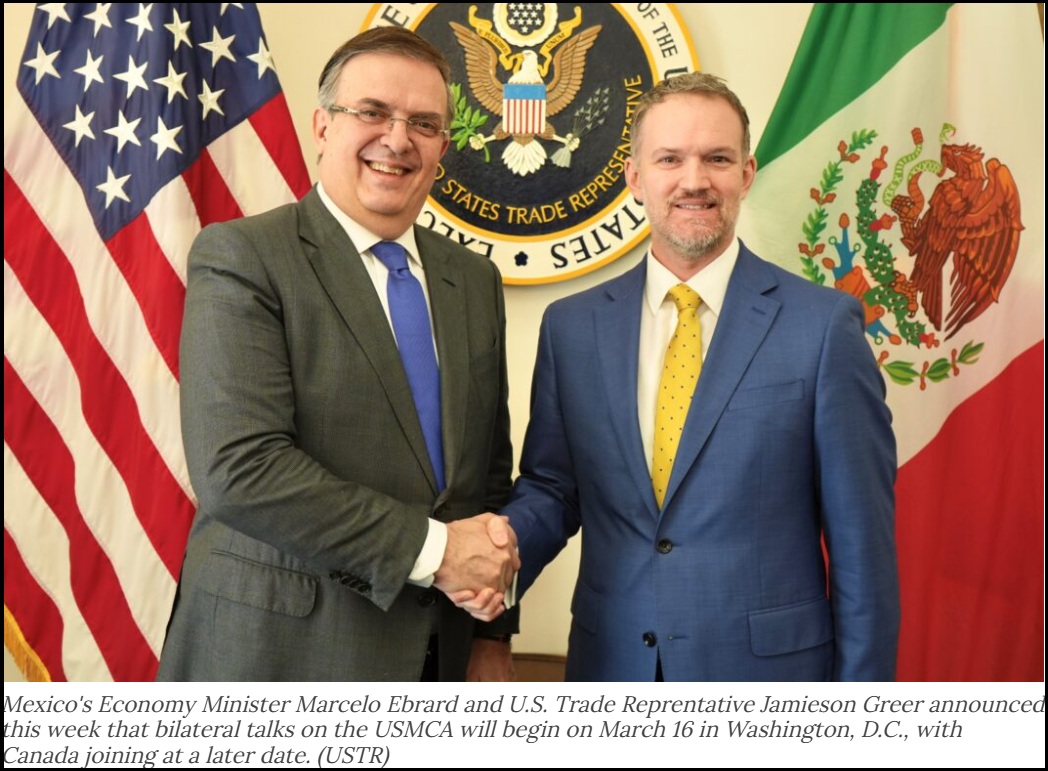
Team Mexico have already been holding bilateral discussions with USTR Jamieson Greer, and I suspect the broad outlines of a free trade agreement between the U.S and Mexico have already been agreed.
While Mexico has been working diligently for 16 months to get into alignment with the USA on a new free trade agreement, Canada has been doing everything possible to retain their “elbows up” position in opposition to the USA. This will not work out well for Canada.
“The key thing that has struck me, and I think it has struck all Canadians, is so many of these guys in the Trump administration, frankly, they just hate Canada,” said Brian Clow, former Prime Minister Justin Trudeau’s deputy chief of staff who led Canada-U.S. affairs. {source}
I have created this site to help people have fun in the kitchen. I write about enjoying life both in and out of my kitchen. Life is short! Make the most of it and enjoy!
This is a library of News Events not reported by the Main Stream Media documenting & connecting the dots on How the Obama Marxist Liberal agenda is destroying America


 Centinel2012