Posted originally on CTH on March 17, 2026 | Sundance
CTH has said to watch the U.S.-Japan trade relationship closely because the outlines of multiple geopolitical shifts can be referenced from a new strategic relationship surrounding multiple sectors, including energy.
The U.S, relationship with Japan is both leverage and a hedge against old alliances that may seek to disrupt the global reset currently underway through President Trump policy. The issues with the European Union, U.K, USMCA and other tenuous allies, look entirely different when President Trump has alternative partnerships for massive energy exports.
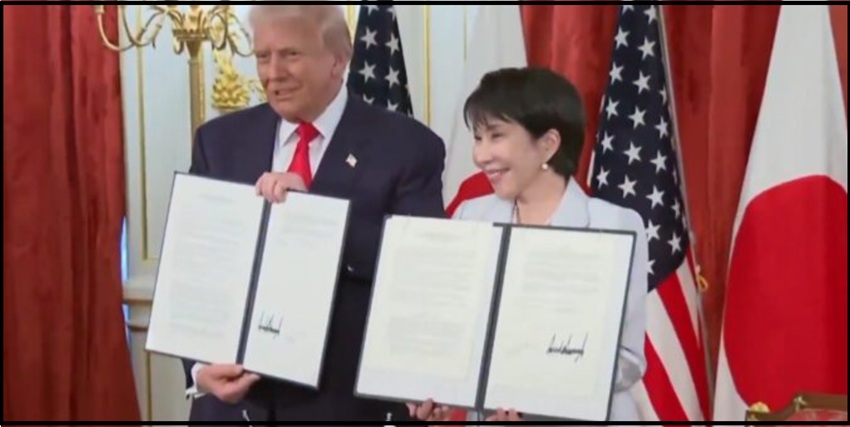
ENERGY NEWS – In a major move to secure stable energy supplies amid escalating geopolitical tensions, Japan has inked deals worth up to $56 billion with the United States for oil, natural gas, and liquefied natural gas (LNG) purchases and investments.
This agreement, finalized at the Asia-Pacific Energy Security Forum in Tokyo on March 14, 2026, underscores Japan’s push to diversify its energy imports and deepen economic ties with the US under Prime Minister Sanae Takaichi’s administration.
The deals come as part of a broader framework stemming from the 2025 US-Japan trade agreement, where Japan pledged $550 billion in US investments over several years, with energy as a key pillar.
The $56 billion package represents a significant escalation in Japan’s commitment to American energy, building on an initial $36 billion tranche announced earlier in 2026.
This latest round emphasizes immediate purchases and long-term infrastructure projects, responding to global market volatility driven by conflicts in the Middle East and disruptions in key shipping routes like the Strait of Hormuz.
[…] The agreements encompass a mix of direct energy purchases, joint ventures, and infrastructure investments. (read more)
As a nation that needs energy partnerships, Japan seeks stability and predictability. Japanese Prime Minister Sanae Takaichi has gone all-in on a strategic energy partnership with the United States.
As the tectonic plates are shaken:
♦ If Canada wants to try and leverage the energy trade infrastructure against a USMCA reset, President Trump has Venezuela production as an offset.
Japanese automakers have already told Canadian trade ministers that if Canada loses the USMCA, there’s no value in maintaining auto manufacturing north of the border – because the target customers are all in the USA. Japan would move all production out of Canada. I doubt China could replace at scale.
♦ If Europe, who is now dependent on LNG from Norway and the USA, wants to create geopolitical friction, President Trump now has Japan as a replacement customer. More behavioral leverage.
U.S. firms are making a lot of money selling LNG to Europe, but Trump has just created a customer base that is more reliable and politically consistent.
♦ Then, as the short-term lifting of LNG and oil sanctions on Russia is proving (petrodollars used), think about the potential for India and Southeast Asia to be supported by Russian exports. Who holds that distribution key, again Trump.
It is not accidental that India is sending support vessels to the Strait of Hormuz as requested by President Trump. Here’s the kicker… With oil and gas from Russia, India doesn’t need the Iranian oil and gas; yet, they are sending support. Why? Because Prime Minister Modi wants Trump to keep their Russian purchase exemptions in place.
We can see how a strong collaborative relationship with Japan can negate any negative economic impact the mask wearing Europeans and Canadians might want to try and leverage. In actuality, Canada, the U.K and Europe don’t have any leverage at all in the new world of trade.
One way to look at this is to say the primary “Build Back Better” nations, those most entrenched in the selling of climate change as a tool for manipulation and control, are being positioned to have the least amount of input into a new, tiered set of established nations for global energy development.
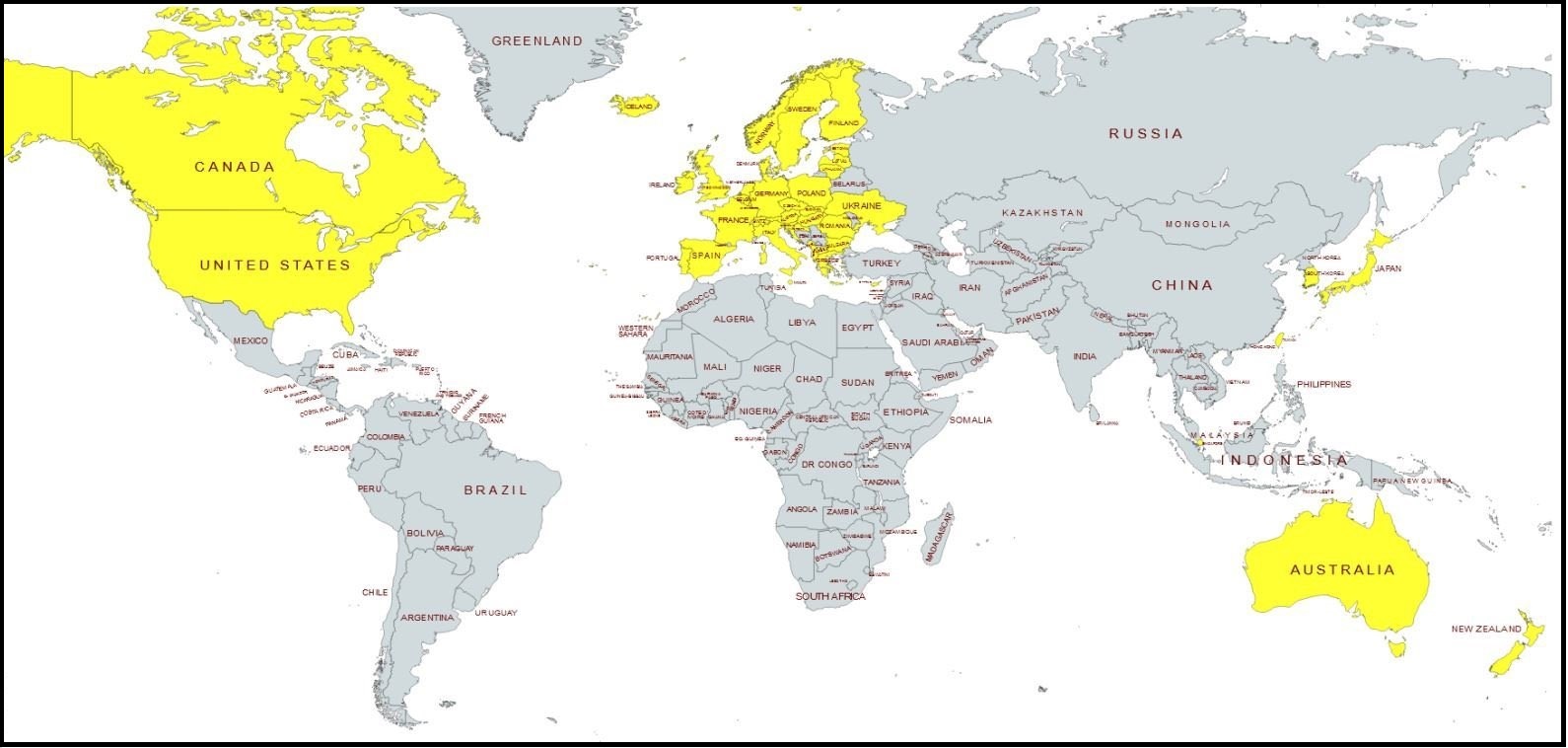
Take a look at that Russian Sanctions map again. The nations in yellow created the sanctions:
Now, overlay the new energy trade relationships that are forming.
The USA fuels the Western Hemisphere.
Russia fuels the Eastern Hemisphere.
Europe is reliant on the Middle East.
China loses geopolitical power, Russia gains power.
Europe loses geopolitical power, India gains power.
Deal with Iran and most conflict is resolved in the Middle East.
The USA controls the Western Hemisphere. And with India and Japan as allies, the Indo-Pacific outline is realized.
Posted originally on CTH on March 17, 2026 | Sundance
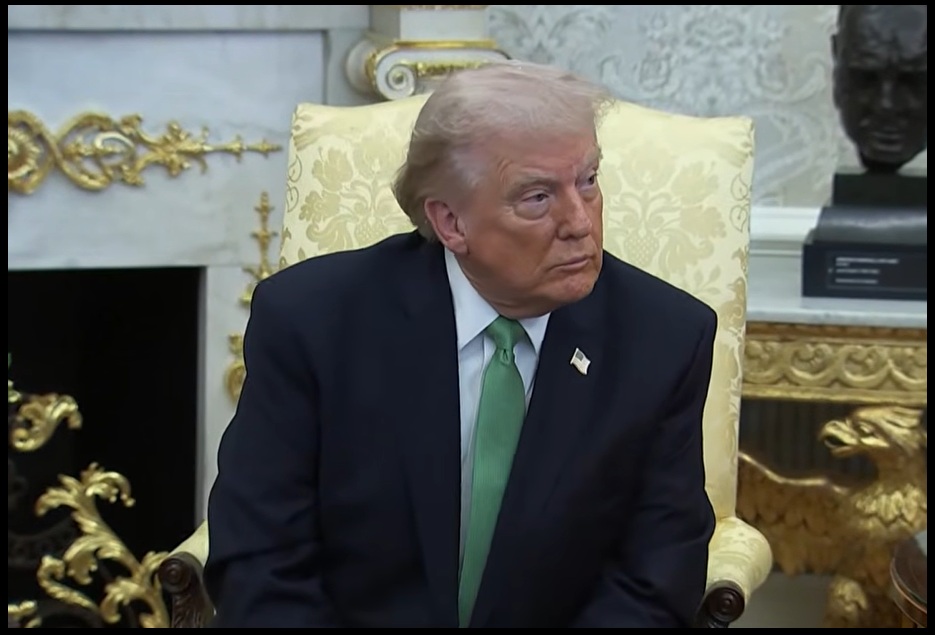
President Donald Trump is not happy with NATO allies over the issue of the Iran war and their refusal to escort oil out of the gulf region. President Trump criticized the EU member nations for refusing to support U.S. military efforts in the Strait of Hormuz.
Trump is then asked questions about if he would reconsider the U.S. relationship with NATO, warning it’s “not good for a partnership,” and signaling possible reconsideration of U.S. ties with NATO. WATCH:
.
The folks at the Lyndon LaRouche PAC are getting a ton of content to use in their anti-imperialism analysis as this conflict between President Trump, the U.K, the E.U and the NATO alliance continues.
Posted originally on CTH on March 17, 2026 | Sundance
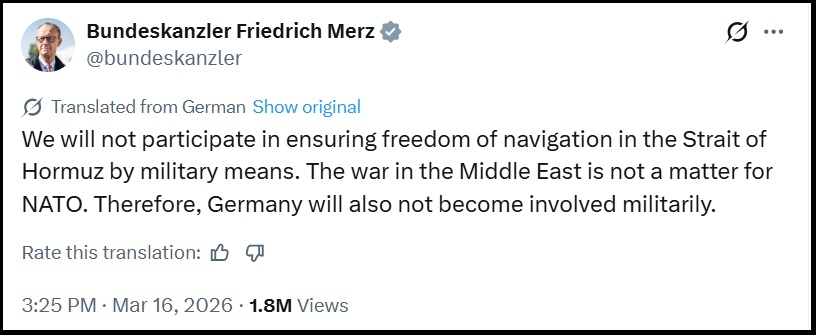
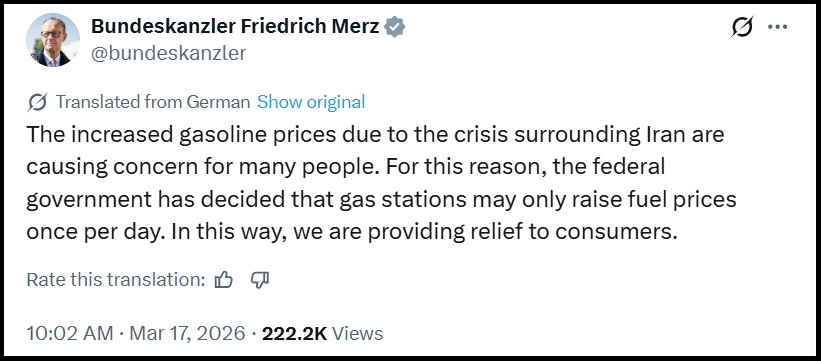
The EU has balked at the request of President Trump to support military escorts for EU oil shipments through the Strait of Hormuz destined for European Ports. However, it is the position of German Chancellor Fredrich Merz which really highlights the arrogance of the issue.
Germany has deactivated its nuclear reactors and decided not to purchase Russian oil/gas. As a consequence, the German industrial economy is contracting; the German auto industry is collapsing; German manufacturing plants are closing – and mass layoffs have been announced.
Into this self-created dynamic, Germany has become dependent on (1) Oil and Gas from the middle east, and (2) LNG from the USA. Germany is a completely dependent nation on the issue of energy production. Yet, this is Germanys position:
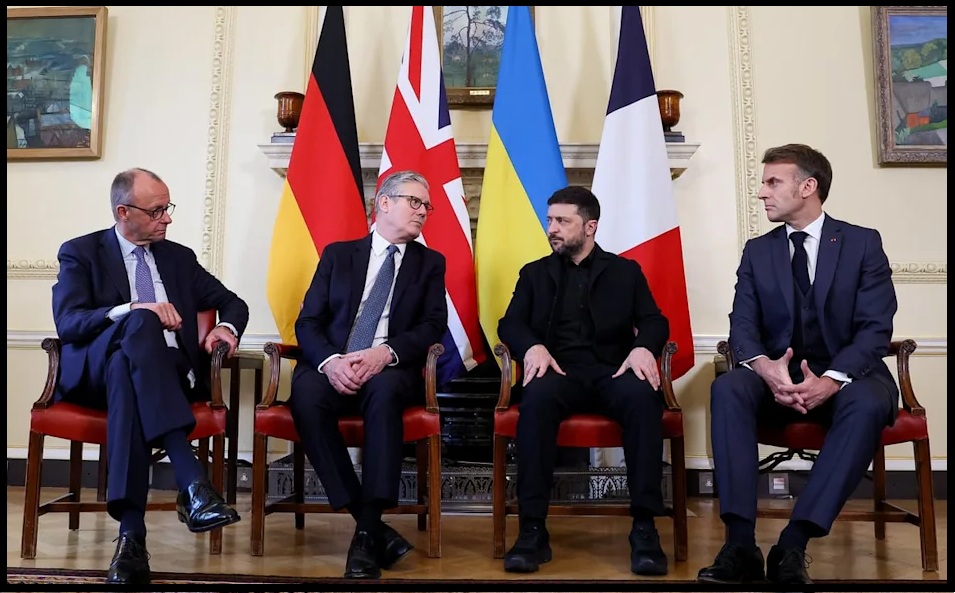
Setting aside for a moment that “the middle east is not a matter for NATO,” while reminding ourselves Ukraine is also not a NATO member state – yet Germany is supporting the pro-war ‘coalition of the willing,’ President Trump previously pointed out that NATO would never come to the aid of the USA when the Greenland Arctic Security debate was going on.
The EU in general, and Germany specifically, is essentially proving President Trump’s point. However, as a result of intentional migration, Germany has over five million Muslim residents now residing inside the country. We should consider that this overlay is also part of their internal political consideration.
What Chancellor Merz said next is almost too European to be real, but it is:
The German government destroyed affordable energy for Germans. The German government refuses to escort their own equity stakes to mitigate energy costs for Germans. Now the German government will limit the price increases to once per day to provide relief to Germans.
Seriously folks, you cannot make this stuff up.
The tectonic plates are shifting, and we are bearing witness to old geopolitical structures collapsing as the ground beneath them moves.
When history is written it will reflect that President Trump didn’t destroy NATO – he simply removed the mask.
PRESIDENT TRUMP – “The United States has been informed by most of our NATO “Allies” that they don’t want to get involved with our Military Operation against the Terrorist Regime of Iran, in the Middle East, this, despite the fact that almost every Country strongly agreed with what we are doing, and that Iran cannot, in any way, shape, or form, be allowed to have a Nuclear Weapon.
I am not surprised by their action, however, because I always considered NATO, where we spend Hundreds of Billions of Dollars per year protecting these same Countries, to be a one-way street — We will protect them, but they will do nothing for us, in particular, in a time of need.
Fortunately, we have decimated Iran’s Military — Their Navy is gone, their Air Force is gone, their Anti-Aircraft and Radar is gone and perhaps, most importantly, their Leaders, at virtually every level, are gone, never to threaten us, our Middle Eastern Allies, or the World, again! Because of the fact that we have had such Military Success, we no longer “need,” or desire, the NATO Countries’ assistance — WE NEVER DID! Likewise, Japan, Australia, or South Korea.
In fact, speaking as President of the United States of America, by far the Most Powerful Country Anywhere in the World, WE DO NOT NEED THE HELP OF ANYONE! Thank you for your attention to this matter.”
Posted originally on CTH on March 14, 2026 | Sundance
President Trump’s latest two messages via Truth Social present an interesting geopolitical approach with multiple enmeshed aspects.
First, some background context is needed. Treasury Secretary Scott Bessent and USTR Jamieson Greer are in Paris to meet with Chinese government officials ahead of a scheduled meeting between Chairman Xi Jinping and President Trump.
The main objective of the pre-summit assembly before President Trump goes to Beijing, is to hammer out the actionable agreement details that can be signed off by Xi and Trump. Bessent and Greer are looking to put a deal together with their Chinese counterparts so that Trump and Xi can announce mutually beneficial outcomes during their summit.
Second, President Trump has already indicated the March 31/April 1 meeting with Xi will be all business. The traditional pomp and splendor will not be present, and Trump will only be visiting Beijing – no sidelines.
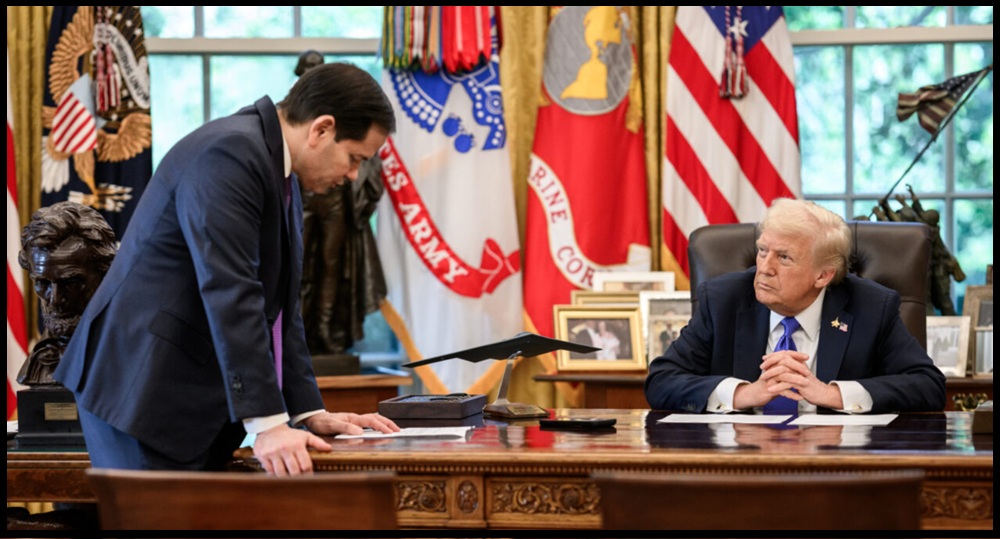
Third, Secretary Rubio will be accompanying Trump on this trip to Beijing, which might seem ordinary were it not for the fact that in 2020 China sanctioned and banned Rubio from entering China for criticizing Xinjiang and Hong Kong.
Fourth, there are rumors that President Trump is going to announce a significant weapons deal with Taiwan at some point immediately following the trip. If those rumors are true, it would be a top priority for the Chinese advance team in Paris to stop that from happening.
Regardless of what happens in the next few weeks, President Trump will be meeting with Chairman Xi with full Eagle eye confrontation toward the returning dragon stare. There will be no panda mask on this trip whatsoever; this face to face is an apex predator showdown, while the world watches intently.
Everything President Trump does between now and his arrival in Beijing, should be contemplated through this adversarial position. With strong moves in Venezuela and Iran President Trump has already pulled Chairman Xi into the jianshu circle, showing the soul of his blade.
Chairman Xi does not have anything resembling a retreat position. He has a highly focused domestic audience, and the eyes from the Great Hall of the People will be watching intensely.
In the next two weeks we will likely see critical probes of both Trump and Xi’s wills surface in ancillary stories connected to each stakeholder, most likely swirling around the Iran conflict. Do not be surprised if we see all of the advanced USA influence purchasing by China now activated with very specific anti-Trump narratives.
That is the context for President Trump to call out many of the oil dependent countries:
TRUTH SOCIAL – “Many Countries, especially those who are affected by Iran’s attempted closure of the Hormuz Strait, will be sending War Ships, in conjunction with the United States of America, to keep the Strait open and safe. We have already destroyed 100% of Iran’s Military capability, but it’s easy for them to send a drone or two, drop a mine, or deliver a close-range missile somewhere along, or in, this Waterway, no matter how badly defeated they are.
Hopefully China, France, Japan, South Korea, the UK, and others, that are affected by this artificial constraint, will send Ships to the area so that the Hormuz Strait will no longer be a threat by a Nation that has been totally decapitated. In the meantime, the United States will be bombing the hell out of the shoreline, and continually shooting Iranian Boats and Ships out of the water. One way or the other, we will soon get the Hormuz Strait OPEN, SAFE, and FREE! President DONALD J. TRUMP
There is a significant overlay here.
First, any nation that sends supportive military ships into the Strait of Hormuz is openly taking a position against the Iranian regime. China cannot take that position, and President Trump knows it – so he’s calling out the dragon’s alignment for the world to see.
…. If you get oil from the region, come protect your ships while I kill the bad guys…
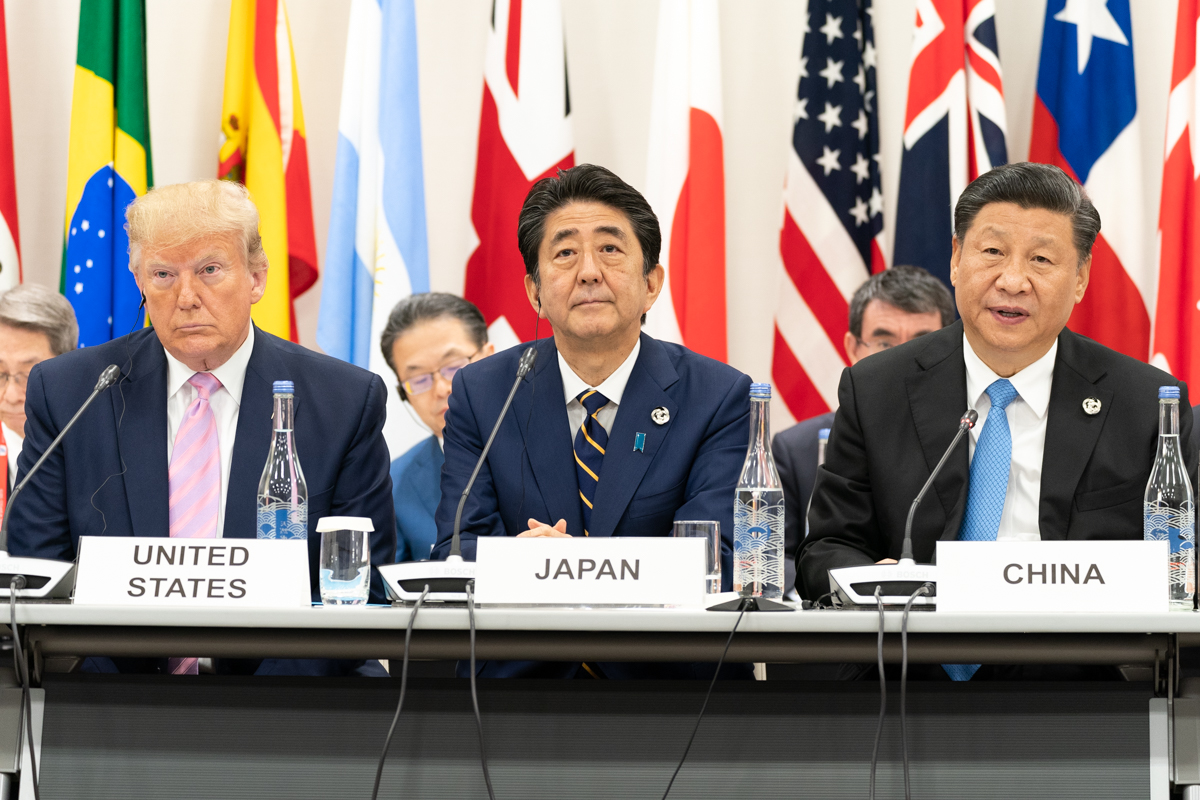
Remember, Japan has a very limited military, and their post-World War II constitution was blocking them from building one. Changing that position was the goal of Japanese Prime Minister Shinzo Abe, a friend of Trump, and he was traveling throughout Japan with that message when he was assassinated. That objective now falls to the protege’ of Abe, Prime Minister Sanae Takaichi.
Japan is included on that list of countries specifically to antagonize the dragon, with President Trump saying I have a strong industrial friend in your back yard.
For the rest, notice the countries Trump did not name: India, Thailand, Vietnam, Philippines or any of the Asian countries that are dependent on oil from the middle east. Trump is not asking the dependency allies of the United States to participate. Instead, President Trump is calling upon the fake-ally countries that oppose the United States but hide behind a friendly smiling mask.
This is a bold underline for President Trump’s former statement where he publicly doubted the NATO allies would ever come to assist the USA (ie. Greenland), even though they are dependent on the security the USA provides.
In this Iranian conflict, the Europeans are dependent on oil from the middle east, but they will not put their military into the fight even if it secures their own economic future. Opening the Strait of Hormuz benefits the Europeans, but they only want to pontificate grand prose about it; similar to how they pontificated about the threat Iran presented, then lost their supportive tongue when Trump finally did something about it.
A few hours later, President Trump drives home the point:
TRUTH SOCIAL – “The United States of America has beaten and completely decimated Iran, both Militarily, Economically, and in every other way, but the Countries of the World that receive Oil through the Hormuz Strait must take care of that passage, and we will help — A LOT! The U.S. will also coordinate with those Countries so that everything goes quickly, smoothly, and well. This should have always been a team effort, and now it will be — It will bring the World together toward Harmony, Security, and Everlasting Peace!”President DONALD J. TRUMP
Now we wait to see who steps up.
Spoiler Alert – ¹No one will!
¹And that’s the point Trump is making.
I also concur with this point:
Shanaka Anslem Perera: “The coalition call is not about Iran. Iran’s military is destroyed. The coalition call is about the world that emerges after Iran. If America escorts the tankers alone, the Strait reopens under American control and dollar pricing survives. If a coalition escorts them, the Strait reopens under international consensus and the yuan-for-Hormuz proposal dies. If nobody escorts them, the Strait stays closed and China’s shadow fleet is the only commerce moving through it.”
Posted originally on CTH on March 13, 2026 | Sundance |
‘Trump, you magnificent bastard, I read your book!’
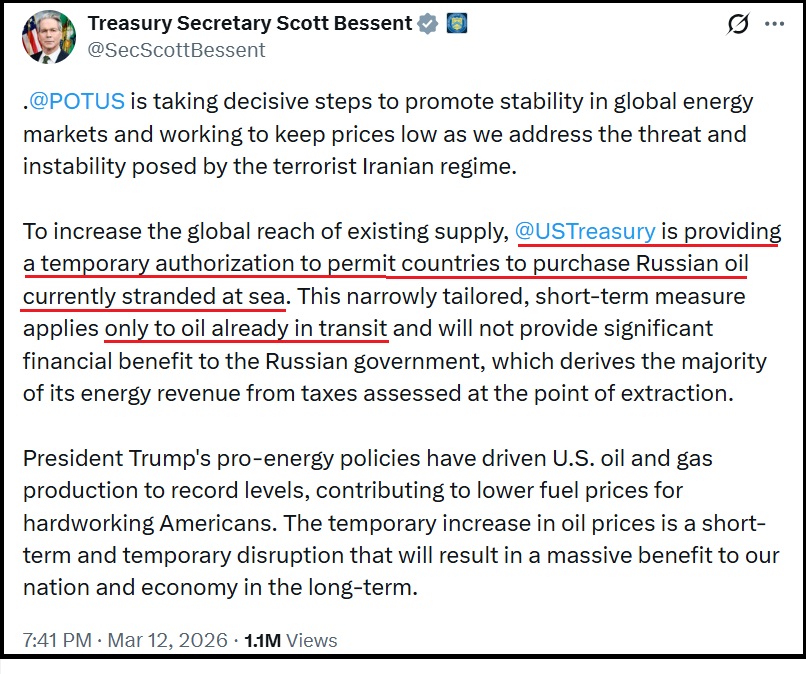
President Trump and Treasury Secretary Scott Bessent are facing mounting criticism for creating a window for Russia to sell oil and gas to the global market via “narrowly tailored, short-term” sanction relief. However, few people are putting the issue into context, and the background here is exceptionally interesting.
According to the terms announced by Secretary Bessent, the license to sell applies solely to Russian crude or petroleum products loaded onto vessels as of March 12 and is valid through midnight Washington time on April 11. [Treasury Notice Here – OFAC Technical Details Here]
The sanction relief license to sell will be done in globally recognized petrodollars and applies only to preexisting oil and petroleum products that are already in transit at sea. However, here’s where it gets very interesting and the ramifications are significant.
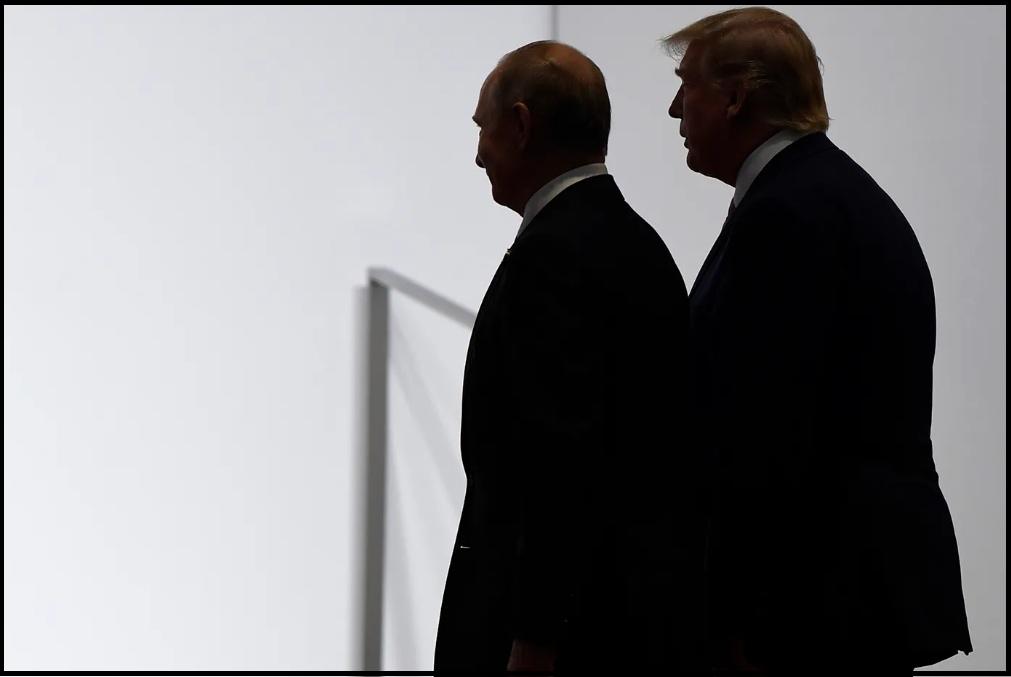
Immediately following the Alaska summit between Russian President Vladimir Putin and President Trump, Russia restarted Arctic-2 LNG terminals and began increasing oil production for storage on ‘floating platforms.’ President Trump met with Putin on August 15, 2025, and the curious increase in Russian production began on August 18, 2025.
In the past six months Russia has been pumping sanctioned oil and gas and storing it on ships and mobile sea platforms, seemingly (at the time) with no customers. Suddenly, against the background of the Iran conflict, all of that previously stored ‘on the water‘ production, now worth double, is authorized for global sale (in petrodollars).
Either Russian President Putin is the luckiest guy in the world, or Russia knew something.
In 2025 what Russia did following the Alaska summit did not make sense; now it does and the ramifications are stunning.
President Trump was looking for a way to organize a strategic partnership with Russia on the issue of energy production but was hampered by the preexisting sanction regime and strong opposition from domestic and international politics.
The ‘coincidental’ timing’ of Trump meeting with Putin and then subsequently Russia producing massive amounts of oil and gas for storage on the water suddenly starts to take on an entirely new light. Did Putin know something was coming, something that would eventually make the Russian over production and ‘on the sea’ storage worth billions.
The implications here are quite remarkable; however, they simultaneously explain most of the behaviors since the Iran confrontation began.
Media reports highlight that Vladimir Putin was asked about a previous joint agreement for military support between Iran and Russia and why Russia did not respond when Iran was attacked. Foreknowledge would explain that reaction.
Additionally, the Russian Federation president never responded to the Trump operation to take down Venezuelan dictator Maduro and seize control over Venezuela’s oil production.
If there was some discussion inferring that a ‘limited sanction relief’ protocol might be possible, that would explain why Russia began storing oil and gas at sea.
This fact pattern would also indicate that President Trump’s decision toward Iran was made at least six months ago, with a set of geopolitical events planned between the Alaska summit and the eventual confrontation with Iran.
TIMELINE: Trump and Putin meet. Three days later Russia begins pumping oil/gas and storing it at sea. President Trump then triggers the Venezuela western hemisphere security operation; Russia stays silent. President Trump then triggers the confrontation with Iran; Russia rejects involvement. And then two weeks after the Iran confrontation begins, Trump removes sanctions on Russian oil/gas “in transit” at sea.
Suddenly all of the Russian produced and stored product ‘on the water’ has greater value and new customers.
Just a coincidence? No way.
The United States needs the oil/gas market stability that Russia can provide.
Venezuela was/is to Trump as Ukraine was/is to Putin.
Posted originally on CTH on March 12, 2026 | Sundance
When the Supreme Court made their ridiculous decision to nullify the import tariffs under the International Emergency Economic Powers Act (IEEPA) use, the high court noted several alternate approaches would not be legally problematic. One of those approaches would be the use of Section 301 trade tariffs.
Yesterday USTR Jamieson Greer quietly announced that a Section 301 review would be taking place for the following countries: China, the European Union, Singapore, Switzerland, Norway, Indonesia, Malaysia, Cambodia, Thailand, Korea, Vietnam, Taiwan, Bangladesh, Mexico, Japan, and India.”
♦ Section 301 tariffs are a trade enforcement mechanism established under the Trade Act of 1974. They allow the U.S. government to impose tariffs on imports from countries that are found to be engaging in unfair trade practices. The Office of the United States Trade Representative (USTR) conducts investigations to determine if a country is violating trade agreements, and if so, it can impose tariffs as a corrective measure {SOURCE}
USTR PRESS RELEASE – WASHINGTON — Today, United States Trade Representative Jamieson Greer announced the initiation of investigations regarding the acts, policies, and practices of various economies under Section 301(b) of the Trade Act of 1974 relating to structural excess capacity and production in manufacturing sectors.
The investigations will determine whether those acts, policies, and practices are unreasonable or discriminatory and burden or restrict U.S. commerce. The economies subject to these investigations are: China, the European Union, Singapore, Switzerland, Norway, Indonesia, Malaysia, Cambodia, Thailand, Korea, Vietnam, Taiwan, Bangladesh, Mexico, Japan, and India.
“The United States will no longer sacrifice its industrial base to other countries that may be exporting their problems with excess capacity and production to us. Today’s investigations underscore President Trump’s commitment to reshore critical supply chains and create good-paying jobs for American workers across our manufacturing sectors,” said Ambassador Greer.
“The Trump Administration’s reindustrialization efforts continue to face significant challenges due to foreign economies’ structural excess capacity and production in manufacturing sectors. Across numerous sectors, many U.S. trading partners are producing more goods than they can consume domestically. This overproduction displaces existing U.S. domestic production or prevents investment and expansion in U.S. manufacturing production that otherwise would have been brought online. In many sectors, the United States has lost substantial domestic production capacity or has fallen worryingly behind foreign competitors.” (read more)
Additionally, Section 232 [Steel and Aluminum examples] of the Trade Expansion Act of 1962 (19 U.S.C. §1862, as amended) authorizes the President to impose trade restrictions—such as a tariff or quota—if the Secretary of Commerce determines, following an investigation, that imports of a good “threaten to impair” U.S. national security. {SOURCE}
Section 232 is currently covering all the steel and aluminum import tariffs.
Section 122 of the Trade Act of 1974 allows the U.S. president to impose tariffs of up to 15% to address “large and serious” balance-of-payments deficits. This authority can be exercised without prior congressional approval for a limited duration of 150 days. After this period, any tariffs must be extended by Congress. {SOURCE}
Section 122 has already been deployed to retain the “baseline reciprocity tariffs.”
USTR Greer is now walking through the process of deploying Section 301 and will eventually become the legal underpinning to replace Section 122 and retain all tariff status without congressional extension needed. Most of this is technical and legal compliance as several of the aforementioned nations have already finalized free trade agreements.
Posted originally on CTH on March 12, 2026 | Sundance
It is transparently obvious now that Canada is going to rely on UniParty (Corporate) opposition to President Trump in the dissolution of the USMCA (CUSMA) in favor of two distinctly different bilateral trade agreements; one with Canada and one with Mexico.
A bilateral trade negotiation between the United States and Canada would be devastating to the interests of the Canadian government. Particularly after the Venezuela operation and new strategic relationship with the United States, Canada has almost zero points of leverage to negotiate anything similar to their current exploitative trade position.
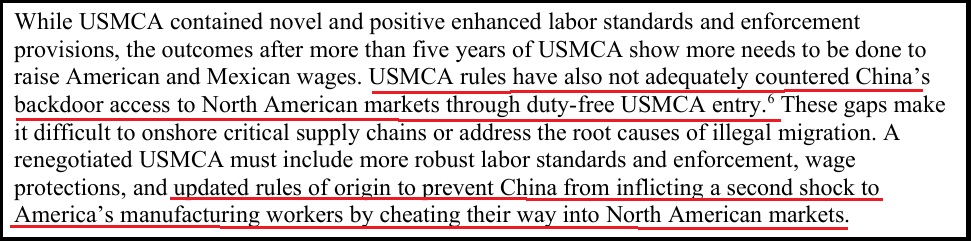
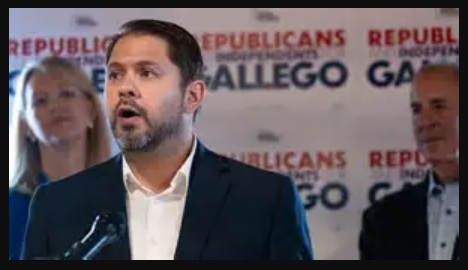
Canada is going to rely on congress to stop Trump from forcing reciprocity in the bilateral discussions. However, as a positive indicator that President Trump will factually have congressional support for the elimination of the USMCA, Democrat Senator Ruben Gallego has written a letter to President Trump requesting a comprehensive review. [LETTER HERE]
This is a key Senate democrat who notes the problem. One of Gallego’s top points of concern is the loophole that Canada uses to assemble Chinese component parts into finished goods for tariff free distribution into the United States.
Ever since President Trump won the 2024 election, Mexico has been taking proactive independent action to block Chinese component goods. But Canada has done the opposite and begun to enhance their trade relationship with China to take even more Chinese component and finished goods.
Gallego writes to U.S. Trade Representative Jamieson Greer from the position of wanting to increase wages and enhance jobs in both Mexico and the USA, growing both economies. However, Gallego’s advocacy simultaneously bolsters why the USMCA should be dissolved and also puts Canada at a distinct disadvantage.
MEXICO – Mexico’s President Claudia Sheinbaum told reporters during her morning news briefing on Wednesday that her U.S. counterpart, Donald Trump, is open to doing away with the U.S.-Mexico-Canada trade agreement (USMCA) and replace it with individual trade deals with each country.
[…] “There might be revisions that create bilateral deals instead of involving the three countries because some things are more important between Mexico and the United Sates or between Canada and the United States,” said Sheinbaum. “Not everything has to be trilateral.”
Mexico’s president said the subject was brought up by Trump during a Tuesday phone conversation. […] According to Sheinbaum, her country is ready to consider possible changes. (read more)
Just like the original NAFTA dissolution, if Senate democrats agree the USMCA is structurally flawed then Canada will lose its only hope to retain the trilateral agreement.
It appears that some Senate democrats like Gallego recognize this issue and support the need for exceptional change.
There is a significant difference between Mexico and Canada as it pertains to trade. Two distinctly different bilateral trade agreements would be the best outcome for the USA.
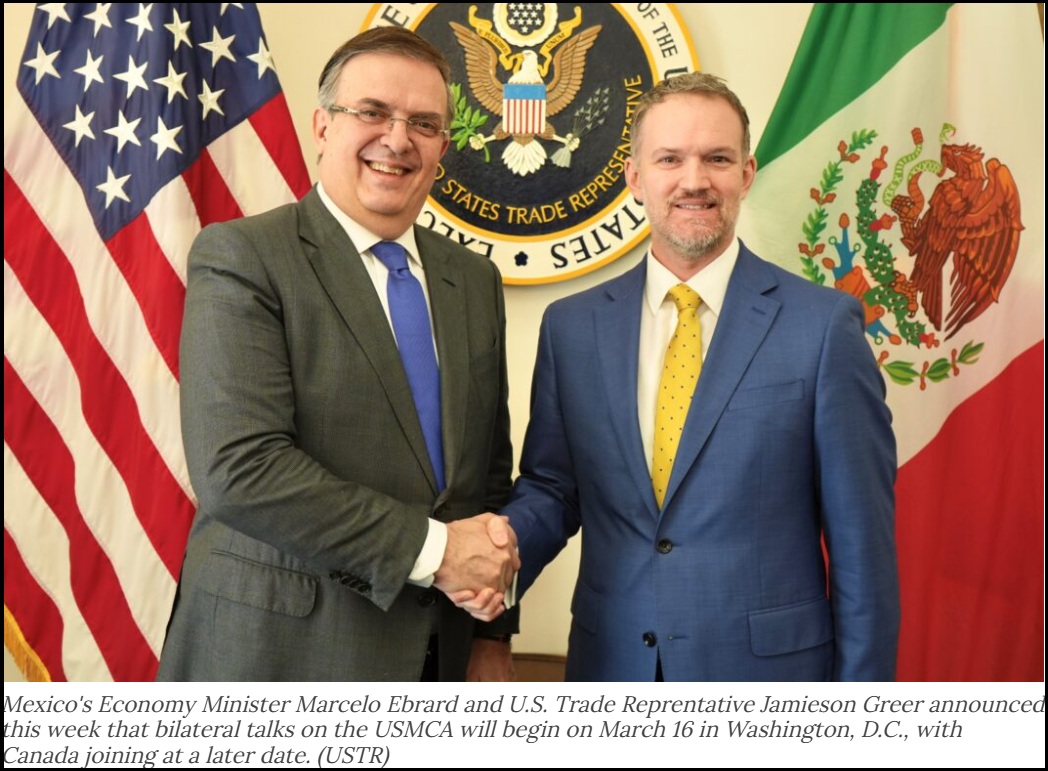
Team Mexico have already been holding bilateral discussions with USTR Jamieson Greer, and I suspect the broad outlines of a free trade agreement between the U.S and Mexico have already been agreed.
While Mexico has been working diligently for 16 months to get into alignment with the USA on a new free trade agreement, Canada has been doing everything possible to retain their “elbows up” position in opposition to the USA. This will not work out well for Canada.
“The key thing that has struck me, and I think it has struck all Canadians, is so many of these guys in the Trump administration, frankly, they just hate Canada,” said Brian Clow, former Prime Minister Justin Trudeau’s deputy chief of staff who led Canada-U.S. affairs. {source}
Posted originally on CTH on March 12, 2026 | Sundance
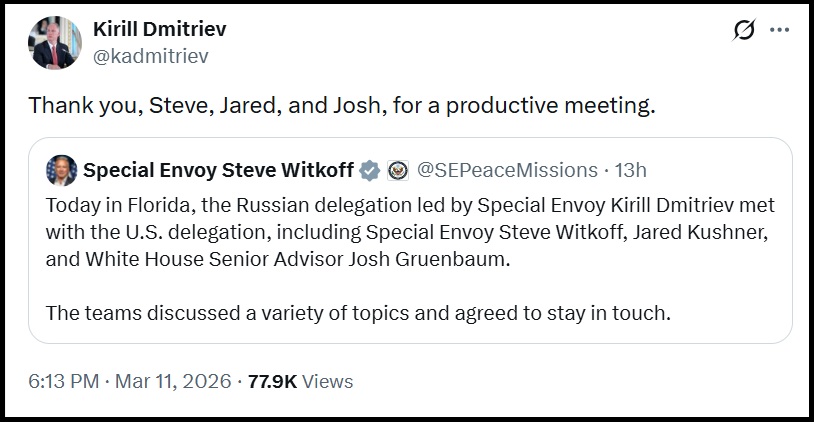
The fact that Team Russia and Team USA would be discussing a strategic economic alliance on the issue of energy is not a surprise to those who watched both President Putin and President Trump outline that same content discussion in Alaska last August. However, given the current conflict with Iran and the escalating oil price issue, Russia and the USA discussing Russian oil capacity and U.S. sanctions therein takes on a new angle.
It has been obvious that domestic U.S. politics, in combination with the Russia-Ukraine war, has impeded President Trump from organizing a strategic reset with Russia pulling away from historic conflicts. However, CTH is also clear-eyed on the longer-term ramifications for Eastern Europe when contrast with Putin’s ambitions to fix what he perceives as prior Russian Federation mistakes regarding the West (more on that at the end).
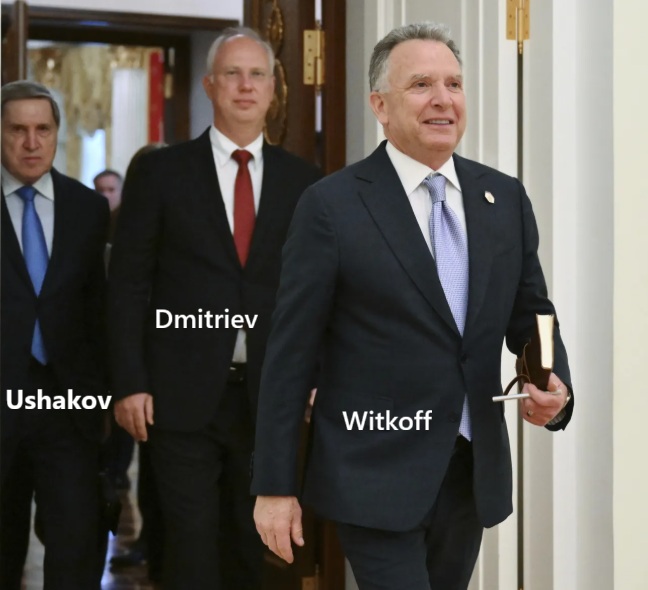
As noted in social media exchanges from Witkoff and Dmitriev, the discussion was productive.
All indications of this meeting give the appearance of less focus on progress in the Ukraine-Russia conflict, and a higher focus on current economic conditions -created by the Iran conflict- that could be enhanced with cooperation between the U.S. and Russia. {GO DEEP BACKGROUND}
According to Kirill Dmitriev, Russian special presidential envoy for investment and economic cooperation with foreign countries and director general of the Russian Direct Investment Fund (RDIF), relayed through the Russian News Agency (TASS), “he visited the US upon orders from Russian President Vladimir Putin, taking part in a meeting of the heads of a working group on economic cooperation between the two countries.”
According to the envoy, the meeting addressed both promising projects that can help restore Russia-US relations and the current crisis on global energy markets.
The US is becoming increasingly aware of the role of Russian oil and gas in ensuing the stability of the world economy, as well as of the [in]effectiveness of sanctions against Russia, Dmitriev said after the meeting. (source)
“We discussed promising projects that could contribute to the restoration of Russian-American relations and the current crisis on global energy markets,” Dmitriev also wrote in a Telegram post.
“Today, many countries, primarily the United States, are beginning to better understand the key, systemic role of Russian oil and gas in ensuring the stability of the global economy, as well as the ineffectiveness and destructive nature of sanctions against Russia.”
With the strong likelihood that Russia’s restart of their flagship LNG terminal Arctic-2 was directly related to the August summit in Alaska {SEE HERE}, there is already a baseline established for strategic cooperation.
President Trump would have no problem with Russia introducing millions of barrels of oil into the global market given the issues created by conflict in/around the Strait of Hormuz. However, obviously the issues for streamlined Russia oil exports surround (1) preexisting sanctions, (2) domestic U.S. anti-Russia politics and (3) the political and economic position of the anti-Russia European Commission leadership.
As we previously outlined with the Liquified Natural Gas (LNG) benefit, Russia previously extracted, liquified and pumped massive amounts of LNG into floating storage platforms from Arctic-2. Those LNG supplies doubled and tripled in value in a few days once Qatar shut down their production facilities and are now being sold to various Asian countries.
Europe has a massive energy problem with severely low LNG storage rates and now a shortage of oil, with EU gasoline prices rising much higher & faster than the rest of the world. Europe is facing a severe energy crisis overall and now their preexisting economic troubles are being amplified.
More than ever Europe needs the Russian oil/gas, but ridged ideologues will never compromise on their anti-Russia position. They have even steeper sanctions against Russian oil/gas scheduled to trigger at the end of this month.
It will be interesting to see how President Trump navigates the potential benefit from Russian energy products into the global market against the backdrop of all the geopolitical angst and political opposition against Russia.
…. AND that brings me to a point of discussion that I’ve had with a few dialed-in people.
When you look at the long term, and when you overlay the mindset of Russian President Vladimir Putin, almost everyone in Russia/Eastern Europe who evaluates the future can see the potential for Putin to exploit the EU’s self-created economic vulnerabilities for his own expansionist objectives.
Yes, some elements of the U.S. banter about further Russian expansion are not propaganda. Most of it is, but there is an element to the future forecast -beyond the Ukraine conflict- that could see Russia in a much stronger position, and the EU in a position of significant weakness.
The MAGA-minded European and Russian people, the ones who have strong wisdom on the issues, can all see a specific set of dominos falling that could place Putin in a position to recapture the remaining pro-Russian geographies in Europe back into an expanded Russian Federation.
Given the highly unstable mindset and friction points within European leadership, that would be a very bad combination to contemplate.
A strategic USA reset with the Russian Federation is a reasonable and pragmatic goal. There is no reason for America and Russia to be in conflict or opposition and pulling Russia away from a relationship with China has massive benefits for both countries.
The Russian people are not affectionate toward China at all, not even a little bit. In reality, China is a necessary ally for Russia but not a choice they would select if other options were available and variables were changed. The Russian people are exceptionally independent, incredibly strong and brutally proud; however, they are also more Western-minded (European, without self-flagellation) than Eastern-minded (Asian).
Here’s where/why Trump is being careful and pragmatic. President Trump doesn’t want to see an outcome where Russia is eventually stronger than Europe. There’s not enough frictionless history between the USA and Russia to trust Putin when he says the Federation has no plan to expand into Europe.
The USA can/should be strategic allies with Russia. However, it would be much better if a strong Europe existed at the same time. Hence, Vice President Vance and Secretary of State Rubio continuing to emphasize that Europe needs to stop cowering in politically correct wokeness. The EU is destroying itself at the same time Russia is getting stronger.
.
Last point, the Lyndon LaRouche team, Promethean Action PAC, are very happy with the ongoing fracture of the USA away from the UK/EU group. However, be cautious around Political Action Committees who say, “President Trump needs people to understand what he is doing” and we are here as his official policy interpreters.
Remember, President Trump doesn’t need policy interpreters.
Posted originally on CTH on March 10, 2026 | Sundance
The origin of this issue goes back to 2021 and the relaunch of the Build Back Better European green energy program to fight the non-existent climate change problem. We have been highlighting the consequences within the EU auto sector.
We noted in October of last year, the EU’s mandated fines against auto manufacturers who do not hit their production goals for electric vehicle sales began in 2025. EU automakers unable to meet the regulatory compliance goal began purchasing carbon credits to avoid stiff EU fines. Many of those carbon credits were purchased from Chinese EV automakers, who then turned around and started using the extra EU revenue to discount Chinese cars sold in Europe.
At the same time as Chinese autos hit record highs in Europe, EU car sales are flat or declining. Now, Volkswagen is announcing they lost half their profits in one year and will be cutting 50,000 jobs in the next four years.
(MSM – Europe) – Volkswagen just revealed its operating profit sank like a stone last year, dropping by more than half as tariffs, Chinese competition, and shifting strategies took a serious bite out of the bottom line. And that performance now has the VW Group’s execs reaching for the cost-cutting scissors, including plans to shed 50,000 jobs by the end of the decade.
The German automaker reported an operating profit of €8.9 billion ($10.3 bn at current rates) for 2025. That’s down a hefty 53 percent from the year before and well below what analysts were expecting. Revenue, meanwhile, barely moved, slipping only slightly to around €322 billion ($374 bn). (read more)
This was very predictable. In essence, EU car companies buy Chinese car company carbon credits, to avoid the EU fines. The Chinese car companies then use the carbon credit revenue to subsidize lower priced Chinese EVs to the European car market, thereby undercutting the European EV car companies.
The EU tariff applied to gasoline powered cars or hybrids from China is 10%. That tariff is not enough to stop the imports. The Chinese hybrid autos are substantially less than European car brands, and there’s no financial incentive for China to build auto plants in the EU zone especially when you consider the EU is subsidizing those cars by purchasing carbon credits.
When analyzed from a cost and consequence, the entire EU dynamic toward car companies is a little funny. However, for Germany this is a serious issue, and with the German industrial economy already stagnant – every impact to their auto industry only makes the situation worse.
When you overlay the big picture of their expensive “green energy” costs, the EU find themselves in an unescapable downward spiral. Quite literally, all commonsense seems to have been lost in their green energy chase.
By focusing on energy targets, specifically by trying to force production of European electric vehicles that are not favored by European car purchasers, the EU is shrinking their economy to the benefit of Beijing exploitation.
German Chancellor Friedrich Merz recently travelled to China for a discussion with Chairman Xi Jinping. Chancellor Merz returned to German with a stark message about how the nation needed to quickly get productive in order to meet the far superior work ethic he saw in China.
At the same time, the EU has destroyed its energy sector by chasing windmills and solar farms instead of maintaining the much cheaper coal and gas alternatives. Overall, Europe has made a series of really bad decisions, but those consequences will surface the hardest within the largest industrial economy, Germany.
Posted originally on CTH on March 8, 2026 | Sundance
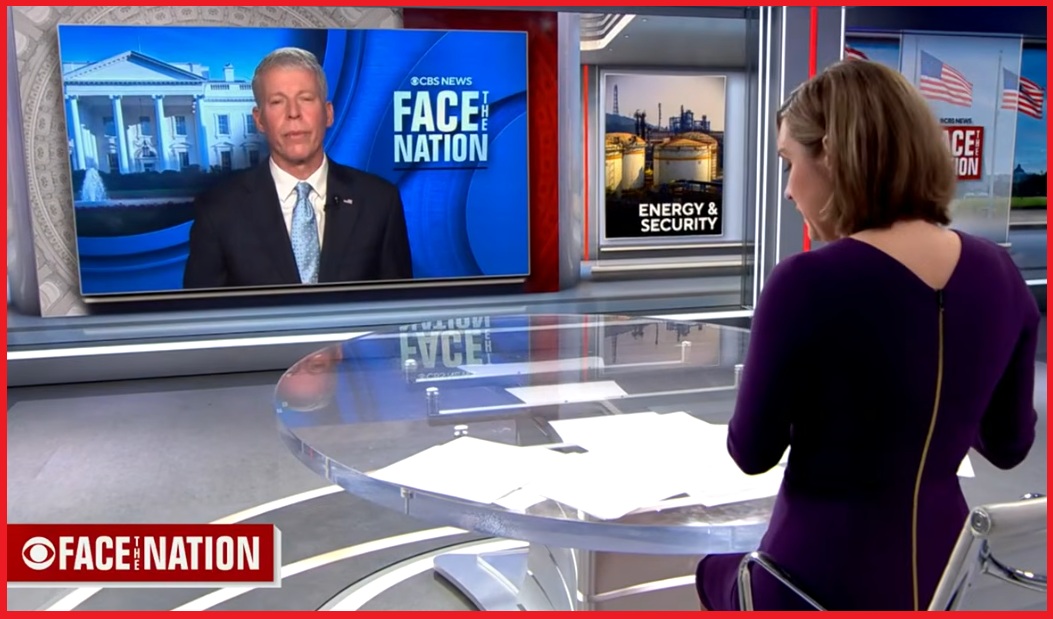
Energy Secretary Chris Wright appears on Face the Nation to push back against the narrative engineering of CBS’s Margaret Brennan. The video and transcript are below.
[Transcript] – MARGARET BRENNAN: We turn now to Energy Secretary Chris Wright, who joins us this morning from Denver. Good morning to you.
SECRETARY OF ENERGY CHRIS WRIGHT: Thanks for having me Margaret.
MARGARET BRENNAN: So 50,000 U.S. troops deployed, six Americans that we know of so far killed in action, civilians stranded. We look at our polling, Mr. Secretary, and we see that this is an unpopular war among the majority of Americans. More than half of them, 56% disapprove. When you speak to energy executives about the scope and duration of American involvement, what do you tell them? How long?
SEC. WRIGHT: I tell them that for 47 years, Iran is warg- waged war against the United States, and they’ve- throughout that 47 years, they’ve tried to undermine the energy development and energy infrastructure of all their neighbors, as they’re doing right now, and it’s time to put it to an end. So yes, we have a, we have a temporary period of elevated energy prices, but it will not be long. In the worst case, this is weeks, this is not months, and it leads to a much better place. It leads to an Iran that’s defanged, that can’t threaten its neighbors, can’t threaten American soldiers and can’t continue to drive up energy prices by making a mess of the Middle East. They can move to commerce, not conflict.
MARGARET BRENNAN: Well, but you have the moment we are in right now, and as you know, gasoline prices up 14% in the past week. According to AAA, reports the national average is $3.45. We’ve seen oil prices spike. How high do you think oil and gas are going to go?
SEC. WRIGHT: They shouldn’t go much higher than they are here because the world is very well supplied with oil. There’s no energy shortage at all in the Western Hemisphere.
MARGARET BRENNAN: Right.
SEC. WRIGHT: The United States is a net exporter of oil, a large net exporter of natural gas. But refineries in Asia and Europe are seeing an interruption from the normal crude flows. But there is massive energy stores around the world. What you’re seeing is emotional reactions and fear that this is a long term war. This is not a long term war–
MARGARET BRENNAN: –But–
SEC. WRIGHT: –It’s a temporary movement.
MARGARET BRENNAN: Sorry, go ahead, temporary movement.
SEC. WRIGHT: No, I’m saying look, we’ve seen previous administration have done everything they could. They begged, bartered and bribed the Iranian government to stop its nefarious activity, stop its murderous behavior, and it simply hasn’t worked, and now, they’re, they’re expanding missile and drone program that are rapidly growing to protect their desire to build a nuclear weapon. We’re going to cross the threshold where we can’t put them back in the box. Now is the time to end their risk to America and the world.
MARGARET BRENNAN: But as you know, when I ask you about energy prices, this is not a supply problem. You said there’s plenty of supply. The head of the International Energy Agency said, lot of oil, logistics are the problem. It’s dislocation. It’s a serious problem. So what he’s referring to there is being able to actually move it around. I know you said there’s, there’s one vessel that’s gone through the Strait of Hormuz. 20 million barrels per day typically go through it. When do you get back to that level?
SEC. WRIGHT: Oh, I think it will be relatively soon. Of course, I don’t know exactly. All of our military assets right now are focused on ending Iran’s ability to kill their neighbors, threaten American soldiers and threaten ship traffic in the Strait of Hormuz, but that’s going swimmingly well. Their missile launches are down 90%, the drone launches are down over 80% I think in the relatively near term, you’re going to see their capacity so low that we’ll see more normal ship traffic return to the Strait of Hormuz.
MARGARET BRENNAN: So you don’t think Navy escorts of vessels are necessary?
SEC WRIGHT: They might be. They might be. The U.S. is here to do everything we can to keep world oil markets supplied. Yes, if they have some residual–
MARGARET BRENNAN: –When will you make that decision?
SEC. WRIGHT: We’re, we’re in engagement right now with people that want to get tankers moving out of the Gulf. And so, yes, there could be there- early tankers probably will involve some direct protection by the U.S. military, but most important is to defang their ability to threaten these ships.
MARGARET BRENNAN: So the president had said he was open to tapping the American stockpile of oil, the Strategic Petroleum Reserve, but I saw you on other networks this morning, kind of throwing cold water on the idea. You referred to it as depleted. Are you saying America doesn’t have adequate stockpiles?
SEC. WRIGHT: No. America still has over 400 million barrels of oil in our strategic petroleum reserve, and, of course, robust production. We’re, we’re, more than happy to use that if it’s needed. But as you said earlier, it’s a logistics issue. Where do they need oil? They need oil at refineries in Europe and in Asia. And that’s why we took a very pragmatic step. There’s over 100 million barrels of floating Russian crude waiting in line to deliver to China. That’s going to be sold, it’s going to be refined, but that could be one or two months from now. So in a pragmatic way, with no change in U.S. policy towards Russia, we told the Indians, bring that into your refineries. You know, if you, if you’re feeling a shortage of crude, prices are being bid up, draw down that Russian crude stocks that are sitting right offshore.
MARGARET BRENNAN: Yeah. So on that point, the U.S. has temporarily suspended some sanctions to make that Russian oil, you say was already going to be sold anyway, make it available. But doesn’t Russia still financially benefit from that? Why isn’t the U.S. seizing those Russian tankers if they are our adversary?
SEC. WRIGHT: Because right now, because right now, we’re worried about Iran and fixing a 47-year problem there, and we’re worried about American consumers. We want to stop the rise in–
MARGARET BRENNAN: –Russia was helping Iran–
SEC. WRIGHT: –gasoline and diesel prices. Well, there’s been rumors of that. We don’t know if that’s true or not. Certainly, they’ve gotten a strong message from us. But this is oil already on the ocean–
MARGARET BRENNAN: –These Iranian drones have Russian parts in them. The Russians have been buying Iranian drones. That is very well documented, and CBS has confirmed and reported that there was sharing of intelligence. Russia providing intel to target Americans. So how is Russia not part of this?
SEC. WRIGHT: Look, Russia, Russia is expert at causing trouble around the world, so I’m not saying they’re not. I’m saying I don’t- if they’re helping Iran, it’s not working very well, but we’re not helping Russia by just accelerating the sale of their oil to stop the rise of energy prices and keep European and Asian refineries in oil. We’re just doing pragmatic things to get through a short period that will bring in an era of even lower energy prices because a major energy producing region of the world, the Middle East, will no longer have a strong, powerful Iran that can threaten their neighbors, that can threaten the United States of America and was not far away from a nuclear bomb. That’s an–
MARGARET BRENNAN: –How much–
SEC. WRIGHT: –unacceptable scenario. That’s the risk to energy prices was not doing anything.
MARGARET BRENNAN: So when the Qataris say you could see $150 barrel in oil, that’s something America could stomach? President Trump wouldn’t say, I’m done with this war because I can’t stand the political pressure and the American people saying I don’t like what I’m paying at the pump?
SEC. WRIGHT: No, the president’s going to continue to stay focused on ending a 47-year conflict, stay focused on growing the global energy supply. This is actually part of that effort. It does involve a temporary impediment to energy production, but on the other side, it will allow much more energy production and much lower energy prices. But this is not a long term conflict. Most presidents have just thought, they’ll kick the can down the road. The risk is simply too great to kick that increasingly dangerous can down the road.
MARGARET BRENNAN: Yeah.
SEC. WRIGHT: President Trump’s bold leadership is enough’s enough. We’re going to put it to an end.
MARGARET BRENNAN: I want to ask you about Venezuela. The U.S. deposed Maduro. He’s sitting in a prison. Just this past week, though, we had the interior secretary visiting Venezuela and sitting across from Maduro’s Chief thug, Diosdado Cabello. This is someone who has a $25 million bounty on his head. He ran the prisons, he ran the militias. He was treated as a counterpart to an American official. Is this the same playbook the Trump administration is going to run in Iran, that you will deal with the same regime you’ve been telling me is terrible to deal with for 47 years?
SEC. WRIGHT: We don’t know what the regime will be in place at the, at the end of this conflict, but we do know that regime will not have a massive weapons arsenal, that that regime will no longer be a massive threat to Americans and to the Middle East and to global oil supplies. President Trump is using bold leadership. We can’t change the world at a blink of an eye, but we can steer it in massively positive directions, and yes, Venezuela is a great example of that. Crime in the nearby Trinidad and Tobago has plummeted already from our actions in Venezuela, and President Trump’s insistence that he’s going to work with that our neighbors to reduce drug trafficking in the Western Hemisphere. Leadership takes- involves risks, but if you want to drive improvement, you’ve got to be confident, you’ve got to have the right agenda, and you’ve got to have the courage to do it. This president does.
MARGARET BRENNAN: Energy Secretary Wright, thank you for your time this morning. Face the Nation will be back in a minute. Stay with us.
I have created this site to help people have fun in the kitchen. I write about enjoying life both in and out of my kitchen. Life is short! Make the most of it and enjoy!
This is a library of News Events not reported by the Main Stream Media documenting & connecting the dots on How the Obama Marxist Liberal agenda is destroying America





 Centinel2012