President Trump Calls on Oil Dependent Nations to Send Military Ships to Backstop Security in Hormuz


Posted originally on CTH on March 14, 2026 | Sundance 

President Trump’s latest two messages via Truth Social present an interesting geopolitical approach with multiple enmeshed aspects.

First, some background context is needed.  Treasury Secretary Scott Bessent and USTR Jamieson Greer are in Paris to meet with Chinese government officials ahead of a scheduled meeting between Chairman Xi Jinping and President Trump.

The main objective of the pre-summit assembly before President Trump goes to Beijing, is to hammer out the actionable agreement details that can be signed off by Xi and Trump.  Bessent and Greer are looking to put a deal together with their Chinese counterparts so that Trump and Xi can announce mutually beneficial outcomes during their summit.
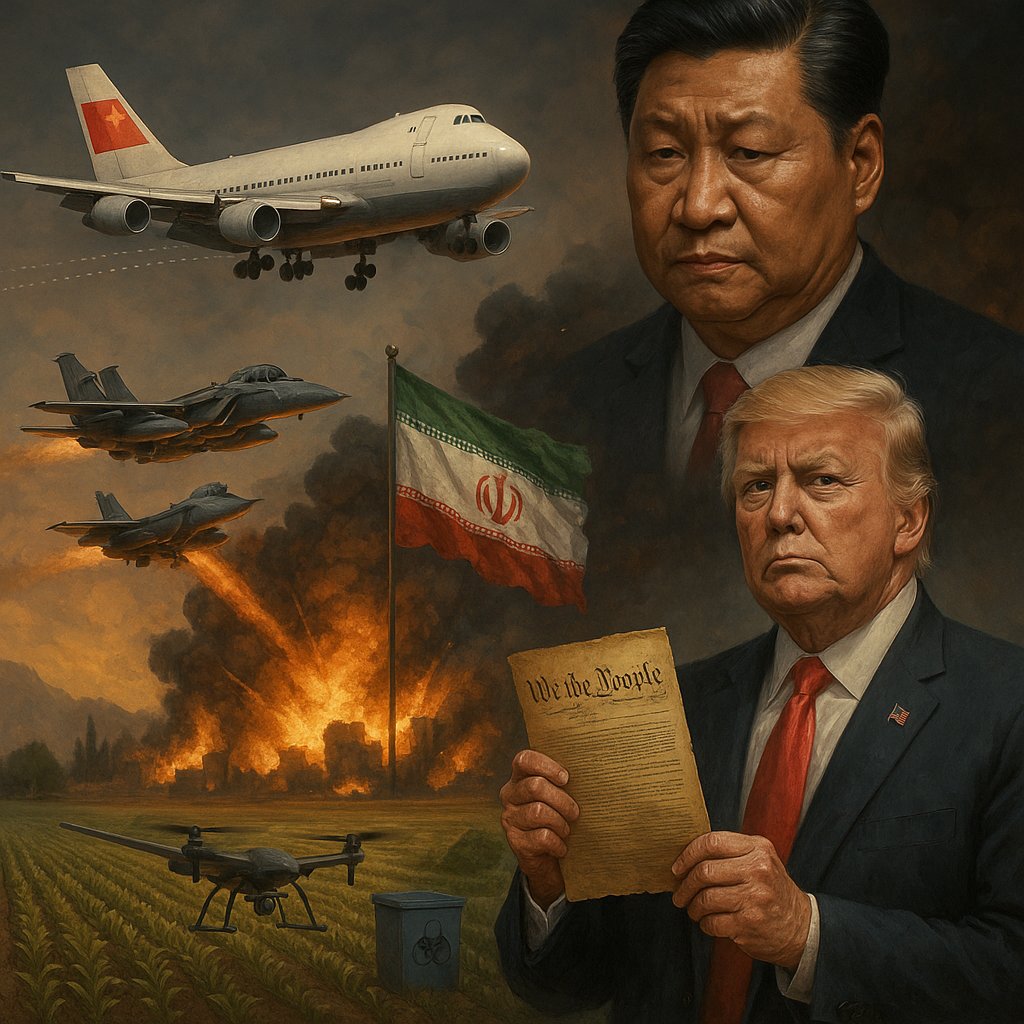
Second, President Trump has already indicated the March 31/April 1 meeting with Xi will be all business. The traditional pomp and splendor will not be present, and Trump will only be visiting Beijing – no sidelines.

Third, Secretary Rubio will be accompanying Trump on this trip to Beijing, which might seem ordinary were it not for the fact that in 2020 China sanctioned and banned Rubio from entering China for criticizing Xinjiang and Hong Kong.

Fourth, there are rumors that President Trump is going to announce a significant weapons deal with Taiwan at some point immediately following the trip.  If those rumors are true, it would be a top priority for the Chinese advance team in Paris to stop that from happening.

Regardless of what happens in the next few weeks, President Trump will be meeting with Chairman Xi with full Eagle eye confrontation toward the returning dragon stare.  There will be no panda mask on this trip whatsoever; this face to face is an apex predator showdown, while the world watches intently.
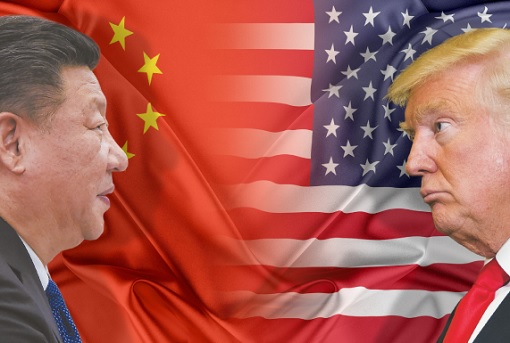
Everything President Trump does between now and his arrival in Beijing, should be contemplated through this adversarial position.  With strong moves in Venezuela and Iran President Trump has already pulled Chairman Xi into the jianshu circle, showing the soul of his blade.

Chairman Xi does not have anything resembling a retreat position. He has a highly focused domestic audience, and the eyes from the Great Hall of the People will be watching intensely.

In the next two weeks we will likely see critical probes of both Trump and Xi’s wills surface in ancillary stories connected to each stakeholder, most likely swirling around the Iran conflict. Do not be surprised if we see all of the advanced USA influence purchasing by China now activated with very specific anti-Trump narratives.

That is the context for President Trump to call out many of the oil dependent countries:

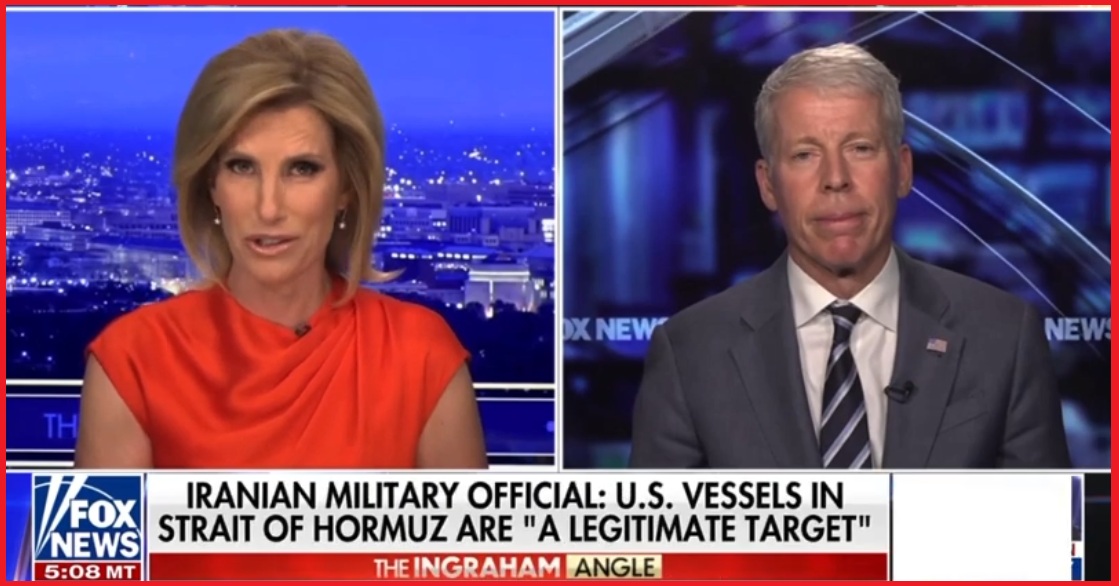
TRUTH SOCIAL – “Many Countries, especially those who are affected by Iran’s attempted closure of the Hormuz Strait, will be sending War Ships, in conjunction with the United States of America, to keep the Strait open and safe. We have already destroyed 100% of Iran’s Military capability, but it’s easy for them to send a drone or two, drop a mine, or deliver a close-range missile somewhere along, or in, this Waterway, no matter how badly defeated they are.

Hopefully China, France, Japan, South Korea, the UK, and others, that are affected by this artificial constraint, will send Ships to the area so that the Hormuz Strait will no longer be a threat by a Nation that has been totally decapitated. In the meantime, the United States will be bombing the hell out of the shoreline, and continually shooting Iranian Boats and Ships out of the water. One way or the other, we will soon get the Hormuz Strait OPEN, SAFE, and FREE! President DONALD J. TRUMP

There is a significant overlay here.

First, any nation that sends supportive military ships into the Strait of Hormuz is openly taking a position against the Iranian regime.  China cannot take that position, and President Trump knows it – so he’s calling out the dragon’s alignment for the world to see.

…. If you get oil from the region, come protect your ships while I kill the bad guys…
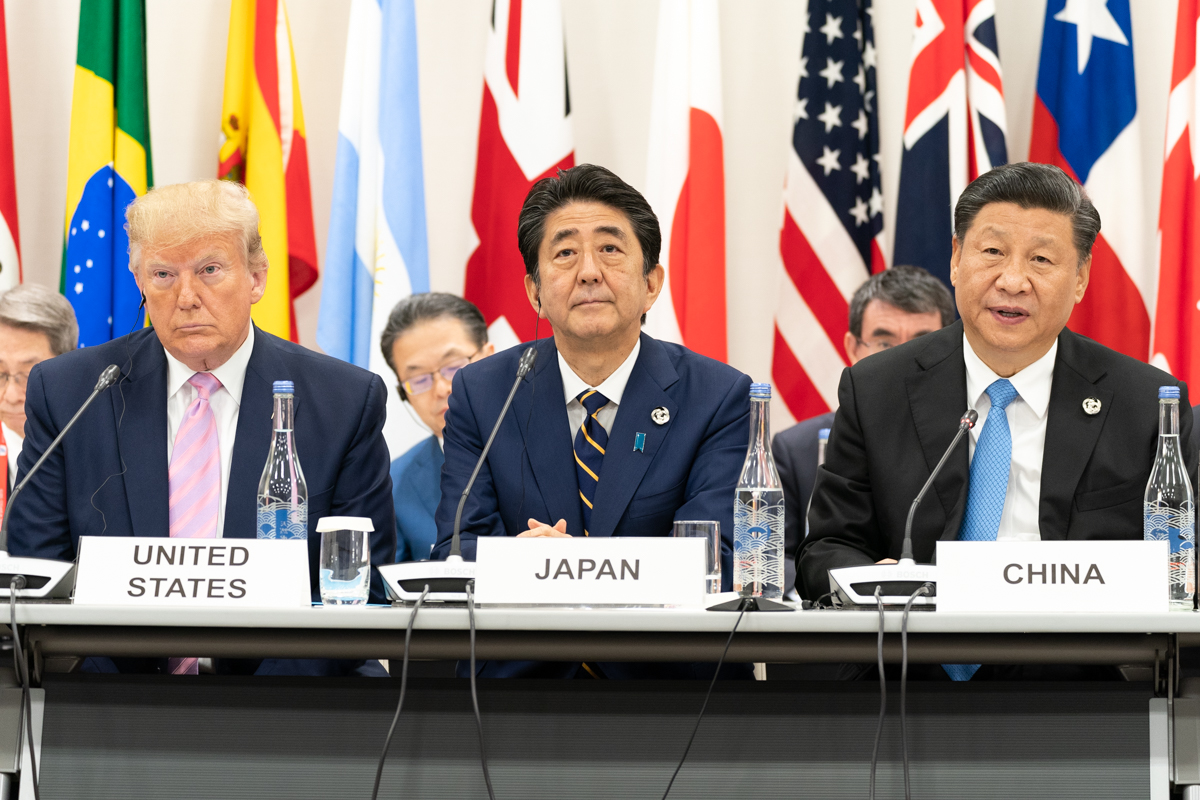
Remember, Japan has a very limited military, and their post-World War II constitution was blocking them from building one.  Changing that position was the goal of Japanese Prime Minister Shinzo Abe, a friend of Trump, and he was traveling throughout Japan with that message when he was assassinated.  That objective now falls to the protege’ of Abe, Prime Minister Sanae Takaichi.

Japan is included on that list of countries specifically to antagonize the dragon, with President Trump saying I have a strong industrial friend in your back yard.

For the rest, notice the countries Trump did not name: India, Thailand, Vietnam, Philippines or any of the Asian countries that are dependent on oil from the middle east.   Trump is not asking the dependency allies of the United States to participate. Instead, President Trump is calling upon the fake-ally countries that oppose the United States but hide behind a friendly smiling mask.

This is a bold underline for President Trump’s former statement where he publicly doubted the NATO allies would ever come to assist the USA (ie. Greenland), even though they are dependent on the security the USA provides.

In this Iranian conflict, the Europeans are dependent on oil from the middle east, but they will not put their military into the fight even if it secures their own economic future.  Opening the Strait of Hormuz benefits the Europeans, but they only want to pontificate grand prose about it; similar to how they pontificated about the threat Iran presented, then lost their supportive tongue when Trump finally did something about it.

A few hours later, President Trump drives home the point:

TRUTH SOCIAL – “The United States of America has beaten and completely decimated Iran, both Militarily, Economically, and in every other way, but the Countries of the World that receive Oil through the Hormuz Strait must take care of that passage, and we will help — A LOT! The U.S. will also coordinate with those Countries so that everything goes quickly, smoothly, and well. This should have always been a team effort, and now it will be — It will bring the World together toward Harmony, Security, and Everlasting Peace!” President DONALD J. TRUMP

Now we wait to see who steps up.

Spoiler Alert – ¹No one will!
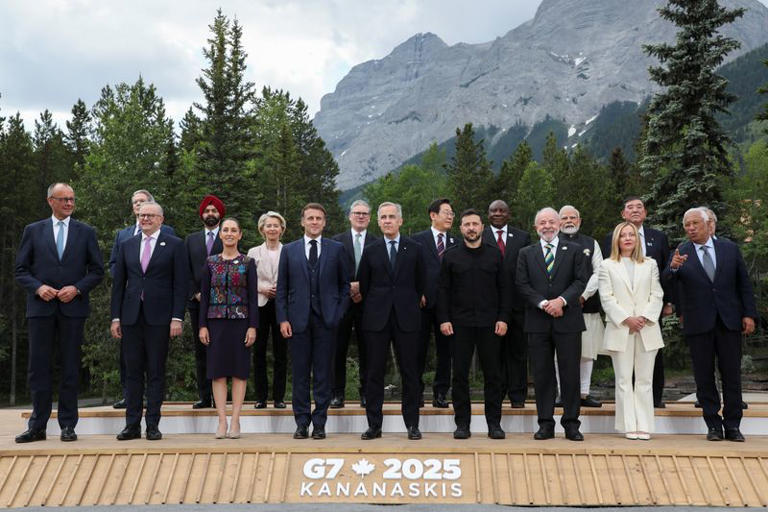
¹And that’s the point Trump is making.

I also concur with this point:
Shanaka Anslem Perera“The coalition call is not about Iran. Iran’s military is destroyed. The coalition call is about the world that emerges after Iran. If America escorts the tankers alone, the Strait reopens under American control and dollar pricing survives. If a coalition escorts them, the Strait reopens under international consensus and the yuan-for-Hormuz proposal dies. If nobody escorts them, the Strait stays closed and China’s shadow fleet is the only commerce moving through it.”

Iranian Regime Clerics Flee to Safe Harbor of Canada?


Posted originally on CTH on March 14, 2026 | Sundance 

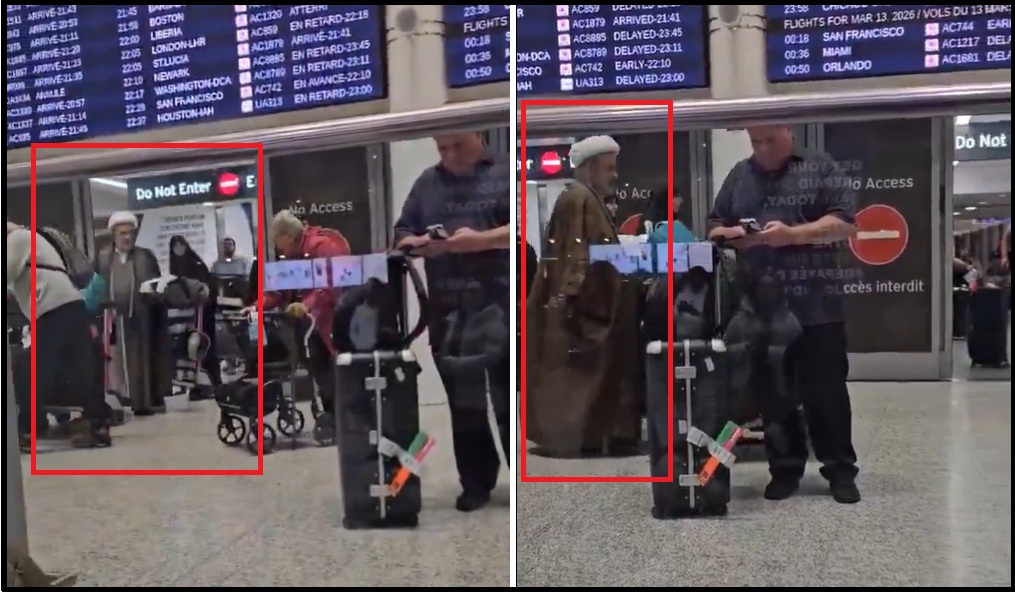
This is quite a remarkable development.  Someone in the Toronto airport captured video of Iranian Cleric Hojjatoleslam Morteza Tayebi arriving in Canada yesterday [Video Here].  As the story is told, apparently 700+ members of the Iranian Revolutionary Guard Corps (IRGC), who carry out regime terrorism, reside or have dual citizenship in Canada. [HERE]

“The individual observed in the Pearson Toronto Airport videos, carrying a suitcase while dressed in clerical attire, is Hojatoleslam Morteza Taieb.  According to some reports, he holds residency or citizenship in Canada and travels between Iran and this country.” {Source}

Canadian Member of Parliament Melissa Lantsman has been trying to draw attention to the issue for several years, claiming the IRGC is carrying out domestic terrorism in Canada while supporting the activity of the Iranian government.

Melissa Lantsman“the government knows there are IRGC agents here in Canada. They know these terrorists perpetuate violence, terrify our citizens, and do the work of the mullahs in our own streets. But the government lets them stay in Canada.  Why?

Great question. Additionally, if Iranian Mullahs and Clerics are part of a fanatical war against the U.S. then wouldn’t their ability to seek safe harbor in Canada represent a threat to the United States?

That said, the IRGC members living in Canada in combination with dual citizenship for Mullahs and Clerics certainly explains the soft response from Prime Minister Mark Carney.

Known Wolf – Former Convicted ISIS Sympathizer Opens Fire at Old Dominion University, Killing Professor Wounding Two


Posted originally on CTH on March 12, 2026 | Sundance 

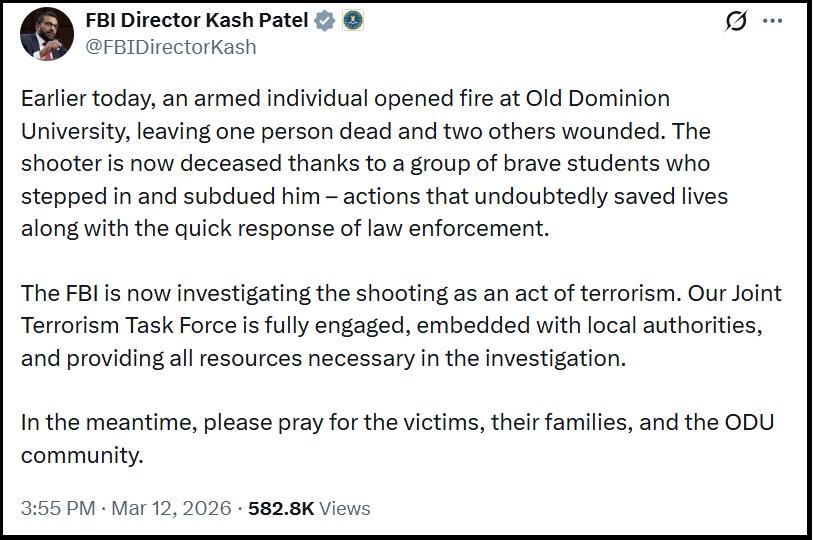
How was this previously convicted ISIS supporter allowed out of prison and not deported?  A ridiculously avoidable terrorist incident has unfolded at Old Dominion University in Virginia.

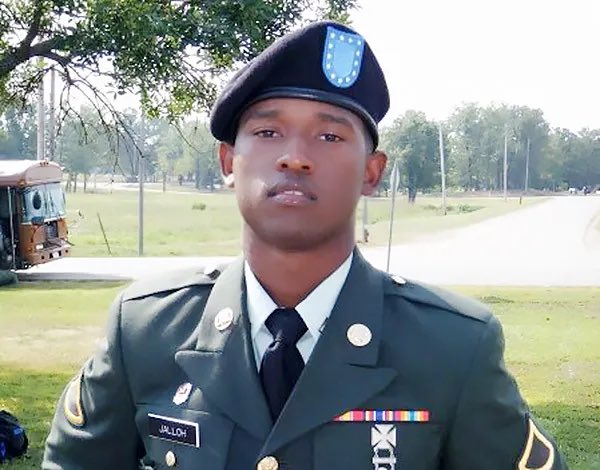
Mohamed Jalloh was born in Sierra Leone, became a naturalized US citizen, was radicalized by al-Qaeda, was then convicted for providing material support to ISIS in 2017 and sentenced to 11 years in prison; then released from prison early in 2024 under Biden.

NEW YORK POST – The madman who opened fire at Old Dominion University on Thursday, killing a retired military officer instructing an ROTC class, has been identified as an ex-National Guard soldier convicted of trying to support ISIS, The Post has learned.

Mohamed Bailor Jalloh, 36, stormed into a classroom inside ODU’s Constant Hall and asked if it was an ROTC class. When someone confirmed that it was, he launched the suspected terror attack, shooting the professor several times, law enforcement sources said.

A heroic ROTC cadet at the Virginia school jumped to action to prevent more carnage, stabbing Jalloh to death after the crazed suspect gunned down the class instructor, the sources said. (read more)

[SOURCE]

Energy Secretary Chris Wright Discusses Iranian Tanker Strikes Near Strait of Hormuz and Strategic Petroleum Reserve Release


Posted originally on CTH on March 11, 2026 | Sundance

Tanker ships in the Gulf region continue to be targeted by various Iranian munitions including air and sea drones.  Three tanker ships were hit today.  Secretary of Energy Chris Wright appears on Fox News to discuss the issues with Iran and the decision to release oil from the SPR.  WATCH:

WASHINGTON—U.S. Secretary of Energy Chris Wright released the following statement regarding the International Energy Agency (IEA) and the U.S. Strategic Petroleum Reserve (SPR):

“Earlier today, 32 member nations of the International Energy Agency unanimously agreed to President Trump’s request to lower energy prices with a coordinated release of 400 million barrels of oil and refined products from their respective reserves.

“As part of this effort, President Trump authorized the Department of Energy to release 172 million barrels from the Strategic Petroleum Reserve, beginning next week. This will take approximately 120 days to deliver based on planned discharge rates.

“President Trump promised to protect America’s energy security by managing the Strategic Petroleum Reserve responsibly and this action demonstrates his commitment to that promise. Unlike the previous administration, which left America’s oil reserves drained and damaged, the United States has arranged to more than replace these strategic reserves with approximately 200 million barrels within the next year—20% more barrels than will be drawn down—and at no cost to the taxpayer.

“For 47 years, Iran and its terrorist proxies have been intent on killing Americans. They have manipulated and threatened the energy security of America and its allies. Under President Trump, those days are coming to an end.
“Rest assured, America’s energy security is as strong as ever.”

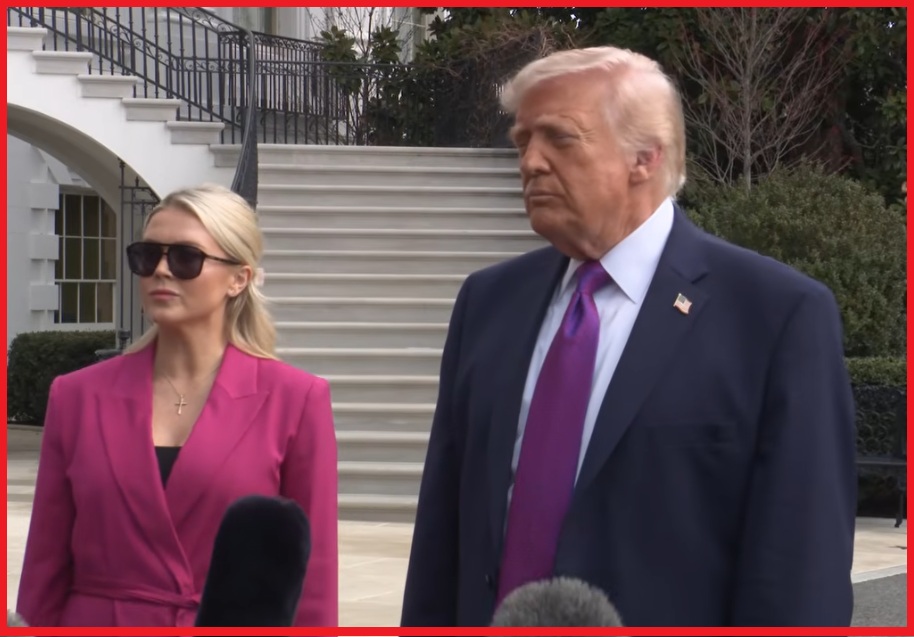
President Trump Impromptu Presser on Iran and SAVE America Act Departing the White House


Posted originally on CTH on March 11, 2026 | Sundance

President Trump answers questions from the media as he departs the White House for Ohio and Kentucky.  The majority of the questions surrounded Iran and the SAVE America Act.  WATCH:

.

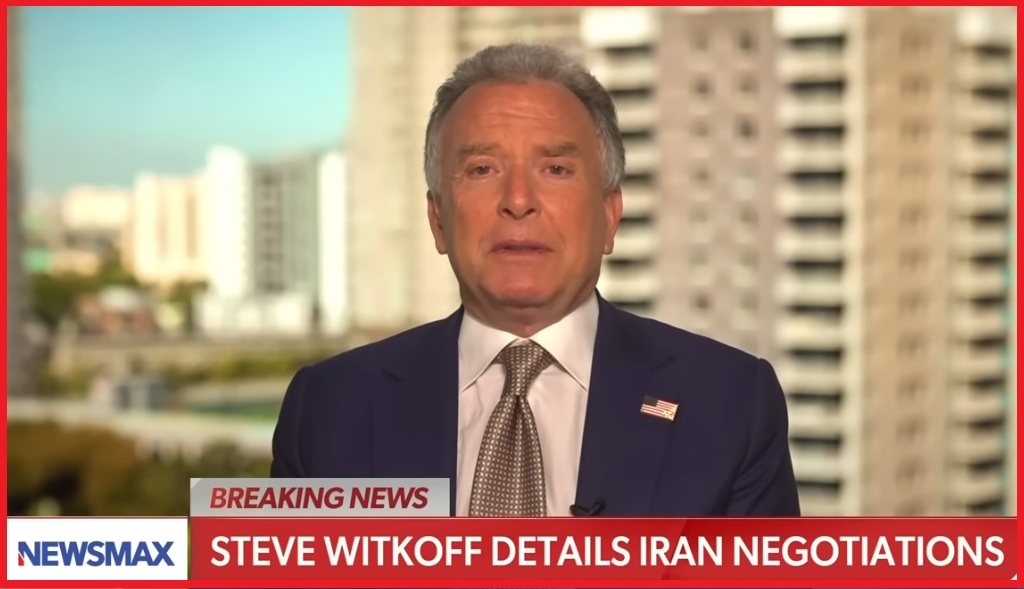
Special Envoy Steve Witkoff Gives Background Information on Breakdown of U.S-Iran Diplomatic Discussions


Posted originally on CTH on March 11, 2026 | Sundance

President Trump’s U.S. Special Envoy, Steve Witkoff, recently sat down with Greta Van Susteren to outline the point of diplomatic discussions with Iran’s Foreign Minister Abbas Araghchi when things broke down.

The Witkoff explanation is interesting as he outlines Iran’s unwillingness to even consider a cease to their ballistic missile program as part of the expanded security talks.  According to Envoy Witkoff, Foreign Minister Araghchi was intransigent on several key points of concern; even becoming loud and aggressive as he was pushed to explain why seeking ballistic missiles would be needed.

It’s an interesting background perspective that gives context to the decision that President Trump ultimately reached.  WATCH: 

.

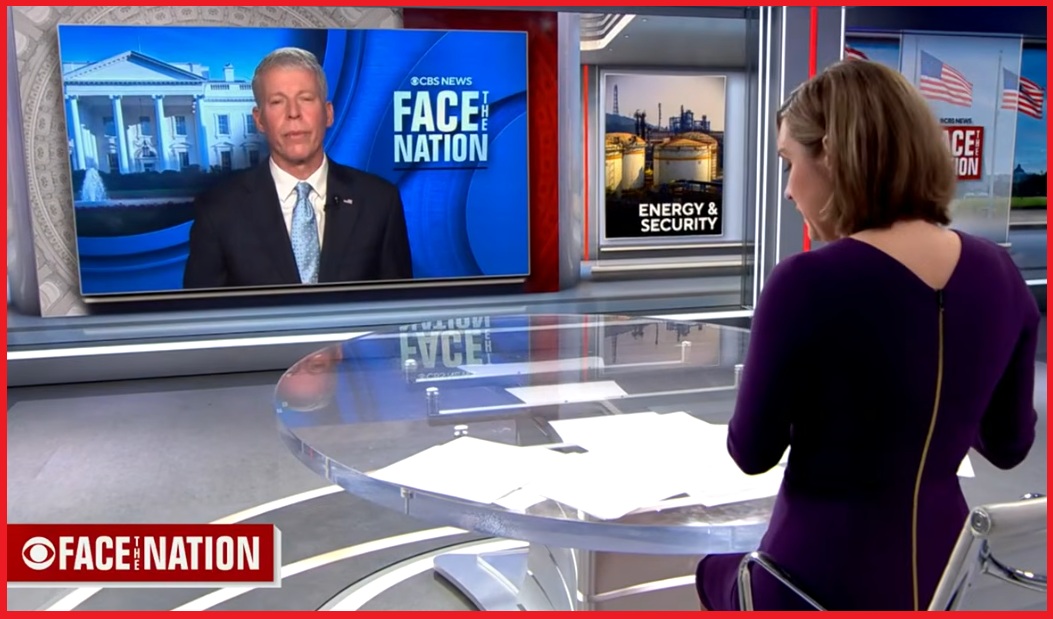
Sunday Talks – Energy Secretary Chris Wright Discusses Anticipated Timeline for Price Stability


Posted originally on CTH on March 8, 2026 | Sundance 

Energy Secretary Chris Wright appears on Face the Nation to push back against the narrative engineering of CBS’s Margaret Brennan.  The video and transcript are below.

[Transcript] – MARGARET BRENNAN: We turn now to Energy Secretary Chris Wright, who joins us this morning from Denver. Good morning to you.

SECRETARY OF ENERGY CHRIS WRIGHT: Thanks for having me Margaret.

MARGARET BRENNAN: So 50,000 U.S. troops deployed, six Americans that we know of so far killed in action, civilians stranded. We look at our polling, Mr. Secretary, and we see that this is an unpopular war among the majority of Americans. More than half of them, 56% disapprove. When you speak to energy executives about the scope and duration of American involvement, what do you tell them? How long?

SEC. WRIGHT: I tell them that for 47 years, Iran is warg- waged war against the United States, and they’ve- throughout that 47 years, they’ve tried to undermine the energy development and energy infrastructure of all their neighbors, as they’re doing right now, and it’s time to put it to an end. So yes, we have a, we have a temporary period of elevated energy prices, but it will not be long. In the worst case, this is weeks, this is not months, and it leads to a much better place. It leads to an Iran that’s defanged, that can’t threaten its neighbors, can’t threaten American soldiers and can’t continue to drive up energy prices by making a mess of the Middle East. They can move to commerce, not conflict.

MARGARET BRENNAN: Well, but you have the moment we are in right now, and as you know, gasoline prices up 14% in the past week. According to AAA, reports the national average is $3.45. We’ve seen oil prices spike. How high do you think oil and gas are going to go?

SEC. WRIGHT: They shouldn’t go much higher than they are here because the world is very well supplied with oil. There’s no energy shortage at all in the Western Hemisphere.

MARGARET BRENNAN: Right.

SEC. WRIGHT: The United States is a net exporter of oil, a large net exporter of natural gas. But refineries in Asia and Europe are seeing an interruption from the normal crude flows. But there is massive energy stores around the world. What you’re seeing is emotional reactions and fear that this is a long term war. This is not a long term war–

MARGARET BRENNAN: –But–

SEC. WRIGHT: –It’s a temporary movement.

MARGARET BRENNAN: Sorry, go ahead, temporary movement.

SEC. WRIGHT: No, I’m saying look, we’ve seen previous administration have done everything they could. They begged, bartered and bribed the Iranian government to stop its nefarious activity, stop its murderous behavior, and it simply hasn’t worked, and now, they’re, they’re expanding missile and drone program that are rapidly growing to protect their desire to build a nuclear weapon. We’re going to cross the threshold where we can’t put them back in the box. Now is the time to end their risk to America and the world.

MARGARET BRENNAN: But as you know, when I ask you about energy prices, this is not a supply problem. You said there’s plenty of supply. The head of the International Energy Agency said, lot of oil, logistics are the problem. It’s dislocation. It’s a serious problem. So what he’s referring to there is being able to actually move it around. I know you said there’s, there’s one vessel that’s gone through the Strait of Hormuz. 20 million barrels per day typically go through it. When do you get back to that level?

SEC. WRIGHT: Oh, I think it will be relatively soon. Of course, I don’t know exactly. All of our military assets right now are focused on ending Iran’s ability to kill their neighbors, threaten American soldiers and threaten ship traffic in the Strait of Hormuz, but that’s going swimmingly well. Their missile launches are down 90%, the drone launches are down over 80% I think in the relatively near term, you’re going to see their capacity so low that we’ll see more normal ship traffic return to the Strait of Hormuz.

MARGARET BRENNAN: So you don’t think Navy escorts of vessels are necessary?

SEC WRIGHT: They might be. They might be. The U.S. is here to do everything we can to keep world oil markets supplied. Yes, if they have some residual–

MARGARET BRENNAN: –When will you make that decision?

SEC. WRIGHT: We’re, we’re in engagement right now with people that want to get tankers moving out of the Gulf. And so, yes, there could be there- early tankers probably will involve some direct protection by the U.S. military, but most important is to defang their ability to threaten these ships.

MARGARET BRENNAN: So the president had said he was open to tapping the American stockpile of oil, the Strategic Petroleum Reserve, but I saw you on other networks this morning, kind of throwing cold water on the idea. You referred to it as depleted. Are you saying America doesn’t have adequate stockpiles?

SEC. WRIGHT: No. America still has over 400 million barrels of oil in our strategic petroleum reserve, and, of course, robust production. We’re, we’re, more than happy to use that if it’s needed. But as you said earlier, it’s a logistics issue. Where do they need oil? They need oil at refineries in Europe and in Asia. And that’s why we took a very pragmatic step. There’s over 100 million barrels of floating Russian crude waiting in line to deliver to China. That’s going to be sold, it’s going to be refined, but that could be one or two months from now. So in a pragmatic way, with no change in U.S. policy towards Russia, we told the Indians, bring that into your refineries. You know, if you, if you’re feeling a shortage of crude, prices are being bid up, draw down that Russian crude stocks that are sitting right offshore.

MARGARET BRENNAN: Yeah. So on that point, the U.S. has temporarily suspended some sanctions to make that Russian oil, you say was already going to be sold anyway, make it available. But doesn’t Russia still financially benefit from that? Why isn’t the U.S. seizing those Russian tankers if they are our adversary?

SEC. WRIGHT: Because right now, because right now, we’re worried about Iran and fixing a 47-year problem there, and we’re worried about American consumers. We want to stop the rise in–

MARGARET BRENNAN: –Russia was helping Iran–

SEC. WRIGHT: –gasoline and diesel prices. Well, there’s been rumors of that. We don’t know if that’s true or not. Certainly, they’ve gotten a strong message from us. But this is oil already on the ocean–

MARGARET BRENNAN: –These Iranian drones have Russian parts in them. The Russians have been buying Iranian drones. That is very well documented, and CBS has confirmed and reported that there was sharing of intelligence. Russia providing intel to target Americans. So how is Russia not part of this?

SEC. WRIGHT: Look, Russia, Russia is expert at causing trouble around the world, so I’m not saying they’re not. I’m saying I don’t- if they’re helping Iran, it’s not working very well, but we’re not helping Russia by just accelerating the sale of their oil to stop the rise of energy prices and keep European and Asian refineries in oil. We’re just doing pragmatic things to get through a short period that will bring in an era of even lower energy prices because a major energy producing region of the world, the Middle East, will no longer have a strong, powerful Iran that can threaten their neighbors, that can threaten the United States of America and was not far away from a nuclear bomb. That’s an–

MARGARET BRENNAN: –How much–

SEC. WRIGHT: –unacceptable scenario. That’s the risk to energy prices was not doing anything.

MARGARET BRENNAN: So when the Qataris say you could see $150 barrel in oil, that’s something America could stomach? President Trump wouldn’t say, I’m done with this war because I can’t stand the political pressure and the American people saying I don’t like what I’m paying at the pump?

SEC. WRIGHT: No, the president’s going to continue to stay focused on ending a 47-year conflict, stay focused on growing the global energy supply. This is actually part of that effort. It does involve a temporary impediment to energy production, but on the other side, it will allow much more energy production and much lower energy prices. But this is not a long term conflict. Most presidents have just thought, they’ll kick the can down the road. The risk is simply too great to kick that increasingly dangerous can down the road.

MARGARET BRENNAN: Yeah.

SEC. WRIGHT: President Trump’s bold leadership is enough’s enough. We’re going to put it to an end.

MARGARET BRENNAN: I want to ask you about Venezuela. The U.S. deposed Maduro. He’s sitting in a prison. Just this past week, though, we had the interior secretary visiting Venezuela and sitting across from Maduro’s Chief thug, Diosdado Cabello. This is someone who has a $25 million bounty on his head. He ran the prisons, he ran the militias. He was treated as a counterpart to an American official. Is this the same playbook the Trump administration is going to run in Iran, that you will deal with the same regime you’ve been telling me is terrible to deal with for 47 years?

SEC. WRIGHT: We don’t know what the regime will be in place at the, at the end of this conflict, but we do know that regime will not have a massive weapons arsenal, that that regime will no longer be a massive threat to Americans and to the Middle East and to global oil supplies. President Trump is using bold leadership. We can’t change the world at a blink of an eye, but we can steer it in massively positive directions, and yes, Venezuela is a great example of that. Crime in the nearby Trinidad and Tobago has plummeted already from our actions in Venezuela, and President Trump’s insistence that he’s going to work with that our neighbors to reduce drug trafficking in the Western Hemisphere. Leadership takes- involves risks, but if you want to drive improvement, you’ve got to be confident, you’ve got to have the right agenda, and you’ve got to have the courage to do it. This president does.

MARGARET BRENNAN: Energy Secretary Wright, thank you for your time this morning. Face the Nation will be back in a minute. Stay with us.

[END TRANSCRIPT]

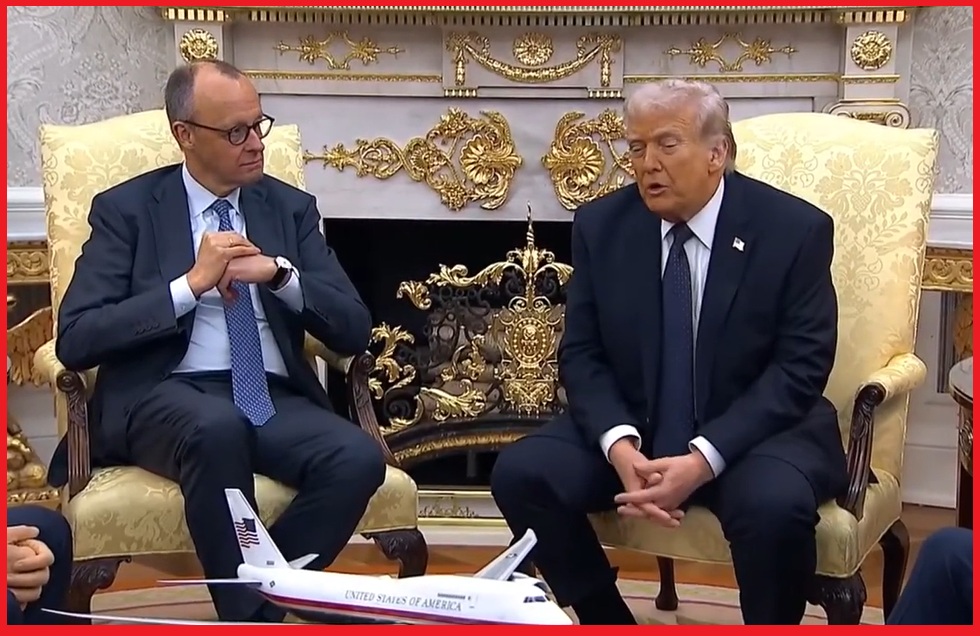
President Trump Announces U.S. Economic Boycott of Spain During Meeting with German Chancellor Friedrich Merz


Posted originally on CTH on March 3, 2026 | Sundance 

President Trump holds a bilateral meeting with German Chancellor Friedrich Merz in the Oval Office.  After brief remarks of mutual appreciation, President Trump and Chancellor Merz responded to questions from the assembled press pool.

Chancellor Merz expressed support for the objective of eliminating the regime threat from Iran.  President Trump notes at the beginning how Iran is targeting civilian targets in the region and generating even more support from the Gulf states for the USA.

When asked about the British and Spanish refusal to support U.S. military logistics and deployment, President Trump let the media be aware he is not happy with the position of Spain and the U.K.  President Trump also announced [11:00 of video] an economic embargo of trade with Spain as an outcome of their position.

.

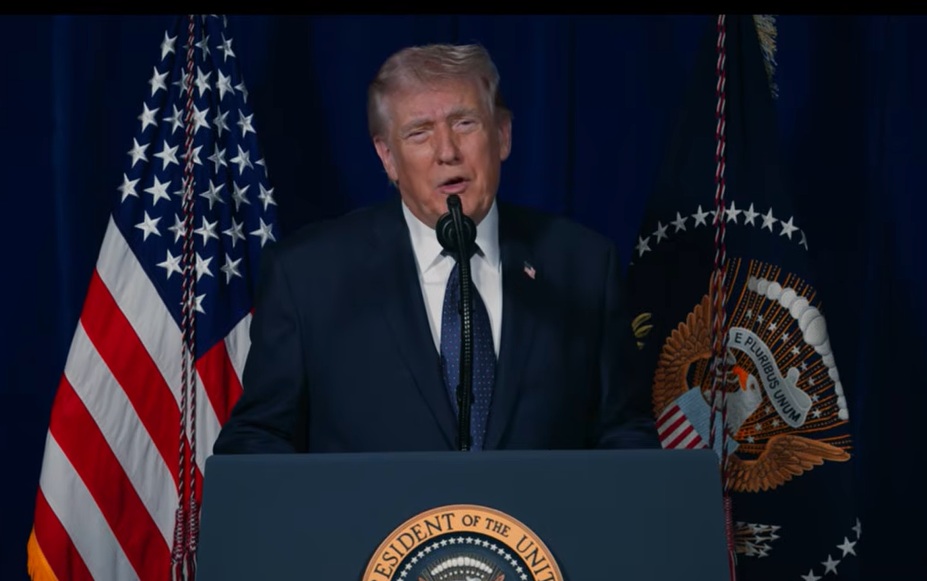
President Trump Delivers Updated Remarks About ‘Operation Epic Fury’


Posted originally on CTH on March 1, 2026 | Sundance 

President Trump makes remarks about the ongoing “Operation Epic Fury.”

.

Sunday Talks – Senator Tom Cotton Discusses U.S. Military Operation Against Iran – Video and Transcript


Posted originally on CTH on March 1, 2026 | Sundance 

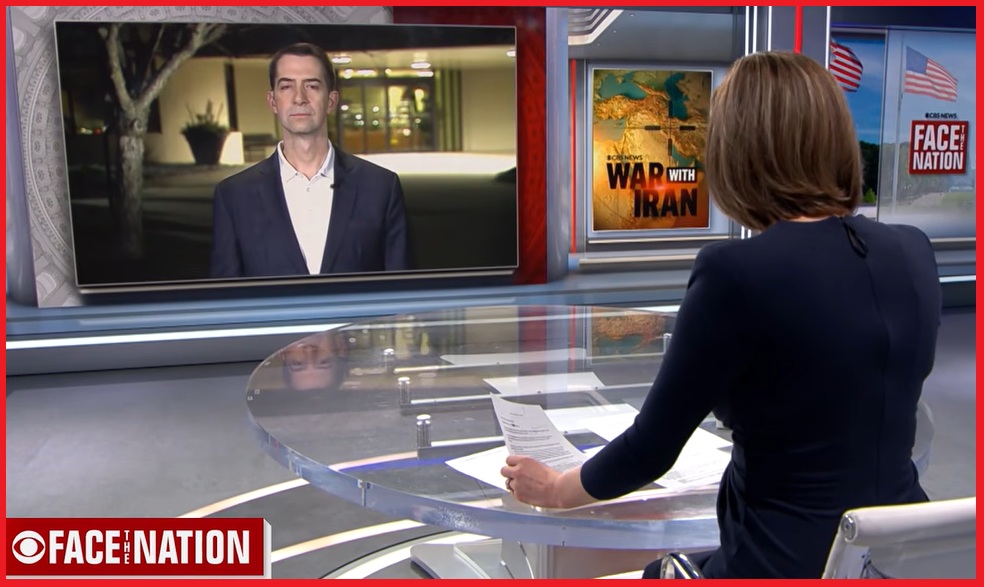
Senate Intelligence Committee Chairman Tom Cotton appears on CBS Face the Nation to discuss the ongoing U.S. military operation against Iran.  Video and Transcript Below

[TRANSCRIPT] – MARGARET BRENNAN: Imtiaz Tyab reporting from Muscat, Oman. We turn now to the chairman of the Senate Intelligence Committee, Arkansas Republican Tom Cotton, who joins us from Bentonville. Good morning to you, Senator.

SEN. TOM COTTON: Good morning, Margaret.

MARGARET BRENNAN: The President of the United States warned the American public that there could be casualties, American casualties. Does that mean the U.S. is putting boots on the ground?

SEN. COTTON: No, Margaret, the president has been clear that what we should expect to see is an extended air and naval campaign that’s designed not only to continue to set back Iran’s nuclear ambitions, but most importantly, to destroy its vast missile arsenal. Many more missiles than the United States and Israel have air defenses combined, as well as the missile launchers and its missile manufacturing capability. Now obviously one risk of that kind of campaign is that an aircraft could be shot down, and the president would never leave a pilot behind. So no doubt we have combat search and rescue assets in the region that are prepared to go in and extract any downed pilot. But barring that kind of unusual circumstance, Margaret, the president has no plan for any kind of large scale ground force inside of Iran.

MARGARET BRENNAN: The New York Times is reporting that it was the CIA that provided the intelligence in regard to the exact location of the Supreme Leader and then he was subsequently killed. You’re smiling as I say that. Are you confirming that it is true that it is the United States that pinpointed his location leading to his death?

SEN. COTTON: No, Margaret, I can’t confirm anything about the intelligence that the United States intelligence community collects. I can tell you that, of course, we have exquisite intelligence collection methods, that the location and the intentions of the Supreme Leader and the other Ayatollahs in Iran, or for that matter, the leaders of other adversaries around the world, is obviously one of the highest priorities of our intelligence community. But clearly, this operation is driven by intelligence collected by Israel and the United States that has once again proven that our nations have capabilities that no other nation on earth has.

MARGARET BRENNAN: Indeed. There are questions, though, about what happens next. Secretary of State Marco Rubio testified to Congress last month and was asked specifically, what happens if Iran’s regime fails. Take a listen.

[ON TAPE]

DATE: JANUARY 28, 2026 SECRETARY RUBIO: So I don’t think anyone can give you a simple answer as to what happens next in Iran if the Supreme Leader and the regime were to fall, other than the hope that there would be some ability to have somebody within their systems that you could work towards a similar transition.

[END TAPE]

MARGARET BRENNAN: That was a month ago. We’re seeing some succession planning happening inside Iran. Is this a managed regime change here, or is the United States betting on regime collapse?

SEN. COTTON: Well, Margaret, first, I want to stress what happens next in the days ahead and probably the weeks ahead. Iran does have a vast missile arsenal, and that’s going to be the prior- prior- priority objective for this military campaign. It is destroying that arsenal that threatened American troops from bases as far flung as the Indian Ocean to Western Europe, and making sure Iran can’t rebuild it–

[CROSSTALK]

MARGARET BRENNAN: –Many of those are being fired right now–

SEN. COTTON: –As far as the future- well, but we’re stopping a lot of them from being fired before Iran can fire them. It’s much easier to kill the archer on the ground than it is to shoot his arrows out of the sky. As far as the long term future of Iran’s government, Secretary Rubio is right, I don’t think anyone can give you a simple answer. There’s probably a lot of jockeying inside of Iran right now, they have a very consultative, deliberative process to replace the Supreme Leader. There’s a reason why he didn’t want to have a clear succession plan in place. It’s hard to do that when the United States is pummeling their leadership every moment of the day. I’m sure, though, that there are also some supreme- or there are also some leaders inside of Iran who might be jockeying to audition for the role of Iran’s Delcy Rodriguez.

MARGARET BRENNAN: Okay, but what you just described in terms of Delcy Rodriguez sounds like it is a managed transition, not regime change. Is that accurate?

SEN. COTTON: Margaret, again, as Secretary Rubio said, it’s not a simple answer–

MARGARET BRENNAN: –Right, but we’re in the middle of it now. So don’t you need an answer?

SEN. COTTON: –We’re going to continue to hit not just their military capabilities–

MARGARET BRENNAN: –At least an outcome, a goal?–

SEN. COTTON: –But we’re going to continue to hit their military capabilities, and we’re going to continue to hit their senior leadership, the ayatollahs, who have also been complicit in 47 years of heinous crimes, not only against Americans but against their own people. Again, there’s no simple answer for what’s going to come next. But as President Trump promised last month when the Iranian people were rising up against their own regime, help is on the way. Help has arrived.

MARGARET BRENNAN: Well, exactly. You’re talking about what comes next, but then you’re also telling me you don’t know what comes next. So do you believe that regime change is possible from air support alone? Has a leader of the opposition been identified? Is the opposition unified to deliver in a way that President Trump is calling on the people to do? Are we arming anyone to actually challenge the regime?

SEN. COTTON: Margaret, the opposition is 90 million Iranians who have suffered under the brutal Islamic Republic Revolutionary regime for the last 47 years.

MARGARET BRENNAN: Yes, and the president–

SEN. COTTON: –We’ve seen in recent months that there’s–

MARGARET BRENNAN: –called them to take over their government.

SEN. COTTON: And we would all celebrate if the Iranian people were able to rise up and reclaim their freedom and reclaim their destiny. And as the president said when he promised help is on the way, help has arrived. And that’s why you’ve already seen some protests out celebrating the death of the supreme leader, the man who has brutally repressed his own people for almost 40 years. Now, we can’t necessarily dictate what course that is going to take, but the help that the president promised is on the scene, and it’s going to continue to be on the scene for probably a few weeks, as we make sure that Iran’s military is no longer capable of threatening our own troops, our Arab friends in the region and Israel, and also repressing its own people.

MARGARET BRENNAN: This is a big gamble by the president. Before the strikes, according to CBS polling, 74% of Americans said that Trump would need approval from Congress for military action against Iran. He did not seek that. If this operation takes weeks, which is how you described it, do you believe the administration has effectively made its case to the American public to expect casualties to support this action?

SEN. COTTON: Margaret, I thought the president’s eight minute video yesterday was outstanding. It laid out Iran’s 47-year campaign of terror and revolutionary violence against the United States and our people and really, the civilized world. I’m sure the president will speak more in the coming days, will have briefings to Congress–

MARGARET BRENNAN: –47 years, he did not describe imminence or justify that in that video. Do you believe that the American public is owed something more than a Twitter video?

SEN. COTTON: Margaret, I think an eight minute address to the American people, whether the president posted on social media or whether it happens on your network, is in keeping with presidential custom of addressing the American people. Again, I’m sure that he’s going to be speaking more in coming days. The administration will be briefing Congress, and we’re going to have a vote in the Congress. The Democrats are forcing a vote–

MARGARET BRENNAN: –On the War Powers Act.

SEN. COTTON: I expect there’ll be overwhelming Republican support for our troops, for the, for our troops, and for the president’s decision to finally eliminate the threat of Iran. And I would invite Democrats in the Congress to join their Democratic colleagues like John Fetterman and Josh Gottheimer and Greg Landsman in supporting our troops, in finally putting America’s foot down against the Islamic Republic of Iran.

MARGARET BRENNAN: Senator Cotton, we appreciate you in your role in oversight of the Intelligence Committee, making the case for the administration. We have more questions, and we would love to put them to the administration as well. Thank you very much for your time this morning. Face the Nation will be back in one minute. Stay with us.

[End Transcript]