Producer Price Inflation Continues Surging at 11 Percent, Annualized Processed Food Increases Now 34.8 Percent


Posted originally on the conservative tree house on May 12, 2022 | Sundance

The “Producer Price Index” (PPI) is essentially the tracking of wholesale prices at three stages: Origination (commodity), Intermediate (processing), and then Final (to wholesale). Today, the Bureau of Labor and Statistics (BLS) released April price data [Available Here] showing another 11.0% increase year-over-year in Final Demand products at the wholesale level.

Last month when looking at internal economic activity that showed a contraction in consumer purchases of goods, we said pay attention to the service side of the ledger now.  Knowing people have stopped buying ‘stuff’, if people are starting to run out of money, they will cut back in the service sector (dining out, etc).

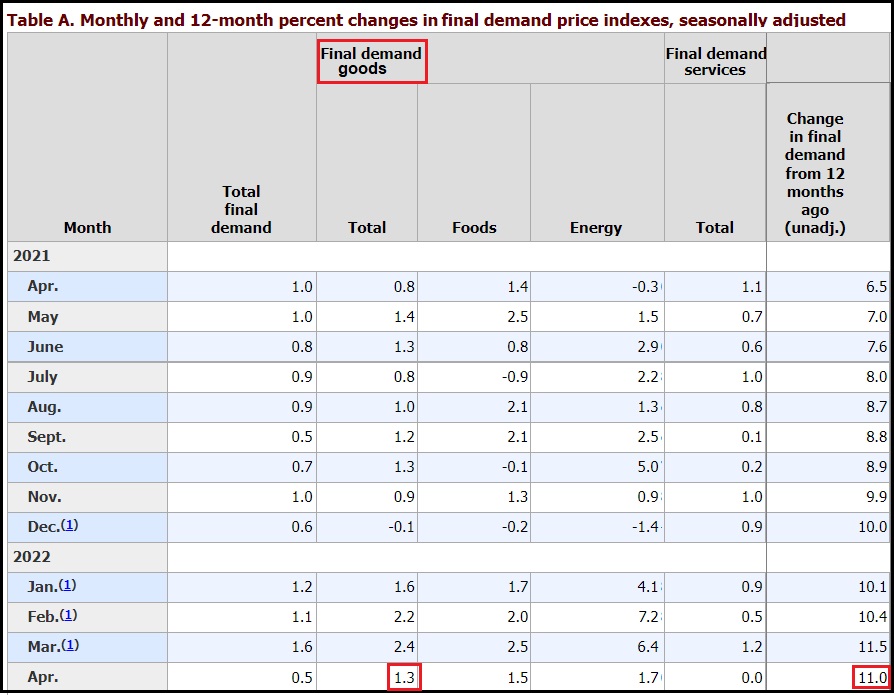
While the PPI focuses on prices, the PPI data for April shows exactly that service side contraction now taking place.  Wholesale inflation in goods is determined heavily by higher costs for raw materials and processing.  However, the rate of inflation within the service sector is more connected to what consumers can afford.   Modified Table-A, look at the April difference between goods (1.3%) and services (0.0%):
[Ex. The lawn company might pay 50% more for oil and gasoline (goods side), but they may not be able to increase the rate they charge you by 50% to mow the grass (service side).]

The major current production inflation in both goods and services is directly connected to the cost of energy.  Energy prices are embedded in every sector of the economy.  For “goods” higher electricity, heating/cooling and petroleum costs (packaging, materials, transportation, etc) are unavoidable and passed on to consumers. For “services,” individuals and companies raise their prices to compensate for increases in their own costs.  It is a cumulative inflation snowball.

In April the Total PPI of 0.5% was influenced by downward price pressure from the service side.   The price of final demand (wholesale) goods increased 1.3%.  The price of final demand (wholesale) services was 0.0%.  [Note: Wholesale trade services dropped by 0.5%]

Normally I would clean up TABLE-A “intermediate demand goods both processed and unprocessed.” However, in this month the entire field of data tells a very compelling story.
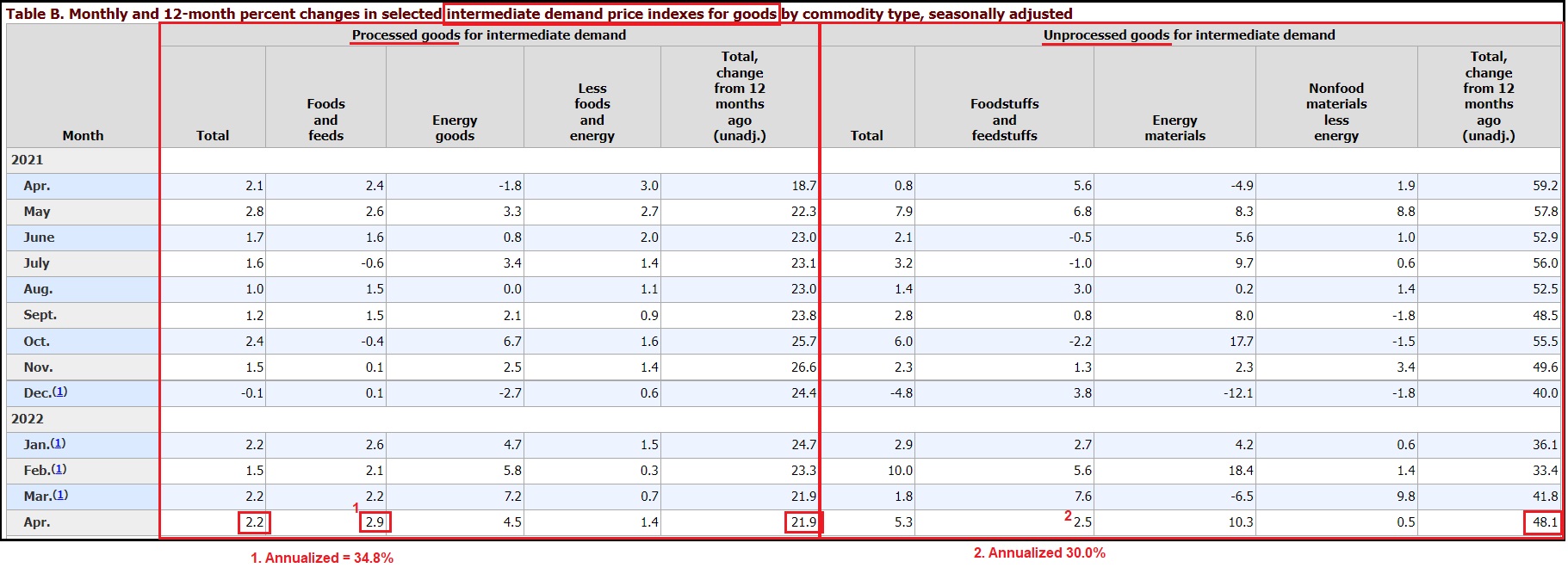
Note that Intermediate Demand Processed foodstuff prices grew at 2.9% in April.  Annualized that is a 34.8% increase in price.  This is the scale of future price increases we are likely to see at the supermarket.   That 35% rate of inflation for center store products is exactly what CTH predicted for the third wave of price increases.

The Intermediate Demand Unprocessed foodstuffs, increased in price by 2.5% in April, those foodstuffs are entering the wholesale market at a 30.0% annualized rate of inflation vs last year.

As an analogy, think of the difference between processed foodstuffs (center store and dairy) and unprocessed foodstuffs (fresh produce, meats) as you would normally think about them in the supermarket.   As you can see the processed product rate of inflation (34.8%) is higher than the non-processed (30.0%).  The difference is the additional costs associated with processing as a major result of energy prices.

What the producer price index at the wholesale level is telling us, is that inflation on consumable goods is still not yet at the apex.   For durable goods the prices are less volatile, but price pressures are still in the upward direction. The price of gasoline and transportation overall will be a big factor in current prices of highly consumable goods.   We cannot and will not start to climb out of the inflation spiral on goods until we see oil, gas and energy prices stabilize first.

On the service side, inflation is going to be determined by how long businesses and operators can continue operations without raising prices.  How long can a restaurant pay 30-to-35% more for their supplies, before those price increases need to show up on the menu?

Joe Biden sucks.

(WASHINGTON) – […] The producer price data captures inflation at an earlier stage of production and can sometimes signal where consumer prices are headed. It also feeds into the Federal Reserve’s preferred measure of inflation, the personal consumption expenditures price index.

Thursday’s figures came just a day after the government released consumer price data for April, which showed that inflation leapt 8.3% last month from a year ago. That increase is down slightly from the four-decade high in March of 8.5%. On a monthly basis, inflation rose 0.3% in April from March, the smallest increase in eight months.

Still, there were plenty of signs in the consumer price report that inflation will remain stubbornly high, likely for the rest of this year and into 2023. Rents rose faster as many apartment buildings have lifted monthly payments for new tenants. Prices for airline tickets jumped by the most on records dating to 1963. And food prices continued to rise sharply.

The Federal Reserve has stepped up its fight against rampant price increases, lifting its benchmark short-term interest rate by a half-point last week to a range of 0.75% and 1%. That increase is double its usual quarter-point hike. (read more)
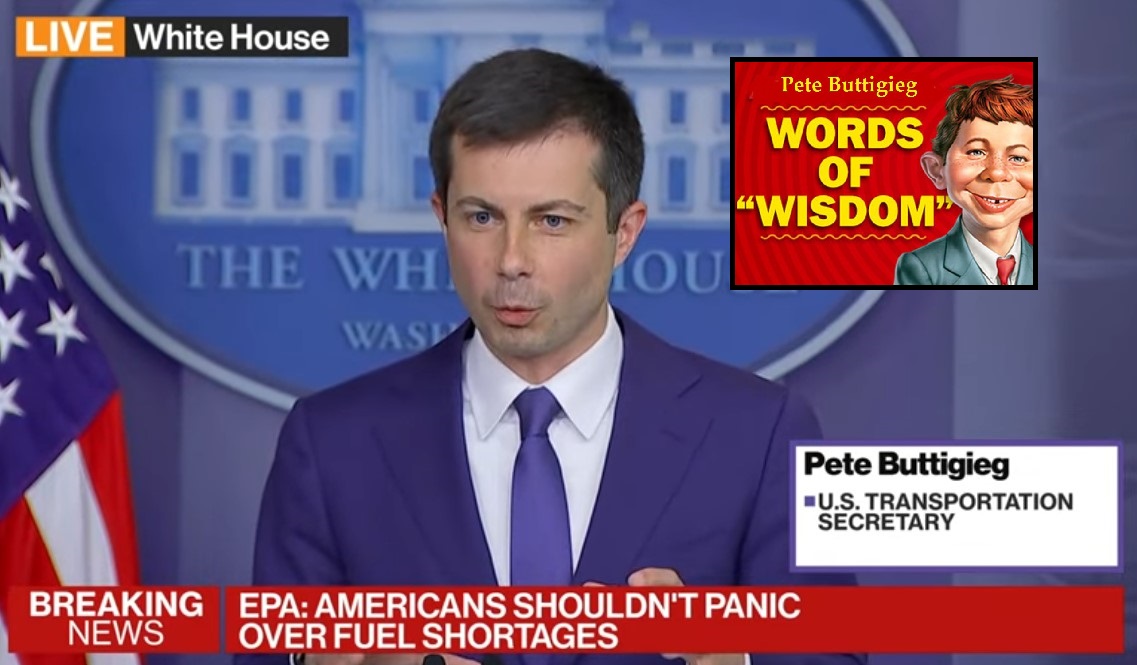
Diesel Fuel Shortage Sets Stage for Next Biden Created Crisis


Posted originally on the conservative tree house on May 12, 2022 | Sundance

It has often been said that if you chase the global climate change ideology to its natural conclusion, we end up in communal groups sitting around a tepid campfire eating some form of sustainable algae cakes and picking parasites off each other…  Prior to Joe Biden that prediction might have seemed like hyperbole. Now, not so much.

Indeed, the Green New Deal energy policy of Joe Biden creates massive downstream consequences.  Unfortunately, the White House doesn’t seem to care. The high prices and scarcity of critical goods are a feature, not a flaw, as they chase their climate friendly Build Back Better agenda.

Following the continuum of intended consequence, now we have diesel fuel shortages beginning to hit the U.S. economy; and with scarcity comes higher prices of an almost astronomical scale. “The national average price of diesel is now $5.54 per gallon, which is an increase of 22 cents from last week, which was when the most recent record was set. Data shows there’s no state that’s currently seeing diesel prices below $5.12 per gallon.” (LINK)

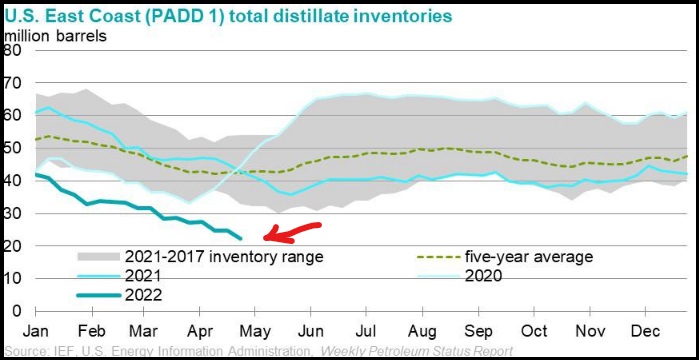
Making matters even worse is a drop in available inventory of diesel fuel which is about to become a crisis for the east coast of the U.S.  Some Truck Stop operators like Love’s and Pilot are already warning their big rig customers they may not have fuel for truckers.

[…] “Love’s is monitoring the fluid situation on the East Coast, we have experienced minimal outages during low traffic hours,” Oklahoma-based Love’s Travel Stops said in an emailed statement. “The company has no plans to restrict purchases of diesel.”

[…] Earlier on Wednesday, the U.S. government’s Energy Information Administration said total inventories of distillates, which is mainly diesel fuel but also heating oil, fell last week to a 17-year low of 104 million barrels, which is 23% below normal.

On the East Coast, the situation is even worse. The EIA said distillate fuel oil inventories in the so-called PADD 1 district that covers the Northeastern states fell by 1.1 million barrels last week to just 21 million barrels, the lowest ever recorded in data going back to 1990.

Love’s truck stops, with some 550 locations across 41 states, also seemed to confirm reports on social media Wednesday that said Love’s and other truck stops such as Pilot were informing their fleet operators that shortages of diesel fuel on the East Coast may happen in the coming week at some stores. (read more)

Not only is the logistics of transportation contingent upon the use of diesel fuel for tractor trailer deliveries of essential goods, the other big users of diesel fuel are also farmers.

If it wasn’t challenging enough to triple the price farmers are paying for fertilizer this year, now the costs to operate the equipment they depend on has just doubled with the increases in diesel fuel.

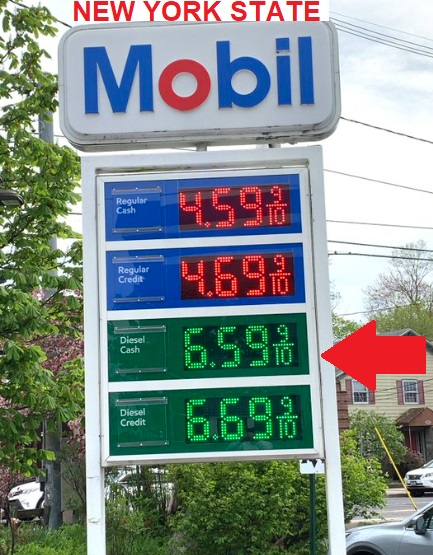
Some farmers are now even reporting farm diesel prices are higher than on-road diesel, which is typically not the case. … Certain areas of the country have seen shortages already and we expect that to continue. Supplies at New York Harbor–a hub for diesel distribution–are at a 30-year low,” says Meyer. “As such, the East Coast of the U.S. has been hit especially hard, resulting in diesel prices above $6.00 per gallon in that area.  (more)

ENERGY POLICY:

♦ West Coast ports that cannot handle container off-loads due to emission regulations.

♦ Nationwide fertilizer shortages and high prices.

♦ Massive increases in gasoline and diesel fuel costs.

♦ Limited shoreline refinery capacity due to federal regulations.

♦ Stunning increases in food costs at the grocery store.

… And what does the administration do against this backdrop?

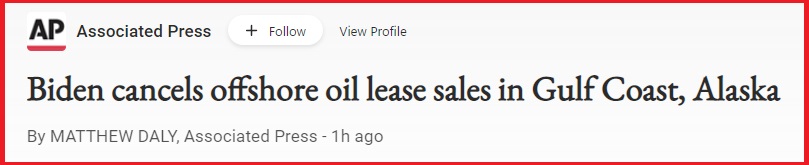
WASHINGTON (AP) — The Biden administration says it is canceling three oil and gas lease sales scheduled in the Gulf of Mexico and off the coast of Alaska, removing millions of acres from possible drilling as U.S. gas prices reach record highs.

The Interior Department announced the decision Wednesday night, citing a lack of industry interest in drilling off the Alaska coast and “conflicting court rulings” that have complicated drilling efforts in the Gulf of Mexico, where the bulk of U.S. offshore drilling takes place.

The decision likely means the Biden administration will not hold a lease sale for offshore drilling this year and comes as Interior appears set to let a mandatory five-year plan for offshore drilling expire next month.

[…] A federal appeals court in New Orleans, meanwhile, is considering a challenge to a moratorium on new federal leasing that Biden imposed soon after taking office in January 2021. Biden said the administration needed to consider the effect of new drilling on climate change and conduct proper environmental reviews.

Louisiana and 12 other states challenged Biden’s order, saying laws passed in response to the 1970s oil crisis require lease sales on federal lands and waters.

The Biden administration failed to “grapple with prior analyses” of the planned sales to give a valid reason for postponing or canceling them, Louisiana Deputy Solicitor General Joseph Scott St. John told a 5th U.S. Circuit Court of Appeals panel this week.  The three-judge panel did not indicate when they will rule. (read more)

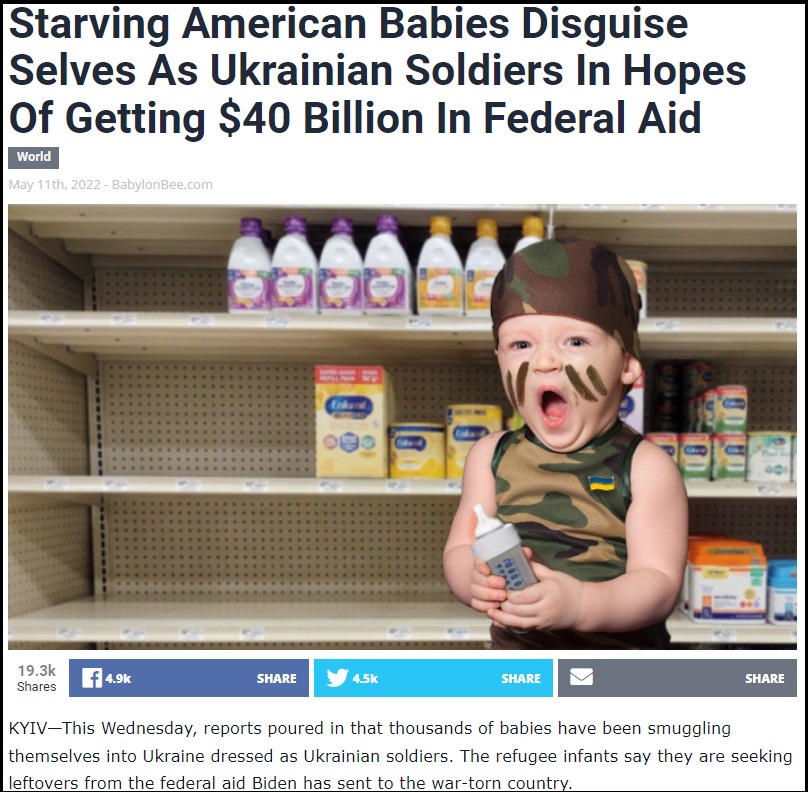
Brilliant Satire Contrasts National Priorities of Joe Biden


Posted originally on the conservative tree house on May 12, 2022 | Sundance

When the satire hits the central nerve of accuracy….

(READ HERE)

FBI Whistleblower Biden Attacking Free Speech


Armstrong Economics Blog/Corruption Re-Posted May 11, 2022 by Martin Armstrong

Biden Starts Shouting at Union Audience About Desperate Hungry Families and Boxes of Food


Posted originally on the conservative tree house on May 11, 2022 | Sundance

Joe Biden was in Chicago today attending the International Brotherhood of Electrical Workers conference.   As he delivered his remarks about the U.S. economy, the installed occupant of the White House started yelling about food boxes and desperate hungry Americans.  WATCH (40 secs):

Perhaps someone should tell Joe Biden that he’s in charge of the economy he is complaining about.  The failures he speaks of are happening under his stewardship.

I know it seems odd, but Joe Biden did this yesterday when he promised in his inflation speech that if people supported Joe Biden as president, Joe Biden would fix the inflation problems Joe Biden created last year.  It all seems rather odd.  And now he’s just yelling about it.

Precarious Leftist Tells Democrat Caucus Grocery Prices are Hurting Americans, Colleagues Respond “We’re Not Seeing it in the Polls”


Posted originally on the conservative tree house on May 11, 2022 | Sundance 

I’ve been pondering this disconnect for several weeks as the messaging from inside the beltway, including their expressed priorities, seem even more disconnected than before.  The DC bubble has always been present; however, lately the disconnect is even more profound.

Perhaps the increased distance in priorities can be explained by federal politicians cancelling townhall meetings and constituent engagement due to the pandemic. Perhaps politicians are holding party positions disconnected from the population they are supposed to represent because they have spent two years physically distancing from the voters.  Whatever the cause, the disconnect is now more severe.

The contrast is even more significant when it comes to the far-left politicians, because they travel amid a very closed communal tribe where outside opinions are considered toxic to their sense of identity.  The term “safe spaces” was literally coined because leftists cannot handle differences of opinion.

The professional leftist arguments are generally flawed, illogical, antithetical to common values and historically weak.  As an outcome their advocate policy positions are weak and easy to deconstruct when challenged.  To avoid being challenged they rarely hold open discussions with constituents in their districts without extreme vetting measures to avoid confrontation.

Regardless of root cause, most Democrats are severely disconnected from the economic reality of their district citizens.  This is evidenced in a Politico report today discussing the example of Democrat House member Katie Porter of California.

As the article notes, Ms. Porter told the House Democrat Caucus of her experience in the ‘real world’ with people who are grocery shopping.  The perplexed Democrats sat quietly listening to the stories of how price increases for food and gasoline are seriously hurting something called ‘working-class‘ people.

The ideological Democrat caucus was stunned to hear of these stories from a place called Main Street USA, where people go shopping for food and stuff.

However, Ms Porter is optimistic that for the first time since she has been in office, the House Democrats could now have an understanding of how rising energy prices, increasing gasoline prices and major jumps in food prices might be a problem for Americans who do not live in DC.

(Politico) […] Only after Rep. Katie Porter put bacon in her cart at her local grocery store recently did she notice that its price had spiked to $9.99 a pound. Reluctantly, she put the package back.

It was a dose of reality that Porter, a California progressive and single mother of three, has long understood. But she’s not sure all of her Democratic colleagues share her interest in connecting to average Americans’ experiences outside the Beltway.

When Porter gave an emotional speech about how inflation has been hitting her family for months during a private House Democratic Caucus meeting last week, she said it seemed like the first time the personal toll of high consumer prices had sunk in for some lawmakers in the room.

“Too often, Congress recognizes issues too late,” Porter, a top GOP target this fall in a swing district, said in an interview. “I had a colleague mention to me, ‘We’re not seeing it in the polls’ … Well, you don’t know what to ask.”

For Porter, the episode revealed how much work Democrats still need to do to assure voters they understand everyday anxieties, particularly inflation’s strain on family budgets. She’s not alone: Some Democrats have warned for months their party is falling short when it comes to communicating to an increasingly exasperated public. (read more)

Joe Biden Labels Donald Trump “The Great MAGA King”


Posted originally on the conservative tree house on May 11, 2022

During a speech filled with obfuscation, nonsense and economic doublespeak, Joe Biden turned to discuss the federal deficit.  During his remarks in Chicago Biden called President Donald J Trump “The Great MAGA King,” as if that would be a bad thing… lol.  WATCH:

We’ve gone from Deplorable, to MAGA, to Ultra MAGA and now The GREAT MAGA.

We shall celebrate our latest elevation with the dance of The Great MAGA King below:

.

Senate Democrat Effort to Create Massive Expansion of Abortion via Federal Law Fails by 11 Votes


Posted originally on the conservative tree house on May 11, 2022 | Sundance

Senate Democrats wanted to manufacture a political optic using the hot button issue of abortion.  The senate pushed a bill for a massive expansion of abortion, far beyond Roe -v- Wade, to the floor.  However, the bill needed 60 votes to pass cloture, end debate.

Embarrassingly, and in a pure political stunt, Senate Majority Leader Chuck Schumer summoned Kamala Harris to the upper chamber in the event she was needed for a “tie-breaking” vote.  However, cloture requires 60 votes, not 50, so the optics of Harris only highlighted the insufferable politics.

The cloture vote failed 49-51, far short of the 60 votes needed to end debate and attempt to pass the bill.  Democrat Senator Joe Manchin voted with republicans to block the cloture effort.  The federal abortion legislation now disappears back into the filing cabinet from which it came.

WASHINGTON – […] In a 49-51 vote, the Senate rejected the Democratic legislation, with Sen. Joe Manchin (D-W.Va.) and all Republicans voting against the measure. While the outcome was no surprise and mirrored a similar vote on abortion protections the Senate took in February, Majority Leader Chuck Schumer suggested the court’s draft opinion, published by POLITICO last week, had raised the stakes.

“Today’s vote is one of the most consequential we will take in decades because for the first time in 50 years, a conservative majority, an extreme majority on the Supreme Court, is on the brink of declaring that women do not have freedom over their own bodies,” Schumer said in a floor speech Wednesday morning, adding that the decision “will live in infamy.” (read more)

According to Manchin’s earlier statement, “Democrats are “trying to make people believe that this is the same thing as codifying Roe v. Wade. And I want you to know, it’s not,” he argued, referring to the bill’s ban on some state restrictions on the procedure currently allowed. “This is not the same. It expands abortion.”

Kamala Harris has a sad moment in the Senate, created by Chuck Schumer {Direct Rumble LinkWATCH:

Interesting, Joe Manchin Questions DIA Berrier and DNI Haines About Whether Ukraine Can Win, DIA Confirms We are in a Proxy War With Russia


Posted originally on the conservative tree house on May 11, 2022 | Sundance

The next Democrat and Lincoln Project presidential candidate for ¹2024, Joe Manchin, questions Defense Intel Agency (DIA) Director Lt. Gen. Scott Berrier and Director of National Intelligence (DNI) Avril Haines about whether Ukraine can actually win the current war with Russia.  It’s an interesting exchange because none of the DeceptiCon senators will usually approach the issue.

Lt General Scott Berrier (DIA) says [00:56], “that is a difficult predication to make. I think where the [DIA assessment] is at is a prolonged stalemate should no factor change on either side. In other words, the Russians continue to do what they’re doing, and we continue to do what we are doing for the Ukranians.”  Read that emphasis carefully.

What Berrier is saying is affirming we are in a direct proxy war.  So long as the United States remains the essential fighting force behind the Ukrainian military, they can achieve a stalemate.  However, if the United States withdraws support, Russia will win.  DIA Berrier is saying directly the U.S. can only achieve a stalemate in Ukraine.  WATCH:

.

Manchin was not being misogynistic in not asking Haines that question.  Remember, the ODNI is only supposed to be faced internally into the United States security and intelligence operations.  ODNI Avril Haines is a political operative from the Obama administration, specifically implanted into the Office of the Director of National Intelligence, because that specific element of the intelligence apparatus only looks inward into the U.S. citizenry for threats against government.

Please emphasize this point when needed.  The ODNI does not evaluate national security issues abroad. The Patriot Act created the ODNI to set up a threat radar that only looks internally.  We The People are the threat the office of the ODNI was created to evaluate.  Emphasize that as needed.

¹If the mid-term 2022 ends up being a wipe out for the leftist communists in the Biden administration, Joe Manchin will be their 2024 candidate.

BLS Data 8.3 Percent, Inflation Not Falling Despite Demand Side Moderation, Boosted by Continued Production Inflation


Posted originally on the conservative tree house on May 11, 2022 | Sundance 

The Bureau of Labor Statistics (BLS) released the inflation data from April today [DATA HERE] showing 0.3% increased inflation in April and a continued 8.3% ‘sticky’ inflation year-over-year.

CTH is going to say something slightly unusual, this data is actually worse than expected.   The hidden canary in the mine is within this BLS sentence which shows in the statistics, “the index for gasoline fell 6.1 percent over the month, offsetting increases in the indexes for natural gas and electricity.”  Remember, these are backwards reflections of price captured in early/mid-April.

The actual price of gasoline dropped 1% in April during the timeframe captured.  Yes, there was an actual 18 days in April when gasoline prices moderated and slightly ticked down; however, those prices immediately jumped again late April through today.

Because the BLS puts a 5x weight on the importance of gas [Table A], the 1% temporary drop in gasoline led to 6.1% downward “seasonally adjusted” price pressure.

All of that said, and with the heavy weighting of the gasoline prices considered, the net inflation results barely moved from March (8.5%) to April (8.3%). I modified Table-A to take out the noise.  You can see the downward pressure from gasoline and simultaneously the upward price pressure from food, specifically food at home.

This outcome is a reflection of what we have been seeing in the supermarkets and grocery stores.

The Joe Biden $1.9 trillion COVID spending package that created $1,400 checks for all Americans, was passed in March 2021.  That massive infusion of cash took place in April of 2021.  We are just now cycling through the year-over-year comparisons when that artificial economic stimulus took place.

The 2021 demand side inflation took off immediately after that massive spending spree.  It was May, June and July of 2021 when the cash infusion and $1,400 checks drove demand side inflation.  Starting next month, we cycle through that period in year-over-year comparisons.

As we have noted for a few months and has been quantified in the drop of overall first quarter GDP, the demand inflation is over.  Most of the current inflation is being driven by producer price inflation, the cost to make and produce things.

The demand for goods and services is low (stagnant), but the prices to create goods and the costs of services remains high (inflation).  Put those two dynamics together and you have “stagflation,” our current economic status.

The production inflation is directly connected to the cost of energy.  Energy prices are embedded in every sector of the economy.  Higher electricity, heating/cooling and petroleum costs (packaging, materials, transportation, etc) are unavoidable and passed on to consumers.  Individuals and companies who provide services raise their prices to compensate for increases in their own costs.  It is a cumulative inflation snowball.

I modified Table 1 to take out the noise (see below).  You can see how production inflation continues to be the problem, even as the demand for the products and services declines.  You can also see the weighting factor for gasoline overall and how it skews the overall inflation data.

Year-over-year inflation will statistically begin to give the appearance of moderation, once the June (’21) to June (’22) comparison cycle arrives.  The Fed and White House will use the intentionally timed statistical outcome to claim inflation is diminishing.  It’s a political trick we expected.

The key to remember is that western government debt incurred during COVID-19 is the problem.  The debt incurred is unsustainable, and that debt burden can only be reduced by devaluing the currency.  Inflation is the devaluing of currency that makes the debt manageable.  Dollars that are worth less also make the dollar-based debt worth less.

From the position of the government inflation is good, it makes the debt burden less heavy.  Unfortunately, that same inflation makes our money worth less, and our wages are chewed up by higher prices. Wages are destroyed by the increased prices the prior spending created.

• Inflation on durable goods is now at/near the apex.  The durable goods price flatlines right now as all production costs are embedded in the cost of the product.  The prices of finished goods are now set; inflation has caught up to production; the prices of on-shelf and inbound deliveries are higher, but stable.  Production inflation is built in, prices will not drop.  However, depending on origination, transportation costs may still increase the end price of finished goods as they transfer to the consumer market.

Now, we enter the phase where consumer demand becomes the dominant factor in price.  Simultaneously, demand is contracting because the higher rate of inflation in highly consumable goods (energy, utility costs, housing, gasoline, food) is now a spending priority for consumers and eating a larger portion of wages.   As a result, the price of durable goods is now dependent on the ability of the consumer to pay for them.

Sellers of durable goods are going to be chasing a smaller customer base who can afford the higher prices.  Durable goods prices will remain static, and now durable goods prices will likely become part of the competitive equation.  The businesses within the durable goods sector are going to have to find customers in order to stay in business.  Incentives will show up this summer as businesses need customers.   If you are a wise, careful and smart shopper for durable goods you will find some modest deals.

• Inflation on consumable goods is not yet at the apex.  It’s likely close to production parity, but price pressures are still volatile in the upward direction. The price of gasoline and transportation overall will be a big factor in current prices of highly consumable goods.  We should see oil, gas and energy prices stabilize first.

Rents will likely increase for another three to six months, then stabilize (and, in my opinion start to fall).

Housing overall is far more challenging as mortgage rates are climbing.  Refinancing as a method to bridge the income gap between wages and expenses is a big problem now in this phase.  There is going to be a period of massive fluctuations and instability in the housing market depending on region and employment stability as the recession phase of the total economy is going to bite hard.

For most regions with mixed blend underlying economies (products and services) macro housing prices have peaked.  For ordinary housing purchases, not institutional investments, we should start to see price decreases again as the customer base for higher prices shrink.  Obviously, this is driven by inventory and regional specifics; however, I am talking in the aggregate within the macro housing situation.

Food prices still have some upward pressures through Memorial Day.  Then a period of stability will settle, before the third wave of food inflation hits later in the summer/fall of this year; that’s when the increases in farming costs will reach the fork.

Late summer and fall food prices will likely be 15 to 20 percent higher than current prices at the supermarket.  The fresh foods will be on the upper side of the future price wave, and the processed foods on the lower end; however, both will increase.

The last factors in the food price are far more challenging to predict….  Supply?   Any problems within the food production cycle that impacts supply will drive prices, beyond what we already expect.  If there are major shortages, the prices will go even higher.

This food environment is unfortunately the best time for Big Agriculture, the Wall Street multinationals, to make the most profit.  The Big Ag multinationals will exploit every possible angle within inventory, supply and harvest controls to maximize their profit equation.

There are a great deal of unknown global variables right now that could impact U.S. food prices later this year.  The only certainty is that prices will further increase.

Joe Biden sucks.