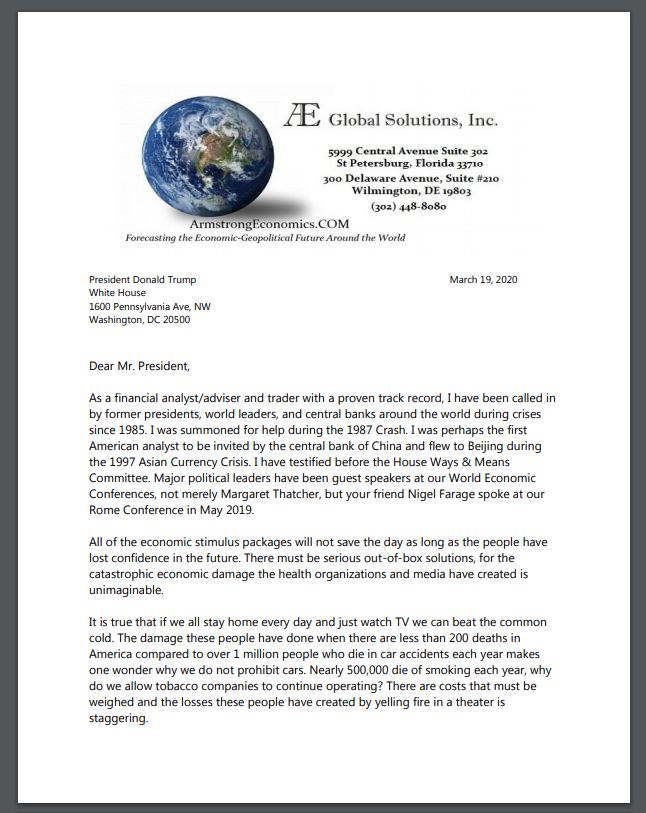
Trump Can Circumvent the Democrats on some Issues


COMMENT: Good onya Martin!,
President Trump also made reference to needing to be careful “not to make the cure worse than the disease”-also a suggestion you made in your letter!
People in my condo association here in Fort Myers are way more critical than I expected-I meet them walking in the mornings. The condo association just decided to close our pools and gym this afternoon without consulting anybody who lives here.

My bank now allows only “Drive-through service”…the lady at the bank was spraying the bank notes last Friday when I went there-I kid you not.

FC

REPLY: People have no idea the amount of damage this is causing. This letter is circulating around many governments right now. I believe it will even be discussed this morning in Britain behind closed doors. There is another agenda which has been playing out.

Pelosi’s demands are outrageous and are intended to prevent Trump from responding to the crisis. He has presidential powers under executive orders to take action without the Democrats approval. Trump was able to cancel the loans because of a 2008 amendment to the Higher Education Act aimed at forgiving the debt of severely injured veterans. Such veterans who are unable to work are sent an application they can fill out to have their debts erased.

I believe under the Higher Education Act the president could erase the balances of all direct federal loans, which are the ones held by the government itself, and which account for about 70% of student loans in the U.S. There is a provision in there that my reading would allow the Secretary to develop anti-fraud safeguards and thus can fight back and void all student loans where the student has been unable to find employment in the field of their degree. This would circumvent the Democrats on the Student Loans, who demand everyone gets $30,000 off. I would forgive all loans where they have been unable to find employment in the field of their degree. Force reform in education. I will prepare the solution for Social Security tonight. It was the Democrats who sold-out the student to the bankers making their student loans non-dischargeable in bankruptcy.

If the Democrats refuse to sign the bill, they Trump should announce all businesses are to reopen immediately and increase the hospital bed space

Did Trump Get The Letter?


COMMENT: Marty, Trump read your letter. He is adopting a lot of that from the student loans but most telling is he used your analogy that more people die in car crashes but we do not outlaw cars.

Fantastic Job;

WK

REPLY: I believe the letter has made it also around Congress and is circulating in the British Parliament. I want to thank everyone for helping. I will do another regarding Social Security. Now is the time when we just may be able to push back.

New Yorkers Flood Florida – Governor DeSantis Writes Executive Order Requiring 14 Day Self-Quarantine…


Approximately 20,000 to 40,000 New Yorkers are currently arriving in Florida daily as they flee from the epicenter of the most explosive coronavirus outbreak.   However, if the elderly are the most vulnerable; and if isolating the most vulnerable population is the best course of action; and with the largest population of older residents living in Florida; then why are New Yorkers allowed to travel to Florida?

According to data released by Governor DeSantis: Monday saw 190 direct flights from the New York City area into various Florida airports. If 150-200 people average per flight, that’s 28,500 to 38,000 New York metropolitan area residents arriving in Florida today.

In an attempt to mitigate the inbound infection spread, today Florida Governor Ron DeSantis signed an executive order requiring all arriving New York and New Jersey residents to be screened upon arrival and self-quarantine immediately after arriving in the state.   Not sure how policing compliance is possible.

TALLAHASSEE, Fla. (AP) — Florida Gov. Ron DeSantis said Monday he is issuing an executive order mandating that anyone arriving on a flight from New York City and the surrounding area submit to self-quarantine for two weeks as he tries to avoid issuing a statewide shutdown similar to other states.

DeSantis said in an address from his Tallahassee office that more than 100 such flights arrive daily in Florida and he believes each contains at least one person infected with the new coronavirus.

He said he has been in contact with federal officials about curtailing such flights, but has not yet received a response. He said arriving passengers will be screened by health officials and law enforcement and told they must self-quarantine. He said those travelers will not be allowed to stay with family or friends, because that is one way the virus is spread. (read more)

.

Big Picture – President Trump Signs Executive Order Targeting: Hoarding, Price Gouging and Supply Chain…


To understand the purpose and specific need of the latest Executive Order CTH can share a familiar analogy to help better conceptualize the issues.

There are several supply chains that are being affected by the coronavirus mitigation effort; two specific sectors involve healthcare products and food distribution. Today’s executive order targets both.

As a network of U.S. manufacturing continues to increase the production of healthcare products, masks, shields, ventilators and medicines; any hoarding or pricing opportunism around those items is obviously a matter of great interest for overall public health.

Breaking911@Breaking911

AG BARR: “If you have a big supply of toilet paper in your house, this is not something you have to worry about.

But if you are sitting on a warehouse with masks, surgical masks, you will be hearing a knock on your door.”

Embedded video

1,246 people are talking about this

However, as time continues to expand, the impacts on another critical sector actually start to worsen…. Most people have no idea the complexity of the field-to-fork supply chain.

Imagine a country where the internal economy was based on two modes of transit, built out over two generations.  Fifty percent of all transit in cars, and fifty percent of all transit on motorcycles…. time progresses, generations grow and live, and all known and familiar transportation is based on these two complementary methods; equally distributed, cars and motorcycles.

Over decades the national infrastructure is based on this accepted transit system.  There are two independent origination manufacturing systems, each supplying 50 percent of the end user products.

There are ancillary economic systems each based on a service to either car owners, or motorcycle owners.   No-one ever thinks about it, and life is just occurring as usual.

At the top of the economy input there is fuel.  50% of the public use fuel for their cars and 50% of the public use fuel for their motorcycles; each is using the same input, the same fuel.  Again, no-one ever thinks about it.

150 million people prefer cars and 150 million people prefer motorcycles… it’s an equal distribution across all regions and states; and no-one gives it a thought.

Then, one day, with no advanced notice, the government bans all motorcycle transit.

Now what happens?

300 million people immediately impacted. 150 million people severely impacted. Motorcycle manufacturing is immediately idled. Motorcycle sellers are immediately shuttered.  Motorcycle parts, repairs, distribution, and all the ancillary systems that supported those 150 million consumers are immediately shut down.

What happens?

Officials are correct, there’s plenty of fuel; there’s an abundance of fuel.  But 150 million consumers of that fuel no longer have a need for it.  Additionally, 100 million of the 150  million motorcycle consumers don’t have cars.  Overnight, they now need cars.

What happens within the auto industry?

How can the auto industry expand to create products for 100 million new customers.  How can the auto industry possibly support a 75 percent overnight increase in demand for their product?  What about all of the car providers, mechanics, technicians and auto-workers?  How does the auto industry acquire production capacity to meet the immediate need?

Replace motorcycles with restaurants, and cars with grocers, and you see the issue.

There’s plenty of food atop the system, but the 50/50 consumption dynamic has just been turned on its head.   The retail grocery supply-chain cannot compensate because there is no upstream production capacity to meet the demand of the end user.

The longer this continues, the worse it will get; and it will get worse – much worse.  All retailers are now pulling from the same upstream manufacturers and suppliers.  We are now seeing the word “rationing” come into play.

With a national emergency declared, FEMA is now activated and Rear Admiral John Polowczyk is in control of critical supply chain needs.

Think about another familiar analogy.  Think about fuel needs during hurricanes.

In preparation for a hurricane impact residents head to the gas stations to fill-up their vehicles and fuel cans preparing for power outages.  Generators need fuel, so everyone preps for the power disruption.   Then the hurricane hits and power is knocked out.

On the first day without power everyone has their prepared fuel supplies.  For the first 24 hours the empty gas stations are an annoyance, but doable. However, starting day two, and continuing on all subsequent days without power, the need for fuel increases at an alarming rate.  Within moments of a fuel truck arriving the station tanks are emptied by convoys of vehicles and gas purchasers with cans needing to be refilled.

On day three without power, there’s no amount of inbound fuel delivery that can compensate for the demand.  As long as power remains knocked-out, the scarcity of fuel remains.  People traveling anywhere to locate gas.  People get desperate.

On day four, five, six, it doesn’t get better… it gets worse.

The only thing to stop the cycle is a return of power slowing the demand for fuel.  If the power remains turned-off, the fuel demand will always exceed the fuel supply.  It doesn’t matter how much fuel is shipped, the infrastructure of fuel supplies and fuel distribution cannot compensate for the overwhelming demand.  The only thing that fixes the problem is the return of power street by street, neighborhood by neighborhood, town by town.

Keep the power turned off, and the fuel supply will *always* be short.  Period.  This has been shown to be demonstrably true regardless of region.

In this example the loss of power is similar to the closing of restaurants.  Until the impacted food distribution system returns, the other half of the food distribution system will not be able to fully fill the void.

The manufacturing and distribution infrastructure, the key aspect to the retail food supply-chain, cannot compensate for a consumer demand of such significant proportions.

In an effort to mitigate the supply shortage, stores have limited their hours of operation; but it’s still not enough.  Additionally, stores are now going to initiate ever tighter sales limits or ::cough:: “rationing” ::cough:: in an effort to control the outputs.   This is one example amid many, but it will expand:

H-E-B is announcing new product limits shoppers should know about.   These limitations are aimed at protecting the supply chain so everyone is still able to get essentials.

[…] The following food items are now subject to new limits and restrictions as of Sunday, March 22:

  • Chicken – 2 items
  • Ground Beef – 2 items
  • Ground turkey – 2 items
  • Hot dogs – 8 items
  • Water multipacks – 2 items
  • Water gallons – 2 items
  • Baby formula – 2 items
  • Eggs – 2 items
  • Frozen vegetables – 4 items
  • Frozen potatoes – 4 items
  • Frozen breakfast – 4 items
  • Frozen pizza – 4 items
  • Boxed dinners – 8 items
  • Pasta – 4 items
  • Pasta Sauce: 4 items
  • Rice – 4 items
  • Canned Soup – 8 items
  • Canned Vegetables – 8 items
  • Canned Beans – 8 items
  • Canned seafood – 8 items
  • Canned meat – 8 items
  • Dried Beans – 4 items
  • Nut butters – 4 items
  • Oatmeal – 4 items
  • Cereal – 4 items
  • Bread – 4 items
  • Milk – 2 items
  • Powdered Milk – 2 items

Non-food items

  • Acetaminophen – 2 items total (includes baby, trial and travel sizes, OTC)
  • Baby diapers – 2 items
  • Baby wipes – 2 items
  • Sanitary tampons, pads and liners – 2 items
  • Bath tissue multipack (SA, Gulf, Border, Central TX, W TX, N TX) – 1 items
  • Bath tissue single roll (SA, Gulf, Border, Central TX, W TX, N TX) – 2 items
  • Bath tissue (Houston area) – 2 items
  • Paper towels: 4 items
  • Disinfecting & antibacterial sprays – 4 items
  • Disinfecting & antibacterial wipes – 4 items
  • Trial and travel size disinfecting & antibacterial sprays/wipes – 2 items
  • Liquid bleach – 2 items
  • Hand sanitizer – 2 items
  • Hand soap – 2 items
  • Hydrogen peroxide – 2 items
  • Rubbing (Isopropyl) Alcohol/swabs – 2 items
  • Latex gloves – 2 items
  • Masks – 2 items
  • (link)

There is no need to panic, again the top of the system is abundant, but there is a greater need to understand what proactive measures are now being considered by government officials as they look at a much bigger landscape today than they were looking at a few weeks ago.

In October, November and December regional warehouses the size of schools (around the nation) are filled with frozen chicken wings.  Yes, chicken wings.   Additionally, tens-of-thousands of square feet are filled with frozen pizzas.   Why?  Because the last week of January and first week of February everyone shops for Superbowl Sunday.  Without all that pre-staging, the supply chain could not support the demand.

In June, July August and Sept., millions of square feet of frozen food warehouse space (around the country) is filled with frozen turkeys.  All prepared for distribution in October and November for Thanksgiving.  Without all that pre-staging throughout the year, the supply chain could never support the demand.

Once emptied in Sept/Oct, cleaned, sanitized and prepped, those deep freeze warehouses start filling up with chicken wings and pizzas again.  [In the southeast, space is also leased for FEMA ice storage as part of the summer emergency plan for hurricanes.]

The food supply chain is a massive and complex system with a multitude of component parts that happen in the background that no-one notices.  If done correctly, no-one should ever notice; but the system is far less simple than most consider.

When you hear the words “non-essential” consider…. The U.S. food supply chain requires constant supplies of: oil, packaging (and all ancillary), cardboard (and all ancillary), paper, recycling, steel, plastics, stone, hydraulics, rubber, parts to repair machinery, fabric, cotton, mechanics, data analysts, communication experts, accountants, actuaries, refrigeration, coolant, glass, wood, barrels, tanks, trucks, and much more…

Whatever “it” is may seem “non-essential” until you start to realize it is part of a massive and diverse input system into a very complex sector of the economy. Remove one component and the system, already under considerable strain, can freeze or slow.

That’s where “rationing” comes in….

MUST WATCH – Tom Cotton Outlines Nancy Pelosi Emergency Relief Scheme…


There are many people, many voters, simply stunned at how the Democrats are trying to use the COVID-19 economic emergency to add unrelated ideological elements to the Coronavirus Aid, Relief, and Economic Security Act.

Senator Tom Cotton walks through some of the items the Democrats are demanding before they will allow economic relief to U.S. companies and workers. MUST WATCH:

White House Coronavirus Task Force Briefing – 5:30pm ET Livestream…


The White House COVID-19 task force will be holding an update to deliver information to the public and answer questions from the media.  Anticipated start time 5:30pm ET

U.S. Attorney General Bill Barr is expected to join this briefing and there may be a myriad of new consequences outlined, raised and discussed as the coronavirus mitigation effort begins to enter the third month.  The ripple effects are almost beyond comprehension.

Fox News Livestream – Fox Business Livestream – PBS Livestream Link

.

.

Ground Reports Requested – How Well Stocked is Your Local Grocery Store?….


Week #3 of the COVID-19 impact continues.  The supply chain is being modified hour-by-hour.  You may not recognize it, but your feedback matters; your feedback shapes decisions…

Several factors have increased retail market demand for fresh food and non-perishables. People stocking up, kids out of school, some panic shopping (example toilet paper) and now curfews & quarantines have people purchasing more for ‘meals prepared at home’.

Add in closed restaurants and the demand on retail food markets is severely stressed. With that in mind what are you experiencing in your city, town or neighborhood market? Use the comment section to share your experience. How is the supply chain responding to the increased demand in your area? Has the panic buying settled down?

THE BIG PICTURE

The aspect that most models are missing, is the pressure on the supply-chain will not soon end. The restaurant sector (‘food away from home’) appears to be operating at far less than half capacity (perhaps as low as 25%) due to coronavirus restrictions. As long as those food consumers remain shifted into the retail supply chain (food at home), there are going to be long-term shortages due to capacity constraints and distribution limits.

Processing/Manufacturing – – – Distribution – – – Retail Stores

To gain an idea of the scale of the challenge here’s some big picture analytics.  There are approximately 50,000 retail outlets for grocery sales nationwide with about 250 large scale distribution centers (warehouses) regionally placed.

If you take an average across all grocers, a conservative estimate for one product category, hot dogs, each retail store would need roughly 20 cases for a resupply (all brands).  That’s one million cases of hot dogs across all retail outlets.  [50,000 stores at 20 cases each]

However, the distribution centers would also need 1 million cases, for a replenishment average of 2.5 to 3 days later.  Additionally, within 7 days (from the original delivery date) another 1 million cases would have to arrive from the manufacturer(s) to resupply the distribution centers.

That’s a total production demand for ‘hot dogs‘ of 3 million cases per week across all brands.  240 to 360 individual packages selling (twice weekly) at the store level across all grocery outlets; throughout the country.

3 million cases of hot dogs equals 600 semi tractor-trailers with 5,000 cases each, nationwide in the logistical supply chain. [200 trailers per stage: retail (day 1), distribution (day 2.5/3.0), manufacturing (day 7)]  That’s 600 tractor trailer loads, for one product category, nationwide.   [Easter is April 12th, Memorial day May 25th]

That’s a very conservative supply chain estimate in one product category.

That’s just hot dogs.

Now, take the same baselines and consider the logistics of 100 cases of paper goods at the current level of need (retail all outlets), resupply (all distribution), and manufacturing:

100 cases needed per retail outlet (50,000) equals a 5 million case fill on day one.  An additional five million cases on day 3 (from distribution), and an additional five million within seven days from manufacturing.  That’s 15 million cases needed.

LOGISTICS: At 800 cases per trailer, 15 million cases of paper goods means 6,250 semi-trailers (retail), 6,250 trailers all distribution within three days, and 6,250 semi-trailers from manufacturing to distribution within seven days.  A total of 18,750 trailer loads of paper goods (towels and toilet tissue) within one week; nationwide.

♦ It is impossible for the current manufacturing supply chain (all outlets) to start from a ZERO baseline in stores and generate 3,000,000 cases of hot dogs, delivered by 600 tractor trailers, in a week.

♦ It is impossible for the current manufacturing supply chain (all outlets) to start from ZERO baseline in all stores and generate 15,000,000 cases of paper goods, delivered by 18,750 tractor trailers, in a week.

• CEREAL – It also seems impossible for the current retail supply chain (all outlets) to start from ZERO and generate 12,000,000 cases of cereal (all brands), delivered by 6,000 tractor trailers in a week.  (80 cases per store, equals 2,000 trailers/2k per – total supply chain)

• SOUP – It seems impossible for the current retail supply chain (all outlets) to start from ZERO and generate 6,000,000 cases of soup (all brands), delivered by 2,400 tractor trailers in two weeks 14 days. (40 cases per store, equals 800 trailers – total supply chain)

[Note for distribution of non perishable “pasta” and “rice” the sector mirrors soup.]

Bottom Line – There are going to be long term retail supermarket shortages until restaurants re-open.  Yes, the total food supply chain is ok, but the retail sector of the supply chain is grossly overwhelmed.  Math is math and too few are doing it.

Because it’s a proprietary sector with lots of competition and few ways for a big picture overview of the total supply-chain landscape, individual executives are not being forthcoming about the potential for the scale of disruptions.

Easter is April 12th and Memorial Day is May 25th.

Most consumers are not aware food consumption in the U.S. is now a 50/50 proposition. Approximately 50% of all food was consumed “outside the home” (or food away from home), and 50% of all food consumed was food “inside the home” (grocery shoppers).

Food ‘outside the home’ includes: restaurants, fast-food locales, schools, corporate cafeterias, university lunchrooms, manufacturing cafeterias, hotels, food trucks, park and amusement food sellers and many more.  Many of those venues are not thought about when people evaluate the overall U.S. food delivery system; however, this network was approximately 50 percent of all food consumption on a daily basis.

The ‘food away from home‘ sector has its own supply chain.  Very few restaurants and venues (cited above) purchase food products from retail grocery outlets.   As a result of the coronavirus mitigation effort the ‘food away from home’ sector has been reduced by half of daily food delivery operations, possibly more.  However, people still need to eat.

That means retail food outlets, grocers, are seeing sales increases of 25 to 50 percent, depending on the area.  This, along with some panic shopping, is the reason why supermarkets are overwhelmed and their supply chain is out of stock on many items.

There is enough food capacity in the overall food supply chain, and no-one should worry about the U.S. ever running out of the ability to feed itself.  However, the total food supply chain is based on two segments: food at home and food away from home.

The seismic shift toward ‘food at home‘ is what has caused the shortages, and that supply chain is not likely to recover full service of products again until the ‘food away from home’ sector gets back to normal.   No need to panic, but there will be long-term shortages.

At the top of the food supply there is ample product and capacity.  Its the diversion of customers to the retail grocery sector causing the shortages.

Large chain-stores were impacted first and worst as their proprietary supply chain, and their automated replenishment systems, are more vulnerable to such wide-scale disruption. Their resupply is based on eight week averages; all of the technology that builds the technological framework of that resupply-chain is useless now.  However, smaller regional markets, less than 25 stores or mom-and-pops, are/were impacted less due to their use of wholesalers for distribution and a faster response time.

However, in this phase-3 those wholesalers will now enter a period where they are in competition for resupply with the large retail outlets…. so we are entering the phase were smaller stores, and independents, are going to have more trouble getting product.

The fresh-meat, poultry and produce sections are the first disrupted (short term) but least disrupted long-term (recovering now).  The reason is simple, the raw material isn’t needed in the restaurant supply chain; those products are right now in the process of being shifted to manufacturing, protein processing, and eventually into the retail food supply chain to end up in your local supermarket refrigerated store cases.

With the increased diversion, increased production and increased distribution, inside of two weeks we should see fresh meats, chicken, pork etc. (protein sector) return to normal in your area supermarket.

Produce is both nationally and locally sourced, so that supply chain was never as much at risk of disruption; it is, quite simply, just overwhelmed on the distribution side.  With the restaurant sector demand reduced the produce operations will recover quickly as soon as supply chain diversion and distribution increases.  Less than a week and the produce section in your local supermarket should be solid.

However, the frozen foods, frozen pizzas, frozen meals ready to eat (RTE) and specifically processed lunchmeats and cheeses will continue to suffer from supply chain issues.  The reasons are not complex.  Processed food has a production capacity.  Think about Oscar Meyer, Tyson, Hormel, etc. they can only process a maximum amount within their manufacturing facilities.  [China owns Smithfield, so China controls that company]

To the extent that extra shoppers means extra consumers wiping out frozen foods, lunch-meats, bacon and cheeses, the manufacturing side of the retail food system will be limited by their capacity.  That sector is not going to change and long-term supply chain issues will continue.  However, on the good news side, we should be able to buy lunch meats at the in-store deli counters because that bulk delivery processing sector will have more production capacity.

So if you’re looking for bologna (or similar), and the it’s not available pre-packaged in the traditional case, try looking for it in the deli section.  It will be more expensive, but such is life with coronavirus.

In addition to the shortages in frozen foods, processed lunch-meat and dairy items, the non-perishable goods will also have wide-spread outages.  Again, this is a store issue (phase-1), distribution capacity issue (phase-2), and will now become an upstream production capacity issue in phase-3.

Bread, canned goods, rice, cereals, pasta, flour, sugar, bottled water, etc. are selling beyond the capacity of the traditional supply chain to keep up with demand.

Traditional emergency food recovery and distribution models (think hurricanes) are designed for short-term disruptions to the restaurant sector that provides 50% of food outside the home; and, as a result, short-term increases to at home food needs.  Those emergency and recovery models have contingency plans for short-term regional bursts of specific non perishable products into specific areas.  This ain’t that.

The current supply chain disruption is a severe reduction in the availability of ‘food outside the home‘ for a sustained period.  Losing the entire sector is very unusual, unprecedented, unforeseen in scale; and there is no national contingency plan for a nationwide demand on all retail supermarket food products simultaneously.

Once these warehouse fulfillment centers run out, every retail outlet in the country is pulling from the same upstream supplier network.  Again, there’s no need to panic, the total food supply is not short, we all just need to adjust our shopping habits and get a little creative.

What do things look like in your neighborhood?

Are things improving?

IMPORTANT DETAILS – Secretary Mnuchin Outlines Details of Recovery Bill Democrats are Blocking…


Treasury Secretary Steven Mnuchin discusses the steps the White House is taking to mitigate economic pain and suffering being felt by businesses and workers.  The U.S. economy has essentially been shut down In an effort to deal with the spread of the Chinese coronavirus; there are worries that parts of the economy will never recover if a rescue package doesn’t quickly reach businesses and workers. [Important Conversation]

Mnuchin helped design a relief bill to protect the economy and U.S. workers, and ensure the economy is able to restart quickly. Democrats are blocking proactive the emergency bill to take advantage of the crisis with demands unrelated to economic needs.

Democrats Blocking Emergency Relief Bill to Get More Windmills and Emission Standards…


Democrats are blocking Senate Bill S.3548, The Coronavirus Aid, Relief, and Economic Security Act, or the CARES Act.   House Speaker Pelosi is instructing Senator Schumer not to support any relief bill unless it includes: cancellation of college student debt, union protections, tax subsidies for windmills/solar, and new airline emission standards.

Beware the Deep State in Times of Crisis


Give them an inch, and they will take a mile..

Big Government claims to care about its subjects (We The People). This is obviously false.

If government cared about is, it wouldn’t have allowed the creation of the Federal Reserve and the IRS to steal the fruits of our labor. They wouldn’t allow poisonous GMOs into our food supply. It wouldn’t send young people to fight and die in pointless, endless wars based on lies. It wouldn’t allow babies and toddlers to be brutalized with an ever-growing and already long list of poisonous vaccinations that cause autism. It wouldn’t eagerly strip away our freedoms with each and every crisis.

The coronavirus is the latest crisis and big government and the Fake News media are having a grand old time fanning the flames of fear.

Our freedom of assembly is gone. POOF! Our freedom of speech when it comes to the virus is limited. Only the corrupt CDC and even more corrupt WHO are supposed to have the say and have control of the data. We are repeatedly told not to listen to anyone else!

We The People had better darn well shut up and do as we’re told! Lives are at stake! You don’t want anyone to die, do you? Of course you don’t! Therefore, you WILL stay in your home and watch the fear porn channels each day. Start begging for still yet another government safety net. Demand that government receives more power and authority! Demand martial law and the mobilization of the troops! Demand Bill Gates release his vaccine antidote—you know, the one that comes with a handy-dandy microchip that can be scanned at government checkpoints to make sure you got your shot.

We need to be safe!

Shut down the economy and cause countless millions to lose their jobs! No worries, we will all get a pittance from our generous government. Becoming dependent on handouts from our virtuous and incorruptible government masters is a wonderful solution! To hell with self-reliance. We had all better do what we’re told, too…because the government can take it away if we don’t fall in line and march lockstep according to their dictates.

I’m being facetious of course.

In reality it all makes me sick how easy it was for government to remove not only our freedom, but our livelihoods as well. We are no longer the home of the brave. We’re the land of the fearful.

—Ben Garrison