When Rumor Transforms into False Facts


It seems that it does not matter if a rumor is true or false. What seems to matter is how it can be whipped up into creating some response just as the coronavirus is causing a global economic collapse. There is probably a no better example of a rumor that led to murder and a scandal that was on the front pages of newspapers around the country and even in Europe back in 1906 which involved the golden nude statue of Diana on display now in the New York Metropolitan Museum of Art.

Diana was commissioned by architect Stanford White as a weather vane for the tower of the former Madison Square Garden. It would eventually cost him his life. Diana was the goddess of the hunt. The daughter of the Roman god JUPITER and his mistress, Latona, Diana was born on the island of Delos with her twin brother, APOLLO, the god of light. She was celebrated on August 13th.



For some strange reason, as society moves into interesting turning points there is always some rumor that turns out to be false, but it still captures the attention of society. The supermodel of the day back at the turn of the century was Evelyn Nesbit (1884 or 1885 – 1967). She was in a love triangle and the two men hated each other. She married the mentally unstable multimillionaire Harry Kendall Thaw, who shot and killed the prominent architect Stanford White in front of hundreds of witnesses at the rooftop theater of Madison Square Garden on the evening of June 25, 1906, below this statue of Diana. This became what the press would call the “Trial of the Century,” which they whipped up into a real frenzy.
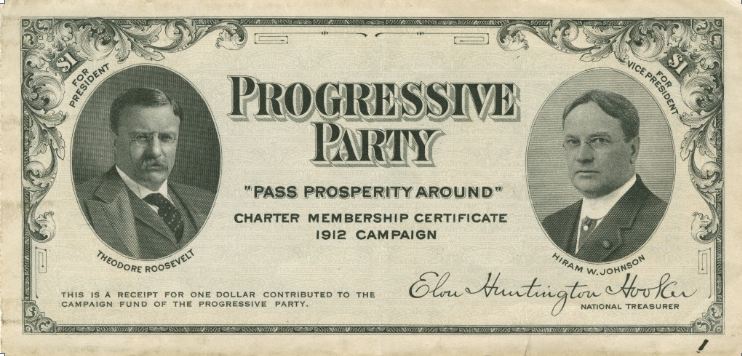
There are cycles within society that oscillate between openness and modesty. From the 1890s on, there was not just the rise of the Progressive Movement built on the back of Marxism, but along with this trend, there were major changes in society. We know generally about the rise of the Free Love Movement of the hippies during the 1960s, but what most people do not know is that there has been a cycle to change in social etiquette as well between openness and modesty.

Teddy Roosevelt was an ancient coin collector. When Teddy Roosevelt (1858-1919) became president on September 14, 1901 – March 4, 1909, he commissioned Augustus Saint-Gaudens (1848 –1907)  to redesign the $20 gold coin and made it high relief as the ancient coins had been struck. The machines could not handle the high relief and so the coins had to be reduced in their relief. But Augustus Saint-Gaudens was at the center of a curious rumor that was not true and yet it led to the murder under a statue he also was commissioned to make — the famous golden statue of Diana.

Evelyn Nesbit lost her virginity to Stanford White at the age of 14 which was not illegal back in the day. While the general ages of consent are now set between 16 and 18 in all U.S. states, the age of consent has widely varied throughout the country over time. Back in 1880, the ages of consent were set generally at 10 or 12 in most states, with the exception of Delaware where it was 7-years-old. The ages of consent were raised across the U.S. starting in the post-World War I era which seems to be a clash between the conservatives v the rising progressive of the Roaring ’20s. For the most part, by 1920 ages of consent generally rose to 16–18. The last state to raise its age of general consent was Hawaii which finally increased it to 16 from 14 in 2001.

While sexually, this applied to only girls, the US government decided to enlist 18-year-old boys during WW2 and the Korean war for the first time. There was an outcry in US that 18-year-olds can serve the army and die, but they can’t vote nor have a drink. Hence, the 26th amendment was passed on 1st July 1971 which lowered the age of voting from 21 to 18.

The Diana statue was unveiled atop Madison Square Garden’s tower on September 29th, 1891. The 304-foot (92.66 m) building had been completed a year earlier and was the second-tallest in New York City just in time for the Panic of 1893 as the Empire State Building was for the Great Depression. But the addition of the statue made it the city’s tallest, by 13 feet (3.96 m). The rumor was that Evelyn Nesbit was the nude model. That was simply not true for she was at best just 7 years 0ld. Nevertheless, that popular rumor had become assumed fact.

The hatred of her husband, Thaw, toward White, had become a major public contest. Thaw shot and killed White under the statue which was never his wife Evelyn Nesbit. BTW, there tends to be a 43-year cycle between social perspectives that oscillate between openness and modesty. While naked statues are everywhere in Europe, in America, this has been a battle back and forth within society.


 

Martin Armstrong — Answering Questions


QUESTION #1: Martin, I cannot believe the stuff you do. Truly amazing. I’ve got two questions, should you have any time:
1] if Coronagate is real, do you have any idea who is pulling the strings and why?
2] have you ever wondered why pi features so heavily in your cycles?
I don’t know how you do it,
Regards,
PR

QUESTION #2: It is obvious that any service which has been bullish on gold will never mention you. I use to read __ and thought they were real. I notice they are always bullish gold and will not quote you. That is true of all the gold bugs. It looks like fake news is its own contagion.

HC

COMMENT #3: Marty, you should republish the fact that you turned down $500 million for Socrates to shut up the naysayers.

HJ

COMMENT #4: Martin I work in a government organization. I had the opportunity today to engage with our emergency operations center. While in conversation it dawned on me administrators have handed counsel over to our OEM team who are credentialed emergency operations personnel.

The credential of emergency management was created in colleges and universities after 9-11. These folks have these degrees and have been waiting almost 20 years for something to do. Now word got out about this flu-bug and now these OEM ‘professionals’ are running around like roided out professional wrestlers…

They seem to be playing a game of one-up-manship with each other over who can be the most alarmist. Since they are OEM credentialed professionals, politicians listen to them since they are the experts. The number of impractical and unsustainable actions we are being asked to do to protect ourselves from the virus and each other is ponderous…

Its unfortunate emergency management has been taken from first responder types and put in the hands of college-educated professional emergency responder bureaucrats

ANSWER: I have not seen any credible evidence that this is a manufactured virus. About 14% of viruses are corona each year. I have spoken with several real researchers and they all disagree with the claims of some manufactured biological weapon (see review). I think this is just a combinations of over-zealous people who come up with theories of contagions who have direct access to the government like the climate change people, then the press accepts their version and attacks any politician if they disagree.

As far as the pro goldbug news, they are clearly engaging also in fake news. They do not report fairly but its always the same thing. They cannot get beyond the Quantity of Money theory and are trapped in the old school of thinking. No matter how many times they are wrong, they just blamed some conspiracy. Like politicians, they avoid mirrors.

As far as why the Pi influence exists, it is just the perfect cycle.

As far as the OEM teams, it is the same as the military. They have all these weapons they view as toys and they just want to find an excuse to play with them.


NAYSAYERS:

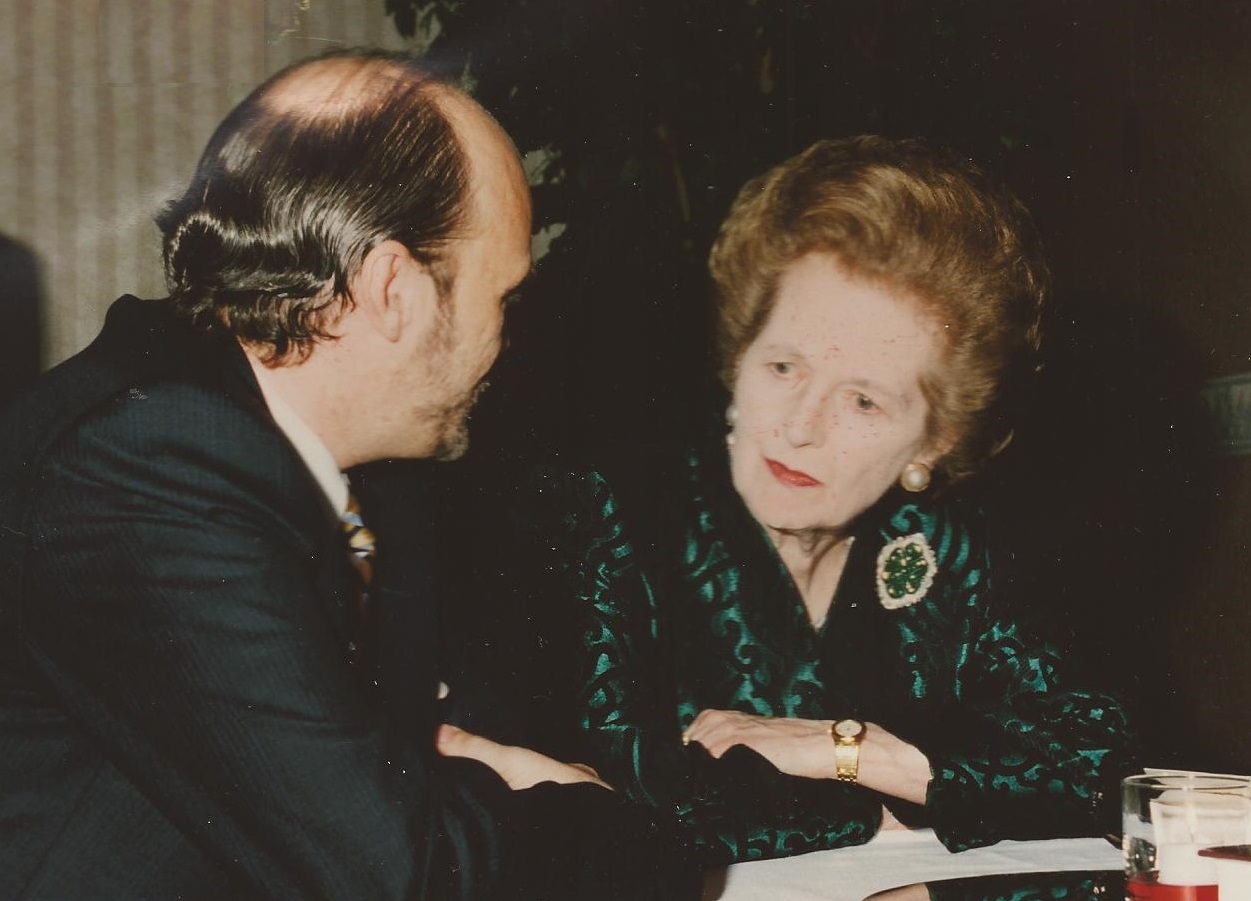
Look, I really do not care about those people. As Margaret Thacher once said to me, if she walked on top of the water across the Thames river, they would report that was only because she could not swim.

We are not blocked in China BECAUSE they know it is a computer that writes all the reports. We have been negotiating with a major Chinese institution that has hundreds of billions of clients. They want to provide all our research to their clicks on a per click basis. Even if you charged even $1 per click on every stock in Asia, and just 1 million people looked at one thing, that is $1 million per day. We are negotiating such projects in India and the Middle East.

The naysayers are the people who have been wrong. That is why they have to bad-mouth me to hide their failures based on antiquated theories. We have probably more clients than all of them combined and then some. People want UNBIASED analysis – not opinio

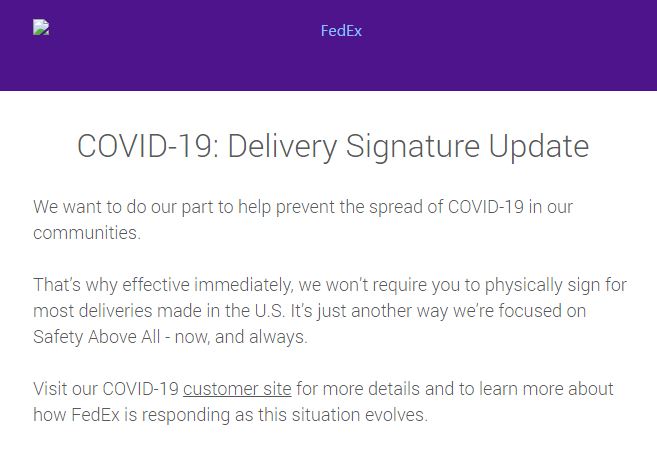
FedEx Ends Signature Requirements


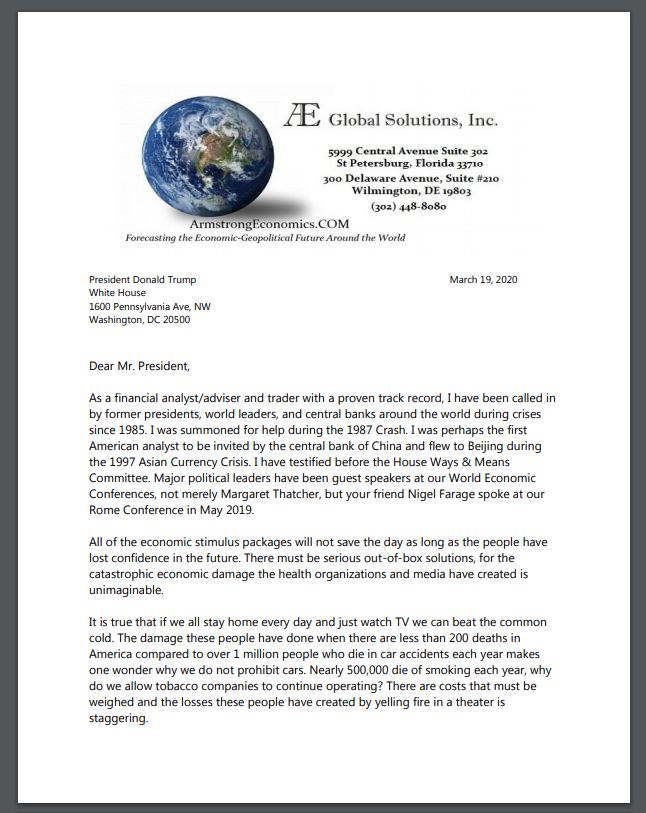
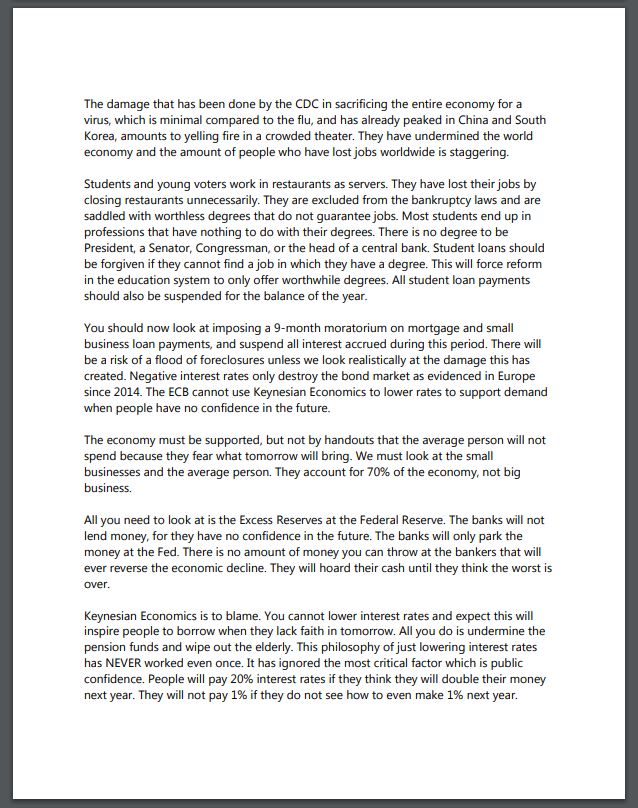
Asking for Your Help – Forward This Letter To Whoever You May Think Will Help


President Donald Trump Letter- Final


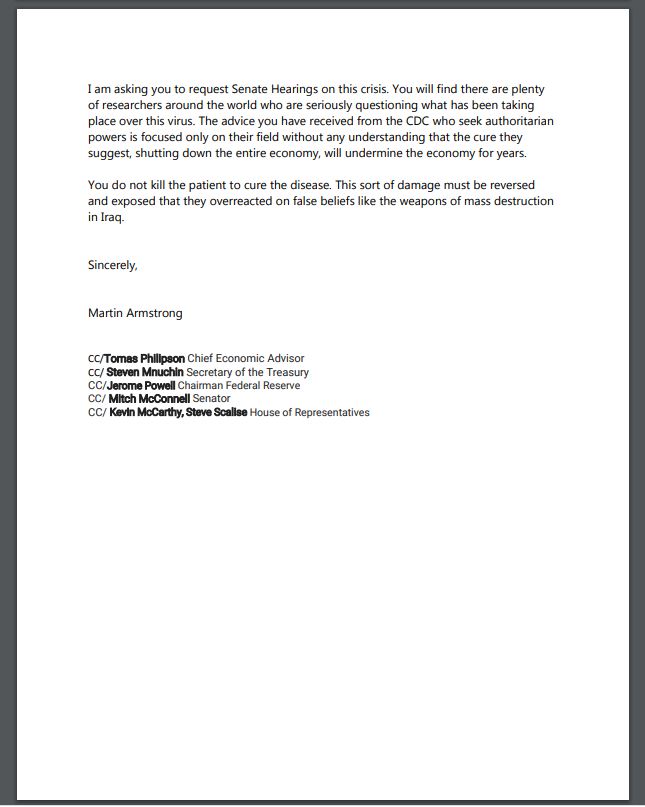
This is a letter I have sent to the White House but others are sending it to the various heads of central banks. Please forward it to whoever you may think will help try to turn the tide. We must end this panic and return to some normalcy. As mentioned, this would also be the cure for the common cold – home confinement. There are so many advisers claiming the numbers are false and many more people are dying without any supporting evidence. They always like to paint the worse possible picture on pure speculation. You do not do this with the world economy. Those that still cling to the Quantity Theory of Money and claim this will be hyperinflationary so buy gold, well you just saw what happened to Bridgewater. They never understand the interworking of the economy and the herd mentality of society.

Hyperinflation has NOTHING to do with the quantity of money. They do not know their history and just repeat what others have said without ever verifying facts. In December 1922, the government of Germany imposed a FORCED LOAN confiscating 10% of everyone’s assets. They gave them bonds that were worthless. That is when the people lost confidence in the government and refused to accept their money as valid.

It has always been a factor of CONFIDENCE. We are endangering the world economy and this collapse is now already being argued proves that Bernie is right and capitalism is wrong. So if we do not turn the tide, your future will be lost forever.

Former Obamacare Official Spreads Panic on MSNBC Demands All Masks Sent to New York City…


As you watch this, you start to realize the national panic hasn’t yet really sunk in.  However, think carefully about the instability of Mr. Slavitt and how he expresses it.

Former Obamacare official Andy Slavitt appears on MSNBC in a state of panic to demand that all medical masks and equipment throughout the nation be sent to New York City; while accusing other states, including Texas, of “hoarding” critical healthcare supplies.

Former FEMA Administrator Craig Fugate recognizes that participating in any discussion with this level of emotional panic is not going to be helpful, he walks off set. WATCH:

.

Panicked NYC resident and visibly unstable former ACA official Andy Slavitt, is talking about medical equipment when he demands all masks and supplies be redirected to New York with a sense of urgency.  However, imagine *if* the shortage *was* food. Prepare yourselves and your family accordingly.

We Apologize For Site Overload – Expanded Servers Are Up


Some people have asked why don’t we open up Socrates for free in a crisis? The answer is simple. Every time there is a crisis, our web traffic explodes. You must realize we are the largest forecasting firm in the world. We cover more than 1,000 markets ever day. When the surge of millions of people tries to get in at one time, the system is designed to automatically scale up more servers, but the surge today was far beyond anything anyone has ever expected. The system simply could not scale up multiple servers fast enough around the world.

We may have to split the system further as some have suggested that each level becomes its own server group so that when tens of millions trying to get into the basic level, it does not bring down all levels.

We will implement this reversion ASAP and thanks for all the recommendations.

Yes, this may be a good problem too much business as some have suggested. But my goal is to have a system covering every aspect of the world that people can turn to for unbiased analysis by a computer without the conflicts of interest or human prejudices and outright biase

California Orders State-Wide Lockdown – All Residents Must Stay at Home…


Comrade citizens, California governor Gavin Newsome announced today he has issued a statewide “stay at home” order.  California residents can only leave their homes when necessary and/or critical during the coronavirus pandemic.

Public gatherings are not allowed. [Executive Order HERE] Under the order California residents can travel alone and visit: Gas stations, Pharmacies, Grocery stores, farmers markets, food banks, convenience stores, take-out and delivery restaurants; Banks and Laundromats/laundry services.

.

[California COVID-19 Details]

Specific Retail Food Shortages Will Not Soon Improve, But the Overall Food Supply Chain is Very Strong…


We are entering into phase-3 of the supply-chain distribution shortages within the retail food sector.   Phase-1 was immediate impact.  Phase-2 was the spread to the warehouse and distribution.  Phase-3 impacts are further upstream, processing & suppliers.

The current shelf-stock shortages are not soon to reconcile; however, the shortages are still in the regional phase.  Meaning there is a big difference in the availability of products depending on the type of distribution network, and the specific retailers, in your area.

The ‘spider-spread effect’ happens when large metropolitan chains, serving large urban and megalopolis areas (1 million+ residents in 50 mile radius), reach a critical shortage in their supply network; and those residents then drive distances to locate their needs.  This is going on now across the country as regional supply chains try to keep up with demand.

Most consumers are not aware that food consumption in the U.S. is now a 50/50 sector.  Approximately 50% of all food was consumed “outside the home” (or food away from home), and 50% of all food consumed was food “inside the home” (grocery shoppers).

Food ‘outside the home’ includes: restaurants, fast-food locales, schools, corporate cafeterias, university lunchrooms, manufacturing cafeterias, hotels, food trucks, park and amusement food sellers and many more.  Many of those venues are not thought about when people evaluate the overall U.S. food delivery system; however, this network was approximately 50 percent of all food consumption on a daily basis.

The ‘food away from home‘ sector has its own supply chain.  Very few restaurants and venues (cited above) purchase food products from retail grocery outlets.   As a result of the coronavirus mitigation effort the ‘food away from home’ sector has been reduced by half of daily food delivery operations, possibly more.  However, people still need to eat.

That means retail food outlets, grocers, are seeing sales increases of 25 to 50 percent, depending on the area.  This, along with some panic shopping, is the reason why supermarkets are overwhelmed and their supply chain is out of stock on many items.

There is enough food capacity in the overall food supply chain, and no-one should worry about the U.S. ever running out of the ability to feed itself.  However, the total food supply chain is based on two segments: food at home and food away from home.

The seismic shift toward ‘food at home‘ is what has caused the shortages, and that supply chain is not likely to recover full service of products again until the ‘food away from home’ sector gets back to normal.   No need to panic, but there will be long-term shortages.

At the top of the food supply there is ample product and capacity.  Its the diversion of customers to the retail grocery sector causing the shortages.

Large chain-stores were impacted first and worst as their proprietary supply chain, and their automated replenishment systems, are more vulnerable to such wide-scale disruption.  Smaller regional markets, less than 25 stores or mom-and-pops, are/were impacted less due to their use of wholesalers for distribution.

However, in this phase-3 those wholesalers will now enter a period where they are in competition for resupply with the large retail outlets…. so we are entering the phase were smaller stores, and independents, are going to have more trouble getting product.

Additionally, distance from distribution hub  will also play a role in your ability to locate product.

Residents within 50 miles from a distribution center (retail grocery warehouse) will find their stores with a better in-stock position.

Residents living 50 to 100 miles from distribution will see less products available. People living 100+ miles will likely see the worst in-stock positions for typical staples, perishables and non-perishables unless they are locally procured.

The fresh-meat, poultry and produce sections are the first disrupted (short term) but least disrupted long term.  The reason is simple, the raw material isn’t needed in the restaurant supply chain; those products are right now in the process of being shifted to manufacturing, protein processing, and eventually into the retail food supply chain to end up in your local supermarket refrigerated store cases.

With the increased diversion, increased production and increased distribution, inside of two weeks we should see fresh meats, chicken, pork etc. (protein sector) return to normal in your area supermarket.

Produce is both nationally and locally sourced, so that supply chain was never as much at risk of supply chain disruption. Additionally, with the restaurant sector demand reduced the produce operations will recover quickly as soon as the supply chain diversion and distribution increases.  Less than a week and the produce section in your local supermarket should be solid.

However, the frozen foods, frozen pizzas, frozen meals ready to eat (RTE) and specifically processed lunchmeats and cheeses will continue to suffer from supply chain issues.  The reasons are not complex.  Processed food has a production capacity.  Think about Oscar Meyer, Tyson, Hormel, etc. they can only process a maximum amount within their manufacturing facilities.  [China owns Smithfield, so China controls that company]

To the extent that extra shoppers means extra consumers wiping out frozen foods, lunch-meats, bacon and cheeses, the manufacturing side of the retail food system will be limited to their capacity.  That sector is not going to change and long-term supply chain issues will continue.  However, on the good news side, we should be able to buy lunch meats at the in-store deli counters because that bulk delivery processing sector will have more production capacity.

So if you’re looking for bologna (or similar), and the it’s not available pre-packaged in the traditional case, try looking for it in the deli section.  It will be more expensive, but such is life with coronavirus.

In addition to the shortages in frozen foods, processed lunch-meat and dairy items, the non-perishable goods will also have wide-spread outages.  Again, this is a store issue (phase-1), distribution capacity issue (phase-2), and will now become an upstream production capacity issue in phase-3.

Bread, canned goods, rice, cereals, pasta, flour, sugar, bottled water, etc. are selling beyond the capacity of the traditional supply chain to keep up with demand.

Traditional emergency food recovery and distribution models (think hurricanes) are designed for short-term disruptions to the restaurant sector providing 50% of food outside the home; and, as a result, short-term increases to at home food needs.  Those emergency and recovery models have contingency plans for short-term, regional bursts of specific non perishable products into specific areas.  This ain’t that.

The current supply chain disruption is a severe reduction in the availability of ‘food outside the home‘ for a sustained period.  Losing the entire sector is very unusual, unprecedented, unforeseen in scale; and there is no national contingency plan for a nationwide demand on all retail supermarket food products simultaneously.

Once these warehouse fulfillment centers run out, every retail outlet in the country is pulling from the same upstream supplier network.  Again, there’s no need to panic, the total food supply is not short, we all just need to adjust our shopping habits and get a little creative.

If you love seafood there should be plenty of it.  75% of all U.S. seafood was consumed at restaurants.  The seafood sector will, by necessity of the perishable nature, rapidly move into the retail supply-chain. That should mean low prices and plenty of seafood in your neighborhood store.

On the paper-goods production side… there is no model for needing paper towels, kleenex and toilet tissue at the extreme level currently identified.  Production of cleaning products has been increased by every manufacturer and paper-goods suppliers like Georgia Pacific are operating 24/7… but the demand is gobsmacking.

Why the heck has everyone been buying so much toilet tissue?  weird.

Advertisements
Seen ad many times
Not relevant
Offensive
Covers content
Broken
REPORT THIS AD

Treasury Secretary Steven Mnuchin Explains U.S. Financial Response to Economic Impact from Chinese Coronavirus…


Treasury Secretary Steven Mnuchin called-in to Maria Bartiromo earlier today to discuss the overall financial approach of the Trump administration to the COVID-19 impacts.

Mnuchin has been working closely with House and Senate political leadership to structure the financial flow needed for particular sectors and workers inside the Main St economy.  The target date for legislation directing the financial relief is early next week.

The underlying economy is strong. The treasury response is targeted to those who need short-term relief. Short-term economic indicators are no longer valid.

FDA Speeding Clinical Trials of Chloroquine as Possible Therapeutic – FDA Commissioner Stephen Hahn Transcript…


During the task force briefing President Trump announced authorizing to the FDA to relax regulationsto speed up clinical trials for several anti-viral remedies to treat coronavirus. Specifically citing a therapudic drug known as chloroquine President Trump noted trials are underway and could be made available for treatment “almost immediately.”

Now, a drug called chloroquine — and some people would add to it “hydroxy-.” Hydroxychloroquine. So chloroquine or hydroxychloroquine. Now, this is a common malaria drug. It is also a drug used for strong arthritis. If somebody has pretty serious arthritis, also uses this in a somewhat different form.

FDA commissioner Stephen Hahn told reporters scientists still have to conduct clinical trials to see if chloroquine, hydroxychloroquine, and several other anti-viral medications are effective against coronavirus.  However, since chloroquine and hydroxychloroquine are already FDA approved to treat malaria & arthritis, they could be used to treat other conditions, including coronavirus, in an “off label” basis.

DR. HAHN: So, before the President nominated me and I was confirmed as Commissioner for Food and Drugs, I was a cancer doctor. And I’ve sat across from countless number of patients and had to talk to them about their diagnosis and their treatment. And one thing that was really important is to provide hope. I have great hope for how we’re going to come out of this situation.

What’s also important is not to provide false hope, but to provide hope. And, as a doctor, that’s the way I come to this. I’m speaking now to the American people as Commissioner of Food and Drugs, but that part of me has not left. Just look at the way the American people have responded to our calls for mitigation, for social distancing. The American people have great resiliency, and I’m so incredibly proud of how the American people have responded.

As the President mentioned, he asked us to be aggressive, to break down barriers to innovation, and to accelerate the development of lifesaving treatments. And we’re doing that at the FDA.

The FDA is committed to continuing to provide regulatory flexibility and guidance, but let me make one thing clear: FDA’s responsibility to the American people is to ensure that products are safe and effective and that we are continuing to do that.

Our folks — and they’re tremendous professionals — are working day and night to do this. You just can’t even imagine how much they’re working to provide this support for the American people and I thank them.

Since early January, long before the first domestic case, FDA began working in collaboration with CDC. I also want to note that we stood up an incident command group and had been focused on the coronavirus since the very beginning of this public health emergency. This is, in addition, an all-of-government and all-of-America approach and I’ll describe what I mean by that, in terms of the development of therapeutics.

An important part of that work is expanding the potential therapeutic options associated with coronavirus, and we’ve learned from our colleagues across the globe about this. But I want to focus on one thing: I was a cancer researcher before all this, and one thing I know about this great country of ours is that we have unbelievable innovators. We have people who, every day, it’s their job to develop treatments for all sorts of diseases. We are incredibly blessed, as a country, to have this.

And as is true in any illness, these great American innovators — academia, private sector — they have engaged us about the best possible treatment options. We are looking at everything that’s coming across our desks as possible treatment options for coronavirus, and we’re extremely encouraged by the interest and the promise that we’ve seen from these great American innovators.

Now, again, we need to look at it. We need the data, we need the information to make the absolute best decisions for the American people. But I want to assure you, we have over 17,000 people at FDA who are doing this every day.

We need — we need to make sure that these — this sea of new treatments will get the right drug to the right patient at the right dosage at the right time. As an example, we may have the right drug, but it may not be in the appropriate dosage form right now, and that may do more harm than good. Those are the things that that’s our job to look at. And that’s why it’s really important we have these dedicated professionals looking at these aspects of therapeutic development.

At the same time, we’re also working through different mechanisms to actually get drugs into the hands of providers and patients.

The President mentioned this, but one of the mechanisms is called compassionate use. Let me just tell you about this. If there’s an experimental drug that’s potentially available, a doctor could ask for that drug to be used in a patient. We have criteria for that and very speedy approval for that.

The important thing about compassionate use — and that’s what the President meant, “This is even beyond Right to Try” — is that we get to collect the information about that. Because one of the things that I’ll promise the American people is we will collect the data and then make the absolute right decisions based upon those data about the safety and efficacy of the treatments.

We are working expeditiously, and we are working to make sure that these products are as safe and effective as they possibly can be. Let me tell you about a few things that we’re currently working on. And this is a plan that was developed with many of the people at this table, our infectious disease experts on the task force.

In the short term, we’re looking at drugs that are already approved for other indications. So they’re already approved, as the President said, for other diseases.

As an example, many Americans have read studies and heard media reports about this drug, chloroquine, which is an anti-malarial drug. It’s already approved, as the President said, for the treatment of malaria, as well as an arthritis condition.

That’s a drug that the President has directed us to take a closer look at, as to whether an expanded-use approach to that could be done to actually see if that benefits patients. And again, we want to do that in the setting of a clinical trial — a large, pragmatic clinical trial — to actually gather that information and answer the question that needs to be answered and — asked and answered.

Let me give you another example: There’s a cross-agency effort about something called convalescent plasma. This is a pretty exciting area. And again, this is something that we have given assistance to other countries with as this crisis has developed. So FDA has been working for some time on this.

If you’ve been exposed to coronavirus and you’re better and you don’t have the virus in your blood, we could collect the blood. Now, this is a possible treatment; this is not a proven treatment — just want to emphasize that. Collect the blood, concentrate that, and have the ability, once it’s pathogen-free — that is, virus-free — to be able to give that to other patients. And the immunoglobulins — the immune response — could potentially provide a benefit to patients. It’s another thing that we’re looking at.

Over the next couple weeks, we’ll have more information on that. We’re really pushing hard to try to accelerate that. That’s in the sort of more medium- and short-term. And that’ll be a bridge to other therapies that will take us three to six months to develop.

And this is a continuous process. There is no beginning and end to each of this. This is — you know, we’re pushing this through.

The other great thing about the great innovators of America is some of them tell us it’s taken us years — years — to develop therapies. They’re looking at pushing that to the months period of time. And we’re trying to provide them the reg- — the regulatory flexibility, but, at same time, the scientific oversight to make sure that gets done in the best way possible for the American people.

The President mentioned that there is a vaccine trial currently being performed. It’s a phase-one trial, so it’s the earliest study that gets done. We expect that to take 12 months to get to completion — to actually a time where we could approve a vaccine. But that’s — these are all things to bridge to the prevention part of this with a vaccine. It’s exciting work. And the President is right: This is record time for the development of a vaccine and impressive public-private partnership.

The FDA’s efforts to facilitate the development of these products are focused on ensuring timely access, while also meeting the agency’s world-respected gold standard, relying on strong data from clinical trials to determine if an experimental or an off-the-shelf drug that’s used for something else can safely and effectively treat patients.

We want to assure the American people that FDA is all hands on deck, as the President mentioned — these efforts — and continue to work with interested sponsors to help expedite the work. We remain steadfast in helping to foster the development of safe and effective therapies for COVID-19. Thank you. (transcript)