
Determining the ‘exact’ blackbody temperature of the planet is the first step in determining what the “greenhouse’ effect is; for without that value all else is either speculation or based on an unreliable value. This leads us to a quandary since the plant is a globe spinning around a titled axis of rotation and with an elliptical orbit around the sun Figure 1 which is the source of virtually all the energy that heats the planet. Clearly with these facts there cannot be one temperature for the planet and so an average can be very misleading and lead to false conclusions; especially as it hides large energy flows on the planet.
Traditional calculations of the planets black body temperature ignore the variables which then lead one to assume a steady state situation verses the real dynamic situation that actually drives climate. To justify this assumption a general statement that the variances are too small to have any meaningful effect are promoted. In some cases with fewer variables this might be true but in this case I think not.
These are the main variables, constants and forces:
- The sun has a cycle of about eleven years and that gives a small variation in the suns output of about 1%
- The planet has an elliptical Orbit that varies by 3.34% or 4,999,849 miles
- The axial tilt of the planet is 23.4 degrees which causes winter and summer to alternate between Aphelion and Perihelion about every 10,000 years
- The planet is a sphere so only one side faces the sun at any given moment
- The sun’s energy reaches the planet on a line drawn from the center of the sun to the center of the planet which only intersects the equator twice a year
- The energy from the sun is concentrated around this line, a hot spot.
- The planet is a sphere so the suns radiation drops off in all directions from this line by a Cosine factor to zero at the edge 90 degrees from the center line
- The spin and tilt of the planet means that the center line, in effect, moves up 23.4 degrees and down 23.4 degrees during the course of one orbit
- That movement means the distribution of the energy in the hot spot also moves
- The distribution of land and ocean are not uniform on the planet and therefore the absorption of the solar flux is very different at points the hot spot travels over.
- The albedo of the planet is a variable not a constant mainly as a factor of the amount and kind of clouds.
- Energy from the core adds a small amount of energy
- Tidal forces from the sun and the moon also add some energy
- Energy is carried North and South from the hot spot centered on the line by the atmosphere and the ocean
- The Coriolis Effect along with tidal forces drive thermal transfer north and south at an angle and these are then main contributors to the climate

Figure 1, The Earth’s Orbit
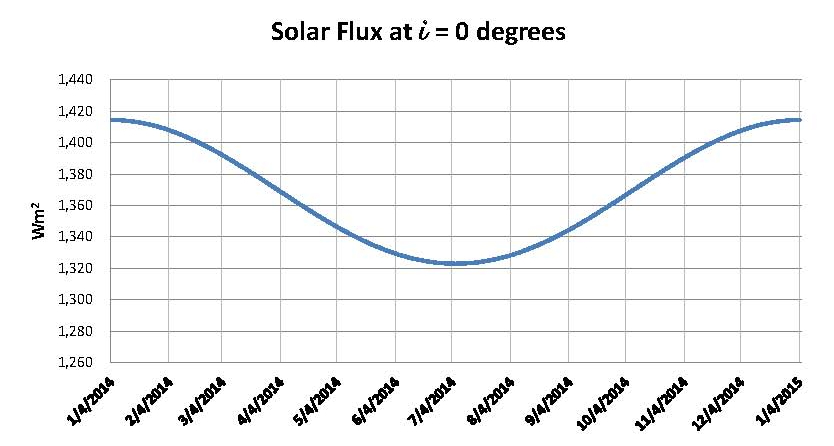
Figure 2, Orbital changes in solar flux
There are three sources of energy that determine the climate on the earth: the radiation from the sun which is said to be 1366 Wm2 The actual value based on the orbital range is from 1414.4 Wm2 in January to 1323.0 Wm2 in July Figure 2 and there is also an eleven year sun spot cycle with a range of 1.37 Wm2. The hot core of the planet adds ~0.087 W/m2 and the gravitational effects of the moon and the sun (tides) adds another ~.00738 Wm2. Of these three the sun’s radiation is by far the most important but considering all three the range during an eleven year solar cycle is from a high of ~1415.3 Wm2 to a low of ~1322.4 Wm2 so a more accurate mean would be 1368.34 Wm2.
The energy emitted by the planet must equal the energy absorbed by the planet and we can calculate this using the Stefan-Boltzmann Law. Which is the energy flux emitted by a blackbody is related to the fourth power of the body’s absolute temperature. In the following example the tidal and core temperatures are added after the albedo adjustment since they are not reduced by the albedo.
E = σT4
σ = 5.67×10⁻⁸ Wm2 K sec
A = 30.6% (the planets albedo, this is not actually a constant)
σTbb4 x (4πRe2) = S πRe2 x (1-A)
σTbb4 = S/4 * (1-A)
σTbb4 = 1368.24/4 Wm2 * .694
σTbb4 = 247.46 Wm2
Tbb = 254.36 K
Earth’s blackbody temperature Earth’s surface temperature
Tbb = 252.23O K (-20.92O C) low Ts = ~287.75O K (14.6 O C) today
Tbb = 254.36O K (-18.79O C) mean
Tbb = 256.54O K (-16.51O C) high
The difference between the blackbody and the current temperatures is what we call the ‘greenhouse’ effect that averages 33.36O Celsius (C), today, although the range is from 35.52O C to 31.11O C from variations in the 11 year solar cycle. This documented variation means that the stated Blackbody radiation as shown here will give a 4.41O variation or let’s say 14.0O C plus or minus 2.2O C because of the Stefan-Boltzmann Law which has a 4th power amplification. This will result in a slow 11 year cycling fluctuation of energy in the tropics where the bulk of the energy comes that is not inconsequential.
If we add clouds to the picture it get even more complex as they have a significant effect on the planets albedo as we know from two major volcanoes’ both in Indonesia; one in 1815 Tambora and the other in 1883 Krakatoa both of which threw enough particles into the atmosphere to significantly lower the temperature of the planet. Although dust is not a cloud the point is that if the albedo of the planet is changed it does have a major effect on global temperatures. The lack of thermometers in 1815 means we really don’t know what the effect was other then 1816 in known as the year without a summer. The other eruption in 1883 is well documented and is estimated to have dropped world temperatures by 1.20O C which would be equivalent to about a 4.2% reduction in the global albedo. The importance of clouds can be seen in the following Chart Figure 3. A reasonably estimate of the total effect of clouds on the global albedo would be about 50% if nothing else changed or a reduction in Albedo of from 30% to 15%.
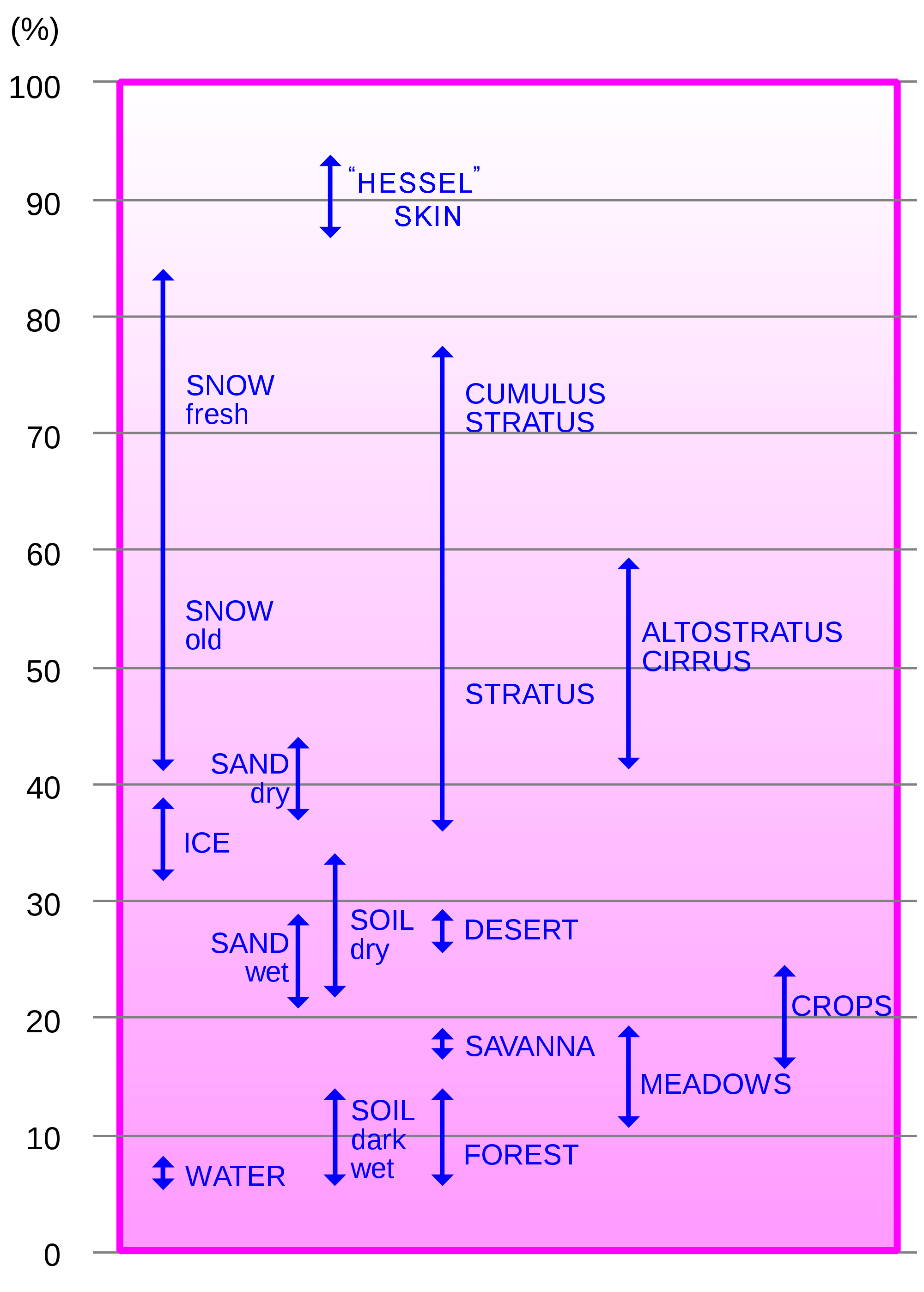
Figure 3, Albedo of various surfaces
Just for sake of argument if we varied the cloud levels by +/- 10% we find that at low solar flux and high clouds the Blackbody temperature would be 249.46O K and with high solar flux and low clouds the Blackbody temperature would be 259.32O K a range of 9.86O C. The reason this is so important is that properly modeling cloud levels is the area with the most uncertainly in the present models as clouds form at much lower mesh resolutions that the present models can deal with even if the formation could be properly modeled.
Despite this variation in incoming solar flux the planet’s temperatures has been very stable as previously shown in Figure 1 so we know there are no positive feedback process of any consequence on the planet. Other factors are also important in doing climate work such as 52.3% of the solar energy is concentrated within 45.0 degrees of the hot spot and 77.6% within 60 degrees of the hot spot. And the heat from the core and probably the tides is concentrated where the crust is the thinnest under the oceans and this concentration of energy core heat and tides) combined with Coriolis forces is probably what drives the ocean currents. In my opinion these other important factors are not being considered properly in the climate models, and that results in climate models that don’t work properly e.g. the inability to explain why there has been a pause in the warming calculated by NASA and NOAA over that past ten years despite a continuing increase in the level of CO2 in the atmosphere.
We also know from geological studies Figure 4 that the planets temperature has been relatively stable over the past 600 million years with a mean of about 17O C or 290O Kelvin (K) and with a range of plus or minus 5O K or C based on the information in Figure 4. During the past 250 million years CO2 concentrations have ranged from a low of ~280 ppm (a historic low) in 1800 to the present low of 400 ppm to a high of over 2,000 ppm probably averaging around 1,500 ppm. There was only one other period in the past 600 million years with CO2 this low. Going back further CO2 was estimated to be as high is 7000 ppm, but we will ignore that for now.
This means that whatever the processes are that relate to determining the thermal balance of the planet they must work within this range of ~12O C to be valid. Although Figure 4 shows a range of 10O C it would be prudent to spend resources to determine these values with as great accuracy as possible. We’ll assume a mean of 16O C with a range from 10O to 22O C as being more reasonable in this work. Also we are now in one of only three cold periods which are very rare in the past 600 million years and if we count that partial dip 150 million years ago that means that there is probably a 150 million year cycle there; maybe one of those first determined my Milutin Milankovic.
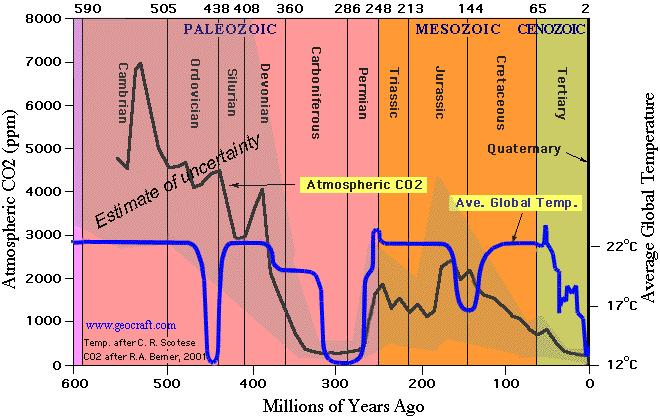
Figure 4, Geological temperatures and Carbon Dioxide
Additional discussion as to the so called “greenhouse” effect must start with the important correction that this process is not a true greenhouse effect, since it is not the same process that occurs in a greenhouse used to grow food. The actual process that occurs is based on the structure of the atoms involved and how they interact with the various frequencies of visible and infrared radiation that are in play on the planet. However at this point in time there is no way to correct for the misuse of the words so we are stuck with it and all the complications that therefore arise in trying to properly discuss the issue with lay people and even some with technical knowledge.
The greenhouse effect occurs within the earth’s atmosphere and the main constitutes of wet air, by volume ppmv (parts per million by volume) are listed in the following table. Water vapor is 0.25% over the full atmosphere but locally it can be 0.001% to 5% depending on local conditions. Water and CO2 are mostly near the surface not in the upper atmosphere so the bulk of the greenhouse effect must be close to the surface. This table is different than most as it shows water.
Gas Volume Percentage
Nitrogen (N2) 780,840 ppmv 78.8842%
Oxygen (O2) 209,460 ppmv 20.8924%
Argon (Ar) 9,340 ppmv 0.9316%
Water vapor (H2O) 2,500 ppmv 0.2494%
Carbon dioxide (CO2) 400 ppmv 0.0399%
Neon (Ne) 18.18 ppmv 0.001813%
Helium (He) 5.24 ppmv 0.000523%
Methane (CH4) 1.79 ppmv 0.000179%
There are only two of these gases that are relevant to determining how that 33O C (today) happens. That is not to say the others do not contribute but that at the present concentrations of Water H2O and Carbon Dioxide CO2 they are the main determinants. And since we know the range of temperatures that have existed geologically then we have set the range which these to gases must interact in, meaning that any set of equations or models or theories that predict values outside this range must be suspect based on geological evidence.
Also it must be kept in mind that the solar flux falls on a spot centered on a line drawn from the center of the earth to the center of the sun and because of the 23.4O axial tilt of the planet this “Hot” spot moves up and down as the planet moves though its orbit. Because of the shape of the planet the intensity falls off quickly as we move north and south and east and west according to a cosine factor so the heat energy is mostly over oceans near the equator where the atmosphere is the densest.
The first image below Figure 5 shows a recent distribution of water across the planet and it is clearly concentrated over the oceans close to the equator and that results in the heat imbalance and therefore movement north and south as shown in the second image Figure 6.
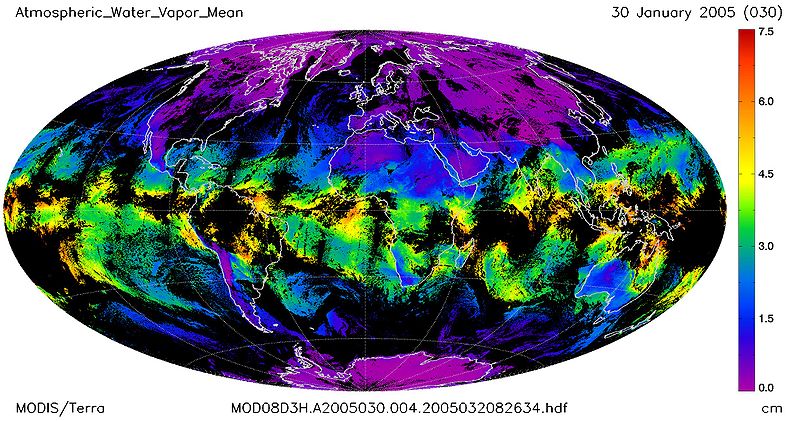
Figure 5, water vapor concentrated near the equator
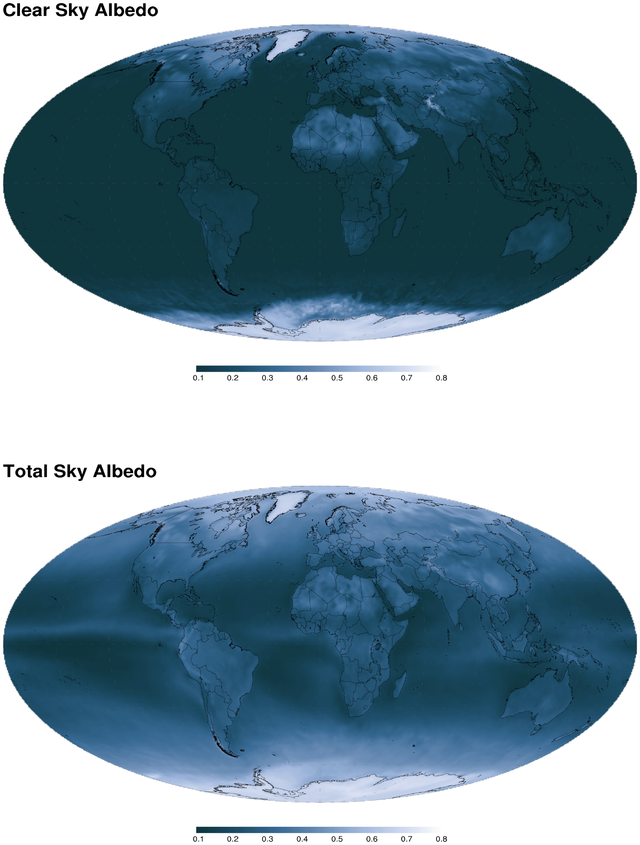
Figure 6, change in albedo
In summary we now know that the Blackbody temperature of the planet is a variable.
Tbbl = 252.23O K (-20.92O C) low at Aphelion
Tbbm = 254.36O K (-18.79O C) and the yearly mean
Tbbh = 256.54O K (-16.51O C) high at Perihelion
Therefore the ‘greenhouse effect, with clouds as a constant, must be a variable.
Ts = ~287.75O K (14.6O C) today
Ghl = Tbbl + Ts = 35.52O C
Ghm = Tbbm + Ts = 32.39O C
Ghh = Tbbh + Ts = 31.11O C
Considering there would probably be fewer clouds during cool period and more clouds during warm period the following would be more like the true effect considering both.
Tbblc = 252.98O K (-20.17O C) low at Aphelion
Tbbmc = 254.36O K (-18.79O C) and the yearly mean
Tbbhc = 255.83O K (-17.32O C) high at Perihelion
Therefore the ‘greenhouse effect with clouds included must also be a variable. In this case we assume fewer clouds in cooler periods and more clouds in warmer periods of 2.5% which reduces the range and acts as a negative feedback on the process.
Ts = ~287.75O K (14.6O C) today
Ghlc = Tbblc + Ts = 34.77O C
Ghmc = Tbbmc + Ts = 32.39O C
Ghhc = Tbbhc + Ts = 31.92O C
The range in temperature just from orbital changes is 4.41O C but including clouds that range is reduced to 2.85O C however in either case it is significantly more than the warming that the IPCC claims has happened looking at only Carbon Dioxide as the main factor. These are hard numbers based on the solar flux which is known and the orbital parameters of the Earth that are also known. The large variances come from the Stefan-Boltzmann Law; which is the energy flux emitted by a blackbody is related to the fourth power of the body’s absolute temperature. The fourth power in the equation magnifies the small variation in solar flux significantly.
 Centinel2012