A Climate Model That Works


A quick review of several sources including Wikipedia that had estimated dates of 5 previously identified warm and cold periods going back almost 3,000 years was used to give these average dates for either the bottom or the peak temperature in that period.

The Sub Atlantic Cold Period 363 BC

The Roman Warm Period 365 AD

The Dark Age Cold Period 700 AD

The Medieval Warm Period 1192 AD

The Little Ice Age 1602 AD

The average peak to bottom for these observed Cycles is 491 years or 982 years for a complete cycle. So if we add 491 years to the last bottom which was in 1602 AD that would make the peak of the “current” warming trend 2149 AD. This has nothing to do with CO2 although CO2 will add some to the coming peak maybe even .5 degree Celsius.

Basically what this quick 30 minutes study showed is there is nothing to worry about except corrupt politicians.

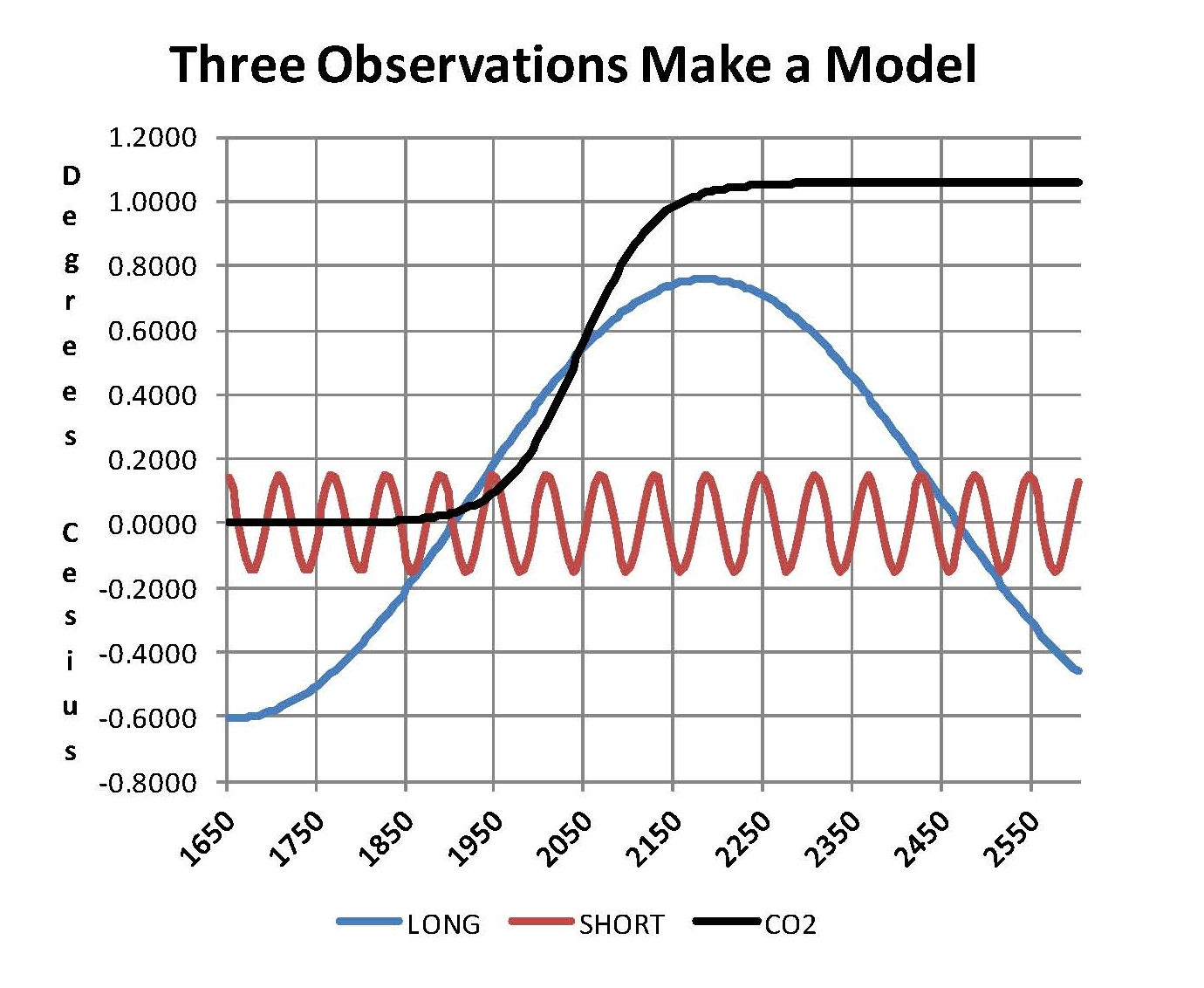
Based on this quick review and other information all previously shown on my blog a climate model can be constructed in a reasonable amount of time (Took me a couple of years since I was starting from scratch) Which is as follows. Chat One shows mathematically derived plots based on empirical observations of NASA–GISS data and other data such as was shown in the opening paragraph of this post. The cyan line is based on the war and cold cycles in the opening. The red line is based on El Nino, LA Nina and the Atlantic Multidecadal Oscillation (AMO). The black line is based on a mathematical analysis of NOAA CO2 growth rates projected into the future and reaching a level of 1,000 ppm by the end of the next century.

The blue line is the base since we knows what the temperature was in 1600 and we have a good idea what the level of CO2 was back then as well. Therefore from Chart One we can see that the blue pattern takes about 1,000 years to make a cycle and the total rang is 1.4 degrees Celsius. The red line has a cycle of 70 years with a range of .38 degrees Celsius. And CO2 from 1650 to the peak in about 2150 is about 1.0 degrees Celsius however keep in mind that half of the increase has already been used up since we are at 400 ppm now.

Image1

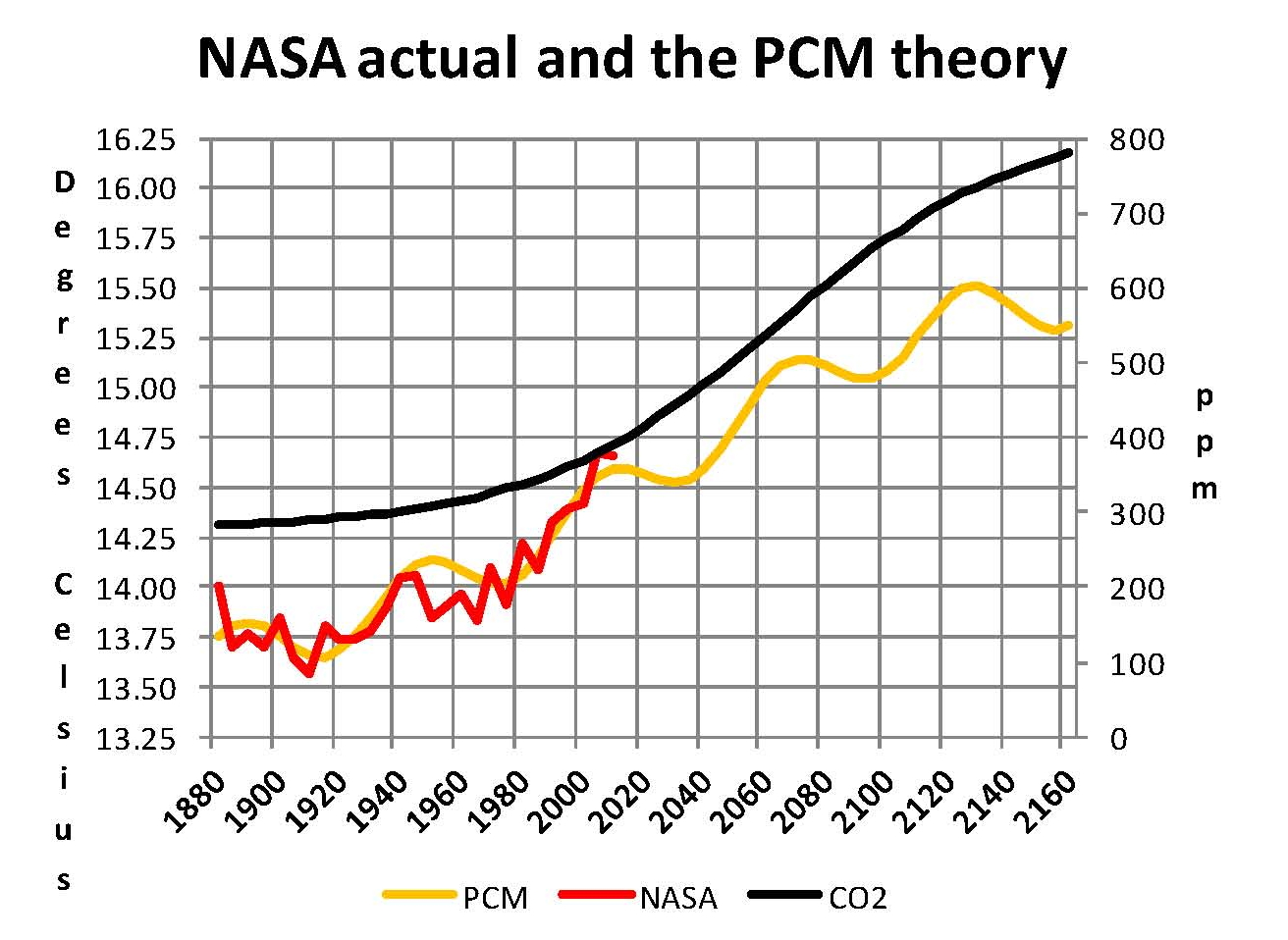
Chart Two is a composite made from adding all three of the items in Chart One together. Obviously after 2150 the blue line starts moving down and since it is the largest of the three it will drag down all the rest with it for another 500 years just as it has done for the past 3000 years. The yellow line is the sum of the three items in Chart one labeled PCM The red line are actual NASA-GISS temperatures for their Table LOTI. The red and yellow line match well indicating that there is validity in the assumption used here. Previous posts here have showed most of the detail for doing this including all the equations, for those that interested.

Image2

The Current Global Warming from a Historical Respective


A quick review of 13 dates from previously identified  Global warm and cold periods going back almost 3,000 years gives these average dates for either the bottom or the peak temperature in that period.

The Sub Atlantic Cold Period 363 BC

The Roman Warm Period 365 AD

The Dark Age Cold Period 700 AD

The Medieval Warm Period 1192 AD

The Little Ice Age 1602 AD

The average peak to bottom for these observed Cycles is 491 years or 982 years for a complete cycle. So if we add 491 years to the last bottom which was in 1602 AD that would make the peak of the “current” warming trend 2149 AD This has nothing to do with CO2 although CO2 will add some to the coming peak maybe even 1 degree Celsius.

Basically what this quick 30 minutes study showed is there is nothing to worry about except corrupt politicians.


Analysis of Global Temperature Trends, May 2015 What’s really going on with the Climate?


The analysis and plots shown here are based on the following: first NASA-GISS temperature anomalies (converted to degrees Celsius so non-scientists will understand the plots) as shown in their table LOTI, second James E. Hansen’s Scenario B data, which is the very core of the IPCC Global Climate models (GCM’s) and which was based on a CO2 sensitivity value of 3.0O Celsius, lastly, a plot based on an alternative climate model designated ‘PCM’ and based on a sensitively value of .65O Celsius.

An explanation of the alternative model designated PCM is in order since many have interpreted this PCM model as a statistical least squares projection of some kind and nothing could be further from the truth. A decade ago when I started this work the first thing I did was look at geological temperature changes since it is well known that the climate is not a constant; I learned that in my undergrad geology and climatology courses in 1964. One quickly finds that there is a clear movement in global temperatures with a 1,000 some year cycle going back at least 3,000 to 4,000 years; probably because of the apsidal precession of about 21,000 years for a complete cycle. However about every 10,000 years the seasons are reversed making the winter colder and the summer warmer (northern hemisphere) 10,000 years from now. There are also 60 to 70 year cycles in the Pacific and the Atlantic oceans that are well documented. We also know that there are greenhouse gases such as Carbon Dioxide and the National Academy of Sciences (NAS) estimated that Carbon Dioxide had a doubling rate of 3.0O Celsius plus or minus 1.5O Celsius in 1979

The IPCC still uses the NAS 3.0O Celsius as the sensitivity value of Carbon Dioxide and a number in that range is required to make the IPCC GCM’s work. The problem with using this value is it leaves no room for other factors and hence the need of the infamous Hockey Stick plots of the IPCC from Mann, Bradley & Hughes in 1999. The PCM model is based on a much lower value for Carbon Dioxide consistent with current research which places the value between 0.65O and 1.5O Celsius per doubling of Carbon Dioxide. If the long and short movement in temperatures and a lower value for Carbon Dioxide are properly analyzed and combined a plot that matched historical and current (non manipulated) NASA temperature estimates very well can be constructed. This is not curve fitting.

The PCM model is such a construct and it is not based on statistical analyses of raw data. It is based on creating curves that match observations (which is real science) and those observations appear to be related to the movement of water in the world’s oceans. The movements of ocean currents is well documented in the literature all that was done here was properly combine the separate variables into one curve which had not been previously done. Since this combined curve is an excellent predictor of global temperatures unlike the IPCC GCM’s it appears to reflect reality a bit better than the convoluted IPCC GCM’s which after the past 19 years of no statistical warming have been shown to be in error.

Now, to smooth out highly erratic monthly variations a 12 month running average is used in all the plots. This information will be shown in four tables and updated each month as the new data comes in about the middle of the month. Since no model or simulation that cannot reasonably predict that which it was design to do is worth anything the information presented here definitively proves that NASA, NOAA and the IPCC just don’t have a clue.

000 2015-05 a

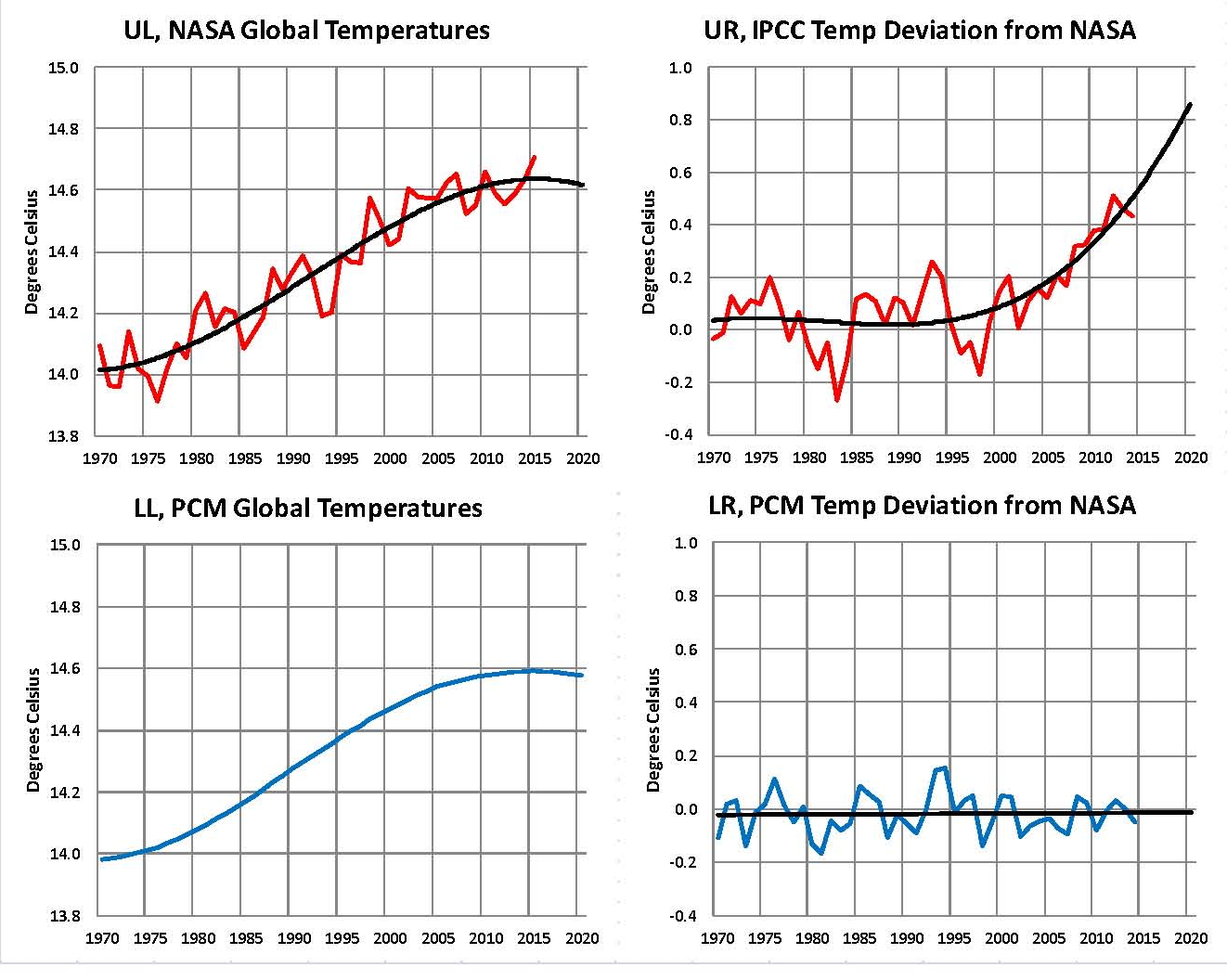
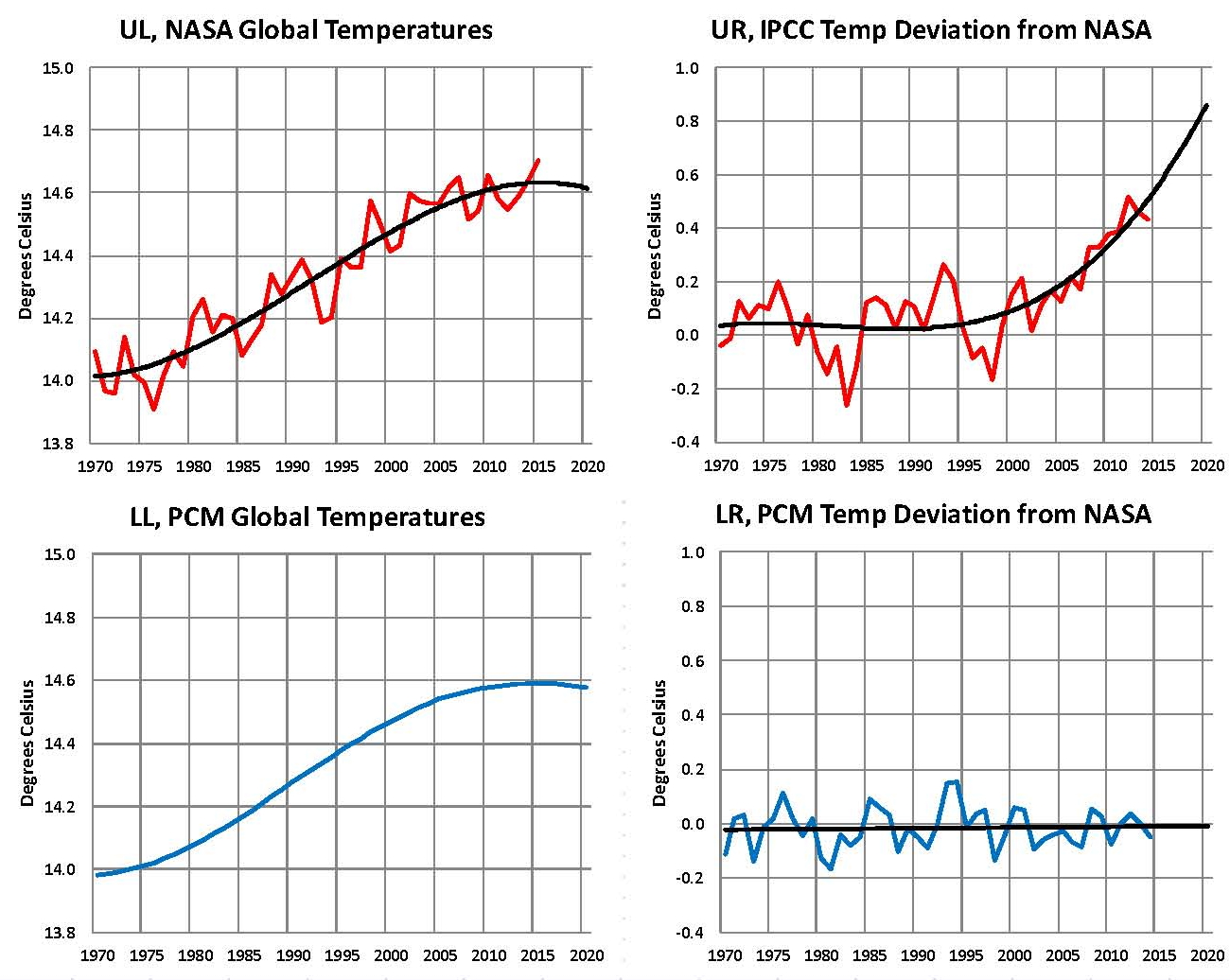
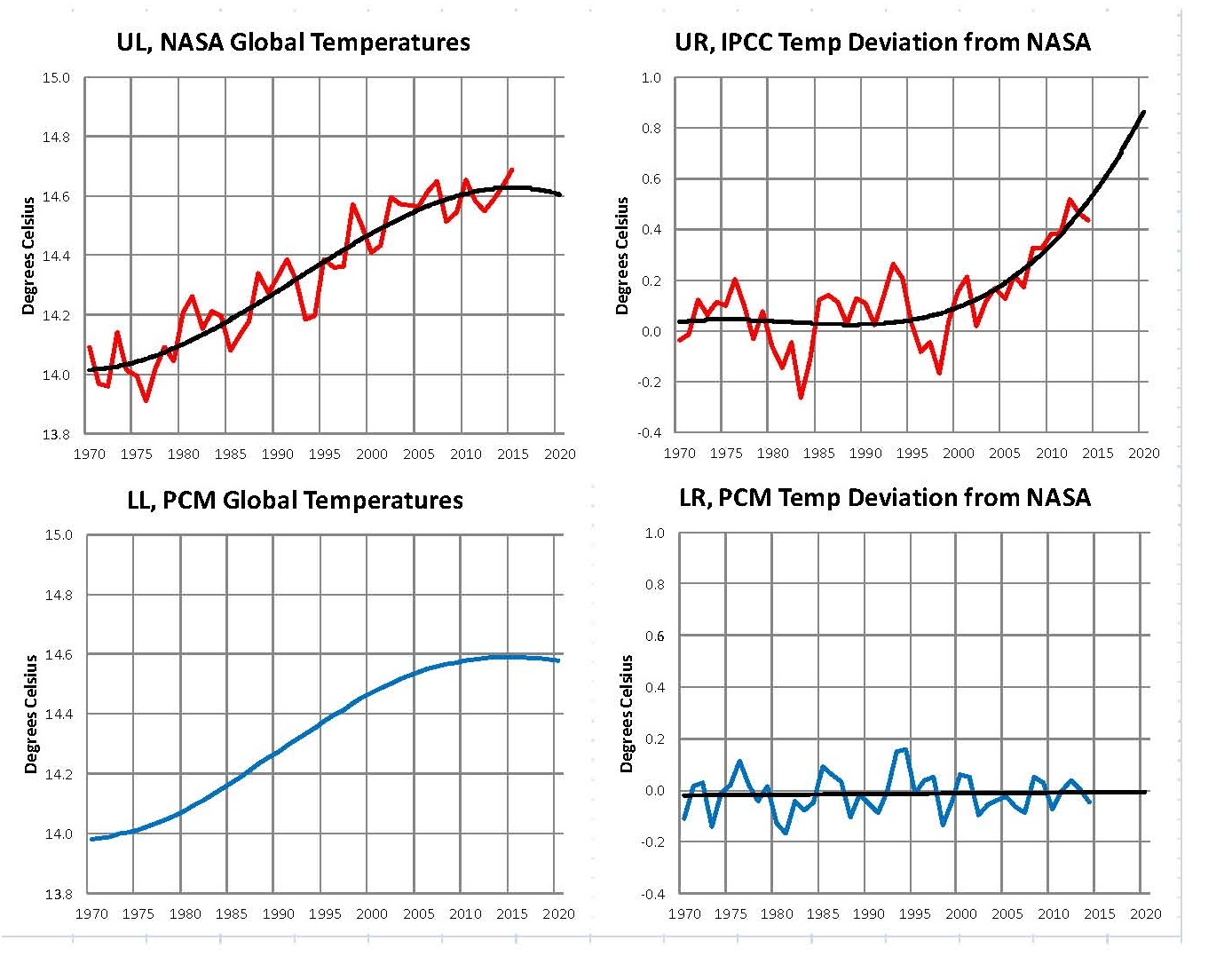
The first plot, UL is a plot of the NASA temperature anomaly converted to degrees Celsius and shown in red with a black trend line added. There has been a very clear reversal in the upward movement of global temperatures since about 2001 and neither the UN IPCC nor anyone else has an explanation for this 13 years later. Since CO2 has continued to increase at what could be argued an increasing rate this raises serious doubts about the logic programmed into all the IPCC global climate models.

The next plot UR, also in red, shows the IPCC estimates of what the Global temperature should be, based on Hansen’s Scenario B, with the NASA actual temperatures’ subtracted from them. Therefore this plot represents a deviation from what the Climate “believers” KNOW what the temperature should be; with a positive value indicating the IPCC values are higher than actual and a negative value indicating the IPCC values are lower than actual, as measured by NASA. A black trend line is added and we can clearly see that the deviation from expected is increasing at an increasing rate. This makes sense since the IPCC models project increased temperatures based primarily on the increasing level of CO2 in the earth’s atmosphere. Unfortunately, for them, the actual temperatures from NASA are trending down (even as they try to hide the down ward movement with data manipulation) since other factors are in play, therefore each year the gap between them widens. Since we have 13 years of observations’ showing this pattern it becomes hard to justify a continuing belief in the IPCC climate models, there is obviously something very wrong here.

The next plot LL shown in blue is based on the equations in the PCM climate model described in previous papers and posts here and since it is generated by “equations” a trend line is not needed. As can be seen the PCM, LL, and the NASA, UL, trend plots are very similar the reason being that in the PCM model there is a 68.2 year cycle that moves the trend line up and then down a total of .30O Celsius (currently negative .0070O Celsius per year); and we are now in the downward portion of that trend which will continue until around 2035. This short cycle is clearly observed in the raw NASA data in the LOTI table going back to 1868. Then there is a long trend, 1052.6 years with an up and down of 1.36O Celsius (currently plus .0029O Celsius per year) also observed in the NASA data. Lastly there is CO2 adding about .005O Celsius per year so they basically wash out which matches the current holding pattern we are experiencing. However within a few years the increasing downward trend of the short cycle will overpower the other two and we will see drop of about .002O Celsius per year and that will be increasing until till around 2025 or so. After about 2035 the short cycle will have bottomed and turn up and all three will be on the upswing again. These are all round numbers shown here as representative values.

The last plot LR in blue uses the same logic as used in the UR plot, here we use the PCM estimates of what the Global temperature should be with the NASA actual temperatures’ subtracted from them. A positive value indicates the PCM values are higher than actual and a negative value indicates the PCM values are lower than expected. A black trend line was added and it clearly shows that the PCM model is tracking the NASA actual values very closely. In, fact since 1970 the PCM model has rarely been off by more than +/- .1 degrees Celsius and has an average trend of almost zero error, while the IPCC models are erratic and are now approaching an error rate of +.5O above expected.

In summary, the IPCC models were designed before a true picture of the world’s climate was understood. During the 1980’s and 1990’s CO2 levels were going up and the world temperature was also going up so there appeared to be correlation and causation. The mistake that was made was looking at only a ~20 year period when the real variations in climate move in much longer cycles. Those other cycles can be observed in the NASA data but they were ignored for some reason. By ignoring those trends and focusing only on CO2 the models will be unable to correctly plot global temperatures until they are fixed.

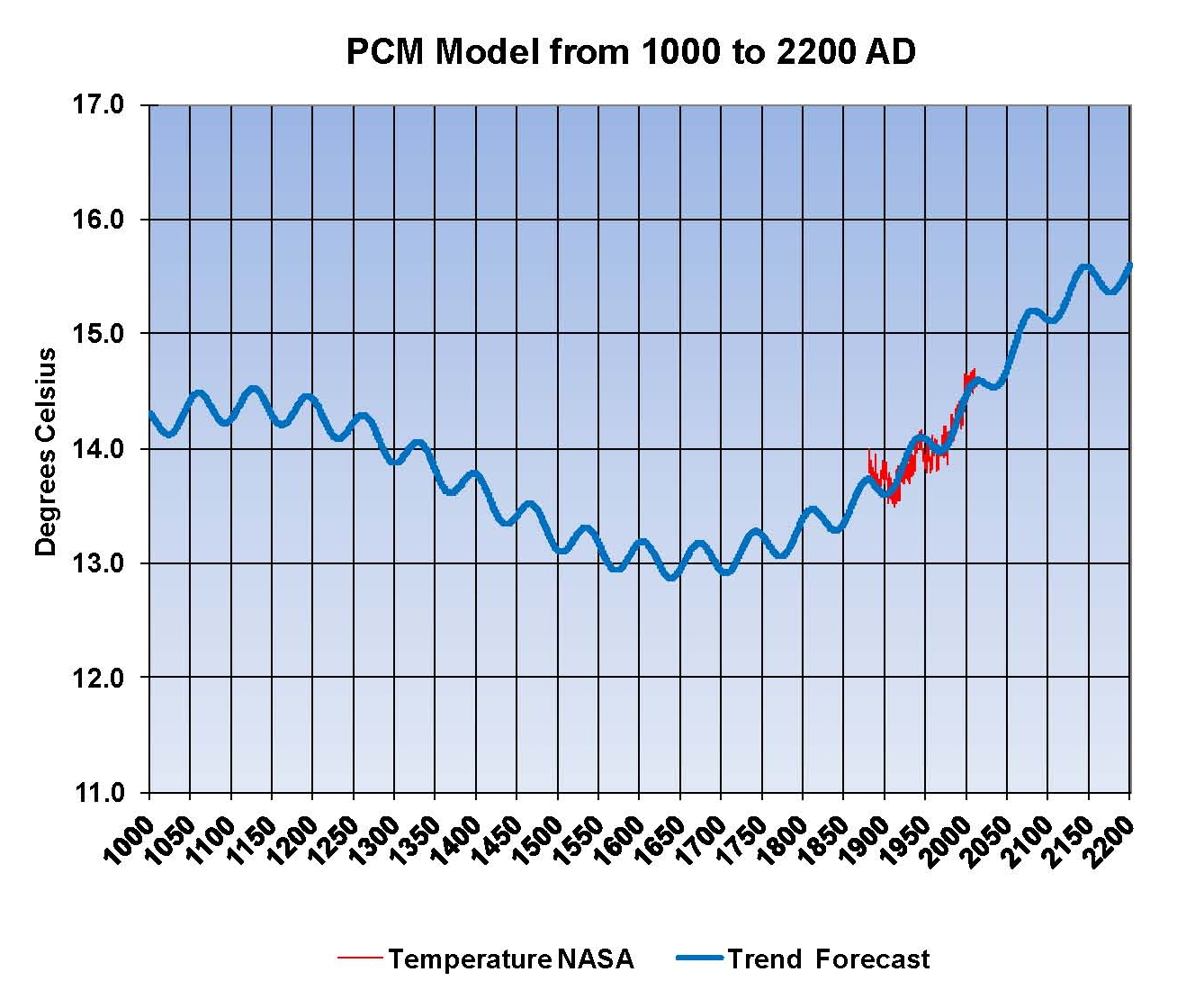
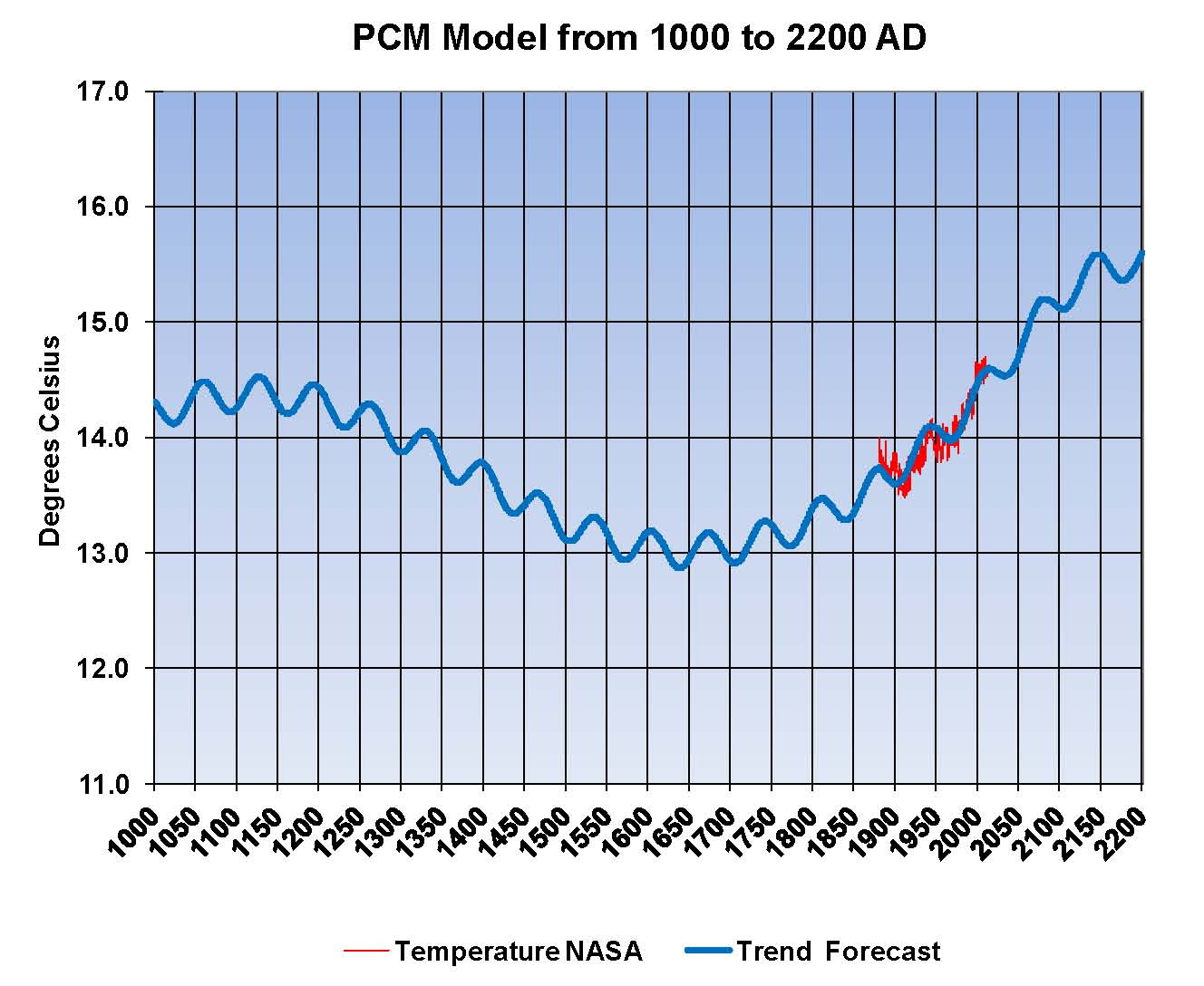
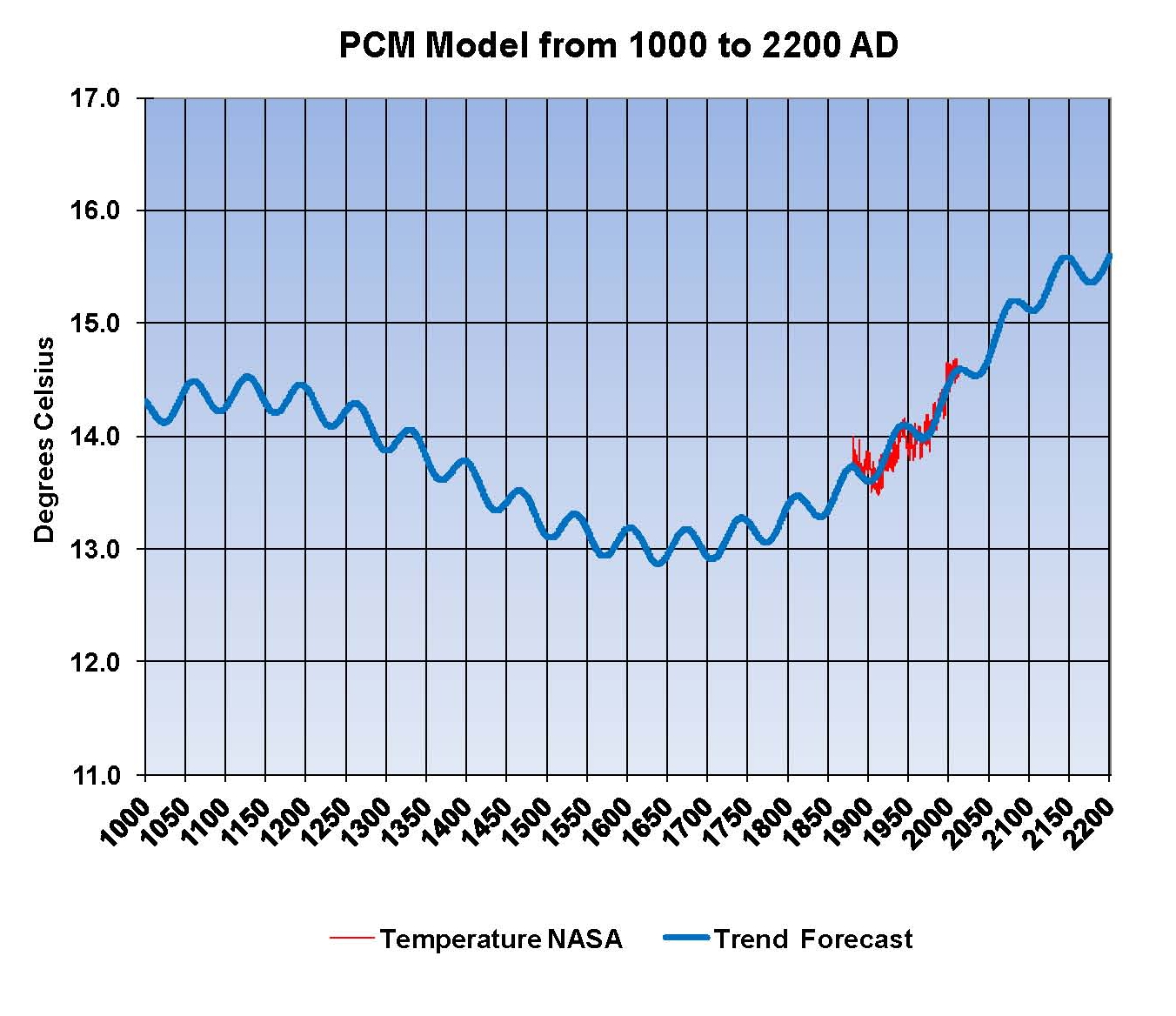
Lastly the next Chart shows what a plot of the PCM model would look like from the year 1000 to the year 2200. The plot matches reasonably well with history and fits the current NASA-GISS table LOTI date very closely, despite homogenization. I understand that this model is not based on physics but it is also not curve fitting. It’s based on observed reoccurring patterns in the climate. These patterns can be modeled and when they are you get a plot that works better than any of the IPCC’s GCM’s. If the conditions that create these patterns do not change and CO2 continues to increase to 800 ppm or even 1000 ppm than this model will work into the foreseeable future. One hundred fifty years from now global temperatures will peak at around 15.5 to 15.7 degrees C and then will be on the downside of the long cycle for the next 500 years. The overall effect of CO2 reaching levels of 1000 ppm or even higher will be between 1.0 and 1.5 degrees C which is about the same as that of the long cycle.

Carbon Dioxide is not capable of doing what Hansen and Gore claim!

000 2015-05 b

The purpose of this post is to make people aware of the errors inherent in the IPCC models so that they can be corrected.

The Obama administration’s “Need” for a binding UN climate treaty with mandated CO2 reductions in Europe and America means there will be such a resolution presented at the COP12 conference in Paris in December. To support this NASA will be forced to show ever increasing global temperatures for the rest of 2015 that will make less and less sense based on observations and satellite data which will all be dismissed or ignored.

Sir Karl Raimund Popper (28 July 1902 – 17 September 1994) was an Austrian and British philosopher and a professor at the London School of Economics. He is considered one of the most influential philosophers of science of the 20th century, and he also wrote extensively on social and political philosophy. The following quotes of his apply to this subject.

If we are uncritical we shall always find what we want: we shall look for, and find, confirmations, and we shall look away from, and not see, whatever might be dangerous to our pet theories.

Whenever a theory appears to you as the only possible one, take this as a sign that you have neither understood the theory nor the problem which it was intended to solve.

… (S)cience is one of the very few human activities — perhaps the only one — in which errors are systematically criticized and fairly often, in time, corrected


Analysis of Global Temperature Trends, April 2015 What’s really going on with the Climate?


The analysis and plots shown here are based on the following: first NASA-GISS temperature anomalies (converted to degrees Celsius so non-scientists will understand the plots) as shown in their table LOTI, second James E. Hansen’s Scenario B data, which is the very core of the IPCC Global Climate models (GCM’s) and which was based on a CO2 sensitivity value of 3.0O Celsius, lastly, a plot based on an alternative climate model designated ‘PCM’ and based on a sensitively value of .65O Celsius.

An explanation of the alternative model designated PCM is in order since many have interpreted this PCM model as a statistical least squares projection of some kind and nothing could be further from the truth. A decade ago when I started this work the first thing I did was look at geological temperature changes since it is well known that the climate is not a constant; I learned that in my undergrad geology and climatology courses in 1964. One quickly finds that there is a clear movement in global temperatures with a 1,000 some year cycle going back at least 3,000 to 4,000 years; probably because of the apsidal precession of about 21,000 years for a complete cycle. However about every 10,000 years the seasons are reversed making the winter colder and the summer warmer (northern hemisphere) 10,000 years from now. There are also 60 to 70 year cycles in the Pacific and the Atlantic oceans that are well documented. We also know that there are greenhouse gases such as Carbon Dioxide and the National Academy of Sciences (NAS) estimated that Carbon Dioxide had a doubling rate of 3.0O Celsius plus or minus 1.5O Celsius in 1979

The IPCC still uses the NAS 3.0O Celsius as the sensitivity value of Carbon Dioxide and a number in that range is required to make the IPCC GCM’s work. The problem with using this value is it leaves no room for other factors and hence the need of the infamous Hockey Stick plots of the IPCC from Mann, Bradley & Hughes in 1999. The PCM model is based on a much lower value for Carbon Dioxide consistent with current research which places the value between 0.65O and 1.5O Celsius per doubling of Carbon Dioxide. If the long and short movement in temperatures and a lower value for Carbon Dioxide are properly analyzed and combined a plot that matched historical and current (non manipulated) NASA temperature estimates very well can be constructed. This is not curve fitting.

The PCM model is such a construct and it is not based on statistical analyses of raw data. It is based on creating curves that match observations (which is real science) and those observations appear to be related to the movement of water in the world’s oceans. The movements of ocean currents is well documented in the literature all that was done here was properly combine the separate variables into one curve which had not been previously done. Since this combined curve is an excellent predictor of global temperatures unlike the IPCC GCM’s it appears to reflect reality a bit better than the convoluted IPCC GCM’s which after the past 19 years of no statistical warming have been shown to be in error.

Now, to smooth out highly erratic monthly variations a 12 month running average is used in all the plots. This information will be shown in four tables and updated each month as the new data comes in about the middle of the month. Since no model or simulation that cannot reasonably predict that which it was design to do is worth anything the information presented here definitively proves that NASA, NOAA and the IPCC just don’t have a clue.

000 2015-04 a

The first plot, UL is a plot of the NASA temperature anomaly converted to degrees Celsius and shown in red with a black trend line added. There has been a very clear reversal in the upward movement of global temperatures since about 2001 and neither the UN IPCC nor anyone else has an explanation for this 13 years later. Since CO2 has continued to increase at what could be argued an increasing rate this raises serious doubts about the logic programmed into all the IPCC global climate models.

The next plot UR, also in red, shows the IPCC estimates of what the Global temperature should be, based on Hansen’s Scenario B, with the NASA actual temperatures’ subtracted from them. Therefore this plot represents a deviation from what the Climate “believers” KNOW what the temperature should be; with a positive value indicating the IPCC values are higher than actual and a negative value indicating the IPCC values are lower than actual, as measured by NASA. A black trend line is added and we can clearly see that the deviation from expected is increasing at an increasing rate. This makes sense since the IPCC models project increased temperatures based primarily on the increasing level of CO2 in the earth’s atmosphere. Unfortunately, for them, the actual temperatures from NASA are trending down (even as they try to hide the down ward movement with data manipulation) since other factors are in play, therefore each year the gap between them widens. Since we have 13 years of observations’ showing this pattern it becomes hard to justify a continuing belief in the IPCC climate models, there is obviously something very wrong here.

The next plot LL shown in blue is based on the equations in the PCM climate model described in previous papers and posts here and since it is generated by “equations” a trend line is not needed. As can be seen the PCM, LL, and the NASA, UL, trend plots are very similar the reason being that in the PCM model there is a 68.2 year cycle that moves the trend line up and then down a total of .30O Celsius (currently negative .0070O Celsius per year); and we are now in the downward portion of that trend which will continue until around 2035. This short cycle is clearly observed in the raw NASA data in the LOTI table going back to 1868. Then there is a long trend, 1052.6 years with an up and down of 1.36O Celsius (currently plus .0029O Celsius per year) also observed in the NASA data. Lastly there is CO2 adding about .005O Celsius per year so they basically wash out which matches the current holding pattern we are experiencing. However within a few years the increasing downward trend of the short cycle will overpower the other two and we will see drop of about .002O Celsius per year and that will be increasing until till around 2025 or so. After about 2035 the short cycle will have bottomed and turn up and all three will be on the upswing again. These are all round numbers shown here as representative values.

The last plot LR in blue uses the same logic as used in the UR plot, here we use the PCM estimates of what the Global temperature should be with the NASA actual temperatures’ subtracted from them. A positive value indicates the PCM values are higher than actual and a negative value indicates the PCM values are lower than expected. A black trend line was added and it clearly shows that the PCM model is tracking the NASA actual values very closely. In, fact since 1970 the PCM model has rarely been off by more than +/- .1 degrees Celsius and has an average trend of almost zero error, while the IPCC models are erratic and are now approaching an error rate of +.5O above expected.

In summary, the IPCC models were designed before a true picture of the world’s climate was understood. During the 1980’s and 1990’s CO2 levels were going up and the world temperature was also going up so there appeared to be correlation and causation. The mistake that was made was looking at only a ~20 year period when the real variations in climate move in much longer cycles. Those other cycles can be observed in the NASA data but they were ignored for some reason. By ignoring those trends and focusing only on CO2 the models will be unable to correctly plot global temperatures until they are fixed.

Lastly the next Chart shows what a plot of the PCM model would look like from the year 1000 to the year 2200. The plot matches reasonably well with history and fits the current NASA-GISS table LOTI date very closely, despite homogenization. I understand that this model is not based on physics but it is also not curve fitting. It’s based on observed reoccurring patterns in the climate. These patterns can be modeled and when they are you get a plot that works better than any of the IPCC’s GCM’s. If the conditions that create these patterns do not change and CO2 continues to increase to 800 ppm or even 1000 ppm than this model will work into the foreseeable future. One hundred fifty years from now global temperatures will peak at around 15.5 to 15.7 degrees C and then will be on the downside of the long cycle for the next 500 years. The overall effect of CO2 reaching levels of 1000 ppm or even higher will be between 1.0 and 1.5 degrees C which is about the same as that of the long cycle.

Carbon Dioxide is not capable of doing what Hansen and Gore claim!

000 2015-04 b

The purpose of this post is to make people aware of the errors inherent in the IPCC models so that they can be corrected.

The Obama administration’s “Need” for a binding UN climate treaty with mandated CO2 reductions in Europe and America means there will be such a resolution presented at the COP12 conference in Paris in December. To support this NASA will be forced to show ever increasing global temperatures for the rest of 2015 that will make less and less sense based on observations and satellite data which will all be dismissed or ignored.

Sir Karl Raimund Popper (28 July 1902 – 17 September 1994) was an Austrian and British philosopher and a professor at the London School of Economics. He is considered one of the most influential philosophers of science of the 20th century, and he also wrote extensively on social and political philosophy. The following quotes of his apply to this subject.

If we are uncritical we shall always find what we want: we shall look for, and find, confirmations, and we shall look away from, and not see, whatever might be dangerous to our pet theories.

Whenever a theory appears to you as the only possible one, take this as a sign that you have neither understood the theory nor the problem which it was intended to solve.

… (S)cience is one of the very few human activities — perhaps the only one — in which errors are systematically criticized and fairly often, in time, corrected

Analysis of Global Temperature Trends, March 2015 What’s really going on with the Climate?


The analysis and plots shown here are based on the following: first NASA-GISS temperature anomalies (converted to degrees Celsius so non-scientists will understand the plots) as shown in their table LOTI, second James E. Hansen’s Scenario B data, which is the very core of the IPCC Global Climate models (GCM’s) and which was based on a CO2 sensitivity value of 3.0O Celsius, lastly, a plot based on an alternative climate model designated ‘PCM’ and based on a sensitively value of .65O Celsius.

An explanation of the alternative model designated PCM is in order since many have interpreted this PCM model as a statistical least squares projection of some kind and nothing could be further from the truth. A decade ago when I started this work the first thing I did was look at geological temperature changes since it is well known that the climate is not a constant; I learned that in my undergrad geology and climatology courses in 1964. One quickly finds that there is a clear movement in global temperatures with a 1,000 some year cycle going back at least 3,000 to 4,000 years; probably because of the apsidal precession of about 21,000 years for a complete cycle. However about every 10,000 years the seasons are reversed making the winter colder and the summer warmer (northern hemisphere) 10,000 years from now. There are also 60 to 70 year cycles in the Pacific and the Atlantic oceans that are well documented. We also know that there are greenhouse gases such as Carbon Dioxide and the National Academy of Sciences (NAS) estimated that Carbon Dioxide had a doubling rate of 3.0O Celsius plus or minus 1.5O Celsius in 1979

The IPCC still uses the NAS 3.0O Celsius as the sensitivity value of Carbon Dioxide and a number in that range is required to make the IPCC GCM’s work. The problem with using this value is it leaves no room for other factors and hence the need of the infamous Hockey Stick plots of the IPCC from Mann, Bradley & Hughes in 1999. The PCM model is based on a much lower value for Carbon Dioxide consistent with current research which places the value between 0.65O and 1.5O Celsius per doubling of Carbon Dioxide. If the long and short movement in temperatures and a lower value for Carbon Dioxide are properly analyzed and combined a plot that matched historical and current (non manipulated) NASA temperature estimates very well can be constructed. This is not curve fitting.

The PCM model is such a construct and it is not based on statistical analyses of raw data. It is based on creating curves that match observations (which is real science) and those observations appear to be related to the movement of water in the world’s oceans. The movements of ocean currents is well documented in the literature all that was done here was properly combine the separate variables into one curve which had not been previously done. Since this combined curve is an excellent predictor of global temperatures unlike the IPCC GCM’s it appears to reflect reality a bit better than the convoluted IPCC GCM’s which after the past 19 years of no statistical warming have been shown to be in error.

Now, to smooth out highly erratic monthly variations a 12 month running average is used in all the plots. This information will be shown in four tables and updated each month as the new data comes in about the middle of the month. Since no model or simulation that cannot reasonably predict that which it was design to do is worth anything the information presented here definitively proves that NASA, NOAA and the IPCC just don’t have a clue.

000 2015-03 a

The first plot, UL is a plot of the NASA temperature anomaly converted to degrees Celsius and shown in red with a black trend line added. There has been a very clear reversal in the upward movement of global temperatures since about 2001 and neither the UN IPCC nor anyone else has an explanation for this 13 years later. Since CO2 has continued to increase at what could be argued an increasing rate this raises serious doubts about the logic programmed into all the IPCC global climate models.

The next plot UR, also in red, shows the IPCC estimates of what the Global temperature should be, based on Hansen’s Scenario B, with the NASA actual temperatures’ subtracted from them. Therefore this plot represents a deviation from what the Climate “believers” KNOW what the temperature should be; with a positive value indicating the IPCC values are higher than actual and a negative value indicating the IPCC values are lower than actual, as measured by NASA. A black trend line is added and we can clearly see that the deviation from expected is increasing at an increasing rate. This makes sense since the IPCC models project increased temperatures based primarily on the increasing level of CO2 in the earth’s atmosphere. Unfortunately, for them, the actual temperatures from NASA are trending down (even as they try to hide the down ward movement with data manipulation) since other factors are in play, therefore each year the gap between them widens. Since we have 13 years of observations’ showing this pattern it becomes hard to justify a continuing belief in the IPCC climate models, there is obviously something very wrong here.

The next plot LL shown in blue is based on the equations in the PCM climate model described in previous papers and posts here and since it is generated by “equations” a trend line is not needed. As can be seen the PCM, LL, and the NASA, UL, trend plots are very similar the reason being that in the PCM model there is a 68.2 year cycle that moves the trend line up and then down a total of .30O Celsius (currently negative .0070O Celsius per year); and we are now in the downward portion of that trend which will continue until around 2035. This short cycle is clearly observed in the raw NASA data in the LOTI table going back to 1868. Then there is a long trend, 1052.6 years with an up and down of 1.36O Celsius (currently plus .0029O Celsius per year) also observed in the NASA data. Lastly there is CO2 adding about .005O Celsius per year so they basically wash out which matches the current holding pattern we are experiencing. However within a few years the increasing downward trend of the short cycle will overpower the other two and we will see drop of about .002O Celsius per year and that will be increasing until till around 2025 or so. After about 2035 the short cycle will have bottomed and turn up and all three will be on the upswing again. These are all round numbers shown here as representative values.

The last plot LR in blue uses the same logic as used in the UR plot, here we use the PCM estimates of what the Global temperature should be with the NASA actual temperatures’ subtracted from them. A positive value indicates the PCM values are higher than actual and a negative value indicates the PCM values are lower than expected. A black trend line was added and it clearly shows that the PCM model is tracking the NASA actual values very closely. In, fact since 1970 the PCM model has rarely been off by more than +/- .1 degrees Celsius and has an average trend of almost zero error, while the IPCC models are erratic and are now approaching an error rate of +.5O above expected.

In summary, the IPCC models were designed before a true picture of the world’s climate was understood. During the 1980’s and 1990’s CO2 levels were going up and the world temperature was also going up so there appeared to be correlation and causation. The mistake that was made was looking at only a ~20 year period when the real variations in climate move in much longer cycles. Those other cycles can be observed in the NASA data but they were ignored for some reason. By ignoring those trends and focusing only on CO2 the models will be unable to correctly plot global temperatures until they are fixed.

Lastly the next Chart shows what a plot of the PCM model would look like from the year 1000 to the year 2200. The plot matches reasonably well with history and fits the current NASA-GISS table LOTI date very closely, despite homogenization. I understand that this model is not based on physics but it is also not curve fitting. It’s based on observed reoccurring patterns in the climate. These patterns can be modeled and when they are you get a plot that works better than any of the IPCC’s GCM’s. If the conditions that create these patterns do not change and CO2 continues to increase to 800 ppm or even 1000 ppm than this model will work into the foreseeable future. One hundred fifty years from now global temperatures will peak at around 15.5 to 15.7 degrees C and then will be on the downside of the long cycle for the next 500 years. The overall effect of CO2 reaching levels of 1000 ppm or even higher will be between 1.0 and 1.5 degrees C which is about the same as that of the long cycle.

Carbon Dioxide is not capable of doing what Hansen and Gore claim!

000 2015-03 b

The purpose of this post is to make people aware of the errors inherent in the IPCC models so that they can be corrected.

The Obama administration’s “Need” for a binding UN climate treaty with mandated CO2 reductions in Europe and America means there will be such a resolution presented at the COP12 conference in Paris in December. To support this NASA will be forced to show ever increasing global temperatures for the rest of 2015 that will make less and less sense based on observations and satellite data which will all be dismissed or ignored.

Sir Karl Raimund Popper (28 July 1902 – 17 September 1994) was an Austrian and British philosopher and a professor at the London School of Economics. He is considered one of the most influential philosophers of science of the 20th century, and he also wrote extensively on social and political philosophy. The following quotes of his apply to this subject.

If we are uncritical we shall always find what we want: we shall look for, and find, confirmations, and we shall look away from, and not see, whatever might be dangerous to our pet theories.

Whenever a theory appears to you as the only possible one, take this as a sign that you have neither understood the theory nor the problem which it was intended to solve.

… (S)cience is one of the very few human activities — perhaps the only one — in which errors are systematically criticized and fairly often, in time, corrected

Is Man-made Climate Change Real #8?


Part Eight Issues with Determining what the Blackbody Temperature of the Earth is.

In Part Two we discussed how the temperature of the planet was determined starting with the Blackbody temperature which is based on incoming solar radiation primarily in the visible and near visible frequencies. All the energy that is absorbed by the planet must, by the principles of science, eventually escape into space or the planet would have melted a long time ago. Therefore the energy emitted by the planet must equal the energy absorbed by the planet and we can calculate this using the Stefan-Boltzmann Law and that was also shown in Part Two. Using the Stefan-Boltzmann Law we determined that the planets Blackbody temperature was 254.36O Kelvin which corresponds to -18.79O Celsius or -1.82O Fahrenheit. Although this is true it’s a bit misleading since the planet is a sphere, its axis is tilted, its spinning and it contains a significant amount of water on the surface.

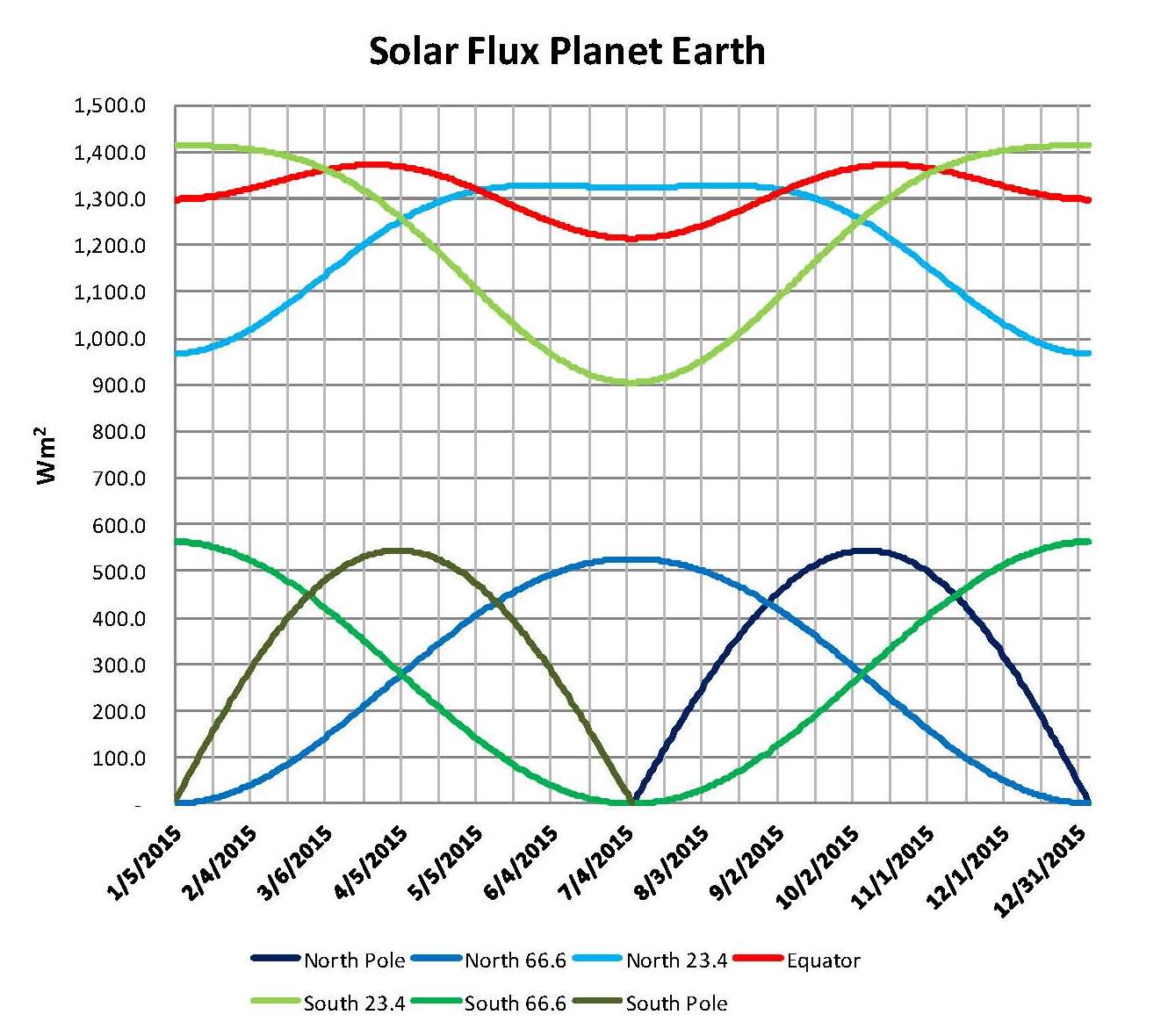
Why this matters is the result of the thermal properties of the actual diverse surfaces of the planet which are not consistent and this creates large thermal flows in the atmosphere and the oceans as the planet tries to equalize the incoming energy in the form of heat to achieve a true uniform global temperature; which by the way is not even possible. Much of this retention and movement of heat is what we call the greenhouse effect, climate and weather. To appreciate the complexity of the thermal flows let’s look at what the energy reaching the planet looks like ignoring the atmospheric clouds, water in the oceans, and the albedo in general, a perfectly round ball of rock with a magnetic field and an atmosphere of pure nitrogen. The plots shown here are not “exact” but should be very close considering the problems with orbital variations, axial orientation changes and 365.25 days per year.

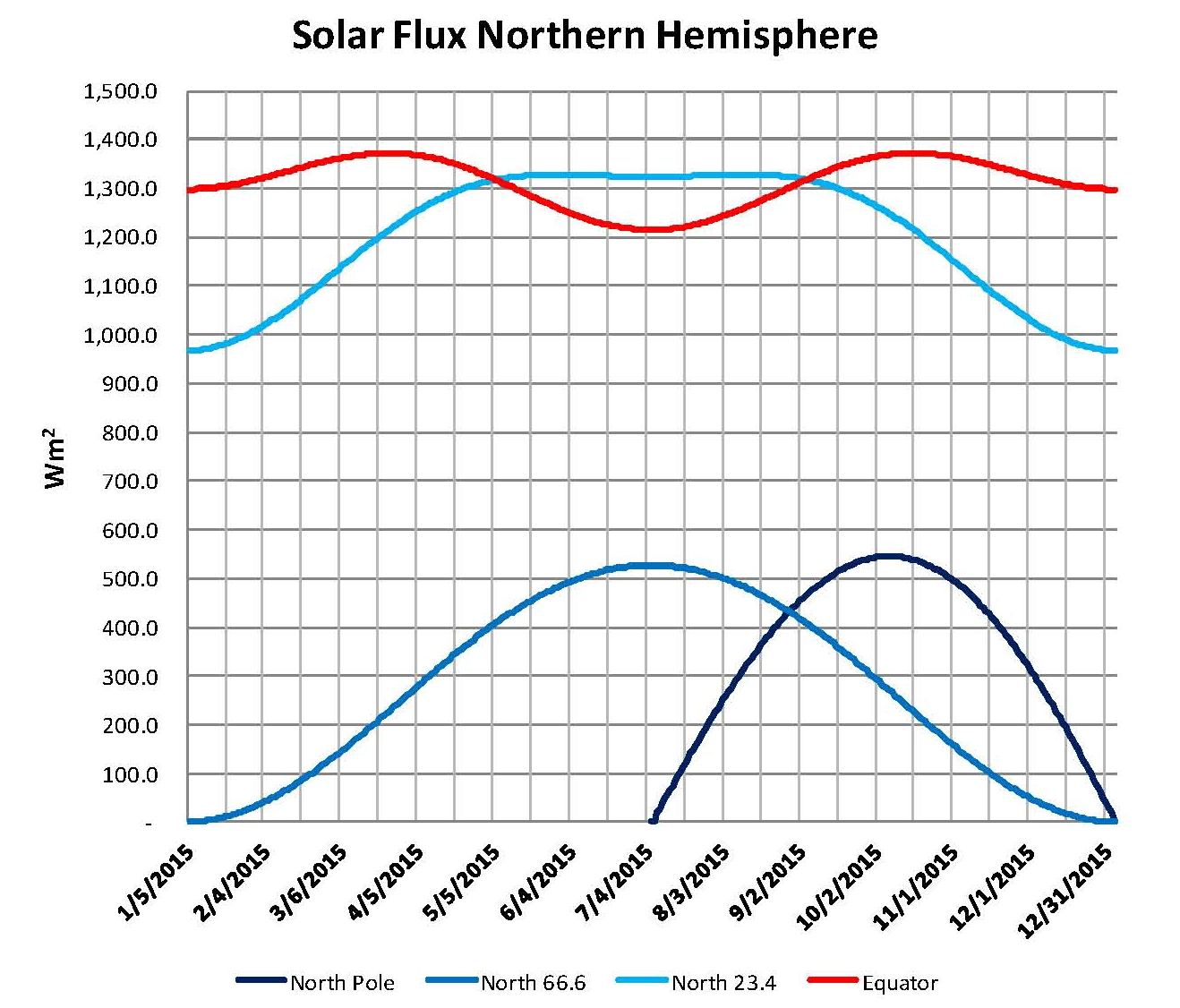
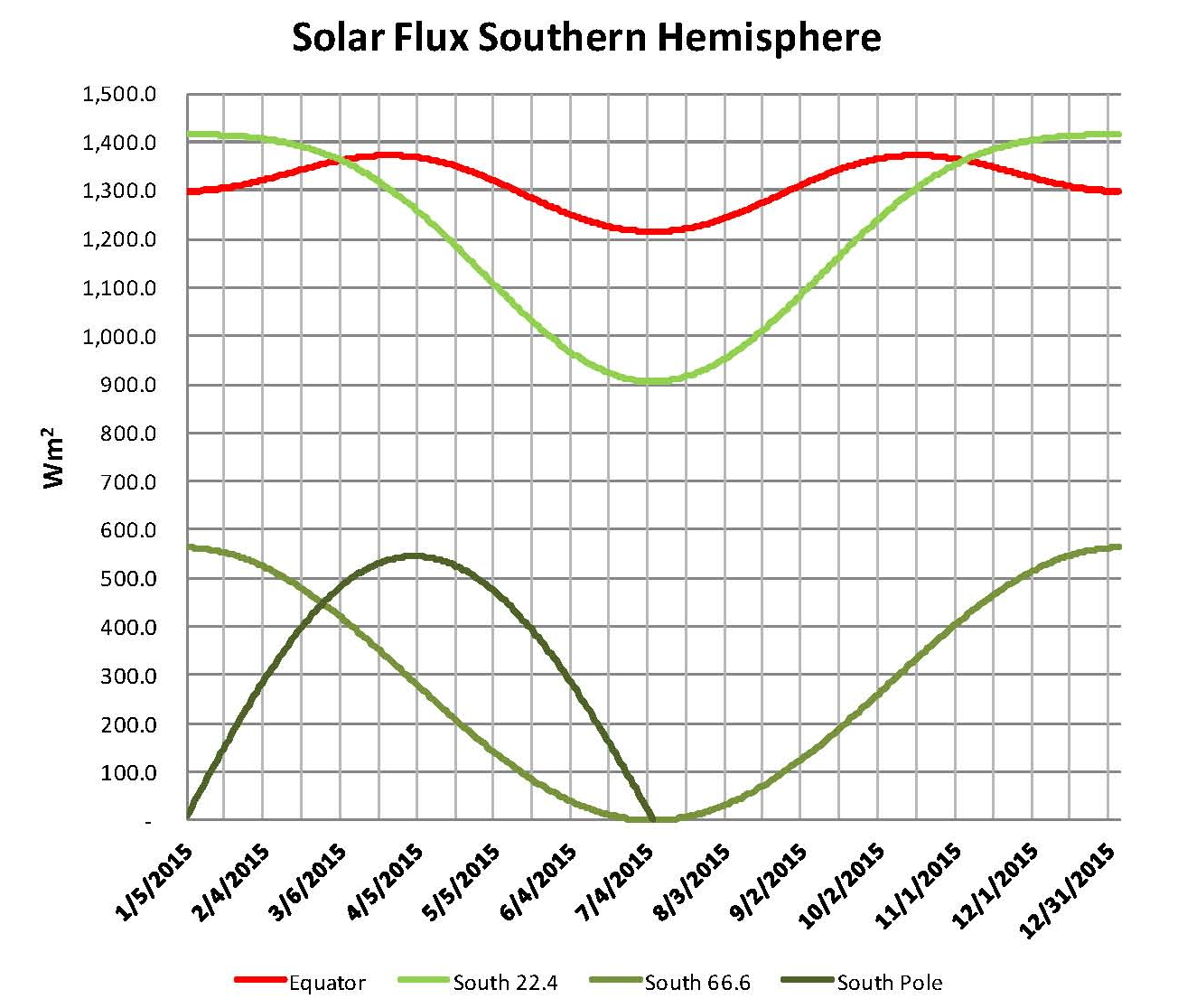
The first Chart, is of Northern Hemisphere and is a plot of the energy reaching the planet in three different areas; the equator shown in red, the Tropic of Cancer (23.4 degrees north latitude) shown in light blue, the Arctic circle (66.6 degrees north latitude shown in medium blue and the North pole shown in dark blue. Because of the tilt of the planets axis of 23.4 degrees there is a very large difference in the amount of solar flux that reaches the planet’s surface in the higher latitudes. We know that above the Arctic Circle there is total darkness for half the year, well that also means no heat energy arrives there either and this is clearly shown in these Charts.

Obviously the majority of the energy reaching the planet from the sun comes in between the equator and the Tropic of cancer; further we can see that the least energy is received in the first quarter of the year and the second least is in the four quarter. Second and third quarters have the most energy coming in. This unequal distribution of energy creates a thermal flow from the equator to the pole and because most of the land on the planet is also in the Northern hemisphere, where we are, that means that we see this energy flow and some assume that its climate change both because of the movement north of heat and also because of variations in the albedo (how much gets reflected back before reaching the surface) reaching the planet by cloud formation.

000-pt8-01 Anomalies

The Second Chart, is of the Southern Hemisphere and it is also a plot of the energy reaching the planet in three different areas; the equator shown in red, the Tropic of Capricorn (23.4 degrees south latitude) shown in light green, the Antarctic Circle (66.6 degrees south latitude shown in medium green and the South pole shown in dark green. This Chart is very similar to that of the north but reversed, just flipped winter and summer.

Obviously the majority of the energy reaching the planet from the sun comes in between the equator and the Tropic of Capricorn; further we can see that the least energy is received in the second and third quarters and fourth and first quarters have the most energy coming. This unequal distribution of energy also creates a thermal flow from the equator to the pole and because most of the water on the planet is in the Southern hemisphere that means that we don’t see this energy flow as much since it dampened by all the water although there still is a flow south of heat. We also have a large land mass at the South Pole with most of the planets ice stored there making this the coldest place on the planet as there is no water underneath the ice.

000-pt8-02 Anomalies

Putting these previous two Charts together we have the next Chart showing both the North and South Hemispheres together. Looking at this Chart one could say that it looks like the average energy input would be between 700 and 800 W/m2 but this Chart is really just the side facing the Sun the other side gets nothing so half of that or ~350 W/m2 would be more accurate, and the actual value is 342 W/m2 so we have a confirmation of that guess.

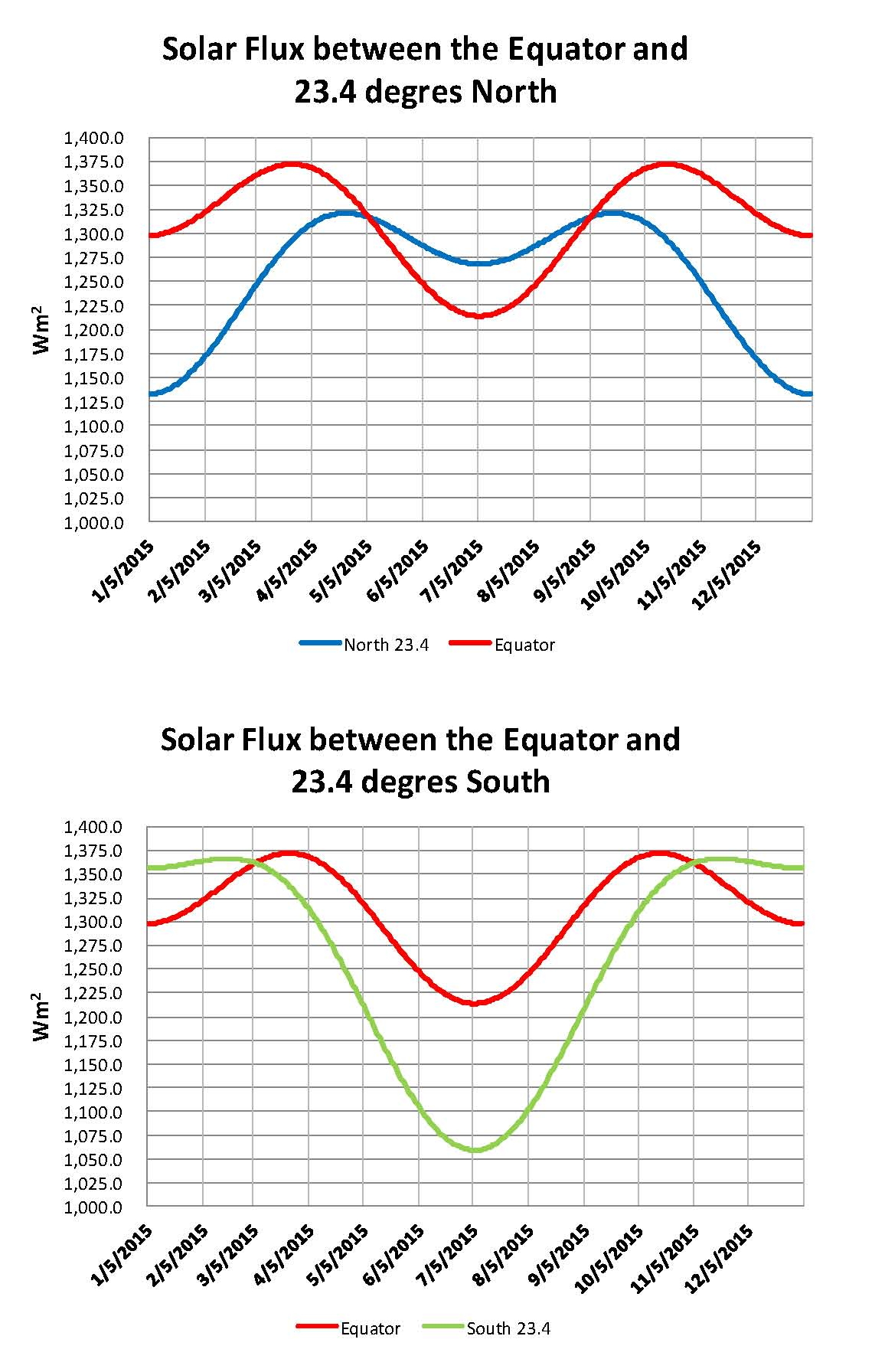
The plots of the Tropics of Cancer and Capricorn are interesting as there is a large difference between them because of the axial tilt of 23.44 degrees of the planet in relationship to the earth being 147,098,290 Km at Perihelion from the sun and being 152,098,232 Km from the sun at Aphelion. This effect is interesting since there is an approximate 10,000 year cycle to the orientation of the earth’s axis to the Perihelion (close) and Aphelion (far). In other words the patterns shown here will be reversed in 10,000 years and it will be hotter in the summer and colder in the winter in the northern hemisphere. I think this could explain the 1000 year warm cool cycle that we see developing around 4,000 years ago.

000-pt8-03 Anomalies

The next two Charts shows the differences between the Northern and Southern hemispheres in the areas where the Solar Flux is the strongest, in more detail. Because the Earth is closest to the sun in the Northern Hemispheres Winter and the North pole is pointed away from the Sun the difference between the winters and summers are small; while in the Southern Hemisphere the Earth is farther from the Sun in the Summer when the South pole is pointed toward the Sun and so the difference between Winter and summer is largest. Offsetting this is the fact that the southern hemisphere is mostly water which mitigates the differential.

000-pt8-04 Anomalies

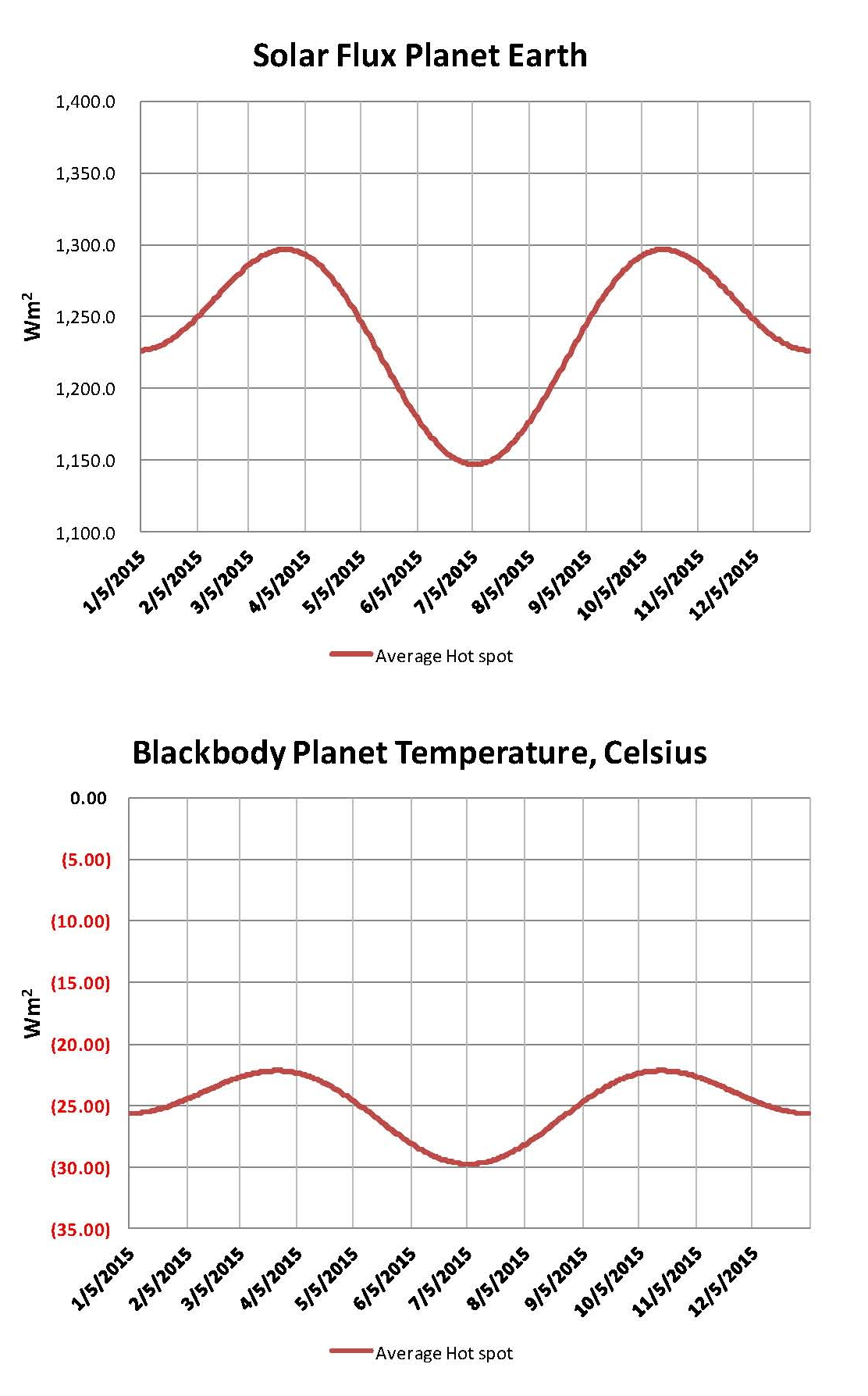
The next chart two Charts are based on an average of the values shown here for the Tropic of Cancer, the equator and the Tropic of Capricorn. However since the Earth is a sphere picking three lines is not the same are calculating the actual area and averaging that. So these Charts are good only to shows a relationship not an actual value. However, having said that what is shown is not all that far off since the actual area involved is close to equal.

The first Chart shows W/m2 in the area around the equator and the second Chart shows the W/m2 converted to degrees Celsius using the Stefan-Boltzmann Law. Looking at the scales on both charts you will find that on the first chart W/m2 there is a ~4% change in solar radiation and in the second Chart degrees Celsius there is a ~16% change because the Stefan-Boltzmann Law has a 4th power relationship from W/m2 to degrees Celsius.

000-pt8-05 Anomalies

The current (February 2015) global temperature according to NASA is 14.79 degrees Celsius and the generally accepted value for the total greenhouse effect is 33 degrees Celsius. So that makes the blackbody temperature -18.21 degrees Celsius; which is in general agreement with the scientific literature. This simple method used above, which was not meant to calculate the blackbody temperature, isn’t all that far off from the real number being about ~8 degrees C to low.

Analysis of Global Temperature Trends, February 2015. What’s really going on with the Climate?


Last month I published that January would be my last Post of this kind because the NASA data tampering was getting to bad to use to measure global temperature. A week later I realized I had used the wrong table and although the data tampering is still there it’s not as bad as I thought so I published a correction on this blog. This post resumes what I have been doing since January 2014.

The analysis and plots shown here are based on the following: first NASA-GISS temperature anomalies (converted to degrees Celsius so non-scientists will understand the plots) as shown in their table LOTI, second James E. Hansen’s Scenario B data, which is the very core of the IPCC Global Climate models (GCM’s) and which was based on a CO2 sensitivity value of 3.0O Celsius, lastly, a plot based on an alternative climate model designated ‘PCM’ and based on a sensitively value of .65O Celsius.

An explanation of the alternative model designated PCM is in order since many have interpreted this PCM model as a statistical least squares projection of some kind and nothing could be further from the truth. A decade ago when I started this work the first thing I did was look at geological temperature changes since it is well known that the climate is not a constant; I learned that in my undergrad climatology course in 1964. One quickly finds that there is a clear movement in global temperatures with a 1,000 some year cycle going back at least 3,000 to 4,000 years; probably because of the apsidal precession of about 21,000 years for a complete cycle. However about every 10,000 years the seasons are reversed making the winter colder and the summer warmer (northern hemisphere) 10,000 years from now. There are also 60 to 70 year cycles in the Pacific and the Atlantic oceans that are well documented. We also know that there are greenhouse gases such as Carbon Dioxide and the National Academy of Sciences (NAS) estimated that Carbon Dioxide had a doubling rate of 3.0O Celsius plus or minus 1.5O Celsius in 1979

The IPCC still uses the NAS 3.0O Celsius as the sensitivity value of Carbon Dioxide and a number in that range is required to make the IPCC GCM’s work. The problem with using this value is it leaves no room for other factors and hence the need of the infamous Hockey Stick plots of the IPCC from Mann, Bradley & Hughes in 1999. The PCM model is based on a much lower value for Carbon Dioxide consistent with current research which places the value between 0.65O and 1.5O Celsius per doubling of Carbon Dioxide. If the long and short movement in temperatures and a lower value for Carbon Dioxide are properly analyzed and combined a plot that matched historical and current NASA temperature estimates very well can be constructed. This is not curve fitting.

The PCM model is such a construct and it is not based on statistical analyses of raw data. It is based on creating curves that match observations (which is real science) and those observations appear to be related to the movement of water in the world’s oceans. The movements of ocean currents is well documented in the literature all that was done here was properly combine the separate variables into one curve which had not been previously done. Since this combined curve is an excellent predictor of global temperatures unlike the IPCC GCM’s it appears to reflect reality a bit better than the convoluted IPCC GCM’s which after the past 19 years of no statistical warming have been shown to be in error.

Now, to smooth out highly erratic monthly variations a 12 month running average is used in all the plots. This information will be shown in four tables and updated each month as the new data comes in about the middle of the month. Since no model or simulation that cannot reasonably predict that which it was design to do is worth anything the information presented here definitively proves that NASA, NOAA and the IPCC just don’t have a clue.

2015-02-01

The first plot, UL is a plot of the NASA temperature anomaly converted to degrees Celsius and shown in red with a black trend line added. There has been a very clear reversal in the upward movement of global temperatures since about 2001 and neither the UN IPCC nor anyone else has an explanation for this 13 years later. Since CO2 has continued to increase at what could be argued an increasing rate this raises serious doubts about the logic programmed into all the IPCC global climate models.

The next plot UR, also in red, shows the IPCC estimates of what the Global temperature should be, based on Hansen’s Scenario B, with the NASA actual temperatures’ subtracted from them. Therefore this plot represents a deviation from what the Climate “believers” KNOW what the temperature should be; with a positive value indicating the IPCC values are higher than actual and a negative value indicating the IPCC values are lower than actual, as measured by NASA. A black trend line is added and we can clearly see that the deviation from expected is increasing at an increasing rate. This makes sense since the IPCC models project increased temperatures based primarily on the increasing level of CO2 in the earth’s atmosphere. Unfortunately, for them, the actual temperatures from NASA are trending down (even as they try to hide the down ward movement with data manipulation) since other factors are in play, therefore each year the gap between them widens. Since we have 13 years of observations’ showing this pattern it becomes hard to justify a continuing belief in the IPCC climate models, there is obviously something very wrong here.

The next plot LL shown in blue is based on the equations in the PCM climate model described in previous papers and posts here and since it is generated by “equations” a trend line is not needed. As can be seen the PCM, LL, and the NASA, UL, trend plots are very similar the reason being that in the PCM model there is a 68.2 year cycle that moves the trend line up and then down a total of .30O Celsius (currently negative .0070O Celsius per year); and we are now in the downward portion of that trend which will continue until around 2035. This short cycle is clearly observed in the raw NASA data in the LOTI table going back to 1868. Then there is a long trend, 1052.6 years with an up and down of 1.36O Celsius (currently plus .0029O Celsius per year) also observed in the NASA data. Lastly there is CO2 adding about .005O Celsius per year so they basically wash out which matches the current holding pattern we are experiencing. However within a few years the increasing downward trend of the short cycle will overpower the other two and we will see drop of about .002O Celsius per year and that will be increasing until till around 2025 or so. After about 2035 the short cycle will have bottomed and turn up and all three will be on the upswing again. These are all round numbers shown here as representative values.

The last plot LR in blue uses the same logic as used in the UR plot, here we use the PCM estimates of what the Global temperature should be with the NASA actual temperatures’ subtracted from them. A positive value indicates the PCM values are higher than actual and a negative value indicates the PCM values are lower than expected. A black trend line was added and it clearly shows that the PCM model is tracking the NASA actual values very closely. In, fact since 1970 the PCM model has rarely been off by more than +/- .1 degrees Celsius and has an average trend of almost zero error, while the IPCC models are erratic and are now approaching an error rate of +.5O above expected.

In summary, the IPCC models were designed before a true picture of the world’s climate was understood. During the 1980’s and 1990’s CO2 levels were going up and the world temperature was also going up so there appeared to be correlation and causation. The mistake that was made was looking at only a ~20 year period when the real variations in climate move in much longer cycles. Those other cycles can be observed in the NASA data but they were ignored for some reason. By ignoring those trends and focusing only on CO2 the models will be unable to correctly plot global temperatures until they are fixed.

Lastly the next Chart shows what a plot of the PCM model would look like from the year 1000 to the year 2200. The plot matches reasonably well with history and fits the current NASA-GISS table LOTI date very closely, despite homogenization. I understand that this model is not based on physics but it is also not curve fitting. It’s based on observed reoccurring patterns in the climate. These patterns can be modeled and when they are you get a plot that works better than the IPCC’s GCM. If the conditions that create these patterns do not change and CO2 continues to increase to 800 ppm or even 1000 ppm than this model will work into the foreseeable future. One hundred fifty years from now global temperatures will peak at around 15.5 to 15.7 degrees C and then will be on the downside of the long cycle for the next 500 years. The overall effect of CO2 reaching levels of 1000 ppm or even higher will be between 1.0 and 1.5 degrees C which is about the same as that of the long cycle.

Carbon Dioxide is not capable of doing what Hansen and Gore claim!

2015-02-02

The purpose of this post is to make people aware of the errors inherent in the IPCC models so that they can be corrected.


Sir Karl Raimund Popper (28 July 1902 – 17 September 1994) was an Austrian and British philosopher and a professor at the London School of Economics. He is considered one of the most influential philosophers of science of the 20th century, and he also wrote extensively on social and political philosophy. The following quotes of his apply to this subject.

If we are uncritical we shall always find what we want: we shall look for, and find, confirmations, and we shall look away from, and not see, whatever might be dangerous to our pet theories.

Whenever a theory appears to you as the only possible one, take this as a sign that you have neither understood the theory nor the problem which it was intended to solve.

… (S)cience is one of the very few human activities — perhaps the only one — in which errors are systematically criticized and fairly often, in time, corrected

Is Man-made Climate Change Real #7?


Part Seven Equations that define Climate

The PCM Climate model development was based on some very basic and simple principles that I think NASA, NOAA and the IPCC has either ignored or forgotten. The reason for this is they thought they knew what was causing the apparent increase in world temperatures in the 1980’s. Therefore they didn’t try to find out why but instead looked only at what the result would be if that observed pattern was caused by CO2 and that it continued into the future. Since CO2 was not the Ultimate cause of the increase in apparent Global temperatures the results of the work were flawed and we now have policy being built to, in essence, stop Mother Nature from doing what is natural to her. Obviously this will not work and will ultimately cause great harm!

The first is that the Earth’s temperature is very stable never deviating from a mean of about 17 degrees Celsius by more than +/- 2% over the past several hundred million years; which means there are no positive feedback mechanisms.

The second is the fact that for all practical purposes the planet’s surface temperature is determined solely by the energy arriving here from the sun and how long it stays there.

The third is that water in the oceans, lakes and rivers along with what is the atmosphere acts as a thermal buffer that holds a tremendous amount of heat.

The fourth is that the energy that makes it to the surface falls on a small circle centered on a direct line from the center of the sun to the center of the earth creating a hot spot.

The fifth is that the energy from the hot spot flows north and south to the polls through both the oceans and the atmosphere.

The sixth is that the planet rotates around the sun in an elliptical orbit and the planet spins around its axis so that hot spot moves up to the tropic of cancer and down to the tropic of Capricorn creating thermal flows that are not easy to model as the land and water portions are not the same over the entire planet.

The seventh is that changes in the intensity of the solar wind will make changes in the earth’s magnetic field and that changes how high energy particles enter the atmosphere and that increases or decreases the planets cloud cover.

The eighth is that small changes in cloud cover make changes in the planets albedo and that will make changes in the amount of energy reaching the surface of the planet.

The ninth is that small changes in the energy reaching the planet’s surface makes a large change in the temperature because of the physics involved in the Stefan-Boltzmann Law.

The tenth is that the combination of: the orbital changes of the Earth, the fact that the Earth rotates every 24 hours, and there is a variable energy input from solar radiation and the solar wind create, means that what we call climate and weather is not and has never been a constant

It is my professional opinion that the physics and chemistry interactions on the planet considering all the variables, along with the external orbital variables are not model-able with present knowledge and computer power to predict global climate with sufficient precision and accurately to justify make energy or economic policy. By this I mean we have not been measuring climate at the global level long enough to know if the logic we have developed and use is correct or not. Temperatures have gone both up and down while CO2 was going up.

However, having said that I do think that there is enough data over the past 4000 to 5000 years to make a crude model that will explain or at least get us into a ball park understanding of the thermal energy flows that seem to us as climate change. This misunderstanding is because these changes are orders of magnitude longer than a human life. In particular there is a thousand year cycle and a seventy year cycle that is observed and we know that CO2 will have some effect on how fast the heat in the atmosphere radiates off the planet e.g. the black body temperature and the greenhouse effect which was discussed in Part Two.

Since we know that the last cold period, the little ice age, bottomed around 1600 to 1650 and we know there is a thousand year pattern and a seventy year pattern it seemed to me that it should be possible to write simple equations that would be able to show these thermal movements. The following equations will, in fact, accurately predict Global Temperatures from January 1600 to the present; with two assumptions. One is that the Global Temperature was in the general range of 13.5 degrees Celsius in 1600. Two was that CO2 levels were in the range of 270 ppm during that same period. The developed equations are robust enough to allow for some changes in these two key variables. A model of CO2 was already shown in part four.

The following five equations will produce a Global Temperature from a time series starting from January 1600 to which we give the value 1 and label that number as M. Each succeeding month from that date adds 1 to that number such that January 2015 is M = 4981 and that gives a CO2 value of 399.98 ppm verses the actual of 399.96 or an error of .02 ppm which is basically no error; and a Global Temperature of 14.57 degrees Celsius verse NASA at 14.74 degrees Celsius for an error of .17 degrees Celsius using January 2015 values published in the LOTI table.

The following are the definitions of the terms used in the five equations. GT equals Global Temperature in degrees Celsius. LT equals the Global Temperature adder from the 1000 years cycle. ST equals the Global Temperature adder from the short cycle. CO2 equals the level of CO2 in ppm. CT equals the Global Temperature adder from the CO2 level. Just an aside the result from using these five equations may not be exactly what my spreadsheet calculates because it uses more places in the calculation.

GT = 13.5 + LT + ST + CT

LT = SIN (( M -3500 ) * .0004974 ) * .45

ST = SIN (( M -350 ) * .0088139 ) * .14

CO2 = 270 + 730 / ( 1 + 8.75 * EXP ( .00173 * (4612 – M )))

CT = (( 14 / ( + EXP ( -.009 * CO2 ))) -7 ) – 5.867

These five equations were developed without the use of any statistical software and were first developed using the 2003 version of Excel; since then I have upgraded to the 2007 version so I can now use the .xlsx format. I am also sure that these equations could be improved on with the use of appropriate software which I do not have. This model was developed solely by observation of the relationships found. The serious reader, if interested, may request a copy of the spreadsheet containing this model by sending me a formal request to david.pristash@gmail.com and after reviewing the request I will send the requester a copy of the spreadsheet in xlsx format or a reason why I did not

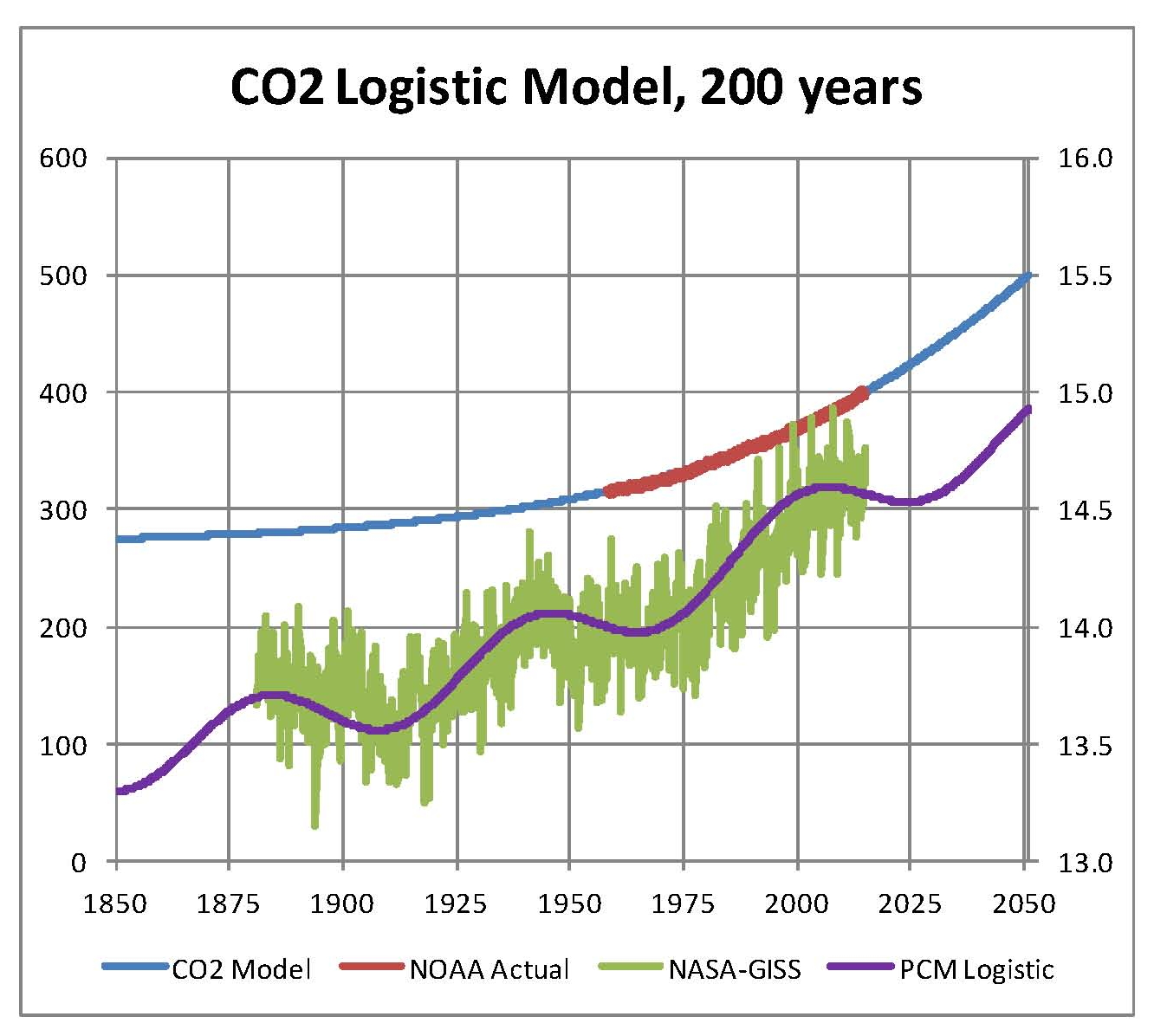
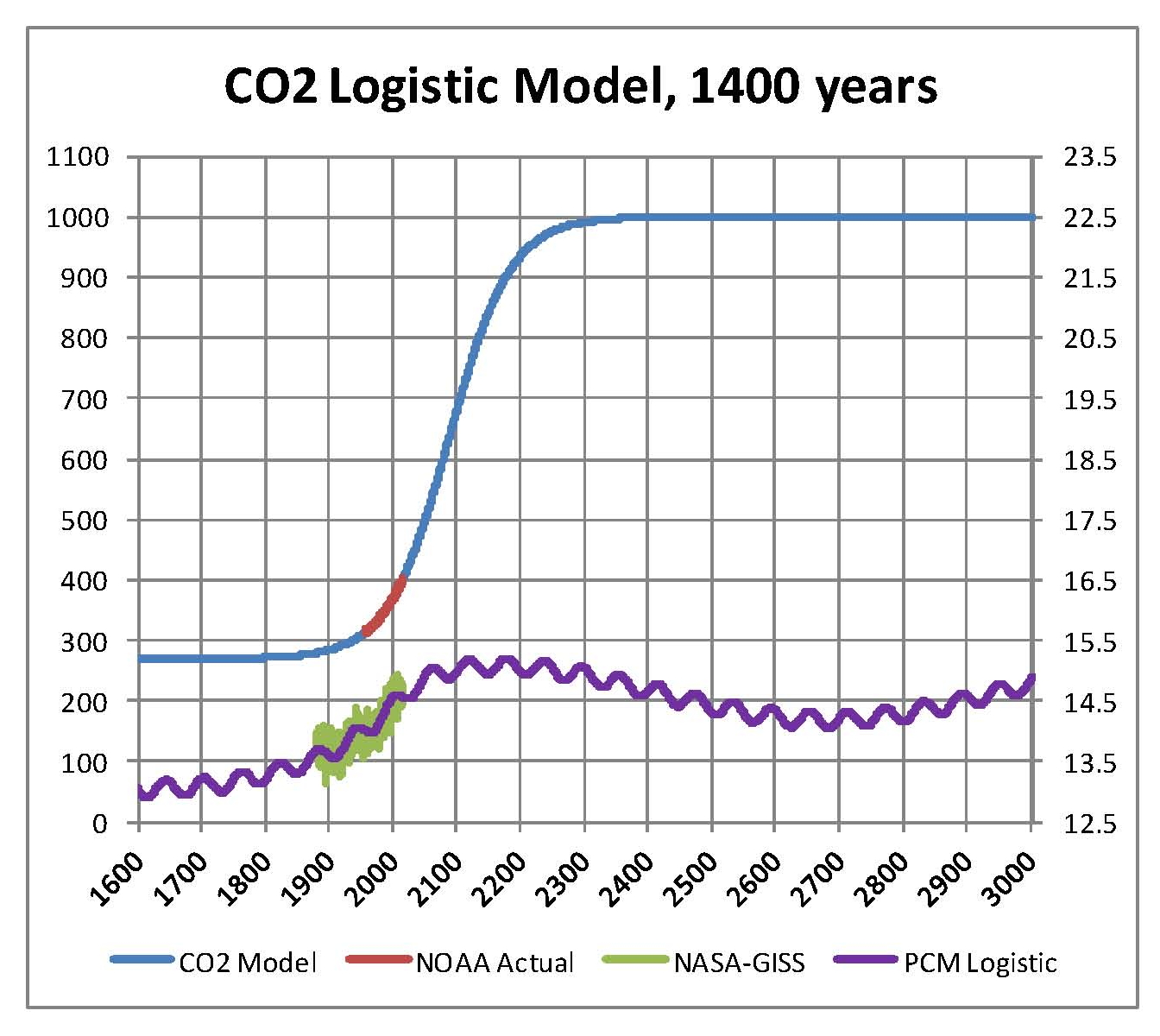
The following three Charts were made using these five equations the large variation in the NASA data can be seen in these charts and that is why I use a 12 month running average and/or the blocks of 10 years in most of my work. These Charts are identical except for the time frames shown. The red plot is actual NOAA monthly CO2 data in ppm. The Green plot is actual monthly NASA data converted from anomalies to degrees Celsius for Global Temperature. The blue plot is the CO2 model in ppm. The purple plot is the PCM Climate model projection of Global temperatures cased on these five equations in degrees Celsius.

0002-01 PCM MODEL

The first Chart is for a 200 year period bracketing the NASA and NOAA data. The purple PCM plot is not perfect but it is very close to the green NASA plot.

0002-02 PCM MODEL

This Chart goes back to 1600 which is about the time the temperatures bottomed out during the Little Ice Age and forward to 2100.

0002-03 PCM MODEL

This last Chart starts at the bottom of the last ice shows the peak of the current long cycle around 2150 at 15.1 or 15.2 degrees Celsius and then continues moving down to the next tough around 2700 and then continuing with the start of the next upswing. We can see that the 2700 bottom is only about .6 or .5 degrees Celsius higher even though CO2 has peaked at 1000 ppm.

It is my personal belief after studying the available literature that the variations is the suns electromagnetic radiation along for the particle based solar wind has an effect on the Earth’s magnetic field; and those variations allow more or less of the cosmic rays (charged particles) to enter the Earth’s atmosphere. Those particles interact with the water in the atmosphere to create droplets which then form clouds. Clouds being the main driver of the Albedo of the Earth have a significant effect on how much and how long the thermal energy stays on the atmosphere before being re-radiated out. This is, of course, the greenhouse effect which determines the earths Global Temperature.

This is not my idea but it is the one that I think is the principle cause of the short cycle and possibly of the long cycle as well.


Is Man-made Climate Change Real #6?


Part Six Anomalies

The IPCC, NASA NOAA and most scientists that study Climate change and Anthropogenic Climate Change use a system of measurement for Global temperatures that most of us are not familiar with called Anomalies. I’ve described this method in previous posts on my blog in this series but once more will not hurt. Basically, someone determines a Base period and then observations are measured against that base and therefore the result can be either higher or lower than the Base. The Base period should have some relevance to the subject but whether it does or not, it must be a constant or the system will not work.

NASA and NOAA work together on developing a Global temperature and when they set the system up they picked a period from 1951 through 1980. 30 years or 360 months, as their Base and when they did that they determined, obviously sometime after 1980, that the Global temperature was 14.0 degrees Celsius. Now this is important, there is no scientific reason to use that period and according to NASA it was because that is when most of the scientists at NASA and NOAA had grown up. A much better Base would have been the geological global mean estimated to be around 17.0 degrees Celsius but then all the values would be negative and that wouldn’t have looked good.

Now that they NASA and NOAA have their base they subtract it from the global temperature that they have calculated with their proprietary software. Keep in mind that there really is no Global temperature if for no other reason than the earth is a sphere and one side is always facing the sun (Hot) the source of all our energy and one side facing away from the sun (cold). Let’s do an example, for January 2015 NASA determined that the global temperature was 14.74 degrees Celsius so 14.74 minus 14.0 (the base) leaves .74 which they then multiple by 100 and that gives us an anomaly of 74. That value is published in many versions but we’re interested in a table called the Land Ocean Temperature Index LOTI and that table gives those values all the way back to January 1880. Most temperature data that comes from NASA or NOAA is in this anomaly format.

NOAA publishes the C02 information but they do not use this format they publish an actually value in this case CO2 in the atmosphere as parts per million volume (ppmv), for example the value for January 2015 was 399.96 ppmv. Sometimes the v is dropped so it would be 399.96 ppm. NOAA publishes the CO2 ppm value by month and they go back to March 1958 so there is not as much data to use in evaluations as with Global temperatures. In previous posts here, an equation was shown that will generate a curve that matches historical CO2 levels, present CO2 levels and CO2 levels as shown in IPCC reports such as the latest AR5.  When we get to that part of this analysis we’ll show both and then drop the NOAA portions since it is for such a short period of time.

This completes the introduction and now we get to what we are going to do that’s different from previous Climate work by others. Basically we are going to convert CO2 levels to an anomaly using the same system that NASA uses for temperature. By doing that we’ll be comparing everything to the 1951 -1980 base period in the same kind of units. This should make any patterns or correlations more visible. We’ll start with showing the NASA Global temperature anomalies and then add on other items.

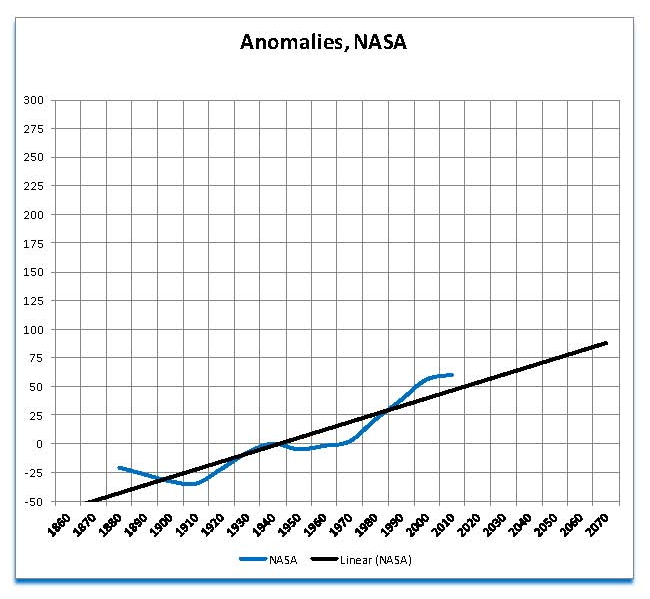
But first one other comment and that is we have had to make some adjustments in the NASA temperature data to make it more understandable. The first part is done by combining blocks of months and then taking an average. We are looking at climate changes not weather and so daily or even monthly movements do not mean anything. We picked ten years for a block for all the work here and we start with 1880 to 1899. This gives a smooth plot rather than the jagged ones that are normally seen and that makes it difficult to pick out climate from weather. Also in the case of NASA data we average 4 different current reports 2012.12, 2013.12, 2014.12 and 2015.01 the most current. This was done because of the process that NASA uses to determine the Global mean temperature creates some variation in the anomalies this averaging helps to minimize those variations. The following Chart was generated using this method. I have talked about this process in other posts here if the reader is interested.

The NASA global temperature anomalies using the method described here are shown in the blue plot on the Chart. We can see that there is a downward movement from 1880 to 1900 then an upward movement to 1940 then a downward movement to 1980 then a large upward movement to 2010. And lastly what looks like the beginning of another downward movement starting around 2010. In addition the entire series is moving up as shown by the black trend line.

There is no dispute on the patterns shown here the only issue is whether what this Chart shows is natural or manmade?
0001-01 Anomalies

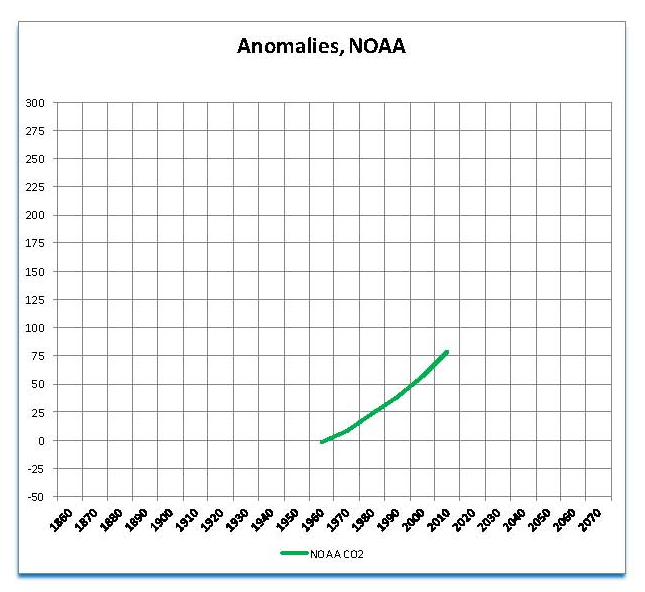
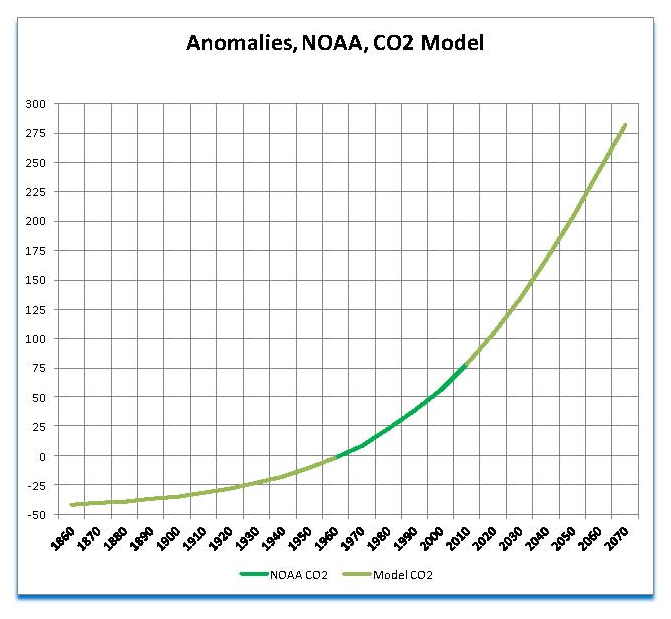
The next part of this analysis is looking at NOAA CO2 data in the same anomaly format and as previously stated there is much less information here than with Global temperatures. The first Chart shown below is a plot in Green of the CO2 data from NOAA and although most show this as a straight line, it is not it is a polynomial curve actually a logistic curve again as previously discussed here in Part Four. But first let’s look at just the NOAA data in anomaly format using the same base as the NASA Global temperatures, 1951 to 1980. The actual published NOAA CO2 plots in ppm are shown in Part Four

0001-02 Anomalies

In the next Chart we’ll add the logistic curve to the actual NOAA data blocking out the common years in the CO2 model so you can see how the fit between the two data sets is very good. The actual NOAA is in green and the Modeled CO2 is in light green. Again as previously stated this logistics curve shows CO2 values that are in agreement with historical CO2 records, present CO2 and future projections of CO2 as published by the IPCC in their various assessments, the most current being AR5.

For the rest of this analysis we will use the logistic curve for CO2 and show it as a green plot labeled NOAA CO2 as there is no real difference.
0001-03 Anomalies

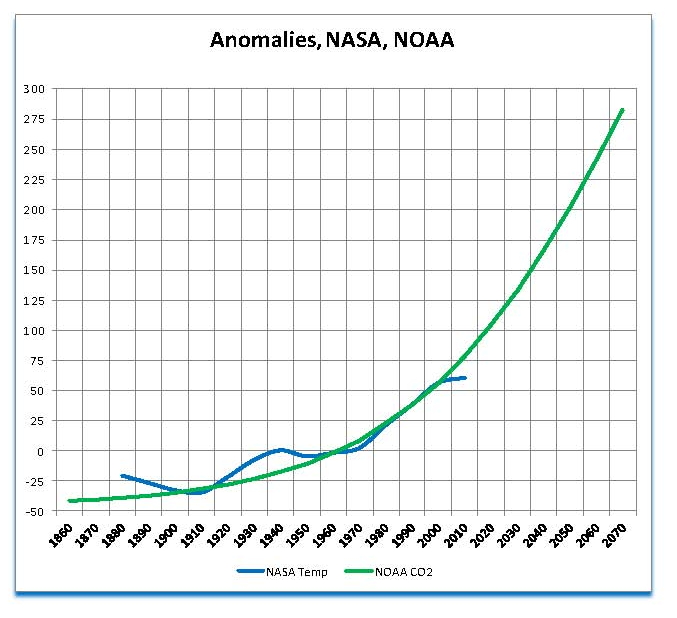
The next Chart shows the NASA Global Temperature and the NOAA CO2 anomalies combined. There does seem to be a relationship between the upward movement of CO2 and the upward movement in global temperature especially in the period from 1970 through 2000. We’ll continue this analysis to see if this apparent relationship is real or not.
0001-04 Anomalies

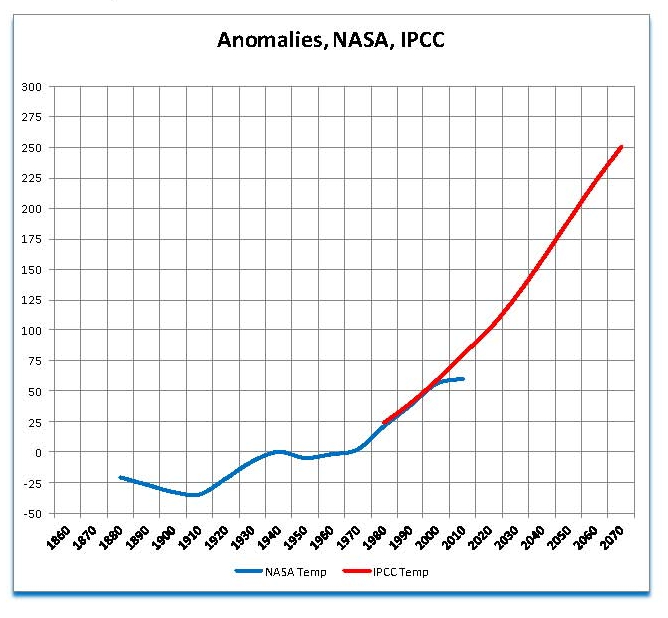
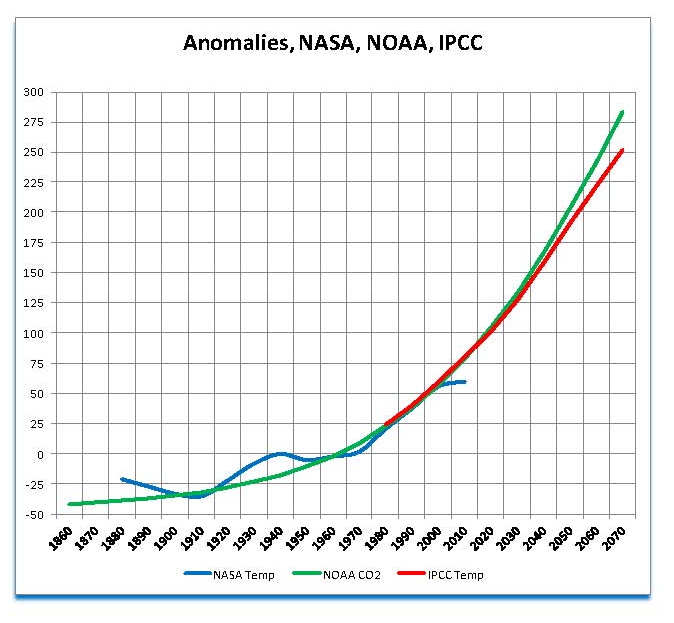
The next thing to look at now that we have past temperatures and a reasonable forecast of CO2 is what the IPCC estimates, based on the anthropogenic theory, Global temperatures will be in the future. They make this harder than it needs to be by tying the projections to economic projections, but since none of the proposed CO2 reductions have come to pass we’ll use the one business as usual, since it is the most likely. The next Chart shows just the past NASA Global Temperatures and the IPCC estimates of what future Global temperatures will be. Keep in mind that we are showing Anomalies not actual Global Temperatures.

There can be no dispute that the IPCC projection does appear to follow the NASA trend from 1980 through 2000. This trend would make Global temperatures about 15.75 degrees Celsius by 2050. This can be calculated by adding to the base of 14.0 degrees Celsius the y axis value of 175 for 2050 after diving it by 100 to turn it back into degrees Celsius. Also we do not see any deviations its strictly a smooth upward plot not like the actual from the past.

0001-05 Anomalies

In the next Chart we’ll add back the NOAA CO2 plot and we’ll see that the IPCC projection and the CO2 projection are very close indicating that there is a very close relationship between the IPCC projection and the CO2 projection. Since the IPCC was chartered to show what the 1980 to 2000 trends would do IF THE RELATIONSHIP SHOWN THERE WAS VAILD this extension is of no surprise. This Chart is similar to the one shown in Part One that Hansen showed to Congress and is also widely used by the IPCC and NASA.
0001-06 Anomalies

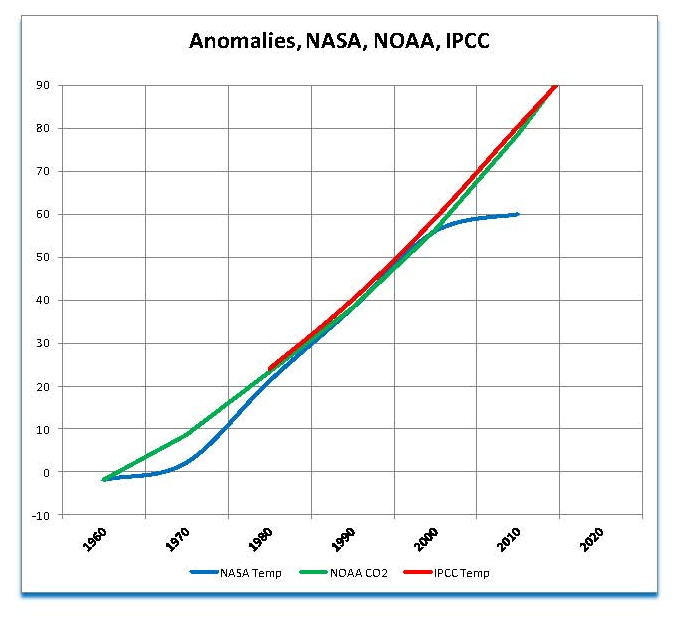
Now let’s zoom in and look at the 60 year period from 1960 through 2020 so we can see more detail; this is shown in the next Chart. There is a very clear and consistent relationship between all three measure NASA temperature, NOAA CO2 and the IPCC temperature projections using the Anomaly system from about 1975 through 2005. This is of no surprise as the IPCC developed their Global Climate Models, GCM’s, to show this. It was the prevailing view in the environmental movement, at that time, that there was a direct link between CO2 levels and Global temperature.

There is an obvious departure shown here between the correlation between CO2 and Global temperature. From 1880 to 1900 CO2 is below Global temperature then from 1910 to 1950 its above Global temperature; its only from 1975 to maybe 1995 the CO2 and NASA Global temperature growth rates match. That is only a 20 year out of 134 years where this is a match which is only 14.9%.
0001-07 Anomalies

However, there is a developing problem as NASA Global temperatures are no longer following the IPCC projections even though CO2 is going up as expected. The current deviation is almost a quarter of a degree Celsius now which can be seen in the above Chart as the blue NASA plot is below the IPCC and NOAA plots by 20 units and if we divide by 100 that is .2 degrees Celsius.

Going back to the very first Chart in this series of the Global temperatures as calculated by NASA we saw that there appeared to be a pattern of ups and downs in the temperature and based on those ups and downs another down was due, and that is exactly what we see in the above Chart; the beginning of a down period.

There are other theories about Climate Change one of which is based on variations in solar radiation which affects the Blackbody temperature and variation is the suns magnetic field which affects cloud formation and Albedo. We have also shown in Part Five that there are global movements in temperature that have been observed going back to the last Ice Age some 11,000 years ago, but especially in the past 4,000 years. Using modeling techniques and curve fitting an alternative Climate model designated PCM was developed in 2007 that has proved to be very accurate in projecting the Global temperature published in the NASA LOTI table.

This model is based on a long cycle of approximately 1000 years a short cycle of almost 70 years and a factor for CO2 using a sensitivity value under 1.0 degrees Celsius. Using the same method of looking at anomalies from the NASA base of 1951 to 1980 we have the following plot of the PCM model. We have the overall upward movement, and the cycle of ups and downs as was observed in the NASA Global temperature plot we first showed. So is this plot better than the IPCC’s plot at matching the NASA data?
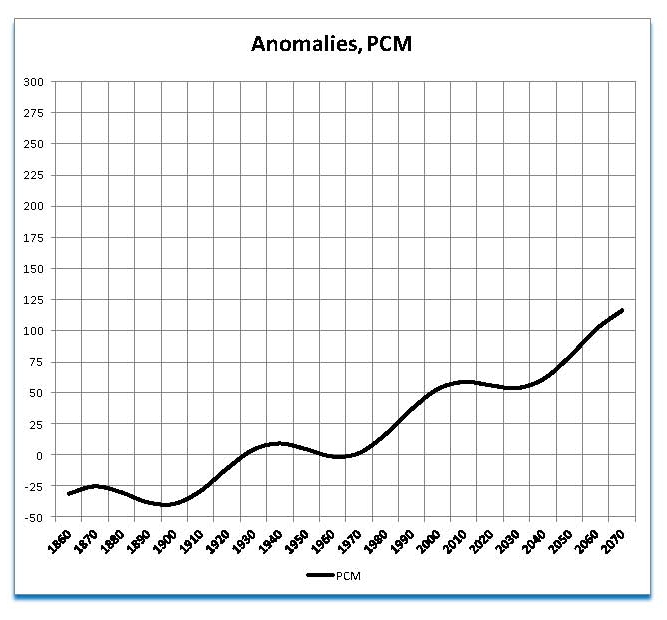
0001-08 Anomalies

In the next Chart we add the PCM model to previous one showing NASA Temperature NOAA CO2 and the IPCC Temperature projection plots. Although we do not have a perfect match going all the way back to 1880 it is just as good for the period 1970 though 2000 as the IPCC. But more importantly it is significantly better that the IPCC from 200 to the present since is shows a slight down trend just as does the NASA data.
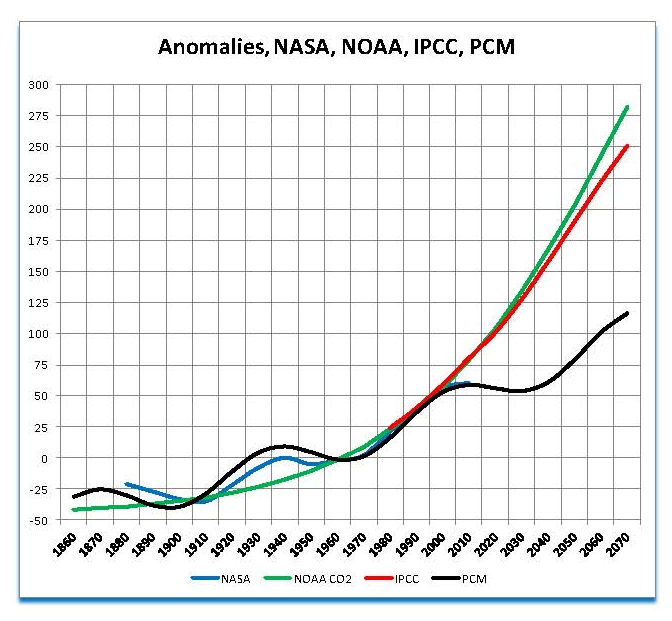
0001-09 Anomalies

We’ll show one last Chart looking at the same 60 year period we used to look at the IPCC values close up. The next Chart adds the PCM model to that Chart and it’s very clear that the PCM model is significantly closer to that of the published NASA LOTI values for the entire period of NASA published Global temperatures. Although the PCM model does use a factor for CO2 it is not slowly dependant on CO2 for its projections; instead we have looked at past Global temperature movements and matched them with the more current CO2 sensitivity values found in the published papers and which was also previously shown in Part Three.
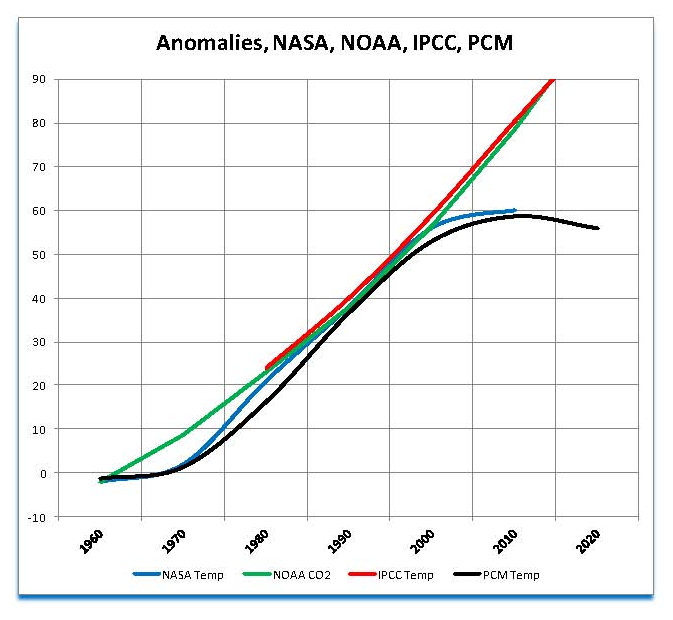
0001-10 Anomalies

A model is only as good as its projections or forecasts so based on the above Chart it is beyond dispute that the PCM model is significantly better than that of the IPCC. Further, since the PCM projects cooling and the IPCC projects warming the disparity will only get worse and worse.

The next part will be a discussion of the logic and equations used to develop the PCM Global climate model



What Will NASA Do in 2015 to make the Earth Warmer?


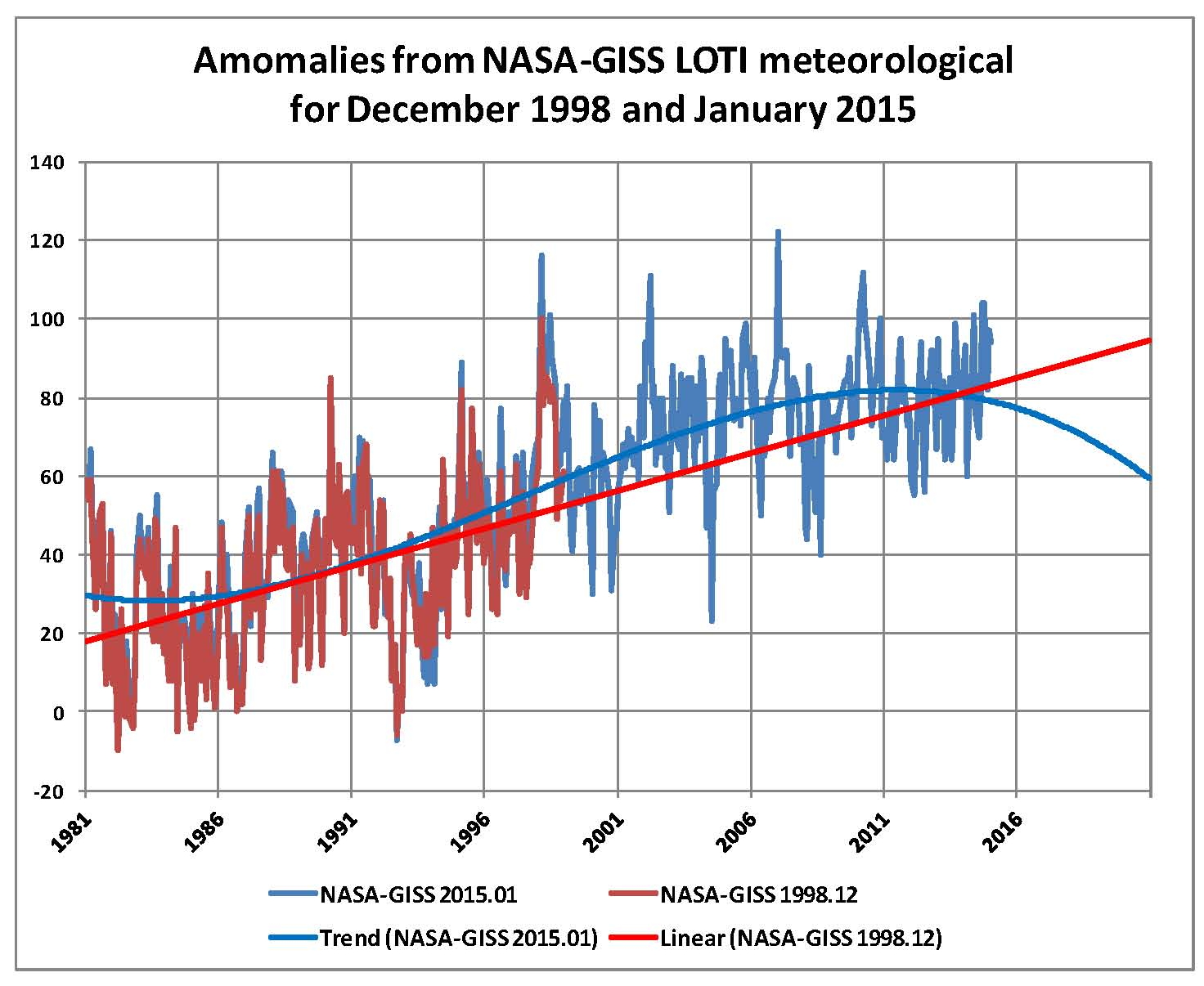
Approximately ten or so years ago increases in Global temperatures slowed down and then actually reversed. This is fact not speculation for if you take any of the NASA LOTI releases put them in a spreadsheet and then draw a chart and add a trend line using the polynomial Order 3 option the resultant plot will turn down around 2010. The generated plot will also follow the NASA LOTI data very nicely going back to 1880, even with the data manipulation that they have resorted to, to hide the current move down in Global Temperatures.

This downturn has created an unexpected problem for those that want to change how we live in the U.S. with the UN Agenda 21 sustainable world they have already started to implement. Since the main premise was the CO2 emissions from power generation was their culprit that meant that source must be eliminated; however if the Global temperature was not going up than there was a “major” problem with their core belief which also included moving away from a free people to a system where the people were controlled, for their own good. The control of the people was required since the Warmest’s needed to reduce the people’s energy usage and the people would not support a reduced standard of living without coercion.

When NASA realized that they had a problem with CO2 going up and Global temperatures going down they resorted to manipulating the data though the “Homogenization” process they use to blend all the data collected into one Global temperature. The process they used created an upward movement in Temperatures’ that was obvious to anyone that looked and in the past on this blog I have talked about it. Because of the intentional change of data and trends that NASA has been doing I was mislead a few weeks ago when I issued my monthly report which I have done for the past year. I compared the January 2015 values to the wrong past values and although the change was in the same direction it was not to the same magnitude as I showed. For that I must apologize.

This post is using the correct data and will give the same result just to a slightly lesser degree. I have also added a forecast of what I think NASA will do with the temperatures over the next several months as they need to support the United Nations Climate Change Conference (COP21) which will be held in France at the Le Bourget site from 30 November to 11 December 2015 and the conference objective is to achieve a legally binding and universal agreement on climate, from all the nations of the world.

To achieve this they have determined that they need to show that the planet is overheating, whether it is or not, and since it is not (by satellite data) they need to show it in another form, hence the data manipulation at NASA-GISS.

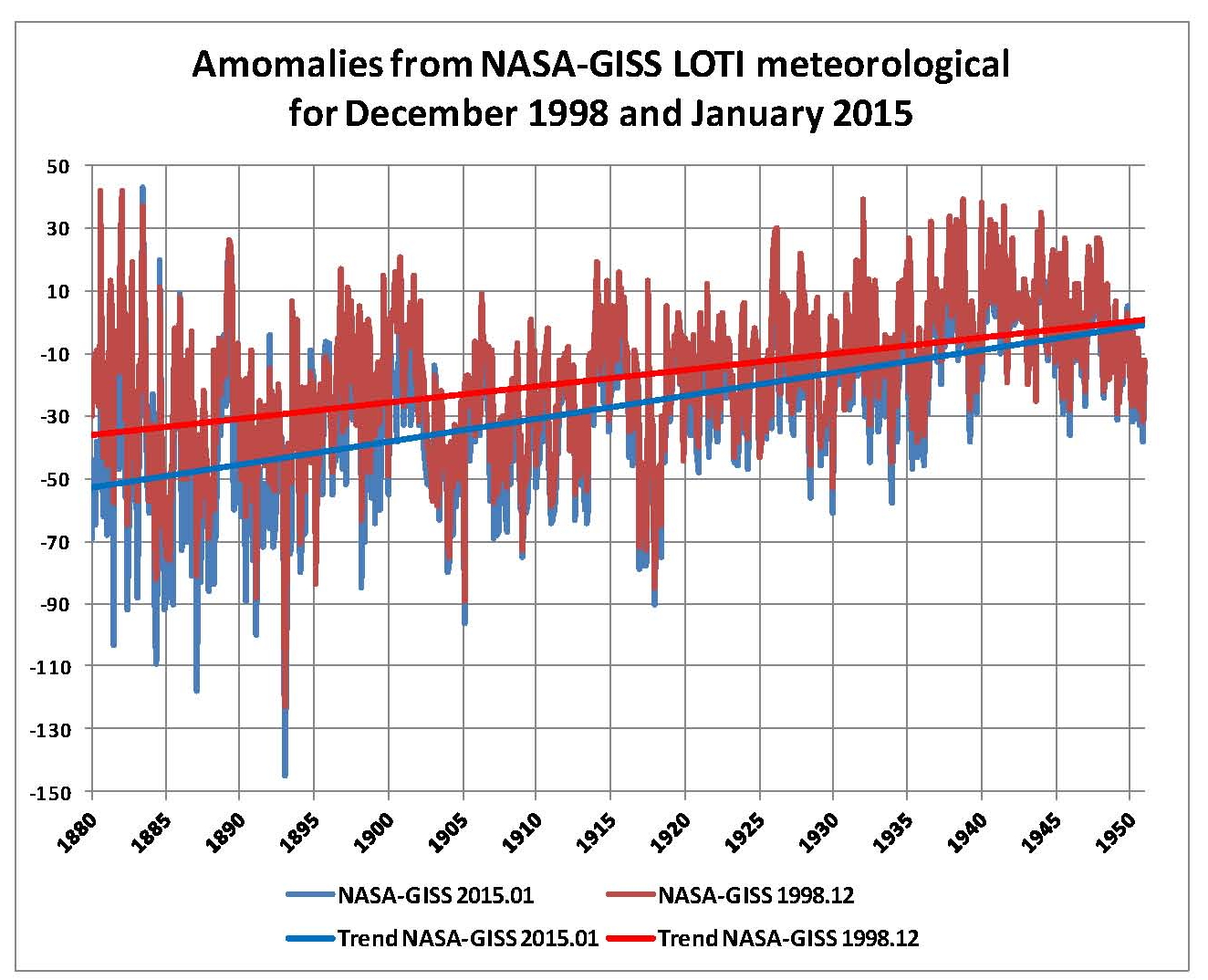
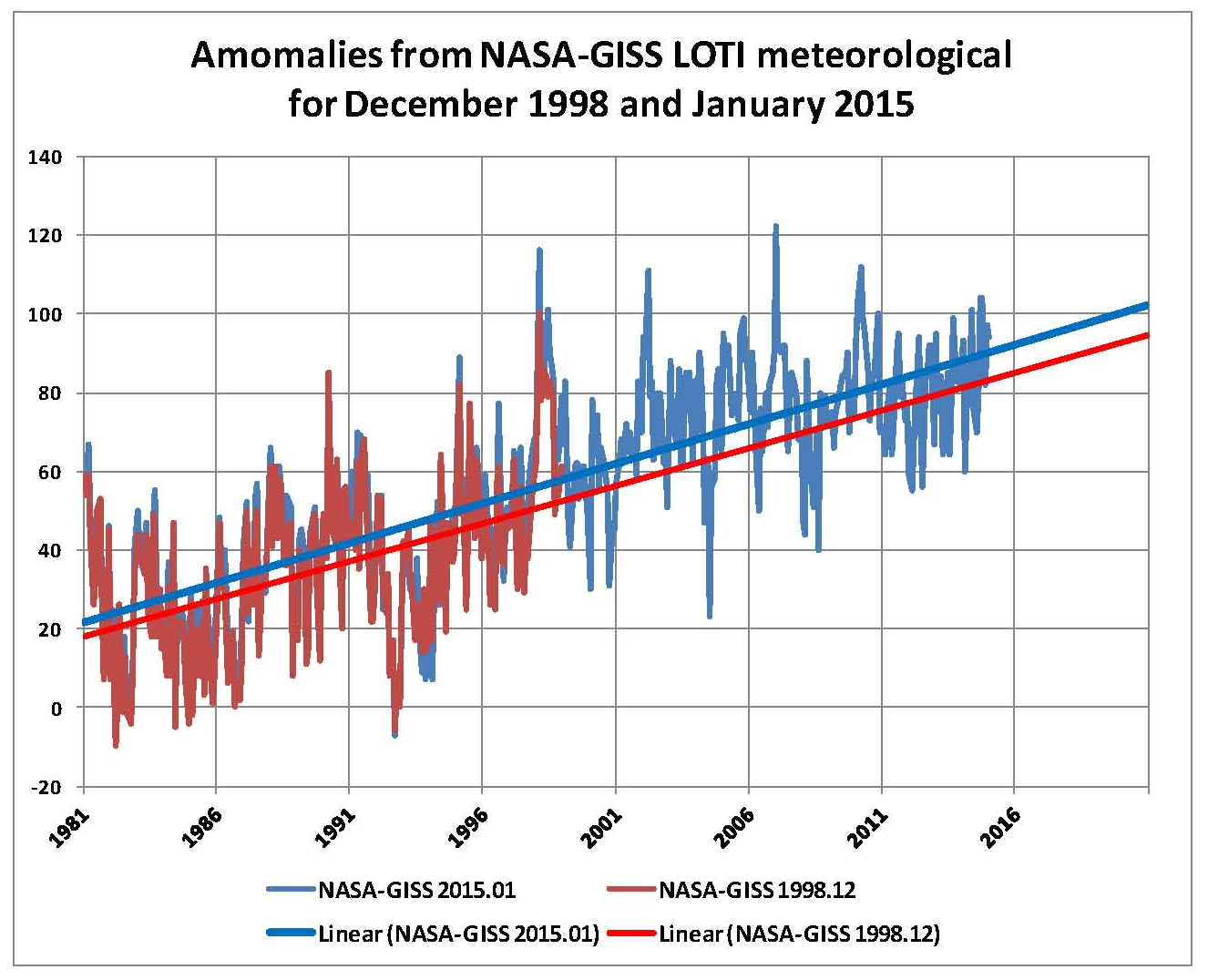
This manipulation is shown in the next three Charts which all use LOTI data the first from December 1998 (Red) and the second from January 2015 (Blue) which trend lines as required in the same colors. The first is in the period January 1880 to December 1950 which is the entire temperature series up to the point that NASA uses to determine their anomaly. The anomaly is the base temperature that NASA uses to measure temperature changes from. The second Chart is the period used to determine the NASA anomaly which is from January 1951 to December 1980, 30 years. The third Chart, actually a series of Charts on the same period, is from January 1981 to the present. To support the need for a warmer present they will need to move the 1880 to 1950 data down, keep the 1951 to 1980 data constant and move the 1980 to the present data up as much as possible. If that can be shown in the following Charts then that proves what is being down since no other change would produce this effect.

10 M-1

Clearly, in this Chart, the past temperatures have been moved down almost a quarter of a degree C in 1880 from the 1998 red plot to the 2015 blue plot. Further the two trends almost merge at the December 1950 date since they cannot change that period since it sets the anomaly value of zero or 14.0 degrees Celsius. Random changes or adjustments would not do this.

10 M-2

We can see in this Chart that there is some movement in both trend lines; both are slightly below 0 in 1951 and slightly above zero in 1980. They also appear to be offsetting so we’ll check that by adding all the anomalies from this period to see if they cancel and they do. There are 360 values in that period and the 1998 series adds up to -2 and the 2015 series adds up to 4. I would be willing to bet if we looked at rounding differences the differences would be even closer to zero. So again we have proof that the manipulation of the data is not without purpose since any programmed change, with a purpose, must keep this period at or almost at zero anomalies.

10 M-3

This next potion, from 1981 to the present, is a bit more complex since it is showing the planned results of the NASA data manipulation so we are going to show a series of Charts. Since the 1998 red plot only goes to 1998 we can’t do a one for one comparison but we can see that for the period where the two plots are common the blue plots are above the red on the upside and the red plots are below the blue on the down side indicating that the blue plot is showing a warmer temperature and this is verified when we add the trend lines which clearly show that the blue trend is shifted up. Because NASA had to keep the 1951 to 1980 period constant the trend lines are closer together in 1981 than they are later on in 2015; this is additional prove of the manipulation

10 M-4

Next we get rid of the linear trend to the 2015 data and add a polynomial trend using a 3rd order to see if it gives a better fit to the data and it does. This trend clearly shows the Global temperature peak around 2010/2011 and the down trend ever since. This is especially true if we would ignore the last couple of years where the data manipulation has started.


Sir Karl Raimund Popper (28 July 1902 – 17 September 1994) was an Austrian and British philosopher and a professor at the London School of Economics. He is considered one of the most influential philosophers of science of the 20th century, and he also wrote extensively on social and political philosophy. The following quotes of his apply to this subject.

If we are uncritical we shall always find what we want: we shall look for, and find, confirmations, and we shall look away from, and not see, whatever might be dangerous to our pet theories.

Whenever a theory appears to you as the only possible one, take this as a sign that you have neither understood the theory nor the problem which it was intended to solve.

… (S)cience is one of the very few human activities — perhaps the only one — in which errors are systematically criticized and fairly often, in time, corrected