Is Man-made Climate Change Real #5?


Part Five Geological Facts

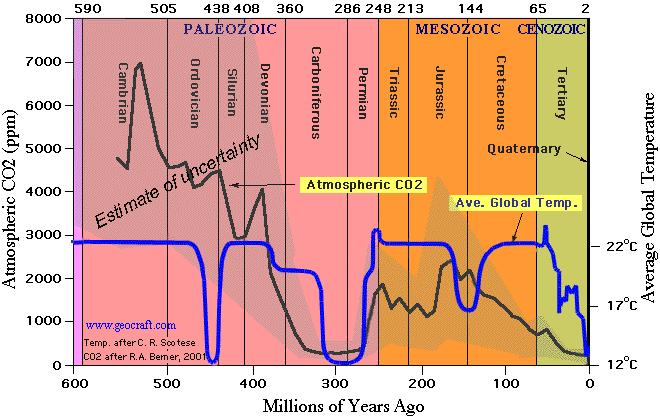
This will be a short section placed here to show what the past was until recently when all this history mysteriously disappeared. The point to these Charts is that climate has NEVER been a constant with global temperatures ranging from a low of around 12 degrees C to a high of around 22 degrees C and CO2 ranging from under 300 ppm to as high as 7,000 ppm. We are presently at 400 ppm CO2 with a global temperature of around 14.6 degrees C which is historically low as can be seen on the following chart going back 600 million years. It would seem that a mean temperature of 17 degrees C, as shown here, and a CO2 level of over 1000 ppm would be more normal then what we have now so why the hysterical political movement to control CO2?

BB-04

The next chart is more current going back to the last ice age some 11,000 years ago. This chart is particularly interesting as it shows that there have been 4 cycles of cold and warm going back over 4,000 year. Based on those 4 cycles and considering the difficulty of determining exact dates and temperatures it can be said that over the past four thousand years there have been 4 cycles of about one thousand years duration with an amplitude of maybe 1.5 degrees C. And we are what would appear to be a peak of the forth cycle, indicating that we can expect a downward movement to start in the next hundred years or so. Based only on this observation It should be possible to develop a model that would be valid over this period of time and where we have human records to support these temperature changes.

BM-9

However, there are also some significant temperature variations with shorter durations as shown on the next Chart. This Chart is of the Atlantic Multidecadal Oscillation or AMO where there appears to be a 60 some year cycle of under one degree C there is also a larger cycle in the pacific known as La Nina and El Niño.

BM-8

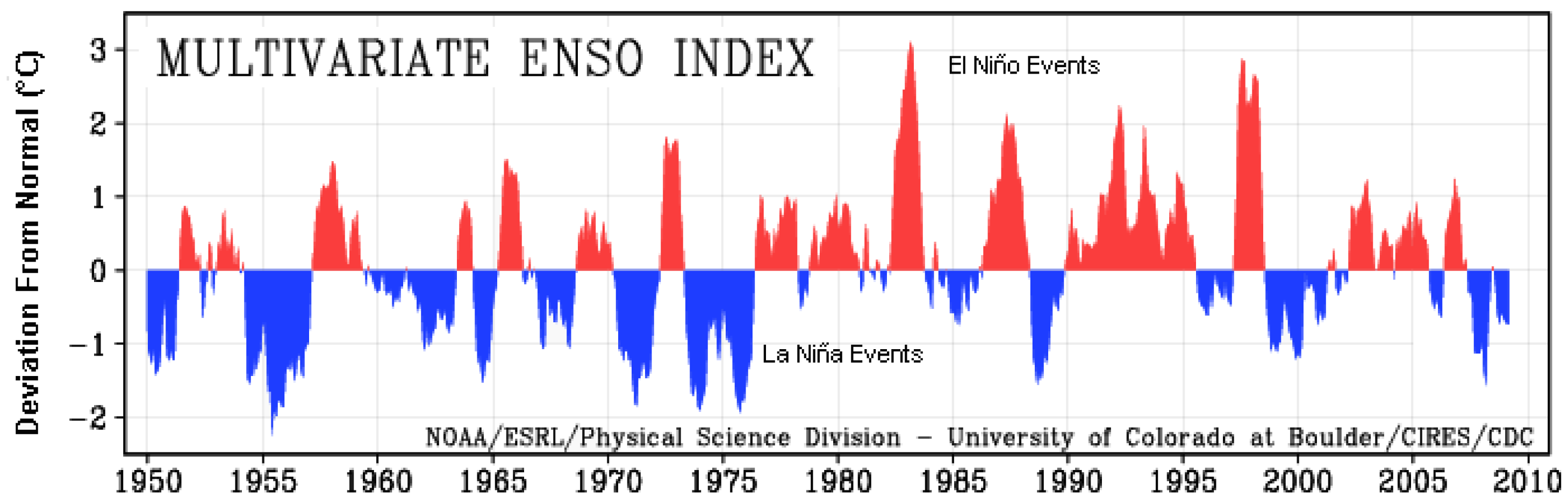
The Pacific variations are not as consistent as those in the Atlantic are,but there is a greater variation as can be seen in the next chart where the La Nina and El Nino events are shown as a multivariate index called the ENSO.

FIGURE 19

The purpose to showing this four Charts is to establish that there are geological and even decadal variations in climate and none of these have anything to do with mankind or CO2; therefore any proper theory of Climate must consider these variables as a base to work from. Only when that is done can considerations be given to things like Carbon Dioxide, which probably is only a bit player in Climate.

In the next section we’ll put this all together and show what is really happening with Global Climate and also why the Warmists and their obedient media are so wrong.

The Great Global Warming Swindle Full Movie


This is a good summary of the Climate Change movement which is not based on science but it is a political religious movement that has been forced on us by UN Agenda 21. The movement MUST BE STOPPED!

New result shows CO2 has almost no effect on temperature


I agree CO2 is not driving climate except mother nature!

tallbloke's avatarTallbloke's Talkshop

An article in the Daily Mail today piqued my interest. It trumpets empirical results which they say empirically confirm the theoretical CO2 greenhouse effect for the first time:

greenhouseeffect“Scientists have witnessed carbon dioxide trapping heat in the atmosphere above the United States, showing human-made climate change ‘in the wild’ for the first time.

A new study in the journal Nature demonstrates in real-time field measurements what scientists already knew from basic physics, lab tests, numerous simulations, temperature records and dozens of other climatic indicators.

They say it confirms the science of climate change and the amount of heat-trapping previously blamed on carbon dioxide.”

“These instruments, located at ARM research sites in Oklahoma and Alaska, measure thermal infrared energy that travels down through the atmosphere to the surface.

They can detect the unique spectral signature of infrared energy from CO2.

Other instruments at the two locations detect the unique signatures of…

View original post 548 more words

Global Warming Over The Past 70 years


This post is 100% right its just a money game and the politicians love it even more than the academics!

Tony Heller's avatarReal Climate Science

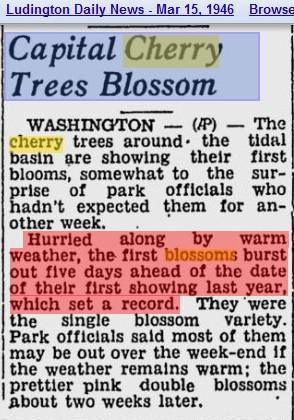
In 1946, cherry trees were blooming in Washington DC by mid-March

paintimage4240

Ludington Daily News 

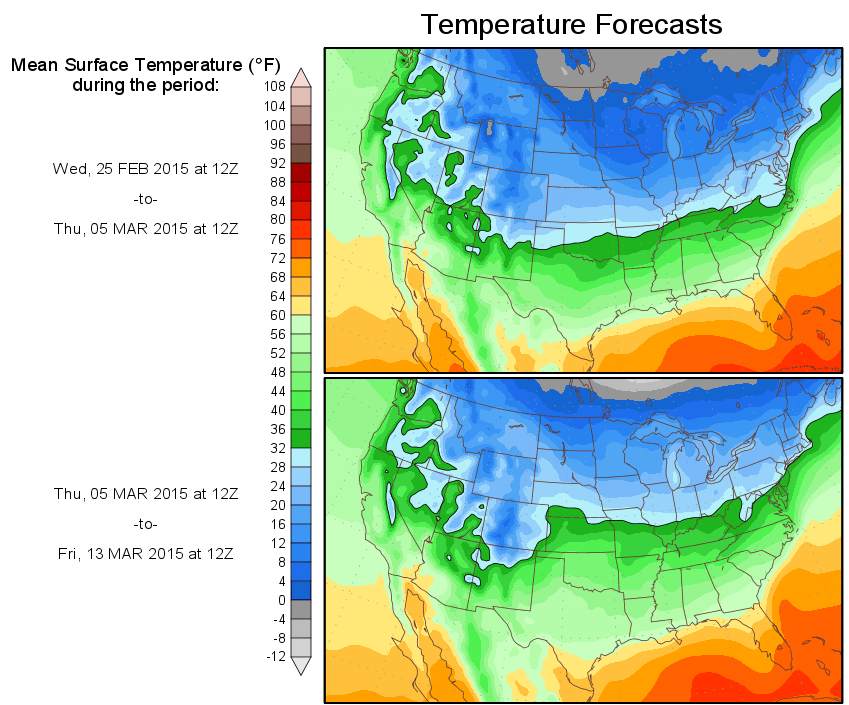
After 70 years of out of control warming, Washington and most of the rest of the country will be lucky to be above freezing by mid-March.

ScreenHunter_7425 Feb. 25 22.09

But cherry blossoms are just cherry picking. What about sea level and the polar meltdown?

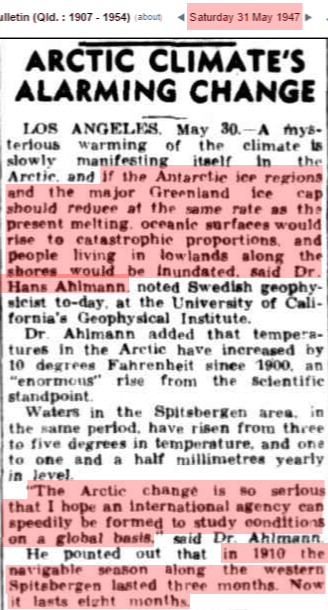
Scientists warned in 1947 that the poles had warmed 10 degrees, were melting, and were going to drown us all – unless we gave them money to study it.

ScreenHunter_7427 Feb. 25 22.14

temperatures in the Arctic have increased by 10 degrees Fahrenheit since 1900. An ‘enormous’ rise from the scientific standpoint. Waters in the Spitsbergen area, in the same period, have risen from three to five degrees in temperature, and one to one and a half millimetres yearly in level. ‘The Arctic change is so serious that I hope an international agency can speedily be formed…

View original post 58 more words

Is Man-made Climate Change Real #4?


Part Four A Model for CO2 levels

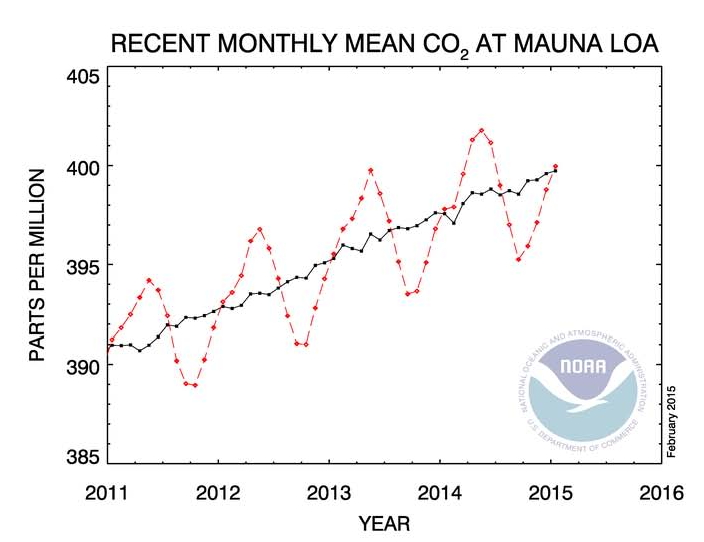
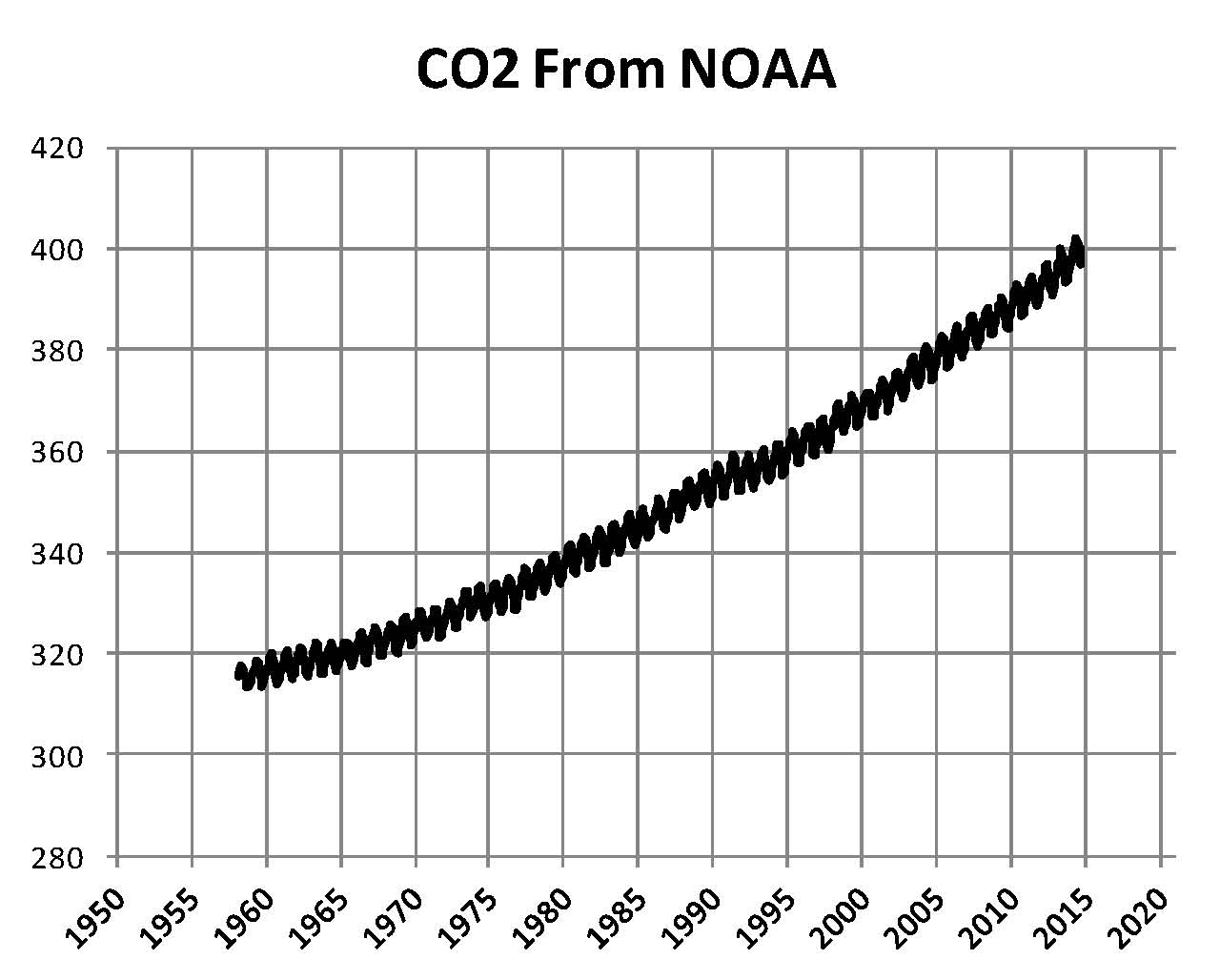
Carbon Dioxide (CO2) has been measured very accurately since 1958 By NOAA-ESRL and the trend published monthly; for example this is the chart for January 2015 where the CO2 level was 399.96 ppm. There is little to no reason to not believe these postings by NOAA-ESRP since they are direct measurements using calibrated equipment at the Mauna Loa location in the Hawaiian Islands.

PART 3-1

These NOAA records go back to March 1958 and the pattern seen in the above Chart goes all the way back to that date which is a summer peak and a winter trough. NOAA and others have determined that in pre-industrial times the CO2 level was in the range of 270 to 280 ppm and then as the use of coal and then oil began the level of CO2 started to rise. Scientists observing this pattern assumed that all the increase was caused by man, however in ecological times CO2 has in fact risen and fallen and it appears to follow increases in temperatures and since there were no humans we could not have created these past changes so there is more to this than just a simple CO2 and temperature relationship.

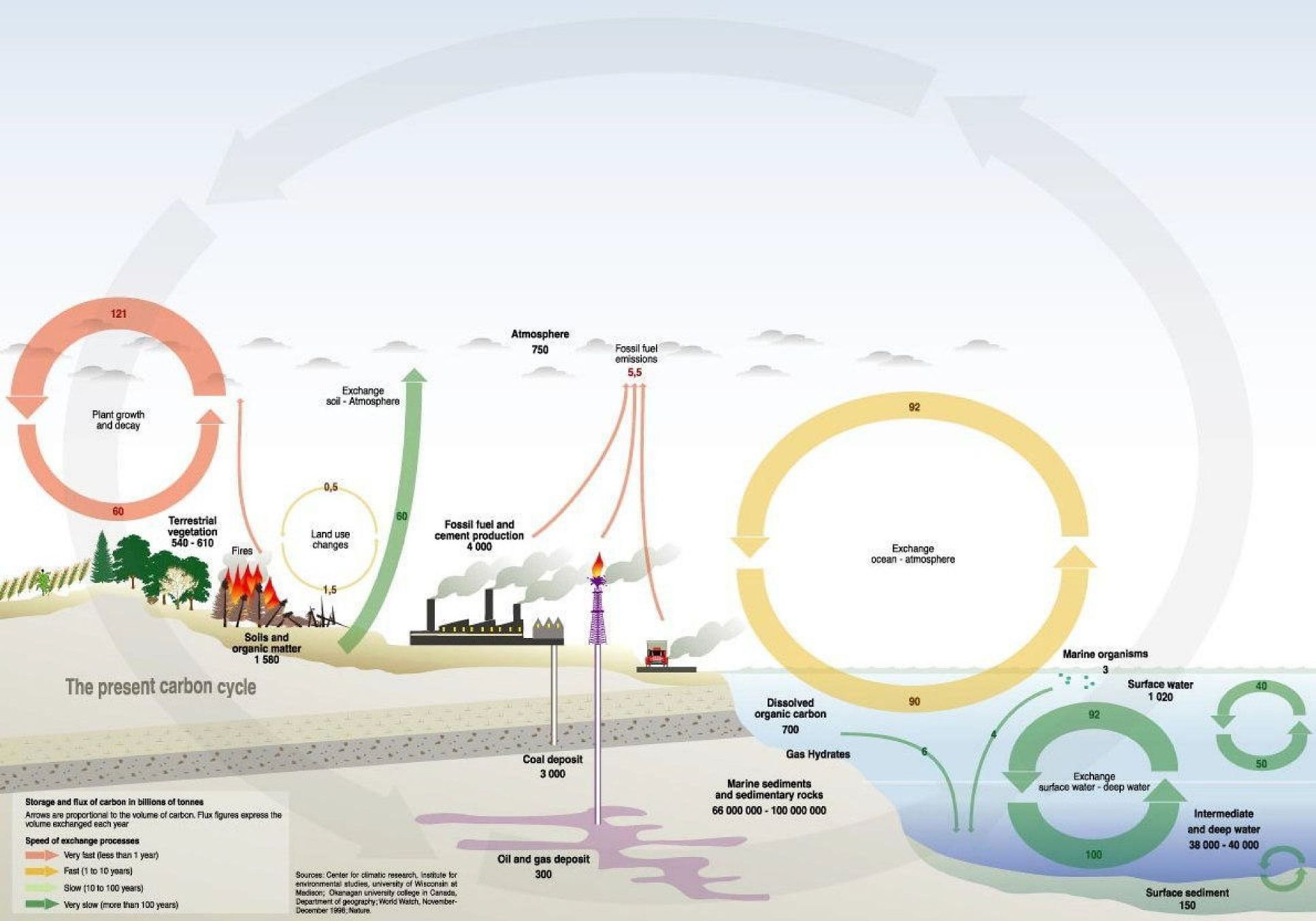
The next Chart shows a diagram of the planet’s Carbon cycle. There is no doubt that man is adding to the CO2 in the atmosphere but the overall movement of CO2 into and out of the planet’s atmosphere is significantly great probably by 30 or more also indicating that CO2 caused by mankind is not the main player here. One must also understand that carbon Dioxide is a requirement for plant life and higher levels are better than lower levels. Commercial Greenhouse raise the level of CO2 to over 1000 ppm to speed up planet growth and 1200 ppm, 3 times where we are at now, would not cause any problems for plants or mankind.

PART 3-2

So since more CO2 is good and less CO2 is bad for all life on the planet why has it been targeted for removal? Well the only reason is that some have determined that the global temperature of the planet is directly linked to the level of CO2. Therefore CO2 must be removed from the atmosphere or we will destroy all life on the planet. This seems to be counter to Nature but Scientists have determined that they know what is really going on in the climate so we must trust them.

This theory of CO2 being the reason that the Global temperature is going up is based solely on the sensitivity level of CO2 being 3.0 degrees C as discussed in the previous post; so what we need next is to show what the future level’s of CO2 will be so we can see if there really is a direct link between CO2 and global temperature later in this series. The next Chart is of the entire NOAA published CO2 level from March 1958 to January 2015. There is no doubt that the level is going up and it even seems to be accelerating and the calculated mean level of CO2 will probably be over 400 ppm by the end of 2015.

PART 3-3

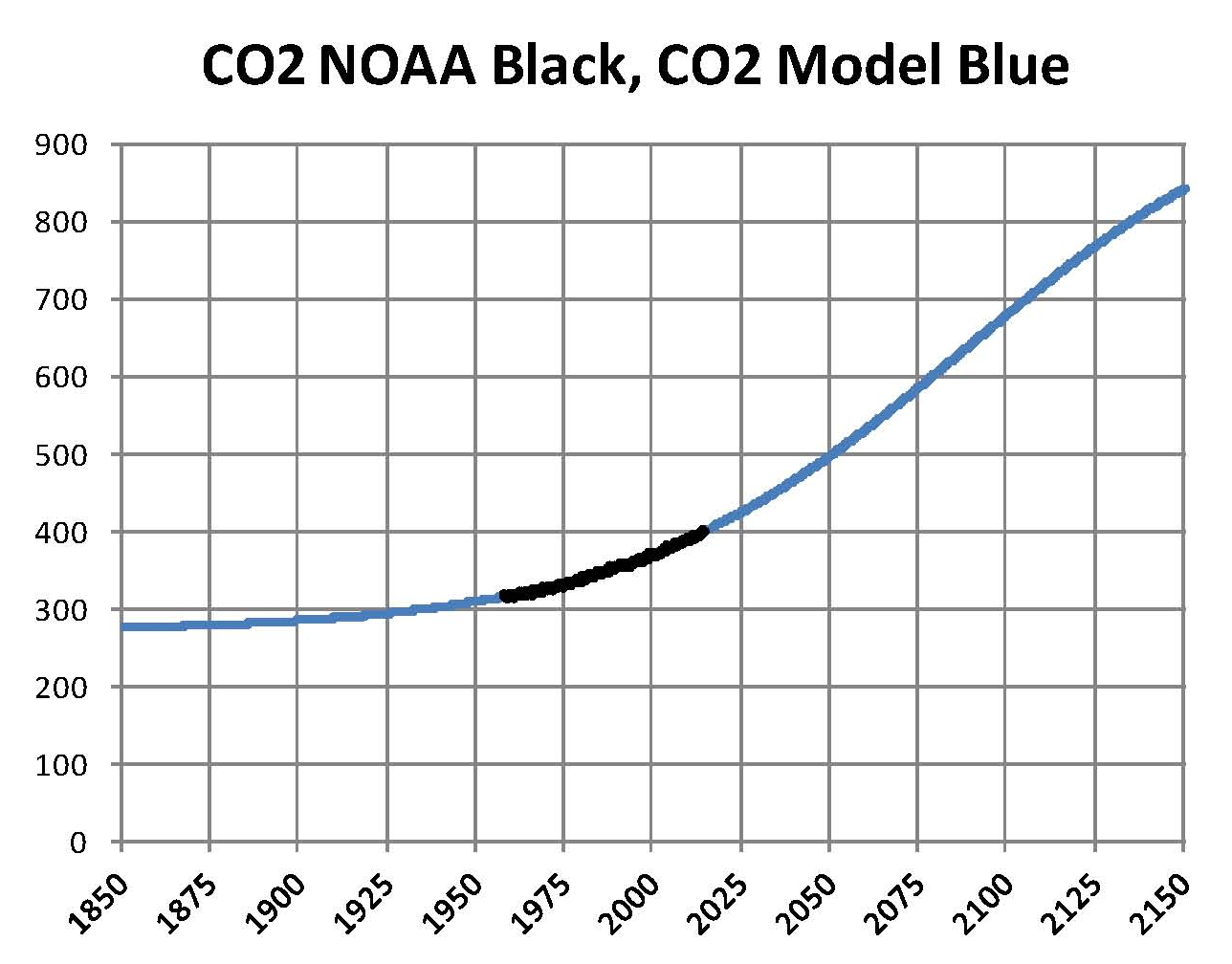
In order to make projections into the future we need to model this NASA CO2 data and the closest fit end up being a form of a logistics curve. If we assume a starting point of January 1600 as 270 ppm for CO2 than the following equation will produce a curve that matches the NASA-ESRL data mean and goes to 1000 ppm around 2300. This curve fits both historical and projected levels of CO2 in the available literature.

 CO2 = 270 + 730 / ( 1 + 8.75 * EXP ( .001733 * (4612 – M )))

M represents the number of months from January 1600 which means that January 2015 is M = 4981 and that gives a CO2 value of 399.98 ppm verses the actual of 399.96 or an error of .02 ppm which is basically no error. The following Chart shows a part of the curve generated by this equation.

PART 3-4

There is no question about the level of CO2 in the atmosphere; however there is uncertainty as to the source of all of the increase. But for discussion purposes we will concede that most if not all the increase is due to the use of fossil based fuels, i.e. coal, petroleum, natural gas and wood.


The next issue discussed here will be a look at some historical records on temperatures and CO2 levels.


Is Man-made Climate Change Real #3?


Part Three Carbon Dioxide and Water sensitivity

In looking at climate change one must look at the greenhouse effect which brings one to water H2O and carbon dioxide CO2; although there are other factors they are minimal and can be ignored since H2O and CO2 are the main contributors. We know from the previous post in this series that the total Greenhouse effect is 33.4 degrees Celsius and that requires only one assumption and that is that the global temperature is 14.6 degrees Celsius today. We are ignoring the current NASA January 2015 publication for Global temperatures since they are obviously false and the purpose of this series of technical papers is to show why. For the record, NASA states that the Global temperature for January 2015 was 14.94 degrees Celsius (an anomaly of 94). I believe that it is closer to 14.59 degrees Celsius (an anomaly of 59).

The makeup of the 33.4 degrees C of the Greenhouse effect is extremely important in understand climate; therefore the Global temperature. In the previous post where we established the 33.4 degree value for the Greenhouse effect we left the discussion with the problem of how much of that 33.4 degrees C is water and how much is CO2. To make that determination we need to know both the sensitivity value of water and CO2.so let’s get into that issue now.

The next Chart shows a plot of some of the debated CO2 values starting with .65 degrees C the cyan plot and moving up to 1.0 degrees C the light green plot, to 1.5 degrees c the yellow plot, to 2.0 degrees C the orange plot, to 2.5 degrees C the red plot to 3.0 degrees C the dark red plot. The X axis shows CO2 in ppm and the Y axis is in degrees Celsius. There is a black vertical line at 400 ppm the present level of CO2 in the atmosphere and another at 500 ppm in purple for what might be expect by 2050. The cyan rectangle is placed on the plot for .65 degrees C value and shows the area of current concern which is between the vertical Back line, where we are now, and where we could be in 35 years. It’s clear the remaining effect of CO2 with a sensitivity value from .65 degrees C will contribute very little to any future climate change.

The dark red rectangle in the Chart is placed on the plot for a sensitivity value of 3.0 degrees C which what the IPCC uses in their GCM’s. Because of the shape of the curve you can see that there could be a significant additional warming to the planet if the 3.0 degrees C value is correct. According to the IPCC in their Fifth Assessment Report (AR5) issued in 2014 this value (climate sensitivity or CO2 forcing) is likely to be in the range 1.5 to 4.5 degrees C with a best estimate of about 3.0 degrees C, and is very unlikely to be less than 1.5 degrees nor greater 4.5 degrees C. However there are scientists that think that the CO2 climate forcing values maybe as low as .4 degrees C. Since the GCM models are very, very sensitive to this number the admitted range of uncertainty is a major problem that sheds doubt to the validity of the GCM models.

IPCC REPORT 1

But since we already know that the values the IPCC uses were developed in 1979 by the NAS what has happens since then? The next chart shows 28 studies and the range of values that each author believes is the correct value for CO2 sensitivity that is expected. The older values are on the right and the newer ones on the left except for the NAS 3.0 degree C value which is shown twice once as the NAS in 1979 and the other as the IPCC’s AR5 from 2014 which is shown to the far left since it is still what the IPCC uses; one can see how far off it is from the more current studies.

The range in these studies is from about .02 degree C to 10.0 degree C with an estimated average of around 1.9 degrees C. It’s clear from Chart that 3.0 degrees C is higher than what much of the peer reviewed studies support and in reality values closer to MIT’s Lindzen of .65 degrees C work much better in practice. However whichever it is its surly not certain or there would not be such a wide range of estimates. Also it is very interesting that the trend is down which is significant since with time we normally get closer to the truth rather than further away.

IPCC REPORT 6

Much of the very wide range of estimates for CO2 forcing results from the way that solar insolation enters the planet’s atmosphere and how much water is assumed to be in the atmosphere. These are major factors and are not well understood or the range of values would not be what they are. The next Chart shows the incoming and outgoing radiation frequencies involved in calculating the forcing values incoming on the left and outgoing on the right. Also there two absorption bands for CO2 with a black and red oval around them; in the black one there is one common band with water and one that is not but since there is very little energy there they can probably both be dismissed. Then if we look at the outgoing radiation which is now in the Infrared (IR) we can see there is only one common band shown with the red oval. So the process in question is how much does the CO2 absorb incoming insolation, if any, and more importantly how much outgoing IR is absorbed and then how much of the re-radiated IR is then absorbed by the water H2O?

IPCC REPORT 3

CO2 is only .04% of the atmosphere and water is .25% overall and has a wide range from almost 0 to 5% so any calculation of what affect CO2 can have on trapping thermal energy is not an easy task. Complicating this even more is the question of how long does the water hold the heat as it does eventually send it out of the earth’s atmosphere. In my opinion this issue is so complicated that it may not be solvable with complex equations based on physics and chemistry and so a better method might be to back into it from the 33.4 degree value which is close to being reasonable. From geological records we know that the planet has never overheated even when CO2 was almost 20 times more than it is now at 7,000 ppm or we would not be here. We also know that the IPCC climate models appear to have a runaway positive feedback bias showing global temperatures at levels never experienced on the plant for high levels of CO2.

So first let’s assume a lower value for CO2 such as .65 degrees C since it would prevent the runaway heating effect. The next Chart shows a CO2 plot in green based on the .65 degree value. Also shown are two lines the first at 400 ppm where we are now and the second an arrow pointing to the right from the intersection of the curve and the 400 ppm. If this curve is correct then we can expect only another half degree Celsius increase due to Carbon Dioxide even if it doubles to 800 ppm.

IPCC REPORT 4

What so many people forget when they are discussing the subject of Climate Change or Anthropogenic Climate Change is that the primary greenhouse gas in the atmosphere is Water, just plain old H2O at .25% or 2,500 ppm. The Carbon Dioxide CO2 that so many are extremely worried about is only a minor player at only .04% or 400 ppm. The how that these two interact in our atmosphere along with incoming solar radiation and outgoing infrared (IR) is what keeps the atmosphere of the planet 33.4 degrees Celsius warmer than it would be without these two gases. In other words as previously discussed the planet would be an ice ball and probably devoid of life without them.

When studying climate in relationship to Water and the various other trace gases such as CO2, Ozone, and Methane one finds that there are only a few bands (frequencies) of visible (incoming) or Infrared radiation (outgoing) where the trace gases could affect water which is the repository of the heat making up that 33.4 degrees Celsius of warming as previously shown here   Ozone absorbs ultra violet which is very important to us but does not interact with the water or the Carbon Dioxide in the atmosphere so it can be dismissed for considerations involving changes in global temperature. Methane at present levels is only 1.8 ppm and so even though it could be a factor at higher levels it can also be dismissed for now; and so for all practical purposes that only leaves Water and Carbon Dioxide to consider for changes in the climate with the variations of these gases in the atmosphere.

When we look at the previous Chart of absorption bands it shows the radiation transmitted by the atmosphere or absorbed it would seem that the ratio of absorption of energy by Carbon Dioxide to Water is about 1 to 6 or in other words 16.7% CO2 and 83.3% H2O. We know following the logic used here that 5.5 degrees Celsius was the approximate amount of increase in the atmosphere from Carbon Dioxide using a forcing value of .65 degrees C and so if we subtract that from 33.4 degrees Celsius we get a remainder of 27.9 degrees Celsius. That must then be the amount contributed by the water itself to the process and we can make another chart showing the contribution due to water shown next. To make the chart we have water at 2500 ppm and we know the amount of increase in temperature must be 27.9 degrees Celsius so what sensitivity value will produce that curve? This Chart shows that if the sensitivity value of water is approximately 2.45 degrees C than we get the required value to made this logic work.

IPCC REPORT 5

This process makes sense since if the numbers were reversed and we made Carbon Dioxide have a sensitivity of 3.0 degrees Celsius (as the IPCC claims it is) than the warming from CO2 would be 26.0 and there would be no room for the water as there would only be 7.4 degrees available for the water. However, since we know the absorption bands of the CO2 and Water and we know the distribution on energy coming in and gong out we also know that this is not possible.

Therefore the ~.65 sensitivity value must be a close approximation of the actual situation in the atmosphere and the IPCC value that they use of 3.0 degrees Celsius must be wrong.


In the next section we’ll look at Carbon Dioxide (CO2) and see if we can develop an equation to forecast its past and future levels where we need to look at future Global temperatures.


Is Man-made Climate Change Real #2?


Part Two CO2 and Water

The issue of whether global climate is natural or manmade is complex, so much so that I do not believe we have the knowledge nor computer power to simulate global climate at sufficient resolution to justify trying to modify human behavior. However having said that commonsense tells us that pollution is bad and should be minimized, where possible, and in the US we have already done this and we are now passing into the realm where the benefits no longer justify the coasts. Energy and lots of it is fundamental to maintaining an advanced society and so the true nature of Climate is critical since the current mode in the political class is that Climate is affected by the production of energy and therefore must be controlled. This belief has manifested itself in the concept of anthropogenic climate change meaning that man is changing the global climate by his very existence. And this belief is being promoted by many to include Bill gates of Microsoft. Gates at a TED presentation in 2010 presented an equation on where CO2 comes from and that if we don’t stop the CO2 increase there will be dire consequences for mankind. In previous posts here I have explained that so further discussion here is not needed.

To determine whether climate is changing we need a base and that base is, what is the natural global temperature of the planet?

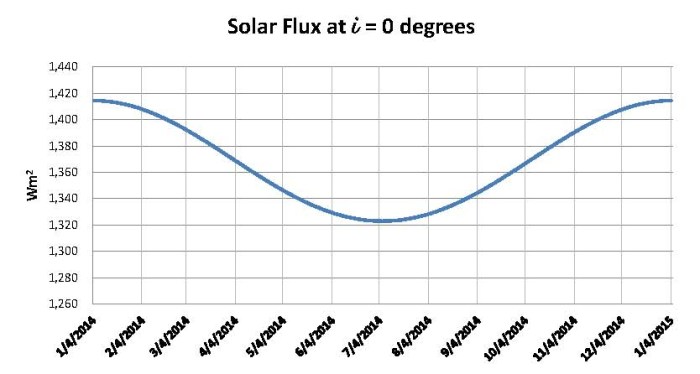
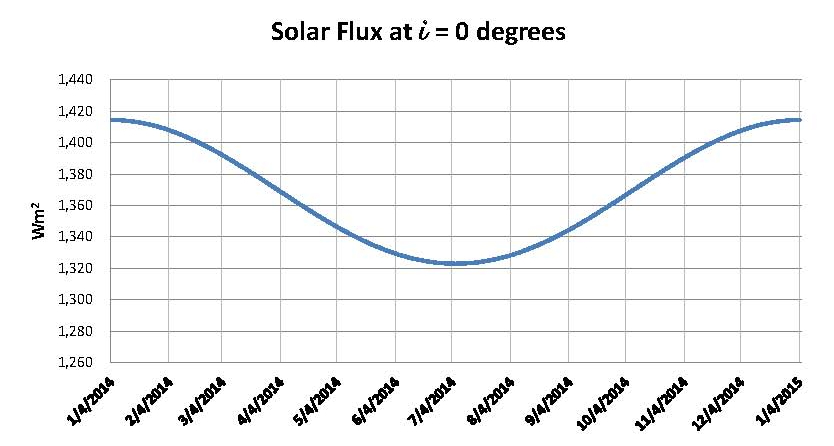
The natural or base temperature of the planet is directly controlled by solar radiation which is known with great accuracy and precision. Once that is known it’s a simple calculation to determine the base temperature. This is done using the following method. There are three sources of energy that determine the climate on the earth: the radiation from the sun which is said to be 1366 Wm2 The actual value based on the orbital range is from 1414.4 Wm2 in January to 1323.0 Wm2 in July and there is also an eleven year sun spot cycle with a range of 1.37 Wm2. The hot core of the planet adds ~0.087 W/m2 and the gravitational effects of the moon and the sun (tides) adds another ~.00738 Wm2. Of these three the sun’s radiation is by far the most important but considering all three the range during an eleven year solar cycle is from a high of ~1415.3 Wm2 to a low of ~1322.4 Wm2 so a more accurate mean would be 1368.34 Wm2.

The energy emitted by the planet must equal the energy absorbed by the planet and we can calculate this using the Stefan-Boltzmann Law. Which is the energy flux emitted by a blackbody is related to the fourth power of the body’s absolute temperature. In the following example the tidal and core temperatures are added after the albedo adjustment since they are not reduced by the albedo.

E       = σT4
σ     = 5.67×10⁻⁸ Wm2 K sec
A       = 30.6% (the planets albedo, this is not actually a constant)

σTbb4 x (4πRe2) = S πRe2 x (1-A)
σTbb4 = S/4 * (1-A)
σTbb4 = 1368.24/4 Wm2 * .694
σTbb4 = 247.46 Wm2
    Tbb = 254.36 K

Earth’s blackbody temperature                         Earth’s surface temperature

Tbb = 252.23O K (-20.92O C) low                         Ts = ~287.75O K (14.6 O C) today
Tbb = 254.36O K (-18.79O C) mean
Tbb = 256.54O K (-16.51O C) high

The difference between the calculated blackbody and the current temperatures is what we call the ‘greenhouse’ effect that averages 33.39O Celsius (C), today (18.79 C +14.6 C = 33.39 C), although the range is from 35.52O C to 31.11O C from variations in the earths orbit and the 11 year solar cycle. This documented variation means that the stated Blackbody radiation as shown here will give a 4.41O variation or let’s say 14.0O C plus or minus 2.2O C because of the Stefan-Boltzmann Law which has a 4th power amplification. This will result in a slow 11 year cycling fluctuation of energy in the tropics where the bulk of the energy comes that is not inconsequential.

It is also known that the bulk of this 33.4 degrees C is found in the water in the earth’s atmosphere, and that some of it comes from CO2. The water in the atmosphere acts as a kind of thermal buffer that delays the incoming radiation from the sun from leaving. If this were not the case there would be no life on earth and it would be nothing but an ice ball so we should be very glad that there is a greenhouse effect.

The above calculation is an exact calculation of the value of the TOTAL current greenhouse effect and is in agreement with accepted values although the one presented here is more exact then the 33 degrees C generally used. The main variable in this calculation is the planets albedo (the amount of reflected light of the planet) whose main component is the planets clouds. Since a small change in the albedo will change the amount of radiation absorbed by the planet and that small change in incoming radiation is multiplied by a factor of 4 the level and makeup of the clouds if more important than any other factor including CO2.

The IPCC climate models are not capable of handling the complexity of cloud formation and so adjustments and work-a-rounds are used and they are not models they are assumptions. In my opinion this is one the two reasons that the IPCC climate models tend to support a run-a-way thermal build up and why they are afraid of CO2. What the models have ignored is that the planet has had a very stable temperature for 600 million years despite CO2 being, at times, over 17 times greater levels than the present. Today’s IPCC climate models cannot handle the CO2 levels that existed in the past and so they are missing something.

Lastly in this section since the planet would have a stable temperature at any given level of CO2 that means that there must be some balance between the water and the CO2 for every level of CO2 and water. Since we know that the two must equal 33.4 degrees C and that water is the primary greenhouse gas that means that the effect from CO2 must be less than that of water. This brings us to the next problem the sensitivity value of CO2 as it must not be great than that of water by definition. The Sensitivity value is a number that describes the amount of effect the CO2 has on temperature. However the 1979 NAS Chaney report stated that it is probably 3.0 degrees C and that is what the IPCC uses today. If the CO2 sensitivity value is 3.0 degrees C than its affect on the climate must be greater than that of water and since that is not possible that means that the CO2 sensitivity value must be less than 3.0 degrees C.

If that is the case, which I think it is, than the CO2 sensitivity value cannot be 3.0 degrees C. And if that is true then the IPCC Climate models are wrong because they are programmed to use this value; and they will not work with a different value. Or I should say that they will not support the Politicians wishes if it is not 3.0 degrees C and then these scientists would lose their jobs.

This will give the reader a basic understanding of what the Greenhouse effect is and how it is calculated. The next post will be on CO2 and water sensitivity.

My NASA Data Manipulation Theory Verified 4 days after being posted.


Last Sunday February 15 I wrote a post here on why NASA was manipulating temperature date buy making the past colder and the present warmer.  Today right on clue The Huffingtonpost wrote two posts on this very subject.

Despite The Recent Snow, The U.S. Has Actually Been Having An Unusually Warm Winter

UN Negotiators Agree On Early Draft Of Climate Deal For Upcoming Paris Conference

Why would they have done this only a few days after the NASA data release, it takes time to write these posts and so the most likely reason is they were ready for this story before the NASA data was released.

The last part of what I wrote in that post is that this data manipulation will continue until the Paris UN Climate conference building up to a crescendo in October / November just in time for the conference. I will post what the NASA numbers will be before the next data release in mid March.

Here is the graphic from what I posted in NASS-GISS Date Manipulation is fact not speculation V2 a few days ago on this subject.

100 data manipulation


The Blackbody Temperature of the Planet Earth


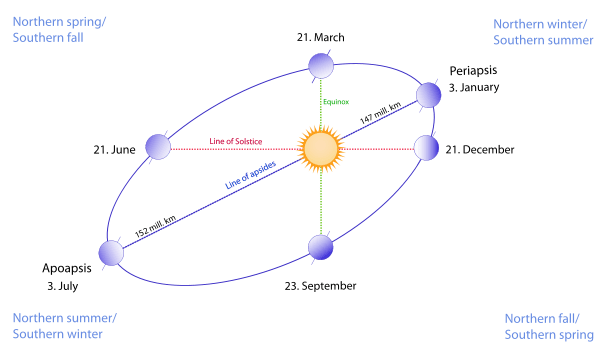
Determining the ‘exact’ blackbody temperature of the planet is the first step in determining what the “greenhouse’ effect is; for without that value all else is either speculation or based on an unreliable value. This leads us to a quandary since the plant is a globe spinning around a titled axis of rotation and with an elliptical orbit around the sun Figure 1 which is the source of virtually all the energy that heats the planet. Clearly with these facts there cannot be one temperature for the planet and so an average can be very misleading and lead to false conclusions; especially as it hides large energy flows on the planet.

Traditional calculations of the planets black body temperature ignore the variables which then lead one to assume a steady state situation verses the real dynamic situation that actually drives climate. To justify this assumption a general statement that the variances are too small to have any meaningful effect are promoted. In some cases with fewer variables this might be true but in this case I think not.

These are the main variables, constants and forces:

  1. The sun has a cycle of about eleven years and that gives a small variation in the suns output of about 1%
  2. The planet has an elliptical Orbit that varies by 3.34% or 4,999,849 miles
  3. The axial tilt of the planet is 23.4 degrees which causes winter and summer to alternate between Aphelion and Perihelion about every 10,000 years
  4. The planet is a sphere so only one side faces the sun at any given moment
  5. The sun’s energy reaches the planet on a line drawn from the center of the sun to the center of the planet which only intersects the equator twice a year
  6. The energy from the sun is concentrated around this line, a hot spot.
  7. The planet is a sphere so the suns radiation drops off in all directions from this line by a Cosine factor to zero at the edge 90 degrees from the center line
  8. The spin and tilt of the planet means that the center line, in effect, moves up 23.4 degrees and down 23.4 degrees during the course of one orbit
  9. That movement means the distribution of the energy in the hot spot also moves
  10. The distribution of land and ocean are not uniform on the planet and therefore the absorption of the solar flux is very different at points the hot spot travels over.
  11. The albedo of the planet is a variable not a constant mainly as a factor of the amount and kind of clouds.
  12. Energy from the core adds a small amount of energy
  13. Tidal forces from the sun and the moon also add some energy
  14. Energy is carried North and South from the hot spot centered on the line by the atmosphere and the ocean
  15. The Coriolis Effect along with tidal forces drive thermal transfer north and south at an angle and these are then main contributors to the climate
BB-01
Figure 1, The Earth’s Orbit

BB-02
Figure 2, Orbital changes in solar flux

There are three sources of energy that determine the climate on the earth: the radiation from the sun which is said to be 1366 Wm2 The actual value based on the orbital range is from 1414.4 Wm2 in January to 1323.0 Wm2 in July Figure 2 and there is also an eleven year sun spot cycle with a range of 1.37 Wm2. The hot core of the planet adds ~0.087 W/m2 and the gravitational effects of the moon and the sun (tides) adds another ~.00738 Wm2. Of these three the sun’s radiation is by far the most important but considering all three the range during an eleven year solar cycle is from a high of ~1415.3 Wm2 to a low of ~1322.4 Wm2 so a more accurate mean would be 1368.34 Wm2.

The energy emitted by the planet must equal the energy absorbed by the planet and we can calculate this using the Stefan-Boltzmann Law. Which is the energy flux emitted by a blackbody is related to the fourth power of the body’s absolute temperature. In the following example the tidal and core temperatures are added after the albedo adjustment since they are not reduced by the albedo.

E  = σT4
σ  = 5.67×10⁻⁸ Wm2 K sec
A  = 30.6% (the planets albedo, this is not actually a constant)

σTbb4 x (4πRe2) = S πRe2 x (1-A)
σTbb4 = S/4 * (1-A)
σTbb4 = 1368.24/4 Wm2 * .694
σTbb4 = 247.46 Wm2
Tbb = 254.36 K

Earth’s blackbody temperature               Earth’s surface temperature

Tbb = 252.23O K (-20.92O C) low              Ts = ~287.75O K (14.6 O C) today
Tbb = 254.36O K (-18.79O C) mean
Tbb = 256.54O K (-16.51O C) high

The difference between the blackbody and the current temperatures is what we call the ‘greenhouse’ effect that averages 33.36O Celsius (C), today, although the range is from 35.52O C to 31.11O C from variations in the 11 year solar cycle. This documented variation means that the stated Blackbody radiation as shown here will give a 4.41O variation or let’s say 14.0O C plus or minus 2.2O C because of the Stefan-Boltzmann Law which has a 4th power amplification. This will result in a slow 11 year cycling fluctuation of energy in the tropics where the bulk of the energy comes that is not inconsequential.

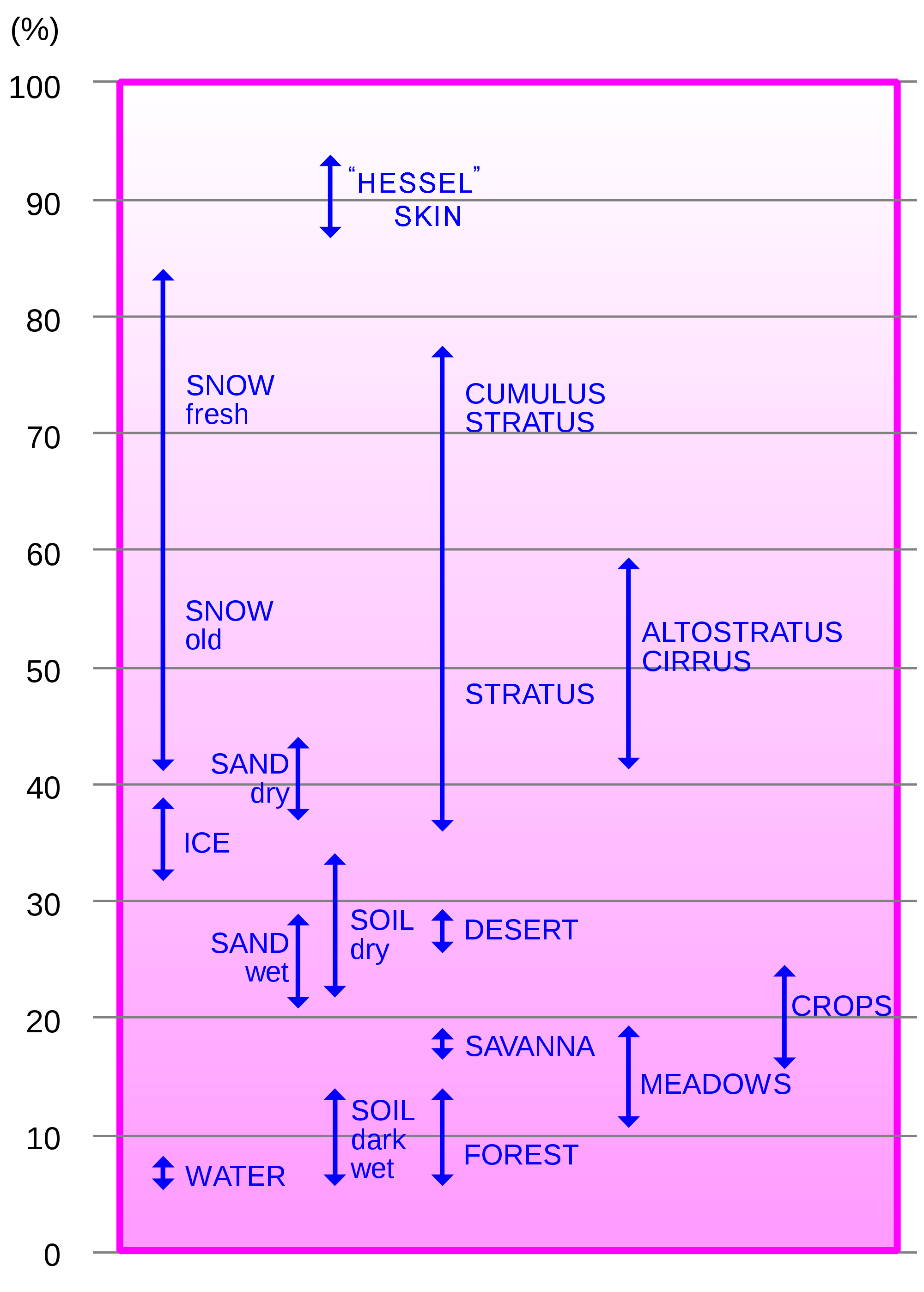
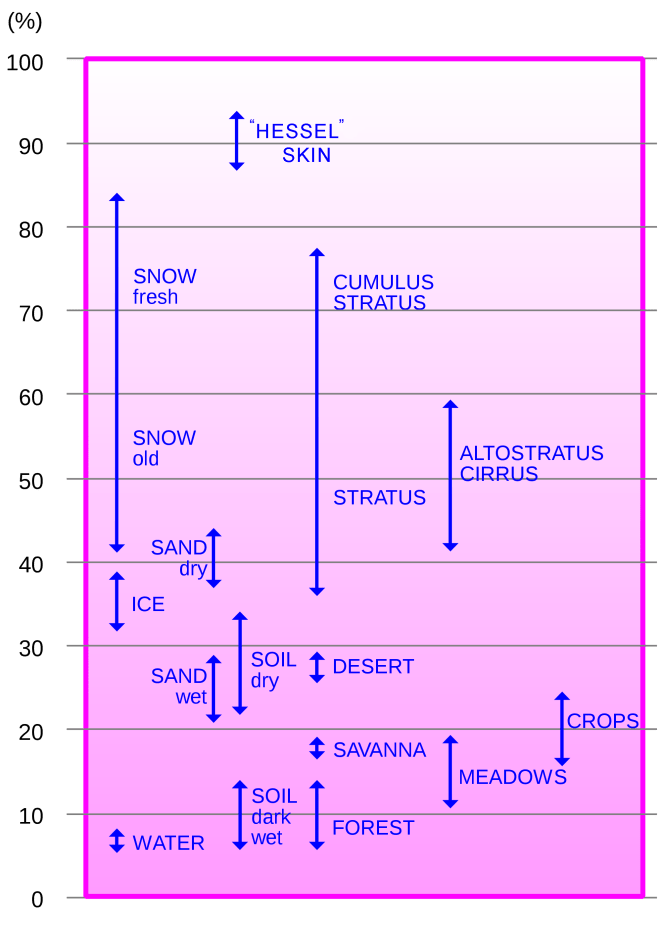
If we add clouds to the picture it get even more complex as they have a significant effect on the planets albedo as we know from two major volcanoes’ both in Indonesia; one in 1815 Tambora and the other in 1883 Krakatoa both of which threw enough particles into the atmosphere to significantly lower the temperature of the planet. Although dust is not a cloud the point is that if the albedo of the planet is changed it does have a major effect on global temperatures. The lack of thermometers in 1815 means we really don’t know what the effect was other then 1816 in known as the year without a summer. The other eruption in 1883 is well documented and is estimated to have dropped world temperatures by 1.20O C which would be equivalent to about a 4.2% reduction in the global albedo. The importance of clouds can be seen in the following Chart Figure 3. A reasonably estimate of the total effect of clouds on the global albedo would be about 50% if nothing else changed or a reduction in Albedo of from 30% to 15%.
BB-03
Figure 3, Albedo of various surfaces

Just for sake of argument if we varied the cloud levels by +/- 10% we find that at low solar flux and high clouds the Blackbody temperature would be 249.46O K and with high solar flux and low clouds the Blackbody temperature would be 259.32O K a range of 9.86O C. The reason this is so important is that properly modeling cloud levels is the area with the most uncertainly in the present models as clouds form at much lower mesh resolutions that the present models can deal with even if the formation could be properly modeled.

Despite this variation in incoming solar flux the planet’s temperatures has been very stable as previously shown in Figure 1 so we know there are no positive feedback process of any consequence on the planet. Other factors are also important in doing climate work such as 52.3% of the solar energy is concentrated within 45.0 degrees of the hot spot and 77.6% within 60 degrees of the hot spot. And the heat from the core and probably the tides is concentrated where the crust is the thinnest under the oceans and this concentration of energy core heat and tides) combined with Coriolis forces is probably what drives the ocean currents. In my opinion these other important factors are not being considered properly in the climate models, and that results in climate models that don’t work properly e.g. the inability to explain why there has been a pause in the warming calculated by NASA and NOAA over that past ten years despite a continuing increase in the level of CO2 in the atmosphere.

We also know from geological studies Figure 4 that the planets temperature has been relatively stable over the past 600 million years with a mean of about 17O C or 290O Kelvin (K) and with a range of plus or minus 5O K or C based on the information in Figure 4. During the past 250 million years CO2 concentrations have ranged from a low of ~280 ppm (a historic low) in 1800 to the present low of 400 ppm to a high of over 2,000 ppm probably averaging around 1,500 ppm. There was only one other period in the past 600 million years with CO2 this low. Going back further CO2 was estimated to be as high is 7000 ppm, but we will ignore that for now.

This means that whatever the processes are that relate to determining the thermal balance of the planet they must work within this range of ~12O C to be valid. Although Figure 4 shows a range of 10O C it would be prudent to spend resources to determine these values with as great accuracy as possible. We’ll assume a mean of 16O C with a range from 10O to 22O C as being more reasonable in this work. Also we are now in one of only three cold periods which are very rare in the past 600 million years and if we count that partial dip 150 million years ago that means that there is probably a 150 million year cycle there; maybe one of those first determined my Milutin Milankovic.
BB-04
Figure 4, Geological temperatures and Carbon Dioxide

Additional discussion as to the so called “greenhouse” effect must start with the important correction that this process is not a true greenhouse effect, since it is not the same process that occurs in a greenhouse used to grow food. The actual process that occurs is based on the structure of the atoms involved and how they interact with the various frequencies of visible and infrared radiation that are in play on the planet. However at this point in time there is no way to correct for the misuse of the words so we are stuck with it and all the complications that therefore arise in trying to properly discuss the issue with lay people and even some with technical knowledge.

The greenhouse effect occurs within the earth’s atmosphere and the main constitutes of wet air, by volume ppmv (parts per million by volume) are listed in the following table. Water vapor is 0.25% over the full atmosphere but locally it can be 0.001% to 5% depending on local conditions. Water and CO2 are mostly near the surface not in the upper atmosphere so the bulk of the greenhouse effect must be close to the surface. This table is different than most as it shows water.

Gas                                      Volume                 Percentage

Nitrogen (N2)                   780,840 ppmv            78.8842%
Oxygen (O2)                     209,460 ppmv            20.8924%
Argon (Ar)                           9,340 ppmv              0.9316%
Water vapor (H2O)               2,500 ppmv              0.2494%
Carbon dioxide (CO2)              400 ppmv              0.0399%
Neon (Ne)                                18.18 ppmv          0.001813%
Helium (He)                                5.24 ppmv         0.000523%
Methane (CH4)                           1.79 ppmv          0.000179%

There are only two of these gases that are relevant to determining how that 33O C (today) happens. That is not to say the others do not contribute but that at the present concentrations of Water H2O and Carbon Dioxide CO2 they are the main determinants. And since we know the range of temperatures that have existed geologically then we have set the range which these to gases must interact in, meaning that any set of equations or models or theories that predict values outside this range must be suspect based on geological evidence.

Also it must be kept in mind that the solar flux falls on a spot centered on a line drawn from the center of the earth to the center of the sun and because of the 23.4O axial tilt of the planet this “Hot” spot moves up and down as the planet moves though its orbit. Because of the shape of the planet the intensity falls off quickly as we move north and south and east and west according to a cosine factor so the heat energy is mostly over oceans near the equator where the atmosphere is the densest.

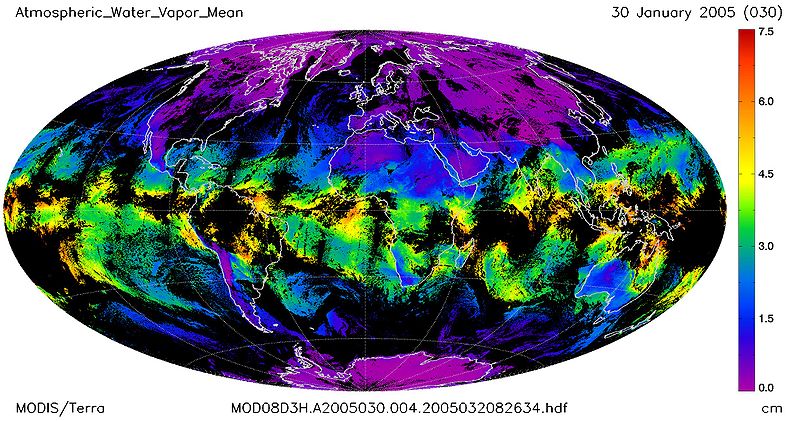
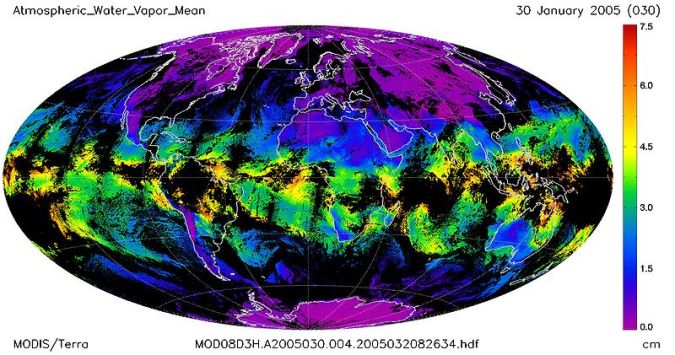
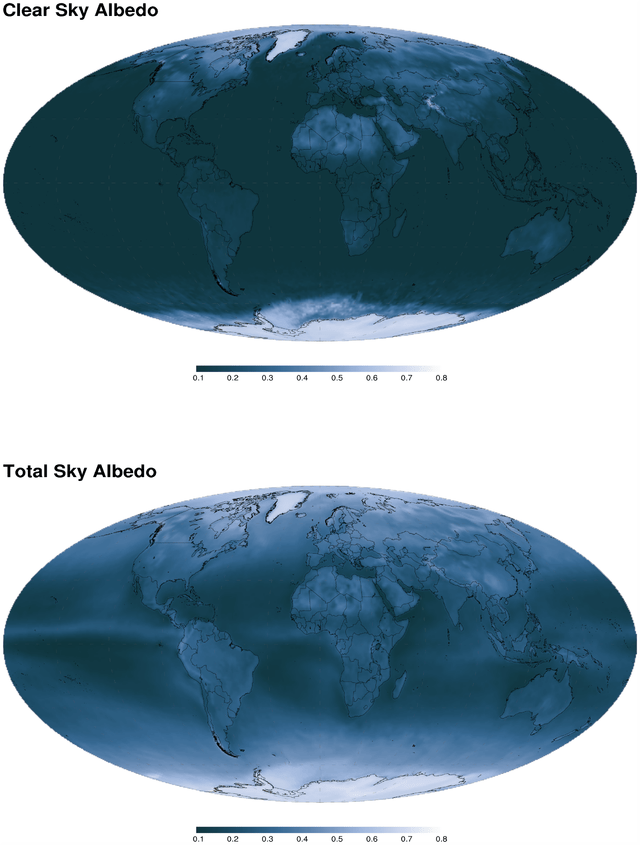
The first image below Figure 5 shows a recent distribution of water across the planet and it is clearly concentrated over the oceans close to the equator and that results in the heat imbalance and therefore movement north and south as shown in the second image Figure 6.
BB-06
Figure 5, water vapor concentrated near the equator
BB-05
Figure 6, change in albedo

In summary we now know that the Blackbody temperature of the planet is a variable.

Tbbl   = 252.23O K (-20.92O C) low at Aphelion
Tbbm  = 254.36O K (-18.79O C) and the yearly mean
Tbbh = 256.54O K (-16.51O C) high at Perihelion

Therefore the ‘greenhouse effect, with clouds as a constant, must be a variable.

Ts = ~287.75O K (14.6O C) today

Ghl     = Tbbl + Ts  = 35.52O C
Ghm = Tbbm + Ts = 32.39O C
Ghh   = Tbbh + Ts = 31.11O C

Considering there would probably be fewer clouds during cool period and more clouds during warm period the following would be more like the true effect considering both.

Tbblc = 252.98O K (-20.17O C) low at Aphelion
Tbbmc = 254.36O K (-18.79O C) and the yearly mean
Tbbhc  = 255.83O K (-17.32O C) high at Perihelion

Therefore the ‘greenhouse effect with clouds included must also be a variable. In this case we assume fewer clouds in cooler periods and more clouds in warmer periods of 2.5% which reduces the range and acts as a negative feedback on the process.

Ts = ~287.75O K (14.6O C) today

Ghlc    = Tbblc + Ts  = 34.77O C
Ghmc = Tbbmc + Ts = 32.39O C
Ghhc  = Tbbhc + Ts = 31.92O C

The range in temperature just from orbital changes is 4.41O C but including clouds that range is reduced to 2.85O C however in either case it is significantly more than the warming that the IPCC claims has happened looking at only Carbon Dioxide as the main factor. These are hard numbers based on the solar flux which is known and the orbital parameters of the Earth that are also known. The large variances come from the Stefan-Boltzmann Law; which is the energy flux emitted by a blackbody is related to the fourth power of the body’s absolute temperature. The fourth power in the equation magnifies the small variation in solar flux significantly.

Analysis of Global Temperature Trends, October 2014 What’s really going on with the Climate?


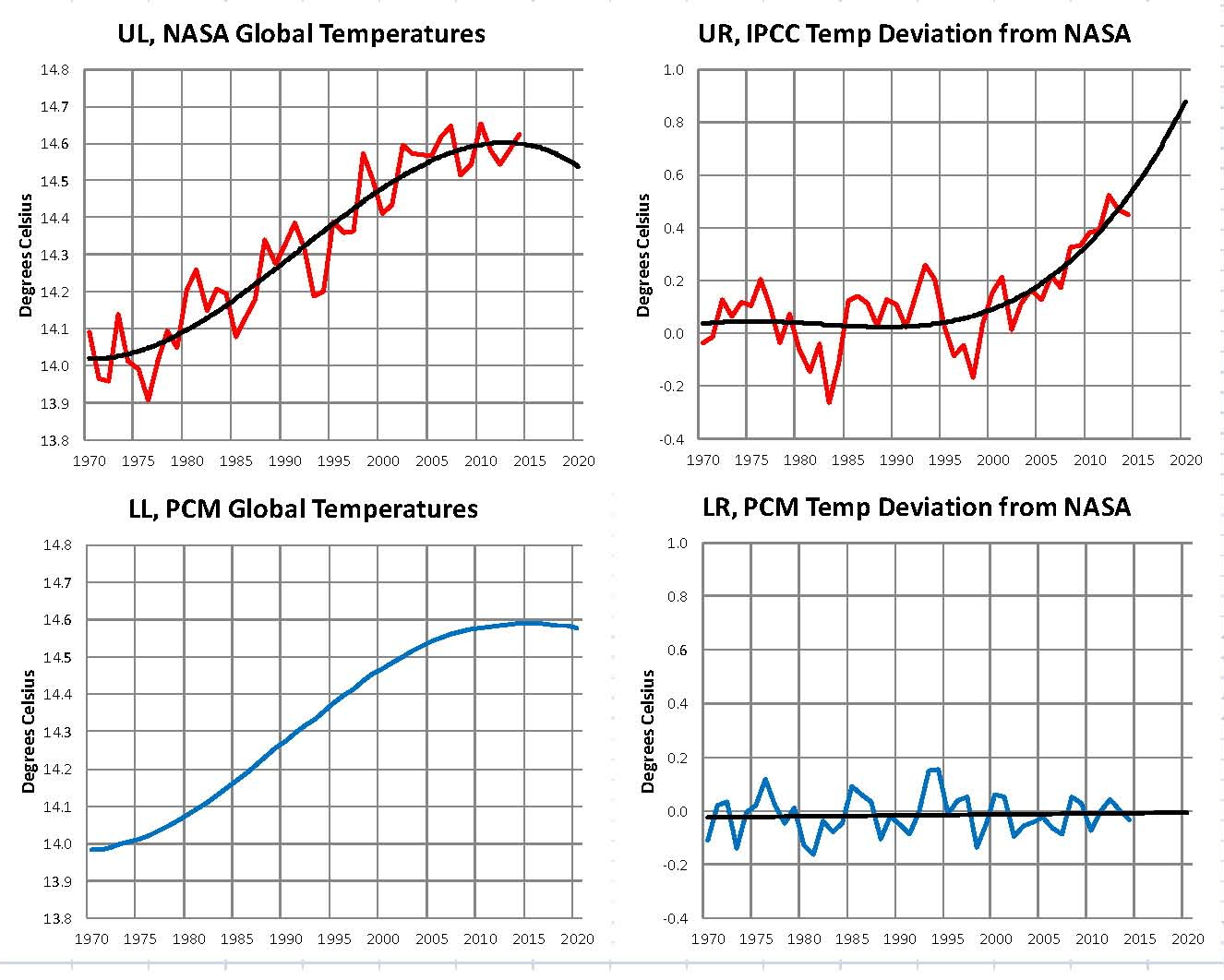
The analysis and plots shown here are based on the following: first NASA-GISS temperature anomalies (converted to degrees Celsius) as shown in their table LOTI, second James E. Hansen’s Scenario B data, which is the very core of the IPCC Global Climate models (GCM’s) and which was based on a CO2 sensitivity value of 3.0O Celsius, lastly, a plot based on an alternative climate model designated ‘PCM’ and based on a sensitively value of .65O Celsius.

The next three paragraphs have been added to this monthly temperature plot to clear up confusion regarding the methods used in this work. That confusion is my fault for not properly explaining what is shown here.

An explanation of the alternative model designated PCM is in order since many have interpreted this PCM model as a statistical least squares projection of some kind and nothing could be further from the truth. A decade ago when I started this work the first thing I did was look at geological temperature changes since it is well know that the climate is not a constant; I learned that in my undergrad climatology course. One quickly finds that there is a clear movement in global temperatures with a 1,000 some year cycle going back at least 3,000 to 4,000 years. There are also 60 to 70 year cycles in the Pacific and the Atlantic oceans that are well documented. We also know that there are greenhouse gases such as Carbon Dioxide and the National Academy of Sciences (NAS) estimated that Carbon Dioxide had a doubling rate of 3.0O Celsius plus or minus 1.5O Celsius in 1979

The IPCC still uses the NAS 3.0O Celsius as the sensitivity value of Carbon Dioxide and a number in that range is required to make the IPCC GCM’s work. The problem with using this value is it leaves no room for other factors and hence the need of the infamous Hockey Stick plot of the IPCC from Mann, Bradley & Hughes in 1999. The PCM model is based on a much lower value for Carbon Dioxide consistent with current research which places the value between 0.65O and 1.5O Celsius per doubling of Carbon Dioxide. If the long movement the short movement and a lower value for Carbon Dioxide are properly analyzed and combined a plot that matched historical and current NASA temperature estimates very well can be constructed.

The PCM model is such a construct and it is not based on statistical analyses of raw data. It is based on creating curves that match observations (which is real science) and those observations appear to be related to the movement of water in the world’s oceans. The movements of ocean currents is well documented in the literature all that was done here was properly combine the separate variables into one curve which had not been previously done. Since this combined curve is an excellent predictor of global temperatures unlike the IPCC GCM’s it appears to reflect reality a bit better than the convoluted IPCC GCM’s which after the past 19 years of no statistical warming have been shown to be in error.

Continuing from the first paragraph, to smooth out monthly variations a 12 month running average is used in all the plots. This information will be shown in four tables and updated each month as the new data comes in about the middle of the month. Since no model or simulation that cannot reasonably predict that which it was design to do is worth anything the information presented here definitively proves that NASA, NOAA and the IPCC just doesn’t have a clue.

IPCC-10

The first plot, UL is a plot of the NASA temperature anomaly converted to degrees Celsius and shown in red with a black trend line added. There has been a very clear reversal in the upward movement of global temperatures since about 2001 and neither the UN IPCC nor anyone else has an explanation for this 13 years later. Since CO2 has continued to increase at what could be argued an increasing rate this raises serious doubts about the logic programmed into all the IPCC global climate models.

The next plot UR, also in red, shows the IPCC estimates of what the Global temperature should be, based on Hansen’s Scenario B, with the NASA actual temperatures’ subtracted from them. Therefore this plot represents a deviation from what the Climate “believers” KNOW what the temperature should be; with a positive value indicating the IPCC values are higher than actual and a negative value indicating the IPCC values are lower than actual, as measured by NASA. A black trend line is added and we can clearly see that the deviation from expected is increasing at an increasing rate. This makes sense since the IPCC models project increased temperatures based primarily on the increasing level of CO2 in the earth’s atmosphere. Unfortunately, for them, the actual temperatures from NASA are trending down (even as they try to hide the down ward movement with data manipulation) since other factors are in play, therefore each year the gap between them widens. Since we have 13 years of observations’ showing this pattern it becomes hard to justify a continuing belief in the IPCC climate models, there is obviously something very wrong here.

The next plot LL shown in blue is based on the equations in the PCM climate model described in previous papers and posts here and since it is generated by “equations” a trend line is not needed. As can be seen the PCM, LL, and the NASA, UL, trend plots are very similar the reason being that in the PCM model there is a 68.2 year cycle that moves the trend line up and then down a total of .30O Celsius (currently negative .0070O Celsius per year); and we are now in the downward portion of that trend which will continue until around 2035. This short cycle is clearly observed in the raw NASA data in the LOTI table going back to 1880. Then there is a long trend, 1052.6 years with an up and down of 1.36O Celsius (currently plus .0029O Celsius per year) also observed in the NASA data. Lastly there is CO2 adding about .005O Celsius per year so they basically wash out which matches the current holding pattern we are experiencing. However within a few years the increasing downward trend of the short cycle will overpower the other two and we will see drop of about .002O Celsius per year and that will be increasing until till around 2025 or so. After about 2035 the short cycle will have bottomed and turn up and all three will be on the upswing again. These are all round numbers shown here as representative values.

The last plot LR in blue uses the same logic as used in the UR plot, here we use the PCM estimates of what the Global temperature should be with the NASA actual temperatures’ subtracted from them. A positive value indicates the PCM values are higher than actual and a negative value indicates the PCM values are lower than expected. A black trend line was added and it clearly shows that the PCM model is tracking the NASA actual values very closely. In, fact since 1970 the PCM model has rarely been off by more than +/- .1 degrees Celsius and has an average trend of almost zero error, while the IPCC models are erratic and are now approaching an error rate of +.5O above expected.

In summary, the IPCC models were designed before a true picture of the world’s climate was understood. During the 1980’s and 1990’s CO2 levels were going up and the world temperature was also going up so there appeared to be correlation and causation. The mistake that was made was looking at only a ~20 year period when the real variations in climate move in much longer cycles. Those other cycles can be observed in the NASA data but they were ignored for some reason. By ignoring those trends and focusing only on CO2 the models will be unable to correctly plot global temperatures until they are fixed.

The purpose of this post is to make people aware of the errors inherent in the IPCC models so that they can be corrected.

Sir Karl Raimund Popper (28 July 1902 – 17 September 1994) was an Austrian and British philosopher and a professor at the London School of Economics. He is considered one of the most influential philosophers of science of the 20th century, and he also wrote extensively on social and political philosophy. The following quotes of his apply to this subject.

If we are uncritical we shall always find what we want: we shall look for, and find, confirmations, and we shall look away from, and not see, whatever might be dangerous to our pet theories.

Whenever a theory appears to you as the only possible one, take this as a sign that you have neither understood the theory nor the problem which it was intended to solve.

… (S)cience is one of the very few human activities — perhaps the only one — in which errors are systematically criticized and fairly often, in time, corrected