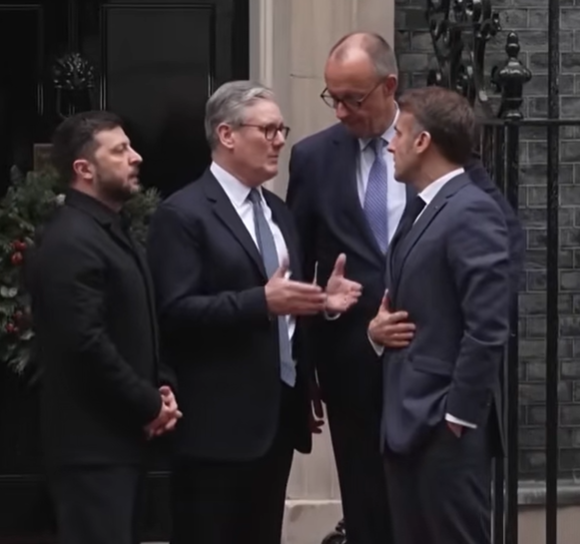
Yesterday, Ukraine President Volodymr Zelenskyy traveled to London to meet with British PM Keir Starmer, German Chancellor Friedrich Merz and French President Emmanuel Macron.
As expected, part of the Zelenskyy meeting with the “coalition of the willing” included a briefing by Ukraine negotiator Rustem Umerov, the secretary of Ukraine’s National Security and Defense Council, who held detailed consultations for three days last week in Miami with Trump’s envoys Steve Witkoff and Jared Kushner.
President Zelenskyy then departed London traveling with his media entourage to Brussels for the next round of discussions with the European Union stakeholders, financiers and politicians. During the trip Zelenskyy told his media stenographers, “Under our laws, under international law — and under moral law — we have no right to give anything away. That is what we are fighting for.”
The U.K, France and Germany support Zelenskyy’s position that he is not going to concede any territory to the Russian Federation, specifically the 30% of the Donbas area in Eastern Ukraine currently at the heart of the physical conflict.
The 30% issue surrounds the Donetsk region in Ukraine, which includes the cities of Kramatorsk and Sloviansk. Russia is currently pushing deep into fortified Ukraine resistance in this region with a population of around 100,000. Zelenskyy claims losing this area would allow Putin to invade the Dnipropetrovsk, Zaporizhzhia and Kharkiv regions.
Historically, this Donbas area was part of a brutal long-term Ukraine civil war between the pro-Russia eastern Ukrainian citizens and the pro-EU western aligned Ukrainian army. Russia’s current position is for Ukraine to cede the entire Donbas to Russia as part of the ceasefire agreement, or Russia will continue forward conflict military operations until successful.
Seeing things through the pragmatic prism of inevitability, President Trump’s view appears to be that this Donbas area will be lost to Russia one way or the other. So, the best scenario to stop the killing is for Ukraine to give up this territory as part of the ceasefire terms. Zelenskyy, with support of the EU, France, Germany and U.K says a firm “no.”
Politico reports that Zelenskyy said in August of this year “it would take Russia four-years to fully occupy the Donbas,” subsequently a lot of killing would take place during this process. President Trump is trying to stop the brutal “killing” part of that dynamic by getting the negotiation to the point of concession, but the EU team view any land area concession as positive affirmation for Russia to continue threatening Europe.
♦ On the ‘Security Guarantee‘ issue, this is where a quagmire is presented by European leaders.
From a pragmatic standpoint a European demilitarized zone, stood up and supported by EU military forces would appear to be the best solution. However, the “coalition of the willing” say they are willing to put security troops into Ukraine, but only if the USA will defend them if attacked by Russia. In essence, quasi-NATO forces on a non-NATO country, that if attacked would draw the entirety of NATO into the conflict, including the United States.
The U.K, France, Germany and EU Commission want a security structure similar to NATO for Ukraine that legally binds the United States to defend their interests if the ceasefire does not hold. President Trump has rejected this construct as yet another way for Europe to pull the U.S into a conflict zone that is not in our vital national security interests.
The ceasefire proposal structured by Trump, Witkoff and Kushner – seemingly supported by Russia, does not permit Ukraine to join NATO; however, EU membership is entirely up to the EU and people of Ukraine to decide. If Ukraine joins the EU, then EU forces alone should provide the security guarantee, not NATO which includes the U.S. and Canada.
(Washington Post) […] Zelensky said Ukraine will not surrender its territory in the eastern Donbas region — not to hasten peace talks, not to satisfy Washington’s push for compromise and not under pressure from Moscow’s continuing military onslaught.
Ukraine and Europe have insisted that a ceasefire be declared along current battle lines, but Russia has refused. Putin has claimed, illegally, to have annexed four entire regions of Ukraine (in addition to Crimea, which Russia seized in 2014) — far more territory than his military forces have been able to occupy.
Some Ukrainian officials held out hope that the negotiations could still bear fruit.
The proposal “is closer to be doable for Ukraine, but not easy and not finished,” said a senior Ukrainian official familiar with recent discussions, who spoke on the condition of anonymity because they were not authorized to comment publicly. (read more)
President Zelenskyy, whose term in office has long expired, departed London with his EU media entourage heading to Brussels. The collective group is trying to figure out how to keep America tied to their stakeholder interests in Ukraine.
The European leaders are manufacturing a construct that is not supported by the vast majority of the citizens within the EU, even within Ukraine itself. Meanwhile back in the USA, congress (House and Senate majorities) supports the position of Ukraine and the EU against the interests of President Trump and the voting majority.
There are trillions at stake.
The ruling class is supporting Zelenskyy, while the killing of the non-ruling class continues on the fields of Ukraine.
Posted originally on CTH on December 8, 2025 | Sundance
President Trump holds a roundtable discussion with Agriculture Secretary Brooke Rollins and various farm state senators as he outlines $12 billion in support and subsidy for American farmers.
With energy prices lowered, the costs for natural gas, fertilizer, diesel and gasoline prices have fallen; however, food costs have remained high. President Trump announced with Brooke Rollins an initiative to help support American farmers with the intended objective to lower production costs from the field that will hopefully transfer to the fork.
Secretary Rollins and President Trump announce a $12 billion bridge subsidy to assist farmers with proactive planning for the 2026 planting season. The money is coming from revenue generated by tariffs, and row crop farming will be the first subsidies delivered. WATCH (media questions begin at 31:40):
Posted originally on CTH on December 7, 2025 | Sundance
Secretary of Treasury Scott Bessent appears on CBS’s Face the Nation for an inflation and affordability debate with narrative engineer Margaret Brennan.
The primary narrative can be seen in Brennan’s emphasis of the new democrat catch phrase “affordability.” Having gaslit the American electorate over the issues of Joe Biden’s economic/energy policy which created record inflation, the same media who ran cover for Joe Biden have switched during the Trump administration to calling the subsequent high costs an “affordability” crisis.
In essence, Biden’s economic, energy and monetary policies drove 2021/2022 inflation to record levels, this made all prices rise massively. Those high prices are now the “affordability problem.” WATCH:
[Transcript] – MARGARET BRENNAN: Good morning and welcome to ‘Face The Nation.’ We have a lot of news to get to, and we begin with the Secretary of the Treasury, Scott Bessent. Good to have you here.
TREASURY SECRETARY SCOTT BESSENT: Morning, Margaret.
SEC. BESSENT: Mr. Secretary, a lot of people are out there holiday shopping. Here is how the President described back in April, what to expect from this season.
[SOT]
PRESIDENT DONALD TRUMP: Maybe the children will have two dolls instead of 30 dolls, you know. And maybe the two dolls will cost a couple of bucks more than they would normally.
[END SOT]
MARGARET BRENNAN: Was the President’s prediction then, correct?
SEC. BESSENT: Margaret, it’s actually been a very strong holiday season, and the- you know, we’ve seen across all the income cohorts thus far. And so there’s nothing to say that there are two dolls instead of 30 dolls.
MARGARET BRENNAN: The President was wrong to predict lower numbers of purchases and higher prices?
SEC. BESSENT: The economy has been better than we thought. We’ve had the 4- 4% GDP growth in a couple of quarters. We’re going to finish the year, despite the Schumer shutdown, with 3% real GDP growth.
MARGARET BRENNAN: Well, the maker of Tonka Trucks, their CEO, said it’s going to cost 40 bucks for their toys right now because of tariffs and inflation, it was 30 bucks the year before that, 25. Prices in the toy space are accelerating, and people are feeling that.
SEC. BESSENT: Well, Margaret inflation is a composite number, and it’s roughly the same year over year. And if we were to look at all imported goods, imported goods inflation is below the inflation number.
MARGARET BRENNAN: The inflation number, you mean the–
SEC. BESSENT: The PC- the PCE number which is about 2.9%. Imported goods inflation is about 1.8. It’s the service economy that’s generating inflation, which actually has nothing to do with tariffs.
MARGARET BRENNAN: But when we hear from for example, the President, when he says that affordability is a con job by Democrats, that seems to just not be resonating with consumers that have been polled by CBS. 60% of Americans polled by this network told us President Trump makes prices and inflation sound better than they really are, and his approval rating in the economy is now down to 36% in our latest poll. On inflation, approval is even lower, 32%. Don’t you need to show that you feel the pain?
SEC. BESSENT: Well, Margaret, I think the President’s frustrated by the media coverage of what’s going on–
MARGARET BRENNAN: This is the polling of average Americans.
SEC. BESSENT: –No, no- yeah, but I think the average Americans, they are hearing a lot from media coverage. And I will tell you that affordability has two components, there is inflation, and then there is real incomes. Real incomes are up about 1% and what we’re not going to do is say that Americans don’t know what they’re feeling. We’ve been working on it every day. I was on your show on March talking about affordability. The- we’ve made a lot of gains, but remember, we’ve got this embedded inflation from the Biden years, where mainstream media, whether it’s Greg Ip at the Wall Street Journal, toxic Paul Krugman at New York Times or former Vice Chair, Alan Blinder, all said it was a vibecession. The American people don’t know how good they have it. Now, Democrats created scarcity, whether it was in energy or over regulation, that we are now seeing the- this. affordability problem, and I think next year we’re going to move on to prosperity.
MARGARET BRENNAN: You do think there is an affordability problem?
SEC. BESSENT: Sorry?
MARGARET BRENNAN: You do believe there’s an affordability problem?
SEC. BESSENT: Oh, I think the Biden administration created a terr–
MARGARET BRENNAN: No, but now we’re nearly 12 months in, you said the President would own the economy at this point.
SEC. BESSENT: I said that the Biden administration created the worst inflation in 50 years, and maybe for working Americans, the worst inflation of all time. And we have pulled that number down- that Strategas research does something called the common man index. Under Biden, the accumulated inflation number, as measured by CPI, was about 20%. Their index showed 35. This year for the first time, the common man index is below the inflation index because the basket of goods for working Americans, food, gasoline, rent is coming down. So I wrote an essay March 12, 2024, and it talked about the three I’s, immigration, interest rates and inflation. Immigrant- mass, unfettered immigration, depressed wages caused housing prices to go up. President has closed the border that is fixed. Interest rates have come down. The bond market just had the best year since 2020 and now we are working on inflation, and I expect inflation to roll down strongly next year.
MARGARET BRENNAN: Well, I mean, grocery prices are up nearly 3% compared to last September. The President seems to be acknowledging that grocery prices, or at least beef prices, are a challenge, because he put out this order just yesterday saying they’re going to investigate corporate price gouging for high beef prices. Isn’t suing the food companies the same thing the Biden administration did, and it didn’t really work? How is this any different?
SEC. BESSENT: Well, nothing- nothing the Biden administration did worked–
MARGARET BRENNAN: So why are you doing it?
SEC. BESSENT: Because this isn’t the same thing. If they- if they had done this, if they’d done it properly, we’d be in a different spot. And like, beef is one component. Thanksgiving Turkey was down 16%.
MARGARET BRENNAN: Well, I know you are working on the trade front, and for American farmers and the prices that they are experiencing, that they’re feeling a pinch about not having a market to sell into, necessarily.
SEC. BESSENT: Not- not anymore.
MARGARET BRENNAN: Well, the agricultural Secretary just said that the President is going to announce a bridge payment for farmers this week to give them short term relief while you’re working on these- finalizing these trade packages. There are these low crop prices, and the soybeans in particular, I know you spoke with China’s Vice Premier Friday. Are they going to speed purchasing up?
SEC. BESSENT: Well, they’re not going to speed purchasing up. They’re in the cadence that we agreed to. Soybean prices are up about 12 or 15% since the agreement with the Chinese. They are going to buy 12.5 million metric tons. But Margaret, I’m involved in the agricultural industry. I run a soybean farm, and I can tell you–
MARGARET BRENNAN: You own one, you invest in it.
SE. BESSENT: Sorry?
MARGARET BRENNAN: You own or invest in–
SEC. BESSENT: –People in my family go out and work on it. I actually just divested it this week as part of the- my ethics agreement, so I’m out of that business. But I probably know more about any Treasury Secretary than- about agriculture since the 1800s and I can tell you that what farmers need is certainty, and we have put that in place with this trade deal. 12 and a half million metric tons this year, 25 million metric tons for the next three years, for soybeans, also sorghum, the- and lumber.
MARGARET BRENNAN: So those purchases, just to clarify, those will be this year, because I heard you say this past week that some of the purchases wouldn’t take place until February.
SEC. BESSENT: Well, for the- for the season, so the crop year.
MARGARET BRENNAN: The season year?
SEC. BESSENT: Yep.
MARGARET BRENNAN: Okay. But why- if everything’s fine, then why do farmers need a bridge payment from the Agricultural Department?
SEC. BESSENT: Sorry?
MARGARET BRENNAN: Why would farmers need a bridge payment from the Agriculture Department, then?
SEC. BESSENT: Because these prices haven’t come in, because the Chinese actually used our soybean farmers as pawns in the trade negotiations. And we are going to create this bridge because, again, agriculture is all about the future. You’ve got to start financing for planning next year when things will be very good.
MARGARET BRENNAN: I want to ask you about something that was announced this past week, the Trump accounts, and building on this concept so parents, as I understand, are going to be able to open these accounts via the Treasury for their kids, their tax deferred investment vehicles to U.S. citizen children under 18, get $1,000 from the government for babies born between 2025 and 2028. So there are going to be restrictions on what the money can be used for college tuition or their first house, is that right?
SEC. BESSENT: No, it is- the federal government for children born in the period you just described, is going to put $1,000 into these Trump accounts, it will be invested in a widely diversified, low cost index, and then it will be available–
MARGARET BRENNAN: In the stock market, in an exchange traded fund or mutual fund.
SEC. SCOTT BESSENT: So in essence, it is a trust fund. It is a piece of the American economy for every child, and they will be able to take it out when they’re 18, or they can convert it to a more IRA-type program and keep it for their retirement.
MARGARET BRENNAN: So there won’t be the restrictions I mentioned there about how they use the money?
SEC. BESSENT: No.
MARGARET BRENNAN: Okay, so there was also a broadening of this- this past week, with the Dell Foundation making a significant investment in the American children. So how is this going to work? Why structure it this way, instead of a savings account, for example?
SEC. SCOTT BESSENT: Well, a savings account just gets interest. This is the compounding power of the stock market. As Warren Buffett says, don’t- don’t bet against the American stock market, don’t bet against the economy. And this is going to bring a whole group of new investors into the market. We’re going to couple it with a big amount of financial literacy, so that children understand what they own. The incredible gift by Michael and Susan Dell will be the- is a program that philanthropists’ foundations can do to top up these accounts. And we are expecting, we’re already at- Treasury is already in discussions with foundations, with major philanthropists to top up these accounts. It could either be for all children, or you can specify it by zip code, a school district, or you can do what the Dells did, and say that it will be- won’t apply to the zip codes of the top 20% of earners.
MARGARET BRENNAN: And more information is going to be coming out on how to use this and access it?
SEC. SCOTT BESSENT: Yes, in the coming weeks, we’ll do that, and then the official kickoff will be July 5.
MARGARET BRENNAN: Before I let you go, I want to ask you about this massive fraud out in Minnesota, and the state welfare program has been under federal investigation since all the way back in 2022. The President told you, though, this week, to look into Somalis who, quote, ripped off that state for billions of dollars. He said they contribute nothing. What exactly are you investigating?
SEC. SCOTT BESSENT: Well, Margaret, to be clear, the initial fraud that was discovered by the IRS for which I’m the Acting Commissioner- is discovered by IRS Criminal Investigations Unit. This was not an endogenous thing that the state of Minnesota decided. We had to go in and clean up the mess for them, and this is part of the continued cleanup. A lot of money has been transferred the- from the individuals who committed this fraud, including those who donated to the government- Governor, donated to Representative Omar and donated to AG Ellison, but they’ve been transferred to something called MBs–
MARGARET BRENNAN: Mortgage backed securities, what–?
SEC. BESSENT: Sorry?
MARGARET BRENNAN: Transferred to what?
SEC. BESSENT: These are money- the- bureau services, and they are wire transfer organizations that are outside the regulated banking system, and that money has gone overseas, and we are tracking that- the- both to the Middle East and Somalia to see what the uses of that have been.
MARGARET BRENNAN: Okay, but you have no evidence of that money being used to fuel terrorism, which is what some conservative writers are alleging?
SEC. SCOTT BESSENT: That’s why it’s an investigation. We started it last week. We’ll see where it goes. But I can tell you that, you know, it’s terrible. You know, Representative Omar tried to downplay it. Said, oh, it was very- the- it was very tough to know how this money should- should be used. She was gaslighting the American people.
MARGARET BRENNAN: Well, we’ll talk to her.
SEC. BESSENT: Yeah. But, you know, when you come to this country, you got to learn which side of the road to drive on. You got to learn to stop at stop signs, and you got to learn the- not to defraud the American people.
MARGARET BRENNAN: Well, there are plenty of- plenty of criminal behavior from communities well beyond the immigrant community, but we’ll talk about this with Representative Omar shortly. Thank you, Mr. Secretary.
Posted originally on CTH on December 7, 2025 | Sundance
President Donald Trump and First Lady Melania Trump attend the Kennedy Center Honors. During the arrival ceremony President Trump answered questions on the red carpet from the assembled press pool.
.
Sylvester Stallone is one of the honorees and gave some strong remarks about his relationship to President Trump. Below:
Posted originally on CTH on December 7, 2025 | Sundance
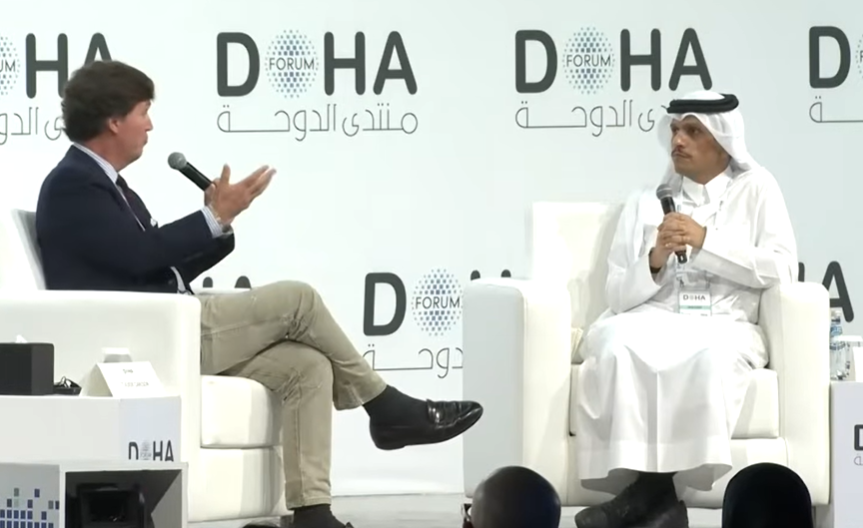
Tucker Carlson is attending a conference in Doha along with a series of U.S. and EU political pundits and people within the geopolitical world including Donald Trump Jr. This conference has people like Mark Levin and Laura Loomer going bananas as the Qatar vs Israel influence operation reaches new political levels of antagonism.
In the interview below Tucker Carlson is interviewing Qatar’s Prime Minister and Foreign Minister Sheikh Mohammed bin Abdulrahman Al Thani on the Israel–Gaza war, U.S. foreign policy toward Israel, Qatar’s long and ongoing role in mediation with Hamas, and the surge of propaganda targeting Doha.
The discussion includes how various administrations have asked Qatar for assistance, and the issue of Israel attacking Qatar amid the active peace talks. Tucker Carlson also tackles the issue of U.S. voices calling him a propagandist for Qatar head on. WATCH:
.
As previously noted, Donald Trump Jr also attended the Doha, Qatar, conference. His remarks are below.
The Qatar vs Israel influence battle, seems to be -essentially- the JD Vance vs Ron DeSantis pre-battle and influence operation. I’ll keep watching it unfold, because the transparency of the objectives is interesting.
Posted originally on CTH on December 6, 2025 | Sundance
President Trump presented the Kennedy Center Award to the 2025 recipients from the Oval Office. The awards were presented to George Strait: Renowned country music star known as the “King of Country,” with over 60 number one hits and 120 million records sold. Michael Crawford: Actor and singer famous for his role as the Phantom in “The Phantom of the Opera.” Sylvester Stallone: Iconic actor known for his roles in the “Rocky” series and other major films. Gloria Gaynor: Celebrated singer best known for her anthem “I Will Survive.” and KISS: Legendary rock band known for their theatrical performances and iconic music.
The President placed around each honoree’s neck a new medal that was designed, created and donated by jeweler Tiffany & Co., according to the Kennedy Center and President Trump.
It’s a gold disc, etched on one side with the Kennedy Center’s image. The honoree’s name appears on the reverse side, with the date of the ceremony. The medallion hangs from a navy blue ribbon and replaces a large rainbow ribbon decorated with three gold plates that rested on the honoree’s shoulders and chest. WATCH:
Posted originally on CTH on December 6, 2025 | Sundance
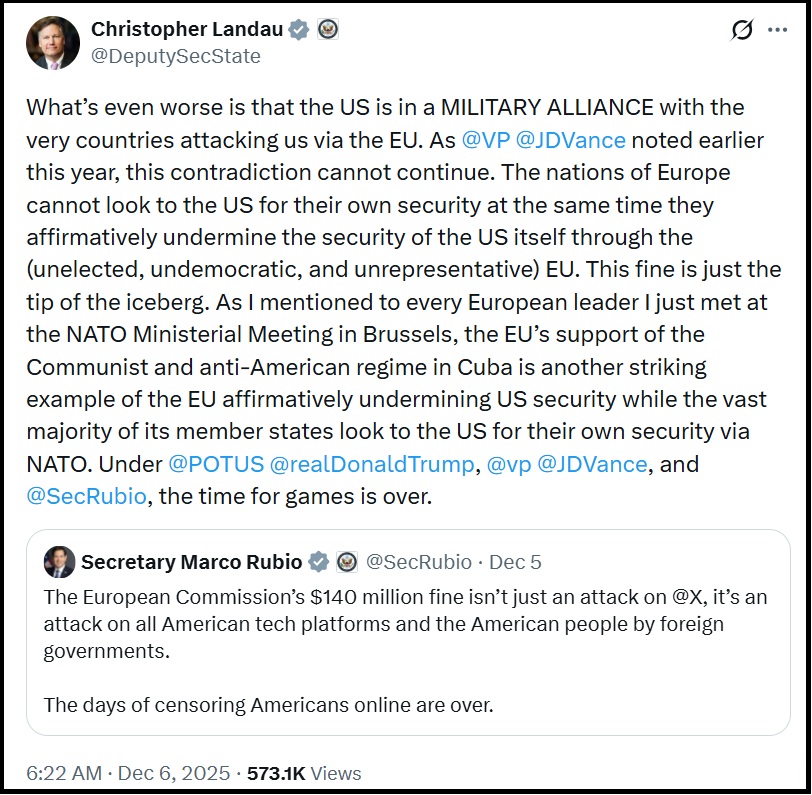
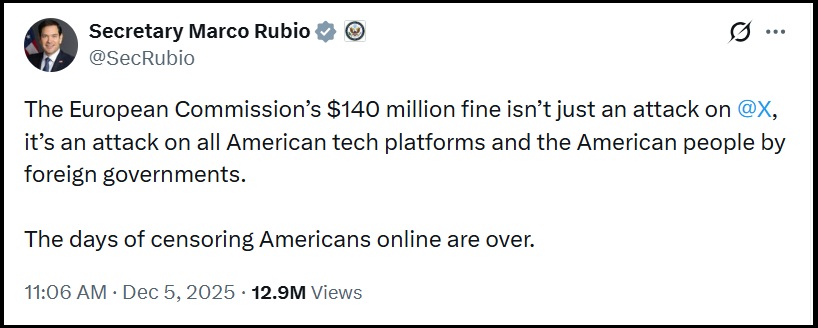
Deputy Secretary of State Chris Landau presents a well-articulated change in perspective from the U.S. State Department. The response comes following the EU decision to levy a compliance fine against the social media platform X.
What Christopher Landau notes as the contrast and conflict in ideological priority from the EU can just as easily be applied to the USA dynamic with Canada. As noted by Twitter user John Frank, “The same observations can easily apply to the relations with Canada, given the divergence between the US role in the military alliance with Canada, while Canada is involved in activities which work against US interests.”
At a certain point it does become necessary to distinguish exactly what values, benefits, perspectives and priorities frame the positions that determine who our U.S. allies really are, and who should benefit from that relationship.
It is good to see a structurally different perspective from the U.S. State Department that puts a bold underline under the term “western alliances.” What values are those alliances based on?
Posted originally on CTH on December 5, 2025 | Sundance
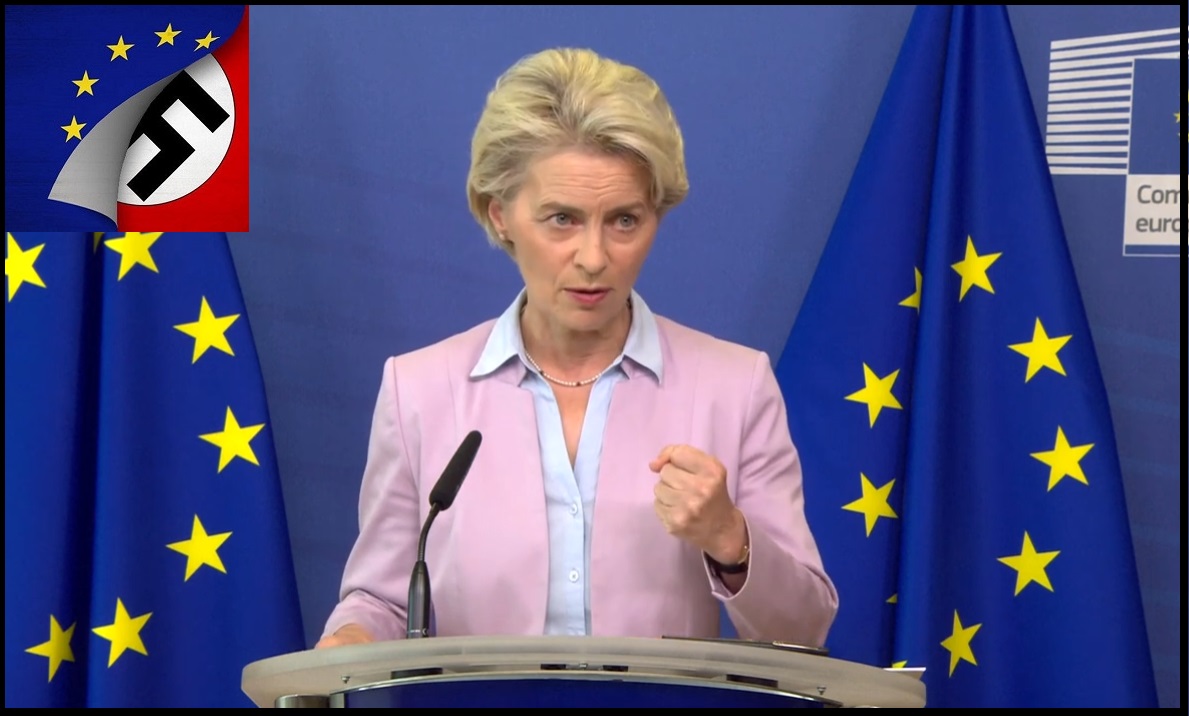
The European Union has fined the X social media platform (formerly Twitter), owned by Elon Musk and his investment group, $140 million (usd) for violations of the EU Digital Services Act. The decision by the EU is likely to create even more friction between President Trump and the European Union. However, this problem is not difficult to solve.
The collective government within the EU accuse Elon Musk and X of permitting misinformation, disinformation and malinformation to appear on the platform.
The European DSA is ultimately designed to control information, that reality should not be debated. All efforts to control traditional and social media are efforts to control information.
The specifics of the reasoning for the fine are typically European. (1) Twitter allows ordinary people to deliver information at the same level as people who should be defined as more important. (2) Advertisers of those who pay for promotion of information on X are not easily identifiable – people need to figure it out on their own. (3) It is too difficult to figure out who is providing the information.
Basically, all of the EU concerns center around information control. It’s really an ideology issue. In the outlook of the EU, bureaucrats and elites feel they are superior and must rule/protect the people under them. Ordinary people having access to information that may or may not be approved by the EU is the underlying issue.
EUROPE – […] Before Musk acquired X, when it was previously known as Twitter, the checkmarks mirrored verification badges common on social media and were largely reserved for celebrities, politicians and other influential accounts, such as Beyonce, Pope Francis, writer Neil Gaiman and rapper Lil Nas X.
After he bought it in 2022, the site started issuing the badges to anyone who wanted to pay $8 per month.
That means X does not meaningfully verify who’s behind the account, “making it difficult for users to judge the authenticity of accounts and content they engage with,” the Commission said in its announcement.
X also fell short of the transparency requirements for its ad database, regulators said.
Platforms in the EU are required to provide a database of all the digital advertisements they have carried, with details such as who paid for them and the intended audience, to help researches detect scams, fake ads and coordinated influence campaigns. But X’s database, the Commission said, is undermined by design features and access barriers such as “excessive delays in processing.”
Regulators also said X also puts up “unnecessary barriers” for researchers trying to access public data, which stymies research into systemic risks that European users face.
“Deceiving users with blue checkmarks, obscuring information on ads and shutting out researchers have no place online in the EU. The DSA protects users,” Henna Virkkunen, the EU’s executive vice-president for tech sovereignty, security and democracy, said in a prepared statement. (more)
Stopping this nonsense is not complicated.
Attach a $1,000 free speech support fee to every European automobile sold in the USA.
Their pontificating ideology is less important than their need for money.
Posted originally on CTH on December 5, 2025 | Sundance
In the world of Trumpian geopolitical trade stuff, three issues are very interesting to watch. (1) The strategic reset with Russia which could break the official western construct of financial control. (2) The proactive and defensive positioning of Mexico (desperate attempt to retain economic attachment), and (3) the certain dissolution of the USMCA what Canadians call CUSMA.
Canadian media are starting to realize something we have talked about on these pages for years; President Trump intends to end the USMCA because the USMCA was used as a fracture point to eliminate NAFTA.
Wall Street, the U.S. Congress, the massive K-Street lobbying network around the U.S. Chamber of Commerce and the entire political apparatus of business and industry would never permit the end to NAFTA; too many trillions at stake. So, President Trump replaced NAFTA with the interim USMCA, which was better but factually more useful in elimination of the original.
Now, as we have discussed by highlighting President Trump’s no-so-subtle words on the issue, the Canadian media is realizing the USMCA will be dissolved in favor of two independently negotiated bilateral trade agreements; one with Canada and one with Mexico.
🚨MAJOR BREAKING
Trump signals that he could EXIT from USMCA entirely.
This is EXTINCTION LEVEL to Canada.
He going to do it. I have a strong feeling about this.
(CTV) – U.S. President Donald Trump could decide next year to withdraw from the Canada-United States-Mexico trade agreement (CUSMA), Politico reported on Thursday, citing U.S. Trade Representative Jamieson Greer.
“The president’s view is he only wants deals that are a good deal. The reason why we built a review period into CUSMA was in case we needed to revise it, review it or exit it,” Greer told Politico’s White House bureau chief Dasha Burns in a podcast episode that airs Friday.
Greer also raised the idea of negotiating separately with Canada and Mexico and dividing the agreement into two parts in the podcast, adding that he spoke with Trump about that possibility just this week.
The White House, Canadian and Mexican governments did not immediately respond to Reuters request for comment.
Trump on Wednesday said that the CUSMA agreement – which faces an upcoming review- will either be left to expire or another deal will be worked out.
The USMCA, which replaced the North American Free Trade Agreement in 2020 and was negotiated during Trump’s first term as president, requires the three countries to hold a joint review after six years. (link)
I have talked to a lot of Canadians on the issues of economics and trade. As a result, I can say with complete sincerity that not since the COVID-19 examples of New Zealand (lockdowns) and Australia (vaxx), has a nation engaged in such a level of mass cognitive dissonance as the govt of Canada on the issue of economics and trade – in the past few years. It is stunning.
To understand the reality of the situation Here’s an IN-DEPTH LINK. Apparently, few really understand the full scope of the issues.
For those who have followed along with the U.S-Canada trade positioning, the current status of conflict between the Trump administration and the government of Canada is not surprising. {GO DEEP}
Going all the way back to the replacement of NAFTA, with the USMCA, President Trump always said he did not favor multilateral trade deals with multiple countries; instead, he preferred bilateral free trade agreements.
Some people have construed the bilateral preference of President Trump to be the elimination of globalism in favor of nationalism in trade agreements.
While the outcome of the Trump approach indeed aligns with that theme, it is not specifically the objective of President Trump to eliminate global trade, but rather to focus on specific interests in trade that benefit the unique nature of each party involved.
As a result, the USMCA -or CUSMA as said in Canada- is not in alignment with a bilateral free trade agreement, and the conflicted differences between trade with Mexico and trade with Canada are an outcome of this dynamic. The solution is simply to eliminate the multilateral in favor of the bilateral approach. This is the objective of President Trump as expressed.
There is zero leverage on the Canadian side of the trade negotiation, zero.
There is nothing that Canada provides to the USA that the USA cannot create, produce or secure independently. The nature of the economic relationship is entirely lopsided, with the USA getting nothing in return for the massive outflow of U.S. dollars (USD).
Our trade relationship with Canada is based on the U.S. government simply liking our northern neighbor and giving them terms and conditions for their economy to benefit from proximity. Take the friendship out of the equation, which is key to understanding the polar political ideology of the two nations, and there is simply not much reciprocal trade benefit.
Take away the soft wood lumber, we have our own. Take away the oil, we have multitudes of domestic production options. Take away the minerals, again we have both our own unused capacities and enhanced trade agreements with other Free Trade Agreement nations.
Then look at the possibility of a strategic U.S-Russia economic alliance, and all those contracted icebreakers take on new meaning.
Some may think this is an overly harsh view of our Canadian friends. However, the Canadian majority believes in climate change and unfortunately leftist politicians control their industrial economy. Canada is in the middle of a mass formation psychosis. Canada needs to get hard, dispatch cultural Maxism and put deliberate men in charge.
A Canadian conservative is essentially a politically correct Mitt Romney; not strong enough to make a difference.
The best thing President Trump can do for our Canadian friends is to help strategic regions while their overall economy collapses around them. Then we hope guys like this surface to rebuild the Great White North.
Posted originally on CTH on December 3, 2025 | Sundance
In an effort to return common sense, practicality and affordability to the American consumer base for automobiles, President Trump announced the elimination of Joe Biden’s Corporate Average Fuel Economy (CAFE) standards for manufactured cars and trucks.
Under the auspices of the “Green New Deal”, the Biden administration mandated ridiculous quotas for EVs and demanded lower power combustible engines, or pay a climate change tax. These CAFE standards resulted in a surcharge for large vehicles, large engine autos and SUVs, and essentially bifurcated the auto consumer into those who could afford to pay for efficiency and stability, and those who could not.
“We’re officially terminating Joe Biden’s ridiculously burdensome, horrible actually, CAFE standards that impose expensive restrictions and all sorts of problems, gave all sorts of problems to automakers,” President Trump announced from the Oval Office. “It put tremendous upward pressure on car prices, combined with the insane electric vehicle mandate. Biden’s burdensome regulations helped cause the price of cars to soar more than 25%,” President Trump said. WATCH:
(Via White House) – DELIVERING A WIN FOR AMERICAN FAMILIES AND AUTOMAKERS: Today, President Donald J. Trump is delivering major relief to American families by resetting the Biden Administration’s costly and unlawful Corporate Average Fuel Economy (CAFE) standards.
President Trump is returning CAFE standards to levels that can actually be met with conventional gasoline and diesel vehicles. The Biden Administration standards imposed unrealistic fuel economy targets that effectively resulted in an electric vehicle (EV) mandate.
The Trump Administration’s reset of the CAFE standards ensures the program’s fidelity to the legal restrictions set forth by Congress.
The Biden standards broke the law by going far beyond the requirements that were mandated by Congress when it created the CAFE program.
SAVING AMERICAN FAMILIES MONEY: Today’s action represents an enormous win in response to the cost-of-living increases imposed on the economy by the Biden Administration.
The Biden Administration created extraordinarily stringent fuel economy standards for passenger cars and trucks, set at such aggressive levels that they were impossible to meet with available technologies for gas cars.
The Biden standards would have compelled widespread shifts to EVs that American consumers did not ask for, accompanied by significant cost-of-living increases. Since EVs are so expensive to build, automakers must sell them at a loss and make up the difference by significantly raising the sticker price of gas cars.
If President Trump had done nothing, the Biden standards would have raised the average cost of a new car by nearly $1,000, relative to the cost under the standards announced today.
President Trump’s actions will save American families $109 billion in total over the next five years. By helping more Americans buy newer, safer vehicles, this reset is projected to save more than 1,500 lives and prevent nearly a quarter-million serious injuries through 2050.
MARKING A CRITICAL BATTLE IN THE FIGHT AGAINST BIDEN’S HIDDEN COST-OF-LIVING INCREASES: The CAFE reset represents the latest action by President Trump to prevent the Biden EV-related policies from raising costs for Americans.
In June, President Trump signed a joint resolution to end the California EV mandates, which would have effectively been a 100% ban on new gas cars sold in the state by 2035 (with similar effects in 17 states that adopted California’s standards).
In July, President Trump signed into law the Working Families Tax Cuts Act, which set the civil penalty for violating CAFE standards to $0, protecting the U.S. auto manufacturing industry from significant fines.
Under President Trump, the Environmental Protection Agency (EPA) has also released its proposal to rescind the 2009 Endangerment Finding, which ignores Congress’ clear intent under the Clean Air Act and has been used to justify over $1 trillion in costs for the American consumers and economy.
Today’s action helps ensure that even if far-left Democrats return to power, the CAFE standards are sensible, so U.S. automakers are not held to infeasible standards.
Combined with auto loan interest deductibility for new made-in-the-USA vehicles, President Trump continues to deliver real relief that makes owning a safe, reliable car more affordable for every American family. (source)
I have created this site to help people have fun in the kitchen. I write about enjoying life both in and out of my kitchen. Life is short! Make the most of it and enjoy!
This is a library of News Events not reported by the Main Stream Media documenting & connecting the dots on How the Obama Marxist Liberal agenda is destroying America







 Centinel2012