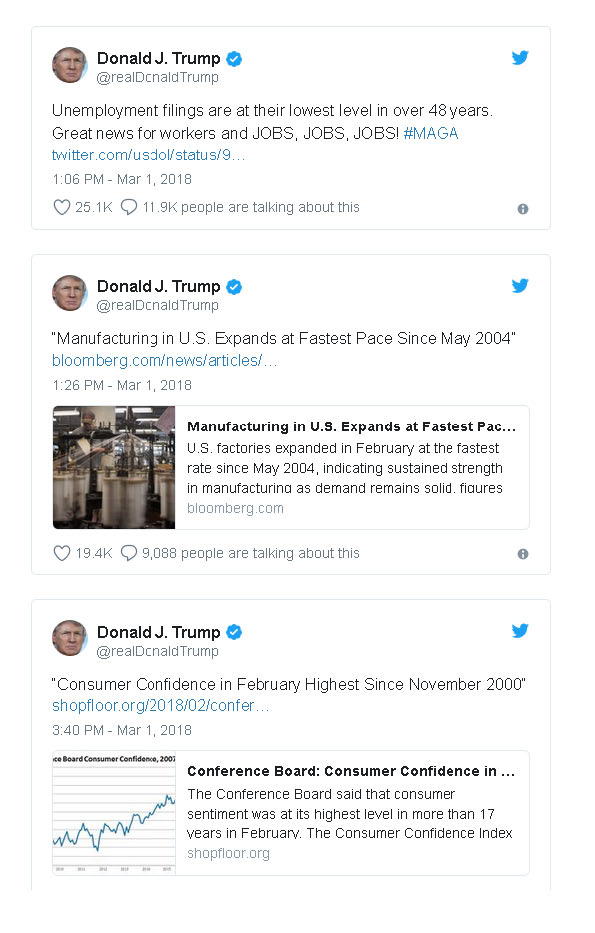
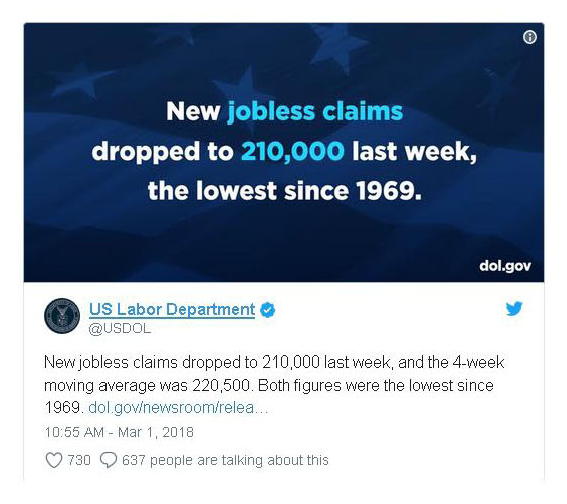
U.S. Unemployment Claims Reach Lowest Level Since 1969…


MAGAnomics baby!!  Throw dem ju-ju bones out the windows and hold on to your britches…  The U.S. Dept of Labor is reporting unemployment claims have dropped to 210,000.  That’s the lowest jobless number since December 6th, 1959.

You know what this means right?

…wait for it.

…wait for it.

That’s right. We better grab chin straps for the hard hats, because pay raises and wage rate increases are thundering toward the middle-class like an unstoppable herd of buffalo. Exactly on schedule.  Cha-ching & Ka-pow.

This has been the plan within very-stable-genius Trump’s MAGAnomics all along.

Take-home paychecks are already seeing the benefits of lower tax rates for the middle-class.  The mid-size employers are simultaneously benefiting from lower corporate tax rates.  This means the employers can afford to pay more…. and right on cue, the labor market says ‘show me the money‘.

We timed this out to appear in Quarter #2 2018:  More take-home pay, PLUS a pay raise, EQUALS the ability to afford slightly higher consumer prices (Q4) on durables.  See how that works?

The January 2018 jobs report showed a gain of 200,000 U.S. jobs, and more importantly, a 2.9% year-over-year growth in wages.  –SOURCE–  [Biggest wage rate jump since the phoney trillion stimulus-funded growth mid-2009.] We continue to remind of our two-year prediction that stunning wage growth will evidence in Q2 of 2018 (April-July)… these wage and labor reports preview that wage growth cycle.

Construction reported by the biggest gain by sector with 36,000. Bars and restaurants added 31,000 and health care was up 21,000. Manufacturing also showed a gain of 15,000 and durable goods-related industries added 18,000.

“Perhaps the biggest positive surprise on hiring is the continued surge for the goods-producing sector with manufacturing and construction leading the way,” said Mark Hamrick, Bankrate.com’s senior economic analyst. (link)

The Main Street economic engine is fundamentally detached from the drivers of the Wall Street economic engine (monetary policy).   While the paper wizards are getting kicked in the teeth, interest rate increases will not diminish Main Street gains because wage increases will remain ahead of price inflation.  Interest rate increases will, however, impact Wall Street because interest rates are monetary policy, and a great deal of Wall Street is based on speculation within the paper (false) economy.

Can you see now why we have been saying for two years MAGAnomics will draw out the new dimension in modern economics?  There is a distance between Main Street’s economic engine and Wall Street’s economic engine.  MAGAnomics operates in the space between them.

The stock market retracts today against fears of: tariffs + inflation = rising interest rates.

Pffffttt…  Many on Wall Street have not recognized that monetary policy will not influence Main Street growth until interest rates, and/or inflation, surpasses the rate of wage growth.   The parity within that dynamic is still about a year-and-a-half away.

If you pay attention, the economic engine disconnect is visible.  Note the market schizophrenia.

February 2018 wage growth will exceed January (driven in part by new tax rates); March will exceed February; April will exceed March…. and so on, and so on, (remember these are year-over-year comparatives).  This is the EXACT reversal of prior economic policies from several administrations that were killing Main Street.

At the very heart of America-First, MAGAnomics focuses on U.S. jobs and U.S. companies.  Investment growth drives labor demand; labor demand drives wage rates; wage rate growth increases consumer demand for goods and services; that demand drives investment; more investment is expansion of production capacity – ie. need more labor.

There will be natural price inflation to come as an outcome of Main Street’s economy expanding. However, two factors:  #1) inflation will creep slow, there’s a natural lag and built in downward price pressure within the gap of unfilled production capacity;  #2) Most importantly growth in wages will exceed the inflation rate -for approximately two years- thereby making increases in product costs irrelevant to consumer demands.

Inside this mix, off-shore manufacturers will continue trying to get their products into the hands of Americans who have more disposable income.  That unique aspect will continue to keep prices down during the phase of shifts from import manufacturing to domestic manufacturing.  Unfortunately, imports might keep GDP growth rates down – but the underlying economy will be expanding as domestic production begins to replace imports.

Ongoing financial results will be solid for companies doing business in the U.S., and actual profit results will gain market weight over speculation.   The Titans are rising.

Economic nationalism is winning…. globalism is losing…. multinationals are shrieking… paper weasels are crying…. Middle Class American workers are CHEERING!

President Trump Delivers Remarks During White House Opioid Summit…


Earlier today First Lady Melania Trump and Senior Policy Adviser Kellyanne Conway held a summit on the opioid epidemic at the White House (videos below).  At the conclusion of the meeting, President Trump delivered closing remarks:

.

Full video of the summit is below:

.

.

Prepare – MAGAnomics Is The Battle – The Restoration of a Balanced Economy is The Goal…


For those who follow closely the strongest argument against the U.S. trade and economic policies of the past 30 years has been the outcome. We don’t need to guess what the pro’s and con’s of the U.S. Chamber of Commerce position is, we are living them. We don’t need to guess what the Wall Street economy delivers, we are living through them.

For the past 30 years the U.S. has lost jobs, wages have been depressed, and the middle-class has suffered through the implementation of economic trade policy that destroyed the U.S. manufacturing base. None of this is in question – the results stare us in the face – yet the Wall Street and multinational corporate club(s) [U.S. CoC chief among them] now demand a continuance of the same.

The economic and trade policies of the Trump administration are adverse to those interests. As we have shared for several years, candidate Trump, now President Trump is an existential threat to the multinational program.

All opposition to President Trump is about the underlying financial and economic policy of America-First. There are trillions at stake.

Those who have read here will note the media are generally oblivious to America-First economic policies; this includes the financial media.

As an example today they are trying to figure out how Steel/Aluminum tariffs would work. Commerce Secretary Wilbur Ross stated clearly exactly how the Steel and Aluminum policy would be carried out; yet for the financial media they claim to be clueless. The level of intellectual dishonesty is off-the-charts.

The truth is, well, two points: •Point #1 – the media don’t want to know; they are committed to selling the prior policy. •Point #2 – there’s almost no-one within the professional economic punditry class who have ever given thought to what happens during the space between two fundamentally different economic policies as executed.

What happens in the space between taking the U.S. economy off the path of ‘service-driven-globalism’, and reasserting the economy back to a balanced ‘production-based national economy’? None of the key participants within the larger discussion have ever contemplated this dynamic.

CTH is one of the few, perhaps the only source, who has gamed-out MAGAnomics.

Allow me to re-emphasize:

All opposition to President Trump stems from the underlying financial and economic policy. All opposition is about money!

When you ask the “why” question five times you end up discovering the financial motive for all opposition. It doesn’t matter who the group is; the opposition is ultimately about money. There are trillions at stake.

When Main Street economic principles are applied Wall Street will initially lose. There’s no way for this not to happen. Most of Wall Street is built on the Multinational platform of economic globalism. Weaken the grip of the multinational corporations and financial interests on the U.S. economy and Wall Street will drop… this is not difficult to predict. This is also necessary.

U.S. stocks, centered around U.S. domestic companies, will go up. U.S. stocks, centered around multinational companies, will go down.

As Secretary Wilbur Ross, U.S.T.R. Robert Lighthizer and U.S. President Trump have previously affirmed, they are going to restore the U.S. manufacturing and production economy -OR- lose office trying.

The U.S. Steel and Aluminum tariffs are just one component of the larger economic issue. Bringing back U.S. production on those sectors is vital to the infrastructure of a manufacturing and production economy.

Additional steps will come from exits of NAFTA and renegotiated trade deals with ASEAN nations, China and Europe. We either have a stable broad-base economy, or we follow the former path and eventually lose the country.

On the specifics of inflation, we have discussed this issue at great length. As stated three years ago, inflation will happen within this cycle –especially in the space between the policy as constructed– however, it will not affect the larger economic restoration because the growth of U.S. wages will exceed the rising prices of durable goods…. AND simultaneously energy prices and high-consumable goods’ prices (food, fuel) will drop. [Exit NAFTA and U.S. food prices will drop 25% within a year]

In this transitional phase (the space between) wage growth will remain ahead of aggregate inflation. No former economic models have any way to measure or gauge this dynamic. We have never been between two entirely different sets of economic policy before. No amount of immediate fed monetary policy will effect what happens on Main Street in this “space between” the two economies.

President Trump Announces Likelihood for Steel and Aluminum Tariffs…


President Trump announces he is like to impose global tariffs on imported steel and aluminum – in a broad effort to ensure U.S. national security and manufacturing capacity within a very important industrial sector.

Earlier today President Trump appeared to be accepting Commerce Secretary Ross proposals for 25 percent tariffs on imported steel and 10 percent for aluminum.  It is likely the tariffs will apply globally to all imports because targeted national tariffs have not worked.  China ships their manufactured steel to another nation first in order to avoid the tariff.  As Secretary Ross has previously stated we end up with a whack-a-mole policy.   So likely the tariff will apply globally regardless of the nation shipping the product.

.

The usual, the corporate GOPe and Chamber of Commerce politicians will go bananas.

Last year President Donald Trump requested a national security Section 232 trade-investigation, to conducted by the U.S. Department of Commerce and Secretary Wilbur Ross, specifically focusing on U.S. steel and aluminum manufacturing.

The discussion continued last month as President Trump met with a group of republican and democrat members of congress to talk about trade policy and focus attention on the lack of American steel and aluminum production.   [The responses from the republican participants was very enlightening and disappointing.]

Commerce Department Recommendations HERE

Hope Hicks Leaving White House….


The New York Times is reporting Ms. Hope Hicks is resigning from her role as White House Communications Director to seek opportunities in the private sector.

This doesn’t come as a surprise considering 29-year-old Ms. Hicks was/is romantically involved with Rob Porter, the embattled White House Staff Secretary who was swamped in a controversy of accusations of abuse against him by former spouses earlier this month.

Hope Hicks was initially candidate Donald Trump’s personal aide, and one of a very small group organized within the initial presidential campaign headed by Cory Lewandowski.

Together with Lewandowski, Hope Hicks, Dan Scavino Jr., Michael Cohen, Michael Glassner, Brad Parscale and Jared Kushner were the team who powered through the political machine to win the GOP nomination and later the presidency.

According to the Times: “Ms. Hicks had been considering leaving for several months. She told colleagues that she had accomplished what she felt she could with a job that made her one of the most powerful people in Washington, and that there would never be a perfect moment to leave, according to White House aides.”  Her exact departure date is unknown.

(NYT) […] “Hope is outstanding and has done great work for the last three years,” Mr. Trump said. “She is as smart and thoughtful as they come, a truly great person. I will miss having her by my side, but when she approached me about pursuing other opportunities, I totally understood. I am sure we will work together again in the future.”

As communications director, Ms. Hicks worked to stabilize, to some extent, a fractious press department of about 40 people who were often at odds with one another in 2017. She maintained one of the lowest public profiles of anyone to ever hold the job, declining to sit for interviews or appear at the White House briefing room podium. That mystique added to the outsize attention she received.

“I quickly realized what so many have learned about Hope: She is strategic, poised and wise beyond her years,” said John F. Kelly, the White House chief of staff. “She became a trusted adviser and counselor, and did a tremendous job overseeing the communications for the president’s agenda including the passage of historic tax reform. She has served her country with great distinction. To say that she will be missed is an understatement.” (Link)

Sebastian Gorka Speech CPAC 2018.


Michelle Malkin Speech CPAC 2018.


Laura Ingraham Speech CPAC 2018.


Jeanine Pirro CPAC 2018 2/23/18


NAFTA Watch – USTR Robert Lighthizer Interview With Laura Ingraham…


As U.S. Trade Officials meet with auto executives surrounding ongoing NAFTA sector negotiations, U.S.T.R. Ambassador Robert Lighthizer appears on Fox News to discuss ongoing trade initiatives with Laura Ingraham.

.

It’s challenging to discuss the basic ‘fatal flaw’ within a modern NAFTA in a short discussion segment; however, Ambassador Lighthizer, Secretary Ross and the newly positioned Peter Navarro have a strong position for withdrawal.

The essential problem with NAFTA is an evolution that took place over time.  In its current form NAFTA became an exploited doorway into the coveted U.S. market.  Asian economic interests, large multinational corporations, invested in Mexico and Canada as a way to work around any direct trade deals with the U.S.

By shipping parts to Mexico and/or Canada; and by deploying satellite manufacturing and assembly facilities in Canada and/or Mexico; China, Asia and to a lesser extent EU corporations exploited a loophole.  Through a process of building, assembling or manufacturing their products in Mexico/Canada those foreign corporations can skirt U.S. trade tariffs and direct U.S. trade agreements.  The finished foreign products entered the U.S. under NAFTA rules.

Why deal with the U.S. when you can just deal with Mexico, and use NAFTA rules to ship your product directly into the U.S. market?

This exploitative approach, a backdoor to the U.S. market, was the primary reason for massive foreign investment in Canada and Mexico; it was also the primary reason why candidate Donald Trump, now President Donald Trump, wanted to shut down that loophole and renegotiate NAFTA.

This loophole was the primary reason for U.S. manufacturers to relocate operations to Mexico.  Corporations within the U.S. Auto-Sector could enhance profits by building in Mexico or Canada using parts imported from Asia/China.  The labor factor was not as big a part of the overall cost consideration as cheaper parts and imported raw materials.

If you understand the reason why U.S. companies benefited from those moves, you can begin to understand if the U.S. was going to remain inside NAFTA President Trump would have remained engaged in TPP.

As soon as President Trump withdrew from TPP the problem with the Canada and Mexico loophole grew.  All corporations from TPP nations would now have an option to exploit the same NAFTA loophole.

Why ship directly to the U.S., or manufacturer inside the U.S., when you could just assemble in Mexico and Canada and use NAFTA to bring your products to the ultimate goal, the massive U.S. market?

From the POTUS Trump position, NAFTA always came down to two options:

Option #1 – renegotiate the NAFTA trade agreement to eliminate the loopholes.  That would require Canada and Mexico to agree to very specific rules put into the agreement by the U.S. that would remove the ability of third-party nations to exploit the current trade loophole. Essentially the U.S. rules would be structured around removing any profit motive with regard to building in Canada or Mexico and shipping into the U.S.

Canada and Mexico would have to agree to those rules; the goal of the rules would be to stop third-party nations from exploiting NAFTA.  The problem in this option is the exploitation of NAFTA currently benefits Canada and Mexico.  It is against their interests to remove it.  Knowing it was against their interests President Trump never thought it was likely Canada or Mexico would ever agree.  But he was willing to explore and find out.

Option #2 – Exit NAFTA.  And subsequently deal with Canada and Mexico individually with structured trade agreements about their imports.  Canada and Mexico could do as they please, but each U.S. bi-lateral trade agreement would be written with language removing the aforementioned cost-benefit-analysis to third-party countries (same as in option #1.)

All nuanced trade-sector issues put aside, the larger issue is always how third-party nations will seek to gain access to the U.S. market through Canada and Mexico.  [It is the NAFTA exploitation loophole which has severely damaged the U.S. manufacturing base.]

This is not direct ‘protectionism’, it is simply smart and fair trade.

Unfortunately, the U.S. CoC, funded by massive multinational corporations, is spending hundreds of millions on lobbying congress to keep the NAFTA loophole open.

The U.S. has to look upstream, deep into the trade agreements made by Mexico and Canada with third-parties, because it is possible for other nations to skirt direct trade with the U.S. and move their products through Canada and Mexico into the U.S.

Additionally, with Canada now joining TPP it has become impossible for the U.S. to remain in NAFTA and simultaneously conduct trade negotiations with TPP nations.

President Trump, Commerce Secretary Wilbur Ross and U.S. Trade Representative Lighthizer well understand this structural problem.  ONLY Trump, Ross, Mnuchin and Lighthizer are willing to confront this problem.  If Trump had lost the election, Clinton would have joined the multinationals and U.S. workers would have suffered greatly.

Lastly, the issue of Canada and Mexico making trade agreements with other nations (especially China), while brokering their NAFTA position with the U.S. as a strategic part of those agreements, is a serious issue that cannot adequately be resolved while the U.S. remains connected to NAFTA.

At the conclusion of Round #6, this was the direct issue at the heart of a very frustrated U.S.T.R. Lighthizer’s strongly worded response to Canada:

[…]  In another proposal, Canada reserved the right to treat the United States and Mexico even worse than other countries if they enter into future agreements. Those other countries may, in fact, even include China, if there is an agreement between China and [Canada]. This proposal, I think if the United States had made it, would be dubbed a “poison pill.” We did not make it, though. Obviously, this is unacceptable to us, and my guess is it is to the Mexican side also. (read full remarks)

So you see, if you just look at the pure economics of the options, and you remember that President Trump is constitutionally antithetical to anyone having influence over U.S. interests other than the American people inside the United States, you can clearly see there is only one-way this entire process ends.