Russian President Vladimir Putin Responds to Zelenskyy and EU During Remarks to Defense Ministry


Posted originally on CTH on December 17, 2025 | Sundance 

During a speech to the Russian Defense Ministry, Russian Federation President Vladimir Putin responded to the generally-public-outline of the Zelenskyy-EU plan to end combat operations against Russia.

Remarkably, President Putin began his statement by thanking North Korean Chairman Kim Jong-un for sending supportive troops to assist the Russian army in the Donbas region.  Putin held a moment of silence for the fallen soldiers from the DPRK.

The entire speech transcript IS HERE.  Below I am pulling out the excerpt that specifically pertains to the current line of conflict in Ukraine and the position of Russia as it pertains to a cessation of hostilities.

VLADIMIR PUTIN – […] “Today, we can see that the geopolitical situation remains tense throughout the world, and even critical in some regions. NATO countries are actively building up and modernizing their offensive forces, and creating and deploying new types of weapons, including in outer space.

Meanwhile, people in Europe are being indoctrinated with fears of an inevitable confrontation with Russia, with claims that preparations must be made for a major war. Various figures who have held or continue to hold positions of responsibility appear to have simply forgotten what that responsibility entails.

They are whipping up hysteria, guided by momentary, personal or group political interests rather than the interests of their people. I have said many times that this is a lie and an irrational narrative about an imaginary Russian threat to European countries. But they are doing this deliberately.

The truth is that Russia has always, until the last possible moment tried, even in the most complicated circumstances, to find diplomatic solutions to differences and conflicts. Responsibility for the failure to use these chances lies squarely with those who believe that they can use the language of force with us.

We continue to call for developing mutually beneficial and equal cooperation with the United States and European countries, and for creating a joint security system in the Eurasian region. We welcome nascent progress in our dialogue with the new US administration, which cannot be said of the current leaders of the majority of European countries.

At the same time, we realize that our Armed Forces remain the key guarantor of Russia’s sovereignty and independence in any international situation. As I have stated, we must work consistently to strengthen them.

What I would like to emphasize here are the objectives to be set in the area of military development, taking into account the dynamics of the situation along the line of contact, among other factors.

First. The goals of the special military operation will undoubtedly be achieved. We would prefer to accomplish this and address the root causes of the conflict through diplomatic means. However, if the opposing side and its foreign patrons refuse to engage in substantive dialogue, Russia will achieve the liberation of its historical lands by military means. The task of creating and expanding a security buffer zone will also be carried out consistently.

Second. Work on modernizing the Armed Forces must continue at a rapid pace and to a high standard, primarily within the framework of the new State Armament Programme for 2027˗2036, which is currently under development.

As I have repeatedly emphasized, the experience gained during the special military operation, emerging trends in combat tactics, and rapidly developing military technologies must be fully taken into account.

Key areas of the state programme include air and missile defense systems, command and control systems, electronic warfare capabilities, and unmanned aerial vehicles (UAVs) operating in all environments.

Of course, improving our strategic nuclear forces remains a priority. As before, they will play a decisive role in deterring aggression and maintaining the global balance of power.” (READ MORE)

Lagarde: Europe Faces “Existential Crisis”


Posted originally on Dec 17, 2025 by Martin Armstrong |  

Lagarde Judges

Christine Lagarde is now warning that Europe faces an “existential crisis” unless urgent reforms are enacted. What she is really admitting is that Europe has reached the end of the centralized model. These are 28 independent nations that were never intended to operate as a single homogeneous culture or economy.

Europe’s problem is not monetary policy. Central banks do not create growth. They merely move liquidity around the system. Growth comes from capital formation, innovation, and confidence. Europe has systematically destroyed all three by punishing success, attacking private enterprise, excessive taxation and regulations. “Would rock-bottom interest rates or QE change the barriers I was talking about? No,” she admitted after years of failed policy.

Lagarde claims that internal trade barriers are now strangling Europe, which is astonishing only because those barriers were intentionally created. Every new regulation raised costs and reduced flexibility. Environmental mandates, tax harmonization, and bureaucratic oversight did not make Europe competitive.

EU Break up

There will be pushback from multiple corners… from people who say: ‘We’re very happy in our corner of Europe, leave us alone,’” she said. The mass socialized project of ensuring the health of all 28 member states is a failure. Nations do not want to curb their economic growth to build up the economy of another nation. These nations also do not necessarily want to invest billions into a war when Europe is not technically at war. “We did so for COVID because it was a matter of survival,” Lagarde said in response to collective defense funding. “Defence is equally a matter of survival and emergency,” she said, calling it “a perfect case in point” for common issuance.

Capital has been fleeing Europe for years, not because of interest rates, but because confidence has collapsed. When governments constantly change the rules and treat capital as an enemy, long-term investment disappears. Europe has borrowed to maintain living standards rather than to increase productivity. That is the classic path of decline. History shows repeatedly that when debt rises faster than output, systems break. What Lagarde calls an “existential crisis” is simply the moment when that reality can no longer be ignored.

This is not a problem that can be solved with reforms from Brussels. The euro was destined to fail from the outset. The computer has been warning since the dawn of the euro and eurozone that the day WILL come when Europe fragments and nations once again choose sovereignty over centralized control.

Zelenskyy and EU Leaders Release Official Position and Joint Statement Following Berlin Negotiations – USA Did Not Sign


Posted originally on CTH on December 16, 2025 | Sundance

Before getting to the details as released for media consumption, three facets deserve emphasis.

(1) The primary objective of Ukraine/EU has been a publicity campaign to retain influence and support. (2) U.S. Emissaries Witkoff and Kushner are silent on the announced negotiated result. (3) Ukraine’s lead negotiator Rustem Umerov notes, “There is a lot of noise and anonymous speculation in the media right now. Please don’t fall for rumors and provocations. The American team led by Steve Witkoff and Jared Kushner are working extremely constructively to help Ukraine find a way to a peace agreement that lasts.”

I would overlay that within the weeks of discussions it is easy to spot distance between Umerov and Zelenskyy, specifically as it pertains to the influence of the EU Leadership group.  Meaning, Zelenskyy is a puppet for the EU team, whereas Umerov appears more pragmatic and seemingly more focused on the interests of Ukraine.

Additionally, despite the violence and death in the war, Ukraine President Volodymyr Zelenskyy continues to say he is in no hurry to end the bloodshed.  This becomes more important to recognize when you look at the post-Berlin comments from Zelenskyy himself.

First, to the outcome of the negotiations as expressed by the EU Leadership team.

This is their official joint statement on their position within the framework.  Again, not signed or accepted by the U.S delegation. [SOURCE]

The Leaders welcomed significant progress on President Trump’s efforts to secure a just and lasting peace in Ukraine. They also welcomed the close work between President Zelenskyy’s and President Trump’s teams as well as European teams over the recent days and weeks. They agreed to work together with President Trump and President Zelenskyy to get to a lasting peace which preserves Ukrainian sovereignty and European security. Leaders appreciated the strong convergence between the United States, Ukraine and Europe.

Leaders agreed that ensuring the security, sovereignty, and prosperity of Ukraine was integral for wider Euro-Atlantic security. They were clear that Ukraine and its people deserved a prosperous, independent, and sovereign future, free from fear of future Russian aggression.

Both the US and European leaders committed to work together to provide robust security guarantees and economic recovery support measures for Ukraine in the context of an agreement on ending the war. This would include commitments to:

♦ Provide sustained and significant support to Ukraine to build its armed forces, which should remain at a peacetime level of 800,000 to be able to deter conflict and defend Ukraine’s territory.

♦ A European-led ‘multinational force Ukraine’ made up from contributions from willing nations within the framework of the Coalition of the Willing and supported by the US. It will assist in the regeneration of Ukraine’s forces, in securing Ukraine’s skies, and in supporting safer seas, including through operating inside Ukraine.

♦ A US led ceasefire monitoring and verification mechanism with international participation to provide early warning of any future attack and attribute and respond to any breaches along with a deconfliction mechanism to work on mutual deescalatory actions that can be taken to benefit all parties.

♦ A legally binding commitment, subject to national procedures, to take measures to restore peace and security in the case of a future armed attack. These measures may include armed force, intelligence and logistical assistance, economic and diplomatic actions.

♦ Invest in the future prosperity of Ukraine, including making major resources available for recovery and reconstruction, mutually beneficial trade agreements, and taking into account the need for Russia to compensate Ukraine for the damage caused. In this vein, Russian sovereign assets in the European Union have been immobilised.

♦ Strongly support Ukraine’s accession to the European Union.

The leaders expressed their support for President Zelenskyy and agreed to support whatever decisions he ultimately makes on specific Ukrainian issues. They reaffirmed that international borders must not be changed by force. Decisions on territory are for the people of Ukraine, once robust security guarantees are effectively in place. They agreed that some issues would need to be resolved in the final stages of negotiations. They underlined that they would support President Zelenskyy to consult his people if needed.

They were clear that as in any deal, nothing is agreed until everything is agreed and that all parties must work intensively towards a solution that could assure a lasting end to the fighting.

They were also clear that any deal should protect the long-term security and unity of the Euro-Atlantic and the role of NATO in providing robust deterrence. They stated that any elements affecting the EU and NATO will be discussed among EU and NATO members respectively.

It is now incumbent upon Russia to show willingness to work towards a lasting peace by agreeing to President Trump’s peace plan and to demonstrate their commitment to end the fighting by agreeing to a ceasefire. Leaders agreed to continue to increase pressure on Russia to bring Moscow to negotiate in earnest.

They all committed to work on rapid further progress in the coming days and weeks to jointly conclude and endorse an agreement for a lasting peace. They reaffirmed their strong support for President Zelenskyy and the people of Ukraine in their fight against Russia’s illegal invasion and in delivering a just and lasting peace.

This statement remains open for other countries to join. [SOURCE LINK]

As noted in the position of the “EU Leadership,” under their plan the Russian sovereign wealth fund will be permanently confiscated by the EU and distributed according to their stakeholder interests.   Ukraine President Zelenskyy later stated he expects to receive $40 to $45 billion euros per year from these confiscated assets.

There are two scenarios: 1 – if the war ends, the funds will go toward rebuilding the country; 2 – if aggression continues, Ukraine expects €40–45 billion annually for defense and security.

Here, in his words to the media after the Berlin conference, is where you need to read between the lines for Zelenskyy’s mindset.  Notice he is already positioning a continuance of the conflict, “if aggression continues….”

To the issue of permanent confiscation of a captured sovereign wealth fund.  Think about the ramifications here, not just to Russia but to the international monetary system.  The Russian sovereign wealth fund is not the money of Vladimir Putin; it is the investment fund belonging to the people of Russia.

This precedent, if carried out, means all nations with sovereign wealth funds (Japan, Asia countries, Saudi Arabia, et al) will now look upon those funds as “at risk” investments forever.  If the U.S/EU assembly can simply confiscate the EU/USD-based wealth of a sovereign nation, then all nations are at risk of a similar outcome based on the ideological alignment of the control group.  Western asset holdings will forever be viewed through this political prism.

Next, Zelenskyy expects to receive all the Russian funds, or €40 to 45 billion annually from the Russian account holders in the EU if the fight continues.

Presumably this Russian money would be used to continue the Ukraine graft and conflict if the USA refuses to send more money.  This is a core element behind what Zelenskyy then said to reporters.

Here are Zelenskyy’s words as quoted and summarized (I have verified by reviewing 3 sources from the media team). The emphasis is mine:

– The U.S. wants a quick end to the war; for us, quality matters. If speed and quality coincide, we’re fully on board, Zelenskyy said.

– Neither de jure nor de facto will we recognize Donbas as Russian.

– Zelensky confirmed talks with Trump and European leaders. According to him, the unity of Ukraine, the U.S., and Europe was demonstrated.

– Today or tomorrow we will finalize the documents. Then, in the coming days, the U.S. will hold consultations with the Russians, followed by consultations with the U.S. President. After that, our teams will meet in the U.S. soon—possibly even over the weekend.

– “I believe we are very close to strong security guarantees. Where there is a Fifth Amendment, as in NATO—meaning a mirror of Article 5 for all Alliance members.

– Ukraine supports the idea of a Christmas truce.

– A reparations loan or other use of frozen Russian assets is a financial guarantee of Ukraine’s security. There are two scenarios: 1 – if the war ends, the funds will go toward rebuilding the country; 2 – if aggression continues, Ukraine expects €40–45 billion annually for defense and security.

– In the first version of the peace plan there were certain points I don’t want to comment on, but importantly, they are no longer there.

– The U.S. is seeking compromise approaches and proposes a free economic zone format, but this does not mean Russian control. At the same time, the President acknowledged that the issue of territories remains one of the key questions, and there is still no consensus.

– “I am ready for elections. If we reach certain sensitive issues and decide elections are needed—if there is a ceasefire, there will be elections.” {SOURCE}

The second point by Zelenskyy is factually stunning. “Neither de jure nor de facto will we recognize Donbas as Russian.” Not within law, nor within a matter of fact, will Zelenskyy recognize the Donbas region as Russian territory.

If accurate and not just PR, Ukraine will not concede the Donbas region to Russia.  This is the context behind all other points on regional geography or territories.  Zelenskyy will not give Putin the Eastern Ukraine region which Russia currently occupies.

In a very real and pragmatic way this position can make all of the negotiated ceasefire talks, entirely moot.  This is also why this appears to be the emphasis: “U.S. officials said that territorial questions — including Donbas — will ultimately be resolved directly between Ukraine and Russia, at the highest political level, essentially leaving the territorial question for the final stage of discussions. {Source}

I’m not sure how the Ukraine-U.S-EU-Russia negotiations can frame all other aspects while simultaneously leaving out the part of territorial concessions until later.

As noted by the official statement from EU Leadership, “as in any deal, nothing is agreed until everything is agreed.”  Perhaps this is how they are structuring momentum; keep focused on the small things for agreement, until you hit the wall of major disagreement at the end.  This would not be beginning with the end in mind.

I’m not sure who the U.S. officials are in these points being relayed by (pro-Ukraine) media, so take this stuff with a grain of salt, because, well… World War Reddit:

STRATEGY ON RUSSIA: U.S. officials say President Trump is focused on reaching a conclusion to this conflict that truly stops Russia from moving west: “Under President Bush – Russia moved West, under President Obama – Russia moved West, under President Biden – Russia moved West. President Trump really wants to see this seeded as an agreement that ends that for good. That’s really what we’re trying to find a way to bring there.” {Source}

American officials say that President Trump’s focus is on robust security guarantees for Ukraine and Europe, while also rebuilding economic and political relations with Russia: “President Trump’s focus on this deal has been, number one, we need to make sure that there’s very, very robust security so that the war really ends and this will not happen again. Number two, how we make sure we deal with all the economic issues for Ukraine, so they have a bright and prosperous future. But also that Russia gets back into the global economy, so that they have incentive not to go back to war in the future, and hopefully they get focused on a different project, which is really the economy and being part of the global world, which is possible.” {SOURCE}

U.S. officials say the parties plan to meet again this weekend, likely somewhere in the United States—possibly Miami—where working groups, including military representatives, will review maps and outstanding issues. They believe roughly 90 percent of the issues between Ukraine and Russia have already been resolved, with a few remaining points still to be worked out. As additional information is gathered, the sides will compare remaining positions, including European views on territorial issues.

U.S. officials say there has been clear and acknowledged progress in narrowing the gaps between Ukraine and Russia. “We’ve identified multiple possible solutions to help bridge those gaps, which we’re proposing to the parties. We broke into a working group today focused specifically on this issue, and within about an hour we produced a three-page draft outlining the key points. As we worked through it, we realized that on roughly 90 percent of the issues there was consensus and unanimity of opinion. That reflects a real good-faith effort”, – Americans said {SOURCE}

Zelenskyy’s public statements seem to change based on his audience.

As you can see below, Zelenskky’s wording is fraught with passive-aggressive context and manipulative structure.   “If these meetings had taken place earlier”…. blah blah blah.  The U.S. team has literally been immersed in discussions with the Ukraine delegation for months.

If there was anything missing in the U.S-Ukraine discussions before, it was/is not an issue of availability from the U.S. side.  The only thing that recently changed substantively is Zelenskyy hiding behind the skirt of Merz, Starmer, Macron and Von der Leyen (EU Leaders) to frame his talking points, AND this newly expressed zero-sum position that none of the Donbas will be conceded.

Just as a reminder: Zelensky and David Arakhamia, Ukraine’s initial negotiator, refused to sign the Istanbul ceasefire and peace agreement because, as they said, “we would have to give up NATO, and that requires changing the Constitution, which is impossible.” This was after Zelenskyy received direct pressure from British Prime Minister Boris Johnson to stop negotiating with Russia.

Now, as it turns out, what they said was “impossible” is entirely possible – just as it has always been possible to hold elections during a war.  Zelensky’s decisions in 2022/2023 had nothing to do with a genuine position of the state, or best interests for Ukraine.  Zelenskyy’s position was driven by a desire for control, power and profit at the cost of the lives and fate of millions of Ukrainians.

Now, Zelenskyy wants a structural security guarantee that creates a de facto NATO alignment.  Essentially, all of the NATO security benefits, NATO recognition, NATO protection, NATO tools, and yet not officially a NATO member.

In addition, Zelenskyy demands full expedited entry into the European Union.

So, to summarize the position of Zelenskyy that is supported by the EU Leaders.  (1) No concession on Donbas. (2) De facto NATO protection and membership. (3) EU membership and (4) Ukraine control of the Russian sovereign wealth fund.

To the folks in the administration who read here:  Please accept that ¹Zelenskyy (et al) is manipulating you into a very narrow gauntlet in order to use the USA clout to achieve an objective that is not part of the administration goal.

Begin with the end in mind and now modify the approach.  Tackle the issue of territorial concessions and watch all of these endless discussions collapse upon their own weight because they are missing the foundational block.  Russian Federation President Vladimir Putin is not going to retreat from Eastern Ukraine; any more than President Trump would give Texas to Mexico.

[¹There’s also a better than average likelihood, Zelenskyy is in alignment with a genuine EU/Nazi mindset. Which, of course, was the reason Obama/DoS selected him in the first place.]

British Intelligence Head Says Prepare for War Against Russia


Posted originally on CTH on December 16, 2025 | Sundance 

The newly appointed head of MI6, Blaise Metreweli, formerly known by her position as “Q”, is literally the granddaughter of factual Ukraine Nazi, Constantine Dobrowolski.  Now, as head of MI6 Metreweli wants war with Russia.

In a rather remarkable speech to the British people, Blaise Metreweli proclaimed Europe is in “the space between peace and war,” with a direct military conflict with Russia looming as the biggest threat.  Metreweli declared, “Our world is being actively remade, with profound implications for national and international security.”

Seemingly targeting a shift in U.S. position toward Europe, Metreweli said, “Institutions which were designed in the ashes of the Second World War are being challenged. New blocs and identities forming and alliances reshaping. Multipolar competition in tension with multilateral cooperation.” 

She went on to imply the risk evident in Elon Musk by saying, “Power itself is becoming more diffuse, more unpredictable as control over these technologies is shifting from states to corporations, and sometimes to individuals.”

The once Great Britain is a collapsing society, completely incapable of controlling the Islamic extremist population within the nation.  Heck, they cannot even stop rubber boats filled with illegal aliens who are crossing the British channel daily, while gangs of rapists run unchecked through the streets of the U.K.

Metreweli’s remarks about preparing for war against Russia would be laughable, were it not for the top intelligence position she occupies which makes her statement alarming.  An expanded segment of her remarks is transcribed below:

[Transcript] … “I’m going to break with tradition and won’t give you a global threat tour, but will focus here on Putin’s Russia. We all continue to face the menace of an aggressive, expansionist and revisionist Russia, seeking to subjugate Ukraine and harass NATO. I find it harrowing that hundreds of thousands have died, with the toll mounting every day, because of Putin’s historical distortions and his compromised desire for respect. He is dragging out negotiations and shifting the cost of war onto his own population.

But Putin should be in no doubt, our support is enduring. The pressure we apply on Ukraine’s behalf will be sustained. Because it is fundamental not just to European sovereignty and security but to global stability.

Alongside the grinding war, Russia is testing us in the grey zone with tactics that are just below the threshold of war. It’s important to understand their attempts to bully, fearmonger and manipulate, because it affects us all.

I am talking about:

Cyberattacks on critical infrastructure.

Drones buzzing airports and bases.

Aggressive activity in our seas, above and below the waves.

State-sponsored arson and sabotage.

Propaganda and influence operations that crack open and exploit fractures within societies.

Countering this activity is the work of intelligence and security services across Europe and the globe. And as the Foreign Secretary made clear in a speech last week, the UK is defending itself against this Russian information warfare – sanctioning Russian media outlets pushing Kremlin narratives.

The export of chaos is a feature not a bug in this Russian approach to international engagement; and we should be ready for this to continue until Putin is forced to change his calculus.

So, how should we respond?

It’s not enough now just to understand the world. We must shape it too.

MI6 is well-positioned to respond to these threats and wider global instability. And we will continue to evolve, just as we have throughout our long history.

The UK government has invested in our intelligence agencies and we are all using our unique powers to keep the British people safe.

Our ‘open and connected’ partnerships across the UK Intelligence Community, with HMGCC, NSSIF and the wider tech ecosystem in the UK will become even more important – because in the digital battleground, no single organisation can prevail alone.

As a global agency, MI6’s inbuilt strength is our partners and our people. The risks I have set out require us to work ever more closely with our colleagues in MI5, GCHQ and in defence and diplomacy. But also with our Five Eyes partners, with the E3, the EU, NATO, those across the Middle East, the Indo-Pacific and beyond. And with many valued partners whose identity needs to remain secret. Together, we integrate our diverse talent, data and tools to meet the threat.

AI is a domain in which we will excel, using the technology to augment, not replace, our human skills. Every digital trace, every byte of data, every algorithmic decision has implications for the safety of the lives of the courageous people who work with us as officers and agents, and for the UK’s strategic advantage.” (read more)

Why does everyone in Europe seemingly want war against Russia?

The Collapse of the Eurozone


Posted originally on Dec 15, 2025 by Martin Armstrong |  

EU Cancelled

A lot of question have come in about the fall of the Eurozone. One thing that they are already discussing is to allow the member states with a debt crisis like Italy that is unsustainable to exist the Eurozone. They are already discussing that Northern Europe will reconfigure itself into a smaller Eurozone to try to say the system and the currency. This is in part why NATO, including American Neocons, are actively pushing for war with Russia for they fear when the Eurozone collapses, NATO will no longer be in a position to wage war.

The stupidity of the EU leaders has been accelerated by their hatred of Donald Trump. The Neocons and NATO are egging them on using their hatred of Trump to ensure that they will choose war rather than peace. Then with just one member state like Italy being pushed to the brink, we will see what too place in 2010 with Greece which was just 2% compared to the Eurozone. Italy is about 15%. There is no possible way for the ECM to bail out Italy or France. They already hold €5 trillion in sovereign debt on their balance sheet.

European Court of Justice (ECJ) did not rule that the ECB cannot increase its balance sheet unlimitedly. In fact, the ECJ has consistently upheld the ECB’s broad discretion in conducting monetary policy, including large-scale asset purchases. However, a major and highly controversial ruling by the German Constitutional Court (Bundesverfassungsgericht) in May 2020, challenged the ECJ and the ECB on this very issue.

German Federal Supreme Court

In May 2020, the German court issued a landmark ruling that directly contradicted the ECJ. It stated that the German government and the Bundesbank (Germany’s central bank) had violated German constitutional law by participating in the PSPP without properly ensuring the ECB had conducted a “proportionality assessment.” The German court argued the ECB had not sufficiently analyzed the economic and fiscal policy effects (like impacts on pensions, real estate bubbles, and savings) of its multi-trillion-euro program.

The core of the ruling was that the ECB had potentially overstepped its monetary policy mandate and veered into economic policy, which is reserved for member states. It gave the ECB three months to provide a proportionality assessment, or the Bundesbank would have to withdraw from the program. This was an unprecedented challenge: A national court effectively declaring an ECJ judgment “ultra vires” (beyond its authority) and threatening to break the unity of the Eurosystem.

This colors the possibility that the ECB can just monetize the debt of any country in default. The ECB, while strongly defending its actions, provided additional documentation and analysis to demonstrate it had considered the proportionality of its measures. The German government and parliament engaged in a review process to satisfy the court.

In April 2021, the German Constitutional Court closed the case, accepting the provided documents as sufficient, thus ending the immediate crisis. The Bundesbank continued its participation.

The Ruling Was About Mandate and Procedure, Not a Hard Limit. Hence, there is no official cap. Neither court established a specific limit (e.g., €5 trillion, 50% of GDP) on the ECB’s balance. This was a Political Warning Shot! It served as a powerful political warning from Germany to the ECB that its policies were being watched closely for overreach, especially as it moved into newer programs like the Pandemic Emergency Purchase Programme (PEPP).

The European Court of Justice ruled the ECB can use large balance sheet expansions. The challenge came from a national court (Germany’s), which argued such expansions must be rigorously justified and remain within the ECB’s monetary policy mandate. The ultimate result affirmed the ECB’s actions but under heightened scrutiny, not with a fixed balance sheet ceiling.

This hangs over the head of the ECB in the event of a member default. This is why my sources are talking about preparing for the DISSOLUTION of the Eurozone by jettisoning troubled states in a desperate effort to retain the EU Parliament and power.

Witkoff and Kushner Meet with Zelenskyy – Negotiators Discussed Security Guarantees for 5 Hours


Posted originally on CTH on December 14, 2025 | Sundance

As with all information during high-stakes negotiations, particularly ones covered in geopolitics, trillions at stake and power dynamics on this scale, it is prudent to ignore most media reporting and focus on the public statements from the negotiators.

German Chancellor Fredrich Merz seated right next to Zelenskyy, highlighting the oppositional nature of the U.S. vs EU position during negotiations.

STEVE WITKOFF – Official Readout: “The meeting in Berlin between President Zelenskyy, Special Envoy Witkoff, Jared Kushner, and delegations from the United States and Ukraine lasted over five hours. Representatives held in-depth discussions regarding the 20-point plan for peace, economic agendas, and more. A lot of progress was made, and they will meet again tomorrow morning.”

Official Readouts are the statements that all parties agree to.  The “readout” is not a shaping statement giving insight into the deal itself, but rather a status statement of the discussions surrounding the deal.

Team Zelenskyy have been waging a public relations campaign to retain support from echo-chambered EU politicians.  The focus is continuation of funding, essentially money. Team Trump have been less public and approaching the negotiations with prudent pragmatism; less PR more substance; their focus is an end to the killing.  These are two distinctly different priority sets.

DW NEWS – Sunday’s discussions in Berlin between Ukrainianand US officials on ending Russia’s war in Ukraine have concluded for the night, with the talks set to continue on Monday.

In a message sent to reporters over WhatsApp, Ukrainian presidential adviser Dmytro Lytvyn, said the talks “went on for more than five hours and ended for today with an agreement to resume tomorrow morning.”

Lytvyn added Ukrainian President Volodymyr Zelenskyy would comment on the discussions on Monday once they were completed. (source)

Zelenskyy Arrives in Berlin for Meeting with Witkoff and Kushner Ahead of Summit with “Coalition of the Willing”


Posted originally on CTH on December 14, 2025 | Sundance

Today, Ukrainian President Volodymyr Zelenskyy arrived in Berlin to meet with President Trump emissaries Steve Witkoff and Jared Kushner ahead of the previously scheduled Monday summit with the Coalition of The Willing, U.K, France and Germany.

The wording used by Zelenskyy tells the dynamic: “We are currently preparing for meetings with the U.S. side and our European friends in the coming days. Berlin will host many events.”

The “U.S side” and “European friends”, a notable distinction in the terminology as Zelenskyy notes his friendship with his European stakeholders.

Today, Sunday, Zelenskyy notes, “I am already in Germany. Today’s agenda includes a meeting with the American negotiating team. We are focusing on how to reliably guarantee Ukraine’s security so that the experience of the Budapest Memorandum and Russia’s invasion are never repeated. We are counting on constructive talks.”

For President Zelenskyy and his EU coalition, everything revolves around the security guarantees.  As noted by Politico:

“The summit in Berlin is important: we are meeting with both the Americans and the Europeans,” Zelenskyy told journalists in a WhatsApp group chat on Sunday, according to a transcript of his remarks. “It is important for us. And believe me, we have done a lot to ensure that these parties all meet together.”

Zelenskyy emphasized the need for Ukraine to receive firm guarantees from the United States and European allies that would be similar to those offered to NATO members, according to the transcript of the group chat.

“These security guarantees are an opportunity to prevent another wave of Russian aggression,” the Ukrainian leader said. “And this is already a compromise on our part.”

Zelenskyy emphasized that the security guarantees would need to be legally binding and supported by the U.S. Congress. He said he expected an update from his team following a meeting between Ukrainian and U.S. military officials in Stuttgart. (link)

“We are talking about bilateral security guarantees between Ukraine and the United States — namely, Article 5-like guarantees … as well as security guarantees for us from our European partners and from other countries such as Canada, Japan and others,” Zelenskyy told journalists in a group chat, according to a report by the Financial Times.

This is exactly what we predicted would happen.

♦ On the ‘Security Guarantee‘ issue, this is where a quagmire is presented by European leaders.

From a pragmatic standpoint, a European demilitarized zone, stood up and supported by EU military forces, would appear to be the best solution.  However, the “coalition of the willing” say they are willing to put security troops into Ukraine, but only if the USA will defend them if attacked by Russia.  In essence, quasi-NATO forces on a non-NATO country, that if attacked would draw the entirety of NATO into the conflict, including the United States.

The U.K, France, Germany and EU Commission want a security structure similar to NATO for Ukraine that legally binds the United States to defend their interests if the ceasefire does not hold.  President Trump has rejected this construct as yet another way for Europe to pull the U.S into a conflict zone that is not in our vital national security interests.

The ceasefire proposal structured by Trump, Witkoff and Kushner – seemingly supported by Russia, does not permit Ukraine to join NATO; however, EU membership is entirely up to the EU and people of Ukraine to decide.  If Ukraine joins the EU, then EU forces alone should provide the security guarantee, not NATO which includes the U.S. and Canada.

It will be interesting to see how the Europeans organize their “security guarantee” proposal.  I strongly doubt Steve Witkoff and Jared Kushner are willing to enter into any “article-5 like” agreement to put American troops into the mix, despite the demands of Zelenskyy.

ENOUGH ALREADY!  If Zelenskyy’s European “friends” are willing to put their military troops into the mix, then the EU friends should be responsible for the security therein.  President Trump needs to exit this hot mess, regardless of what congress wants to see happen.

December 14, 2025 | Sundance 

Chinese Auto Sales to Europe Expected to Top 700,000 Units Sold This year


Posted originally on CTH on December 13, 2025 | Sundance |

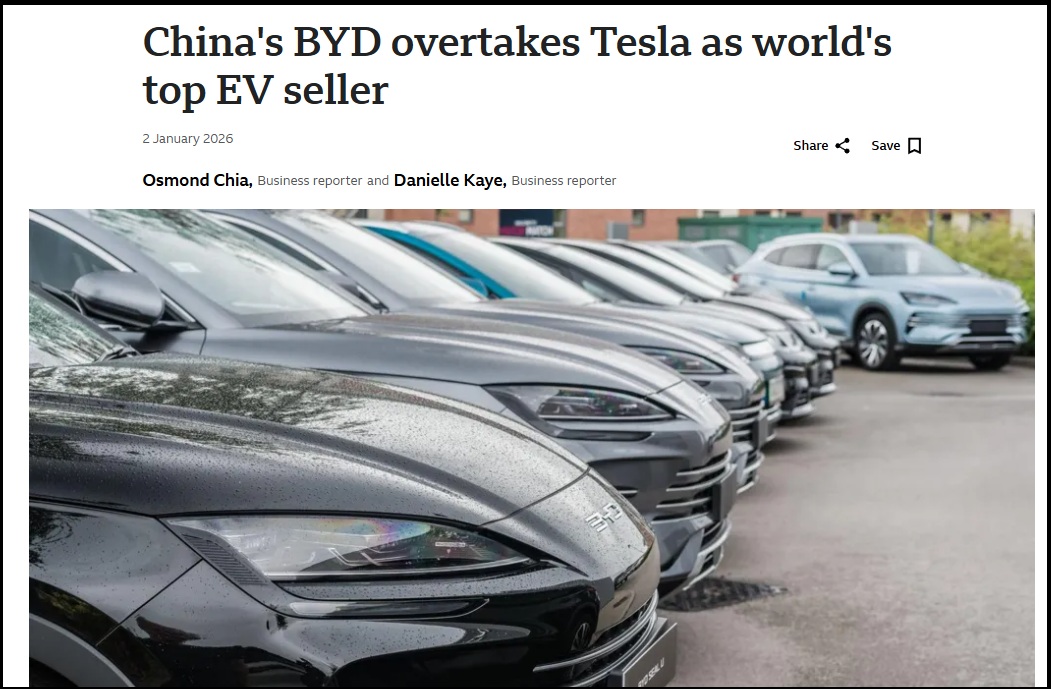
The geopolitical baseline for Europe is often determined by the economics of their situation.  In 2024 approximately 408,000 cars from China were sold in Europe.  For 2025 that number is now expected to exceed 700,000 units despite tariffs.

Previously we highlighted the short-term ramifications of the European Union push to force the sale of electric vehicle (EVs) upon the consumer base.  {SEE HERE} EU automakers unable to meet the compliance goal began purchasing carbon credits to avoid stiff EU fines.  Many of those carbon credits were purchased from Chinese automakers, who then turned around and started using the extra EU revenue to discount Chinese cars sold in Europe.

In essence, EU car companies started subsiding China to undercut their own market. An outcome of the EU chasing the ridiculous green energy project throughout the European free trade zone.

Now reports are beginning to surface of how the non-EV segment of the industry is being lost to less expensive Chinese hybrid autos that: (1) are much cheaper, (2) not bad in quality, and (3) are not subject to the 35% EV tariff rate.

The EU tariff applied to gasoline powered cars or hybrids from China is 10%.  That tariff is not enough to stop the imports. The Chinese hybrid autos are substantially less than European car brands, and there’s no financial incentive for China to build auto plants in the EU zone especially when you consider the EU is subsidizing those cars by purchasing carbon credits.

When analyzed from a cost and consequence, the entire EU dynamic toward car companies is a little funny.  However, for Germany this is a serious issue, and with the German industrial economy already stagnant – every impact to their auto industry only makes the situation worse.

When you overlay the big picture of their expensive “green energy” costs, the EU find themselves in an unescapable downward spiral.  Quite literally, all commonsense seems to have been lost in their green energy chase.

By focusing on energy targets, specifically by trying to force production of European electric vehicles that are not favored by European car purchasers, the EU is shrinking their economy to the benefit of Beijing exploitation.

EUROPE – This year, sales of Chinese-made cars across the EU, UK, and EFTA are expected to exceed 700,000. This is up significantly from the 408,000 that were sold in 2024.

The surge comes despite the fact that additional tariffs of up to 35 percent, on top of the existing 10 percent import duty, were instated in November of last year.

Rather than dampen demand, the tariffs have simply redirected it. While the added fees specifically target EVs and extended-range electric vehicles, hybrid and internal combustion engine (ICE) models remain subject only to the base 10 percent tariff.

Predictably, Chinese brands have leaned into that category, shifting their European strategy toward models that sidestep the higher costs.

Thanks to significantly lower production costs, up to 30 percent cheaper than in Europe, it doesn’t make financial sense for these brands to relocate production just to serve a tariff-guarded market. Instead, they’re exploiting the gap. (read more)

The only Chinese auto plant current in the works for construction is in Hungary, not coincidentally the country with the most common sense as it applies to energy costs. BYD (Build Your Dream) is building a plant in Hungary expected to manufacture 150,000 units/yr.

While most EVs are generally best for short duration use, the Chinese hybrid vehicles are not a terrible build quality if you are an auto purchaser that changes vehicles frequently.  We dodged a bullet by electing President Trump in 2024, because Joe Biden (Blackrock) had positioned the North American auto industry toward a similar fate as currently happening in Europe.

Three Chinese automakers were going to spend $5 billion in Mexico creating new EV and hybrid vehicles destined for the U.S. market. However, Beijing abandoned those plans as soon as President Trump won the election.

The Europeans and leftists in the U.S. scoffed at President Trump for rejecting the premise behind the Green New Deal, which included electric car mandates.  Those same Europeans are now watching as their industrial economy collapses segment by segment; taken over by far cheaper Chinese industrial outputs.

The EU and Canada Collaborate on Digital IDs


Posted originally on Dec 12, 2025 by Martin Armstrong 

EU and Canada agree to collaborate on digital ID mutual recognition, pilots

The latest agreement between the European Union and Canada to collaborate on mutually recognized digital IDs is simply another step in what I have been warning about for years. Whenever government confidence collapses, the political class tightens control. Digital ID is not about convenience; it is about tracking capital and controlling movement as the global sovereign-debt crisis accelerates.

The danger here is obvious. Mutual recognition means a unified framework. They’re building a foundation to establish a GLOBAL digital ID. Once these systems talk to one another, you have created the architecture for a worldwide database controlled by the political elite. This is precisely what the EU has been pushing with its Digital Services Act and the infamous “digital wallet” proposal. Now they are exporting it, just as they exported their disastrous ideas on Net Zero and financial regulation. Canada, collapsing economically and politically, is following Brussels into the abyss.

The EU and Canada will jointly test a pilot for digital identity wallets. Why do two separate continents need their systems to integrate? You cannot have a cross-border digital ID without a central authority. And once the state has the ability to monitor every transaction, every movement, every piece of identification, they will inevitably link this to taxation, travel permissions, banking access, and even political compliance. This is how governments always respond in the final stage of their fiscal life cycle. Rome imposed travel permits. The Soviet Union created the internal passport. Now the West is doing the same with better technology.

Capital will flee regions that move toward centralized digital identification. This is why we are seeing the migration of capital away from Europe and increasingly away from Canada. Both are moving toward a Marxist model where the citizen exists solely to fund the state. The push for digital ID aligns perfectly with the rising authoritarian wave into 2032 as governments fight to retain power in the face of systemic collapse.

Bulgaria’s Government Resigns Amid Civil Unrest


Posted Dec 12, 2025 by Martin Armstrong |  

The entire Bulgarian government has resigned after nationwide protests following the government’s decision to join the European Union. “The government resigns today,” Rosen Zhelyazkov announced. “People of all ages, ethnic backgrounds and religions have spoken out in favour of resignation. That is why this civic energy must be supported and encouraged.”

The media portrayed the initial civil unrest as a reaction to the 2026 budget, but the root of the agitation lies with the nation relinquishing sovereignty to join the euro. The Bulgarian government resignation is symbolic; true power lies with the unelected bureaucrats in Brussels.

“The decisions of the National Assembly are meaningful when they reflect the will of the peopleWe want to be where society expects us to be,” Zhelyazkov said, referring to the anti-government protests. “We have no doubt that the government will receive support in the upcoming vote of no confidence. Regardless, the decisions of the National Assembly are important when they reflect the will of the sovereign,” the prime minister said.

There is massive corruption in the Bulgarian government, hence the need to hold seven snap elections after the 2020 uprising. The people will no longer have the ability to elect their representatives.  Citizens have no trust in their government and do not bother with voting, as voter turnout reached only 34.4% in June 2024. Yes, they may elect who rules Bulgaria, but the EU determines the direction the nation must take. Over 6.4 million citizens must convert to the euro on January 1.

Once Bulgaria joins, it will no longer be able to devalue its currency to remain competitive. That’s how small economies adjust in a floating system. But inside the eurozone, you’re stuck. All monetary policy decisions are made by the ECB in Frankfurt, which answers to no elected body. If Bulgaria experiences a downturn, they can’t cut rates or devalue—just like Greece in 2010. They will be told to cut pensions, raise taxes, and accept IMF mandates. That’s not sovereignty.

Bulgaria now has the luxury of taking on more debt through the European Central Bank. It may now join a war on behalf of the EU against a nation with which it had diplomatic ties throughout the years. Bulgaria is the poorest member of the union; Brussels is not going to allow it to sway the course of the EU agenda in any capacity.