Posted originally on the CTH on January 11, 2023 | Sundance |
Given the fulsome context of the latest ideological alignment coming from the North American Summit, I am entirely certain the ordinary people in the U.S. and Canada do not have any idea just how badly things are likely to deteriorate in the near future. However, for the ordinary people of Mexico, already living in a situation of day-to-day survival, they will not likely note any difference.
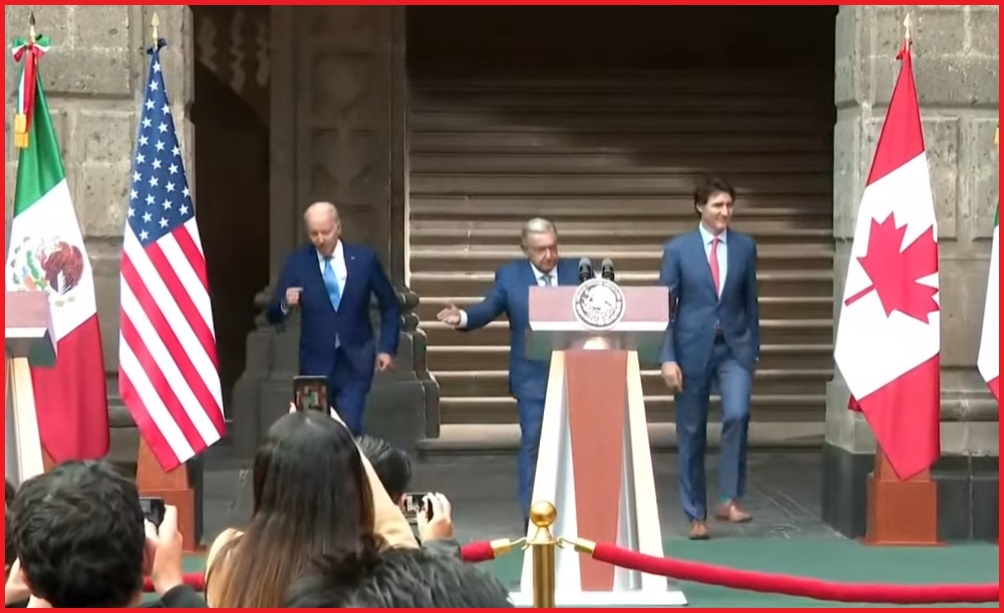
White House occupant Joe Biden, Mexican President Lopez-Obrador and Canadian Prime Minister Justin Trudeau delivered remarks yesterday at the conclusion of their trilateral discussions. You can watch the entire speech set HERE with the full transcript below. What follows is a painful, albeit brutally honest, assessment of the remarks and the predictable future they contain.
AMLO is a soft socialist but has previously indicated his tendency toward economic nationalism. Trudeau is a modern leftist and a true globalist at heart. Biden is a puppet for the modern American political left and economically concerned only for his personal crime syndicate financial situation. Behind Biden’s politics is a blend of Obama domestic ideology and a willingness to align with interventionist foreign policy that benefits his personal financial interests.
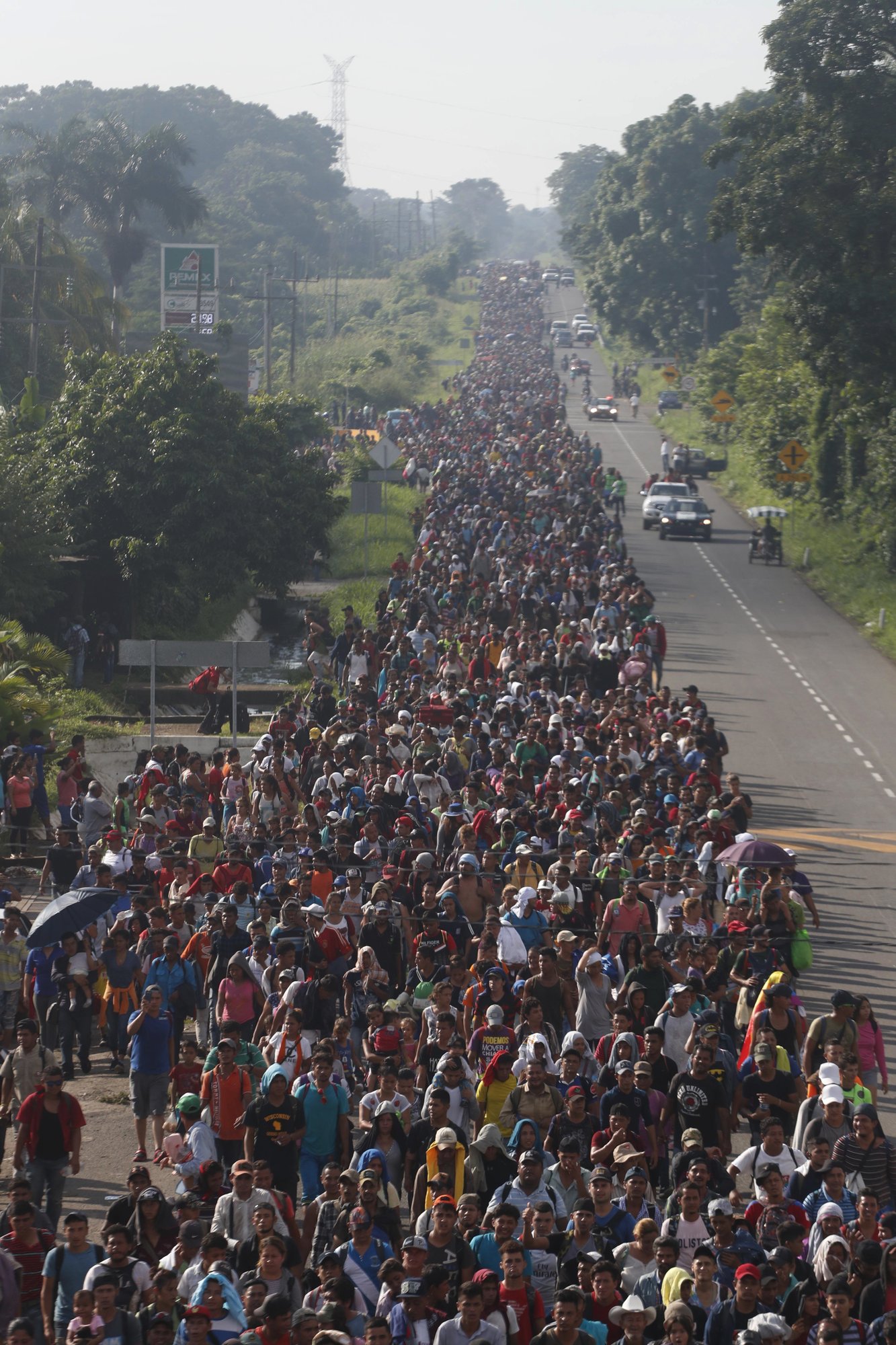
♦ IMMIGRATION – On the issue of mass illegal immigration, Trudeau can wax philosophically about the virtues of multiculturalism and diversity because the United States provides a 2,500-mile migration filtration and border protection zone. For the United States, Joe Biden speaks about the endless ability of America to absorb millions of migrants in the sake of humanity. Biden’s position has little to do with the economic damage created by mass migration because he and his leftist allies are disconnected from the chaos, protected by walls and personal security.
On the issue of illegal migration, it is AMLO’s position that carries the most consequence because Mexico is the funnel control mechanism. It is clear in his remarks that AMLO is a socialist on the issue of unlimited migration, and he has no compulsion to stop the flow of human trafficking from south and central America into the United States.
All three leaders speak of the need to look at the origin of immigration, the conditions in places like Guatemala, Honduras, el-Salvador etc. as the focus of their attention. According to the three amigos it is apparently the responsibility of those living a better life in the United States to provide economic stability, security, social programs and education systems to the less developed nations. In essence, it is the responsibility of American citizens to ensure the quality of life in South and Central America.
There is no sunlight between the three leaders as to the open border policies they support. Sure, there are some words about the various “legal processes” and a high-minded politispeak about visas and various control mechanisms; however, there is zero willingness on their part to ensure national border security for any of the three North American nations, Mexico, the United States and Canada.
Apparently, all three leaders view North America as having the ability to absorb the rest of the hemisphere without any regard to the damaged lifestyle for those already living in the U.S.
♦ ECONOMY – On the economic systems and various issues surrounding economics and trade. Justin Trudeau expresses his commitment to the retention of the Canadian economy as an assembler of products that arrive from other countries. This permits his economy to operate without the need for the exploitative industries around raw material extraction.
Canada can wax philosophically about their “green” climate change economy, because all of the dirty work takes place somewhere else, and the component parts are delivered to the Canadians for clean assembly into finished goods. What is important to Trudeau is access to the U.S. market to sell those finished goods. That’s the sum total of Canada’s economic concern.
From the Mexican perspective, AMLO wants additional investment from North American corporations so he can build a Mexican infrastructure system similar to the United States. AMLO wants an industrial revolution to raise the living standards of the Mexican people, but he recognizes he doesn’t have the education system or social system to create the economy he desires. So, falling back upon his socialist outlook, he wants the multinationals to pay fees and taxes to his government so that he can build the economic infrastructure he demands. AMLO is all about getting this “investment,” or what used to be called corporate bribes for access.
As a result of his focus being on investment, AMLO must repeatedly claim the Mexican government is not controlled by the five major Mexican cartels that operate in each region from the Pacific to the Gulf of Mexico. It’s a lie, and he knows it’s a lie, and everyone around him knows it’s a lie, but it’s a pretending that must exist in order to make the economic demands.
From the perspective of Biden, the U.S. economy is doing swimmingly, and the American people are filled with abundance and happiness, well able to afford sharing all of the economic benefits of living in the United States with the rest of South and Central America. It’s not cognitive dissonance, this is what his advisors tell him, so he believes it. A recent example of the cleaning of El Paso prior to his arrival is an example of the people around Joe Biden maintaining a pretense so that Biden can make claims that are disconnected from reality.
As I have said repeatedly, the advancement of modern leftism is contingent upon pretending things. Denial of truth permits easier trespass. Unfortunately, the vast majority of the professional republican apparatus are also invested in the maintenance of this pretense. As ideology rules the left wing of the UniParty, corporatism rules the right wing – they both act in unison to maintain forward flight.
♦ Drugs and Human Trafficking – All three leaders speak of the need to stop drugs and human trafficking, yet all three leaders pretend not to know their policies as outlined in their remarks are directly responsible for maintaining the most horrific system of serious abuse, sexual exploitation and human smuggling, children trafficked for labor and sex crimes, along with the customary violence of rape, torture and blackmail by the cartels who control every region in Mexico.
It truly is one of the most disgusting aspects to their intentional dissonance, watching the three leaders talk about their virtuous worldview yet knowing the evil nature of the outcomes that stem from abuses within the system the three leaders’ support. The vile nature of their pretense is blood-boiling, and God will have no mercy in final judgement.
Below is the Full Transcript
[TRANSCRIPT] – PRESIDENT BIDEN: Thank you very much. It’s wonderful to be back here in Mexico City. And I want to thank you, Mr. President, for hosting the Prime Minister and me for the 10th North American Leaders’ Summit. This is a magnificent fora.
And we’re true partners, the three of us, working together with mutual respect and a genuine like for one another to advance a safer and more prosperous future for all of our people.
And the reason for this summit and this trilateral relationship are so impactful is because we share a common vision for the future, grounded on common values — and I mean that sincerely — common values we share in our countries.
Since becoming President, I’ve been laser-focused on rebuilding the U.S. economy from the bottom up and the middle out, not the trickle-down economy. Because the bottom up and pr- — and the middle out, it works, because the wealthy do very well and everybody else does well, too, when everybody does well. And “from the bottom up” is — means investing in priorities for working families.
The United States has made historic, bipartisan investments
in infrastructure and innovation that are already beginning to deliver concrete benefits for the American people, and, I would argue, it will ultimately reap benefits for the entire North America.
We’ve renewed our dependence — our deep- — and deepened our cooperation for — of the closest friends and allies — none closer than Mexico and Canada — to take on the biggest challenges facing the region and, quite frankly, the world.
Because there can no longer be any question — none — in today’s interconnected world. We cannot wall ourself off from shared problems. We are stronger and better when we work together, the three of us.
And together, we’ve made enormous progress since our last summit, from COVID — fighting COVID-19 and strengthening our ability to address public health threats, to investing in and building a 21st-century workforce.
At the top of our shared agenda today is keeping North America the most competitive, prosperous, and resilient economic region of the world.
And the strength of our economic relationship among our nations not only supports good-paying jobs in all of our countries, but it generates tremendous growth.
Now we’re working to a future to strengthen our cooperation on supply chains and critical minerals so we can continue accelerating our efforts to build the technologies of tomorrow right here in North America.
This summit — this summit also builds on the continual consultation and cooperation with one another to take on the challenges that impact all three of our nations.
Our entire hemisphere is experiencing unprecedented levels of migration — greater than any time in history. And North America — at the North America Summit Leader hosted in Washington in 2021, we launched the idea of a regional-wide approach — a regional-wide approach to a regional-wide problem. The idea grew into the Los Angeles Declaration on Migration and Protection, which 21 countries ultimately adopted at the Summit of the Americas six months ago.
And we’re working together, especially with our North American partners, to fulfill our commitments under that declaration. They include the policies I announced last week
to expand safe and legal pathways for immigrants from Nicaragua, Cuba, and Haiti that were seeking a better life here in the United States of America.
We also want to thank you, Mr. President, for stepping up to receive into Mexico those not following the lawful pathways we’ve made available, instead of — attempting to unlawfully cross the border between our countries.
On my way here, I stopped in El Paso, Texas, to see the situation with my own eyes and to meet with U.S. border security officials. It’s putting real strain on the communities in both Mexico and the United States. We’re working together to address this challenge in a way that upholds our nations’ laws and protects the human rights of migrants facing desperate circumstances.
We’re also working together to take on the scourge of human smuggling and illegal drug trafficking. In just the last six months, our joint patrols in Mexico have resulted in the arrest of more than 7,000 — 7,000 human smugglers. And we’ve seized more than 20,000 pounds of deadly fentanyl at the border.
And today, we’ve discussed how all three of us can continue to deepen and strengthen our shared efforts to cut off the flow of illegal fentanyl, including by tackling the precursor chemicals used in synthetic drugs as we go after the laboratories where they’re made and the stash houses where they’re stored.
We also talked about meeting our commitments to make North America a clean energy powerhouse — and I believe that’s within our grasp — and a global leader in addressing the climate crisis.
That means working together to promote zero-emissions vehicles, to build charging stations for electric vehicles that are compatible across our international borders. It means exploring shared markets for clean hydrogen. And it means working together to meet our ambitious commitments under the Paris Agreement, including tackling methane and black carbon.
And finally, as three vibrant democracies, we recognize our greatest strength is our people. Let me say that again: Vital democracies we are, and our greatest strength are our people — the strength of our people.
And a key to our competitive edge in the world is our incredible diversity.
So, together, we’re working to address the inequities that for too long have plagued historically marginalized communities in each of our nations to make sure everyone gets a fair shot. It’s one of the smartest investments we can make for our future, and we’re going to make it together.
So, Mr. President and Mr. Prime Minister, I’m han- — I’m honored to stand with you today. And I am grateful to have you both of you as partners and, I might add, friends as we work together to realize a shared vision for North America.
Thank you very much. (Applause.)
PRIME MINISTER TRUDEAU: Bonjour. Good afternoon. Buenas tardes, President López Obrador, mi amigo. Thank you for having us here in Mexico City.
President Biden, my friend, thank you for all your hard work and your valuable insights in today’s meetings.
As a continent, we are unique. We are three large democracies committed to freedom, human rights, equality, and creating real opportunity for everyone. We share deep ties as friends and trading partners.
(Speaks French.) (As interpreted.) During these 30 years, the economies of Mexico, U.S., and Canada have become closely tied because of NAFTA. This trade agreement helped our economies grow and created millions of good employments, and the trade amongst our borders drew investors from the world over.
(Speaks English.) Free trade through NAFTA has helped make our economies among the most competitive in the world. It makes sense why. Combined, we are home to half a billion people. We have an extraordinarily strong innovation ecosystem. Our combined GDP is larger than that of the European Union. And, as leaders, we are all dedicated to driving economic growth that supports the middle class and those working hard to join it.
These are all foundations of a strong and resilient continental economy.
People remember what happened just a few years ago when the certainty of this partnership was in question. Investors, businesses, workers, and citizens all worried about what would happen. When free trade is at risk, that isn’t good for competition in the global market.
Thankfully, the belief in free and fair trade won the day. We renegotiated, and we got an even better deal. To put it simply, we are and always will be stronger together.
The world today is facing a lot of uncertainty. With the rise in authoritarian leaders causing global instability and the high cost of living putting stress on families at home, it’s important that we come together as leaders and as friends to look at ways to make our economies more resilient.
And today, we discussed how we can build reliable value chains on this continent for everything from critical minerals to electric vehicles to semiconductors. This is good for workers, good for consumers, and good for communities across our countries.
(Speaks French.) (As interpreted.) COVID-19 showed us the importance of supply chains and economic resilience, the importance of being prepared, being ready to face a new pandemic, and try to prevent it. Today, we spoke about a way to improve our cooperation in the realm of health services in order to be ready to intervene.
(Speaks English.) We can boost our economic resilience even further through our work to build a clean economy. Things like clean energy, including hydrogen, manufacturing, zero-emission vehicles, and encouraging more people to adopt them.
This is an enormous opportunity for workers and for business.
(Speaks French.) (As interpreted.) We should all be part of climate action. Government and private sector should work together to attain the 2030 goals and objectives.
These goals are not only about reducing pollution to get to the Paris objectives, they have to do to do with our engagements to preserve 30 percent of our lands and oceans in 2030.
Last, COP15 in Montreal, Canada, convened the countries around the world, and we reached a historic agreement to preserve and protect nature. This is essential for the health of the economy.
(Speaks English.) Canada is pleased to have our Mexican and American friends committed so strongly to protecting clean air, clean water, and a brighter future.
Canada is also pleased to see all three countries take steps to more — to build towards building a more diverse, equal, and inclusive society, a society where there is opportunity for everyone, where women and girls are politically and economically empowered, including Indigenous women and girls; where the benefits of growth are felt by workers and families across the economy.
By doing this, we create a more stable, prosperous, and equal future, and we build economies that work for all North Americans.
We made progress on a lot of different things today. There’s a lot going on in the world right now, and as North American leaders, we recognize the roles our countries play in being a source of stability and security, not just in the region but around the world.
(Speaks French.) (As interpreted.) This summit was extremely fruitful. We were able to reiterate our vision and the force of our partnership.
(Speaks English.) I know we’ll make much progress in the coming year. And I look forward to hosting you both in Canada for the next North American Leaders’ Summit.
Thank you. Merci. Gracias. (Applause.)
PRESIDENT LÓPEZ OBRADOR: (As interpreted.) I want to thank, in a very sincere fashion, the participation of President Biden and the Prime Minister of Canada, Justin Trudeau, and also the participation of their respective wives, Jill, Sophie. And I also want to thank their delegations and teams.
The mere fact of being here together today as good neighbors in this environment of respect to look for the wellbeing of our peoples in a joint manner is in itself a very important historic event, a true happening.
Nonetheless, I wanted to highlight that we’ve agreed on strengthening our economic, trade, commercial relations. And for that, we’re going to be creating a joint committee aimed at planning and substituting imports in North America so that we may try to be increasingly self-sufficient in this part of the world and to turn development cooperation into a reality, as well as the wellbeing of all the countries of our continent. We want that to be a reality.
The United States, Canada, and Mexico will propose — each one of those countries will be proposing four members for the formation, for the creation of this task force — of this committee of 12 specialists that not only know this issue we are going to be working on, but they will also have our absolute trust to motivate, to persuade, and invite the business community, workers, public servants of all three governments, and to convince them about the importance that transcendence of being united in North America and for us to be able to speak from here on this unity in everything we do throughout the American continent.
On the part of Mexico and this group, we are going to be represented by Foreign Minister Marcelo Ebrard; Rogelio Ramírez de la O, Finance Minister of Mexico; Raquel Buenrostro Sánchez, who is the Secretary of Economy; and Alfonso Romo Garza, who represents the business community. He’s an independent businessman, Mr. Romo is.
And we also discussed as a priority issue economic commercial trade; integration, as I have already expressed, of the entire American continent; and the wellbeing of the peoples; and the new relations of cooperation, leaving behind interventionism — hegemonic interventionism.
Let me do a set-aside here to express my acknowledgement, my recognition to Prime Minister Trudeau and President Biden for the way, which has been so solidary, in which they’ve acted, in which they are acting vis-à-vis the attempt of coup d’état in Brazil. This shows that there’s a commitment — authentic commitment in favor of democracy. Our support for President Lula of Brazil.
We have to — together, we have to be able to accomplish all this — everything that President Biden just said. We have to be able to accomplish this that is on equal footing for us to be treating each other as good neighbors, economic allies, and as friends.
We, of course, will be helping to turn this dream into a reality. And we are very enthused at the certainty that this is something we can accomplish. Peace is the result of justice. Social problems cannot be solved only with coercion measures. We should always attempt to discourage violence and the migration phenomenon with an approach — humanitarian approach of opportunities for the wellbeing of everyone.
People are good by nature. And it’s circumstances that sometimes make it necessary for someone to take the path of antisocial behaviors. We have seen this in Mexico and also in our sister countries, the countries of Honduras and El Salvador.
For instance, in our country, in Mexico, since corruption is not allowed and the budget is used for development and supporting the poorest sectors of our population, today we not only have jobs, employment, we have seen reductions in violence. We have less migration as well. And we’ve also tempered frustration. And what we can see is this flame — this flame which is alive. I’m talking about the flame of hope. Peace is the fruit — it is the result of justice.
The Central American case is exceptional. With just a few resources, we are helping producers in communities in Honduras and El Salvador so that they can grow their land, so that they can grow their crops with technical assistance, support, and basic income.
And in those towns where we are applying those actions — particularly the program we call Sembrando Vida, which means “sowing life,” and Youth Building the Future Program — we’ve not just seen a reduction of people wanting to migrate to the United States seeking opportunities of better living conditions and jobs, but for many young people of those countries, crime has stopped being the only possibility of survival and the only way to move forward in life.
The migration issue, as many other issues, was discussed in a very broad fashion. And we reached important agreements among the three countries for the benefit of our peoples, as you will be able to see, as you will also be able to know, through a communiqué — a joint communiqué that we have that will be provided to you immediately.
Finally, I want to thank Prime Minister Justin Trudeau for his extraordinary and fraternal program that consists of granting temporary working visas for laborers, workers. This program is already benefiting 25,000 men and women — 25,000 Mexicans. This is a path to follow that is orderly migration. Prime Minister Trudeau is a great ally of Mexico.
President Biden, I want to thank you sincerely for maintaining with Mexico a relationship of cooperation, of friendship — sincere friendship, sir — of respect for our fellow man who live and work in a very honest fashion in the United States who are not harassed. They’re not suffering raids as it unfortunately used to happen in the past.
We have said this and I repeat it today — I insist on this: You, President Biden, you are the first President of the United States in a very long time that has not built not even one meter of wall. And that — we thank you for that, sir, although some might not like it — although the conservatives don’t like it.
In a very special manner, I also want to say that I have requested in a very respectful manner, President Biden — I have requested on insisting — and I know that this is not a simple issue or matter, but it’s a fair and very just matter. And that’s why I’m proposing it. That’s why I’m mentioning this. And also because I truly — I fully trust President Biden.
I’ve asked President Biden to insist before the U.S. Congress to regularize the migration situations of millions of Mexicans who have been in the States working, living in the United States, and contributing to the development of that great nation, which is the United States of America.
I have reasserted, reaffirmed that President Biden is a man with convictions who maintains principles, ideals to guarantee, to ensure as many others — men, women in the United States and throughout the world — that the Statue of Liberty never, never, ever should become a symbol — a void, an empty symbol.
Let me conclude by saying that my professor, great poet, Carlos Pellicer — my master, my teacher — in 1930, he said that the wish of freedom, of liberty is the biggest fruit that has materialized that is in the heart of humans. To be doing that, we have to be free. The sentiments of justice are the children of freedom, of liberty. Never, ever being slaves will we be able to be just and fair.
Thank you very much. (Applause.)
MODERATOR: (As interpreted.) Now let’s begin a Q&A session. Ladies and gentlemen and the U.S. press; Your Excellency, Joseph Biden, Jr., President of the United States of America will take a question from a journalist, a reporter from the United States.
Please.
PRESIDENT BIDEN: All right. I was having trouble hearing, but I’d like to call on Associated Press, Colleen Long, for the first question.
Q Thanks, Mr. President. Hola, Señor. And hi, Prime Minister Trudeau.
For Mr. President, you’ve been accused of being too soft on border security and now too hard, following the recent border policy changes. What’s the right balance?
And on the news at home, can you explain how classified documents ended up in one of your offices? And should the public get — have been notified sooner?
For Prime Minister Trudeau, there’s been a suggestion that Canada lead a multinational security force in Haiti. I wondered if that was a possibility and what you would need.
Y señor, usted Presidente, muchas gracias por la bienvenida esta semana. Quiero preguntar: You said that you would accept — you would be willing to accept more migrants arriving to the U.S.-Mexico border. What do you want from the U.S. in return?
PRESIDENT BIDEN: I’ll answer first?
Well, let me get rid of the easy one first. People know I take classified documents and classified information seriously.
When my lawyers were clearing out my office at the University of Pennsylvania, they set up an office for me — a secure office in the Capitol, when I — the four years after being Vice President, I was a professor at Penn.
They found some documents in a box — you know, a locked cabinet, or at least a closet. And as soon as they did, they realized there were several classified documents in that box. And they did what they should have done: They immediately called the Archives — immediately called the Archives, turned them over to the Archives. And I was briefed about this discovery and surprised to learn that there were any government records that were taken there to that office.
But I don’t know what’s in the documents. I’ve — my lawyers have not suggested I ask what documents they were. I’ve turned over the boxes — they’ve turned over the boxes to the Archives. And we’re cooperating fully — cooperating fully with the review, and — which I hope will be finished soon, and will be more detail at that time.
The first question, now I forgot. (Laughter.) Your first question related to —
Q I — yes, I asked if we — I asked if the —
PRESIDENT BIDEN: I’m only joking.
Q Oh. (Laughs.)
PRESIDENT BIDEN: The answer is — the answer is: You’ve got both — both the extremes are wrong. It’s a basic middle proposition.
Now, look, as was mentioned by all of us in one way or another, this has been the greatest migration in human history around the world, as well as in this hemisphere. And when I got elected, the first thing I — the first major piece of legislation I introduced was to reform the immigration process, to make it more orderly, to make it more — to make sure people have access under the law.
And so, what we found out — and not just in my visit to El Paso, but before that — we found out is that our Republican friends and some — a few Democrats — they were very critical of what’s going on at the border but yet refuse even look at the detail document I submitted for the Congress to consider to reform the process completely.
And so, number one, right now, a majority of our migrants are coming from four countries: Venezuela, Cuba, Haiti, and Nicaragua. And we’re expanding the exi- — the very successful parole program we had, with regard to Venezuela, to Cuba and to Nicaragua and to Haiti to provide safe and orderly and humane processing for people fleeing those countries to come to the United States and claiming under the — seeking asylum.
This is going to reduce the number of people legally trying to cross — illegally trying to cross the border. Venezuelans were trying to enter the country. That they dropped — that has dropped off dramatically because we’ve allowed them to go directly to whatever country — the first country they go to, directly contact the United States, make sure that they make their application showing that they have — they do a background check; they, in fact, have access to a sponsor; and that they have been — they’ve been examined. And that way, they’re able to come through ports of entry.
And it’s dropped off — I’m going to make sure I get the numbers right — dramatically from 1,100 persons trying to enter to — per day — to 250 a day.
I’ve asked the — and I want to thank the President of Mexico for agreeing to take up to 3,000 people back in — as — that don’t meet this criteria. Because, look, right now the cartels make a lot of money, which they use for drug trafficking as well. People go through — have to make it through jungles and a long journey to the — to the — to the border. And many are victimized, not only in terms of what they have to pay, but victimized physically in other ways.
And so we’re trying to make it easier for people to get here, opening up the capacity to get here, but not have them go through that godawful process.
And we’re going to continue our efforts to address the root causes of migration to help people stay in their home countries. I’ve asked the Congress for $4 billion to provide for that. We’ve also had our Vice President provide for private donations of over $3 billion to make sure that people —
Look, all of you know all of us in the United States are immigrants. And mine go all the way back to the Irish famine. But the point is: All of us have been immigrants. And one of the things that comes across fairly clearly is, it’s not like people sit in their home city, county, town and say, “I got a great idea. Let’s sell everything we have, give it to a coyote, go through some jungles and a long path up to the United States, smuggle us across the border, drop us in a desert. And won’t that be fun in a country we don’t even speak the language?”
We have — we can do more than merely just make legal immigration more streamlined. But we can also do it by preventing people from wanting to have to leave in the first place, by helping their communities, in fact, better their circumstances.
And so, I — I hope — you know, and, by the way, my proposals are supported by the Chamber of Commerce, by the American labor movement, not — I mean, which is an unusual coalition — and a whole range of people.
The point here is that my Republican friends in Congress should join us in the solutions.
And the one last point I’ll make — and I’m sorry to go on so long, but we spent a lot of time talking about it — is we have to increase the technological capabilities at the border, both to intercept illegal drugs and other contraband, as well as people being smuggled across the border.
We have now the ability to use and use — some of you have seen them; I know you all — you have, I’m sure — these trucks that ride alongside of a tractor trailer. It’s like a giant X-ray machine, and it can determine what’s inside that tractor trailer. And thousands cross the border every day — illegal commerce. And so, we’re allowed to determine whether or not there — fentanyl is in there, drugs in there, people being smuggled across the border.
We’re going to provide significantly more of those vehicles for the people to be able to determine at the border what need — what — what is coming across legally and illegally.
A lot more to say, but I probably already said too much. Thank you.
MODERATOR: (As interpreted.) David Cochrane, CBC, from Canada, will be asking to Prime Minister Trudeau.
PRIME MINISTER TRUDEAU: (Inaudible) question. And I’ll fold the Haiti question in as well.
Q Okay, thank you, Prime Minister. A question for you and for President Biden as well.
President Biden, you’ve talked a lot about economic cooperation and building continental supply chains and resilience here. But since you’ve been President, Canadians have seen what they consider to be protectionist — U.S. protectionism from you in things such as the Buy American Act. So, what assurances can you give to Canadians and Mexicans watching this at home that they will be equal partners in the economic opportunity you’re talking about in this transition and not have to confront further attempts at American protectionism?
President López Obrador, if you have anything to say on that, we’d love to hear it.
And, Prime Minister Trudeau, if you can answer the Haiti question but also explain to us what steps your government needs to take to take advantage of this opportunity on the continental supply chain resiliency to ensure that Canadian companies make things like semiconductors and don’t just supply critical minerals to American companies.
PRIME MINISTER TRUDEAU: Thank you very much. First, on Haiti, the situation in Haiti is heartbreaking. Canada has stood with the people of Haiti for decades, including over the past three years with multiple interventions with the U.N., with other partners on the ground; military interventions, police interventions, even prison guards.
We have continued to stand with the people of Haiti, and we will continue to. Obviously, this current situation is heart wrenching and we need to continue to be there for the people of Haiti. But we need to make sure that the solutions are driven by the people of Haiti themselves.
That’s why Canada’s focus, as we stepped up over the past months, has been, first of all, in putting significant sanctions on the elites who are responsible for so much of the violence and political instability in Haiti. A handful of small, extraordinarily wealthy families in Haiti have been causing much of the strife because of political and pecuniary interests. And that is why the sanctions that Canada has put forward are causing significant impacts on the ground.
We’re also moving forward with significant supports for the Haitian National Police, including with armored vehicles — the Americans have stepped up on as well — to ensure that the police is able to stabilize the situation on the ground.
Obviously, there’s much more to do. We’ve sent down a group of interlocutors to work both on the political side, but also to liaise directly with the security officials on the ground so that we can be responsive in immediate ways to what is needed for the Haitian National Police to get a better control and ensure greater stability for the people of Haiti.
The U.N. called in September for the free flow of food, medicines, water, and fuel. Much of that has started again. It’s still not where it needs to be, but we’re going to continue to lean in on ensuring that that happens.
But at the same time, we are working with partners across the Caribbean and, indeed, with the United States and Mexico to ensure that if the situation starts to deteriorate once again, we will have options.
But like I said, we’re going to make sure that what we do this time allows for the Haitian people to get the situation under control. And a big part of that is putting those sanctions on the Haitian leadership that are responsible for so much of the misery people are going through.
In regards to the continental supply chain, that was at the center of our conversations throughout this — this North American Leaders’ Summit. The idea that we already work extraordinarily well together with NAFTA, but there’s so much more we can be doing at a time where supply chains around the world are under increasing stress and significant economic actors around the world are becoming less reliable as partners and less desirable as partners in building the technologies and the energy futures that we want.
That’s why — you brought up a few examples of it — our critical minerals approach strategy that we just released a few weeks ago is focused not just on mining the critical minerals that Canada has, that North America and the world needs, in responsible environmental partnership with Indigenous Peoples doing it the right way, but also the development, the processing, the transforming into batteries, the transforming into technology that goes along the value chain as something that is important for Canada.
And, yes, it’s something that we’re continuing to look at. That’s the same thing with electric vehicles where we’re building electric vehicles with our partners in Mexico and in the United States.
But Canada — again, from the critical minerals that go into the batteries and the batteries themselves that we’re starting to build, to the — to the steel and aluminum that is amongst the cleanest in the world being developed in Canada, to the technology, the innovation, from AI to engineering that is part of it — Canada is very much a partner in what we’re developing in terms of more resilient supply chain. So, there’s lots more to do.
Indeed, even on semiconductors, the largest semiconductor packaging plant in North America, I believe, is in Bromont, Québec. And packaging of semiconductors is actually how you assemble them into a unit that can then do the high-value calculations and computations that need to happen.
These are the kinds of things that Canada is very much focused on in ensuring not just prosperity right now, but good jobs as we move towards a environmentally responsible, net-zero, socially inclusive future that the middle class in all three of our countries are relying on.
Q (Inaudible.)
PRIME MINISTER TRUDEAU: (Speaks French.) (As interpreted.) Briefly, in French: In regard to Haiti, Canada has always been there to help the Haitian people, and we are working with our partners in the region to guarantee better solutions for the Haitian people. We have laid sanctions against the elites. We are helping the National Police in Haiti.
We have had good exchanges, good dialogues with our partners in the U.S. and Caribbean countries to guarantee that we will be able to preserve and to have the people of Haiti at the center of the solutions in regard to the economic integration and the competitiveness in North America, be it electric vehicles, be it Critical Minerals Strategy minerals, and the ones we’re going to develop to produce the necessary technologies or in regards to any other technologies in order to work together, because we know that North America can offer many solutions, great competitiveness to the rest of the world, and we are a true force to reckon with in our continent.
MODERATOR: (As interpreted.) Sara Pablo of the Formula Group will pose a question to the constitutional President of the United Mexican States.
Q (As interpreted.) Yes. Good afternoon, Presidents, Prime Minister. And we have a few questions for President Biden.
I know that recently you announced the United States will be receiving citizens from Venezuela, Haiti, Cuba, and Nicaragua. What is the timeframe? And are you thinking of expanding the number of people you will be receiving? And is this — some other nations could be included? And what is the amount in technological improvements in the United States?
And for President López Obrador: How will Mexico be prepared to receive all the migrants the United States will be expelling from its territory? And the new migration center in the southern part of Mexico — what is it all about?
And then, after this 10th summit, are we going to be seeing changes in migration policies in the way migrants are being treated?
And finally, let me — this is for President Biden: Fentanyl. What concrete actions are you going to be implementing? What’s the impact of the detention of Ovidio Guzmán? Because the Cartel of the Pacific is one of the main fentanyl producers.
And finally, another question on energy sector consultations. President Biden, Prime Minister Trudeau, did you discuss those discussions about the USMCA, the T-MEC?
PRESIDENT LÓPEZ OBRADOR: (As interpreted.) Very well. We did speak about migration in a very broad manner. Of course, there is cooperation with the U.S. administration. And at the same time, we have a commitment to protect migrants.
What President Biden has proposed is absolutely true. If migrants cross our country — and, in some cases, they also go through other countries in Latin America — to arrive in the United States, migrants are facing so many risks when they do that, starting with the fact that they are victims of the traffic — the smugglers — the human traffickers known as the “coyotes” or “polleros.” And they charge migrants a high amount of money to take them northbound.
Now, those polleros, or coyotes, have networks. And at the same time, they hire trailers, trucks — truck trailers. The box of the trailer, they can transport up to 300, 400 people. So, constant accidents are taking place on the highways of Mexico, the roads of Mexico, unfortunately.
And the worst of it all is that many migrants are being kidnapped by criminal groups, by criminals. They’re being murdered. And this is very sad, very painful.
That’s why I’m speaking about protection. What we want is an in-depth solution. We’ve always said that people — just as President Biden said, people do not leave their towns, their countries, their families because they like to do it. This is not a pleasure for them. They do it because of the needs they have. This is a necessity.
We’ve always said we have to look at the root causes of all this. We have to try for people to be able to work and be happy where they were born — where their relatives, their customs, their traditions, their cultures are.
And we need to invest for that. We need to invest in development of the countries with more inequality and poverty, because migration has to be an optional thing, not a forced situation.
However, in the meantime — because we’re, of course, doing everything we can to accomplish this — Mexico, with just a few resources, is helping. I have already mentioned that we are working — we are working with communities in El Salvador, in Honduras. We’re going to be starting this in Guatemala and Belize as well.
However, we do need to promote development even more — and wellbeing — to ensure, guarantee opportunities for those that are forced to migrate and leave their communities.
We are not thinking of building any center in the southeastern part of Mexico — any migration center. We’re not thinking of that. What we do is help with shelters, with healthcare services, with food services as well. That’s the way we help migrants.
And we do celebrate the fact that the U.S. administration has taken — made the decision, rather, to have an orderly migration flow in the case, for instance, of our Venezuelan brothers and sisters. And I understand that this plan will also be extended — will be expanded to benefit other migrants, other countries.
We know for sure that since the announcement was made saying that those permits, humanitarian visas were going to be granted in the case, for instance, of the Venezuelan population, we’ve seen a decrease in migration flows or people crossing Mexico to migrate.
This has been a considerable reduction because this was announced in the United States, and this was made public everywhere, saying that 24,000 humanitarian visas or permits were going to be granted and that the formalities had to be covered, the paperwork. Although there are some requirements that have to be met, people decided to do it. So what happened was that a new path has been opened; it didn’t exist before.
Everything was arriving in the United States, risking everything — risking people’s lives, of course, at the risk of their own lives.
Now that this mechanism has been approved, people can file their own request. And this might take time. However, there’s hope. A hope that this is — a purpose is going to be accomplished: the purpose of going to the United States to work, to live.
We celebrate this, and we think that — I insist what Canada is doing is also the right thing to do.
And I was talking about our own experience as well. And you can look at data. It’s there for you to look at. Because of circumstances in the past, migration corresponded to the sister countries of Central America that were — those were the main migration flows from Central America — but, for a long time as well, Mexicans migrating who were going to look for a better living standard, toward going to look for a job in the United States.
And just imagine: There are 40 million Mexicans in the United States — 40 million who were born here in Mexico, who are the children of people who were born in Mexico.
Now, what have we been able to accomplish with all the support for wellbeing? We’ve reduced the number of Mexican migrants, yes. There are less migrants abandoning Mexico now because there’s public investment; because out of 35 million families, 30 million families of Mexican families are now receiving at least a program — a wellbeing program. And this is a very direct manner of doing this here in Mexico.
All the senior citizens, 65 or over, receive a pension. This is a universal program in Mexico. Eleven million of senior citizens in Mexico are getting a pension.
Eleven million students of low-income families, of poor families are getting grants. They’re getting scholarships.
All the boys and girls with disabilities also have their own pension.
We have a program for reforestation. It is the most important reforestation program in the world. And we are planting over 1 million hectares of fruit and timber trees. And we are giving jobs to over 400,000 peasants that are growing, planting those trees.
So, then, all these programs help so that people may be staying in their own communities, in their towns.
We built the Dos Bocas refinery — 35,000 jobs.
We are now building the Mayan train, which is the biggest railroad works in the world because it’s 1,554 kilometers — 1,554 kilometers — in five states of Mexico.
All the Mayan region — which is one of the most important archaeological zones of the world — well, there, people are working, building this railroad system. About 300,000 people are building the train. So, that’s really the option. That’s the path to follow — development, wellbeing.
And I insist, I repeat: I truly celebrate that the Canadian government and the U.S. administration, as well, are now attending to the migration problem with this type of approach. It’s quite lamentable that there are others — other politicians, other presidents, and public officials who are acting in a very inhuman manner.
Right now, in this winter season, for instance, with all due respect — I’m not saying this in a very direct manner, but what I’m saying is that one of the governors of our neighboring country headed a movement to take migrants to New York, to Washington, and just drop them there. This is politicking. This is completely inhuman. This should not be done. Because there are those who forget that we are all migrants.
How is it that that great nation, the United States, was developed with migrants? Thanks to that, so then we have to continue seeking, looking for alternatives. Just as, for instance, in the case of violence, we have to look into the root causes of violence.
And also in the case of our country, youth were never cared for. No services for young people. And the only thing that was done was call them young people who didn’t work, who didn’t study. This is a discriminatory labeling for youth. “They don’t study, they don’t work.” “Ninis,” they were called in Mexico. They don’t do one thing. They don’t do the other thing either.
So no one was ever caring for our youth in Mexico. All those young people only had — the only option they had, I mean, was to migrate. And many migrated, acting in a respectful manner, a very responsible fashion. And others as well were trying to make a living because they didn’t have any other opportunities. So they made a living in what we call the “informal economy,” which is, you know, making a living out in the street, no matter what. I mean, whichever way you can make a living without falling into illicit activities. However, unfortunately, many did go into the path of antisocial behaviors.
But we didn’t really take care of young people in Mexico. However, we now have a program devoted to young people. This program never existed in the past. There are 2.4 million young people who are being hired. They are working, and they’re apprentices.
What are we doing? We are taking away from them this culture, those seats the reserves, the stock. We’re taking that away from criminal groups. We don’t want those criminal groups to be taking our youth away. We want to give them opportunities. That’s exactly what we’re doing in Mexico.
And let me conclude also highlighting another difference which is quite important: There is no corruption in the administration, the government that I represent. There’s no impunity either.
There’s — we have painted this line that is very clear. Crime is one thing, and the authority is a different thing. There is no criminal association or partnership as before.
Yes, this is — we’re even ashamed to mention this, that — to mention that those who were in charge of guaranteeing or ensuring public security were at the service — in the past — were at the service of criminal organizations. This doesn’t happen in Mexico anymore.
That’s why in this meeting, this summit we just held today, all three governments of the three countries, we have reached agreements to continue working together to get peace — to have peace in all three countries so that we can ensure and guarantee security of our peoples.
That’s all I wanted to answer to your question, Madam.
Q (As interpreted.) On fentanyl? On fentanyl and energy consultations?
PRESIDENT LÓPEZ OBRADOR: (As interpreted.) Yes, we are doing that. Just as I was telling you that in the case of migration, first there were brothers and sisters from Central America and also from Mexico, but now, in recent times, a lot of migrants from Venezuela, from Nicaragua, Colombia, Ecuador.
We do have a situation. There are changes in places where we’re — places where people are being pushed to leave their towns, their place of origin for many reasons.
And with drugs, we have a case in point. It is not cannabis. It’s not marijuana. It’s not poppy. It’s not only cocaine either. Now, we have fentanyl and chemicals, which are some of the most dangerous type of substance and very harmful for people because they are causing so many deaths.
So then, we’re working on this in an organized manner. In the case of Mexico, this led us to make all the ports in the customs offices to be controlled by the armed forces in Mexico, all the sea customs office, because fentanyl and other chemicals come from Asia, and they are processed in labs. And we are avoiding the entrance of those chemical substances, and we are destroying labs.
The Navy Secretariat is in charge of managing ports and customs — sea customs offices. For instance, we had so much drug trafficking of chemicals in the port of Manzanillo and also in Lázaro Cárdenas. Now, the Navy is in charge of controlling those customs.
And all the customs, the land customs offices along the border line are now under the responsibility of the Ministry of Defense — National Defense Ministry.
So, we are combating fentanyl and those chemicals, and we’re doing this because we care. Nothing human is alien to us. We truly care being able to help and be of help — the situation in the United States — deaths because of overdose of fentanyl.
And — but just as we discussed today, this is not only an issue of the United States. The thing is that if we do not face this problem, this scourge, we are going to suffer it ourselves as well. So we have to act in a coordinated fashion. And that is something we have been doing, and we discussed it in this summit. It is in the communiqué we are about to give you. And we are defending life — the life.
As I was telling you — I was telling Prime Minister Trudeau and President Biden — their teams, I was telling them as well: We only have two campaigns — publicity or propaganda campaigns — in the government, in my administration. One is dedicated or devoted to not consuming drugs: “Say no to drugs.” Because we have to also think of that. It became quite a famous thing — public fame. Everything related to gangs. They are even series of gangs and organized crime — gangs of organized crimes.
And this is like an apology of that which is desirable, because there are residences, very rich homes in those areas, very luxurious homes, and the cars. Men and women — all very good looking — very handsome men and women well dressed with jewelry all over the place, with a lot of power. And they pick up the phone and they call the head of the police force, head of the military, or even a president of a country. And that was being disseminated all over.
But we have seen a series on the damage caused by fentanyl — how, in six months, the life of a young person is destroyed. And is what those doses contain — they have muriatic acid.
Do people inform about the situation? Do people let other people know about this? No, of course not. So, we are going to be launching an information campaign.
I was telling the President and the Prime Minister vapors — yes, they say, “Well, they’re not bad. I mean, they just have five substances. That’s it. But they’re not bad.”
We did some research on this. Over 30 substances harmful and cancer-causing substances in those devices people smoke with.
And, however, because of the lobbying, corruption as well, the publicity or advertising management — this is being allowed.
And there are many parents and mothers, fathers who don’t even know the damage that their — our children are going through because of vapors. We have to look into this.
But, really, this is not only the responsibility of the government, this is also the responsibility of the media. You can also help us so much on this to, you know, spread the word, to inform people. Radio stations, television networks — they should be devoting time for this to inform people, to guide people on this on how bad drugs can be for people’s health and that people can be successful and they can be happy without having, without needing to fall into drug addiction — those mortal traps.
Well, all this, that’s what we’ve been discussing. I think I’m taking more than the time that I should have taken. It’s cold outside.
Thank you so much, everyone. Thank you from the bottom of my heart. (Applause.) Thank you. Thank you so much.
PRESIDENT BIDEN: I want the record to show — I don’t know what questions I didn’t answer. I’m prepared later. Thank you very much.
[END TRANSCRIPT]














 Centinel2012
