Commerce Secretary Wilbur Ross appeared on Fox Business with Lou Dobbs earlier tonight for a discussion of Steel and Aluminum tariffs and ongoing U.S. trade initiatives.


Commerce Secretary Wilbur Ross appeared on Fox Business with Lou Dobbs earlier tonight for a discussion of Steel and Aluminum tariffs and ongoing U.S. trade initiatives.
I think we’ve figured out why President Trump is doing the Steel and Aluminum tariffs ahead of the NAFTA withdrawal. Perhaps, the wolverine administration is using Steel and Aluminum to draw attention to the NAFTA fatal flaw.
Earlier today Canadian Foreign Minister Chrystia Freeland stated:
“Should restrictions be imposed on Canadian steel and aluminum products, Canada will take responsive measures to defend its trade interests and workers,” Foreign Minister Chrystia Freeland said in a statement, calling any trade restrictions“absolutely unacceptable.” (link)

The key word in that statement from Freeland is “products”. Why? because Canada doesn’t make raw Steel. (Top 40 List) The Canadians, like the Mexicans, import their raw steel from China. Canada then fabricates products from the Chinese steel. This nuanced point is almost always lost on people who discuss trade. This point of origination is also the fatal flaw within NAFTA.
In essence Canada is a brokerage for Chinese manufactured material, and NAFTA is the access trade-door exploited by China for entry into the U.S. market. More on that in a moment. First watch Justin from Canada explain his country’s position. (prompted, just hit play):
.
See, that verbal parseltongue twisting is what happens when you attempt to walk the precarious fine-line of talking points on trade. Canada doesn’t manufacture steel, they purchase steel and manufacture ‘products’. A considerable difference.
Now, here’s where I think President Trump is using the steel example to highlight the NAFTA flaw and awaken people to the larger hidden issues within the heavily manipulated North American Free Trade Agreement.
There’s always that vocal group of GOPe Wall Street defenders, the professional political and purchased republicans, who attempt to hide the NAFTA flaw. So for those who are dismissive, and for the purpose of intellectual honesty, allow me to introduce the example of Chinese Billionaire Mr. Liu Zhongtian.
 Mr. Liu Zhongtian is one of the Chinese billionaires who are extremely skilled at exploiting the NAFTA loophole, generating profit and hiding the reality of NAFTA from the American people. Mr. Liu is not alone, he is simply one of many – Mr. Liu is also the Deputy Secretary of China’s communist party.
Mr. Liu has imported over one million metric tonnes of aluminum ingots into Mexico, that’s over 6% of the world supply, and he stores them there in order to avoid tariffs from the United States.
Chinese billionaire Liu Zohgtian uses Mexico’s NAFTA backdoor access to avoid any U.S. tariff.
2016 […] The pile, worth $2 billion and measuring one million metric tons, represents six per cent of the world’s aluminum.
It was discovered two years ago after a California aluminum executive sent a pilot over San José Iturbide, a city in central Mexico, the Wall Street Journal reported in an investigative piece Friday.
Trade representative Jeff Henderson believes Chinese billionaire Liu Zhongtian, an aluminum magnate, routed merchandise through Mexico to avoid paying US tariffs.
Liu controls China Zhongwang Holdings Ltd, the world’s second largest aluminum producer in its category. His current fortune is estimated at $3.2 billion according to Forbes.
Aluminum manufacturers receive subsidies in China. This means Chinese companies could be able to sell aluminum at a lower price than American firms.
The United States protected domestic trade by enforcing tariffs, which have to be paid when aluminum is imported.
Bringing in merchandise through Mexico would enable a Chinese manufacturer such as Zhongwang to avoid paying those tariffs. (read more)

A photograph of Mr. Liu Zhongtian’s aluminum stockpile in Mexico.
In its current form NAFTA is an exploited doorway into the coveted U.S. market. Asian economic interests, large multinational corporations, invested in Mexico and Canada as a way to work around any direct trade deals with the U.S.
By shipping parts to Mexico and/or Canada; and by deploying satellite manufacturing and assembly facilities in Canada and/or Mexico; China, Asia and to a lesser extent EU corporations exploited a loophole. Through a process of building, assembling or manufacturing their products in Mexico/Canada those foreign corporations can skirt U.S. trade tariffs and direct U.S. trade agreements. The finished foreign products entered the U.S. under NAFTA rules.
Why deal with the U.S. when you can just deal with Mexico, and use NAFTA rules to ship your product directly into the U.S. market?
This exploitative approach, a backdoor to the U.S. market, was the primary reason for massive foreign investment in Canada and Mexico; it was also the primary reason why candidate Donald Trump, now President Donald Trump, wanted to shut down that loophole and renegotiate NAFTA.
This loophole was the primary reason for U.S. manufacturers to relocate operations to Mexico. Corporations within the U.S. Auto-Sector could enhance profits by building in Mexico or Canada using parts imported from Asia/China. The labor factor was not as big a part of the overall cost consideration as cheaper parts and imported raw materials.
If you understand the reason why U.S. companies benefited from those moves, you can begin to understand if the U.S. was going to remain inside NAFTA President Trump would have remained engaged in TPP.
As soon as President Trump withdrew from TPP the problem with the Canada and Mexico loophole grew. All corporations from TPP nations would now have an option to exploit the same NAFTA loophole.
Why ship directly to the U.S., or manufacturer inside the U.S., when you could just assemble in Mexico and Canada and use NAFTA to bring your products to the ultimate goal, the massive U.S. market?
From the POTUS Trump position, NAFTA always came down to two options:
Option #1 – renegotiate the NAFTA trade agreement to eliminate the loopholes. That would require Canada and Mexico to agree to very specific rules put into the agreement by the U.S. that would remove the ability of third-party nations to exploit the current trade loophole. Essentially the U.S. rules would be structured around removing any profit motive with regard to building in Canada or Mexico and shipping into the U.S.
Canada and Mexico would have to agree to those rules; the goal of the rules would be to stop third-party nations from exploiting NAFTA. The problem in this option is the exploitation of NAFTA currently benefits Canada and Mexico. It is against their interests to remove it. Knowing it was against their interests President Trump never thought it was likely Canada or Mexico would ever agree. But he was willing to explore and find out.
Option #2 – Exit NAFTA. And subsequently deal with Canada and Mexico individually with structured trade agreements about their imports. Canada and Mexico could do as they please, but each U.S. bi-lateral trade agreement would be written with language removing the aforementioned cost-benefit-analysis to third-party countries (same as in option #1.)
All nuanced trade-sector issues put aside, the larger issue is always how third-party nations will seek to gain access to the U.S. market through Canada and Mexico. [It is the NAFTA exploitation loophole which has severely damaged the U.S. manufacturing base.]
This is not direct ‘protectionism’, it is simply smart and fair trade.
Unfortunately, the U.S. CoC, funded by massive multinational corporations, is spending hundreds of millions on lobbying congress to keep the NAFTA loophole open.
The U.S. has to look upstream, deep into the trade agreements made by Mexico and Canada with third-parties, because it is possible for other nations to skirt direct trade with the U.S. and move their products through Canada and Mexico into the U.S.


If the U.S. were to exit NAFTA (North American Free Trade Agreement), the price you pay for most foodstuff at the grocery store would drop 10% in the first quarter and likely drop 20% or more by the end of the first year. Here’s why:
Approximately a decade ago the U.S. Dept of Agriculture stopped using U.S. consumer food prices within the reported measures of inflation. The food sector joined the ranks of fuel and energy prices in no longer being measured to track inflation and backdrop Fed monetary policy. Not coincidentally this was simultaneous to U.S. consumers seeing massive inflation in the same highly consumable sector.

There are massive international corporate and financial interests who are inherently at risk from President Trump’s “America-First” economic and trade platform. Believe it or not, President Trump is up against an entire world economic establishment.
When you understand how trade works in the modern era you will understand why the agents within the system are so adamantly opposed to U.S. President Trump.
The biggest lie in modern economics, willingly spread and maintained by corporate media, is that a system of global markets still exists.
It doesn’t.

Every element of global economic trade is controlled and exploited by massive institutions, multinational banks and multinational corporations. Institutions like the World Trade Organization (WTO) and World Bank control trillions of dollars in economic activity. Underneath that economic activity there are people who hold the reigns of power over the outcomes. These individuals and groups are the stakeholders in direct opposition to principles of America-First national economics.
The modern financial constructs of these entities have been established over the course of the past three decades. When you understand how they manipulate the economic system of individual nations you begin to understand understand why they are so fundamentally opposed to President Trump.
In the Western World, separate from communist control perspectives (ie. China), “Global markets” are a modern myth; nothing more than a talking point meant to keep people satiated with sound bites they might find familiar. Global markets have been destroyed over the past three decades by multinational corporations who control the products formerly contained within global markets.
The same is true for “Commodities Markets”. The multinational trade and economic system, run by corporations and multinational banks, now controls the product outputs of independent nations. The free market economic system has been usurped by entities who create what is best described as ‘controlled markets’.
U.S. President Trump smartly understands what has taken place. Additionally he uses economic leverage as part of a broader national security policy; and to understand who opposes President Trump specifically because of the economic leverage he creates, it becomes important to understand the objectives of the global and financial elite who run and operate the institutions. The Big Club.
Understanding how trillions of trade dollars influence geopolitical policy we begin to understand the three-decade global financial construct they seek to protect.
That is, global financial exploitation of national markets.
FOUR BASIC ELEMENTS:
♦Multinational corporations purchase controlling interests in various national outputs and industries of developed industrial western nations.
♦The Multinational Corporations making the purchases are underwritten by massive global financial institutions, multinational banks.
♦The Multinational Banks and the Multinational Corporations then utilize lobbying interests to manipulate the internal political policy of the targeted nation state(s).
♦With control over the targeted national industry or interest, the multinationals then leverage export of the national asset (exfiltration) through trade agreements structured to the benefit of lesser developed nation states – where they have previously established a proactive financial footprint.
Against the backdrop of President Trump confronting China; and against the backdrop of NAFTA being renegotiated, likely to exit; and against the necessary need to support the key U.S. steel industry; revisiting the economic influences within the modern import/export dynamic will help conceptualize the issues at the heart of the matter.
There are a myriad of interests within each trade sector that make specific explanation very challenging; however, here’s the basic outline.
For three decades economic “globalism” has advanced, quickly. Everyone accepts this statement, yet few actually stop to ask who and what are behind this – and why?

Influential people with vested financial interests in the process have sold a narrative that global manufacturing, global sourcing, and global production was the inherent way of the future. The same voices claimed the American economy was consigned to become a “service-driven economy.”
What was always missed in these discussions is that advocates selling this global-economy message have a vested financial and ideological interest in convincing the information consumer it is all just a natural outcome of economic progress.
It’s not.
It’s not natural at all. It is a process that is entirely controlled, promoted and utilized by large conglomerates, lobbyists, purchased politicians and massive financial corporations.
Again, I’ll try to retain the larger altitude perspective without falling into the traps of the esoteric weeds. I freely admit this is tough to explain and I may not be successful.
Bulletpoint #1: ♦ Multinational corporations purchase controlling interests in various national elements of developed industrial western nations.
This is perhaps the most challenging to understand. In essence, thanks specifically to the way the World Trade Organization (WTO) was established in 1995, national companies expanded their influence into multiple nations, across a myriad of industries and economic sectors (energy, agriculture, raw earth minerals, etc.). This is the basic underpinning of national companies becoming multinational corporations.
Think of these multinational corporations as global entities now powerful enough to reach into multiple nations -simultaneously- and purchase controlling interests in a single economic commodity.
A historic reference point might be the original multinational enterprise, energy via oil production. (Exxon, Mobil, BP, etc.)
However, in the modern global world, it’s not just oil; the resource and product procurement extends to virtually every possible commodity and industry. From the very visible (wheat/corn) to the obscure (small minerals, and even flowers).
Bulletpoint #2 ♦ The Multinational Corporations making the purchases are underwritten by massive global financial institutions, multinational banks.
During the past several decades national companies merged. The largest lemon producer company in Brazil, merges with the largest lemon company in Mexico, merges with the largest lemon company in Argentina, merges with the largest lemon company in the U.S., etc. etc. National companies, formerly of one nation, become “continental” companies with control over an entire continent of nations.
…. or it could be over several continents or even the entire world market of Lemon/Widget production. These are now multinational corporations. They hold interests in specific segments (this example lemons) across a broad variety of individual nations.
National laws on Monopoly building are not the same in all nations. Most are not as structured as the U.S.A or other more developed nations (with more laws). During the acquisition phase, when encountering a highly developed nation with monopoly laws, the process of an umbrella corporation might be needed to purchase the targeted interests within a specific nation. The example of Monsanto applies here.
 Bulletpoint #3 ♦The Multinational Banks and the Multinational Corporations then utilize lobbying interests to manipulate the internal political policy of the targeted nation state(s).
With control of the majority of actual lemons the multinational corporation now holds a different set of financial values than a local farmer or national market. This is why commodities exchanges are essentially dead. In the aggregate the mercantile exchange is no longer a free or supply-based market; it is now a controlled market exploited by mega-sized multinational corporations.
Instead of the traditional ‘supply/demand’ equation determining prices, the corporations look to see what nations can afford what prices. The supply of the controlled product is then distributed to the country according to their ability to afford the price. This is essentially the bastardized and politicized function of the World Trade Organization (WTO). This is also how the corporations controlling WTO policy maximize profits.
Back to the lemons. A corporation might hold the rights to the majority of the lemon production in Brazil, Argentina and California/Florida. The price the U.S. consumer pays for the lemons is directed by the amount of inventory (distribution) the controlling corporation allows in the U.S.
If the U.S. lemon harvest is abundant, the controlling interests will export the product to keep the U.S. consumer spending at peak or optimal price. A U.S. customer might pay $2 for a lemon, a Mexican customer might pay .50¢, and a Canadian $1.25.
The bottom line issue is the national supply (in this example ‘harvest/yield’) is not driving the national price because the supply is now controlled by massive multinational corporations.
The mistake people often make is calling this a “global commodity” process. In the modern era this “global commodity” phrase is particularly nonsense.
A true global commodity is a process of individual nations harvesting/creating a similar product and bringing that product to a global market. Individual nations each independently engaged in creating a similar product.
Under modern globalism this process no longer takes place. It’s a complete fraud. Massive multinational corporations control the majority of production inside each nation and therefore control the global product market and price. It is a controlled system.
EXAMPLE: Part of the lobbying in the food industry is to advocate for the expansion of U.S. taxpayer benefits to underwrite the costs of the domestic food products they control. By lobbying DC these multinational corporations get congress and policy-makers to expand the basis of who can use EBT and SNAP benefits (state reimbursement rates).
Expanding the federal subsidy for food purchases is part of the corporate profit dynamic.
With increased taxpayer subsidies, the food price controllers can charge more domestically and export more of the product internationally. Taxes, via subsidies, go into their profit margins. The corporations then use a portion of those enhanced profits in contributions to the politicians. It’s a circle of money.
In highly developed nations this multinational corporate process requires the corporation to purchase the domestic political process (as above) with individual nations allowing the exploitation in varying degrees. As such, the corporate lobbyists pay hundreds of millions to politicians for changes in policies and regulations; one sector, one product, or one industry at a time. These are specialized lobbyists.

EXAMPLE: The Committee on Foreign Investment in the United States (CFIUS)
CFIUS is an inter-agency committee authorized to review transactions that could result in control of a U.S. business by a foreign person (“covered transactions”), in order to determine the effect of such transactions on the national security of the United States.
CFIUS operates pursuant to section 721 of the Defense Production Act of 1950, as amended by the Foreign Investment and National Security Act of 2007 (FINSA) (section 721) and as implemented by Executive Order 11858, as amended, and regulations at 31 C.F.R. Part 800.
The CFIUS process has been the subject of significant reforms over the past several years. These include numerous improvements in internal CFIUS procedures, enactment of FINSA in July 2007, amendment of Executive Order 11858 in January 2008, revision of the CFIUS regulations in November 2008, and publication of guidance on CFIUS’s national security considerations in December 2008 (more)
Bulletpoint #4 ♦ With control over the targeted national industry or interest, the multinationals then leverage export of the national asset (exfiltration) through trade agreements structured to the benefit of lesser developed nation states – where they have previously established a proactive financial footprint.
The process of charging the U.S. consumer more for a product, that under normal national market conditions would cost less, is a process called exfiltration of wealth. This is the basic premise, the cornerstone, behind the catch-phrase ‘globalism’.
It is never discussed.
To control the market price some contracted product may even be secured and shipped with the intent to allow it to sit idle (or rot). It’s all about controlling the price and maximizing the profit equation. To gain the same $1 profit a widget multinational might have to sell 20 widgets in El-Salvador (.25¢ each), or two widgets in the U.S. ($2.50/each).
Think of the process like the historic reference of OPEC (Oil Producing Economic Countries). Only in the modern era massive corporations are playing the role of OPEC and it’s not oil being controlled, thanks to the WTO it’s almost everything.
Again, this is highlighted in the example of taxpayers subsidizing the food sector (EBT, SNAP etc.), the corporations can charge U.S. consumers more. Ex. more beef is exported, red meat prices remain high at the grocery store, but subsidized U.S. consumers can better afford the high prices.
Of course, if you are not receiving food payment assistance (middle-class) you can’t eat the steaks because you can’t afford them. (Not accidentally, it’s the same scheme in the ObamaCare healthcare system)
 Agriculturally, multinational corporate Monsanto says: ‘all your harvests are belong to us‘. Contract with us, or you lose because we can control the market price of your end product. Downside is that once you sign that contract, you agree to terms that are entirely created by the financial interests of the larger corporation; not your farm.
The multinational agriculture lobby is massive. We willingly feed the world as part of the system; but you as a grocery customer pay more per unit at the grocery store because domestic supply no longer determines domestic price.
Within the agriculture community the (feed-the-world) production export factor also drives the need for labor. Labor is a cost. The multinational corps have a vested interest in low labor costs. Ergo, open border policies. (ie. willingly purchased republicans not supporting border wall etc.).
This corrupt economic manipulation/exploitation applies over multiple sectors, and even in the sub-sector of an industry like steel. China/India purchases the raw material, coking coal, then sells the finished good (rolled steel) back to the global market at a discount. Or it could be rubber, or concrete, or plastic, or frozen chicken parts etc.
The ‘America First’ Trump-Trade Doctrine upsets the entire construct of this multinational export/control dynamic. Team Trump focus exclusively on bilateral trade deals, with specific trade agreements targeted toward individual nations (not national corporations).
‘America-First’ is also specific policy at a granular product level looking out for the national interests of the United States, U.S. workers, U.S. companies and U.S. consumers.
Under President Trump’s Trade positions, balanced and fair trade with strong regulatory control over national assets, exfiltration of U.S. national wealth is essentially stopped.
This puts many current multinational corporations, globalists who previously took a stake-hold in the U.S. economy with intention to export the wealth, in a position of holding contracted interest of an asset they can no longer exploit.
Perhaps now we understand better how massive multi-billion multinational corporations and institutions are aligned against President Trump.


♦The Modern Third Dimension in American Economics – HERE
♦The “Fed” Can’t Figure out the New Economics – HERE
♦Proof “America-First” has disconnected Main Street from Wall Street – HERE
♦Treasury Secretary Mnuchin begins creating a Parallel Banking System – HERE
♦How Trump Economic Policy is Interacting With The Stock Market – HERE
♦How Multinationals have Exported U.S. Wealth – HERE
The professional financial class are going bananas at the steel and aluminum tariffs being implemented by the Trump administration. As expected, most of the apoplectic drum-beating is coming from the Wall Street crowd. This same Wall Street crowd conveniently overlooks that last year the EU imposed even HIGHER tariffs on steel and aluminum than the Trump administration is proposing now.
Laughably this group of talking heads is pitching the trade and economic position of Canada and the EU in their talking points. However, the hypocrisy is off the charts.
.
If you think the professional financial class are over-the-top now, just wait until the administration pulls out of NAFTA. These are the battles that matter. The administration is directly over the target. The multinational corporate crowd, including their corporately owned media, are pushing a fundamentally false set of talking points; their economic dishonesty reflects their desperation.
When Main Street economic principles are applied Wall Street will initially lose. There’s no way for this not to happen. Most of Wall Street is built on the Multinational platform of economic globalism. Weaken the grip of the multinational corporations and financial interests on the U.S. economy and Wall Street will drop… this is not difficult to predict. This is also necessary.
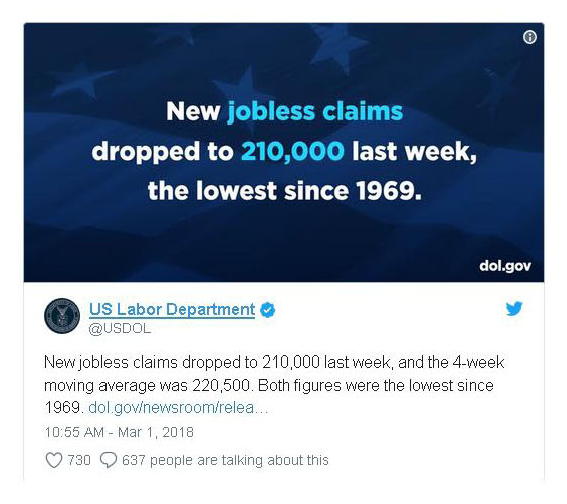
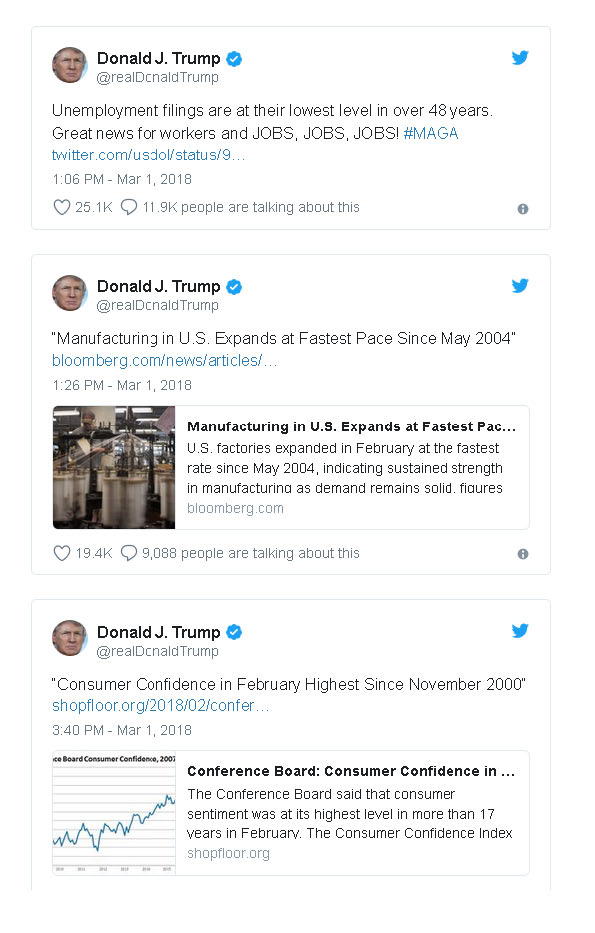
MAGAnomics baby!! Throw dem ju-ju bones out the windows and hold on to your britches… The U.S. Dept of Labor is reporting unemployment claims have dropped to 210,000. That’s the lowest jobless number since December 6th, 1959.

You know what this means right?
…wait for it.
…wait for it.
That’s right. We better grab chin straps for the hard hats, because pay raises and wage rate increases are thundering toward the middle-class like an unstoppable herd of buffalo. Exactly on schedule. Cha-ching & Ka-pow.

This has been the plan within very-stable-genius Trump’s MAGAnomics all along.
Take-home paychecks are already seeing the benefits of lower tax rates for the middle-class. The mid-size employers are simultaneously benefiting from lower corporate tax rates. This means the employers can afford to pay more…. and right on cue, the labor market says ‘show me the money‘.
We timed this out to appear in Quarter #2 2018: More take-home pay, PLUS a pay raise, EQUALS the ability to afford slightly higher consumer prices (Q4) on durables. See how that works?
The January 2018 jobs report showed a gain of 200,000 U.S. jobs, and more importantly, a 2.9% year-over-year growth in wages. –SOURCE– [Biggest wage rate jump since the phoney trillion stimulus-funded growth mid-2009.] We continue to remind of our two-year prediction that stunning wage growth will evidence in Q2 of 2018 (April-July)… these wage and labor reports preview that wage growth cycle.

Construction reported by the biggest gain by sector with 36,000. Bars and restaurants added 31,000 and health care was up 21,000. Manufacturing also showed a gain of 15,000 and durable goods-related industries added 18,000.
“Perhaps the biggest positive surprise on hiring is the continued surge for the goods-producing sector with manufacturing and construction leading the way,” said Mark Hamrick, Bankrate.com’s senior economic analyst. (link)
The Main Street economic engine is fundamentally detached from the drivers of the Wall Street economic engine (monetary policy). While the paper wizards are getting kicked in the teeth, interest rate increases will not diminish Main Street gains because wage increases will remain ahead of price inflation. Interest rate increases will, however, impact Wall Street because interest rates are monetary policy, and a great deal of Wall Street is based on speculation within the paper (false) economy.
Can you see now why we have been saying for two years MAGAnomics will draw out the new dimension in modern economics? There is a distance between Main Street’s economic engine and Wall Street’s economic engine. MAGAnomics operates in the space between them.
The stock market retracts today against fears of: tariffs + inflation = rising interest rates.
Pffffttt… Many on Wall Street have not recognized that monetary policy will not influence Main Street growth until interest rates, and/or inflation, surpasses the rate of wage growth. The parity within that dynamic is still about a year-and-a-half away.
If you pay attention, the economic engine disconnect is visible. Note the market schizophrenia.
February 2018 wage growth will exceed January (driven in part by new tax rates); March will exceed February; April will exceed March…. and so on, and so on, (remember these are year-over-year comparatives). This is the EXACT reversal of prior economic policies from several administrations that were killing Main Street.
At the very heart of America-First, MAGAnomics focuses on U.S. jobs and U.S. companies. Investment growth drives labor demand; labor demand drives wage rates; wage rate growth increases consumer demand for goods and services; that demand drives investment; more investment is expansion of production capacity – ie. need more labor.
There will be natural price inflation to come as an outcome of Main Street’s economy expanding. However, two factors: #1) inflation will creep slow, there’s a natural lag and built in downward price pressure within the gap of unfilled production capacity; #2) Most importantly growth in wages will exceed the inflation rate -for approximately two years- thereby making increases in product costs irrelevant to consumer demands.
Inside this mix, off-shore manufacturers will continue trying to get their products into the hands of Americans who have more disposable income. That unique aspect will continue to keep prices down during the phase of shifts from import manufacturing to domestic manufacturing. Unfortunately, imports might keep GDP growth rates down – but the underlying economy will be expanding as domestic production begins to replace imports.
Ongoing financial results will be solid for companies doing business in the U.S., and actual profit results will gain market weight over speculation. The Titans are rising.
Economic nationalism is winning…. globalism is losing…. multinationals are shrieking… paper weasels are crying…. Middle Class American workers are CHEERING!
Earlier today First Lady Melania Trump and Senior Policy Adviser Kellyanne Conway held a summit on the opioid epidemic at the White House (videos below). At the conclusion of the meeting, President Trump delivered closing remarks:
.
Full video of the summit is below:

.
.
For those who follow closely the strongest argument against the U.S. trade and economic policies of the past 30 years has been the outcome. We don’t need to guess what the pro’s and con’s of the U.S. Chamber of Commerce position is, we are living them. We don’t need to guess what the Wall Street economy delivers, we are living through them.
For the past 30 years the U.S. has lost jobs, wages have been depressed, and the middle-class has suffered through the implementation of economic trade policy that destroyed the U.S. manufacturing base. None of this is in question – the results stare us in the face – yet the Wall Street and multinational corporate club(s) [U.S. CoC chief among them] now demand a continuance of the same.
 The economic and trade policies of the Trump administration are adverse to those interests. As we have shared for several years, candidate Trump, now President Trump is an existential threat to the multinational program.
All opposition to President Trump is about the underlying financial and economic policy of America-First. There are trillions at stake.
Those who have read here will note the media are generally oblivious to America-First economic policies; this includes the financial media.
As an example today they are trying to figure out how Steel/Aluminum tariffs would work. Commerce Secretary Wilbur Ross stated clearly exactly how the Steel and Aluminum policy would be carried out; yet for the financial media they claim to be clueless. The level of intellectual dishonesty is off-the-charts.
The truth is, well, two points: •Point #1 – the media don’t want to know; they are committed to selling the prior policy. •Point #2 – there’s almost no-one within the professional economic punditry class who have ever given thought to what happens during the space between two fundamentally different economic policies as executed.
What happens in the space between taking the U.S. economy off the path of ‘service-driven-globalism’, and reasserting the economy back to a balanced ‘production-based national economy’? None of the key participants within the larger discussion have ever contemplated this dynamic.

CTH is one of the few, perhaps the only source, who has gamed-out MAGAnomics.
Allow me to re-emphasize:
All opposition to President Trump stems from the underlying financial and economic policy. All opposition is about money!
When you ask the “why” question five times you end up discovering the financial motive for all opposition. It doesn’t matter who the group is; the opposition is ultimately about money. There are trillions at stake.
When Main Street economic principles are applied Wall Street will initially lose. There’s no way for this not to happen. Most of Wall Street is built on the Multinational platform of economic globalism. Weaken the grip of the multinational corporations and financial interests on the U.S. economy and Wall Street will drop… this is not difficult to predict. This is also necessary.
U.S. stocks, centered around U.S. domestic companies, will go up. U.S. stocks, centered around multinational companies, will go down.
As Secretary Wilbur Ross, U.S.T.R. Robert Lighthizer and U.S. President Trump have previously affirmed, they are going to restore the U.S. manufacturing and production economy -OR- lose office trying.
The U.S. Steel and Aluminum tariffs are just one component of the larger economic issue. Bringing back U.S. production on those sectors is vital to the infrastructure of a manufacturing and production economy.
Additional steps will come from exits of NAFTA and renegotiated trade deals with ASEAN nations, China and Europe. We either have a stable broad-base economy, or we follow the former path and eventually lose the country.
On the specifics of inflation, we have discussed this issue at great length. As stated three years ago, inflation will happen within this cycle –especially in the space between the policy as constructed– however, it will not affect the larger economic restoration because the growth of U.S. wages will exceed the rising prices of durable goods…. AND simultaneously energy prices and high-consumable goods’ prices (food, fuel) will drop. [Exit NAFTA and U.S. food prices will drop 25% within a year]
In this transitional phase (the space between) wage growth will remain ahead of aggregate inflation. No former economic models have any way to measure or gauge this dynamic. We have never been between two entirely different sets of economic policy before. No amount of immediate fed monetary policy will effect what happens on Main Street in this “space between” the two economies.
President Trump announces he is like to impose global tariffs on imported steel and aluminum – in a broad effort to ensure U.S. national security and manufacturing capacity within a very important industrial sector.
Earlier today President Trump appeared to be accepting Commerce Secretary Ross proposals for 25 percent tariffs on imported steel and 10 percent for aluminum. It is likely the tariffs will apply globally to all imports because targeted national tariffs have not worked. China ships their manufactured steel to another nation first in order to avoid the tariff. As Secretary Ross has previously stated we end up with a whack-a-mole policy. So likely the tariff will apply globally regardless of the nation shipping the product.
.
The usual, the corporate GOPe and Chamber of Commerce politicians will go bananas.
Last year President Donald Trump requested a national security Section 232 trade-investigation, to conducted by the U.S. Department of Commerce and Secretary Wilbur Ross, specifically focusing on U.S. steel and aluminum manufacturing.
The discussion continued last month as President Trump met with a group of republican and democrat members of congress to talk about trade policy and focus attention on the lack of American steel and aluminum production. [The responses from the republican participants was very enlightening and disappointing.]
Commerce Department Recommendations HERE
The New York Times is reporting Ms. Hope Hicks is resigning from her role as White House Communications Director to seek opportunities in the private sector.
This doesn’t come as a surprise considering 29-year-old Ms. Hicks was/is romantically involved with Rob Porter, the embattled White House Staff Secretary who was swamped in a controversy of accusations of abuse against him by former spouses earlier this month.

Hope Hicks was initially candidate Donald Trump’s personal aide, and one of a very small group organized within the initial presidential campaign headed by Cory Lewandowski.
Together with Lewandowski, Hope Hicks, Dan Scavino Jr., Michael Cohen, Michael Glassner, Brad Parscale and Jared Kushner were the team who powered through the political machine to win the GOP nomination and later the presidency.
According to the Times: “Ms. Hicks had been considering leaving for several months. She told colleagues that she had accomplished what she felt she could with a job that made her one of the most powerful people in Washington, and that there would never be a perfect moment to leave, according to White House aides.” Her exact departure date is unknown.

(NYT) […] “Hope is outstanding and has done great work for the last three years,” Mr. Trump said. “She is as smart and thoughtful as they come, a truly great person. I will miss having her by my side, but when she approached me about pursuing other opportunities, I totally understood. I am sure we will work together again in the future.”
As communications director, Ms. Hicks worked to stabilize, to some extent, a fractious press department of about 40 people who were often at odds with one another in 2017. She maintained one of the lowest public profiles of anyone to ever hold the job, declining to sit for interviews or appear at the White House briefing room podium. That mystique added to the outsize attention she received.
“I quickly realized what so many have learned about Hope: She is strategic, poised and wise beyond her years,” said John F. Kelly, the White House chief of staff. “She became a trusted adviser and counselor, and did a tremendous job overseeing the communications for the president’s agenda including the passage of historic tax reform. She has served her country with great distinction. To say that she will be missed is an understatement.” (Link)
I have created this site to help people have fun in the kitchen. I write about enjoying life both in and out of my kitchen. Life is short! Make the most of it and enjoy!
De Oppresso Liber
A group of Americans united by our commitment to Freedom, Constitutional Governance, and Civic Duty.
Share the truth at whatever cost.
De Oppresso Liber
Uncensored updates on world events, economics, the environment and medicine
De Oppresso Liber
This is a library of News Events not reported by the Main Stream Media documenting & connecting the dots on How the Obama Marxist Liberal agenda is destroying America
Australia's Front Line | Since 2011
See what War is like and how it affects our Warriors
Nwo News, End Time, Deep State, World News, No Fake News
De Oppresso Liber
Politics | Talk | Opinion - Contact Info: stellasplace@wowway.com
Exposition and Encouragement
The Physician Wellness Movement and Illegitimate Authority: The Need for Revolt and Reconstruction
Real Estate Lending

 Centinel2012