Posted originally on CTH on February 20, 2026 | Sundance
The frustrating issue with the Supreme Court ruling [SEE HERE] is not simply the legal logic applied, which essentially boils down to actionable definitions surrounding the word “regulate,” but also the high court’s seeming blindness to the “emergency” part of the reason IEEPA was used.
Economic security is national security, and the hollowing out of our ability to independently sustain our national economic system posed a real and substantive threat to our nation. The court never evaluated the ‘urgency’ behind the International Emergency Economic Powers Act (IEEPA) as used by President Donald Trump.
Instead, the court began their legal analysis by seeking to define the word “regulate” as it applies to IEEPA. Part II–B, concluding: (a) IEEPA authorizes the President to “investigate, block during the pendency of an investigation, regulate, direct and compel, nullify, void, prevent or prohibit . . . importation or exportation.” §1702(a)(1)(B) under the Act.
The majority of the court decided presidential ability to levy countervailing duties is not part of the ability to “regulate” importation.
In the opinion of the court, the President can block imports, nullify imports and prohibit imports, but the president cannot “regulate” imports through the use of tariffs. This is the representative logic of a John Roberts court, the voice of Bush Inc.
It is what it is – and many of us saw this nonsense as a likely outcome, but it is still frustrating to see such a detached parseltongue approach to legal opinions when the national security of our nation is at stake. These are the judicial minds who will watch the nation burn to the ground, just so they can remain in power ruling over the ashes.
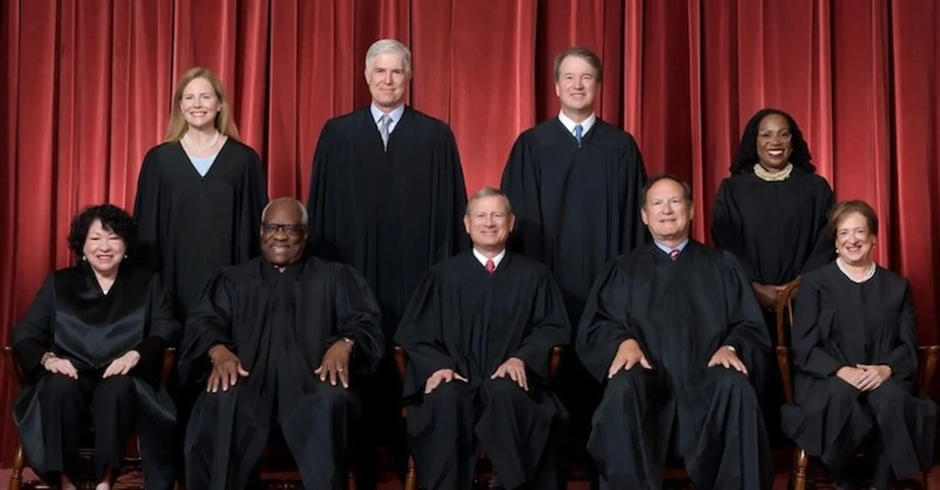
Chief Justice John Roberts and Justices Amy Coney Barrett and Neil Gorsuch joined the court’s three liberals in the majority. Justices Brett Kavanaugh, Samuel Alito and Clarence Thomas dissented.
(Via Politico) – […] “The President asserts the extraordinary power to unilaterally impose tariffs of unlimited amount, duration, and scope. In light of the breadth, history, and constitutional context of that asserted authority, he must identify clear congressional authorization to exercise it,” Roberts wrote, declaring that the 1977 law Trump cited to justify the import duties “falls short” of the Congressional approval that would be needed.
The ruling wipes out the 10 percent tariff Trump imposed on nearly every country in the world, as well as specific, higher tariffs on some of the top U.S. trading partners, including Canada, Mexico, China, the European Union, Japan and South Korea.
Several of those countries have entered trade agreements with the U.S. — and before the ruling indicated that they would continue to honor those agreements.
That is because the victory for the 12 Democratic-run states and small businesses that challenged Trump’s tariffs is expected to be short lived. The White House has signaled it will attempt to use other authorities to keep similar duties in place.
“We’ve been thinking about this plan for five years or longer,” U.S. Trade Representative Jamieson Greer told POLITICO in December. “You can be sure that when we came to the president the beginning of the term, we had a lot of different options”
“My message is tariffs are going to be a part of the policy landscape going forward,” Greer said. (read more)
Justice Thomas agrees with CTH prior position on the issue. IEEPA grants the president the authority to regulate imports, and tariffs are a tool for regulation.
Despite this decision the tariffs will remain in place, perhaps using various authorities which have not been challenged as noted in the Kavanaugh dissent:
That said, with respect to tariffs in particular, the Court’s decision might not prevent Presidents from imposing most if not all of these same sorts of tariffs under other statutory authorities. For example, Section 122 of the Trade Act of 1974 permits the President to impose a “temporary import surcharge” to “deal with large and serious United States balance-of-payments deficits.” 19 U. S. C. §2132(a). Section 201 of the Trade Act of 1974 provides that, if the International Trade Commission determines an article is being imported in such quantities that it is “a substantial cause of serious injury, or the threat thereof, to the domestic industry producing an article like or directly competitive with the imported article,” the President may take “appropriate and feasible action,” including imposing a “duty.” §§2251(a), 2253(a)(3)(A). Section 301 of the Trade Act of 1974 authorizes the President through a subordinate officer to “impose duties” if he determines that “an act, policy, or practice of a foreign country” is “unjustifiable and burdens or restricts United States commerce.” §§2411(a)(c). Section 338 of the Tariff Act of 1930 permits the President to impose tariffs when he finds that “any foreign country places any burden or disadvantage upon the commerce of the United States.” §1338(d). And Section 232 of the Trade Expansion Act of 1962 authorizes the President to, after receiving a report from the Secretary of Commerce, “adjust the imports of [an] article and its derivatives so that such imports will not threaten to impair the national security.” §1862(c)(1)(a).
So the Court’s decision is not likely to greatly restrict Presidential tariff authority going forward. (pg, 63 dissent)



 Centinel2012