
How it all started
During the 1970’s and 1980’s the temperature of the planet did seem to be going up, see Figure 1 from that period, and this led to a reinforcing belief that it was being caused by increasing levels of CO2 as both seemed to be rising together in lock step, in other words there was a correlation between the two variables. This is what eventually led to the creation of the IPCC and the construction of the various Global Climate Models (GCM) [1] Hafemeister and Schwartz, which were designed to show how much the planet’s temperature was going up because of the increasing levels of CO2 in the atmosphere. Inherent in setting up the IPCC and the global climate models was the belief that there was both correlation and cause and effect between the world’s temperature and the level of CO2 in the atmosphere. This was a very serious flaw which has led to much wasted effort and a lot of confusion in the world’s science and engineering communities, because instead of working on producing cheap energy which would improve the lives of everyone on the planet and which we would need in abundance, we are working very hard on reducing CO2 which either significantly increases the cost or reduces the supply of energy and is therefore very counterproductive.
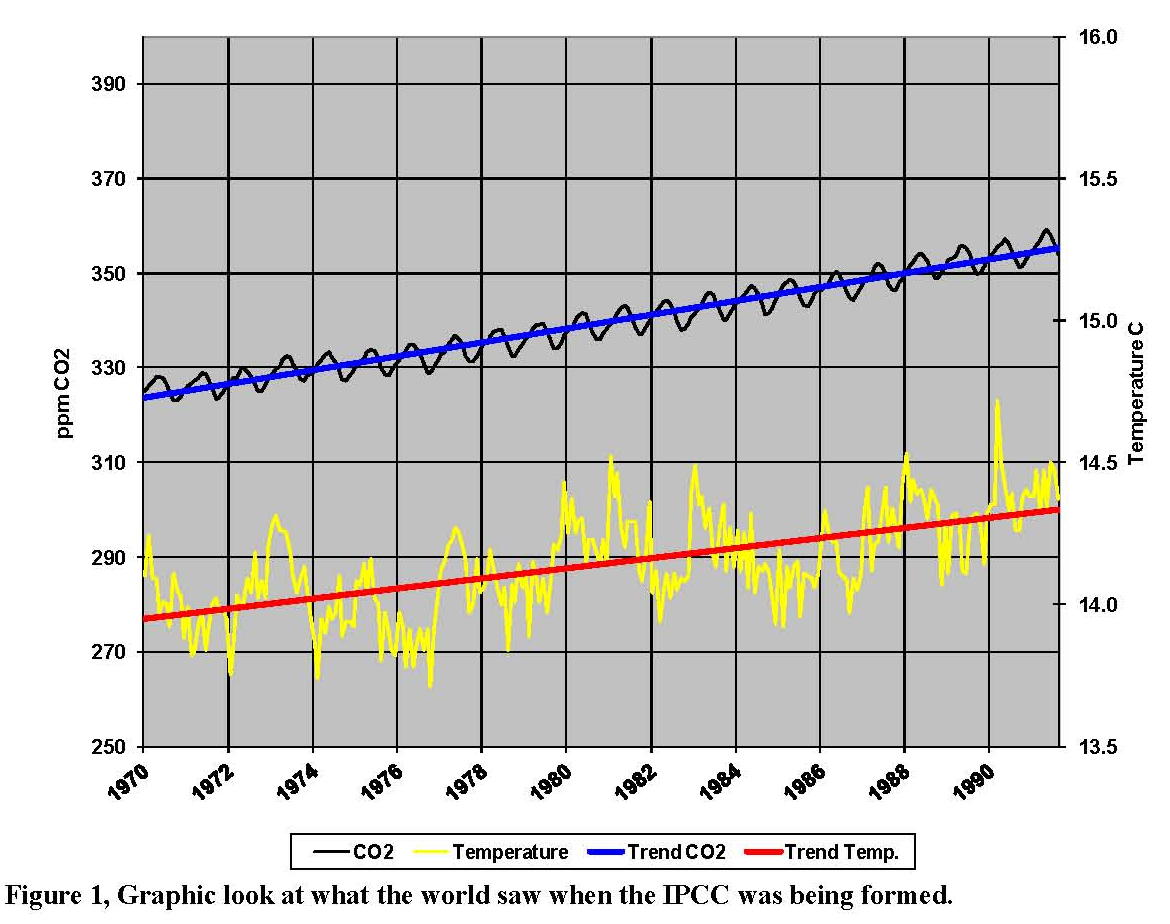
Because of the importance of this Figure 1 some discussion is justified. The trend lines between CO2 and temperature appear to be almost exactly the same. This is, in part, because of the scales used in this chart. However the scales used here are the basically the same as those used throughout this paper, although the portion (window) shown in any one Figure might be different. In this Figure CO2 increases about 9.2% and temperature increases about 4.4% and different scales and units would, in fact, give different numbers. The salient point to the IPCC was that both CO2 and temperature were moving up simultaneously and that gave them the justification for what they were proposing in their Anthropogenic Climate Change Theory.
The IPCC in many cases indirectly acknowledges that they don’t really know what they are doing for example in the IPCC 2007 4th assessment on Climate Change their climatologists admit to having a “low” or “very low” understanding of 13 of the 15 factors that drive climate [2]. So in other words they only know what they are doing 2 out of 15 times or 13.3% of the time yet they want us to trust them and completely change the entire world’s energy production system at a cost of untold trillions of dollars because they just might have guessed correctly; that seems to be a bit much. Most of the science I know, albeit I’m of an older generation, requires over 90% certainty before it is accepted and that’s just the start of a proof of a theory. For example Albert Einstein’s “Theory” of Special Relativity is not acceptance as a law of science it is still only a theory that appears to be correct.
The really amazing thing about what the IPCC and their cohorts are doing is that prior to their founding and the creation of a large amount of government research money there was little to no support for the theory that CO2 was causing planetary change and increasing the earth’s temperature; given that CO2 is only .0398% of the atmosphere even today that does seem to be a bit of a stretch. For example the American Meteorological Society (AMS) had refuted the concept of CO2 as a greenhouse gas in 1951 in its Compendium of Meteorology [3], In which they stated that the idea that CO2 could alter the climate “was never widely accepted and was abandoned when it was found that all the long-wave radiation [that would be] absorbed by CO2 is [already] absorbed by water vapor.” There was also a hugely influential National Academy of Science in their Charney Report from 1979 [4]. This 33-year-old U.S. government report details the role of carbon dioxide and how it might impact the climate. You will see that while CO2 is mentioned no less than 112 times, as you’d expect, but nowhere in this report will you find ANY mention of the greenhouse gas effect/theory.
One of the principle architects’ of the anthropogenic climate change theory was James Edward Hansen and according to Wikipedia he is “… an American adjunct professor in the Department of Earth and Environmental Sciences at Columbia University. Hansen is best known for his research in the field of climatology, his testimony on climate change to congressional committees in 1988 that helped raise broad awareness of global warming, and his advocacy of action to avoid dangerous climate change.” From 1981 to 2013, he was the head of the NASA Goddard Institute for Space Studies in New York City, a part of the Goddard Space Flight Center in Greenbelt, Maryland. Hansen, while at NASA in a leadership role, was the primary driver for the US governments push for control of energy and therefore we must look at his work since it is, if not the primary driver certainly one of the main drivers of world policy on climate today. Hansen retired from NASA-GISS in April of 2013 and has now become very active in the environmental movement.
From the NASA-GISS website, “In particular Hansen gave a presentation to the US congress in 1988 where he showed them what he thought would happen to Global climate if we did not stop putting Carbon Dioxide CO2 into the earth’s atmosphere. In the original 1988 paper, three different scenarios were used A, B, and C. They consisted of hypothesised future concentrations of the main greenhouse gases – CO2, CH4, CFCs etc. together with a few scattered volcanic eruptions. The details varied for each scenario, but the net effect of all the changes was that Scenario A assumed exponential growth in forcings, Scenario B was roughly a linear increase in forcings, and Scenario C was similar to B, but had close to constant forcings from 2000 onwards. Scenario B and C had an ‘El Chichon’ sized volcanic eruption in 1995. Essentially, a high, middle and low estimate were chosen to bracket the set of possibilities. Hansen specifically stated that he thought the middle scenario (B), shown below as Figure 2, the “most plausible”.
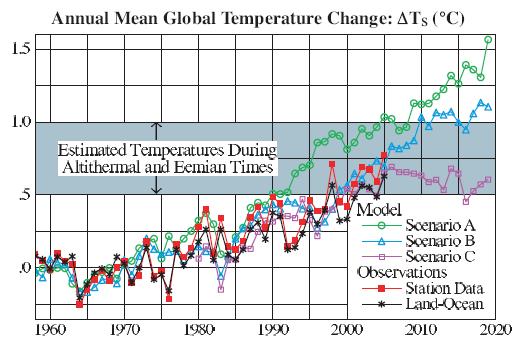
Figure 2 James E. Hansen’s three scenarios
Hansen as well as many others are true believers in the Anthropogenic climate change movement and they have, for the most part, made this into a religion and refuse to admit that there could be any other factors besides CO2 that drive Global climate. What has happened is that rather than look at climate and how it has “always” changed over time Hansen and the IPCC chose to ignore the fact that climate has never been a constant and tried to prove the CO2 “was” the cause of the current change. A look at recent history going back to the last Ice Age shows how foolish that belief is, see Figure 3 below.
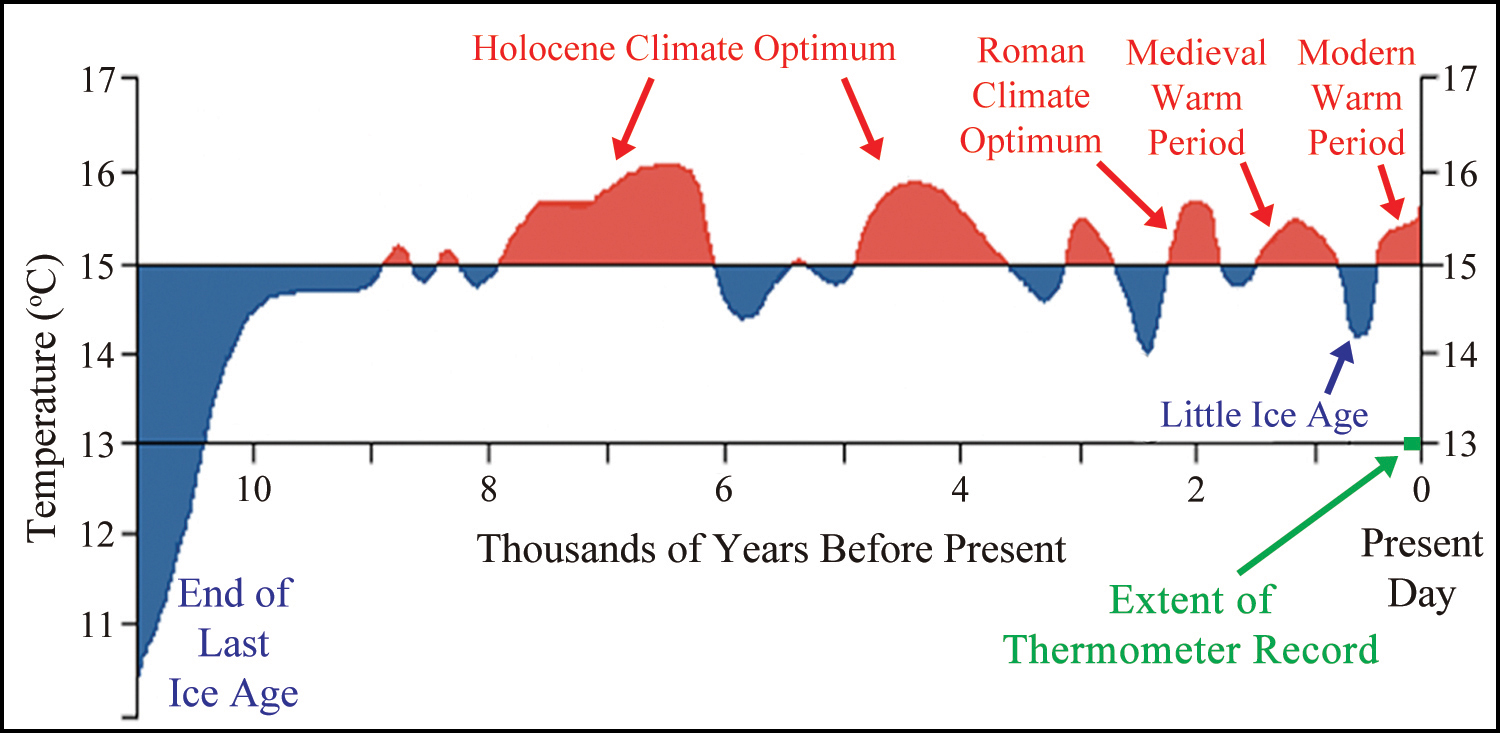
Figure 3, 11,000 years of Change
What should have been done was construct a null hypothesis argument to see if science could prove that the CO2 was not the cause instead of trying to make the models show that it was the cause. Much of what was done in these models was to tweak the assumptions and the raw data to give the result that was desired and that has led to a wide disparity between the current observed downward movement of temperatures and the upward predictions of those temperatures by all the IPCC climate models. This increasing disparity is becoming a major issue with the IPCC (and their supporting agencies) and the other side of this argument. There are now an increasing number of scientists who are not in support of the way the climate work has been done. We have attempted to show here that after wasting billions of dollars that —
CO2 is neither the proximate nor the ultimate cause of the world’s temperature going up.
Continued in A Short History of Climate Change, Part III
 Centinel2012