
Photosynthesis
From approximately 1970 to 2000 the earth had been warming and at the same times the CO2 levels in the earths’ atmosphere had been rising; both apparently in sync as shown in the previous Figure 1. There is probably a very high correlation to the increased level of CO2 in the atmosphere and the increased use of carbon-based fuels by advanced societies in particular the United States (US) the European Union (EU) and the Pacific Rim countries over the past century, [5] Olivier et al. We will concede that point of argument although there are other much larger sources and sinks for carbon on the planet. The issue is that the increase in the CO2 levels has been identified, by some, as a cause of great concern. Their belief is that more CO2 will cause the planet to heat up to unprecedented and disastrous levels [6] Editorial Nature! In essence a positive feed back situation that at some point creates a runway increase in temperature, see Figure 4 where the red oval is Hansen’s Scenario B. If true this is indeed very, very bad and needs to be addressed.
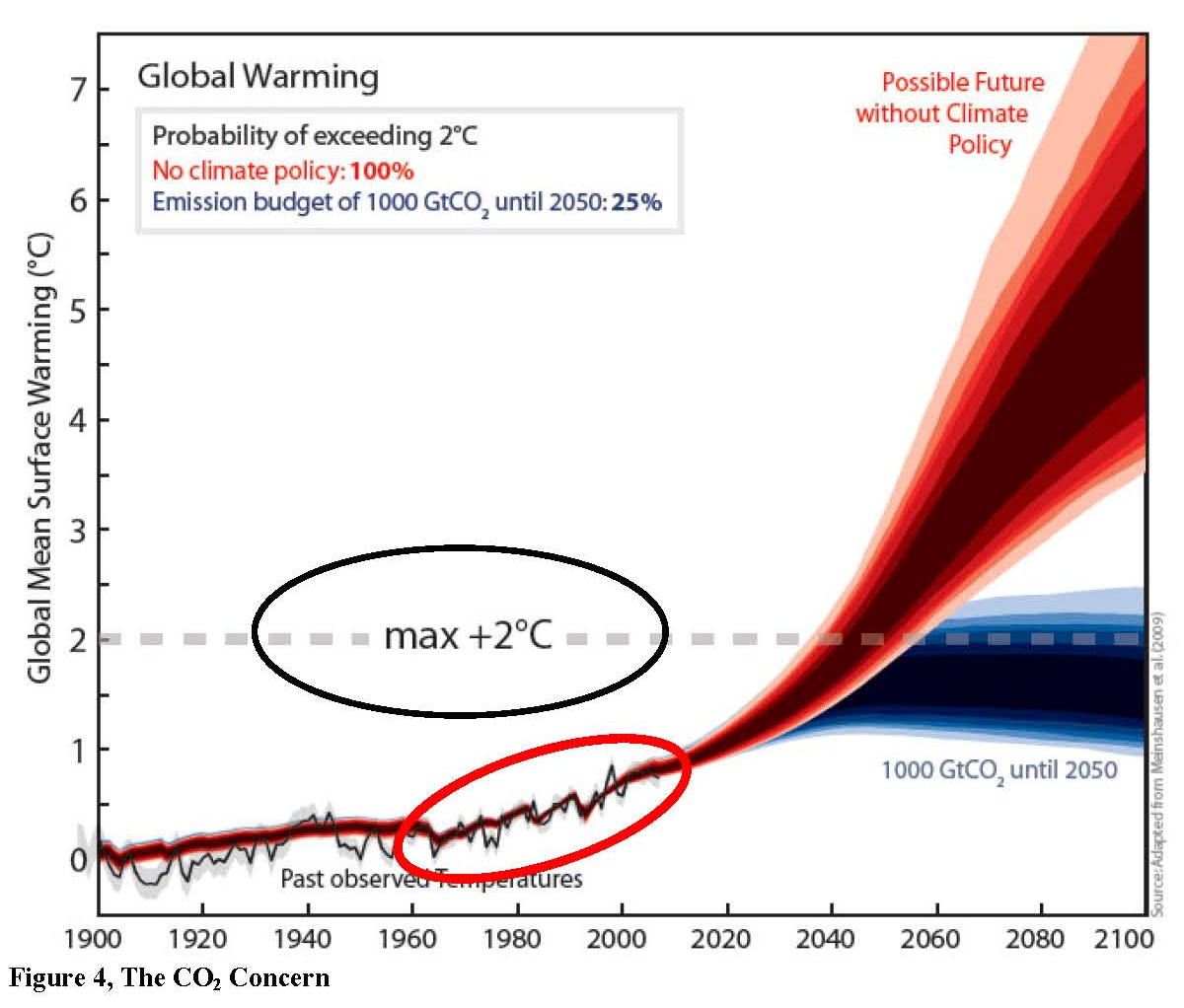
That concern has manifested itself in two counts one patently false and the other without observed verification. The first and totally false statement is that high levels of CO2 in the atmosphere are very dangerous and must be regulated as we have been told by both the United States Supreme Court in Massachusetts v. EPA (2007) and the US EPA. Since an average human probably creates almost a half a ton of CO2 per year just by breathing we are all now in violation of U.S. Supreme Court edicts [7] Fox News 2009.
In fact CO2 is a food that is “required” for photosynthesis to occur in plant life and higher levels of CO2 are better than lower levels and therefore the plants grow faster [8] DeGraaf et al and [9] Soon et al with higher levels of CO2. Figure 5 below shows the basic equation for photosynthesis in plants, where carbon dioxide from the atmosphere and water from the ground are combined by the energy in sun light producing Sugar and Oxygen.

Figure 5, The Equation for Creating Sugar from Carbon Dioxide
When plants appeared and evolved on Earth, it is known for a fact that the carbon dioxide (CO2) concentration was much higher than it is now. Back then, the CO2 concentration was certainly well above 1000 parts per million (ppm) and even well over several thousand ppm early in the earth’s history. Today the average CO2 concentration in outdoors air on the planet is about 400 ppm. Thus, plants enjoy and are stimulated by breathing air with a higher CO2 concentration more like when they first developed. That’s why so many indoor gardeners enrich their garden with CO2 during photosynthesis to supply the plants with this essential building material. Through photosynthesis, the carbon in CO2 is extracted and takes part in the building of leaves, stems, flowers and fruits. Figure 6 shows how the equation shown in Figure 5 works in the plant.
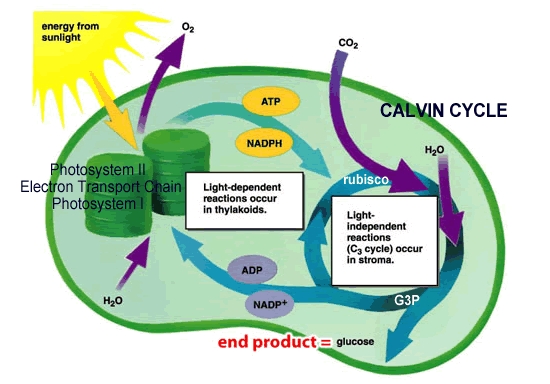
Figure 6, What goes on in a plant leaf
Proper CO2 concentration from early growing to fructification allows for faster maturation and larger yield. Since outdoors air CO2 level varies in the 400-700 ppm range at any given time and most plants grow better in the 700-1500 ppm range, there is a gap to fill. CO2 concentration enrichment aims at filling the gap to raise the limit to plants growth rate.
The benefits of CO2 enrichment are to reduce the time from seedling to harvest, and generally accelerate growth and augment crop yield. Plants also better resist some pests like moulds. Rutgers University compared Romaine lettuce grown outdoors and in a climate controlled greenhouse with CO2 enrichment [10] Both A. J. The results were clearly to the advantage of the indoor greenhouse grown lettuce. Romaine lettuce grown outdoors reached ready-to-market maturity in 62 days. In the greenhouse under a well controlled climate and CO2 enhancement, lettuce heads were ready-to-market in 48 days: a clear gain of 14 days to get to harvest. Also the greenhouse yield weighted 33 % more than field grown lettuce heads. Yield quality was more uniform and greenhouse heads were paid a higher price.
Additional support of increased growth for high levels of CO2 comes from the number of stomata cells in plants which control the intake of CO2 and the output of water. When the stomata cell levels decrease as CO2 levels increase the plant grows faster a well known established fact [11] Cockburn et al. Since the ultimate source of all our food is plant life, restricting the growth of CO2 would seem to be a very bad thing to do. At the heart of this part of the false anthropogenic global warming argument is what the optimum level of CO2 in the atmosphere is. The current unstated assumption is that its ~280 ppm as existed some 300 years ago and that is what it “should” be …
There is no basis in fact or theory for this assumption; therefore any increase or decrease cannot be shown to be either good or bad ipso facto.
References
[1] Hafemeister, David and Schwartz, Peter “A Tutorial in the Basic Physic of Climate Change,” Physics and Science Vol. 37 No. 3 July 2008
[2] Solomon, Susan, et al, IPCC: Climate Change 2007: Working Group I: The Physical Science Basis; 2.9.1 Uncertainties in Radiative Forcing.
[3] Brooks, C.E.P. (1951). “Geological and Historical Aspects of Climatic Change.” In Compendium of Meteorology, edited by Thomas F. Malone, pp. 1004-18 (at 1016). Boston: American Meteorological Association.
[4] Suomi, Verner E. et al, That National Academies “Carbon Dioxide and Climate: A Scientific Assessment” July 1979.
[5] Olivier, Jos G. J., “Trends in Global CO2 Emissions 2012 Report,” PBL Netherlands Environmental Assessment Agency, July 2012
[6] Editorial “Time to act,” Nature 458, (April 30, 2009) 1077-1078
[7] Fox News Friday August 26, 2009, “Don’t Exhale: EPA Expected to Declare Carbon Dioxide a Dangerous Pollutant”
[8] de Graff, Marie-Anne et al, “Interactions between plant growth and soil nutrient cycling under elevated CO2: a meta-analysis”, Global Change Biology (2006) 12, 2077-2091,
[9] Soon, Willie et al, “Environmental effects of increased atmospheric carbon dioxide”, Climate Research Vol. 13 149-164, 1999 October 26.
[10] Both, A. J. et al, Page 3 “Horticultural Engineering,” Volume 18 No. 5, October 2003
[11] Cockburn, William, “Relationships between Stomatal Behavior and Internal Carbon Dioxide Concentration in Crassulacean Acid Metabolism Plants,” Plant Physiol (1979) 63, 1029-1032
 Centinel2012