Iran’s Geography – Mountain Fortress And Deserts


Posted originally on Mar 4, 2026 by Martin Armstrong |  

Topographic map of Iran with the main topographical features ...

When analysts talk about Iran, they too often reduce it to politics, nukes, or ideology. But any real understanding of the strategic challenge must begin with geography. Iran is not Iraq; it is not Afghanistan. It is a vast land mass defined by mountain ranges that have shaped its history, defense, and resistance to outside powers for millennia.

Iran covers roughly 1.65 million square kilometers, making it more thanthree times the size of Iraq and significantly larger than Afghanistan. Its internal geography isn’t open plains, but a series of rugged, interconnected mountain systems with high interior basins and plateaus wedged between them. The two dominant ranges, the Zagros in the west and the Alborz in the north, surround the country’s heartland, rise above 3,000 meters, and in places top 4,000 meters, creating what military theorists have called a mountain fortress

Afghanistan is frequently cited as the quintessential “graveyard of empires,” and its Hindu Kush mountains create an extraordinarily hostile combat environment. But even Afghanistan’s mountains are more accessible valleys and corridors. Iran’s mountains differ in scale and in their relationship to population centers. Iran’s population is concentrated in mountainous basins, not distant from the terrain that conceals them. Cities like Tehran, nestled under the Alborz, and countless towns embedded in the Zagros foothills, are naturally insulated. This gives defenders the ability to move, regroup, and conceal logistics under terrain that challenges air and ground surveillance.

Contrast that with Iraq, where the terrain quickly transitions to flat plains like the Tigris-Euphrates basin, which historically have facilitated rapid warfare. Iraq’s internal highlands exist, but they are limited and do not envelop critical centers. That is why during the Gulf War and the 2003 invasion, coalition forces could maneuver long distances rapidly. In Iran, such maneuver corridors are constrained by elevation, narrow passes, and terrain that favors defensive preparations and ambush.

Terrain matters because it dictates strategy. In Afghanistan, invaders struggled precisely because the rugged landscape broke lines of communication and allowed insurgents to melt into valleys and mountainsides. Iran’s mountains are broader and more extensive, giving defenders even more strategic options: natural choke points, deep interior lines of retreat, and countless niches for irregular or asymmetric resistance. Iran’s military planners understand this well, which is why defensive tunnel networks and surface-to-air missile sites have been deployed to exploit the topography.

Historically, the mountains of Iran have served as a barrier to sovereignty. They helped defend against Arab, Mongol, Ottoman, and Russian incursions over centuries. They served as the backbone of resistance during the Iran–Iraq War, where Iranian forces leveraged rugged terrain to negate some of Iraq’s technical advantages.

So when policymakers today speculate about quick strikes and a six-week regime decapitation, they are ignoring a fundamental constantmountains favor the defender.

Make Billionaires Pay Their Fair Share Act


Posted originally on Mar 4, 2026 by Martin Armstrong |  

Wealth Tax

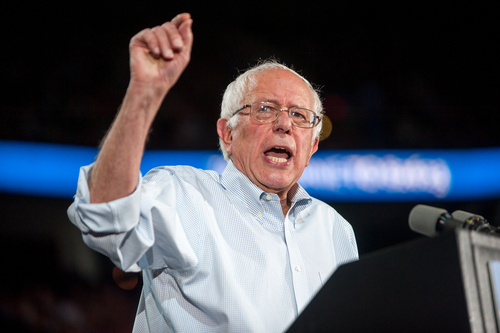
Sen. Bernie Sanders and Rep. Ro Khanna believe it would be “fair” to confiscate trillions from wealthy Americans to redistribute as they see fit. The Make Billionaires Pay Their Fair Share Act would impose a 5% annual tax on the wealth of America’s roughly 938 billionaires and is projected to raise about $4.4 trillion over ten years.

Sanders declared, “In a democratic society, we cannot tolerate 60 percent of our people living paycheck to paycheck while 938 billionaires have become $1.5 trillion richer,” arguing that the “corrupt tax code” favors the ultra-wealthy. Khanna added that “we can tax billionaires a modest amount to make sure everyone has a fair chance.” Whenever policy is driven by moral outrage rather than economic structure, you must step back and examine the unintended consequences.

Bermie Sander 5

A wealth tax of this magnitude targets assets, not income. That means taxing unrealized gains including paper value in stocks, private companies, real estate, and other holdings. History has shown that such taxes often trigger capital flight or relocation of high-net-worth individuals. Europe tried wealth taxes repeatedly and abandoned many of them after discovering they raised less revenue than projected while discouraging investment. Capital moves where it is treated best.

When confidence declines, redistribution becomes politically attractive. But redistribution does not create growth. It reallocates it. The real danger is not the $4.4 trillion number. It is the precedent. Once you redefine wealth as a taxable asset base regardless of liquidity, you fundamentally alter property rights. Markets function on stability and predictability and uncertainty is what drives capital away.

This proposal is unlikely to pass in its current form. Bernie will fossilize before his socialist dreams come true. Yet, ideas that were once considered extreme are now up for mainstream debate. The premise sounds good to voters on paper. Sanders and Khanna are offering “a $3,000 direct payment to every man, woman, and child in a household making $150,000 or less—$12,000 for a family of four. But as those in New York City are learning under Mamdani, tax policies eventually target EVERYONE. Socialistic policies do result in equality—in poverty—as government’s appetite for spending is insatiable.

An Iranian Victory is Different from an American Victory


Posted originally on Mar 3, 2026 by Martin Armstrong |  

Irans Iron Fist

QUESTION: Do you see any possibility that Iran can win?

Jeb

ANSWER: NO, in the conventional sense. The strategy of Iran is completely different from that of the US. It understands that Trump thinks he will be able to overthrow the regime and this will be short and sweet. They know they cannot win against the United States in that sense. They cannot send balistic missiles to attack NYC or LA. The greatest threat here is that they try to hurt the West by attacking the oil facilities in the Middle East. They know Trump has midterms and scandals to deal with like Epstein. They also know that Americans do not support a prolonged Neocon war. This most likely translates into dragging things out knowing that Trump may have bit off more than he can chew listening to the Neocons.

Iran Map R

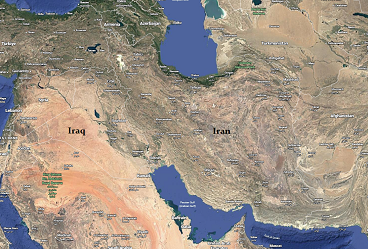
Iran is not a flat piece of land like Iraq. It is mountainous. They also know that a ground assault will be challenging and perhaps more costly in lives than Iraq. Iran mentality is not the same insofar as victory. It is more about surviving, which to them would be a victory.

china_rail_link_to_iran

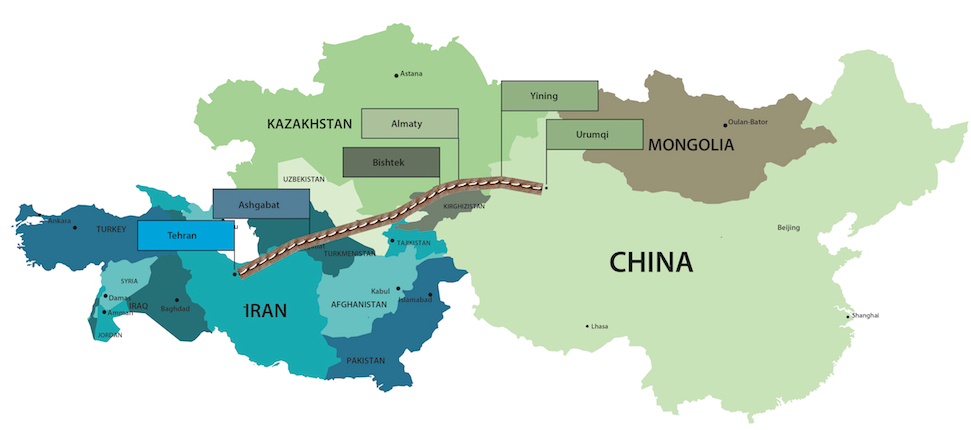
Attacking the oil facilities of the other Middle Eastern states will have a great impact on the West than attacking Israel which they also do not expect to defeat. If they can create enough chaos so that ships stay in ports, that also would be a victory to Iran. What you don’t want to see happen is damaging the railway for oil to China. China is the largest oil importer. That would then threaten their national security.

Martin Armstrong – LIVE In Vancouver! Tickets on Sale NOW!


Posted originally on Mar 3, 2026 by Cassandra |  

QAProductImage scaled

We are pleased to announce upcoming in-person events in Vancouver for you!

Hosted by Mike Campbell, the 2026 World Outlook Conference will feature a full day of in-person events on March 31, 2026. Martin Armstrong himself will be live on stage that evening. Each session is designed to build on the other, giving attendees both practical tools and a strategic perspective at a critical moment in global markets.

Advanced Trading Training with Erwin Pletsch (8:00 am – 12:00 pm | Westin Bayshore Hotel)

This morning session is built for active investors and traders who want to sharpen execution and timing. Erwin Pletsch will walk through how to interpret reversals, directional changes, volatility spikes, and capital flow shifts using the same cyclical framework that underpins Armstrong’s work. Learn how to identify high-risk turning points, how to recognize false breakouts, and how to manage exposure in vertical markets. This is focused on real-world strategy in an environment where volatility is accelerating, and traditional indicators are failing.

Understanding the Economic Confidence Model with Erwin Pletsch (1:00 pm – 4:00 pm | Westin Bayshore Hotel)

The afternoon session explains the architecture behind the Economic Confidence Model (ECM). Attendees will gain clarity on how the 8.6-year cycle operates, how public and private waves alternate, and how political change and economic instability align with measurable timing arrays. This session connects the dots between war cycles, sovereign debt crises, currency realignments, and civil unrest. It is designed for those who want to understand the “why” behind global shifts and the structural timing that drives them.

An Evening with Martin Armstrong Live (6:30 pm | Simon Fraser University Downtown Campus)

The day concludes with Martin Armstrong in person. This live discussion with Michael Campbell, who many of you will remember from past World Economic Conferences, will address the broader challenges facing the Western world. Explore topics such as the sovereign debt crisis, inflation, geopolitical fragmentation, NATO tensions, capital migration, and the transformation of monetary systems. Armstrong will speak candidly about where we stand in the cycle and what that means as we approach the next major turning points.

Together, these three sessions provide attendees with tactical strategy in the morning, structural economic understanding in the afternoon, and big-picture geopolitical and financial forecasting in the evening.

MartinArmstrongImage

The 2026 World Outlook Financial Conference will be more than just a conference. It will be a full immersion into the models shaping the global outlook.

Click the button below to learn more about webinars with Erwin Pletsch:

LearnMoreButton

Click on the button below to learn more about the 2026 World Outlook Financial Conference:

LearnMoreButton


Good News: Dan Crenshaw loses Primary – Cornyn and Paxton Advance to Runoff

Posted originally on CTH on March 4, 2026 | Sundance 

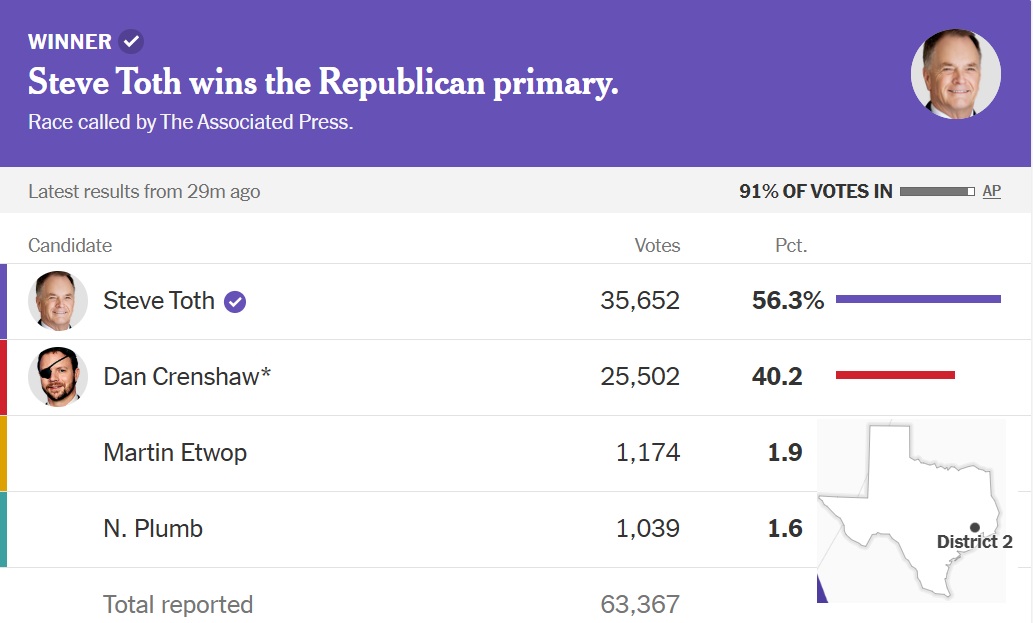
Texas DeceptiCON Dan Crenshaw, aka “one-eyed McCain”, a man of notoriously arrogant and intemperate disposition, has lost the Texas CD02 primary race to Steve Toth.  Mr Toth won 56% of the primary vote, so there will not be a runoff.

At the conclusion of this year, the perpetually horrible Dan Crenshaw will no longer be a congressman.

Apparently, Crenshaw was blindsided and didn’t see it coming. [SOURCE]

.

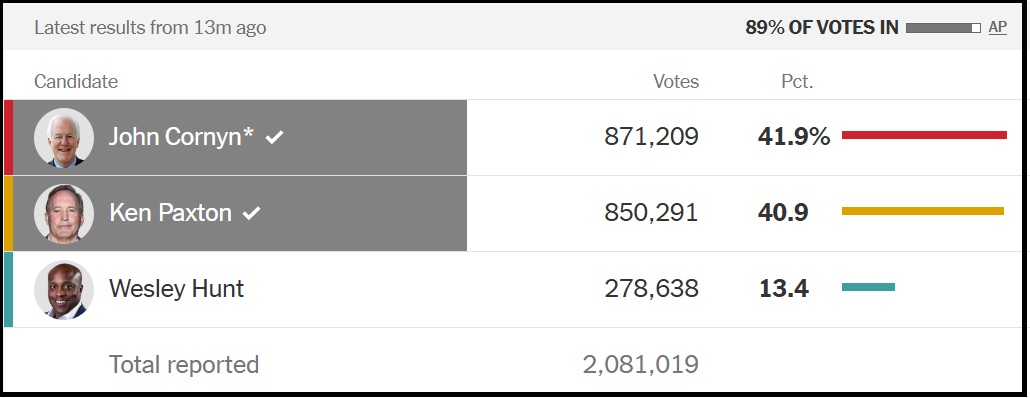
In the statewide republican senate primary, incumbent Senator John Cornyn and Texas Attorney General Ken Paxton will advance to a runoff. Cornyn received 42%, Paxton received 41%, Wesley Hunt received 13.5%. Because no candidate won more than 50% of the vote, Paxton and Cornyn will now advance to a runoff on May 26th. [SOURCE]

The greater share of Wesley Hunt’s vote is expected to go toward Ken Paxton, setting up the opportunity for the people of Texas to finally remove another DeceptiCON from the Senate.  However, the Bush/McConnell clans are expected to rally on Cornyn’s behalf, in order to stop Paxton.

.

We can expect to see all the professionally republican pundits and politicians appealing to the Texas voters to give John Cornyn another term in office.   Obviously, the decision is in the hands of the Texas base – but we can hope Cornyn is dispatched.

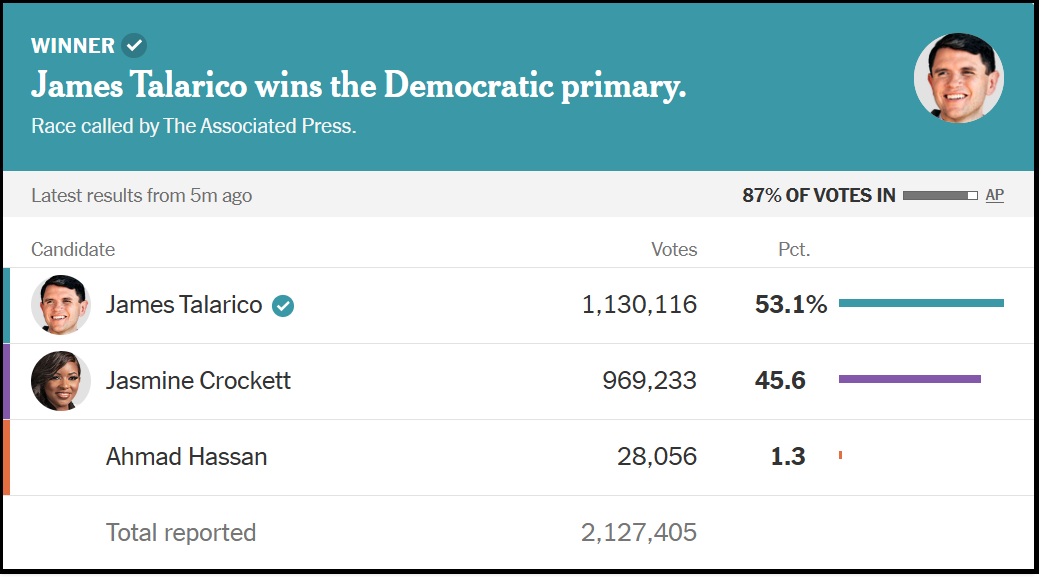
In other good news the insufferable Jasmine Crockett has lost her Democrat senate race. [SOURCE]

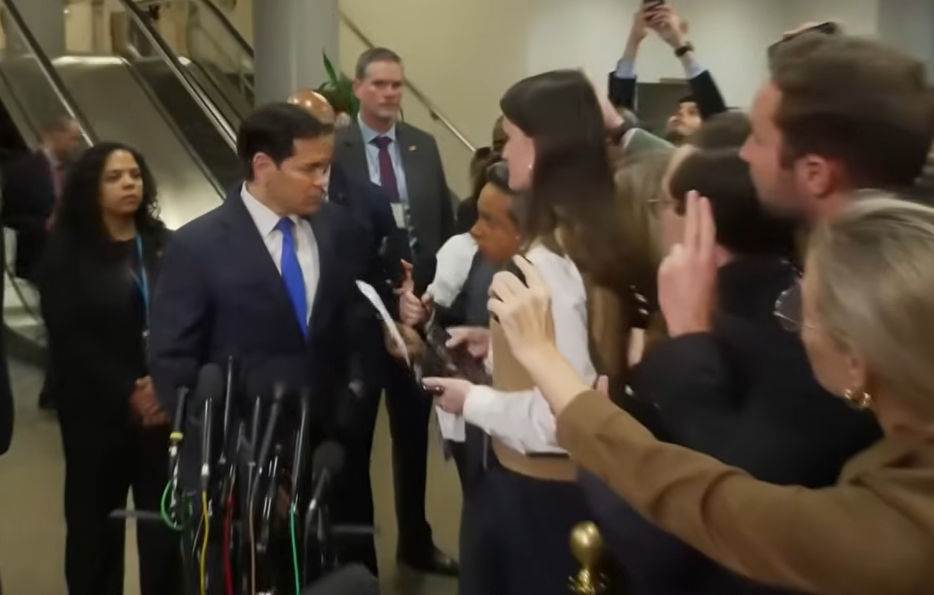
Secretary of State Marco Rubio Updates Media


Posted originally on CTH on March 3, 2026 | Sundance 

Secretary of State Marco Rubio updates the media on current activity surrounding Operation Epic Fury.

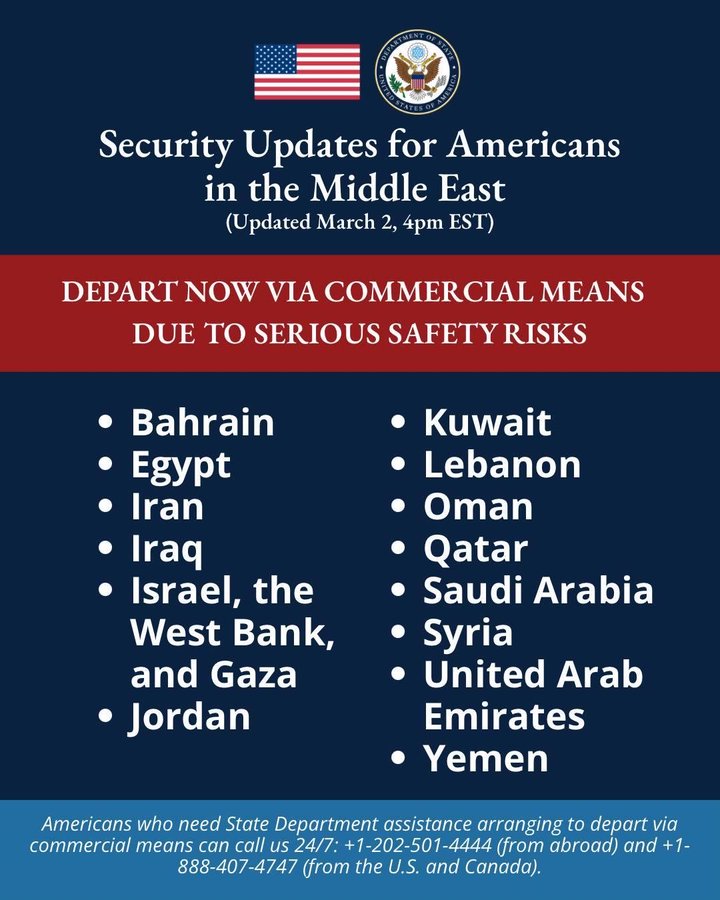
Secretary Rubio begins with an update on what Americans in the region need to know. Rubio asks all Americans to record their status with the U.S. State Department. [State Dept. Website] To get the latest updates visit http://travel.state.gov/destination and enroll to receive alerts directly at http://step.state.gov. Americans who need consular help can reach us 24/7 by phone: +1-202-501-4444 (from abroad) and +1-888-407-4747 (from the U.S. and Canada).

Rubio then outlines the latest report on a drone hitting near a U.S. embassy in Dubai.  A drone struck a parking lot adjacent to a chancellery building and a fire broke out.  No Americans were hurt or injured. The consulate was already on minimal staffing.

Secretary Rubio then provides an update on the general disposition of the conflict effort.  Rubio notes the two most powerful air forces in the world are about to go even more severe in our combat activity deep inside Iran.

The traditional frame of reference for pundits surrounds “the escalation trap.”  Most of them are so stuck in their old Washington DC view of nation building they just cannot see another approach.

How do you avoid the trap? You don’t play the game.

You don’t try to control the outcome on the ground.  You change behavior, without being on the ground.

Eventually, having killed or destroyed everything you want to see killed or destroyed (including their ability to wage war against you), you withdraw – then demand terms.

You don’t need to be there on the ground.

It’s a version of the Venezuela model.

Tell the governing body, whoever that is, whoever surfaces to claim lead with the support of the people, what you expect. Then you hold them accountable.

If they refuse to change behavior, bomb them again – select the refusers as new targets. Wash – Rinse – Repeat.

Again, pull back, await the governing authority to surface, tell them the expectations, if they balk, reject or refuse, bomb them again…. Pull back, await the next crew, tell them the expectations; if they balk, fail or reject, bomb them again…. Then pull back.

Is there an escalation trap? No, you are trying to change behavior – full stop.

You remain open but cold, hard and indifferent to any non-compliant replies.

President Trump Announces U.S. Insurance Underwriting for “All Maritime Trade Flowing Through the Gulf” Along with U.S. Military Escorts


Posted originally on CTH on March 3, 2026 | Sundance

♦ First blow, the Trump tariffs hit Beijing hardest. ♦ Second blow, the Beijing tentacle on the Panama Canal is severed.  ♦ Third blow, global tariff threats changed the risk dynamic for southeast Asia countries who acted as transnational shippers for China. ♦ Fourth blow, cheap sanctioned oil from Venezuela was cut-off. ♦ Now, the fifth blow; cheap, sanctioned Iranian oil is disrupted.

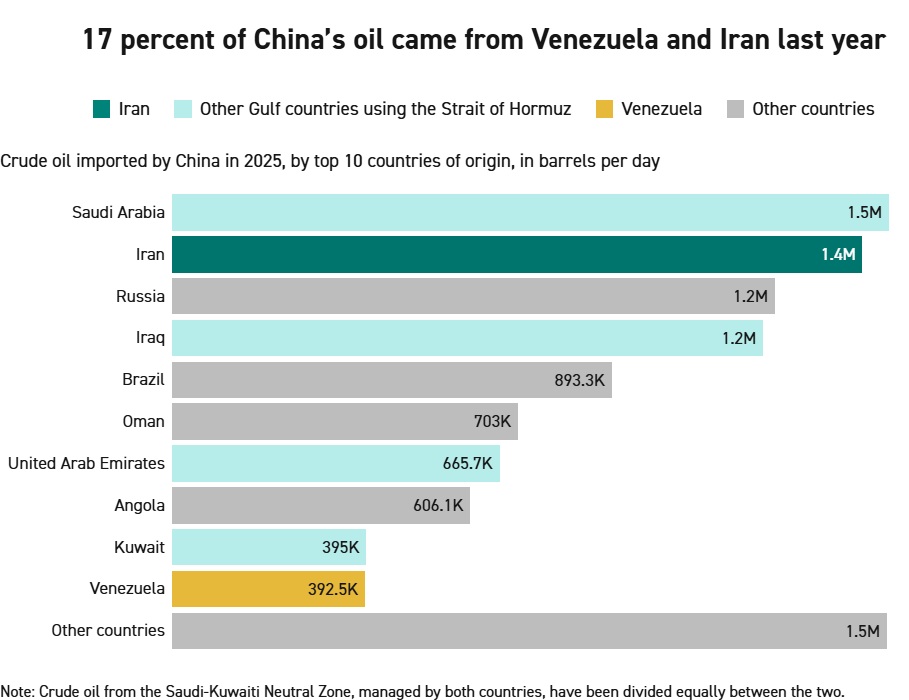
As noted by Politico: Following USA military strikes, “ships have begun to avoid the Strait of Hormuz off the coast of Iran — a critical shipping lane for Gulf nations to export oil to Asia. China in 2025 received about half of its imported oil from the six Gulf countries that rely on the strait. Other large crude oil producers in the region — including Saudi Arabia, Iraq and the United Arab Emirates — transport almost all their crude exports through the geographic bottleneck.

[SOURCE]

It’s not just a factor of oil flow, but also the price that China will ultimately end up having to pay.  Beijing was buying oil from Venezuela, Iran and Russia at steep discounts because their purchases were skirting western sanctions.

With Iranian oil production now no longer a market option, China will seek to replace their needs with more Russian alternative. However, that diversion means the oil India was purchasing from Russia will come at a higher price, and the refined final product that was exported by India will arrive to the European Union carrying an additional cost.

Simultaneously, Vladimir Putin was asked about Russia’s lack of military support to Iran in response to the U.S. military action, to wit the Russian president noted the technical terms of their joint military agreements did not include Russia’s immediate involvement.  In shorthand, Russia is busy and is not getting involved.

Russia was/is partially dependent on receiving military supplies from Iran in exchange for oil transfers.  The military component is reported to include drones from Iran for use in the Ukraine conflict.  Now that exchange profile is shuttered.

Taking Iran’s malign influence off the geopolitical chessboard is beginning to surface in major challenges to the BRICS assembly (Brazil, Russia, India, China, South Africa).  Russia, China and India are impacted directly.

The BRICS nations were skirting western oil sanctions by trading the commodity outside the petrodollar structure.  However, President Trump now controls the flow of oil from Venezuela, and his administration controls the currency in which it is sold.

With Iranian oil removed from the non-petro supply chain, the only remaining non-petro oil producer is Russia – who is simultaneously hit with a loss in military hardware support.  China may end up as a larger oil customer to Russia, but at what price and in what payment structure.

With global oil supplies in a state of flux, and with the USA in control of the oil flow from Venezuela, North America is certainly in the best position for minimal energy disruption.

Asia is heavily dependent on oil flows through the Strait of Hormuz, and the majority of Europe has already shut themselves off from Russian oil production, putting themselves in a position of dependency to the global markets.  The short-term ramifications of this oil disruption hit China, Southeast Asia, Japan and Europe particularly hard.

“OPEC+ countries affirmed on Sunday that they would boost oil production starting in April by 206,000 barrels daily — a modest increase intended to dampen the war’s effect on prices down the road. The majority of the increase would come from Saudi Arabia and Russia.” {SOURCE}

All of a sudden, this happens: Zelenskyy not to be trusted?

“Ukraine is under pressure to let the EU inspect a damaged pipeline carrying Russian oil to Hungary and Slovakia, as the two pro-Kremlin countries accuse Kyiv of overstating the impact of an attack by Moscow — despite what Ukrainian officials say is evidence of extensive destruction,” the report said.

According to five diplomats and EU officials who spoke to the FT, even pro‑Ukrainian governments within the European Union and the European Commission have also asked Ukraine to permit a delegation to inspect the pipeline. Two sources told the newspaper that European Commission President Ursula von der Leyen requested access for EU experts during her visit to Kyiv on Feb. 24, the fourth anniversary of Russia’s full-scale invasion. The request, according to the sources, was refused.

As tensions escalated, the EU’s ambassador to Ukraine, Katarina Mathernova, reportedly asked through the presidential office for permission to inspect the damaged pipeline herself or to allow visits by other EU diplomats. Those requests were denied for security reasons, the sources said.” (link)

T

Iran Conflict – Oil Disruption Hits Key BRICS Members Hard


Posted originally on CTH on March 3, 2026 | Sundance

Consider the severe economic body blows to China in the past 14 months.

♦ First blow, the Trump tariffs hit Beijing hardest. ♦ Second blow, the Beijing tentacle on the Panama Canal is severed.  ♦ Third blow, global tariff threats changed the risk dynamic for southeast Asia countries who acted as transnational shippers for China. ♦ Fourth blow, cheap sanctioned oil from Venezuela was cut-off. ♦ Now, the fifth blow; cheap, sanctioned Iranian oil is disrupted.

As noted by Politico: Following USA military strikes, “ships have begun to avoid the Strait of Hormuz off the coast of Iran — a critical shipping lane for Gulf nations to export oil to Asia. China in 2025 received about half of its imported oil from the six Gulf countries that rely on the strait. Other large crude oil producers in the region — including Saudi Arabia, Iraq and the United Arab Emirates — transport almost all their crude exports through the geographic bottleneck.

[SOURCE]

It’s not just a factor of oil flow, but also the price that China will ultimately end up having to pay.  Beijing was buying oil from Venezuela, Iran and Russia at steep discounts because their purchases were skirting western sanctions.

With Iranian oil production now no longer a market option, China will seek to replace their needs with more Russian alternative. However, that diversion means the oil India was purchasing from Russia will come at a higher price, and the refined final product that was exported by India will arrive to the European Union carrying an additional cost.

Simultaneously, Vladimir Putin was asked about Russia’s lack of military support to Iran in response to the U.S. military action, to wit the Russian president noted the technical terms of their joint military agreements did not include Russia’s immediate involvement.  In shorthand, Russia is busy and is not getting involved.

Russia was/is partially dependent on receiving military supplies from Iran in exchange for oil transfers.  The military component is reported to include drones from Iran for use in the Ukraine conflict.  Now that exchange profile is shuttered.

Taking Iran’s malign influence off the geopolitical chessboard is beginning to surface in major challenges to the BRICS assembly (Brazil, Russia, India, China, South Africa).  Russia, China and India are impacted directly.

The BRICS nations were skirting western oil sanctions by trading the commodity outside the petrodollar structure.  However, President Trump now controls the flow of oil from Venezuela, and his administration controls the currency in which it is sold.

With Iranian oil removed from the non-petro supply chain, the only remaining non-petro oil producer is Russia – who is simultaneously hit with a loss in military hardware support.  China may end up as a larger oil customer to Russia, but at what price and in what payment structure.

With global oil supplies in a state of flux, and with the USA in control of the oil flow from Venezuela, North America is certainly in the best position for minimal energy disruption.

Asia is heavily dependent on oil flows through the Strait of Hormuz, and the majority of Europe has already shut themselves off from Russian oil production, putting themselves in a position of dependency to the global markets.  The short-term ramifications of this oil disruption hit China, Southeast Asia, Japan and Europe particularly hard.

“OPEC+ countries affirmed on Sunday that they would boost oil production starting in April by 206,000 barrels daily — a modest increase intended to dampen the war’s effect on prices down the road. The majority of the increase would come from Saudi Arabia and Russia.” {SOURCE}

All of a sudden, this happens: Zelenskyy not to be trusted?

“Ukraine is under pressure to let the EU inspect a damaged pipeline carrying Russian oil to Hungary and Slovakia, as the two pro-Kremlin countries accuse Kyiv of overstating the impact of an attack by Moscow — despite what Ukrainian officials say is evidence of extensive destruction,” the report said.

According to five diplomats and EU officials who spoke to the FT, even pro‑Ukrainian governments within the European Union and the European Commission have also asked Ukraine to permit a delegation to inspect the pipeline. Two sources told the newspaper that European Commission President Ursula von der Leyen requested access for EU experts during her visit to Kyiv on Feb. 24, the fourth anniversary of Russia’s full-scale invasion. The request, according to the sources, was refused.

As tensions escalated, the EU’s ambassador to Ukraine, Katarina Mathernova, reportedly asked through the presidential office for permission to inspect the damaged pipeline herself or to allow visits by other EU diplomats. Those requests were denied for security reasons, the sources said.” (link)

President Trump Announces U.S. Economic Boycott of Spain During Meeting with German Chancellor Friedrich Merz


Posted originally on CTH on March 3, 2026 | Sundance 

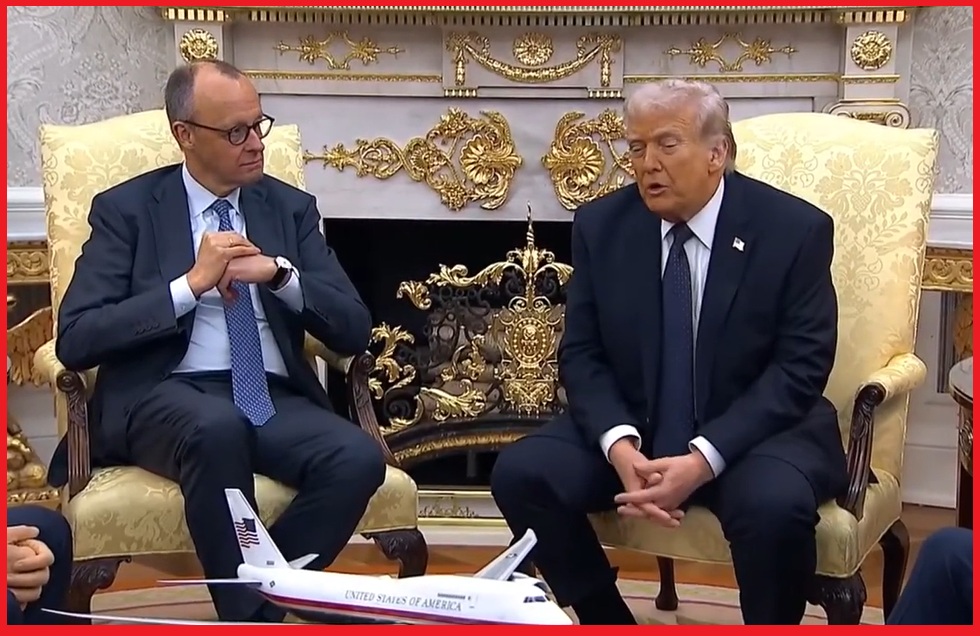
President Trump holds a bilateral meeting with German Chancellor Friedrich Merz in the Oval Office.  After brief remarks of mutual appreciation, President Trump and Chancellor Merz responded to questions from the assembled press pool.

Chancellor Merz expressed support for the objective of eliminating the regime threat from Iran.  President Trump notes at the beginning how Iran is targeting civilian targets in the region and generating even more support from the Gulf states for the USA.

When asked about the British and Spanish refusal to support U.S. military logistics and deployment, President Trump let the media be aware he is not happy with the position of Spain and the U.K.  President Trump also announced [11:00 of video] an economic embargo of trade with Spain as an outcome of their position.

.

President Trump Rejects Premise: The U.S is Not Running Out of Strategic Munitions


Posted originally on CTH on March 3, 2026 | Sundance 

There has been an ongoing narrative from the insufferable leftists and professional pundits in opposition, that the United States military will soon run out of missiles, rockets, drones, bombs and lethal munitions.  Given the global stockpiles of these weapons, the underlying premise always seemed absurd.

President Trump responded to the false claims in both a direct Truth Social message and an interview with Politico.

[Truth Social] – “The United States Munitions Stockpiles have, at the medium and upper medium grade, never been higher or better – As was stated to me today, we have a virtually unlimited supply of these weapons. Wars can be fought “forever,” and very successfully, using just these supplies (which are better than other countries finest arms!). At the highest end, we have a good supply, but are not where we want to be. Much additional high-grade weaponry is stored for us in outlying countries. Sleepy Joe Biden spent all of his time, and our Country’s money, GIVING everything to P.T. Barnum (Zelenskyy!) of Ukraine – Hundreds of Billions of Dollars’ worth – And, while he gave so much of the super high end away (FREE!), he didn’t bother to replace it. Fortunately, I rebuilt the military in my first term and continue to do so. The United States is stocked, and ready to WIN, BIG!!! Thank you for your attention to this matter.” President DONALD J. TRUMP

(VIA POLITICO) – […] In a roughly 4-minute phone call with POLITICO, Trump argued that Tehran’s military capacity is being steadily degraded, even as Iranian forces are expected to “keep lobbing missiles for a while.”

“They’re running out and they’re running out of areas to shoot them, because they’re being decimated,” Trump said. “They’re running out of launchers.”

[…] Trump during the interview said, “we have unlimited of the middle- and upper middle- ammunition and things. We save it and we build it.”

“The defense companies are on a rapid tear to build the various things we need,” he added. “They’re under emergency orders. We’re making it fast. But we have unlimited, as stupid as [former President Joe] Biden was, he didn’t use it.”

[…] Trump has suggested the war could last four or five weeks or be over in a few more days.

He justified the war by saying Iran was on the verge of having a nuclear weapon or being capable of attacking the United States, while Secretary of State Marco Rubio and House Speaker Mike Johnson said Monday that Israel was poised to strike Iran anyway — meaning America would have been hit in response.

[…] Asked whether it is too late for him to consider working with someone in a new government, Trump replied, “Nope, not too late. 49 [senior Iranian leaders] were killed, don’t forget, so that goes pretty deep, right? New ones are emerging. A lot of people want the job. Some of them would be very good.” (read more)

See, President Trump is so good at creating jobs, he’s even creating job openings in the Iranian government.