Former Trump campaign aide George Papadopoulos appears on Fox with Tucker Carlson to discuss the revelations of the FBI/CIA running spy operations against him during the 2016 election. Papadopoulos says the FBI spy wanted him to slip up and say something; however, he had no information.
The admissions within the New York Times story today -outlining how President Obama’s intelligence apparatus ran simultaneous intelligence operations against the Trump campaign- are starting to merge the FBI and CIA operations. CTH anticipated this.
With new information about the “U.K. operation” using Stefan Halper (CIA asset and FBI informant); and the details of the contacts by U.S. intelligence operative Azra Turk; we can overlay the timeline and see a clear picture.
On August 15th, 2016, Lisa Page and Peter Strzok discussed the “insurance policy“:
Two weeks later, September 2nd, 2016, CIA operative Stefan Halper reaches out to George Papadopoulos and introduces him to CIA/FBI asset Azra Turk.
This alignment between the CIA and FBI is not a surprise to anyone who has followed the story behind the 2015/2016 political surveillance issues. However, there’s a specific connection here many are missing.
Remember, everything AFTER March 9th, 2016, is a cover-story. Everything after March 9th, 2016, are operations from both the CIA and FBI to hide the political surveillance that was going on before March 9th, 2016. The surveillance was happening through exploitation of the NSA database through unauthorized FISA search queries; and involved both the CIA and FBI.
This is the point that has not been emphasized enough. However, FISA Judge Rosemary Collyer outlined the connection, albeit with mandatory redactions. The connective evidence is in a footnote on page #87 of Collyer’s report that few are paying attention to:
Read that carefully and you’ll see an agreement between the CIA and FBI to allow contractors. Note:
“[CIA] access to FBI systems was the subject of an interagency memorandum of understanding enter into [in ????])”
CTH believes that redacted date is 2012 as a result of another section of the report and the emphasis that Collyer is placing on the time-frame throughout her full report. Notice also:
“Despite the existence of an interagency memorandum of understanding (presumably prepared or reviewed by FBI lawyers) no notice of this practice was given to the FISC until 2016.”
So there was a secret agreement between the CIA and the FBI that was kept hidden from the FISA court until 2016 when Director Mike Rogers exposed and reported it.
The agreement centered around “access to FBI systems“; and, THIS IS IMPORTANT, we know the overarching issue was “deliberate decisionmaking” that led to “contractor access to the NSA database”, and the fact those contractors were searching “U.S. persons”.
Can you see the process now?
Can you see the potentially layered illegality of the process now?
CIA operatives (contractors) were using FBI portal access (per the secret agreement) to exploit the NSA database and extract search results. Remember, the CIA is not supposed to be conducting surveillance, aka “spying”, inside the U.S. on American citizens.
In essence the secret agreement, unknown to the court, was the CIA hiding their extraction of U.S. person information by using FBI database access. [Through the DOJ-NSD (National Security Division)] Now does it make sense why the DOJ would not allow Inspector General oversight?
In 2015 the Office of Inspector General requested oversight and it was Deputy AG Sally Yates who responded with a lengthy 58-page legal explanation saying, essentially, ‘nope – not allowed.’ (PDF HERE) All of the DOJ is subject to oversight, except the NSD.
The secret MOU (Memorandum of Understanding) between the CIA and FBI was the reason why the DOJ-NSD could never allow inspector general oversight.
In the Obama-era political surveillance programs the lines between the CIA and FBI were blurred. They were working together through contractors. This is why you are noticing blurred lines between the CIA and FBI in the construct of the cover-up.
This is the parallel tracks we previously described, copied below for reference:
Everything after March 9th, 2016, is a function of two intelligence units, the CIA and FBI, operating together to coverup prior political surveillance and spy operations.
Prior to March 9th, 2016, the surveillance and spy operation was using the NSA database to track and monitor their political opposition. However, once the NSA compliance officer began initiating an internal review of who was accessing the system, the CIA and FBI moved to create ex post facto justification for their endeavors. [Full Backstory]
The evidence for this is found in the documents attached to both operations; and bolsters the original statements by Congressman Devin Nunes as highlighted below.
♦The CIA track took place between March and July 2016, and consisted of using foreign intelligence allies in Italy, the U.K and Australia to create a background illusion of Russian involvement with the Trump campaign. This operation was based on earlier -more innocuous- contacts from various countries, weaponized and redeployed in what everyone calls “spygate”. This track successfully culminated in Operation Crossfire Hurricane.
♦The FBI track was domestic-centric, albeit sub-contracted to Fusion GPS and later a former British intelligence officer, and took place between April and October 2016; also to create the illusion of Russian involvement. This operation is best known around the Steele Dossier and FISA warrant against U.S. person Carter Page. The FBI track continued with the Mueller investigation into 2017, 2018 and 2019.
[Transcript] “So it took us a long time to actually get this, what’s called the electronic communication, as we know it now for your viewers, what it is it’s the original intelligence, original reasons that the counterintelligence was started.
Now this is really important to us because the counterintelligence investigation uses the tools of our intelligence services that are not supposed to be used on American citizens. And we’ve long wanted to know: what intelligence did you have that actually led to this investigation? So what we’ve found now, after the investigators have reviewed it, is that in fact there was no intelligence.
So we have a traditional partnership with what’s called the Five Eyes Agreement. Five Eyes Agreement involves our friends in Australia, New Zealand, the United Kingdom, Canada, and of course, us. So long time processes and procedures in place where we move intelligence across.
We are not supposed to spy on each others’ citizens. And it’s worked well. And it continues to work well. And we know it’s working well because there was no intelligence that passed through the Five Eyes channels to our government.
And that’s why we had to see that original communication. So now we’re trying to figure out, as you know, we are investigating the State Department, we think there’s some major irregularities in the State Department, and we’re trying to figure out how this information about Mr. Papadopoulos of all people who was supposedly meeting with some folks in London, how that made it over across into the FBI’s hands.” (video link)
The direct evidence for what Devin Nunes is describing is found in two specific documents. Each of the documents is unique to their track. One track is the CIA the other track is the FBI. The merging point that binds them is the U.S. State Department.
♦ First, we review the CIA track.
The evidence for the CIA track is found in the Weissmann-Mueller report. More specifically, it is found in the intentional way the report tries to conflate two contact points.
This track is CIA Director John Brennan’s work, with enlisted help from the FBI counterintelligence unit (Peter Strzok and Bill Priestap) as they travel to the U.K.
After western intelligence asset Joseph Mifsud (posed as a Russian) plants a story on George Papadopoulos about Russia having “emails of Clinton”, the operation then needs Papadopoulos to share the information. That’s where a joint network comes in. The network is the U.S. embassy in London; the Australian embassy in London; the Australian Ambassador to the U.K. Alexander Downer; and his top aide Erika Thompson.
Notice page #89 of the report; but read carefully and specifically notice the date Weissmann and Mueller use to frame the Russia story extraction from Papadopoulos:
The meeting on May 6th, was NOT a meeting with Australian Ambassador Alexander Downer. That meeting did not happen until May 10th. The recent release of documentsfrom Australia confirm this timeline.
The meeting on May 6th was between George Papadopoulos and Downer’s aide, Erika Thompson: …”that the Trump campaign had received information from the Russian government that it could assist the campaign through the anonymous release of information that would be damaging to Hillary Clinton.”
So, if the U.S. used the information from the May 6, 2016, meeting as conveyed on July 26th, 2016, it was the conversation with Erika Thompson that opened Crossfire Hurricane; not the meeting with Alexander Downer on May 10th. {Go Deep}
This subtle but important distinction in contact and communication reconciles the statement by Devin Nunes; because Thompson is also a reported intelligence operative (spy) and information from her would not be passing through “Five Eyes” official channels. However, for their intents and purposes, the U.S. operation needed to give the appearance of official channels, so the *inference* between the claim and the footnote *implies* Ambassador Downer. But you can see that’s not actually what happened.
This is an example of Weissmann/Mueller disguising the actual origin in their report. They are giving cover to the reality that unofficial intelligence was the actual basis for the originating “EC” or two-page electronic communication from CIA Director John Brennan to FBI Director James Comey. It was that 2-page EC, likely written by FBI counterintelligence agent Peter Strzok, that initiated “Crossfire Hurricane”.
The page in the Weissmann/Mueller report is factually true but the inference is false. It is written in the way they intended, to give a false impression. It is quite subtle and sneaky.
What is outlined on Page #89 is also the CIA track that ran from March to July 31st, 2016.
The operation positioned Joseph Mifsud as a Russian spy; has him plant information on George Papadopoulos; then uses U.S. and AU operatives to withdraw the information; thereby giving the appearance that a Trump campaign official, Papadopoulos, was receiving and passing-on Russian intelligence. This is the CIA justification for creating the EC. This is the CIA cover story.
Now let’s review the evidence of the FBI track and how it also connects to the U.S. State Department. This one is more brutally obvious because the document had to be less ambiguous in construct. This involves the FISA application on U.S. Person Carter Page.
♦ The FBI Track – The Steele Dossier, FISA Warrant and Carter Page.
The second page of the FISA application used to gain a Title-1 surveillance warrant against U.S. Carter Page identifies where the material came from. Notice the direct attribution is to the State Department; not the DOJ or FBI, and certainly not Christopher Steele.
Applying hindsight to the backstory of the Clinton Campaign hiring Fusion GPS, and Fusion hiring Christopher Steele for the Dossier; and the dossier being passed on to the FBI and DOJ via various channels… Question: why would the DOJ be citing the State Department for their claim?
The answer is simple. Carter Page was a known person to the FBI and DOJ. Carter Page was a subject witness from 2012 to 2016 in the Evgeny Buryakov case [DOJ March 2016]. How could the FBI claim Carter Page was “an agent of a foreign power” to the FISA court in October 2016, when they only finished using him as a cooperating subject witness in May of 2016? [DOJ May 2016]
The short answers are: (1) they couldn’t; (2) they were in a big hurry; there was a sense of urgency; they needed the FISA and Steele Dossier as insurance policy; and (3) it wasn’t safe for the DOJ/FBI to make the ‘foreign agent‘ claim against their own prior witness if things went sideways.
Remember, this is all a coverup. Their efforts are about gaining position and appearances to justify a preceding action. Their efforts are not focused on an actual investigation. So they told the FISC the information came from the State Department and [Redacted]. Whichever source could give them the best legal justification to gain the FISA warrant was the leading point in the thought process.
Despite everything around the Steele Dossier primarily inbound from Fusion-GPS and Chris Steele to the DOJ and FBI, the people creating the FISA illusion needed to use the State Department as a valid reference for fraudulent claims they were making.
From the beginning Fusion-GPS was not hired to research Donald Trump; the intelligence community was already doing surveillance and spy operations. The intelligence community needed Fusion GPS to give them a plausible justification for already existing surveillance and spy operations. Fusion created the dossier for them.
The FBI knew Carter Page. Essentially Carter Page was irrelevant, what they needed was the FISA warrant and the Dossier in the system {Go Deep} as their insurance policy.
So there we see two parallel tracks; one from the CIA, and one from the FBI. Both intended to provide a cover story for political surveillance and spy operations that preceded March 9, 2016. The CIA track created ‘crossfire hurricane’. The FBI track created the Steele Dossier. Both had the same purpose.
Both tracks originated from ‘unofficial channels’ and then transferred into official status through the use of two documents. The CIA generated the two-page “EC”; and the FBI generated the FISA application from the Steele Dossier.
Both tracks held the same coverup purpose; both tracks were insurance policies; and both tracks merged for intelligence exploitation after President Trump won the election. After the election the goal was shifted to remove the risk Trump represented.
Once they had the legal justifications for targeting Trump, albeit fraudulently obtained, the effort could move into phase three: by-the-book processes. The FBI track evolved into the Mueller probe; that’s why the Dossier is so important to the validity of the special counsel.
Everything after March 9th, 2016, through today – is covering for everything that happened before March 9th when “contractors” were allowed by the FBI and DOJ to have weaponized access to the NSA database for political surveillance and spy operations.
This two-track process and ultimate merging is what all of the documentary evidence supports. I suspect when the arc of the story concludes, this is where we will be.
…”many of these non-compliant queries involved the use of the same identifiers over different date ranges.”..
This Page #82 sentence specifically highlights that during the 2016 presidential campaign, those who had access to the NSA database were searching the same phone numbers, email addresses, electronic “identifiers”, or people, repeatedly over different dates.
A report in the New York Times, transparently timed and placed by officials within the intelligence apparatus trying to get out ahead of internal investigations, outlines how the FBI sent counterintelligence spies to engage with Trump campaign officials in 2016.
In a stunning admission The New York Times describes how the FBI enlisted a female agent to work the “operation” in the U.K. during August-September 2016 posing as an aide for U.S. intelligence asset/FBI informant Stefan Halper.
Halper was an FBI operative and Cambridge professor who set up meetings with Trump campaign advisor George Papadopoulos. The female agent used a fake name, Azra Turk, and presented herself as an assistant to Stefan Halper; however, she was actually an undercover intelligence operative of the FBI.
NYT […] The woman had set up the meeting to discuss foreign policy issues. But she was actually a government investigator posing as a research assistant, according to people familiar with the operation. The F.B.I. sent her to London as part of the counterintelligence inquiry opened that summer to better understand the Trump campaign’s links to Russia.
The American government’s affiliation with the woman, who said her name was Azra Turk, is one previously unreported detail of an operation that has become a political flash point in the face of accusations by President Trump and his allies that American law enforcement and intelligence officials spied on his campaign to undermine his electoral chances. Last year, he called it“Spygate.”
Ms. Turk went to London to help oversee the politically sensitive operation, working alongside a longtime informant, the Cambridge professor Stefan A. Halper. The move was a sign that the bureau wanted in place a trained investigator for a layer of oversight, as well as someone who could gather information for or serve as a credible witness in any potential prosecution that emerged from the case.
A spokesman for the F.B.I. declined to comment, as did a lawyer for Mr. Halper, Robert D. Luskin. Last year, Bill Priestap, then the bureau’s top counterintelligence agent who was deeply involved in the Russia inquiry, told Congress during a closed-door hearing that there was no F.B.I. conspiracy against Mr. Trump or his campaign.
Obviously the group (CIA, DOJ and FBI) who constructed the political surveillance and spy operations are trying to present their side of the story, prior to investigation by AG Bill Barr and the soon-to-be-released IG report.
The London operation yielded no fruitful information, but F.B.I. officials have called the bureau’s activities in the months before the election both legal and carefully considered under extraordinary circumstances.
They are now under scrutiny as part of an investigation by Michael E. Horowitz, the Justice Department inspector general. He could make the results public in May or June, Attorney General William P. Barr has said. Some of the findings are likely to be classified.
It is unclear whether Mr. Horowitz will find fault with the F.B.I.’s decision to have Ms. Turk, whose real name is not publicly known, meet with Mr. Papadopoulos.
Mr. Horowitz has focused among other things on the activities of Mr. Halper, who accompanied Ms. Turk in one of her meetings with Mr. Papadopoulos and also met with him and other campaign aides separately. The bureau might also have seen Ms. Turk’s role as essential for protecting Mr. Halper’s identity as an informant if prosecutors ever needed court testimony about their activities.
Notice how the leaker of this information to the New York Times appears to have direct knowledge of exactly what IG Horowitz has investigated. This leaked story is coming from within the still employed corrupt elements of the FBI.
[…] This account was described in interviews with people familiar with the F.B.I. activities of Mr. Halper, Ms. Turk and the inspector general’s investigation. They spoke on the condition of anonymity because they were not authorized to discuss the subjects of a continuing inquiry.
As part of Mr. Horowitz’s investigation, his office has examined Mr. Halper’s past work as an F.B.I. informant and asked witnesses about whether agents had adequate control of Mr. Halper’s activities, people familiar with the inquiry have said.
While in London in 2016, Ms. Turk exchanged emails with Mr. Papadopoulos, saying meeting him had been the “highlight of my trip,” according to messages provided by Mr. Papadopoulos. “I am excited about what the future holds for us :),” she wrote.
Notice how The New York Times is intentionally conflating the timing and sequencing of events in this article.
[…] One of the agents involved in the Russia inquiry, a seasoned counterintelligence investigator out of New York, turned to Mr. Halper, whom he viewed as a reliable and trusted informant. They had a longstanding relationship; the agent had even spoken at an intelligence seminar that Mr. Halper taught at the University of Cambridge, discussing his work investigating a Russian espionage ring known as the illegals.
[That section tells the possibilities of who the FBI agent might be. [TWE] George J. Ennis, Jr. (ASAC NY Counterintelligence), Alan E. Kohler Jr. (SSA, NY Counterintelligence) and Stephen M. Somma (SA, NY Counterintelligence) attended the intelligence seminar by Stefan Halper in 2011 (LINK). Alan Kohler, FBI representative at the United States Embassy in London, returned to the seminar in May 2014 (LINK) George Ennis was named the Special Agent In Charge of the Administrative Division at the New York Field Office on April 1, 2015, having had a background in counterterrorism and counterintelligence. (LINK)]
Mr. Halper had the right résumé for the task. He was a foreign policy expert who had worked for the Pentagon. He had been gathering information for the F.B.I. for about two decades and had good contacts in Chinese and Russian government circles that he could use to arrange meetings with high-ranking officials, according to a person briefed on Mr. Halper’s relationship with the F.B.I.
The F.B.I. instructed Mr. Halper to set up a meeting in London with Mr. Papadopoulos but gave him few details about the broader investigation, a person familiar with the episode said.
His job was to figure out the extent of any contacts between Trump campaign advisers and Russia. Mr. Halper used his position as a respected academic to introduce himself to both Mr. Papadopoulos and Mr. Page, whom he also met with several times. He arranged a meeting with Mr. Papadopoulos in London to discuss a Mediterranean natural gas project, offering $3,000 for his time and a policy paper.
[…] The F.B.I. also decided to send Ms. Turk to take part in the operation, people familiar with it said, and to pose as Mr. Halper’s assistant. For the F.B.I., placing such a sensitive undertaking in the hands of a trusted government investigator was essential.
British intelligence officials were also notified about the operation, the people familiar with the operation said, but it was unclear whether they provided assistance. A spokeswoman for the British government declined to comment.
Mr. Trump has repeatedly claimed that British intelligence spied on his campaign, an accusation the British government has vigorously denied. Last month, the president quoted on Twitter an accusation that the British had spied on his campaign and added: “WOW! It is now just a question of time before the truth comes out, and when it does, it will be a beauty!”
When Mr. Papadopoulos arrived in London on Sept. 15, he received a text message from Ms. Turk. She invited him for drinks.
In his book, “Deep State Target,” Mr. Papadopoulos described her as attractive and said she almost immediately began questioning him about whether the Trump campaign was working with Russia, he wrote.
Mr. Papadopoulos was baffled. “There is no way this is a Cambridge professor’s research assistant,” he recalled thinking, according to his book.
The day after meeting Ms. Turk, Mr. Papadopoulos met briefly with Mr. Halper at a private London club, and Ms. Turk joined them. The two men agreed to meet again, arranging a drink at the Sofitel hotel in London’s posh West End.
Notice how Ms. Turk is the primary focus of the interaction.
Turk emailed Papadopoulos; Turk text’d Papadopoulos; Turk met him for drinks etc. However, Halper only “met briefly” with Papadopoulos with Turk present. FBI agent Turk is the working operative here, agent Halper is simply the inconsequential cover.
During that conversation, Mr. Halper immediately asked about hacked emails and whether Russia was helping the campaign, according to Mr. Papadopoulos’s book. Angry over the accusatory questions, Mr. Papadopoulos ended the meeting.
The F.B.I. failed to glean any information of value from the encounters, and Ms. Turk returned to the United States.
Mr. Halper continued to work with the F.B.I. and later met with Mr. Page repeatedly in the Washington area. The two had coincidentally run into each other in July as well at Cambridge, according to people familiar with the episode.
At the urging of Mr. Page, he met another campaign aide, Sam Clovis, Mr. Trump’s campaign co-chairman, to discuss foreign policy. (read more)
It’s obvious the people who ran these spy operations into the Trump campaign are nervous now. After years of denying spying; and after weeks of apoplectic pearl-clutching over AG Barr’s use of the word “spy”; the New York Times now outlines spying directly?
Make sure you go back and re-read the House testimony transcript of how Papadopoulos describes this interaction with Turk and Halper (embed below). Start around page 101
George Papadopoulos@GeorgePapa19
I agree with everything in this superb article except “Azra Turk” clearly was not FBI. She was CIA and affiliated with Turkish intel. She could hardly speak English and was tasked to meet me about my work in the energy sector offshore Israel/Cyprus which Turkey was competing with
I think the meeting between the President and the U.K. PM will be even more interesting now. The day there was a CIA op against me in London, Halper/Turk, the #2 at the U.K. ministry of foreign affairs invited me to the offices to continue to spy on me and probe me more.
Representative Doug Collins and Asst. Attorney General Stephen Boyd blast Judiciary Chairman Jerry Nadler for blatant politicization of the House Judiciary Committee.
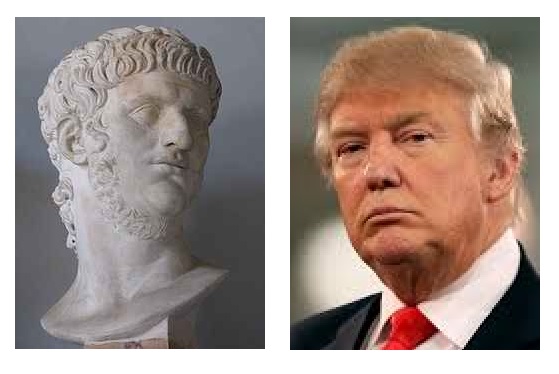
Nero’s Domus Transitoria (Transit House) has finally opened to visitors after 10 years of renovations. Even I have never visited this place despite all the times I have been to Rome. You must descend underground to view the rooms and gardens of the residence, covered over the centuries by other buildings and debris. This was the first palace of Nero, which was nearly destroyed entirely during the Great Fire of Rome in 64 AD. Of course, the stories of FAKE NEWS in those days portrayed Nero as playing the fiddle while the Rome burned. He built his more famous palace on the ruins of Rome, which is why people created the conspiracy theory that he set Rome on fire deliberately so he could build his grand palace.
The Great Fire of Rome took place during July of 64 AD. The fire ravaged Rome for six days, destroying 70% of the city and leaving half its population homeless. For one thing, the fiddle didn’t exist in ancient Rome since it only made its appearance during the 11th century. There is no such evidence that Nero played any role during the Great Fire. The Roman historian Publius Cornelius Tacitus (c. 56–120 AD) wrote that Nero was rumored to have sung about the destruction of Troy while watching the city burn. However, he stated clearly that this was unconfirmed by eyewitness accounts. That was the origin of the saying. When the Great Fire broke out, Nero was at his villa at Antium, some 35 miles from Rome. Nero was not even in Rome during the Great Fire. He was the victim of fake news, and as I have written, he was the last of the Julio-Claudian dynasty. Rome fell into civil war upon his death. We may see Trump become the last real person elected. From here on out, it is going to get nasty in politics.
It is interesting timing that after 10 years the palace is now own. Will Trump be like Nero, not just the victim of fake news, but the last of a dynasty of elected presidents to be followed by civil unrest?
At 10:00am EDT today U.S. Attorney General William Barr will deliver testimony to the Senate Judiciary Committee following the publication of the special counsel report on the 2016 election. There will be a separate discussion thread at 9:00am EDT which will include multiple options to the view the testimony live.
Joe diGenova and Victoria Toensing discuss the latest ebbs and flows amid the fraudulent Weissmann/Rosenstein report, the testimony of AG Bill Barr, and the potential to expose the weaponization of the intelligence apparatus for political surveillance and spying.
The entire leftist political apparatus is not going to give on their strategy. They have been planning this exploitation since November of 2018. This is what they do; this is all they do.
In a strategic set of rolled-out narratives today democrats, together with their leak sources inside the Mueller/Rosenstein group; and in close coordination with their media allies and Lawfare community; timed a series of events to target AG Bill Barr ahead of his senate testimony tomorrow. The timing of all this stuff is transparent.
It began with a letter from Senator Mazie Hirono (D-Hawaii), to the inspector general demanding an immediate investigation of AG Barr for not agreeing to the carefully constructed narrative by Weissman, Mueller and Rosenstein. [Details Here] A group of 12 democrats demand the DOJ-OIG start investigating Attorney General Barr.
Hours later, the Washington Post and New York Times, simultaneously release dual timed articles, outlining their reception of a March 27th letter; leaked from inside the Weissmann/Mueller/Rosenstein operation; showing special counsel group were unhappy with Barr’s four-page summary of the Weissmann/Mueller report because it diluted the intended efforts of Weissmann, Mueller and Rosenstein.
(WaPo) […] “The summary letter the Department sent to Congress and released to the public late in the afternoon of March 24 did not fully capture the context, nature, and substance of this office’s work and conclusions,” Mueller wrote. “There is now public confusion about critical aspects of the results of our investigation. This threatens to undermine a central purpose for which the Department appointed the Special Counsel: to assure full public confidence in the outcome of the investigations.”
The letter made a key request: that Barr release the 448-page report’s introductions and executive summaries, and made some initial suggested redactions for doing so, according to Justice Department officials. (read more)
The coordination between ¹corrupt democrat politicians, ²corrupt DOJ officials, and ³corrupt media entities is both transparent and seamless. AG Bill Barr is set to deliver testimony tomorrow to the Senate. So tonight they launch their proactive narrative assault to set the stage for the context of Barr’s appearance.
If they are so damned concerned about “Mueller’s” investigative intent being diluted, then why don’t they subpoena Robert Mueller?
Mueller complained that Barr’s letter did not capture ‘context’ of Trump probe
In a letter and phone call, special counsel Robert S. Mueller III and Attorney General William P. Barr went back and forth over Mueller’s concerns. “The summary letter the Department sent to Congress…
Mueller complained that Barr’s letter did not capture ‘context’ of Trump probe
In a letter and phone call, special counsel Robert S. Mueller III and Attorney General William P. Barr went back and forth over Mueller’s concerns. “The summary letter the Department sent to Congress…
Mueller Objected to Barr’s Description of Russia Investigation’s Findings
The special counsel laid out his objections in a letter to the attorney general in March.
nytimes.com
1,611 people are talking about this
This is all scripted folks. I know it’s repetitious to keep saying it, but this stuff is all coordinated by ideological allies in congress, the DOJ and FBI, and their media allies.
All of this is following a plan; a predetermined plan; established by a leftist group of fellow travelers; and yes that includes current DOJ and FBI officials like Rod Rosenstein, Chris Wray, David Bowditch and Dana Boente. Check the timing:
Former Deputy National Security Advisor to President Obama, Ben Rhodes, says any investigation of prior administration “will find nothing” that shows former President Obama or White House staff had any “involvement” in the origins of the surveillance of Trump campaign and Russia collusion investigation.
Prior to March 9th, 2016, the Obama-era political surveillance and spy operations consisted of using the FBI and NSA database to track/monitor their opposition. However, once the NSA compliance officer began initiating an internal review of who was accessing the system, the CIA and FBI moved to create ex post facto justification for their endeavors. [Full Backstory] Everything after March 9, 2016, became a cover-story.
Looking at White House engagement in the last half of 2016, The War Economy has done some excellent research on this period to contrast the reference of Ben Rhodes:
[Via TWE] […] On July 31, 2016, the Federal Bureau of Investigation, ran by Director James Comey, opened an investigation into the Trump campaign titled “Crossfire Hurricane”, named after the Rolling Stones documentary of the same name. It focused on the actions of four members of the Trump campaign:
As such, this was an incredibly important time… for Director John Brennan of the Central Intelligence Agency.
As noted previously, the “Crossfire Hurricane” investigation was partially triggered by information received by the Central Intelligence Agency’s Counterintelligence Mission Center, which served as a conduit to the Federal Bureau of Investigation by using contacts developed by the intelligence agency between Russian individuals and members of the Trump campaign.
“The CIA breakthrough came at a stage of the presidential campaign when Trump had secured the GOP nomination but was still regarded as a distance long shot. Clinton held comfortable leads in major polls, and Obama expected that he would be transferring power to someone who had served in his Cabinet.” — The Washington Post
“Intelligence sources said the logs discovered by National Security Council staff suggested Rice’s interest in the NSA materials, some of which included unmasked Americans’ identities, appeared to begin last July around the time Trump secured the GOP nomination and accelerated after Trump’s election in November launched a transition that continued through January.” — Sara Carter, Circa
In the first week of August — directly after the creation of Crossfire Hurricane — Director Brennan contacted Avril Haines via telephone, as he had received intelligence in relation to President Vladimir Putin.
“Inside was an intelligence bombshell, a report drawn from sourcing deep inside the Russian government that detailed Russian President Vladimir Putin’s direct involvement in a cyber campaign to disrupt and discredit the U.S. presidential race.
But it went further. The intelligence captured Putin’s specific instructions on the operation’s audacious objects — defeat or at least damage the Democratic nominee, Hillary Clinton, and help elect her opponent, Donald Trump.” —The Washington Post
As a result of this, Director Brennan created a secret task force at the Central Intelligence Agency’s Headquarters, which was composed of several dozen analysts from the Central Intelligence Agency, the National Security Agency and the Federal Bureau of Investigation.
The Working Group reported to two different groups.
President Barack Obama and less than 14 senior United States Government officials.
A team of operations specialists at the Central Intelligence Agency, the National Security Agency and the Federal Bureau of Investigation.
Also in early August 2016 — presumably the same week — agents at the Federal Bureau of Investigation met with Attorney General Loretta Lynch, where they questioned her about a letter they had received in early March 2016 from a foreign source, supposedly written by Representative Debbie Wasserman Schultz to Leonard Benardo of the Open Society Foundations regarding the Midyear Exam investigation.
During this meeting, the agents offered to give Attorney General Lynch a “defensive briefing”. Shortly after this, the Federal Bureau of Investigation concluded that the Benardo letter was an unreliable document.
President Obama ordered his aides to determine ways to retaliate or deter against the Russian Government through three steps:
Gain a high-confidence assessment from the United States intelligence agencies on Russia’s role and intent.
Check vulnerabilities in state-run election systems.
Seek bipartisan support from Congressional leaders for a statement condemning Moscow and urging states to accept federal assistance.
The same week, Rice, Haines and Lisa Monaco convened meetings in the White House Situation Room, which would later be referred to as “Deputies Meetings”. These meetings were initially attended by:
Director John Brennan, Central Intelligence Agency
Director James Clapper, Office of the Director of National Intelligence
Director James Comey, Director of the Federal Bureau of Investigation
Attorney General Loretta Lynch, United States Department of Justice
As time passed, another Cabinet member joined the Deputies Meetings: Vice President Joe Biden.
The Deputies Meetings needed to defend against any potential leaks, and therefore followed the same protocols taken during the planning stages of the raid of Osama bin Laden.
At a later time, agendas were directly sent to Cabinet secretaries, including Secretary John Kerry and Secretary Ashton Carter. When an agenda was received, their subordinates were ordered never to open the envelopes. Further to this, some agendas were withheld until the participants had arrived in the Situation Room and sat down.
Ordinarily, a video feed from the White House Situation Room is fed into various National Security Council offices to allow senior aides to view the events with zero sound. However, during the Deputies Meetings, the video feeds were switched off.
One of these Deputies Meetings was hosted by Haines, where the attendees of the meetings argued that any deliberative attempt to strike back against Russia would become a tool of propaganda for President Vladimir Putin, while another was concerned about the potential effect any action may have on Election Day 2016.
Haines would later note she was “very concerned” during this time about the potential of Russians gaining influence within the Trump campaign, although she apparently remained unaware of the existence of the Crossfire Hurricane investigation.
As an aspect, or an offshoot, of one of these meetings, Susan Rice informedboth Michael Daniel and Celeste Wallander (who would later gain access to the Steele memos) to cease their planning of retaliation against Russia for their cyber attacks on companies and political campaigns and to stand down from the efforts.
The retaliation efforts were carried out by the Cyber Response Group, a unit within the National Security Council which featured representatives from the Central Intelligence Agency, the National Security Agency, the United States Department of State and the Pentagon.
One of these individuals was Anthony Ferrante, who was in charge of coordinating the United States Government’s response to Russian attempts to meddle in the presidential election as the top cybersecurity official from the Federal Bureau of Investigation. In the present day, Ferrante is investigating the Steele memos on behalf of BuzzFeed News. Anyway, back to the first week of August 2016…
Director Comey also met with President Obama in the Oval Office for a one-on-one meeting, where Director Comey suggested that he write an opinion piece for The New York Times about the potential for Russian interference in the 2016 United States presidential election. Director Comey planned to avoid mentioning the Crossfire Hurricane investigation in the opinion piece.
GEORGE STEPHANOPOULOS: “W– we– we know that– there were s– there were strong objections in– by Republicans in the Senate to being public about this. But at one point, you actually volunteered to put it all on paper?”
JAMES COMEY: “Yeah– I think it was in August, I volunteered that– that I would be– I remember saying that I’m a little tired of being the independent voice on things, after the beating I’d taken after the July 5th announcement. But I said in a meeting with the president, ‘I’m willing to be the voice on this and help inoculate the American people. But I also recognize why this is such a hard question, because if you announce that the Russians are trying to mess with our election, do you accomplish their goal for them? Do you undermine confidence in our election by having the president of the United States, or one of his senior people, say this publicly? Will the Russians be happy that you did that?’ And so I– I wrote an op-ed, was going to go in a major newspaper that laid out what was going on.Not the investigation, ’cause that was too sensitive to reveal, but that, ‘The Russians are here and they’re screwing with us. And this is consistent with what they’ve done in the past,’ and they never took me up on it. The Obama administration deliberated until the beginning of October.”
On August 1, 2016, Director Clapper attended the Department of Defense Intelligence Information Systems Worldwide Conference in Atlanta, GA.
On August 4, 2016, Director Brennan contacted Director Alexander Bortnikov of the Federal Security Service (FSB), where he warned Director Bortnikov against future interference in the United States presidential election.
“When Alexander Bortnikov, the head of Russia’s internal security service, told me during an early August 2016 phone call that Russia wasn’t interfering in our presidential election, I knew he was lying. Over the previous several years I had grown weary of Mr. Bortnikov’s denials of Russia’s perfidy — about its mistreatment of American diplomats and citizens in Moscow, its repeated failure to adhere to cease-fire agreements in Syria and its paramilitary intervention in eastern Ukraine, to name just a few issues. When I warned Mr. Bortnikov that Russian interference in our election was intolerable and would roil United States-Russia relations for many years, he denied Russian involvement in any election, in America or elsewhere, with a feigned sincerity that I had heard many times before. President Vladimir Putin of Russia reiterated those denials numerous times over the past two years, often to Donald Trump’s seeming approval.” — John Brennan, The New York Times
The next day, on August 6, 2016, Hillary Clinton tweeted: “Seriously, what is going on with Trump and Russia?” with a 1 minute, 45 second video attached. The same day, President Obama and the First Family left for their vacation at Martha’s Vineyard.
Two days later, on August 8, 2016, Special Agent Peter Strzok texted Lisa Page about a joint intelligence piece for Director Comey to prepare for him to brief Denis McDonough on August 10, 2016.
In mid-August 2016, Director Brennan shared intelligence with Director Comey, which showed that the Russian Government was actively interfering in the 2016 United States presidential election.
Starting from August 11, 2016, Director Brennan started to personally brief — in consultation with the White House — each member of the “Gang of Eight” about the Russian interference in the 2016 United States presidential election.
JOHN BRENNAN: “Third, through the so-called Gang of Eight process we kept congress apprised of these issues as we identified them. Again, in consultation with the White House, I personally briefed the full details of our understanding of Russian attempts to interfere in the election to congressional leadership; specifically: Senators Harry Reid, Mitch McConnell, Dianne Feinstein and Richard Burr; and to representatives Paul Ryan, Nancy Pelosi, Devin Nunes and Adam Schiff between 11th August and 6th September [2016], I provided the same briefing to each of the gang of eight members. Given the highly sensitive nature of what was an active counter-intelligence case, involving an ongoing Russian effort, to interfere in our presidential election, the full details of what we knew at the time were shared only with those members of congress; each of whom was accompanied by one senior staff member.”
As noted by Director Brennan, the “Gang of Eight” at the time were:
Senator Richard Burr
Senator Dianne Feinstein
Senator Mitch McConnell
Representative Devin Nunes
Representative Nancy Pelosi
Senator Harry Reid
Speaker Paul Ryan
Representative Adam Schiff
On the day the briefings started — August 11 — Representative Pelosi declared that the hacking of the Democratic National Committee was a modern version of the Watergate scandal, conducted by the Russians. At the same time, Director Clapper visited Estonia in person.
Director Clapper worked on preparing the classified briefings for both Donald Trump and Hillary Clinton, as being the nominees of both the Republican Party and Democratic Party allowed them access to some classified information.
Around this time, counterintelligence specialists at the Federal Bureau of Investigation briefed Donald Trump and his surrogates and leadership, and Hillary Clinton and her surrogates and leadership, about the Russian Government’s interference of the 2016 United States presidential election, and issues surrounding cybersecurity.
On August 15, 2016, Special Agent Strzok texted Page: I want to believe the path you threw out for consideration in Andy’s office — that there’s no way he gets elected — but I’m afraid we can’t take that risk. It’s like an insurance policy in the unlikely event you die before you’re 40…”
Meanwhile, Secretary Jeh Johnson arranged a conference call with dozens of state officials in an attempt to enlist their support in the White House’s election defence campaign, with one of the officials called being Brian Kemp.
On August 19, 2016, Special Agent Strzok texted Page that he was preparing for a meeting with Director Clapper, who then after the meeting contacted Director Comey.
Two days later, on August 21, 2016, President Obama and the First Family left Martha’s Vineyard to return to Washington, DC.
On August 24, 2016, Director Brennan and Director Clapper shared the stage together for a symposium at the Nixon Library, where they discussed the Presidential Daily Brief.
It was the next day, August 25, 2016, that Director Brennan contacted Senator Reid through a secure telephone line as part of his classified “Gang of Eight” briefings. During the conversation, Senator Reid was informed that Russia was attempting to assist Trump with winning the election, and that members of the Trump campaign may be working with Russians to achieve this. Director Brennan also advised Senator Reid that, as the Central Intelligence Agency focused on foreign affairs, he would have to speak with the Federal Bureau of Investigation to discuss further.
Another two days later, on August 27, 2016, Senator Reid sent a letter to Director Comey, where he expressed concern and questioned the range of Russian interference. Senator Reid also requested for an investigation to be opened, unaware of the existence of Crossfire Hurricane. In the letter, Carter Page was cited. However, Director Comey later informed the Crossfire Hurricane team that he was contacted by Senator Reid prior and was warned that a letter would be sent.
On the same day, Senator McConnell received his own personal briefing from Director Brennan, where he questioned the underpinnings of the intelligence gathered. Senator McConnell agreed during the briefing to sign a letter to state election officials about potential election interference, requesting that altered language be used for it.
Hillary Clinton then received her first classified briefing — alone, for 2 hours — from the Office of the Director of National Intelligence at a Federal Bureau of Investigation facility in White Plains, NY.
In late August 2016, the Crossfire Hurricane investigation team learned of the memoswritten by Christopher Steele from Special Agent Michael Gaeta, where they then briefed Director Comey and deputies on their existence.
Around this time, Admiral Rogers pushed for a counter-cyber-strike against Russia for their actions, proposing a number of potential scenarios, although none of them were presented to President Obama.
As August 2016 was coming to a close, Director Brennan became more concerned over Russia’s cyber attacks on the United States during the presidential election.
On September 2, 2016, Special Agent Strzok and Lisa Page prepared a set of talking points for Director Comey, as he was preparing for a meeting with President Obama, who wanted to know everything they were doing. Shortly after this, Strzok and Page then discussed their authorship of the opinion piece — this is most likely the same opinion piece Director Comey discussed with President Obama in August 2016.
During this meeting, they tried to arrange a bipartisan letter to be sent to State Governors to defend the election infrastructure. The Republican Party members of the United States Congress disagreed with the plan, as they viewed the request as partisan.
The day after, on September 6, 2016, the Federal Bureau of Investigation, the National Security Agency and the Office of the Director of National Intelligence held a classified briefing with Congressional staff members about Russian hacking and interference in the presidential election, while Director Brennan completed his own personal briefings with the “Gang of Eight”.
Between September 7–8, 2016, the Intelligence and National Security Summit was held, which was attended by Director Clapper, Shawn Henry, Representative Schiff, Deputy Director McCabe, John Carlin, Stuart Evans, Admiral Rogers, William Evanina, Director Comey and Director Brennan.
“Gotta figure that out tomorrow. Insider threat perhaps. Maybe Electoral shenanigans. I’m between Clapper and Evanina and another person or two.” — Peter Strzok, September 5, 2016
Three days later, on September 11, 2016, Director Brennan was interviewed on CBS’s “Face the Nation”, where he warned about Russia’s capabilities in the cyber-realm. Director Brennan also noted that the Federal Bureau of Investigation was investigating the hacking of the Democratic National Committee’s e-mails.
“CIA Director John Brennan warned on Sunday that Russia has ‘exceptionally capable and sophisticated’ computer capabilities and that the U.S. must be on guard.
When asked in a television interview whether Russia is trying to manipulate the American presidential election, Brennan didn’t say. But he noted that the FBI is investigating the hacking of Democratic National Committee emails, and he cited Moscow’s aggressive intelligence collection and its focus on high-tech snooping. ‘I think that we have to be very, very wary of what the Russians might be trying to do in terms of collecting information in a cyber realm, as well as what they might want to do with it,’ he told CBS’ ‘Face the Nation’ on the 15th anniversary of the Sept. 11 attacks.” — CBS News
The next day, on September 12, 2016, Representative Pelosi, Senator McConnell, Senator Reid and Speaker Ryan met with President Obama in the Oval Office to discuss Zika funding.
It was during this Oval Office meeting that President Obama requested for the Senators and Representatives to join him in asking the states to work the White House on protecting the election network infrastructure, which included the development of a bipartisan statement. Senator McConnell pushed for the statement to be “watered down” from the original request.
On September 14, 2016, Monaco attended a Center For Strategic and International Studies conference, where she warned that there would be retaliation from the United States for the hacking of political organisations. Other attendees at the conference includedJames A. Baker and George Toscas.
“They come as the FBI is probing the extent to which Moscow is carrying out an unprecedented digital campaign to potentially undermine confidence in the political process here. The nation’s top national security officials warned Wednesdaythat the United States is prepared to respond to whoever is behind the hacks of political organizations such as the Democratic National Committee. ‘Nobody should think that there’s a free pass,’ said Lisa Monaco, President Obama’s adviser on homeland security and counterterrorism, when asked at a Center for Strategic and International Studies conference about the hacks linked to Russia.” — The Washington Post
Monaco then spoke at the 10-year anniversary of the United States Department of Justice’s National Security Division, where she said that it would be very difficult for Russia to hack the elections. Meanwhile, Special Agent Strzok was briefed by the National Security Agency.
In mid-September 2016, the Steele memo provided by Special Agent Gaeta reached the Crossfire Hurricane investigation team.
On September 22, 2016, Senator Feinstein and Representative Schiff released a joint statement about Russian interference in the presidential election, where they mentioned the briefings they had received from Director Brennan.
“But sources tell BuzzFeed News that the White House — which has stayed silent despite mounting pressure to call out its Moscow adversaries — tried to delay the statement’s release. The public accusation was of such concern to the administration that White House Chief of Staff Denis McDonough was personally involved in the negotiations over releasing it, according to a congressional source.
Feinstein and Schiff, both Democrats, agreed to omit part of their original statement for security reasons, according to another congressional source. That request, which stemmed from concerns over classification, came from the CIA, a congressional source added Wednesday.” — Ali Watkins, BuzzFeed News
In late September 2016, Director Comey ordered the Federal Bureau of Investigation’s Counterintelligence Division — headed by Bill Priestap — to protect the 2016 United States presidential election from foreign interference.
On September 28, 2016, Senator McConnell, Senator Reid, Speaker Ryan and Representative Pelosi sent a bipartisan joint letter to Todd Valentine to warn him about potential cyber-attacks which may affect the presidential election. On the same day, Director Comey testified before the House Judiciary Committee, where he discussed the attempted intrusions into voter database registrations in July, August and beyond.
In October 2016, the Obama Administration officially ruled out moving forward on Director Comey’s plan to write and publish an opinion piece for The New York Times.
JAMES COMEY: “And so I– I wrote an op-ed, was going to go in a major newspaper that laid out what was going on. Not the investigation, ’cause that was too sensitive to reveal, but that, ‘The Russians are here and they’re screwing with us. And this is consistent with what they’ve done in the past,’ and they never took me up on it. The Obama administration deliberated until the beginning of October.”
However, an alternative plan was created in its place by the Obama Administration: in the event Hillary Clinton was defeated on Election Day, then the White House would co-ordinate with Congressional Republicans, former Presidents of the United States, and former Cabinet-level officials — which included both Condoleezza Rice and Colin Powell — to verify the election, which included confirmation that Russia pushed for Trump to win over Hillary. This plan was discussed with Ben Rhodes.
“In October 2016, senior staff in the Obama White House discussed what they should do if Hillary Clinton won the November election and Donald Trump refused to accept the result as legitimate. They had cause to be worried. At that time, Trump had openly speculated that the election might be ‘rigged.’ During his final debate with Clinton on October 19, he said that his opponent ‘should never have been allowed to run’ and declined to answer the question of whether he would concede. ‘I’ll keep you in suspense,’ the Republican nominee said.”
“The Obama White House plan, according to interviews with Rhodes and Jen Psaki, Obama’s communications director, called for congressional Republicans, former presidents, and former Cabinet-level officials including Colin Powell and Condoleezza Rice, to try and forestall a political crisis by validating the election result. In the event that Trump tried to dispute a Clinton victory, they would affirm the result as well as the conclusions reached by the U.S. intelligence community that Russian interference in the election sought to favor Trump, and not Clinton. Some Republicans were already aware of Russian interference from intelligence briefings given to leaders from both parties during the chaotic months before the election. ‘We wanted to handle the Russia information in a way that was as bipartisan as possible,’ Rhodes said.” — New York Magazine
TWE has a fifteen part series of information, assembling more than a year of research, relating to the 2016 election and the intelligence community involvement therein. If you enjoy reading fully cited background material on multiple break-out aspects, his research is a terrific resource. SEE HERE
I have created this site to help people have fun in the kitchen. I write about enjoying life both in and out of my kitchen. Life is short! Make the most of it and enjoy!
This is a library of News Events not reported by the Main Stream Media documenting & connecting the dots on How the Obama Marxist Liberal agenda is destroying America




 Centinel2012