With new spark plugs, Kuddles was thrilled to discuss the latest economic key performance indicators. National Economic Council Chairman Larry Kudlow talks about the health and growth of the U.S. economy with Maria Bartiromo.


With new spark plugs, Kuddles was thrilled to discuss the latest economic key performance indicators. National Economic Council Chairman Larry Kudlow talks about the health and growth of the U.S. economy with Maria Bartiromo.
Today Canada released an updated list of retaliatory tariffs designed as countermeasures to the U.S. Steel and Aluminum tariffs [SEE HERE] which will begin Sunday, July 1st.
Additionally, Foreign Minister Chrystia Freeland, Innovation Minister Navdeep Bains, and Employment and Labour Minister Patty Hajdu, announced they would initiate an emergency program to use Canadian taxes compensate workers, expand unemployment benefits, and subsidize impacted industry. Yes, in a transparent display of political ideology (throwing capitalism directly out the window), Canada doubles-down on centralized government subsidies to offset market impacts. Brilliant ‘eh!

Chrystia Freeland made the announcement on the floor of a Hamilton steel factory Friday. In a rare backdrop, Ms. Freeland actually entered a factory with machines and things, to deliver the carefully choreographed political message (video below – watch the last minute to understand).
Team U.S.A. have applied tariffs to Canadian softwood lumber, Steel and Aluminum as Canada refuses to negotiate new terms for NAFTA where North American products are prioritized. Canada demands the ability to continue importing Asian, mostly Chinese, products for their assembly-based market.
With the latest counter-move by Justin and Chrystia from Canada, it is increasingly likely President Trump will levy a 20% tariff on imported Canadian automobiles. Last month (May) the Canadian economy dropped over 31,000 Full-Time jobs.
Here’s the full video of the announcement. The Q&A Session starts at 16:40 and is really the only part that matters:
.
Canada has put themselves into a tough spot. The current Canadian government cannot support any NAFTA agreement that requires the actual manufacturing of goods in North America. Both Canada and Mexico have structured their economies to import goods from Asia, mostly China, and use their access into the U.S. market to trans-ship their final goods.
Chinese central government, as well as Asian and EU corporations, pay Canada and Mexico (through trade agreements) for U.S. market access. Essentially Mexico and Canada are trade brokers or pass-throughs. Neither Canada nor Mexico have the actual raw material, infrastructure or processes in place to manufacture goods in North America; they both generally only assemble parts made overseas into finished products.
Because of this structural flaw, the Canadian government is doubling down on their intent to keep the status quo in place. However, this approach also makes it a futile exercise to continue talking about renegotiating NAFTA.
Mexican elections are being held July 1st (Sunday), it is yet to be determined if Andres Manuel Lopez Obrador (AM LO), Mexico’s virtually guaranteed-to-win next president, will support a Mexican withdrawal from NAFTA.


Earlier today President Trump delivered remarks celebrating the six month anniversary of the U.S. Tax Cuts and Jobs Act. Today is also the last business day of the second quarter.
.
Long time CTH readers might note in 2015 when we first saw candidate Trump’s economic policy initiatives, we began outlining the sequential economic possibilities if President Trump won. So far, all is going according to plan – STUNNINGLY According To Plan. Seriously, go back and look –FEBRUARY 2016– two-and-a-half years ago.
The possibilities were obvious. As a result we predicted repeatedly that Q2 of 2018 would be the beginning of the largest period of U.S. GDP and wage growth in the past 30 years. Q2 2018 ends tomorrow and the results of Q2 will be announced in the next few weeks. Everything is happening in a logical sequence as a result of Trump’s MAGAnomic plans.


We are now in the third MAGAnomic phase where all international trade agreements are being structured around ‘reciprocity’. Eventually, if President Trump can continue the pressure, all global trade barriers and tariffs will be removed.
This is history.
We are living in most consequential economic period in modern history.
.

On the six-month anniversary of the tax cut/tax reform legislation passage, Treasury Secretary Steven Mnuchin sits down with Maria Bartiromo to discuss the current status of all MAGAnomic initiatives.
Tomorrow is also the last day of the second quarter (April, May June), and today is the last business day of Fiscal Year 2018 third quarter (fiscal years start Oct. 1st).
.
Segment two below. Ivanka Trump joins Secretary Mnuchin to discuss results.
.
In segment three. NEC Chairman Larry Kudlow joins Secretary Mnuchin.
.

Following the groundbreaking ceremony, President Trump delivered remarks to a Wisconsin audience to commemorate the opening of the massive high-tech industrial complex.

From the office of Commerce Secretary Wilbur Ross: The groundbreaking on Foxconn’s $10-billion factory to produce state-of-the-art flat-panel displays in Mount Pleasant represents a milestone for America.
With a 20-million-square-foot campus situated on 3,000 acres, the new Foxconn plant will be among the largest factories ever built in the United States. It will take two years and 10,000 construction workers to build, and employ 13,000 workers when in full production of a variety of LCD screens. It is one of the largest foreign direct investments ever made in the United States.
It would never have happened without the promise of the Trump tax cuts and the President’s personal intervention.
As important as the new factory is to the workers of Wisconsin, the facility is also a symbol of what is to come: It is the first of a large number of investments in advanced manufacturing facilities being reshored from overseas locations back to the United States.
Foxconn CEO Terry Gou has already said that he is considering another enormous facility in the United States.

The active role President Trump and his administration have taken in economic development was another deciding factor. President Trump met with Mr. Gou more than half a dozen times over the last 14 months, impressing upon him the benefits of creating jobs in the United States, and producing in a market of 325 million consumers.
Those meetings were followed with weekly calls between Trump administration officials and Foxconn executives.
Wisconsin Gov. Scott Walker was instrumental as well in selling the virtues of Wisconsin as a business-friendly state and providing the financial incentives needed to seal the deal that will create a large-scale high-tech innovation hub.
The Trump administration understands how important it is to rebuild the U.S. consumer electronics manufacturing sector. The United States still leads in the creation of innovative, high-tech products such as semiconductors, state-of-the art materials and components, parts and software, but it must regain its footing in the large-scale production of consumer electronics.
With advanced manufacturing techniques including robotics, the United States is now competitive with factories in low-wage countries and is an attractive place for investment.
The administration’s business-friendly tax, trade and regulatory policies have tilted the playing field in favor of the United States, but other attributes of doing business in America are contributing to a renaissance in U.S. manufacturing. Among these are the costs of transportation from foreign factories; the need to produce new products in real time to changing consumer demands; rising foreign wage rates; increasing risks associated with producing in foreign markets; strong U.S. intellectual property protections; the establishment of new U.S. apprenticeship and technical training programs; the availability of top technology talent; and the quality of life in America in pristine places like Wisconsin.
Moreover, rebuilding the consumer electronics industry provides researchers in U.S. universities and laboratories with an avenue to commercialize their R&D. And it reinvigorates the large U.S. industrial base of innovative high-tech companies. For every new job created by Foxconn three to four jobs will be created in the supply chain, not to mention the hundreds of jobs supported in local communities.
Since President Trump took office, more than 300,000 new manufacturing jobs have been created in the United States. Last year, the U.S. experienced the net addition of more than 4,000 new factories, after suffering the loss of 65,000 factories between 2001 and 2013.
President Trump promised to fix the tax system; he promised to fix the regulatory system; and he promised to fix trade. We are now seeing tangible results from his delivering on these promises.


President Trump often holds local media Q&A’s when discussing specific local aspects to larger trade and economic initiatives. In this quick interview with Charles Benson President Trump discusses the Foxconn deal (more on that will follow), and the larger issue surrounding a global trade reset objective (important video below).
 As steps are taken within the America-First economic initiatives, many people are overlooking President Trump’s ultimate goal of a complete global reset in trade. The Trump administration wants all trade tariffs and trade barriers removed so that all nations can compete on an even field.
In order to achieve that goal, POTUS Trump is applying the process of reciprocity; assigning an identical U.S. trade standard as the country being confronted.
The international community cannot negotiate (in good faith), from an adversarial position, against an identical trade policy they apply toward the U.S.
However, until today no President has ever called out the global trade hypocrisy; let alone challenged it directly. President Trump will not back down from this approach. The international trade community is just now realizing that fact.
Within the process of negotiation to achieve this reset, President Trump begins to apply the principles of reciprocal trade tariffs. This is the first phase; this is where we are now.
Each nation is now recalculating all of their economic trade analyses, using the new Trump applied reciprocity-initiatives as changes to old equations and calculations. The baselines have changed.
As each nation quantifies the potential for damage, they formulate a plan to avoid the worst-case scenario. Remember, access to the $20 trillion U.S. market is required in order for almost every trade partner to survive; this is ultimately Trump’s leverage.
Each partner will have to concede to terms to continue access to the U.S. market. The terms are simple: “Free, Fair and Reciprocal” trade; on every sector (except national security); without government subsidies. In essence, a completely free global market.
Within the interview, President Trump notes: “the longer it takes, the better deal we are going to make for our country.” In essence, as each nation tries to retain their current benefit status; the longer they wait to apply reciprocity; the bigger the negative ramifications from not accepting the current terms. This is the key point:
.


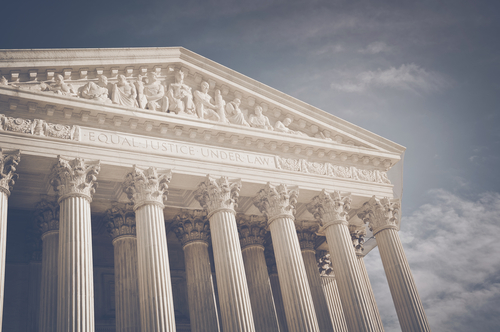
The Supreme Court delivered a decision in the last week of its session that dealt a major blow to a California law requiring anti-abortion pregnancy centers to inform women about publicly funded abortion and contraception services. This was a very slick attempt to circumvent the First Amendment by forcing people to deliver a government script written by politicians. This was a 5-4 ruling delivered by Justice Clarence Thomas, where the court’s conservatives in the majority, stated that the law violated the First Amendment by compelling speech.
“Licensed clinics must provide a government-drafted script about the availability of state-sponsored services, as well as contact information for how to obtain them,” Thomas wrote. “One of those services is abortion — the very practice that petitioners are devoted to opposing.” The legal issue here may be abortion, but once you allow compelled speech on one issue, you will open the door to everything else. In a concurring opinion, Justice Anthony Kennedy wrote that the law was “a paradigmatic example of the serious threat presented when government seeks to impose its own message in the place of individual speech, thought and expression.”
California was trying to circumvent the law by demanding pregnant women be notified of their rights to an abortion. Those who support abortion have to look at all the ramifications once you open that door. You could also then pass laws if a woman seeks an abortion that she MUST view an ultrasound as the worker reads a script explaining about the growth of their fetus. You can pass a law that says you cannot beat your wife. The unintended consequence would be that a man could then beat anyone who was not his wife. Law turns on wordsmithing. As they say, God wrote the Ten Commandments and man has tried to express the same thing in more than one billion pieces of legislation.
If you allow compelled speech that orders a woman to be advised of her right to abortion, you will also authorize a compelled speech instructing a woman on the rights of a child if she seeks an abortion. There are always two sides to every issue. The last thing we need is compelled speeches written by politicians.
Good news within a strenuously spun Reuters article. Don’t get lost looking at the granules; apparently all of the prior Canadian strategy against President Trump has failed.
For well over a year Justin from Canada and Foreign Minister Chrystia Freeland were confident they could leverage the U.S. Chamber of Commerce, purchased DC politicians and ideological allies against President Trump in NAFTA negotiations. The result? Fail, fail and more fail.
Running out of options, Canada now attempts to save their NAFTA construct by turning to the executives within the auto industry:
OTTAWA (Reuters) – Canada’s trade minister last week met senior officials from General Motors Co and Fiat Chrysler Automobiles NV in Detroit, as Ottawa takes its lobbying effort directly to the Big Three carmakers to avert potential U.S. auto tariffs.
The Liberal government is relying on industry partners to press Canada’s cause in the White House and elsewhere, using their influence to protect Canadian interests, sources with direct knowledge of the discussions told Reuters.
[…] The auto industry, Canada’s biggest exporter, represents about 500,000 direct and indirect jobs and contributes C$80 billion ($60.1 billion) a year to the economy.
“Instead of us galloping all over the United States talking to everybody, it’s really focused right now on the automobile manufacturers, the automobile suppliers,” said one source, who requested anonymity given the sensitivity of the situation.
The Canadian message was “now is the time to speak up, now is the time to exercise whatever influence you might be able to bring to bear,” added the source. (read more)
Or put another way…. “Halp”!
Each sequential step in the Trump trade strategy is designed to head-off any counter position by positioning individual best-interests ahead of any defensive group formation.
The Canadian and Mexican economy (due to NAFTA) cannot survive without importing cheap durable goods from China to use in their assembly-based economies, and then trans-ship into the U.S market. However, the U.S. economy can survive, it can actually expand BIGLY, without accepting trans-shipped assembled goods from Mexico and Canada
Put simply, without NAFTA, the assembly processes just moves INTO the U.S because the market *is* the United States. We are the $20 trillion customer. We hold the leverage.
Example:
NOTE: “Donnelly said in his opening remarks that there was already a rise in product being diverted to Canada in recent years and signs of even more since the U.S. tariffs began this year.”..
This is evidence of multinationals exploiting the NAFTA loophole to avoid U.S. tariffs. This fatal flaw is at the very heart of the issue within the U.S. trade policy inside NAFTA. As long as Mexico and Canada remain gateways for foreign good assembly and shipment into the U.S. there will never be a way for the U.S. to demand fair and reciprocal trade.
Canada knows their decades-long designed economic position as shipment/assembly trade-brokers is the central issue is the heart of the confrontation with USTR Lighthizer, Commerce Secretary Ross and President Trump. As multinational corporations seek to avoid Trump tariffs they only exacerbate the issue.
If Canada and Mexico don’t try to stop their duplicitous NAFTA benefit scheme, they will end up with even bigger trade surpluses and become even bigger targets for President Trump. In essence, the reason for Canada and Mexico being subject to even more encompassing Trump tariffs’ grows.
If Canada and Mexico do nothing to stop this influx; Trump will levy more than just steel and aluminum tariffs; he’ll likely tax their auto-sector.
As a consequence Canada moves do back-down Red Dragon:
The Canadian government is preparing new measures to prevent a potential flood of steel imports from global producers seeking to avoid U.S. tariffs, according to people familiar with the plans. The Canadian dollar weakened and shares in Stelco Holdings Inc. soared.
The measures are said to be a combination of quotas and tariffs aimed at certain countries including China, said the people, asking not to be identified because the matter isn’t public. The moves follow similar “safeguard” measures being considered by the European Union aimed at warding off steel that might otherwise have been sent to the U.S. It comes alongside Canadian counter-tariffs on U.S. steel, aluminum and other products set to kick in on July 1. (read more)
The bottom line is U.S. market access is what all production countries need for their goods and the sustainability of their economies.


Tonight President Trump attends a ‘Make America Great Again’ rally in Fargo, North Dakota. Co-hosting the rally is Congressman Kevin Cramer, hoping to unseat ND Senator Heidi Heitkamp in the 2018 midterms. Anticipated start time 7:00pm CDT / 8:00pm EDT With pre-rally speakers and events starting earlier
UPDATE: Video Added
RSBN Livestream Link – Fox News Livestream Link – Alternate Livestream Link
.
RSBN is urgently in need of Financial Support to continue operations – Help Here.
.


I have created this site to help people have fun in the kitchen. I write about enjoying life both in and out of my kitchen. Life is short! Make the most of it and enjoy!
De Oppresso Liber
A group of Americans united by our commitment to Freedom, Constitutional Governance, and Civic Duty.
Share the truth at whatever cost.
De Oppresso Liber
Uncensored updates on world events, economics, the environment and medicine
De Oppresso Liber
This is a library of News Events not reported by the Main Stream Media documenting & connecting the dots on How the Obama Marxist Liberal agenda is destroying America
Australia's Front Line | Since 2011
See what War is like and how it affects our Warriors
Nwo News, End Time, Deep State, World News, No Fake News
De Oppresso Liber
Politics | Talk | Opinion - Contact Info: stellasplace@wowway.com
Exposition and Encouragement
The Physician Wellness Movement and Illegitimate Authority: The Need for Revolt and Reconstruction
Real Estate Lending
 Centinel2012