NSC Russia Expert Escorted From White House Under Intelligence Investigation…


CTH held off reporting on this explosive story until we could see if a tell-tale consequence surfaced; perhaps it has.   On Friday the National Security Council senior director for European and Russian affairs, Andrew Peek, was escorted from the White House grounds and is currently under a security investigation.

There are few details about why Peek was physically removed and is under a very serious investigation; however, some of Andrew Peek’s professional background details tell a story.  The connection to Gen. John Allen is a MASSIVE warning flare.

Andrew Peek, the senior director for European and Russian affairs at the National Security Council, has been placed on administrative leave pending a security-related investigation, people familiar with the situation tell Axios.

First the Daily Mail:

[…] Peek had been in the NSC role for just two months, after most recently working as a deputy assistant secretary of state with responsibility for Iran and Iraq.

[…] Peek had been expected to attend the World Economic Forum in Davos, Switzerland next week with Trump and other top aides. However, he is currently on leave pending a security-related investigation, people familiar with the situation told Axios.

[…] Peek served as a U.S. Army intelligence officer who worked under General John Allen in Afghanistan.

[…] Prior to joining the Trump administration, Peek served as a U.S. Army intelligence officer who worked under General John Allen in Afghanistan.

[…] He was also a national security adviser to Senator Gordon Smith, an Oregon Republican, and Senator Mike Johanns, a Nebraska Republican.  (link)

From a Bloomberg article:

[…] Peek previously served as a deputy assistant secretary of State for Iraq and Iran, and he was seen as an ally of Robert O’Brien.

Andrew Peek came from the State Department.  Because the appointment happened in the past two months, it would appear Andrew Peek was recommended by the Dept. of State and accepted for the NSC post by National Security Advisor Robert O’Brien.

Here’s how it looks:  Andrew Peek was a mole.  A resistance spy sent into the Trump administration as part of the allied deep state resistance effort.  Someone caught him attempting to access something, and here’s how CTH can tell.

The biggest flare that identifies Andrew Peek’s ideology is the connection to former U.S. General John Allen.   CTH has tracked Allen for several years; he was used as part of Hillary Clinton’s campaign.  He spoke at the DNC convention for Hillary Clinton.

Gen. John Allen, (Ret.) stands with veterans as he speaks during the final day of the Democratic National Convention in Philadelphia , Thursday, July 28, 2016. (AP Photo/J. Scott Applewhite)

John Allen was also used, politically, as part of President Obama’s 2014 false narrative around ISIS; giving the illusion of an effort to confront the radical Islamists.  Obama had been holding leverage over John Allen since 2012 [HERE]

Allen, a four-star Marine general, succeeded Petraeus as the top American commander in Afghanistan in July 2011; but General John Allen had a serious zipper problem.  Allen retired in 2012 when his sexual proclivities surfaced.

However, Obama brought him back when he needed a General he could control in 2014.   Allen’s 2012 zipper problem became Obama’s 2014 political leverage to use General Allen as a tool to present the image of Obama’s faux fight against ISIS.

Andrew Peek coming from the stable of John Allen tells us everything we need to know about the ideology of Mr. Peek.  There’s no doubt in my mind that Andrew Peek is therefore an ideological member of the resistance similar to another NSC appointment, Alexander Vindman.

Keep in mind, National Security Advisor Robert O’Brien also comes from inside the Dept of State.   So whether Mike Pompeo and Robert O’Brien set-up Peek as a mole, or whether Peek’s activities were discovered without their foreknowledge is an open question.  However, I find it impossible to believe that NSA Robert O’Brien didn’t know the ideology of Peek prior to the appointment.

Additionally, in the periphery of downstream consequence, and seemingly out of nowhere today, impeachment Lead Manager and HPSCI Chairman Adam Schiff said:

The Intelligence Community is beginning to withhold documents from Congress on the issue of Ukraine. They appear to be succumbing to pressure from the administration. The NSA in particular is withholding what are potentially relevant documents to our oversight.”

Kyle Griffin

@kylegriffin1

Schiff: “The Intelligence Community is beginning to withhold documents from Congress on the issue of Ukraine. They appear to be succumbing to pressure from the administration. The NSA in particular is withholding what are potentially relevant documents to our oversight.” Via ABC

Embedded video

8,825 people are talking about this

Considering the timeline; and considering the topic(s); and considering the ideology; there’s a strong possibility the person on the other end of Peeks’ communication effort was someone in the network of Adam Schiff, perhaps Mary McCord or similar…

Advertisements
REPORT THIS AD

Sunday Talks: Jim Jordan Discusses FBI, Flynn Prosecution, Rosenstein, Page, Strzok, and How it all Connects…


Ohio congressman Jim Jordan appears with Maria Bartiromo to discuss the full background of the FBI surveillance impetus and how the bigger picture brings all of the government activity forward to the actions behind an impeachment trial.

In the full picture, the totality of government effort, the arc of all swamp action, has been to remove a president who is everything these administrative state officials oppose.  It is the independence of a Peoples’ President that represents the threat to the system…

Sunday Talks: White House Impeachment Lawyer Robert Ray Interview With Maria Bartiromo…


One of the White House impeachment lawyers, Robert Ray, sits down for an interview with Maria Bartiromo to discuss the impeachment trial.

As customary with most high-profile defense team assemblies, it would appear there are three or four of the team who have been selected primarily to articulate the legal arguments in the media arena; while the co-lead counsels (Cipollone & Sekulow) focus on the trial detail and presentations therein.

Sunday Talks: Senator Ted Cruz Discusses Upcoming Week of Impeachment…


Texas Senator Ted Cruz appears on Sunday Morning Futures with Maria Bartiromo for a lengthy discussion of the upcoming senate impeachment trial.  Senator Cruz does not currently support subpoenas for witnesses; however, if the full senate votes to call prosecution witnesses Cruz would support reciprocal witnesses for President Trump.

Senator Cruz walks through the anticipated process including the “scheduling order” or senate rules within the impeachment process.  Twelve hours of prosecution, twelve hours of defense, sixteen hours of senator questioning, and then possibly a vote.

Sunday Talks: Alan Dershowitz -vs- George Stephanopoulos….


Harvard law professor Alan Dershowitz is a member of the white house legal team from the perspective of constitutional law.  In this interview George Stephanopoulos was in his old familiar role as a political narrative engineer, trying to get Dershowitz to say he did not agree with the President.  The engineering objective was “Trump Lawyer says President Guilty”.

Background Briefing With White House Counsel…


Re-Posted from The Conservative tree House on  by 

In advance of the formal answer to the Senate summons, the White House counsel held a background press briefing with media.  Here’s the transcript as released:

MR. GIDLEY: Thank you very much. Good afternoon, everyone. Thanks for taking the time to join this background call regarding impeachment.

The ground rules are as follows: Information on this call is on background, and can attributable to “sources close to the President’s legal team.”

SENIOR ADMINISTRATION OFFICIAL: Thanks, Hogan. I’m going to start, and then I’m sure my colleague is going to want to jump in.

So, from a procedural standpoint, we’re going to be filing in the next — probably next hour or two — our answer to the summons. [pdf Answer Here] This was the summons, which is part of the process that the Senate sent over to us with the articles of impeachment. We are issuing a very detailed response. This is not to be confused with our brief; our brief is not due until Monday.

The response that we will be putting forward will address both the procedural and the substantive issues raised in the articles of impeachment. When I talk about the procedural aspects, I’m referring to the procedural irregularities that took place during the course of the investigation. When we talk about substance, we’re referring to legal threshold standards, as it relates to impeachment under the Constitution. So, that’s going to give you an overview.

The answer — our response — will respond to both of those. I’ll give you a taste of it, a little bit, so that you have a sense of the tone of what we’re going to say. Our first response reads as follows:

The Honorable Donald J. Trump, President of the United States, hereby responds: The Articles of Impeachment submitted by House Democrats are a dangerous attack on the right of the American people to freely choose their President. This is a brazen and unlawful attempt to overturn the results of the 2016 election and interfere with the 2020 election — now just months away. This highly partisan and reckless obsession with impeaching the President began even before his election and continues to this day.

We next assert that:

The Articles of Impeachment are constitutionally invalid on their face. They fail to allege any crime or violation of law whatsoever, let alone “high Crimes or Misdemeanors.”

That is all required, of course, by the Constitution itself. So that’s why I’m saying both the process and the legal issues are being impacted here. And then we will respond to each and every one of the two articles separately.

SENIOR ADMINISTRATION OFFICIAL: Yeah, and I — this is [a source close to the President’s legal team]. I think, at the end, there’s a lot of detail in the response. The conclusion, at the end of the day, is that the articles of impeachment violate the Constitution. They are defective in their entirety. They are the product of invalid proceedings that flagrantly denied the President any due process rights. They rest on dangerous distortions of the Constitution that would do lasting damage to our structure of government.

The bottom line is: In the end, this entire process is nothing more than a dangerous attack on the American people themselves and their fundamental right to vote.

SENIOR ADMINISTRATION OFFICIAL: Let me give you some of the individual responses to the two articles of impeachment. With regard to the first article of impeachment, we are going to assert that they must be rejected because the — and it relates to the first article of impeachment — it fails on its face to state an impeachable offense. It alleges no crimes at all, let alone high crimes and misdemeanors, as required by the Constitution. In fact, it does not allege any violation of law whatsoever. We assert that the House Democrats’ abuse of power claim would do lasting damage to the separation of powers under the United States Constitution.

We then get into some very specific allegations, regarding the phone call itself, as it relates to this abuse of power claim. I will tell you this: We will address both the April 21st and July 25th phone calls. We will be making it very clear what President Zelensky said, as well as what the President of the United States said on those calls. We will again reiterate that the House record establishes that President Zelensky and his top aides have never said there was a quid pro quo situation, as that issue came up.

And remember: This case started — first it was going to be quid pro quo. Actually, first it would be extortion, then bribery, then quid pro quo, then it becomes abuse of power — with the word “quid pro quo” never showing up in the actual articles of impeachment.

We’re raising it because we’re going to remind the American people of exactly what this is all about and how it started. So that’s how that one is going to start.

We’re going to also take a look at the fact that the bilateral presidential meeting that was so often discussed actually did take place. The security assistance was sent. And all that took place without the Ukrainian government announcing any investigations.

SENIOR ADMINISTRATION OFFICIAL: With respect to the second article of impeachment, our answer states very clearly that the second article of impeachment also fails on its face to state and impeachable offense. It does not allege any crime or violation of law whatsoever.

To the contrary, the President’s assertion of legitimate executive branch confidentiality interests, grounded in the separation of powers, cannot constitute obstruction of Congress.
Furthermore, the notion that President Trump obstructed Congress is absurd. President Trump acted with extraordinary and unprecedented transparency by declassifying and releasing the transcript of the July 25th call that is at the heart of this matter.

SENIOR ADMINISTRATION OFFICIAL: Let me add one other thing because this will apply to both — this will apply to both articles, but this is contained in our answer, and I think it’s important for you to have a sense of how that sets forth.

We’re also going to go to the process issue. So we’re going to say that House Democrats ran a fundamentally flawed and illegitimate process that denied the President every basic right, including the right to have counsel present, the right to cross examine a witness, and the right to present evidence. And despite all of this, the information that the House Democrats actually assembled disproves their claims against the President. We’re going to then assert — so that’s a process aspect.

Then we’re going to say the President, at all times, acted with full, constitutional legal authority in our own national interests, and continued his administration’s policy of unprecedented support for Ukraine, including the delivery of lethal military aid that was denied to the Ukrainians by the prior administration.

SENIOR ADMINISTRATION OFFICIAL: Again, with respect to article two, obstruction of Congress: We will state that the Trump administration replied appropriately to the subpoena and identified their constitutional defects. And this is an important point: Tellingly, House Democrats did not seek to enforce these constitutionally defective subpoenas in court. To the contrary, when one subpoena recipient sought a declaratory judgement as to the validity of the subpoena he had received, House Democrats quickly withdrew the subpoena to prevent the court from issuing a ruling.

SENIOR ADMINISTRATION OFFICIAL: The way that this — so, I think what you’re getting at — what we’re giving you — this is about a six-page document, is the answer. It’s going to address both procedural irregularities, and substantive irregularities, including the lack of constitutional support for the position that the House advocated in the articles of impeachment.

SENIOR ADMINISTRATION OFFICIAL: And it will address the articles both on the law and the facts.

MR. GIDLEY: Okay. Moderator, we’d like to open for questions now. But I want to remind the group one more time, if I may, that, again, the attribution here is “source close to the President’s legal team.” And, second, is a reminder that the content is embargoed until 5:00 p.m.

With that, if you could open it up for questions, we’d appreciate it.

Q Hi, guys. Thank you so much for doing this. This is Franco Ordoñez, from NPR. In addition to Dershowitz, who says he is going to give an opening statement, will each of you be giving an opening statement? And can you give a flavor of what each of you will be saying? Will you be, kind of, discussing each article, as you just kind of broke down right now, in the opening statement?

SENIOR ADMINISTRATION OFFICIAL: So the way that we plan on it happening — of course, we’re coming up second in this process, as the House Managers will go first — is will do the initial opening, where he will address a variety of both substantive and constitutional and procedural position.

I will — as is planned right now, and this could change — I will go next, where I will be addressing more of an overview on the entire process, which will include, from beginning to end, on how we got there.

Now, we may break it up some. We don’t know yet — where, you know, my colleague goes for 45 minutes and I go for 45 minutes, and maybe we come back up later in the afternoon or evening. It’s going to depend on how the day is flowing.

And then, as to the question you’re asking about Alan and Ken Starr and Bob Ray, they will have discrete functions that they will be addressing at particular times. We don’t know what those times are yet; we just got to see how everything plays out.

Q Hey, it’s Zeke Miller, with AP. Thanks for doing the call. First of all, by any chance, is there any way you can move this on the record, since it’s awfully weird to have a call with “people close to a legal team” when we’re talking to the legal team?

And then, substantively, in terms of this response and the legal brief, do we expect this to sort of be the nature of the President’s defense here — sort of a broadside against the process? And are you concerned that that sort of rhetoric might not fly with the senators who have a more staid view of their chamber?

MR. GIDLEY: First things first, Zeke: Let me address the first question. The answer to that is no. You can call me after and we can have that conversation. But as far as the next one is concerned, I’ll turn it back over to the team.

SENIOR ADMINISTRATION OFFICIAL: Yeah, Zeke, this is [a source close to the President’s legal team]. I think it’s fair to say that this answer addresses both the law and the legal issues and the procedural issues — but also the facts, and takes the facts head on.

So I think it covers all of the issues, not just the procedural issues.

SENIOR ADMINISTRATION OFFICIAL: Right. And the brief — obviously, because we have a lot more we can write in the brief — will cover everything in much more detail.

SENIOR ADMINISTRATION OFFICIAL: This is just the answer. But it does cover — as I have said, it’s both procedural and the substantive legal. It also makes the argument that all you really need to look at are the articles of impeachment themselves. That — if you look at them, they allege no violation of law whatsoever. They don’t remotely begin to approach what you would need to begin (inaudible) impeachment.

So that will be an additional argument that we’ll make — we’ll be making.

Q Hi, there. It’s Michael Moates, with D.C. Chronicle. Hey, I was just curious: The statement that you guys are going to be submitting as your answer, will that be made public through — after — are you guys going to pre-release that? Or are we going to be waiting until after that is submitted to Congress?

SENIOR ADMINISTRATION OFFICIAL: It’s minutes away.

SENIOR ADMINISTRATION OFFICIAL: Yeah, the plan is: It’s embargoed until 5:00 p.m., and we expect to send you guys the text at that time.

SENIOR ADMINISTRATION OFFICIAL: You’ll have the answer, in other words.

Q Good afternoon. This is Jon Decker, from Fox. Thank you for doing this. Republican lawmakers and those speaking on behalf of the President, including yourselves, have repeatedly said that there must be an underlying (inaudible) to meet the standard for impeachment and removal. And you’ve clearly made that point in the answer that you’ve just spoken about.

As you know, yesterday, the Government Accountability Office released a report saying that it was, in fact, illegal for President Trump to withhold military aid from Ukraine to pressure them to interfere in the 2020 election.

Based on this new development, in your view, wouldn’t you each agree that the Republicans’ own standard on impeachment and removal has now been met? Thank you.

SENIOR ADMINISTRATION OFFICIAL: Those aren’t — we’re dealing with discrete articles of impeachment. That’s what this — so, this is not twelve reports later, two week later. It’s a discrete — they brought up two articles of impeachment. That is what’s before the United States Senate.

And we obviously disagree with that conclusion. And, in addition to that, if you look at the articles of impeachment, it’s not only that they don’t allege any crime; they don’t allege any violation of any law whatsoever.

Q Hi, this is Andrew Feinberg, with Breakfast Media. Thanks for doing the call. It sounds a lot like the defense that you’re going to put forth is almost identical to what’s already been said by Republican members of the House, and the President, in his letter just before the vote on the impeachment articles. Is there anything new that we should expect to hear that perhaps addresses the actual allegations being made, rather than the process on these sort of broad brush arguments about the articles of impeachment not mentioning crimes? Anything that hasn’t already been brought up by the House, perhaps?

SENIOR ADMINISTRATION OFFICIAL: There’s no question that, during the course of the presentations and the proceedings before the Senate and then the briefs that we’re going to be filing, we will be addressing both procedure irregularities — again, ignore those (inaudible) implications as well. And also, substantive issues that arise, including facts.

So all of that will be addressed. So, don’t — there shouldn’t be not misunderstanding that this is a factual — an attack only on process. We’re not ignoring the tainted process, because it has serious constitutional implications, but we’re going to be — it’s going to be a full throttle address.

SENIOR ADMINISTRATION OFFICIAL: We will take the facts head on, and we believe that the facts will prove that the President — and have proven that the President did absolutely nothing wrong.

Q Good afternoon, [sources close to the President’s legal team]. This is Kelly O’Donnell, from NBC. When you look at the arc of how expect this trial to move forward, in terms of its length, your willingness or lack thereof to have witnesses, what is your latest thinking on what we should expect for your strategic ideas, going beyond this initial phase that you’re announcing today with the response to the articles?

SENIOR ADMINISTRATION OFFICIAL: Well, I think that, first — the first thing we have to look for is actually how the rules come out — the final rules, what the final agreements are. And I don’t think any of us — what we’re hearing is what you’re hearing, which is 24 hours, each side — which was under the Clinton model. That the witness decisions would be made after the presentation of the actual arguments by both counsels — or by the Managers and by our team.

And then, if there’s witnesses, it would proceed to a vote. And if they decide there’s going to be witnesses, there’d be depositions. And, by the way, if there’s witnesses, it means that, you know — Chuck Schumer takes the view that they hear the witnesses they demand. Well, you know, we would get to demand witnesses, too. It’s a two-way street.

So, we’re prepared for all contingencies. We’ll see what happens. It’s like any other trial; you prepare for the contingencies and you see what happens.

Q Hi, it’s Peter Baker, from the New York Times. Thanks for doing the call. Appreciate it. Quick question: You guys now have a lawyer on your team who has made the argument in the past that it is an impeachable offense to improperly invoke executive privilege to block an investigation. How do you — how are you going to square the statements and the positions that Judge Starr has taken in the past now that he’s on your team and will be on the Senate floor in the trial?

SENIOR ADMINISTRATION OFFICIAL: Yeah, let me address this, because (inaudible) obviously (inaudible). Obviously, the issue of the obstruction of Congress is a significant one, constitutionally. I think he will be very — we will be very pleased with Judge Starr’s presentation on how he’s going to move this forward, what he sees are the issues, and the different aspects of the fact of the activities that we’re involved in, in this situation with Bill Clinton’s, are markedly different than what even the allegations are here.

And remember: It was — Bill Clinton was asserting executive privilege over private conduct. This is markedly different. And I think that that’s a clean distinction and clean (inaudible).

SENIOR ADMINISTRATION OFFICIAL: All right. And, hey, on more thing, if I may address, too. Zeke, I believe you asked the question about the GAO. I just want to make this point. A couple things: First of all, the aid was released, and it was released before the deadline.

Second of all, it’s pretty clear that GAO is just inserting itself in today’s news cycle. Let’s be clear: They made a lot of rulings in the past that they’ve had to go back on, rulings they’ve had to change — and the media didn’t say a word about it when they went after Obama, they went after Clinton, they went after Bush. They’ve done it in the past.

So, this is nothing new from them. The fact is, we’re on strong legal footing, the President has done nothing wrong, and we believe that’s going to be borne out through this process.

Thanks everybody for the call.

[Transcript End]

[IMPEACHMENT ANSWER – pdf]

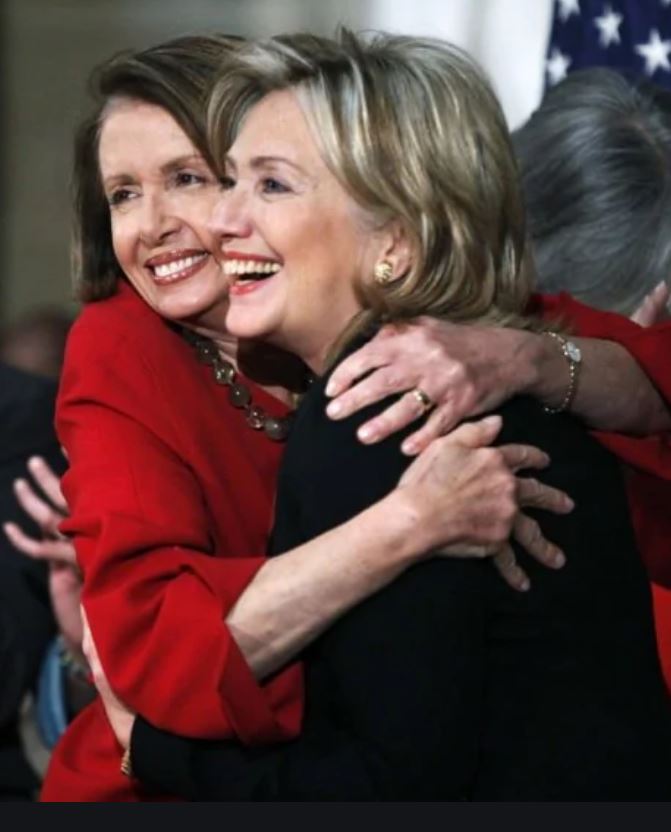
The Real Conspiracy – Hillary & Pelosi


While everyone is left scratching their head as to why Pelosi, who said impeachment was bad for the country, suddenly changed and because of its greatest supporter in the Democrats. Then she held on to the articles of impeachment for about a month which she pretended was to force witnesses to be heard in the Senate, when she knew that her tactics were unconstitutional and even members of her own party were left trying to figure out just what the heck was she up to?

The 2016 election was stolen from Bernie which is why he went to complain to Obama after the votes were rigged and given to Hillary in California. Only after Bernie went to the White House and Obama told him to suck-it-up and take one for the team, did Bernie support Hillary.

This time, the Democrat power-brokers behind the curtain are looking to prevent Bernie once again from winning the nomination. But they also know that Joe Biden is damaged goods and they have no candidate who could possibly win against Trump.

Our computer has been projecting a Trump victory in 2020, but this is not something that will be by a wide margin. We are going to rerun the models and double-check the data to make sure there is no mistake for as it stands now, Trump would win in a landslide looking at a candidate of Biden or Bernie. There is something else brewing behind the curtain.

The Clintons have long been regarded as the most corrupt policial couple perhaps in history. The scheme is to drag out the Impeachment hearing, not to actually get rid of Trump, but to tie up all the senators running in the Democratic Party and force them off the campaign trail. Why? This is not just to give Biden a clear path. They also realize that Biden and his son could be called as witnesses and that will be contested in the Supreme Court.

Then there is all this talk that Pence should be impeached and removed as well. That means the third person in line for the Presidency would be Nancy Pelosi in the flesh. I do not believe this is being considered behind the curtain in any serious manner. However, it is being used as a distraction to hide from public view the real conspiracy behind the curtain.

The REAL conspiracy is that the Democratic candidates will be so divided that at the convention, they will move to DRAFT Hillary relieving her of ever having to appear in any primary or suffer the arrows from the herd of contenders. Tieing up the Impeachment in the Senate will not prevent Trump from campaigning, but it will clear the field of Democrats with an eye on the White House.

Let’s see. But this seems to be a real conspiracy in the works.


DOJ Filing – Former Deputy AG Rod Rosenstein Admits to Authorizing Release of Lisa Page and Peter Strzok Text Messages…


It has always been a curious question about who released the controversial text messages between FBI lawyer Lisa Page and FBI Supervisory Agent Peter Strzok.  In a DOJ court brief (full pdf below) in support of a motion to dismiss the lawsuit of Peter Strzok, former Deputy AG Rod Rosenstein explains how and why he authorized the release:

It would have been a little more interesting if Rosenstein could have narrowed down the timing of OIG notification from “in the summer of 2017”, as it would outline specifically when Rosenstein became aware of the controversial issue.  Before or after he joined the crew in authorizing -and signing- a false FISA application?….

Obviously, at least in my opinion, the lack of specificity here is evidence of Rosenstein’s CYA motive.  If Rosenstein was aware of the texts from inside the key participants of the Crossfire Hurricane team, prior to authorizing the third FISA renewal… he was either a complete doofus, or complicit and willfully blind.   I digress.

Rosenstein saying he decided to release the text messages because they would inevitably become public after his testimony before the House Judiciary Committee during the Mueller investigation. Also saying he wanted to ensure they were not “cherry-picked” for public release by members of Chairman Bob Goodlatte’s committee.

“With the express understanding that it would not violate the Privacy Act and that the text messages would become public by the next day in any event, I authorized [Justice’s Office of Public Affairs] to disclose to the news media the text messages that were being disclosed to Congressional committees.”

Sketchy Rod Rosenstein’s five-page statement can found below in the attachment to the DOJ motion:

.

[Cloud Direct Link to pdf Format Here]

The original news reports from journalists gaining knowledge of the Strzok/Page text messages on December 2nd, 2017, always seemed tied to the ridiculous and coerced guilty plea by Michael Flynn signed two days earlier, November 30th, 2017.

Obviously those within the DOJ/FBI or IC were able to keep the texts hidden from “the summer” through the end of November….  Then Flynn was forced into the plea… and then suddenly a series of leaks from inside the FBI system started on December 1st, 2017.  That chain of events led to congress asking questions and demanding to see them.  As a result of those congressional inquires, Rosenstein authorized their release December 12th, 2017.

Is Impeachment Always Political and Should it be Prevented?


COMMENT: I don’t believe your ECM and when the Republicans impeached Clinton this is just payback which is well deserved. They should shut your site down.

Oppressed Democrat

REPLY: Don’t worry, I have no desire to live forever. I understand that Socialists hate cycles and want to oppress everyone for their own benefits. I am in favor of splitting the country on political principles where you can live with people who think like you, free of people like me who just want to be left alone.

As for your payback, well you are wrong on that also. In the case of Clinton, the impeachment came out from the special prosecutor’s report, which this case against Trump did not. Clinton committed perjury and then tried to get his secretary to confirm his lie. Because of that “obstruction of justice,” it is true that the Republicans controlled the House of Representatives back then as the Democrats do today. However, Clinton was impeached on a bipartisan vote of 258–176 (31 Democrats joined Republicans) because this did come from the special prosecutor report. Nevertheless, I believe that was wrong anyhow.

Clinton was impeached for a crime that in a normal legal proceeding would have landed him in prison for 5 years. The grounds for impeachment were perjury to a grand jury (first article, 228–206)and obstruction of justice (third article, 221–212). I disagreed with that because I question if something ancillary to the position of president is grounds to impeach a president. The perjury was with respect to his sexual conduct. I do not believe that is grounds for impeachment.


The impeachment of Andrew Johnson took place on February 24, 1868. A president is supposed to be impeached only for “high crimes and misdemeanors,” which in my opinion have never been articulated against Trump, Clinton, or Johnson. Anything a president does that is short of treason against the country, I believe, was never intended to be included in the high crimes and misdemeanors.

If the president was driving and failed to renew his license, that is actually a misdemeanor. Driving with a suspended license is considered a misdemeanor and can come with pretty severe consequences. Other traffic misdemeanors that are criminal in nature include driving while intoxicated or driving while impaired by drugs. In some instances, reckless driving can be considered a misdemeanor as opposed to a traffic infraction. The Founding Fathers never envisioned that there could be demands for a license and the failure to pay the fee would be a misdemeanor. That certainly is not grounds for impeachment, which begs the question — have we created way too many laws?

The primary charge against Johnson was a violation of the Tenure of Office Act, which Congress passed because they wanted to punish the South and they felt that Johnson was too soft on the Confederate states. Johnson removed from office Edwin M. Stanton, who was the Secretary of War. He was eventually replaced with General Ulysses S. Grant.

Andrew Johnson was against being hard on the South and opposed the Radical Republicans who demanded the South be punished. During the mid-term election, the Radical Republicans gained more seats and nullified any possible veto of Johnson.

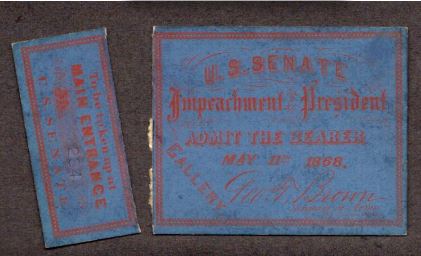
Johnson was the first American president to be impeached on March 2–3, 1868, when the House simply disagreed with his policies. The trial in the Senate began three days later, with Chief Justice Salmon P. Chase presiding. The Senate failed to convict Johnson by one single vote (35–19) on May 16th. They called a 10-day recess attempting to convict him on additional articles on May 26th, but they failed to convict with the same vote.

The legal importance of the impeachment and trial of Andrew Johnson went directly to the political implications for the separation of powers. Congress, as a matter of principle, abused its power in the Johnson impeachment as they are doing with Trump for the principle that Congress should not remove the president from office simply because its members disagreed with him over policy.

The abuse of the impeachment power is creating a system that is undermining the very structure of the Constitution destroying the separation of powers seeking to replace it by a government ruled by Congressional Dictatorial Government.

Consequently, the fact that you have taken the time to send this email verifies my concern that the rise of tensions will become violent for the election. This impeachment of Trump is entirely political and there can be no obstruction of justice where a president is subservient to the House of Representatives, which in and of itself has become a den of political nonsense.

I personally disagree with the power to impeach a president residing in the House of Representatives on a simple majority vote. That has clearly allowed for abuse of Congressional power, for in all cases impeachment has been used simply as a political tool because they dislike the president and/or his policies.

To me, it is an abuse of power for Pelosi to order all Democrats to vote for impeachment. That is a very dangerous precedent. I do NOT say that as a Trump supporter, but as an American with at least a legal background and 40 years of experience with politicians. The plain truth is that politicians will always act in their own self-interest, precisely as Adam Smith discovered in his invisible hand. That has led to the abuse of the impeachment power in all three cases.

Senator Ted Cruz Walks Through Likely Senate Trial Process – Holds Same Concerns as Rand Paul…


Senator Ted Cruz appears for a discussion on the Senate impeachment trial.  Cruz walks through the most likely scenario of 24 hours prosecution case (two or three days), then 24 hours of defense case (two or three days); then the individual Senators submitting questions to the Chief Justice, John Roberts, to ask both sides.   This phase of the process should take two to three weeks total.  Then the issue of “witnesses” will be debated.

.

While the first week is unfolding in the Senate, President Trump will be attending the World Economic Forum in Davos, Switzerland, and negotiating more economic benefits for the U.S.  Quite a remarkable contrast.

Donald J. Trump

@realDonaldTrump

Words of wisdom. Thank you Ted! https://twitter.com/sentedcruz/status/1217855192399601665 

Senator Ted Cruz

@SenTedCruz

TO THE AMERICAN PEOPLE: This is the beginning of the end of the abuse of the Constitution. The Senate will provide a fair trial for @realDonaldTrump. #impeachment #ArticlesOfImpeachment #ImpeachmentTrial #senate #SenateImpeachmentTrial

Embedded video

19.2K people are talking about this

Adopted yesterday by unanimous consent:

  • A Summons to the White House notifying them of the impeachment trial will be issued by the Senate and delivered by Saturday January 18th, 2020, 6:00pm,
  • The House of Representatives (impeachment managers) have a deadline of 5:00pm Saturday, January 18th, 2020, for the filing of their impeachment brief to the Senate.
  • The White House (defense lawyers) have a response deadline of 5:00pm Monday, January 20th, for their response to the House impeachment brief.
  • The House of Representatives (impeachment managers) have a deadline of Noon Tuesday, January 21st, for their rebuttal brief to the White House defense brief.
  • The Senate Trial begins at 1:00pm Eastern, Tuesday January 21st, 2020.

Senators will not be allowed to bring their cell phones or any electronic device into the Senate chamber while the trial is underway.