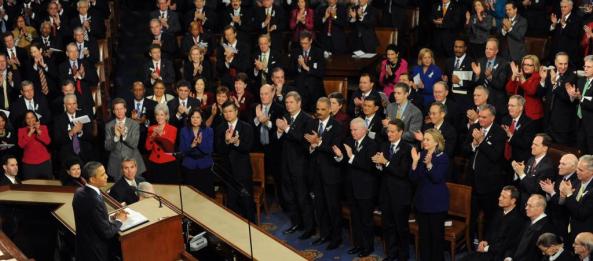
America Faces Most Dangerous Two Years in 150 Years


I agree Obama is likely to set off a constitutional crises as he throws a temper tantrum for loosing the 2014 election.

deacon303's avatarWhiskey Tango Foxtrot

If President Obama suffered a “shellacking” in the 2010 elections, then what he endured Tuesday night was nothing short of a vicious gangland beatdown the likes of which have rarely been seen before in the history of electoral politics.

This, of course, is a wonderful and well-deserved outcome. But beware: America now enters the two most dangerous years of her existence — or certainly the most dangerous since the Great Depression and possibly going all the way back to the Civil War.

Not to dismiss the promising results of Tuesday’s election.

Voters clearly and forcefully rejected the party, politics and policies of President Obama. They slapped his socialist agenda back into the days of Soviet gulags, where it belongs.

His grand visions of mighty government ruling unchecked over desperate ghettos have been snuffed out.

Gone, too, were the so-called “low-information voters” who have been coaxed to the polls since 2008…

View original post 373 more words

The Treacherous Years Of Obama’s Presidency


I agree with this analysis 100% The Republicans must find a way to counter what Obama will try to do and also make the American people understand why! The next two years could make or break the country.

Dubya – The Fair Context and Seven Years Without a Federal Budget…


Very good analysis and it mirrors my views of the last 14 years very closely. Progressives run on feelings and optics which they manipulate through the media and Hollywood! The real world runs much differently and that is what causes the disconnect that Obama is responsible for. Never having been responsible for anything in his life prior to being president he has now feel for how to lead or manage. Its realy hard to see how anyone could have done worse than Obama given the mandate that he got in 2008. He squandered it by forcing Obama Care on us and that lead to the 20010 loss of congress. The citizens being forgiving gave him a second change but all they got was ISIS and Ebola —

The Citizens took Obama to the wood shed two days ago and they gave the republicans the means to straighten out the mess that Obama created. Lets hope they are up to the task!

INCOMPETENCE KILLS


I agree Fred — I only did 4 years but Clinton (both of them) and Obama (both of them) have no clue about what really goes on in the world and especially with the use of force. Everyone knows that if you are in the military and the country needs your service that some will die. The task of a good commander is to win the battle with the minimum of American losses. Clinton (both of them) and Obama (both of them) used the military for strictly political reasons and so the losses were to no end and we didn’t win and yet we fought at great cost; not getting a status of forces agreement in Iraq is what lead us to ISIS. Every person and solider that dies as a result is a direct result of the Incompetence of Obama!

fredsstoryblog's avatarThoughts from Fred

Today I heard former President Bill Clinton offer his opinion on the Obama ISIS plan. It made my blood boil. Maybe I took it more personally than the average citizen because I spent 20 years of my life in an American military uniform. I served in Korea during the Korean war and was there when the fighting ended. I served in the Vietnam War with the 355th TAC Fighter/Bomber Wing which did 85% of the bombing of North Vietnam and the Ho Chi Minh Trail. I was in Orlando, Florida with Mace and Matador Missiles for the Cuban Missile Crisis, ready to go if Hell broke loose.

All of that has a tendency to make me take things concerning our military and our national security a little personal. I have heard much discussion about what President Obama is saying about what we are going to do about ISIS. It seems…

View original post 862 more words

President Barack Obama threatens vetoes and executive orders after GOP sweep


Obama has it wrong again — the Democrat’s lost because of him no matter how hard they ran away from His Policies! The message to Obama was that he had better work with the Republican’s!

The voters do not like what Obama is doing so why would they want more of the same as the last 6 years?

deacon303's avatarWhiskey Tango Foxtrot

President Barack Obama came out swinging on Wednesday just 14 hours after a Republican wave swept over the U.S. Congress in an election that largely repudiated his policies.

‘Congress will pass some bills I cannot sign,’ he said, threatening to dust off a veto pen that he has used only twice in nearly six years.

And he hinted at executive orders that will enrage conservatives. 

‘I’m pretty sure I’ll take some actions that some in Congress will not like,’ he said. ‘That’s natural. That’s how Democracy works.’

Much of reporters’ tussling with the president focused on executive orders related to immigration reform – what some tea party Republicans call an ‘amnesty’ – which he plans to implement this year.

He acknowledged that the GOP won Tuesday’s elections, but framed the results as a mandate for Republicans to work with him, instead of the other way around.

‘Obviously the Republicans had…

View original post 718 more words

Will Republicans Rise To The Occasion?


If the republicans can achieve these three things then they will be American’s party; and if not they will not get a second chance!

deacon303's avatarWhiskey Tango Foxtrot

Polling shows us clearly the American people want solutions. They want progress. They want prosperity and security. They want a government working for them, finally!  Here are their top concerns:Advertisement-content continues below

Number one: it’s the economy, hands down.  The party that deals with ObamaCare, reins in regulation, approves the Keystone Pipeline, reduces taxation, and opens opportunity so that jobs are created and prosperity flourishes is the party that will take the White House in 2016.

Number two: security.  Whether it is terrorism, Ebola, foreign threats, ISIS, or the border and related immigration issues, the American people are frustrated with a government that cannot seem to do anything. The party that enhances security, addresses real threats in realistic ways, succeeds in defeating our enemies, and provides real border security is the party that will take the White House in 2016 and take control of Congress (or retain it).

Number three:

View original post 143 more words

Machiavelli and the Decay of Western Civilization, Part One


Professor Eidelberg has a world class mind and his analysis of Machiavelli’s The Prince in right on but more since he has shown how what Machiavelli wrote ties into Western Civilization and how combined with others thoughts that followed him have lead us to the place we now are  — witch is not good!


Machiavelli and the Decay of Western Civilization

Prof. Paul Eidelberg

Machiavelli is the father of Modernity and Democracy and the creator of Secular Man par excellence. His deceptively simple book The Prince, so often trivialized, marks the Copernican revolution in politics.[1] In that sibylline work Machiavelli undertook the world-historical task of destroying nothing less than the two pillars of Western civilization, classical Greek philosophy and Christianity, whose ethics, whether derived from Nature or nature’s God, derogate from the complete autonomy of human will and desire.

The key to modernity will be found in Chapter 15 of The Prince.[2] There Machiavelli lists ten pairs of qualities for which men, especially rulers, are praised or blamed—qualities which a ruler, “if he wishes to maintain himself,” must be able to “use” and “not use” “according to necessity.” [3] Some rulers, he declares, “are held liberal, some miserly … [and/or] rapacious; some cruel, others full of pity; the one faithless, the other faithful; the one effeminate and pusillanimous, the other fierce and spirited; the one human, the other proud; the one lascivious, the other chaste; the one open, the other cunning; the one hard, the other easy; the one grave, the other light; the one religious, the other skeptical, and the like.”

Machiavelli elaborates in Chapter 18 of The Prince:

It is not necessary for a prince to have in fact all of the qualities written above, but it is indeed necessary to appear to have them. I shall rather dare to say this: that having them and observing them always, they are harmful, but in appearing to have them, they are useful—so as to appear to be full of pity, faithful, human, open, religious, and to be so, but with one’s mind constructed in such a mode that when the need not to be arises, you can, and know how to, change to the contrary.[4]

A mind so “constructed” must be virtually devoid of all emotion, save the desire for power. To harbor emotions is to be susceptible to habits, and it is precisely habits that prevent a ruler from being a Machiavellian, which is to say, a perfect opportunist. To be a perfect opportunist, a ruler must change his “nature” with the times and circumstances, which means he must have no emotional predispositions (other than the desire to maintain and increase his power). This would be possible only if man is nothing more than a creature of habits—habits that can be conquered by men of the caliber of Machiavelli. (Long before Rousseau and twentieth-century behaviorists, Machiavelli let it be known that human nature—if man can be said to have a nature—is plastic or malleable.)

But if human nature is malleable, then it should be theoretically possible to shape the mentality of an age!

This is precisely what Machiavelli set out to do in The Prince and its companion work The Discourses. Notice that in his list of qualities that brings praise to rulers, Machiavelli excludes the four cardinal virtues of Greek political philosophy: wisdom, justice, moderation, and courage!   Moreover, religion (paired with skepticism) is placed last, inverting the Decalogue. Consistent therewith, the central and most significant pair of qualities is designated as “human” and “pride.” One would have expected “pride” (the Christian vice) to be paired with “humility” (the Christian virtue), but Machiavelli deliberately omits humility from the list of qualities for which men and princes are praised. Humility is the virtue of the weak, but also the facade of the “proud”—the priests who denigrate pagan virtu, i.e., manliness, while lording it over the people. Machiavelli replaces aristocratic monotheism with democratic “homotheism.”[5] To complete the process of man’s deification – the new World Oder – the creator of Secular Man simply eliminated every semblance or pretense of godliness, rendering man entirely “human.”   The seed of Humanism was thus planted in Chapter 15 of The Prince. In that seminal chapter Machiavelli advanced Christianity’s historic function, which was to destroy primitive idolatry on the one hand, while facilitating the secularization of mankind on the other.

With justice omitted from the qualities for which rulers are praised, a radically new political science appeared on the stage of world history, one that sanctifies the commonplace, not to say vulgarity, in the name of “realism.[6] In opposition to classical political philosophy, modern political science takes its bearing not from how man should live, but from how men do live—from the is, not from the ought. Again Chapter 15: “… there is such a distance between how one lives and how one should live that he who lets go that which is done for that which ought to be done learns his ruin rather than his preservation … Hence it is necessary for a prince, if he wishes to maintain himself, to learn to be able to be not good, and to use it and not use it according to necessity.”

This separation of morality from politics is the historical consequence of the Christian separation of church and state. Henceforth there are no moral limits as to what man may do. Man is at last fully autonomous. He stands, as Nietzsche was to say, “beyond good and evil.”

Furthermore, in direct opposition to the biblical tradition, which exalts truth and truthfulness the creator of Secular Man teaches would-be rulers to practice deceit and dissimulation constantly. “A prince ought to take great care … that he appears to be, when one sees and hears him, all pity, all faith, all integrity, all humanity, and all religion…. For men, universally, judge more by the eyes than by the hands … Everyone sees what you seem to be, but few touch what you are.”[7] We have here a politics keyed to the sense of touch, the most dynamic and erotic of the senses. For unlike sight and hearing—passive receptors of the written and spoken word—the sense of touch, especially in the hands, connects to the will—the will to power.

The greatest manifestation of the will to power is not the state but the founding of an entirely new “state.” To establish such a state a founder must create “new modes and orders”: he must make the “high” low and the “low” high.[8] To do this he must radically alter people’s inherited beliefs as to what is deserving of praise and blame. This will require not only great force but monumental fraud or deception. Hence the founder must possess virtu, greatness of mind and body. Extraordinary cunning and fierceness—even terror—are essential in the founding of an entirely new state. In no other way can the founder perpetuate his “new modes and orders.” Clearly, the “state”—Nietzsche will later say “philosophy”—is a construct of the mind and will of the “prince.”[9]

Since all new states originate in force, hence in revolutionary violence, their founders are, and by definition must be, “criminals.” Only after they have established new “orders” do they become “legitimate” and respectable. Accordingly, what is decisive in the study of politics is not laws or legal institutions but the dynamics of power, on which alone all laws are ultimately based. Indeed, laws are obligatory only insofar as they can be enforced; otherwise they are mere words having no “effectual truth”—like the best regimes in theory imagined by the philosophers of antiquity. In Chapter 12 of The Prince, Machiavelli writes: “The principal foundations which all states have, whether new, old, or mixed, are good laws and good arms. And because there cannot be good laws where there are not good arms, and where there are good arms there needs must be good laws, I shall omit reasoning on laws and speak of arms.” Arms are the counterpart of the “effectual truth” mentioned in Chapter 15.   There is no such thing as just or unjust laws or just and unjust regimes.

This is precisely the doctrine of legal realism or positivism that identifies the just with the legal, a doctrine that dominates law schools in the democratic world and makes it easier for democracies to recognize and have truck with tyrannies. But to deny the distinction between just and unjust laws is to reject the concept of the “common good,” a concept which appears nowhere in The Prince.[10] Neither does the word “tyrant” (in a book that commends Hiero, Agathocles, Cesare Borgia and others of their ilk as “princes”).[11] The term “justice” appears only in Chapter 19 of The Prince. There ten Roman emperors are mentioned, only two of which die a natural death—the just and gentle Marcus Aurelius and the unjust and ferocious Septimius Severus. Which means that justice is irrelevant in the world of politics (as implied by its omission in Chapter 15). We have in Machiavelli the Deification of Egoism, the modern euphemism of which is Individualism.

Although Marcus Aurelius’ rule was just, whereas Severus’ rule was tyrannical, Machiavelli praises both as “virtuous.” Why? Because the ultimate criterion of “virtue,” as of praise and blame, is success (of which more in a moment). This silent denial of the classical distinction between kingship and tyranny is one of the cornerstones of contemporary political science (which propagates the moral equivalency one hears so much about nowadays). A political science that rejects the traditional distinction between kingship and tyranny can take no account of, in fact must deny, the distinction between the good man and the good citizen. The good citizen is of course the patriot who fights for his country and obeys its laws. His country, however, and therefore its laws, may be unjust—from the traditional point of view. But this means that the good citizen may be a bad man. From which it follows that contemporary political science denies the distinction between good men and bad men—which is why democratic journalists (and only democratic journalists) can publicly proclaim that “one man’s terrorist is another man’s freedom fighter.” These relativists (and their academic mentors) are examples of tamed or democratized Machiavellians.

This leveling of moral distinctions is rooted in a leveling of the distinction between man and beast. The successful ruler, says Machiavelli in Chapter 18 of The Prince, will combine, in varying proportions (depending on circumstances), the cunning of the fox and the fierceness of a lion.[12] And just as it would be absurd to condemn a lion for devouring a lamb, so it would be absurd to condemn a “prince” (by calling him a “tyrant”) for ravaging or subjugating a nation. As Machiavelli puts it in Chapter 3 of The Prince: “It is a thing truly very natural and ordinary to desire to acquire [note the deliberate redundancy]; and when men are able to do so do it, they are always praised or not blamed …” This precept follows an account of Louis XII of France who “was brought into Italy by the ambition of the Venetians … I do not want to blame the part taken by the King for wanting to begin gaining a foothold in Italy …” Machiavelli, the founder of a “value-free” political science, actually shows in Chapter 3 how to conquer his own country! The ultimate criterion of praise and blame is not right and wrong, but success and failure.

We must now ask, what is the world-historical goal of Secular Man? The answer to this question will be found in Chapter 25 of The Prince. There Machiavelli subtly equates God with chance (fortuna). He then identifies chance with “woman” and playfully proclaims that man’s task is to conquer her. What he means is this. “Woman” signifies nature, and man’s ultimate goal is to conquer nature, which will require the overcoming of traditional views of human nature. This is why the word “soul” (anima) never appears either in The Prince or The Discourses. We are given to understand, therefore, that man’s nature is plastic, is unbound by any moral laws or by “conscience” (another deliberately omitted word in The Prince).[13]   And so, just as the “Philosopher” replaced the Olympian pantheon with a new conception of Nature, so the “Prince” replaces Nature (and Nature’s God) with a new conception of Man. This requires elaboration.

The conquest of chance involves the overcoming of God and of all those who have traditionally diminished man by despising the merely “human.” The enemy is the “proud”: not only the priests, who denigrate the body, but the philosophers who exalt kingship and aristocracy. To conquer chance, therefore, one must lower the goals of human life. For the higher the goals of man the more he is exposed to chance and accident. Turn now to Secular Man, to diluted man,, an inevitable bi-product of the undiluted Promethean.

Lowering the goals of human life corresponds to leveling the distinction between man and beast on the one hand, and denying the existence of the soul on the other. Abolish the soul and human reason will have nothing to serve but the wants of the body or sensuality, and such external goods as wealth, power, and prestige. To deny the soul, therefore, is to deify, in effect, the “human, all-too-human”—what the priests referred to, pejoratively, as “human nature.”

Machiavelli’s deification of the merely “human” is the unembellished meaning of humanism; it is the true source of Individualism and Capitalism, of Socialism and Communism, of Fascism and Nazism.

The prerequisites for the Machiavellian conquest of nature can now be more fully appreciated. The first thing needed is a new science of politics, a politics that liberates man’s acquisitive instincts in opposition to classical moderation and Christian asceticism. However, the liberation of acquisitiveness necessitates a rejection of priests, nobles, and kings in favor of the people. Commentators tend to minimize if not overlook Machiavelli’s democratic “bias” (which is actually part of his world-historical project). Machiavelli’s political science had to be democratic if he was to create a new dispensation for mankind. In other words, he had to destroy classical political science, which is essentially aristocratic, if he was to create a democratic era.   Machiavelli is in fact the first philosopher to contend that democracy is the best regime.

In The Discourses he challenges all previous political philosophy by claiming that, “[A]s regards prudence and stability, I say that the people are more prudent and stable, and have better judgment than a prince. And in The Prince he boldly declares: “The end of the people is more honest than that of the great.[14]   Moreover, in overturning the Great Tradition, which praises agrarian as opposed to commercial societies as more conducive to virtue, Machiavelli praises commercial republics because such republics, like Rome, are more powerful, are more capable of dominion. Machiavelli’s political science therefore liberates acquisitiveness and prepares the ground for capitalism (and, for much more, as we shall see later). He is indeed the father of modernity.

The Prince must thus be understood as a conspiratorial as well as a Copernican work. (Incidentally, its longest chapter, like that of The Discourses, is on conspiracy.) Far from being a tract for the times (as some have foolishly believed), this masterpiece of cunning may be regarded as philosophically-armed propaganda addressed to thinkers who might be tempted to make common cause with the “people” and create a new dispensation for mankind. Needed were “collaborators” who would come after Machiavelli and bring to completion his world-historical project. And they were forthcoming. Before discussing his collaborators, allow me to amuse the reader by the following digression.


Continued in Part Two


Machiavelli and the Decay of Western Civilization, Part Two


Continued from Part One.

Machiavelli’s Use of “Gematria

Machiavelli was superficially acquainted with Gematria, the system by which the Hebrew alphabet is translated into numbers. For example, and as Leo Strauss discerned, Machiavelli makes systematic use of the number 13 (and its multiples) both in The Prince and in The Discourses.[15] It so happens that 13 is the numerical value of the Hebrew word meaning “one”—echad. The “prince” is the one par excellence. The “prince,” from the Latin principi, denotes the “first thing,” the “beginning,” something radically “new.” “A New Prince Must Make Everything New” is the title of chapter 26 of The Discourses, where Machiavelli subtly indicates that a new prince must imitate God. It can hardly be a coincidence that The Prince consists of 26 chapters: 26 is the numerical value of the four Hebrew letters comprising the Tetragrammaton, the Ineffable Name of God[16]

Turn, now, to Chapter 13 of The Prince, the inconspicuous center of the book, and to the very last sentence. Referring to great conquerors and how they “armed and ordered themselves,” Machiavelli confides, “to which orders, I, in all things, consign myself” (italics added). Thus, in language borrowed from religion, Machiavelli confesses his faith: he bows to one god only, the god of power. (In the chapter’s central episode, invlving David and Goliath, the knife replaces God.)

But let us go back to the beginning. In Chapter 1 Machiavelli outlines, with remarkable brevity, 13 different modes by which “principates” are acquired. He completes the treatment of the subject in Chapter 11. The central chapter of this group is of course 6. Accordingly, he there decides to “bring forward the greatest examples of “new principates founded by new princes, men who possessed extraordinary “virtue” (a term used 13 times in this chapter). There he mentions Moses in the same breath, as it were, with three pagan law-givers. One of the pagans is Romulus, the mythical founder of Rome, who murdered his twin-brother Remus in order to be “alone,” a “first thing,” a “new beginning”— a “prince” in the profoundest sense of the term.[17] The discussion is largely symbolic. To be a creator of “new modes and orders” one must destroy or overcome what is nearest and dearest—one’s fraternal loyalties, one’s subordination to ancestral beliefs and moral convictions.

Now ponder what Machiavelli says in The Discourses (I, 9): “Where the act [Romulus’ fratricide] accuses, the effect excuses.” The act of murdering one’s brother accuses only because the denunciation of that act represents the established morality—ordinary morality. But the effect excuses because it inaugurates a new morality—an extraordinary morality. With success, however, the extraordinary eventually becomes the ordinary. And so Machiavelli, a “prince”—a “first thing”—destroys the established religious and aristocratic morality and establishes a secular and democratic morality. Nietzsche’s creator of new values, the ubermensch, is but the descendant of the “Prince.”

Returning to Chapter 6 of The Prince, by linking Romulus and Moses, Machiavelli prompts the reader to recall that both Romulus and Moses were abandoned as infants. This blurring of distinctions between Romulus (who murdered his brother) and Moses (who saved his brother)—this moral leveling, is diabolically methodical. The number 6 represents the six directions (north, east, south, west, up and down), hence the physical world. Also, the world was created in six days. It is doubly revealing, therefore, that exactly in Chapter 6 of The Prince will be found Machiavelli’s first reference to God!

It may now be asked: Why does Machiavelli invert the Decalogue in Chapter 15 and not elsewhere? The number 15 reduces to 6 (1+5). Man was created on the sixth day. Man, in the person of Machiavelli, becomes the creator in Chapter 15. In fact, 15 is the Gematria for another name of God: Yod Hei. Moreover, this is the only chapter of The Prince in which Machiavelli does not use historical examples to convey his radically new political science![18] In this chapter he comes into his own as a new prince, a new first thing, a creator of new values.

To be sure, Chapter 24 also reduces to 6 (2+4). It ends with the statement: “And only those defenses are good, are certain, are durable, which depend on you yourself and on your virtue” (emphasis added). God has no place in the world of men. This is an appropriate transition to Chapter 25 where, as we saw, Machiavelli equates God with chance. The number 25 reduces, of course, to 7 (2+5). To many, the number 7 signifies luck or chance.   (Interestingly, Chapter 7 deals with Cesare Borgia who obtained power by chance and lost it by chance.) To others the number 7 symbolizes completion or perfection, for it was on the seventh day that God rested from His creation.

Although Machiavelli can be adequately understood without Gematria or numerology, his use of the latter is indicative of the great subtlety and painstaking care with which The Prince and The Discourses were composed. But what is perhaps most significant about his use of numerology is this. By employing numbers and numerical sequences to modulate the communication of his revolutionary thoughts, less room was left to chance. Numerology added spice to his new science of politics and therefore made it more tempting to his unknown “collaborators.”


Continued in Part three


MACHIAVELLI AND THE DECAY OF WESTERN CIVILIZATION, Part Three


Continued from Part Two

Machiavelli’s “Collaborators”

Machiavelli died in 1527. His fellow Florentine, Galileo was born in 1564.   Without the conquest of nature made possible by Galilean science, Machiavelli’s world-historical project would probably have died with him. While Machiavelli fathered a democratic political science, Galileo fathered the democratic cosmology needed to fashion a new dispensation for man. Galileo’s mathematization of nature—his synthesis of astronomy and physics—overthrew the hierarchically ordered and finite universe of classical (and medieval) philosophy. Heaven and earth now manifested the Idea of Equality. In the mechanistic world inaugurated by Galileo (and perfected by Newton), man can no longer rely on nature or on God for objective and universally valid standards as to how man should live. All ideas on this crucial subject were made equal. Hobbes, who had admired and visited Galileo, saw the consequences of the new “value-free” science: a war of every man against every man, wherein “nothing can be unjust” because in war “the notions of right and wrong, justice and injustice have no place”:

In such condition [writes Hobbes], there is no place for industry; because the fruit thereof is uncertain: and consequently no culture of the earth; no navigation, nor use of commodities that may be imported by sea; no commodious building … no knowledge of the face of the earth; no account of time; no arts; no letters; no society; and which is worst of all, continual fear, and danger of violent death; and the life of man, solitary, poor, nasty, brutish, and short.[19]

Men would resemble so many bodies in ceaseless motion or collision. Accordingly, Hobbes believed that only the most powerful instinct of the human heart, the fear of violent death—Hobbes’ summum malum—could provide a solid, natural foundation for political life. No wonder Hobbes regarded self-preservation as the fundamental law of nature. Only in this debased respect does nature provide a standard for mankind and even dictate a moral imperative: seek peace. Peace requires that men renounce their claims to moral or political superiority; it demands equality. It also requires the recognition that

Good, and evil, are names that signify our appetites and aversions; which in different tempers, customs, and doctrines of men, are different; and divers men, differ not only in their judgment, on the sense of what is pleasant, and unpleasant to the taste, smell, hearing, touch, and sight; but also of what is conformable, or disagreeable to reason, in the actions of common life.[20]

Notice that good and evil, according to Hobbes, have no more rational or objective basis than those secondary qualities of which Galileo said, “I do not believe [that they] are anything but names.”

By dispelling men’s illusions that their ideas of good and evil have any divine sanction or are rooted in nature, Hobbes would turn mankind’s energies away from devastating religious conflicts—his current disciples say “ideological” disputes—to the peaceful conquest of nature. For this purpose he constructed a utilitarian morality based on political hedonism (in contradistinction to the apolitical hedonism of Epicurus).

Kant, who accepted the Galilean-Newtonian physics, preferred a morality based not on men’s inclinations or some pleasure-pain calculus, but on the concept of the free moral will. His categorical imperative—“Act only according to that maxim which you can at the same time will that it should become a universal law”[21]—should be understood as an attempt to substitute categories of reason for the two sources of morality undermined by the new physics: nature and God. Fundamentally egalitarian, Kantian morality is a form of secularized Christianity. Like Christianity, it is intended for men of ordinary reason:

But the most remarkable thing about ordinary reason in its practical concern is that it may have as much hope as any philosopher of hitting the mark. In fact, it is almost more certain to do so than the philosopher, because he has no principle which the common understanding lacks, while his judgment is easily confused by a mass of irrelevant considerations, so that it easily turn aside from the correct way. Would it not, therefore, be wiser in moral matters to acquiesce in the common rational judgment, or at most to call in philosophy in order to make the system of morals more complete and comprehensible and its rules more convenient for use …?[22]

Did not Machiavelli say (quoted above): “[A]s regards prudence and stability, I say that the people are more prudent and stable, and have better judgment than a prince”?

With God and nature having been eliminated as sources of morality, man must find the source of morality in himself. He has tried to do so; every effort has resulted in dismal failure. Bringing heaven down to earth by way of Galileo’s cosmic uniformity has leveled mankind.

Now for a rapid survey of some of Machaivelli’s “collaborators” (discussed at greater length in my book Jerusalem vs. Athens).   Francis Bacon was a sympathetic reader of Machiavelli. His work, Of the Interpretation of Nature, linked science to technology.[23] The purpose of the new science? To alleviate the human condition. For the first time in history, science, divorced from philosophy (the preserve of the Few, i.e., the “proud”), was to serve the Many.

Bearing in mind that the philosophers of modernity regarded religion in general, and Christianity in particular, as their sole competitor as well the greatest barrier to the conquest of nature and to human progress, Hobbes and Locke engaged in a subtle attack on the Bible. To convey their atheism with some subtlety, Hobbes interspersed references to God by saying everything is matter in motion, while Locke paid homage to the deity by proclaiming that human labor is the source of all value. (By the way, the “state of nature” of these two philosophers is nothing more than a hypothetical construction—really a fiction to replace the Creation Narrative and thus propagate a secular, political society.) Influenced by Locke’s exaltation of commerce, Adam Smith produced the Wealth of Nations, the bible of Capitalism, in which he also propagated the novel idea that war could be replaced by economic competition (a prejudice that even two World Wars has yet to dispel).[24]

In Benedict Spinoza Machiavelli had another collaborator. As may be seen in his Theological-political Treatise, Spinoza was the first philosopher who was both a democrat and a liberal; he is also the father of “biblical criticism.”[25] His Treatise exalts democracy as “the most natural form of government,” for there “every man may think what he likes, and say what he thinks.”[26]

Jean-Jacque Rousseau, a philosopher of democracy who nonetheless opposed the commercial society, advanced the Machiavellian idea that man’s nature is infinitely malleable, a product of historical accident. But whereas Machiavelli said that man is by nature “bad,” meaning egoistic, Rousseau held that man is by nature benevolent, that human conflict can be overcome by a “social contract” based on the “general will.” Karl Marx went further. As I have written in Demophrenia:

Marx not only rejected all hitherto existing morality, but also the belief in the naturalistic foundation of egoism. According to Marx, egoism, no less than morality, is an historical product. And only with the simultaneous disappearance of egoism and morality will man achieve true freedom and equality, meaning genuine as opposed to a factitious democracy. How is this to be understood?

Marx believed that man’s exploitation of man is rooted not in any defect of human nature but in the poverty of physical nature. Nature simply does not provide sufficiently for human needs. In other words, not egoism but economic scarcity is the original cause of human conflict and servitude, of human misery and inequality. But with the abolition of private property and the scientific conquest of nature, human exploitation will come to an end. Egoism, which is but a consequence of history, will dissolve, as will morality, which has ever been the morality of the ruling and exploiting class. Henceforth man will be animated by his “generic consciousness,” which alone distinguishes human nature from that of mere animals.[27]

What will replace egoism and the restraints of morality will be a spontaneous fraternal disinterestedness. This, for Marx, is the only true humanism, the only true democracy.


Continued in Part Four


MACHIAVELLI AND THE DECAY OF WESTERN CIVILIZATION, Part Four


Continued from Part Three

Democracy and the Degradation of Man

Thanks to Machiavelli and his philosophical successors, Democracy has become the religion—the idolatry—of modernity, more immune to questioning than any revealed religion. Democracy, which until Machiavelli, and even well into the eighteenth century, was deemed a bad form of government, is today firmly established as the only good from of government—even though it is the seedbed of moral relativism.   Still, it may be argued that the freedom and equality which thrive in democracy have facilitated the conquest of nature enjoined by the Torah: “…replenish the earth and subdue it” (Genesis 1:28).   This was not to be expected of Greek political philosophy, given its aristocratic and agrarian orientation, nor of Christianity, given its otherworldliness and asceticism. But this means that the Greco-Christian tradition had to be overcome to facilitate man’s conquest of nature. Consider the positive consequences.

The conquest of nature liberated countless men, women, and children from stultifying toil and suffering. Of course, much stultifying toil and suffering were exacted in the process, especially in the early stages of Capitalism. But even Marx, in his fusillades against the bourgeoisie, had to admit that Capitalism, despite its “naked, shameless, direct, brutal exploitation,”

has been the first to show what man’s activity can bring about. It has accomplished wonders far surpassing Egyptian pyramids, Roman aqueducts, and Gothic cathedrals. It has created enormous cities and has thus rescued a considerable part of the population from the idiocy of rural life.[28]

Meanwhile, liberal democracy has liberated countless people from political bondage. By virtue of equality of opportunity, it opened the door to hitherto suppressed talents. Also, it introduced humane penal codes. The Idea of Equality destroyed much good but also contributed to human progress—or so it may be argued.   It may also be argued, however, that democracy represents not the progress so much as the degradation of man!   Let us explore this hypothesis.

No less a friend of democracy than Alfred North Whitehead has written—and this was before the soul-shattering and stupefying effects of television: “So far as sheer individual freedom is concerned, there was more diffused freedom in the City of London in the year 1663, when Charles the First was King, than there is today in any industrial city in the world.”[29] Industrial democracy breeds its own kind of bondage. True, Democracy put an end to human slavery; but human slavery in the past was not, in all instances, the unmitigated evil it is made out to be, even though its abolition in modern times was certainly justified. Paradoxical as it may seem, the demise of slavery was not the result of moral progress so much as the result of moral decline![30]

Of course, there have always been masters unworthy of having slaves. Nevertheless, when individuals were historically important, were of the caliber of a King David or of a Plato, it was fit and proper that they should be served by lesser men. Indeed, it was an honor to serve such great personages, to behold their virtues, to imbibe their words of wisdom.

But when the importance of leading individuals declined and they were no longer worthy of human servitude, Divine Providence brought about the rise of Democracy and Science on the one hand, and the eradication of slavery on the other. The process was gradual. The less men merited slave labor, the more they had to rely on animal and hired labor. Eventually, mankind sunk to so low a level as to be unworthy even of animal labor. (Only consider how biologists began to exult in tracing their genealogy to apes and to be offended by the idea of a higher origin!) Providence therefore accelerated the development of science and technology so that animals could be replaced by machines, progressively automated (and now very much geared to the gratification of paltry desires). In other words, given the increasing selfishness and hedonism of modernity, man no longer merits being served by any living thing![31]

However, concomitant with the moral decline of the individual, there has been an outward improvement in the character of society. This dichotomy is not paradoxical.   The progress of science and technology, the hallmark of Western civilization, was actually the result of egoism or moral decline (facilitated by Machiavelli’s corrosive attack on Greco-Christian morality). Rousseau writes in his First Discourse, “our souls have been corrupted in proportion to the advancement of our sciences and arts toward perfection.”[32] Rousseau was not merely referring to the moral depravity of his own times, the peak of the “Enlightenment.” He regarded the relationship between corruption and the progress of the arts and sciences as if it were a law of history, a phenomenon, he says, that “has been observed in all times and in all places.”[33] By corruption Rousseau had in mind the decline of civic virtue, of dedication to the common good, in other words, the ascendancy of egoism. But as we have seen, egoism is the basis of Machiavelli’s godless political science to whose advancement Rousseau contributed.

This political science, whose skepticism or agnosticism underlies all the social sciences and humanities, has thoroughly secularized man, stripped him of sapiential wisdom, while atomizing society. The intellectual functions of Secular Man are limited to the operations of pragmatic reason placed at the service of a welter of desires. The once ordered soul is now the disordered “self.” All the emotions of the self, love included, are self-regarding—as the sexual revolution has made clear.[34] The only “natural” good is the private good.[35] Thus Machiavelli.

And now consider the negative aspects of his offspring. Democracy, which enlarged freedom of expression, is witnessing an appalling decline of intellectual standards. Democracy, which elevated the principle of equality, has engendered a leveling of all moral distinctions. Democracy, which championed human dignity, is now yielding to abject vulgarity.

In the process of this degradation, however, Democracy, with its all-pervasive moral relativism, is destroying all ideological competitors to the Torah—including democracy itself![36] The truth is:

Democracy is nothing more than Machiavelli’s own creation; it has no intrinsic validity. Democratic freedom and equality have no rational foundation and can have no rational foundation when severed from the Torah and man’s creation in the image of God.  

The same may be said of the Sovereign State, another offspring of Machiavelli. If Louis XIV said L’etat c’est moi, he was only echoing Machiavelli’s reference to Louis XII as “France” in Chapter 3 of The Prince. The State is simply a human creation, in which respect there is no difference between L’etat c’est moi and Vox populi vox Dei. In both cases law is dependent solely on the will of the sovereign, be it the One, the Few, or the Many. The jurisprudent Isaac Breuer draws the only sensible conclusion: as long as states insist on their sovereignty and recognize no higher authority than their own laws, there can be no social or international peace. “The anarchy of mankind shows itself in continuously recurring historical catastrophes, foretold with tremendous insistence by all the Prophets, to which only the law of God can put an end.”[37] The experience of six decades of the misnamed United Nations—a frequent instigator of conflict—lends weight to this conclusion.   But then, is not the UN General Assembly, which renders all nations equal regardless of their moral and intellectual character, the pinnacle of relativism?


Continued in Part Five