Posted originally on Mar 22, 2026 by Martin Armstrong |
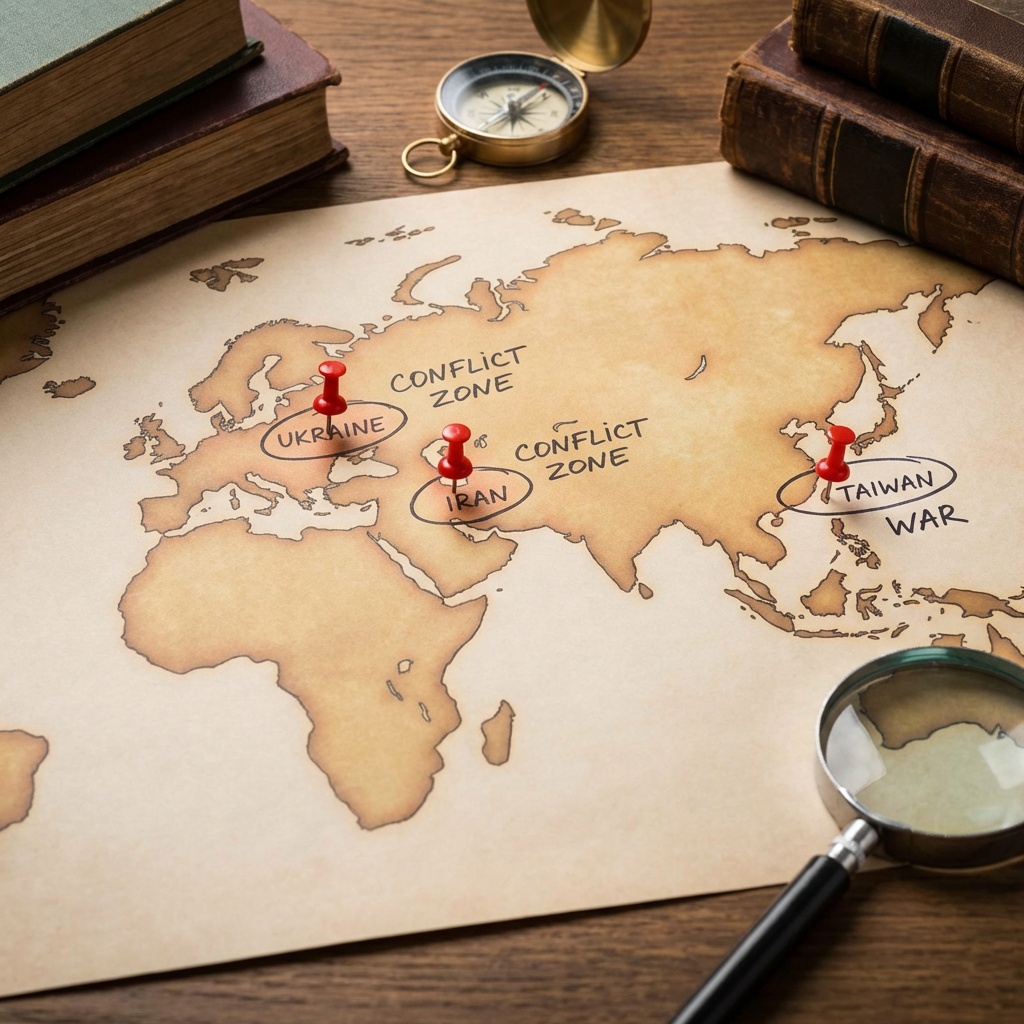
I have warned that (1) Iran can become a proxy war dragging the USA in deeper and deeper using up its missile inventory. At the same time, this is distracting the Administration from Ukraine and Taiwan. The obvious way to defeat the United States is the way Napoleon was defeated. While fighting on multiple fronts certainly contributed to Napoleon’s downfall, describing his defeat as simply a result of “too many wars” is an oversimplification. The core of the problem was strategic overreach: he initiated massive, unnecessary conflicts that bled his forces dry, which in turn allowed a united coalition of European powers to eventually overwhelm him.
China has adopted what is known as the “All-Dimensional Deterrence outside the island chain.” This is a very clear reference to intercepting any U.S. military forces in the Western Pacific Ocean that might attempt to intervene in Taiwan’s defense against an actual attack. Taiwan is already concerned that the US is going through cruise missiles like water in Iran even bringing assets from other regions to protect Ukraine and now Iran. I am concerned that the arrogance of the Neocons really running this war are clearly blinded for they cannot see that engaging in three wars simultaneously will necessitate resurrecting the draft and will add so much debt, the entire system may come crumbling down post 2028.
Iran’s warning that it will strike energy and water infrastructure across the Persian Gulf if Donald Trump follows through on his threat to destroy its power plants has raised fears of mass disruption in a region heavily dependent on desalination for drinking water. Such an attack on Iran’s electricity may hurt the Iranian people where they hope they will rise up against the government. But such an attack will be potentially catastrophic for its Gulf neighbors, which consume around five times as much power per capita. It is electricity that makes the desert cities habitable, in part by powering the desalination plants that produce 100% of the water consumed in Bahrain and Qatar. Such plants use seawater to meet more than 80% of drinking water needs in the United Arab Emirates, and 50% of the water supply in Saudi Arabia. Donald Trump on Sunday gave Iran 48 hours to fully reopen the vital strait of Hormuz to shipping or face the destruction of its energy infrastructure.
The consequences of that will backfile on Trump for it will drastically cut energy from the Middle East and send prices significantly higher and this will shift the markets that are up to now believing the BS that this will be a short war, So far, it appears Trump might back down, but not for long.
We need someone with a cool head here to prevent a major crisis that will forever change the political landscape post-2032.
Posted originally on CTH on January 18, 2026 | Sundance
Last week President Donald Trump officially announced the members of the Gaza Board of Peace; an organization headed by President Trump and tasked to oversee the second phase of his plan to end the Israeli conflict in Gaza, specifically the reconstruction and disarmament of Gaza and Hamas respectively. [SEE HERE]
The members of the “Board of Peace,” chaired by Trump himself, includes Secretary of State Marco Rubio; Emissary Steve Witkoff; Jared Kushner; former British Prime Minister Tony Blair; an American-Jewish billionaire named Mark Rowan; World Bank President Ajay Banga; and Deputy National Security Advisor of the United States, Robert Gabriel. President/Chairman Donald Trump has also appointed Aryeh Lightstone and Josh Gruenbaum as senior advisors to the Board of Peace.
At the same time, President Trump announced another executive body that would operate under the Peace Council to assist with the facilitation of a new Palestinian government, the “Gaza Executive Board.” This structure is intended to manage day to day events on the ground instead of a Hamas loyalist govt. The appointees to the executive board have upset the Netanyahu government of Israel.
According to the White House announcement, the Gaza Executive Board will include: Witkoff; Kushner; Turkish Foreign Minister Hakan Fidan; senior Qatari official Ali al-Thawadi; Egyptian intelligence chief Hassan Rashad; Tony Blair; billionaire Mark Rowan; UAE Minister Reem Al Hashimi; former Bulgarian Foreign and Defense Minister Nickolay Mladenov, who also served as the UN envoy for the Middle East peace process; U.N Representative Sigrid Kagg, and Israeli-Cypriot businessman Yakir Gabbay, who specializes in real estate, technology and international investments.
Additionally, to establish security, preserve peace, and establish a durable terror-free environment, Major General Jasper Jeffers has been appointed Commander of the International Stabilization Force (ISF), where he will lead security operations, support comprehensive demilitarization, and enable the safe delivery of humanitarian aid and reconstruction materials. [link]
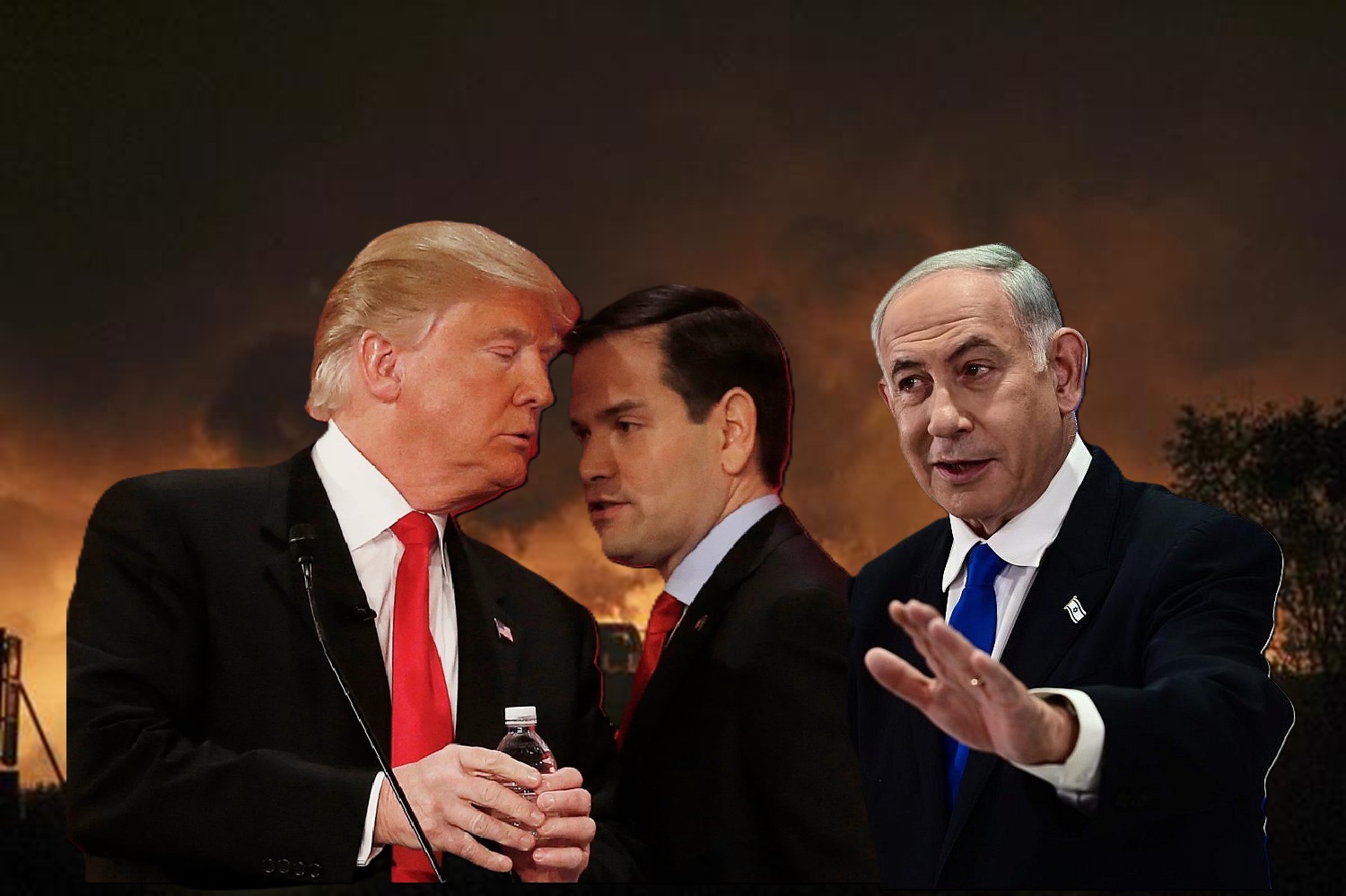
According to Israeli media Netanyahu is not happy, and planning to protest the Turkish, Qatari and UAE appointments to Marco Rubio (not Trump):
“A very unusual statement by the prime minister against the US president, following the publication of the members of the “Executive Committee for Gaza” – which includes, among other things, the Turkish foreign minister and a senior Qatari official. “The announcement of the panel was not coordinated with Israel and is contrary to its policy,” the Prime Minister’s Office said.
“The announcement of the composition of Gaza’s Executive Committee, which is subordinate to the peace conference, was not coordinated with Israel and is contrary to its policy,” the Prime Minister’s Office said, adding that “the prime minister has instructed Foreign Minister Gideon Sa’ar to contact US Secretary of State Marco Rubio on this matter.” (more)
Within the appointments for the executive board, the use of Turkey, Qatar and UAE officials for the governance and reconstruction of Gaza explains the recent parsing of the Muslim Brotherhood chapters as terrorist enablers. When Secretary Rubio made the terrorist designation announcement, the Turkish and Qatari Muslim Brotherhood chapters were notably absent. With the Gaza initiative ongoing, now we see coordinated pragmatism at work.
Rubio chose to focus on Egypt, Jordan and Lebanon to target the Muslim Brotherhood. As we noted, “The Egyptian Muslim Brotherhood were chased out of the country by President Abdel Fattah al-Sisi over a decade ago. The Jordanian chapter is similarly aligned and was previously targeted by King Abdullah. The Lebanese faction is not as well known, but their support for Hamas is well understood.” {Go Deep}
A few things are obvious.
First, President Trump and Secretary Rubio knew in advance they were going to need the strong influences of Qatar and Turkey if they were going to stabilize the interim Gaza reconstruction governing system. Secondly, both Trump and Rubio knew Israeli Prime Minister Benjamin Netanyahu wouldn’t like that; however, pragmatically Trump and Rubio are doing what is in the best interest of the region as a whole, not being narrowly focused on Israel. Additionally, these appointments have upset the Israel-first influencer group in the U.S.
President Trump is restructuring mid-east stability without the need for direct U.S. intervention. Instead, under President Trump’s approach conflict resolution is the responsibility of the regional stakeholders with strong support from President Trump. It is a similar outlook conveyed to Europe about needing to be responsible for their own defense and security solutions while the USA role is supportive in nature.
In this approach the sharp tendrils of U.S. influence start to be untangled, and the national security focus returns to the USA domestically. Mutually beneficial national sovereignty replaces toxic and unending globalist intervention. This is a similar worldview that President Trump also takes toward trade agreements.
Multilateral trade agreements like the Transpacific Trade Partnership (TPP) or the Transatlantic Trade and Investment Partnership (TTIP), or even the NAFTA/USMCA trade agreement are rejected in favor of direct bilateral free trade agreements with individual nations.
In Trump’s trade policy the multilateral deals are dissolved, while the bilateral deals are affirmed. The same outlook holds true for massive institutional agreements that end up with large entanglements often carrying disproportionate costs and disparate benefits. Like NATO, the USA usually ends up with the largest price tag and least benefit from the agreement.
Is NATO/Europe going to fight China over Taiwan? Of course not. If they were, Canada wouldn’t be making deals with Beijing, and Europe would not be allowing China to purchase stakeholder interests in the European car market. The same pragmatic and reasonable outlook applies right now toward how the EU has responded to the Russia/Ukraine conflict; only “willing” if the USA puts our blood and treasure on the line.
This nationalistic outlook is honestly encapsulated in this recent soundbite from President Trump when asked about Canadian Prime Minister Mark Carney making a trade agreement with China. President Trump genuinely doesn’t care. WATCH:
Canada can make whatever deal they want with China; however, that doesn’t mean it will work out well for Canada when the USMCA is dissolved and a new bilateral trade deal between the USA and Canada is renegotiated. Factually, it means Canada will end up in a worse economic place, just look at the history of countries that hugged Big Panda. It is their own independent right to be blind to the risk.
Despite all the warnings from President Trump, Europe became dependent on Russia for low-cost energy; how’d that work out for them? Germany now seriously regrets their green energy approach, but there’s nothing President Trump can do to stop multinational assemblies from being collectively stupid; the only thing he can do is mitigate any collateral damage to the USA.
Instead of European leaders calling President Trump every time Turkish President Recep Erdogan does something against their interests, eventually the group will learn how to engage him individually. In a world of bilateral respect, the lessons from Trump could even have the downstream effect of training the EU to drop their obsession with Russia-bad everything.
The Ukraine conflict could end when Europe finally realizes it’s much easier to turn on a Nordstream gas valve than it is to rebuild 30 German nuclear power plants. President Trump’s refusal to commit U.S. troops to Zelenskyy’s security guarantee will hopefully hasten that conversation.
The same pragmatic realism applies to Greenland. Europe will never respond to any increase in strategic threat presented by China or Russia in the Arctic, and the U.S. will shoulder all the costs if that risk were to materialize. Strategic pragmatism combined with economic realism is why President Trump is focused on the security of the North American continent.
Lastly, there is a segment of MAGA that is angered by President Trump’s interim and necessary approach to removing our foreign policy entanglements in both the European and Mideast continents. Those who are short-sighted don’t see how President Trump is strategically and factually withdrawing U.S. policy from a world of enmeshed dependencies, because in reality charity –along with security– begins at home.
Thankfully, the former Lyndon LaRouche assembly from Promethean Action have begun to recalibrate their British-centric focus, and they’ve started to look at Trump policy beyond the ramifications to London and through the more accurate prism of Trump’s global pragmatism. President Donald Trump isn’t trying to unilaterally destroy British imperialism, not directly. Instead, that old, stuffy and elitist collapse is a consequence of reestablishing independent sovereignty.
Smile, live your very best life and watch it all unfold. After all, Davos is going to be a must-watch event next week.
Posted originally on Jan 2, 2026 by Martin Armstrong |
While the world has focused on Russia/Ukraine, the tensions are rising between the US and China. Let’s face reality. China could move so fast against Taiwan that any hope of U.S. military intervention might arrive way too late to make a difference. China launched a surprise multiday military exercise completely surrounding Taiwan dominating Taiwan’s air space, naval space, and ground forces in an exercise that simulated a total blockade of Taiwan and attacks on its critical infrastructure.
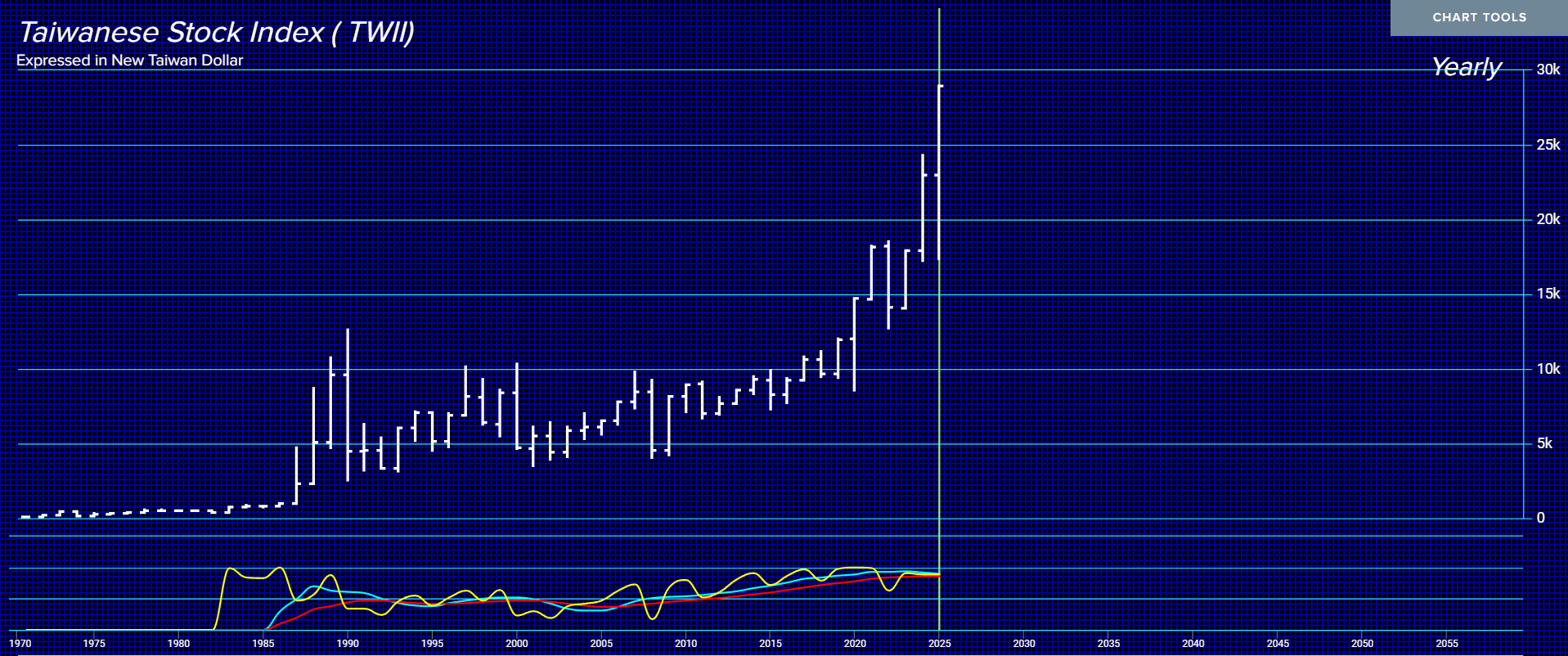
As far as the share market is concerned, 2025 should prove to be the highest annual closing after a 17-year rally. The year 2026 is a Directional Change. We still see January as a Panic Cycle so caution is advisable for a turn back to the downside.
China has adopted what is known as the “All-Dimensional Deterrence outside the island chain.” This is a very clear reference to intercepting any U.S. military forces in the Western Pacific Ocean that might attempt to intervene in Taiwan’s defense against an actual attack.
The State Department has come out and stated for the New Year:
“China’s military activities and rhetoric toward Taiwan and others in the region increase tensions unnecessarily. We urge Beijing to exercise restraint, cease its military pressure against Taiwan, and instead engage in meaningful dialogue,” said State Department spokesperson Tommy Pigott on Thursday. He also added: “The United States supports peace and stability across the Taiwan Strait and opposes unilateral changes to the status quo, including by force or coercion.”
It was the Neocons who were in charge of the Biden Administration even sent Pelosi to Taiwan to instigate a confrontation with China in 2022 as they did in Ukraine to start the war with Russia.
The One China policy in the context of U.S. diplomacy refers to the United States’ acknowledgment of the position held by the People’s Republic of China (PRC) that there is only one China and that Taiwan is part of China. The U.S. does not explicitly endorse the PRC’s claim but “acknowledges” it.
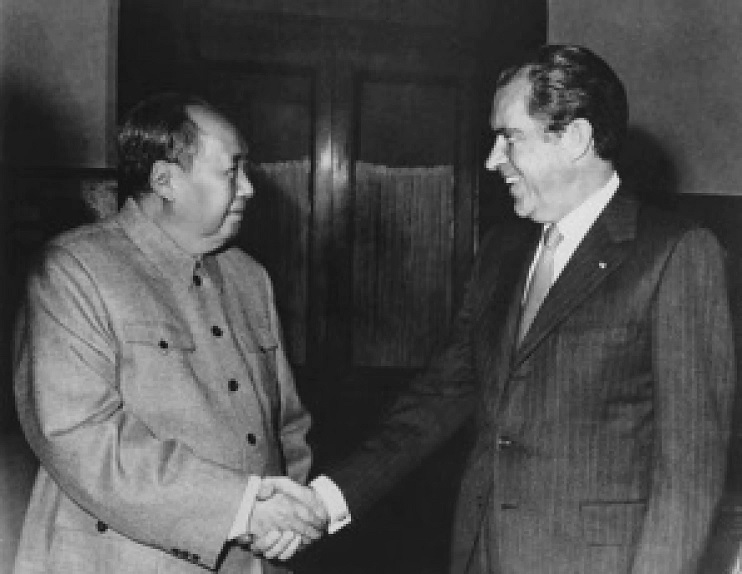
The policy was formally adopted during the process of normalizing relations between the United States and the People’s Republic of China in the 1970s. The first policy was issued By President Nixon known as the Shanghai Communiqué (February 28, 1972). This was issued during President Richard Nixon’s historic visit to China; this is the foundational document. The U.S. side declared:
“The United States acknowledges that all Chinese on either side of the Taiwan Strait maintain there is but one China and that Taiwan is a part of China. The United States Government does not challenge that position.“
Later under President Jimmy Carter, the U.S. switched diplomatic recognition from the Republic of China (Taiwan) to the People’s Republic of China. This became known as the Joint Communiqué on the Establishment of Diplomatic Relations (January 1, 1979). The U.S. “recognizes the Government of the People’s Republic of China as the sole legal Government of China” and “acknowledges the Chinese position that there is but one China and Taiwan is part of China.”
Then in 1979, Congress passed by the following normalization known as the Taiwan Relations Act (April 10, 1979). This act provides a legal framework for continuing unofficial relations with Taiwan and commits the U.S. to providing Taiwan with defensive arms. It creates a persistent tension with the commitments in the Joint Communiqués.
Then the U.S. stated it “does not seek to carry out a long-term policy of arms sales to Taiwan” and intended to reduce arms sales gradually. This was the August 17 Communiqué (1982).
Consequently, the U.S. One China policy was articulated in the 1972 Shanghai Communiqué and cemented in the 1979 Normalization Communiqué. It is based on the Three U.S.-China Joint Communiqués and is fundamentally different from the PRC’s One China Principle, which insists Taiwan is an inalienable part of China. The U.S. policy is a deliberate, strategic ambiguity that acknowledges the Chinese position without endorsing it, while maintaining substantive unofficial ties with Taiwan.
The Pelosi visit Taiwan in August 2022 was a serious violation of the One-China principle and the provisions of the three U.S.-China joint communiqués. It infringed upon China’s sovereignty and territorial integrity, and sent a severely wrong signal to the “Taiwan independence” separatist forces. The Chinese government firmly opposes any form of official exchanges and military contacts between the U.S. and Taiwan, and has taken necessary measures to resolutely safeguard national sovereignty and territorial integrity. Taiwan has been an inalienable part of China’s territory since ancient times, and the Chinese government is unwavering in its commitment to achieve complete national reunification.
Pelosi went to Taiwan as a symbolic confrontation to boost Taiwan Independence like John McCain went to Ukraine to inspire that revolution in 2014. In both cases, it appears that these were deliberate actions to instigate confrontation on both side of the world and have driven China and Russia together reversing the Objectives of Nixon’s policies from the start. What if a Russian politicians stood on the steps of Capit0l Hill and declared Russia is behind you, overthrow your government? But the Western Press looks the other way when Pelosi and McCain deliberately seek to usurp American foreign policy.
Pelosi’s trip on 2022 has definitely set in motion rising tensions in 2023 which will escalate into 2027.
Posted originally on Oct 9, 2025 by Martin Armstrong |
Taiwan’s global dominance of semiconductor chip manufacturing has been at the forefront of the US-China technology war. The focus has been on Taiwan, leaving other avenues of Chinese influence ignored. China used loopholes in US law to purchase over $38 billion in chip-making technology in the last year alone, marking a 66% rise in imports since 2022, when legislation was passed to restrict Chinese access to US chip technology.
Military modernization has become the focal point of concern. These advanced chips have been utilized to develop highly detailed surveillance systems, hypersonic weapons, and cutting-edge AI technology. US intelligence believes national security is at risk and there must be an effort to “impede the PRC’s ability to procure and produce the technologies necessary for its military modernization” to “protect our world-leading technologies and know-how so they aren’t used to undermine our national security.”
The US House of Representatives Select Committee on China is calling for a broad ban on importing US chip technology to China, following the release of a report detailing how Chinese firms have bypassed loopholes in US law to purchase this technology legally.
“These are the sales that made China increasingly competitive in the manufacture of a wide range of semiconductors, with profound implications for human rights and democratic values around the world,” the report said. China accounted for 39% of aggregate sales to Applied Materials, Lam Research, KLA, ASML, and Tokyo Electron. Legislation has curbed but not deterred sales to China.
A spokesman for Tokyo Electron stated that sales to China have declined since 2022, when the U.S. Department of Commerce’s Bureau of Industry and Security (BIS) implemented a law entitled “Export Controls on Advanced Computing and Semiconductor Manufacturing Items to the People’s Republic of China.” The legislation expanded on Export Administration Regulations (EAR) to include foreign-produced advanced computing items and semiconductor chips.
US businesses seeking to conduct business with Chinese semiconductor companies must obtain a license that is notoriously difficult to acquire. The latest report revealing the $38 billion in sales has raised bipartisan concern, and increased restrictions are expected.
This brings the attention back to Taiwan. China may not purchase advanced technology from the US, and if Taiwan were to move 50% of production to US soil, China would certainly lose its competitive edge. Furthermore, China is also not willing to share technology with the US–why would enemy nations share the most crucial components needed to engage in next-generation warfare? China reclaiming Taiwan would eliminate America’s access to semiconductors. Both China and the US can tariff each other to death, but neither can afford to lose the jewel of Taiwan.
Posted originally on CTH on October 5, 2025 | Sundance
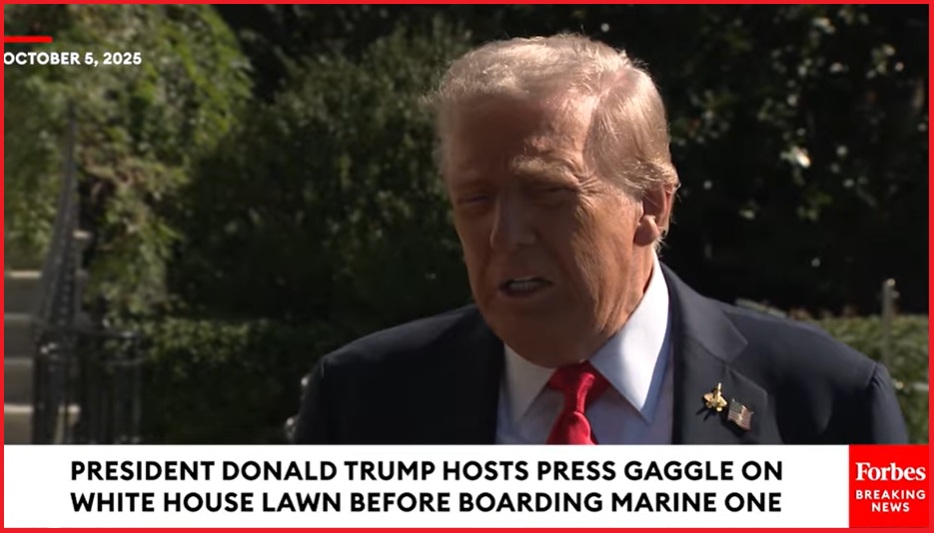
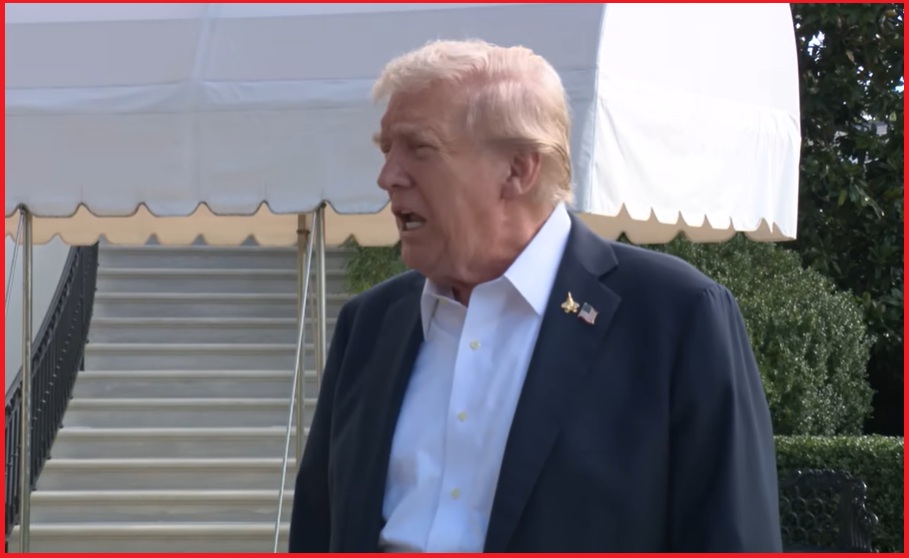
President Trump pauses to answer press pool questions as he departs the White House to attend a Navy celebration event in Virginia.
President Trump took questions on Ukraine, Russia, Gaza, Chicago ICE efforts, Portland Antifa activity, Venezuela drug combat efforts and Israeli hostages getting released. WATCH:
Posted originally on Oct 2, 2025 by Martin Armstrong |
Taiwan will lose protection if it fails to move semiconductor chip manufacturing to the United States. The nation must determine which is more valuable—US protection against Chinese threats or maintaining 95% of the world’s chip production.
The Taiwan Semiconductor Manufacturing Company (TSMC) agreed to invest $100 billion in manufacturing plants in the US earlier in the year, but that has not been a sufficient deal for the current administration. Cornering 95% of the market, the US cannot risk losing its main semiconductor manufacturer in the event that China fulfills its promise to absorb Taiwan as a Chinese province.
US Commerce Secretary Howard Lutnick admitted it is a “herculean task” to move 95% of the world’s chip production 9,000 miles away. “The model is: if you can’t make your own chips, how can you defend yourself, right?” Lutnick argued. Only 2% of Taiwan’s chip manufacturing occurs on US soil.
Nvidia CEO Jensen Huang said it could take up to two decades for supply chain independence, adding, “It’s not a really practical thing for a decade or two.” TSMC has emphasized that its most advanced processes will remain in Taiwan to preserve the “silicon shield”—its economic leverage against Chinese aggression. America will need to guarantee securities to Taiwan, otherwise, what good is it to move production? US facilities will begin to focus on mid-to-high-end nodes that should meet 30% to 50% of US consumer demand by 2030. However, Taiwain demands that the overall global supply remain on the island.
President Tsai Ing-wen is wanted by the Chinese government for defying the One China policy. He has been eager to form a strong alliance with the US as he knows China can only be kept at bay for so long. “In the face of authoritarian expansionism and the challenges of the post-pandemic era, Taiwan seeks to bolster cooperation with the United States in the semiconductor and other high-tech industries. This will help build more secure and more resilient supply chains. We look forward to jointly producing democracy chips to safeguard the interests of our democratic partners and create greater prosperity,” Taiwan’s president stated in 2024.
Trump told Taiwan that it must raise its own defense budget from 2.45% of GDP to around 10%. He has likened America to “an insurance company” for Taiwan and believes the nation should pay for protection.
A large semiconductor chip manufacturing just so happened to host a conference at the same venue in Orlando, Florida, where we held the World Economic Conference in 2024. An employee of mine spoke with one attendee who said shareholders were concerned that their manufacturing headquarters were located in Taiwan. I’m told the general consensus was that even in the event of China following through with its One China policy, the company believed that China would not want to lose such a lucrative business deal with the United States. Yet, what would happen if two nations were at war? Cutting off America’s supply of semiconductors would cripple the tech industry.
Nvidia, Advanced Micro Devices (AMD), Broadcom, Intel, MediaTek, Qualcomm, and others, with North America purchase over 65% of Taiwanese chips. The US-China tensions and Taiwan’s fragile geopolitical position make “Made in Taiwan” a risky bet for Western countries despite the critical importance of its semiconductor manufacturing. Taiwan must decide if the risk of foreign invasion is surrendering half of its share of production.
Posted originally on CTH on September 26, 2025 | Sundance
President Donald Trump holds an impromptu press conference as he departs the White House.
President Trump noted a potential deal with the Gaza conflict has been worked out. Additionally, President Trump took questions about the indictment of former FBI Director James Comey, saying he doesn’t doubt the accuracy of the charges as Comey did factually lie to congress. WATCH:
.
President Trump also spoke to the media upon arrival in Farmingdale, New York, where he will attend the Ryder Cup golf tournament.
Posted originally on CTH on September 25, 2025 | Sundance
President Donald Trump signs executive orders from the Oval Office to dismantle ‘domestic terrorism networks’ and declare a deal on TikTok. Livestream Links Below. WATCH:
I have created this site to help people have fun in the kitchen. I write about enjoying life both in and out of my kitchen. Life is short! Make the most of it and enjoy!
This is a library of News Events not reported by the Main Stream Media documenting & connecting the dots on How the Obama Marxist Liberal agenda is destroying America





 Centinel2012