NOAA/NCDC About To Get Ensnared In Their Tangled Web


When you start tell fibs it gets harder and harder to keep them all straight!

Tony Heller's avatarReal Climate Science

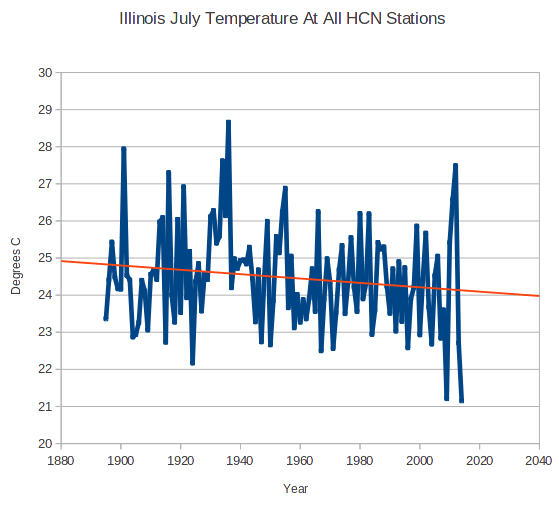
The Illinois State Climatologist says July was the coldest on record

The state climatologist says last month’s relative chilly temperatures tied the record for the coolest July in recorded Illinois history.  And as data are revised he says it’s likely this July will break the record.

July ties the record for coolest ever in Illinois – Consumer News – Crain’s Chicago Business

NCDC’s actual thermometer data shows that the state climatologist is correct, and that Illinois summers have been cooling since the 19th century.

ScreenHunter_1526 Aug. 02 07.12

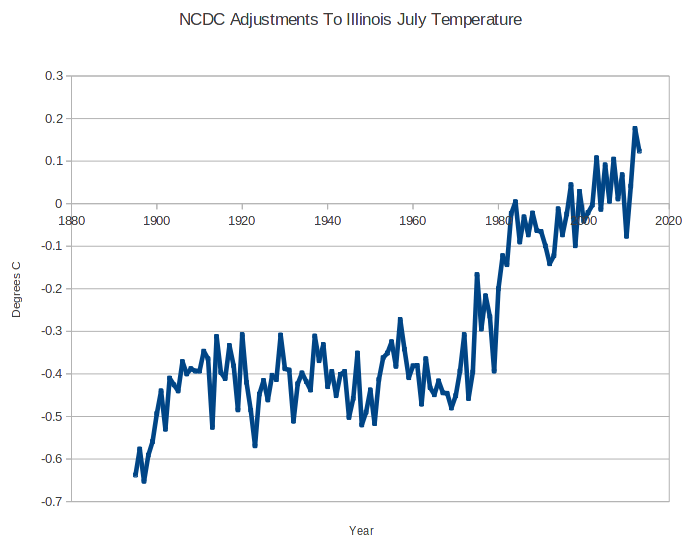
This puts NCDC in a very bad position, because they are massively altering Illinois July temperatures, to hide the cooling trend. How will they handle it?

ScreenHunter_1527 Aug. 02 07.20

View original post

Proof That US Warming Is Mann-Made


Correlation is proof we don’t need causation!

Tony Heller's avatarReal Climate Science

This post is not a joke, but is stunning.

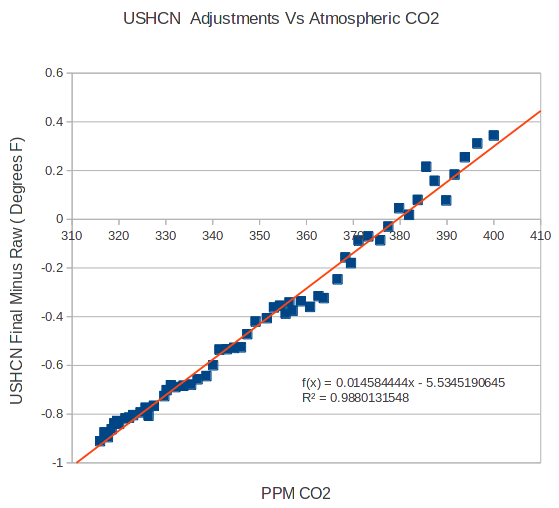
The graph below shows the relationship between atmospheric CO2 and the magnitude of USHCN data tampering. There is almost perfect correlation between the amount of CO2 in the atmosphere and how much cheating our friends at NCDC are doing with the US temperature record.

ScreenHunter_1618 Aug. 03 09.45

Raw: ftp://ftp.ncdc.noaa.gov/pub/data/ushcn/v2.5/ushcn.tavg.latest.raw.tar.gz
Final: ftp://ftp.ncdc.noaa.gov/pub/data/ushcn/v2.5/ushcn.tavg.latest.FLs.52i.tar.gz

Unbelievable. What on Earth are these guys up to? Perhaps I have it backwards. Maybe data tampering drives CO2?

“Our algorithm is working as designed”

– Recent NCDC press release

“If the facts don’t fit the theory, change the facts”

– Albert Einstein.

View original post

Progress At NASA Over The Past 45 Years


NASA as we knew it back then is long gone … 😦

Tony Heller's avatarReal Climate Science

Forty-five years ago NASA could send people to the moon. They can’t do that any more, but they can generate fraudulent climate data much faster than previous generations could have ever dreamed of.

ScreenHunter_1651 Aug. 04 06.24

View original post

Progressives don’t let facts get in their way!


Leaked Memo Gives Away Dems’ ‘Extreme Weather’ Talking Points

Re-Post from the Daily Caller News Foundation by Michael Bastasch 4:38 PM 08/01/2014
Email Michael Bastasch

Democrats are working hard to convince the public that regulations to limit carbon dioxide emissions are necessary to avoid economic and ecological catastrophe, according to a memo obtained by The Washington Post.

The memo from Senate Budget Committee Chairman Patty Murray, a Washington Democrat, tells members how to talk about global warming’s budgetary impact. The memo details how “disaster relief; transportation and infrastructure; national security and agriculture” will all be affected by global warming, reports the Post.

“Climate change, if left unaddressed, will both weaken economic growth and impose additional direct budgetary costs on the federal government,” Murray wrote in the memo sent out Friday. “As a result, climate change poses an increasing threat to the federal government’s already challenging long-term fiscal outlook.”

Murray’s memo puts a lot of focus on budgetary impacts due to “extreme weather” — a major talking point of President Obama during his second term. Murray argues that global warming will increase extreme weather events, like hurricanes and droughts, therefore increasing disaster relief, infrastructure and other types of spending.

“Without action, climate change will undoubtedly affect our country’s ability to produce goods and services, costing jobs and weakening growth,” Murray wrote. “These effects are already being felt due to events such as Hurricane Sandy—which was estimated to have caused $65.7 billion in economic damage—as well as the massive droughts gripping parts of the country.”

Democratic claims that “extreme weather” was becoming more common as carbon dioxide levels increase have been disputed by scientists who say the data tells a different story.

“It is misleading and just plain incorrect to claim that disasters associated with hurricanes, tornadoes, floods or droughts have increased on climate timescales either in the United States or globally,” University of Colorado climate scientist Dr. Roger Pielke said in his testimony before the Senate Environment and Public Works Committee last year. “It is further incorrect to associate the increasing costs of disasters with the emission of greenhouse gases.”

“Hurricanes have not increased in the U.S. in frequency, intensity or normalized damage since at least 1900,” Pielke added. “The same holds for tropical cyclones globally since at least 1970.”

But Democrats have not relented in their push to convince the public that extreme weather will continue to get worse. The Murray memo cites reports by the Risky Business group and the White House Council of Economic Advisors, both of which argue global warming will put high costs on the economy if nothing is immediately done to tackle the issue.

The Risky Business report says that sea level rises could cause up to $507 billion in property damages by 2100 and that farmers in some states could could see crop yields declines by up to 70 percent. The Risky Business group is co-chaired by billionaires Tom Steyer, former New York City Mayor Michael Bloomberg and former Treasury Secretary Hank Paulson.

Read more: http://dailycaller.com/2014/08/01/leaked-memo-gives-away-dems-extreme-weather-talking-points/#ixzz39NrGSDth

Wind Turbines & White Elephants


The Real Inconvenient Truth
Re-Post from Not A lot of People Know That blog July 27, 2014

By Paul Homewood

With thanks to  Peter Austin and Paul, who compiled the lists.

Following the story about the Welsh Govt’s £48K wind turbine in Aberystwyth, which has only produced £5 worth of electricity in the last five years, readers have sent me some more examples of wasted money.

1) Dover

Dover Express report:

THE much-trumpeted £90,000 wind turbine installed outside the council offices has generated just a tenth of the energy it should have done, the Express can reveal.

The 17-metre machine, erected outside the Dover District Council headquarters in Whitfield, was supposed to generate 45,000 kW hours per year, producing 7 per cent of the electricity used in the offices.

But the Express can reveal that just 22,080 kWhrs has been generated in total since November 2007 – less than 4,500 kWhrs per year.

Critics have called the project a “white elephant”, but the authority has defended the scheme and said it has “raised the profile” of renewable energy by educating people across the district.

At 15 pence/KWh, the value of electricity produced is just £675 pa. Assuming (very generously!) no maintenance or interest charges, the payback is 133 years!

Interestingly, the paper reports:

Responding to a Freedom of Information Act request about costs and savings six months after the grant-funded turbine was installed, DDC said at the time: “It should save 45,000 kWhrs per year, producing 7 per cent of the electricity used in the offices.”

But, this week, it appeared to backtrack from the numbers, saying the 45,000 kWhrs figure was the upper limit it could generate and was only achievable with constantly favourable wind speeds and direction.

A spokesman said: “The 45,000 kWhrs quoted is the optimum generation – in order to achieve this, the wind speed would always need to be at the maximum speed that the turbine could operate safely in, and the wind direction would always have to be favourable

Confusion between capacity and output is commonplace. Did the council get its sums wrong in the first place? Or did they knowingly waste £90K of ratepayers money, just to “raise the profile of renewable energy?

2) Derby

We then have the story from the Derby Telegraph of two turbines owned by Severn Trent Water, which have yet to produce any power, despite being ready last December.

The reason? They interfere with the radar at nearby East Midlands Airport.

They are now waiting for the airport to install new radar equipment to “ensure that the airport can operate safely”. I wonder who will pay for that?

3) Milton Keynes

It gets worse, as the Milton Keynes Citizen reports!

Three costly wind turbines built in the grounds of a school are now to be dismantled – after allegedly generating just £3.67 worth of electricity in NINE years.

Milton Keynes Council paid £170,000 for the giant turbines at Oakgrove School at Middleton .

But shortly after the school opened in 2005, the structures were switched off for health and safety reasons due to a manufacturing defect.

A source told the Citizen: “It all seems to be an extraordinary waste of money. None of it is the fault of the school itself – they’ve just been stuck with these huge things that have proved useless.”

The turbines were provided by a German company which has since gone into liquidation, leaving the council unable to get compensation

4) Hinckley

The Hinckley Times have the story of the £40K turbine at North Warwickshire and Hinckley College, which has used more electricity than it has generated.

An eco-friendly wind turbine installed to save energy at a Hinckley college has been labelled a “disaster” after revelations it has expended more power than it has produced.

In its three year lifespan the 31.5ft turbine – thought to have a price tag of around £40,000 – has turned only 8% of the time and has not created electricity but used enough to run an energy hungry household for two years.

When installed on the roof of the new North Warwickshire and Hinckley college campus on Lower Bond Street in September 2011, education chiefs lauded it as part of their commitment to embed sustainability across all college activities and a weapon in the fight to cut carbon emissions by 35% within four years.

But since its set up the vertical axis blades of the turbine have only been spinning for 8% of the time and only been working for 38% – during the remaining 62% of the time, because of its settings, conditions have been ‘unsuitable’ – ie the wind at 5m/s, a fresh breeze – has been deemed too strong and it switches off.

This means the device has used 497 kHw more than it has made – enough to run a fridge for a year, a microwave daily for half-an-hour for two years and a tumble drier daily for six months.

Figures from the college show (based on the average price of a kHw at 17p) the turbine has used £1,730 worth of electricity, twice the annual bill of a high energy usage household.

But what the hell? As was the case in Dover, it is apparently OK to waste taxpayers’ money, just to promote “sustainability”.

Andy Crowter, group director of facilities and estates at North Warwickshire and Hinckley College, said:

”The turbine is not there primarily to create income but to promote sustainability – one of the most important challenges facing the UK. The turbine is a symbol of the college’s awareness of its environmental responsibilities, an icon of good practice to its students and recognition of the college’s award winning Carbon Reduction Plan. “

5) Canada

And it’s not just in Britain, as the National Post report:

Several Prince Edward Island rinks that were convinced to make the expensive conversion to wind power, but never saw the promised savings, are now trying to get rid of the trouble-plagued turbines and win compensation for their troubles.

“We went into debt to purchase this windmill on the promise that it would make us money and it would help us with our power costs,” said Tom Albrecht, vice-president of the South Shore Actiplex in Crapaud, P.E.I., which spent $70,000 and received another $230,000 from the federal and provincial governments to install a turbine.

“The bottom line is buy us out and give us our money back.”

Last week, the Wind Energy Institute of Canada apparently decided to shut down turbines at at least some of the rinks, as it worked through technical problems, according to Darin Craig, past president of the South Shore Actiplex board.

6) Whitfield

The Council at Whitfield, Kent have scrapped the turbine only installed in 2007, as Kent Online report:

The wind turbine at the district council offices at Whitfield, fitted in 2007, is to be scrapped.

“With time and use, the turbine developed a fault in 2012.A council spokesman said: “The turbine was important as not only did it generate renewable energy, but it helped to raise the profile of environmental matters, and was used for educational purposes.

“The turbine was assessed for repairs, but as well as the cost of the repairs, it was clear that the industry and technology had developed, and that the company who supplied the turbine had ceased trading, causing difficulties regarding the availability of parts and servicing arrangements.

“It was considered that the repair costs and ongoing maintenance issues meant that it was no longer viable and sustainable to keep the turbine.

Once again we see the words “raise the profile”.

7) Huddersfield

Five years after installing two turbines on the Civic Centre roof at a cost of £100K, Huddersfield Council are to take them back down, as the Huddersfield Examiner explain:

THE Civic Centre turbines are to be taken down.

Kirklees Council last night announced that the landmark windmills will be removed – five years after they cost £100,000 to install.

One of the 27-feet turbines has been broken for the past 16 months.

Kirklees installed the two windmills in July, 2006, to raise awareness of renewable energy among the thousands of motorists who drive along the ring road every day.

But yesterday officials admitted defeat and said the turbines would be taken down – and new ones installed at a windier location.

A council spokesman said: “It had become clear that carrying out repairs was not the most effective or value-for-money option, so the council has now found a different way of solving the problem.

“We have reached an agreement with the turbine suppliers Proven Energy, who will remove both turbines from the Civic Centre roof over the coming months and will provide the council with two new turbines, free of charge and with longer warranty periods than the current turbines.

“The council’s plan is to locate the new turbines in an open location where the energy generated will be greater than at their current site.”

The spokesman added: “Having one of the current turbines out of action gave us the chance to re-assess the situation. We have come up with the most common sense, effective way forward.

“The new location is yet to be finalised, but we are working with Proven Energy to find a site within the council’s ownership.”

The six-kilowatt windmills cost £101,000 to buy and install in 2006.

Kirklees came up with £70,000 and a Government grant covered the rest.

In 2008 the turbines brought £2,078 into council coffers, but cost £6,431 to maintain and repair.

Although Proven Energy will arrange for the turbines to be taken down and replaced, it hardly seems likely they will be doing this out of goodwill. Meanwhile, Huddersfield ratepayers can feel satisfied that their money has gone to “raise awareness of renewable energy”.

8) Wotton

The Gazette have the story of this wind turbine, that had to be removed for being too noisy:

A SCHOOL in Wotton has been forced to remove its controversial wind turbine after receiving a noise abatement notice.

Blue Coat Primary School’s prized 15-metre turbine was taken down in August after standing unused for a number of months.

Robert Weaver, environmental health officer at Stroud District Council, said: “As soon as it was operational, it was giving out unacceptable levels of noise at quite a lot of dwellings nearby, as well as some quite far away.”

The school had been warned when it was granted planning permission in 2009 that if noise were to become an issue the turbine may have to be decommissioned.

Specialist engineers had worked with the school over a period of about eight months to try to reduce noise, but modifying the blade tips and even shortening the blades themselves had little effect.

Simon Weston, chairman of governors at Blue Coat School, said the school had taken a reluctant but pragmatic decision that they had reached the end of the road after the physical adaptations to the turbine provided no improvement to the noise.

Wotton resident Michael Toft, 61, who lives just 100 metres from the school, said he was relieved that the threat of permanent noise intrusion in his house and garden had been removed.

He said: “The turbine wasn’t just noisy in high winds. It had a whole repertoire of sound effects, ranging from an inexorable swishing in light winds, through to chuffing like a never-arriving steam train in moderate winds, with the piece de resistance being a full-blown impression of a helicopter hovering over the field outside our garden when the wind was strong.”

He added: “On a visual note, I don’t think it’s right that structures like this should be sited prominently on skylines within the Cotswolds AONB.”

The school is now hoping to pass the turbine on to be used elsewhere, as the equipment is entirely functional.

Grant-funded, largely from the public sector, the turbine was part of the school’s renewable energy drive. Solar panels are also installed on site.

It was hoped that the turbine would engage children at Blue Coat with energy issues, as well as reduce the school’s carbon footprint and electricity bills.

Cllr Dennis Andrewartha, executive member for planning for Stroud District Council, said: “We explored every possibility to see if the school’s wind turbine could stay up and generate power but ultimately it was too noisy and affected too many residents.

“Since it went up we have had around 40 complaints about the noise nuisance and our officers have been out to assess the problem a number of times. We are great supporters of green energy so it was with reluctance that we had to see this wind turbine come down.”

Mr Weston added: “We still take environmental education seriously. It’s nice to have practical things you can point at, but certainly our interest in making it [renewable energy] an important part of the curriculum is ongoing.”

Since when was “renewable energy” an “important part of the curriculum”? More to the point, if the noise was so bad 100 metres away, what damage has been to done to children’s health at the school itself, who would be exposed to it for several hours every day?

9) Exeter

At the home of the Met Office, Exeter City Council will probably never recoup the cost of their Civic Centre turbines, as the Express & Echo report:

THE money Exeter City Council spent on installing wind turbines at its city centre base is unlikely ever to be recouped in energy savings, the Echo can reveal.

The authority invested £5,000 putting three wind turbines on the roof of the Civic Centre in 2007.

But it could take up to 50 years for the turbines to match that sum in savings. And as the average shelf-life of a turbine is understood to be 20-25 years, it is likely to have been a loss-making enterprise.

The city council has defended the outlay and revealed savings made through a number of other green initiatives are more considerable.

But campaigners for lower taxes have criticised the move as a “PR project” which was not a serious effort to save money.

The turbines were aimed at helping the council meet its Government-set target of reducing CO2 emissions and it was one of the first local authorities to take the step.

A council spokesman said it was not possible to quantify what the turbines were powering but added: “We estimate the energy produced saves the council in excess of £100.”

However, Maurice Spurway, spokesman for Exeter Friends of the Earth, said: “There are some occasions when it is more important to focus on the message of reducing carbon dioxide emissions than the economy of it.

“Survival of the planet is more important and reducing CO2 as we progress towards the 22nd century is crucial, so anything which has been done in this direction is the right thing to do.

10) Greenock

Up in Scotland, Inverclyde Academy were reported in 2011 to be ready to scrap their turbine, installed just three years earlier;

Inverclyde Academy was hailed as the first school in the UK to have one of the 50-kilowatt wind turbines when the building opened to pupils in December 2008.

The turbine is meant to provide 15 to 25 per cent of the school’s annual energy requirement.

But the turbine hasn’t generated any power for more than a year.

It has been plagued by technical problems, including a faulty gearbox, and its manufacturer has gone bust.

Now Inverclyde Council says if the turbine cannot be repaired, it may have to be taken away.

11) Portland

Down in Dorset, another turbine installed at a Primary School has had to be shut down as it was killing too many seabirds, as the Dorset Echo relate:

A £20,000 wind turbine brought in to make a Portland primary school more environmentally friendly has been turned off because it was killing seabirds.

Headteacher Stuart McLeod, of Southwell Community Primary School, said they ‘tried everything’ to solve the problem but had no choice but to shut it down.

In the past few months the nine metre high generator has taken the lives of 14 birds – far higher than the manufacturer’s estimate of one per year.

The wind turbine was installed at the school around 18 months ago, thanks to grant funding, to provide six kilowatts of power an hour.

Mr McLeod said: “We’ve got the ideal location for wind power but unfortunately seagulls kept flying into it.

I guess that really taught the kids to be “environmentally conscious”!

12) Climping, West Sussex

Despite being on the coast, this turbine at the Climping Village School had to be shut down, because it was not producing enough power. From the Bognor Regis Observer:

A WIND turbine has been removed from Climping’s village school because it generated too little power.

The 9m-high turbine was installed at St Mary’s Primary School in 2005 as part of an experiment to see if the winds along the coast would make it sustainable.

The pilot project was designed to test wind energy technology, reduce school energy costs and provide an educational tool for pupils.

But a West Sussex County Council spokesman said: “The decision to remove the turbine has been taken because of a series of factors, but mainly because the system has not performed well.

“Energy-saving costs at the school of £550 between April 2011 and March 2012 were not enough to cover the costs of maintaining and insuring the turbine. The company which manufactured and installed the turbine has also gone into liquidation.”

The turbine’s cost was mainly covered by external grants and the county council met the short-term running costs. It was considered unsustainable for the school to take on these costs.

Yet another company gone into liquidation.Take the grant money and run!

There are no doubt hundreds of other examples up and down the country. A lot of pain and wasted money could have been avoided if attention had been paid to this study from Southampton University back in 2009:

The final report demonstrated conclusively that micro-wind turbines installed on buildings performed very poorly, some consuming more power than they generated. Even at the best sites in exposed and windy rural areas, annual yields were far lower than the estimates predicted by industry. None of the devices mounted on buildings would pay for themselves within the expected life of the turbines.

But when it’s not your money you’re spending, then what the hell?

Get Ready for the New England Power Shortage


The Grid almost went down last winter and this summer is colder than normal if it get as cold as last winter or colder — well be prepared!

Governors are already meeting in emergency session.

Re-Post from The American Spectator By 7.18.14

UPI
In 1980, under the first administration of Governor Jerry Brown, California decided it wasn’t going to build any more power plants but would follow Amory Lovins’ “soft path,” opting instead for conservation and renewable energy. By 2000, with the new digital economy sucking up electricity, a drought in the Pacific Northwest cut hydropower output and the state found itself facing the Great California Electrical Shortage.

You know what happened next. For weeks the Golden State struggled to find enough electricity to power its traffic lights. Brownouts and blackouts cascaded across the state while businesses fired up smoke-belching diesel generators to keep the lights on. Governor Gray Davis finally got booted out of office but the state didn’t rescue itself until it threw up 12,000 megawatts of new natural gas plants.

At that point California officials decided that the whole thing had been engineered by Enron and other out-of-state merchant providers and the charges and lawsuits flew. No Democrat ever learned a lesson. The state is now 60 percent dependent on natural gas for its electricity — twice the national average — and its electric bills are almost twice that of surrounding states. Industry is headed for the door.

So how have California’s liberal counterparts on the East Coast managed to avoid the same fate? You’d think a region that could produce Elizabeth Warren and Bernie Sanders plus legions of college students trained to hate fossil fuels would have no trouble pursuing the same green dreams. Well, it’s about to happen. In the next few years New England will be facing a full-scale power shortage.

Last week the governors of the six New England states met in an emergency session at Bretton Woods, New Hampshire, to discuss what to do about the pending crisis. Significantly, they asked the premiers of five of Canada’s provinces to attend. That makes sense because if the region is going to get electricity from anywhere it is probably going to be from north of the border.

In a hell-bent campaign to rid itself of any form of dirty, messy “non-renewable” energy, New England has been closing down coal and oil plants for the last decade. In 2000, 18 percent of New England’s electricity came from coal and 22 percent from oil. Today it’s 3 percent coal and 1 percent oil. Meanwhile, natural gas — the fuel that everybody loves until you have to drill for it — has risen from 15 percent to a starkly vulnerable 52 percent, just behind California.

There’s only one problem. New England doesn’t have the pipelines to bring in the gas. Nor is anyone going to allowed to build it, either. Connecticut and Massachusetts are only a short distance from eastern Pennsylvania, where fracking for natural gas has leapfrogged the Keystone State into third place for overall energy production. Yet a proposal by Sempra Energy of Houston to expand its existing pipeline from Stony Point, New York, has already met fierce resistance from people who want nothing more to do with fossil fuels and construction is highly unlikely.

It’s not as if it’s not needed. Last winter, when record low temperatures hit, there just wasn’t enough gas to go around. Utilities that service home heating have long-term contracts and get first dibs. You can’t stockpile gas the way you stockpile coal, so power plant operators were left bidding against each other for what was left. Prices skyrocketed from $4 per mBTU to an unbelievable $79 per mBTU and electricity prices spiked to ten times their normal level. Just to put things in perspective, during the first four months of last winter, New England spent $5.1 billion on electricity. In the whole of 2012, it had spent only $5.2 billion.

And that’s just the beginning. New England is now limping along with 33,000 megawatts of electrical capacity, which barely meets its needs. At one auction last winter, the New England Independent Systems Operator, which manages the grid, came up 145 megawatts short — an almost unheard of occurrence. Yet in the next two years the region will be closing down 1/10th of its capacity in a bid to rid itself of anything that does not win favor with environmentalists. First to go will be the last of four coal plants at Salem Harbor, which can no longer meet the EPA’s new regulatory requirements. Next Brayton Point, the largest remaining coal plant, will be retired for the same reason. Finally, a continual barrage of protests and legislative attacks has persuaded Mississippi-based Entergy to close the Vermont Yankee Nuclear Station and “let the Yankees freeze in the dark,” as they used to say in Texas and Louisiana. The reactor provided 75 percent of Vermont’s electricity and 4 percent of the power for the region, carbon-free.

“It’s going to be very tricky for New England over the next three to four years,” says Gordon van Welie, CEO of the Independent Systems Operator of New England, which run the grid. Van Welie begged the region not to close down Vermont Yankee and Brayton Point, but who listens to anyone who understands electricity anymore? Interestingly, New England only got through last winter by regularly importing 1,400 megawatts from Indian Point, the two nuclear plants on the Hudson in neighboring New York. Says New Hampshire energy consultant William P. Short III, “Without Indian Point, New England would have been toast.” As you might expect, New York Governor Andrew Cuomo and most of the state’s Democratic politicians are trying to close down Indian Point as well.

Naturally, all this is falling hardest on people who hold blue-collar jobs. The Gorham Paper and Tissue Company in New Hampshire was forced to reduce production and lay off workers in the depths of last winter. The Great Northern Paper Co. in Maine laid off 200 workers and closed down for four months. In fact, if you want to know why we have “income inequality” and a “disappearing middle class,” look no further than the class warfare being waged on American industry by upper-educated elites snugly ensconced in the digital economy or sitting in Washington writing regulations telling everybody else what to do. “We’re going to have an economy that operates only nine months of the year,” complains Maine Governor Paul LePage, the only Republican in the region.

So where will New England be getting its electricity? Almost daily the newspapers are filled with stories about how the region is “going green” and about to enter the delightful world of “clean energy.” It’s sheer fantasy. No one has the slightest notion of what it would entail. You would have to cover half of the Green Mountains with windmills to recover the power lost at Vermont Yankee and even then it would only work when the wind is blowing. Almost as soon as the news came about the closing of Vermont Yankee, one company proposed building a power plant that burned wood in the wilds of western Massachusetts. However, someone soon discovered that burning wood produces smoke and carbon dioxide as well. It was quickly shouted down. It’s probably just as well. At one point Massachusetts drew up plans to harvest wood for electricity and discovered it would soon strip the state of its forests.

So the only “clean energy” left in New England these days is hydroelectricity — generated in Canada. The Canadians are indeed developing huge dams in James Bay and are eager to sell to Americans. But that means building transmission lines down from the north and everyone is opposed to that as well. Northeast Utilities, which services much of New England, has been trying to build a Northern Pass transmission corridor since 2009 but environmental groups insist the lines be buried underground. Two documentary films — a standard item these days — have already been made opposing the project. Meanwhile, environmentalists have become so ambitious and well funded that they have bought up land and property rights in northern New Hampshire just to block its path. Plans to bury just eight miles of the 187-mile route have ballooned costs from $200 million to $1.4 billion and the project is years from completion — if ever.

So what is likely to happen? Another cold winter is certain to bring skyrocketing prices and possible brownouts. New Englanders already pay 45 percent higher electric bills than the rest of the country and that figure can only grow. The first region of the country to industrialize is about the drive away the last of its blue-collar workshops.

One thing the region will not run short of, however, is political bluster. When the New England States Committee on Electricity (NESCOE) tried to broker a deal to have ratepayers finance a collectively owned gas pipeline, the volunteer organization was lambasted for “conspiring with industry to produce profits” and “failing to consider all the renewable alternatives.” When the crisis finally arrives this winter or next, you can be sure Vermont’s socialist Senator Bernie Sanders will be at the head of the pack, braying that the whole thing has been caused by “speculators.”

Analysis of Global Temperature Trends, June 2014


What really going on with the Climate?

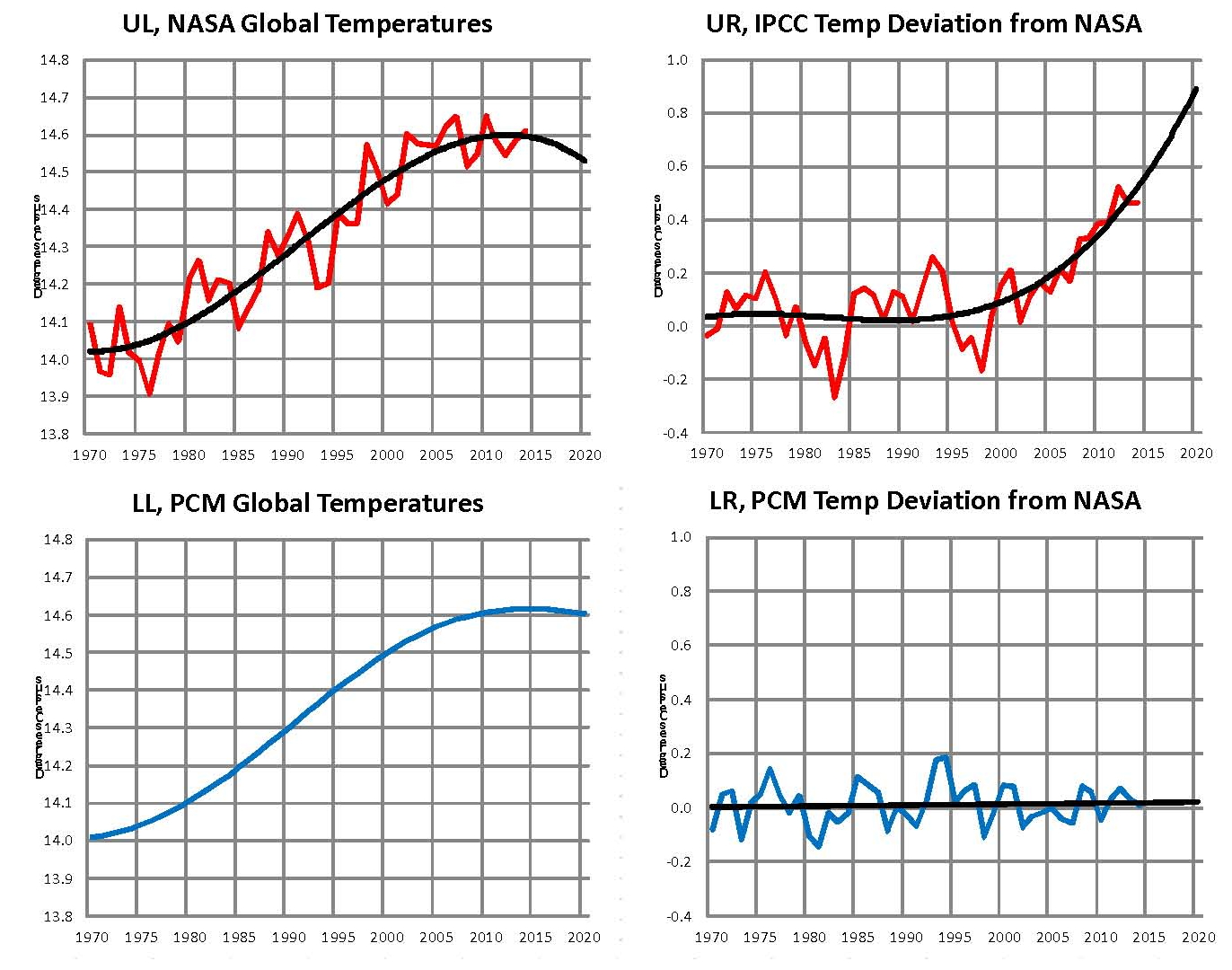
The analysis and plots shown here are based on the following: first NASA-GISS temperature anomalies (converted to degrees Celsius) as shown in their table LOTI, second James E. Hansen’s Scenario B data, which is the very core of the IPCC Global Climate models which was based on a CO2 sensitivity value of 3.0O Celsius, lastly, a plot based on an alternative climate model designated ‘PCM’ and based on a sensitively value of .65O Celsius. To smooth monthly variations a 12 month running average is used in all the plots. This information will be shown in four tables and updated each month as the new data comes in about the middle of the month. Since no model or simulation that cannot reasonably predict that which it was design to do is worth anything the information presented here definitively proves that the IPCC just doesn’t have a clue.

IPCC-08

The first plot, UL is a plot of the NASA temperature anomaly converted to degrees Celsius shown in red with a black trend line added. There has been a very clear reversal in the upward movement of global temperatures since about 2001 and neither the UN IPCC nor anyone else has an explanation for this. Since CO2 has continued to increase at what could be argued an increasing rate this raises serious doubts about the logic programmed into all the IPCC global climate models.

The next plot UR, also in red, shows the IPCC estimates of what the Global temperature should be, based on Hansen’s Scenario B, with the NASA actual temperatures’ subtracted from them. Therefore this plot represents a deviation from what the Climate “believers” KNOW what the temperature should be; with a positive value indicating the IPCC values are higher than actual and a negative value indicating the IPCC values are lower than actual. A black trend line is added and we can clearly see that the deviation from expected is increasing at an increasing rate. This makes sense since the IPCC models project increased temperatures based primarily on the increasing level of CO2 in the earth’s atmosphere. Unfortunately, for them, the actual temperatures from NASA are trending down (even as they try to hide the down ward movement with data manipulation) since other factors are in play, therefore each year the gap between them widens. Since we have 12 years of observations’ showing this pattern it becomes hard to justify a continuing belief in the IPCC climate models, there is obviously something very wrong.

The next plot LL shown in blue is based on the equations in the PCM climate model described in previous papers and posts here and since it is generated by “equations” a trend line is not needed. As can be seen the PCM, LL, and the NASA, UL, trend plots are very similar the reason being that in the PCM model there is a 68.2 year cycle that moves the trend line up and then down a total of .30O Celsius (currently negative .0070O Celsius per year); and we are now in the downward portion of that trend which will continue until around 2035. This short cycle is clearly observed in the raw NASA data in the LOTI table going back to 1880. Then there is the a long trend, 1052.6 years with an up and down of 1.36O Celsius (currently plus .0029O Celsius per year) also observed in the NASA data. Lastly there is CO2 adding about .005O Celsius per year so they messily wash out which matches the current holding pattern we are in. However with a few years the increasing downward trend of the short cycle will overpower the other tow and we will see drop of about .002O Celsius per year and that will be increasing until till around 2025. After about 2035 the short cycle will turn up and all three will be on the upswing again. These are all round numbers shown here are representative values.

The last plot LR in blue uses the same logic as used in the UR plot, here we use the PCM estimates of what the Global temperature should be with the NASA actual temperatures’ subtracted from them. A positive value indicates the PCM values are higher than actual and a negative value indicates the PCM values are lower than expected. A black trend line was added and it clearly shows that the PCM model is tracking the NASA actual values very closely. In, fact since 1970 the PCM model has rarely been off by more than +/- .1 degrees Celsius and has an average trend of almost zero error, while the IPCC models are erratic and are now approaching an error rate of +.5O above expected.

The IPCC models were designed before a true picture of the world’s climate was understood. During the 1980’s and 1990’s CO2 levels were going up and the world temperature was also going up so there appeared to be correlation and causation. The mistake that was made was looking at only a 20 year period when the real variations in climate move in much longer cycles. Those other cycles can be observed in the NASA data but they were ignored for some reason. By ignoring those trends and focusing only on CO2 the models will be unable to correctly plot global temperatures until they are fixed.

The purpose of this post is to make people aware of the errors inherent in the IPCC models so that they can be corrected.

Sir Karl Raimund Popper (28 July 1902 – 17 September 1994) was an Austrian and British philosopher and a professor at the London School of Economics. He is considered one of the most influential philosophers of science of the 20th century, and he also wrote extensively on social and political philosophy. The following quotes of his apply to this subject.
If we are uncritical we shall always find what we want: we shall look for, and find, confirmations, and we shall look away from, and not see, whatever might be dangerous to our pet theories.
Whenever a theory appears to you as the only possible one, take this as a sign that you have neither understood the theory nor the problem which it was intended to solve.
… (S)cience is one of the very few human activities — perhaps the only one — in which errors are systematically criticized and fairly often, in time, corrected

The Blackbody Temperature of the Planet Earth


This is a key step in the Climate Debate

Determining the ‘exact’ Blackbody temperature of the planet is the first step in determining what the “greenhouse’ effect is; for without that value all else is either speculation or based on an unreliable value. This leads us to a quandary since the plant is a global spinning around a titled axis and with an elliptical orbit around the sun Figure 1 which is the source of virtually all the energy that heats the planet. Clearly with these facts there cannot be one temperature for the planet and so an average can be very misleading and lead to false conclusions.

Traditional calculations of the planets black body temperature ignore the variables which then lead one to assume a steady state situation verses the real dynamic situation that drives climate. To justify this assumption a general statement that the variances are too small to have any meaningful effect are promoted. I some cases with fewer variables this might be true but in this case I think not.

These are the main Variables:

1. The sun has a cycle of about eleven years and that gives a small variation in the suns output of about 1%
2. The planet has an elliptical Orbit that varies by 3.34% or 4,999,849 miles
3. The axial tilt of the planet is 23.4 degrees which causes winter and summer to alternate between Aphelion and Perihelion about every 10,000 years
4. The planet is a sphere so only one side faces the sun at any given moment
5. The sun’s energy reaches the planet on a line drawn from the center of the sun to the center of the planet which only intersects the equator twice a year
6. The energy from the sun is concentrated around this line
7. The planet is a sphere so the suns radiation drops off in all directions from this line by a Cosine factor to zero at the edge 90 degrees from the center line
8. The spin and tilt of the planet means that the center line moves up 23.4 degrees and down 23.4 degrees during the course of one orbit
9. That movement means the distribution of energy also moves
10. The distribution of land and ocean are not uniform on the planet
11. The albedo of the planet is a variable not a constant
12. Energy from the core adds a small amount of energy
13. Tidal forces from the sun and the moon also add some energy
14. Energy is carried North and South from the hot spot centered on the line by the atmosphere and the ocean
15. The Coriolis Effect along with tidal forces drive thermal transfer north and south at an angle and these are then main contributors to the climate

FIGURE 01
Figure 1, the Earth’s orbit

FIGURE 02
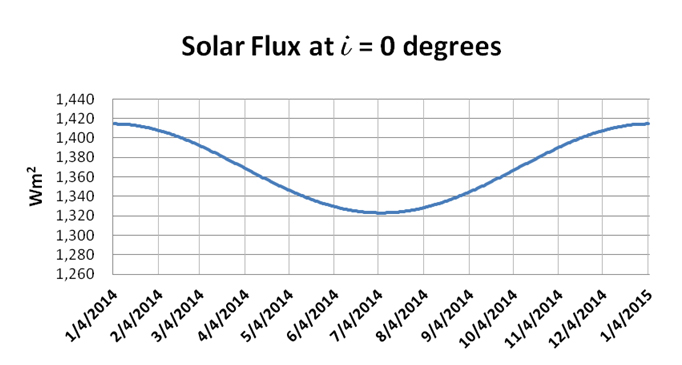
Figure 2, orbital changes in solar flux

There are three sources of energy that determine the climate on the earth: the radiation from the sun which is said to be 1366 Wm2 The actual value based on the orbital range is from 1414.4 Wm2 in January to 1323.0 Wm2 in July Figure 2 and there is also an eleven year sun spot cycle with a range of 1.37 Wm2. The hot core of the planet adds ~0.087 W/m2 and the gravitational effects of the moon and the sun (tides) adds another ~.00738 Wm2. Of these three the sun’s radiation is by far the most important but considering all three the range during an eleven year solar cycle is from a high of ~1415.3 Wm2 to a low of ~1322.4 Wm2 so a more accurate mean would be 1368.34 Wm2.

The energy emitted by the planet must equal the energy absorbed by the planet and we can calculate this using the Stefan-Boltzmann Law. Which is the energy flux emitted by a blackbody is related to the fourth power of the body’s absolute temperature. The tidal and core temperatures are added after the albedo adjustment.

E = σT4
σ = 5.67×10⁻⁸ Wm2 K sec
A = 30.6% (the planets albedo, this is not a constant)

σTbb4 x (4πRe2) = S πRe2 x (1-A)
σTbb4 = S/4 * (1-A)
σTbb4 = 1368.24/4 Wm2 * (1-A)
σTbb4 = 342.16 Wm2 * (1-A)
σTbb4 = 254.36 Wm2

Earth’s Blackbody temperature                      Earth’s surface temperature

Tbb = 252.23O K (-20.92O C) low                  Ts = ~287.75O K (14.6 O C) today
Tbb = 254.36O K (-18.79O C) mean
Tbb = 256.54O K (-16.51O C) high

The difference between the Blackbody and the current temperatures is what we call the ‘greenhouse’ effect that averages 33.36O Celsius (C), today, although the range is from 35.52O C to 31.11O C from variations in the 11 year solar cycle. Despite this variation in incoming solar flux the planet’s temperatures is very stable. Other factors are also important in doing climate work such as the solar energy is concentrated between about +/- 30 degrees of the equator maybe a bit more. And the heat from the core and probably the tides is concentrated where the crust is the thinnest under the oceans and this concentration of energy core heat and tides) combined with Coriolis forces is probably what drives the ocean currents. In my opinion these other important factors are not being considered properly in the climate models.

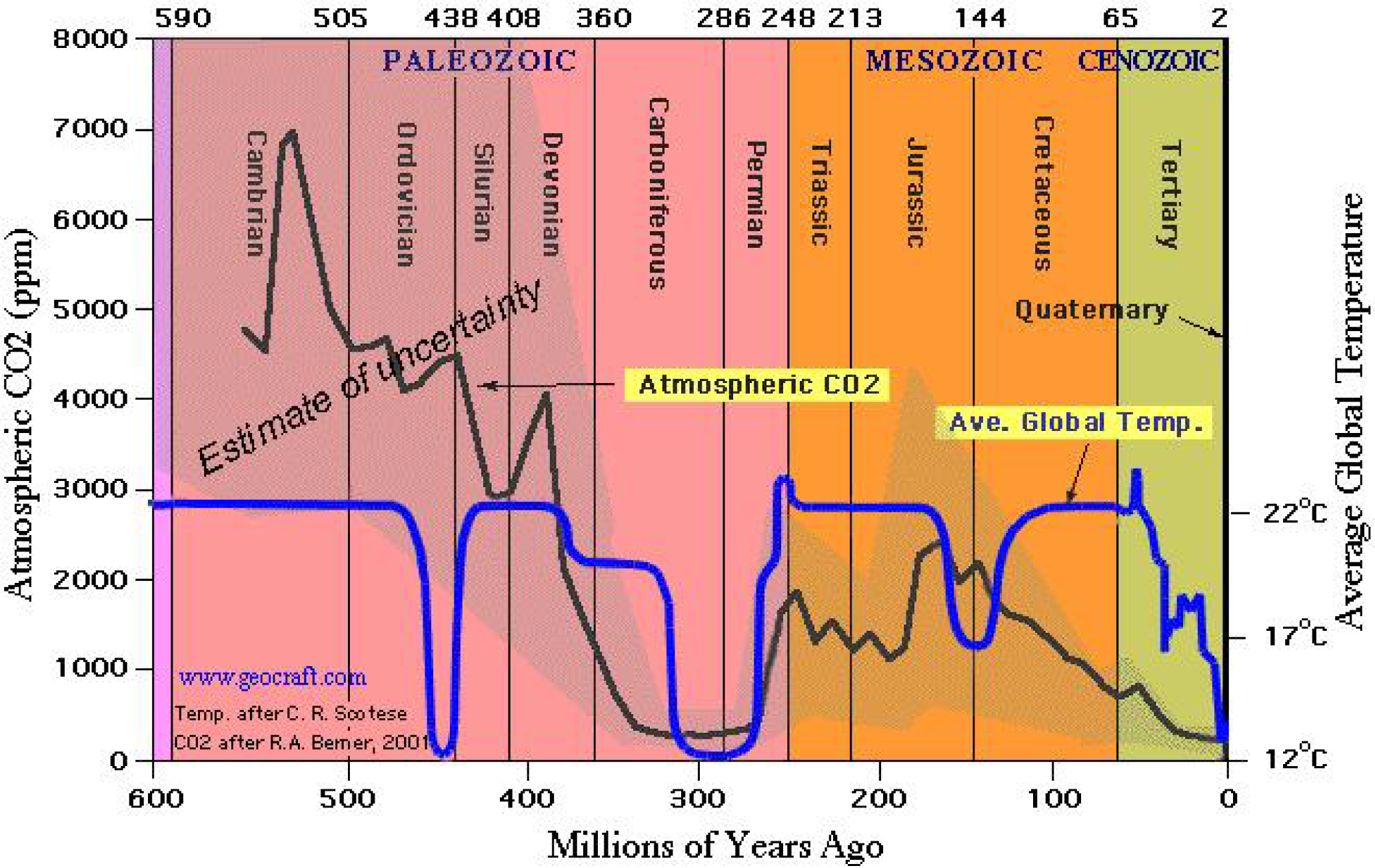
We also know from geological studies Figure 3 that the planets temperature has been relatively stable over the past 600 million years with a mean of about 17O C or 290O Kelvin (K) and with a range of plus or minus 5O K or C based on the information in Figure 3. During the past 250 million years CO2 concentrations have ranged from a low of ~280 ppm (a historic low)in 1800 to the present low of 400 ppm to a high of over 2,000 ppm probably averaging around 1,500 ppm. There was only one other period in the past 600 million years with CO2 this low. Going back further CO2 was estimated to be as high is 7000 ppm, but we will ignore that for now.

This means that whatever the processes are that relate to determining the thermal balance of the planet they must work within this range to be valid. Although Figure 3 shows a range of 10O C it would be prudent to spend resources to determine these values with as great accuracy as possible. We’ll assume a mean of 16O C with a range from 10O to 22O C as being more reasonable. Also we are now in one of only three cold periods which are very rare in the past 600 million years and if we count that partial dip 150 million years ago that means that there is probably a 150 million year cycle there; maybe one of those first determined my Milutin Milankovic.

FIGURE 03
Figure 3, Geological temperatures and Carbon Dioxide

Additional discussion as to the so called “greenhouse” effect must start with the important correction that this process is not a true greenhouse effect, since it is not the same process that occurs in a greenhouse used to grow food. The actual process that occurs is based on the structure of the atoms involved and how they interact with the various frequencies of visible and infrared radiation that are in play on the planet. However at this point in time there is no way to correct for the misuse of the words so we are stuck with it and all the complications that therefore arise in trying to properly discuss the issue with lay people and even some with technical knowledge.

The greenhouse effect occurs within the earth’s atmosphere and the main constitutes of wet air, by volume ppmv (parts per million by volume) are listed in the following table. Water vapor is 0.25% over the full atmosphere but locally it can be 0.001% to 5% depending on local conditions. Water and CO2 are mostly near the surface not in the upper atmosphere so the bulk of the greenhouse effect must be close to the surface.

                                   Gas Volume Percentage
Nitrogen (N2)                                 780,840 ppmv   78.8842%
Oxygen (O2)                                   209,460 ppmv   20.8924%
Argon (Ar)                                          9,340 ppmv    0.9316%
Water vapor (H2O)                             2,500 ppmv     0.2494%
Carbon dioxide (CO2)                            400 ppmv     0.0399%
Neon (Ne)                                          18.18 ppmv     0.001813%
Helium (He)                                         5.24 ppmv     0.000523%
Methane (CH4)                                    1.79 ppmv      0.000179%

There are only two of these gases that are relevant to determining how that 33O C (today) happens. That is not to say the others do not contribute but that at the present concentrations of Water H2O and Carbon Dioxide CO2 they are the main determinants. And since we know the range of temperatures that have existed geologically then we have set the range which these to gases must interact in, meaning that any set of equations or models or theories that predict values outside this range must be suspect based on geological evidence.

Also it must be kept in mind that the solar flux falls on a spot centered on a line drawn from the center of the earth to the center of the sun and because of the 23.5O axial tilt of the planet this “Hot” spot moves up and down as the planet moves though its orbit. Because of the shape of the planet the intensity falls off quickly as we move north and south and east and west according to a cosine factor so the heat energy is mostly over oceans near the equator where the atmosphere is the densest.

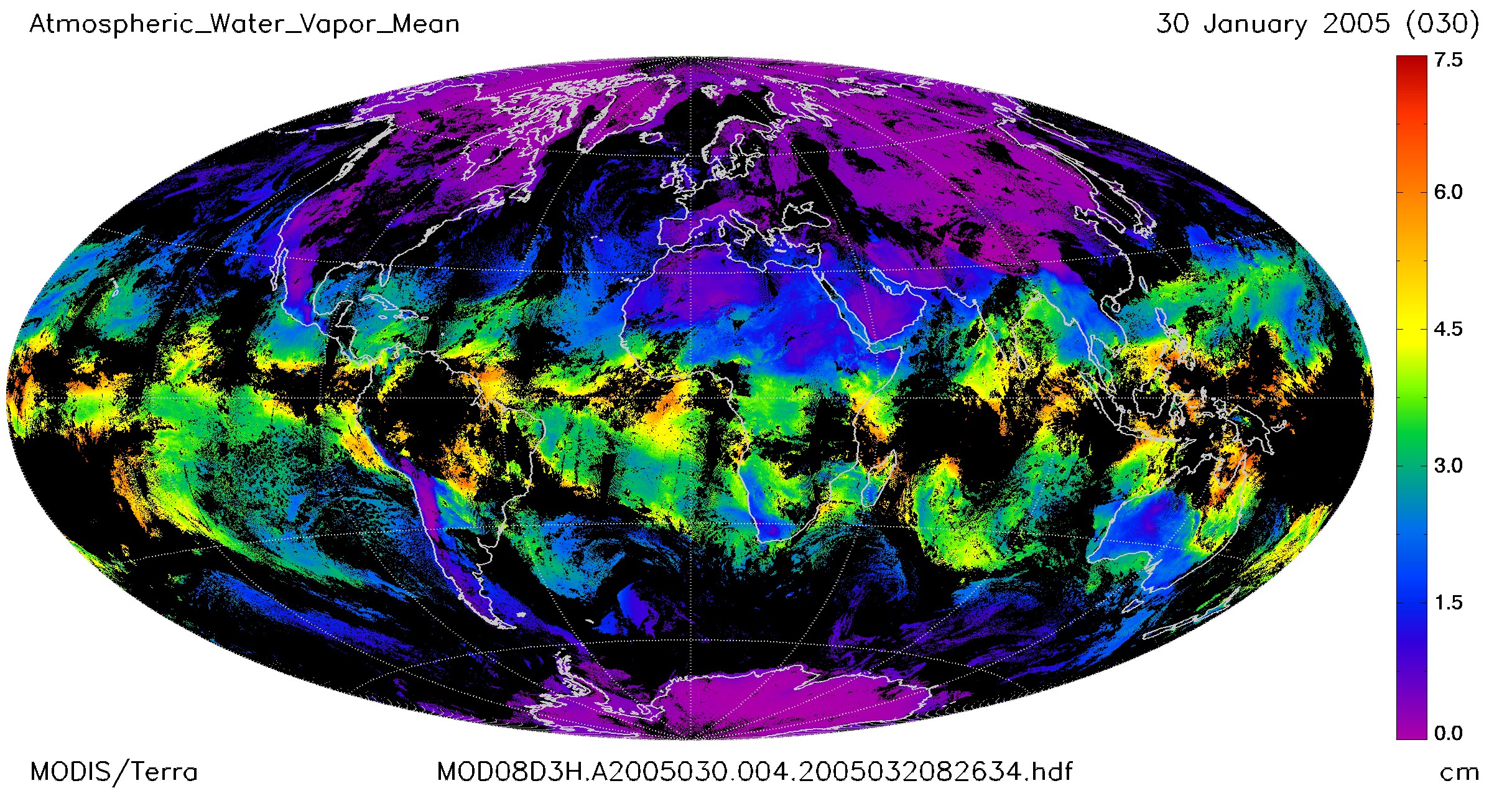
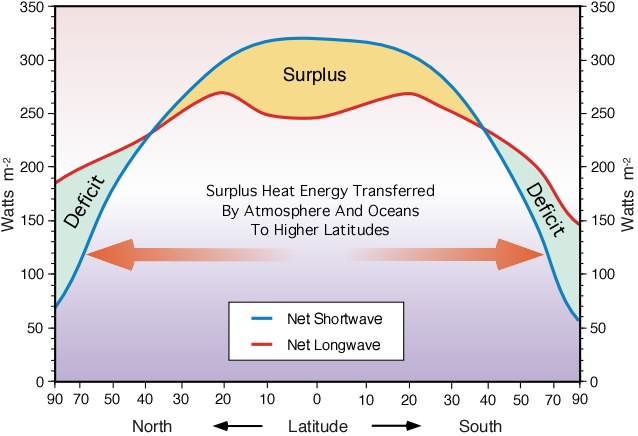
The first image below Figure 4 shows a recent distribution of water across the planet and it is clearly concentrated over the oceans close to the equator and that results in the heat imbalance and therefore movement north and south as shown in the second image Figure 5.

FIGURE 04
Figure 4, water vapor concentrated near the equator

FIGURE 05
Figure 5, basic heat flows from the equator north and south

The next two images show how that energy is moved by the water Figure 6 and the atmosphere north and south from the equator Figure 7.

FIGURE 06
Figure 6, Ocean currents

FIGURE 07
Figure 7, Atmospheric heat flows

In summary we now know that the Blackbody temperature of the planet is a variable.

Tbbl   = 252.23O K (-20.92O C) low at Aphelion
Tbbm = 254.36O K (-18.79O C) and the yearly mean
Tbbh  = 256.54O K (-16.51O C) high at Perihelion

Therefore the ‘greenhouse effect must also be a variable.

Ts = ~287.75O K (14.6O C) today

Ghl =   Tbbl + Ts    = 35.52O C
Ghm = Tbbm + Ts = 32.39O C
Ghh =  Tbbh + Ts   = 31.11O C

The range in temperature just from orbital changes is therefore 4.41 O C which is significantly more than the warming that the IPCC claims has happened. These are hard numbers based on the solar flux which is known and the orbital parameters of the Earth that are also known. The large variances come from the Stefan-Boltzmann Law; which is the energy flux emitted by a Blackbody is related to the fourth power of the body’s absolute temperature. The fourth power in the equation magnifies the small variation in solar flux significantly.

Kentucky Group Wants To Tax Breathing


I knew this was coming — these people are mentally defective.

Tony Heller's avatarReal Climate Science

A national tax on anything that produces carbon emissions — gasoline, airplanes and coal-burning power plants — is the goal of the new Kentucky chapter of Citizens’ Climate Lobby, an international nonprofit group seeking to curb global warming.

Carbon tax sought to curb global warming

Humans exhale a terrifying 40,000 PPM CO2 – enough to raise current atmospheric CO2 levels by 100X. In order to rescue mankind from global warming, breathing must be stopped through taxation or whatever other means is necessary.

View original post

Going …. Going …. Gone


I agree 100% with this as it goes along with my work on the manipulation that NASA does with the temperature data. But the irony to this is no matter how much they play with the numbers they can’t get the temperatures up to where the climate models say they MUST BE …

Tony Heller's avatarReal Climate Science

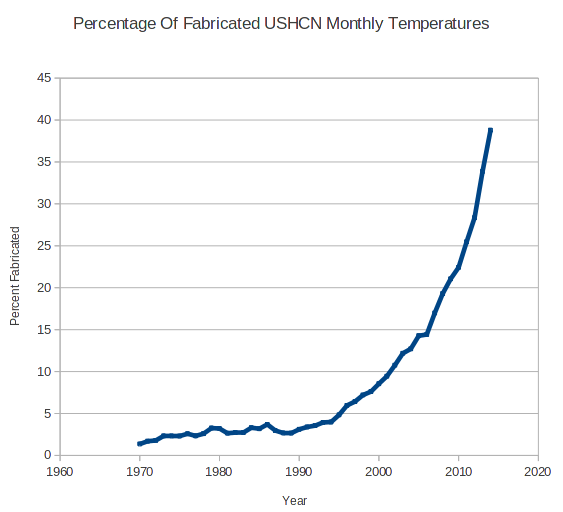
Thirty-nine percent of USHCN data is now fabricated, meaning that there is now 39% more monthly temperature data reported than measured, compared to less than 5% in 1990.

ScreenHunter_605 Jun. 22 04.40

The fabricated data is warming 7°F/century faster than the measured data since 1990, when the data started disappearing.

ScreenHunter_607 Jun. 22 05.03

In fact, the measured TOBS adjusted data shows no warming since 1990. All US warming since 1990 is due to data fabrication.

ScreenHunter_609 Jun. 22 05.11

I am considered a heretic for excluding imaginary temperature data from my analysis, and simply averaging the thermometer data. It is now considered unacceptable by the orthodoxy to use actual measured data.

View original post