
Posted originally on Aug 22, 2025 by Martin Armstrong |
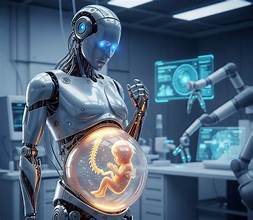
The most human of experiences has been automated as China unveiled a new AI robot that is capable of carrying a fetus to full term, replicating the entire pregnancy process from conception to birth. Kaiwa Technology in Guangzhou plans to release these robots in 2026 for $1,400, or a small fraction of what couples pay for surrogates. Has science gone to far in the quest to play God?
These “pregnancy robots” are vastly different from traditional incubators that are utilized for premature or at-risk newborns. The fetus develops within the robot’s artificial womb in synthetic amniotic fluid. Scientists have developed artificial placentas equipped with a tube system operated by AI, which can feed the baby oxygen and nutrients during gestation. Humans have never procreated through an artificial womb nor has a robot replicated the whole gestation process.
Surrogacy was deemed unethical, and the Chinese government banned the practice in 2001. The government prohibited the trade of ova, sperm, embryos, and other related reproductive items. If not outright banned, most nations have a complicated legal framework surrounding surrogacy and parental rights. The Chinese government believes gestational surrogacy exploits women in poverty, and the law recognizes the birthing mother as the legal mother. Still, repealing the one-child policy and infertility have caused a spike in interest.
Some believe this technology will be a breakthrough for couples suffering from infertility. Outside China, same-sex couples could also benefit from AI-driven surrogacy that costs a fraction of the price. Women may not be exploited for their wombs, but what about the babies born to non-human figures?
The mother-child relationship is the genesis of life and creation. The age-old debate of nature v nurture always concludes that both are essential. Scientists conducted a number of unethical studies during the last World War to see what would happen if a baby were deprived of nurture. Naturally, these studies could never be replicated again.
The Third Reich was keenly interested in eugenics and expanding the Aryan race. In 1935, Heinrich Himmler implemented selective breeding programs for “racially pure” women. Lebensborn homes were developed to discreetly provide unwed women the opportunity to procreate. The Christian society villainized unwed mothers, and so the program operated in secrecy. After birth, biological parents were forced to surrender all parental rights to the German government who assumed full parental guardianship. Thousands of children were born under this program that lasted nine years and expanded to all Nazi-occupied territories.
As a report from the Ministry of Justice stated: “Leaders of the [League of German Girls have] intimated to their girls that they should bear illegitimate children; these leaders have pointed out that in view of the prevailing shortage of men, not every girl could expect to get a husband in future, and that the girls should at least fulfill their task as German women and donate a child to the Fuhrer.”

Newborns were deprived of maternal bonding and nurturing, a crucial factor that the Nazis failed to consider. “Racially and genetically valuable” babies experienced severe cognitive issues. Some of the children were placed in mental facilities for the remainder of their lives. Children showed signs of impaired memory, attentional deficits, emotional dysregulation, and delayed learning. Countless children experienced intense trauma regarding their true identities.
In more recent times, brain imaging of children born in neglect showed prefrontal cortex development issues. A 2015 study examined infants from Tbilisi Infants Orphanage at ages from 1 month to 3 years of age. Maternal deprivation led to a decrease in serotonin levels and plasma growth hormone. Dopamine and norepinephrine changers were witnessed as well. “Maternal deprivation induces growth and developmental retardation, high morbidity and abnormal stress response, associated with altered neurotransmitter level and disrupted processes of immune regulation,” the study concluded.
Obviously, there has never been a study to determine development within an artificial womb. Animal studies have shown that maternal hormones such as prolactin (PRL) are excreted during late pregnancy and activate neural brain circuits responsible for the biological nurturing response for both the mother and newborn. The biochemical communication between the mother and child determines fetal outcomes. Could an artificial placenta create the same experience?
Developmental issues are one major area for concern. Countless dystopian tales discuss what could happen if governments could control the population. The Nazis may have attempted to expand the Aryan race, but what could other governments do with this same power? Governments and globalist entities are constantly determining ways to control the population. The majority of developed nations are experiencing a severe decline in birth rates coupled with an aging population. The government could create a subset of humans to act as future soldiers, workers, or worse. Scientists need a human egg and sperm for these devices, and those born to robotic mothers would be humans. Bad actors could easily hide their misdeeds by pretending robot-born humans are AI. We may need to not only prove our identity but our actual existence as sentient homo sapiens in the future.
Categories:TechnologyCivilization








 Centinel2012