Posted originally on CTH on March 31, 2026 | Sundance
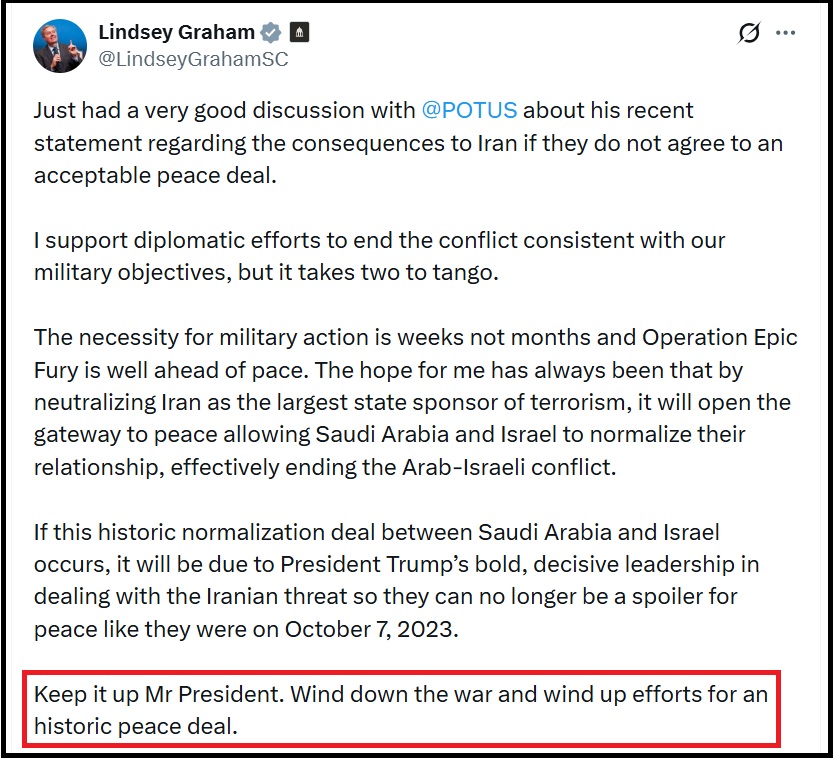
Senator Lindsey Graham (U-DC) has never met a military combat operation he didn’t like. In his career Graham, like his friend John McCain (RIH), has always supported war against every country.
However, beyond the unquenchable bloodlust there is one thing Senator Graham fears, an exit from NATO. With the Iran conflict providing buckets of citations for why the United States should pull back from the NATO alliance, citations that Graham cannot easily refute, the war monger is worried the old war ethos of NATO could be lost.
Posted originally on CTH on March 30, 2026 | Sundance
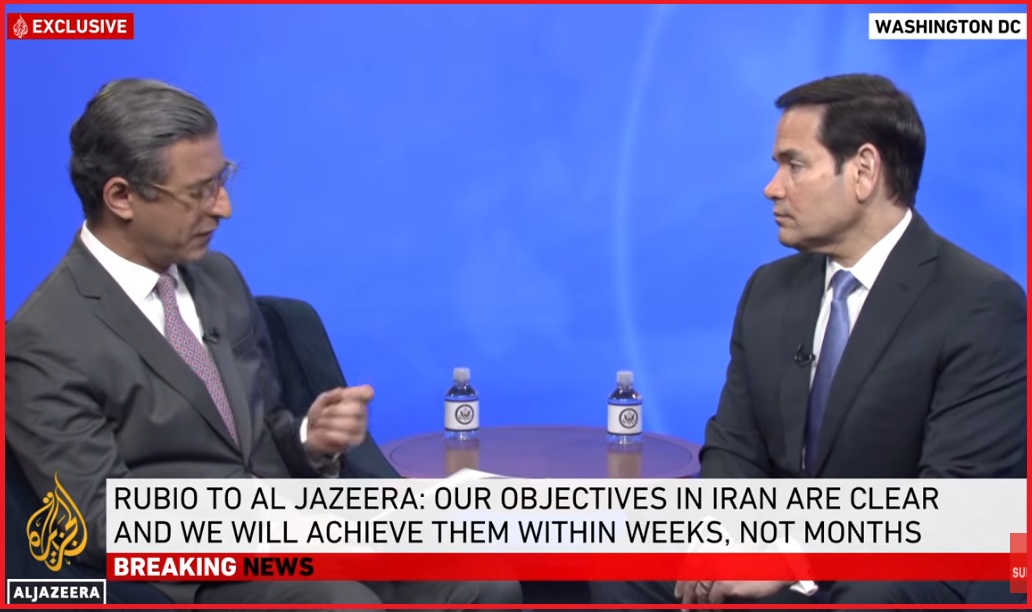
Al Jazeera is essentially the state run media outlet of Qatar. Secretary of State Rubio sat down for a lengthy interview with Al Jazeera that will be shared throughout the Arab world.
“In an exclusive Al Jazeera interview, US Secretary of State Marco Rubio stated that President Trump always prefers diplomacy, with messages and indirect talks ongoing between the US and figures inside Iran. Rubio demanded that Iran abandon all nuclear weapons ambitions, end its missile and drone programmes, and stop sponsoring terrorism across the region. He rejected Iran’s conditions for ending the war — including sovereignty over the Strait of Hormuz and financial compensation — calling the strait demand illegal and a dangerous global precedent. Rubio declared that the strait “will be open one way or another” after US military objectives are achieved, whether through Iranian compliance or an international coalition.”
“He outlined those objectives as the destruction of Iran’s air force (achieved), navy (largely achieved), missile launchers, and weapons factories — all to be completed in weeks, not months. Rubio expressed disappointment with NATO allies like Spain for denying basing rights and airspace, warning that the US would re-examine its NATO commitment. He confirmed the US would welcome regime change in Iran but insisted it was not the official objective of the current military operation. The interview also covered post-Maduro stabilisation in Venezuela and called for serious economic and political reforms in Cuba.”
Posted originally on CTH on March 25, 2026 | Sundance
The rebranded Lyndon LaRouche PAC has another good outline on the new strategic alliances assembled by President Trump as the ongoing conflict with Iran continues.
Susan Kokinda reviews how the United Kingdom and Europe have been sidelined as President Trump directly negotiates with key stakeholders in the middle east and Asia. Kokinda correctly notes the messaging from Russia indicates a strategic awareness that old systems are fracturing and the potential for new strategic alliances is rising.
“Susan Kokinda argues President Trump has opened a new diplomatic space to de-escalate the Iran conflict by working through a regional roster—Saudi Arabia, Egypt, Turkey, Pakistan, Gulf States, and back channels into Iran—while the U.K., EU, and NATO are absent and increasingly irrelevant. Citing reporting that ministers met in Riyadh and that Egypt, Turkey, and Oman carried messages, she says this “Board of Peace” architecture is isolating Iran and weakening its proxies, pointing to Lebanon’s move against Hezbollah, the Palestinian Authority’s condemnation of Iran, and Hamas considering disarmament. Kokinda links Europe’s exclusion to self-inflicted energy weakness from Green and anti-Russia policies, noting rushed LNG moves and a delayed Russian oil ban vote. She concludes Ukraine’s outlook darkens as Europe and Britain lack leverage, highlighting Zelenskyy’s scramble for support in London and Washington.” WATCH:
Posted originally on CTH on March 3, 2026 | Sundance
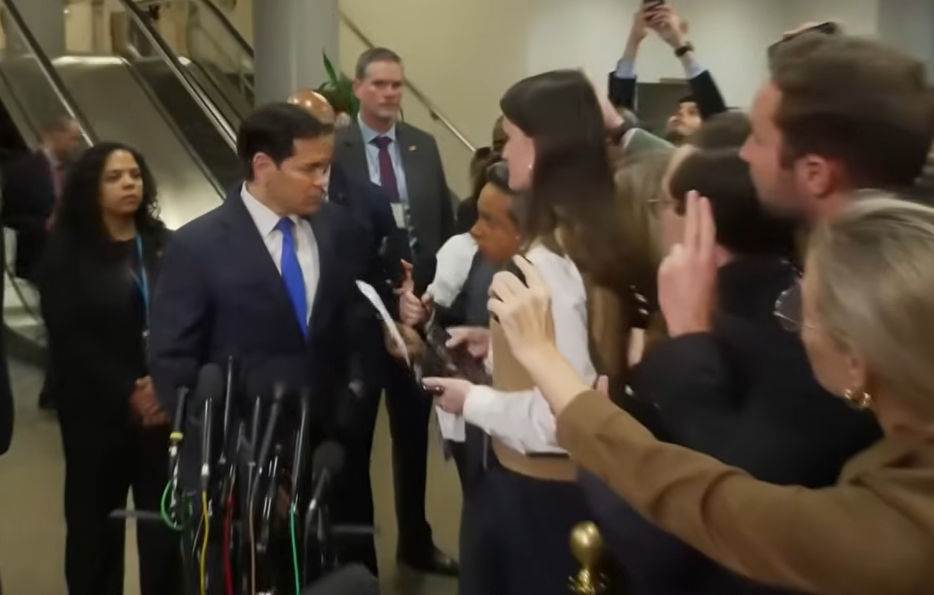
Secretary of State Marco Rubio updates the media on current activity surrounding Operation Epic Fury.
Secretary Rubio begins with an update on what Americans in the region need to know. Rubio asks all Americans to record their status with the U.S. State Department. [State Dept. Website] To get the latest updates visit http://travel.state.gov/destination and enroll to receive alerts directly at http://step.state.gov. Americans who need consular help can reach us 24/7 by phone: +1-202-501-4444 (from abroad) and +1-888-407-4747 (from the U.S. and Canada).
Rubio then outlines the latest report on a drone hitting near a U.S. embassy in Dubai. A drone struck a parking lot adjacent to a chancellery building and a fire broke out. No Americans were hurt or injured. The consulate was already on minimal staffing.
Secretary Rubio then provides an update on the general disposition of the conflict effort. Rubio notes the two most powerful air forces in the world are about to go even more severe in our combat activity deep inside Iran.
The traditional frame of reference for pundits surrounds “the escalation trap.” Most of them are so stuck in their old Washington DC view of nation building they just cannot see another approach.
How do you avoid the trap? You don’t play the game.
You don’t try to control the outcome on the ground. You change behavior, without being on the ground.
Eventually, having killed or destroyed everything you want to see killed or destroyed (including their ability to wage war against you), you withdraw – then demand terms.
You don’t need to be there on the ground.
It’s a version of the Venezuela model.
Tell the governing body, whoever that is, whoever surfaces to claim lead with the support of the people, what you expect. Then you hold them accountable.
If they refuse to change behavior, bomb them again – select the refusers as new targets. Wash – Rinse – Repeat.
Again, pull back, await the governing authority to surface, tell them the expectations, if they balk, reject or refuse, bomb them again…. Pull back, await the next crew, tell them the expectations; if they balk, fail or reject, bomb them again…. Then pull back.
Is there an escalation trap? No, you are trying to change behavior – full stop.
You remain open but cold, hard and indifferent to any non-compliant replies.
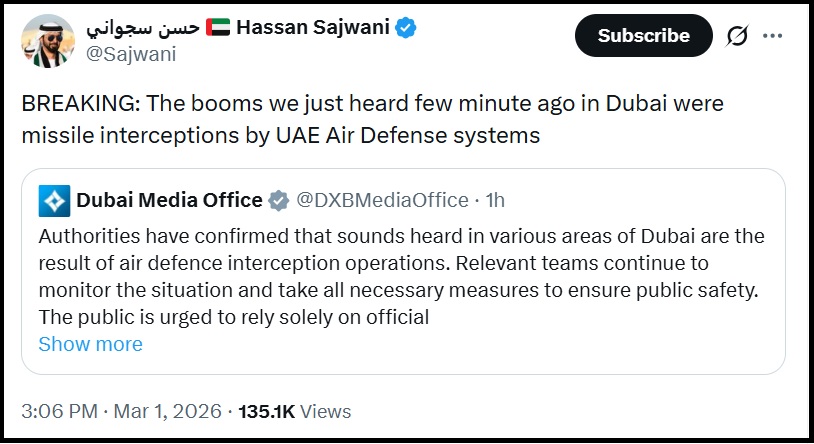
Posted originally on CTH on March 1, 2026 | Sundance
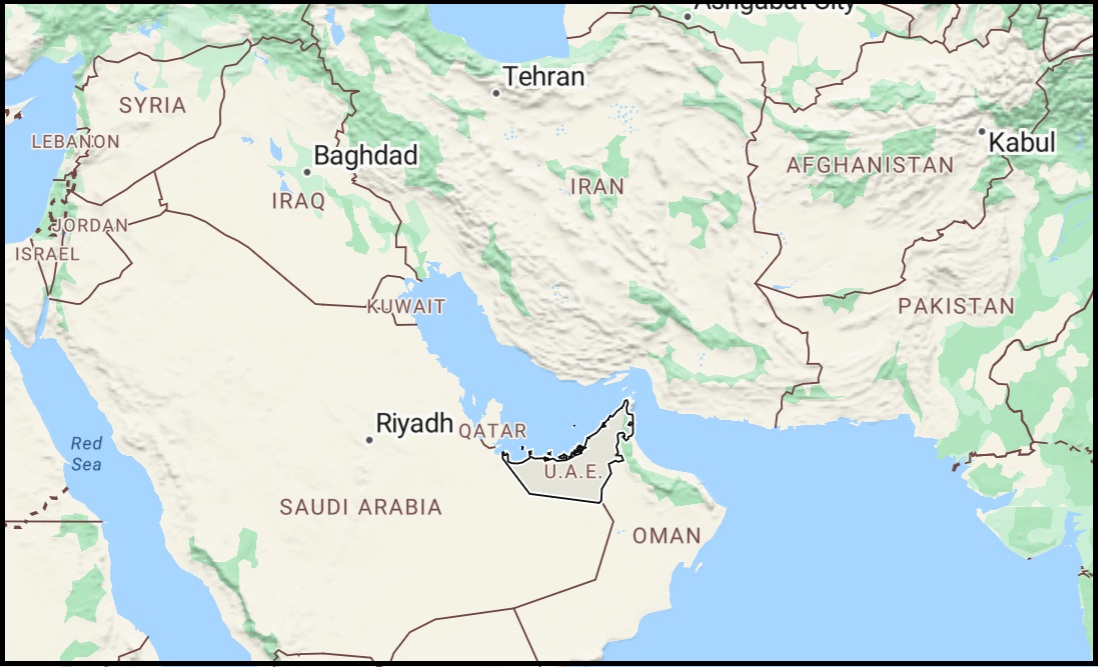
The United Arab Emirates (UAE) is a very popular tourist destination in the middle east with most travelers traveling to the playground of Dubai. Their economy and image as a safe and secure country are very important. As a result, they are keenly sensitive, proactive toward negative impressions and highly focused on international opinion/security.
Iran has been sending drones and cruise/ballistic missiles into the entire region; hitting Kuwait, Saudi Arabia, the UAE, Bahrain, Qatar, Jordan and Israel.
The UAE is sharing how intense they are being targeted along with the network of defense systems being deployed to intercept the attacks.
UAE Ministry of Defense confirms we successfully shot down: 165 ballistic missiles, 2 cruise missiles and 541 drones fired by Iran.
On day 2, we shot down 20 ballistic missiles (8 fell in sea), 2 cruise missiles, and 311 drones. 21 drones hit civilian targets. {SOURCE}
This is a remarkable amount of Iranian firepower being targeted toward one regional nation. The air defense system of the UAE is highlighting the value in very proactive defense positioning. Quite remarkable.
“[…] – The UAE’s air defense today achieved a success rate of more than 96% in intercepting missiles after destroying 132 out of 137, and more than 93% in intercepting drones after intercepting 195 out of 209, for a total of 327 threats intercepted out of 346 with a success rate of around 95%. This is a figure that places it among the highest interception rates globally, which typically range between 85% and 95% depending on the type of threat and the conditions of engagement.” (source)
I have created this site to help people have fun in the kitchen. I write about enjoying life both in and out of my kitchen. Life is short! Make the most of it and enjoy!
This is a library of News Events not reported by the Main Stream Media documenting & connecting the dots on How the Obama Marxist Liberal agenda is destroying America





 Centinel2012