
Posted originally on the CTH on February 13, 2025 | Sundance
Today, President Donald J Trump signed an executive order triggering the first ever system of “reciprocal trade tariffs,” a seismic change in U.S. trade policy that will also consider the respective nation’s VAT (Value Added Tax) tariff.
Within the executive order [as outlined], the Secretary of Commerce and the United States Trade Representative will consider foreign industry subsidies, and non-monetary tariff barriers as part of the determination of the tariff levied. This is a stunning shift in U.S trade agreements that will cut through all the angles being deployed to avoid U.S. tariffs and block U.S exports into their country.
The policy will pressure foreign nations to lower their trade barriers to U.S. goods and eliminate disparity in foreign trade agreements. One big example will be the impact on the EU through the continuing Marshall Plan. The EU will now face reciprocal tariffs and no longer benefit from one-way tariff acceptance. There are obviously no tariffs on products made inside the USA.
With “reciprocal tariffs” the Commerce Dept and USTR will now determine the trade imbalances with each individual country and will evaluate each FTA (Free Trade Agreement), one-by-one to deconflict the trade imbalance. Direct tariffs, subsidies, regulatory hurdles, non-monetary trade barriers and hidden export subsidies will be addressed as part of the reciprocity evaluation. This is a completely new dynamic in the era of modern global trade and economics.
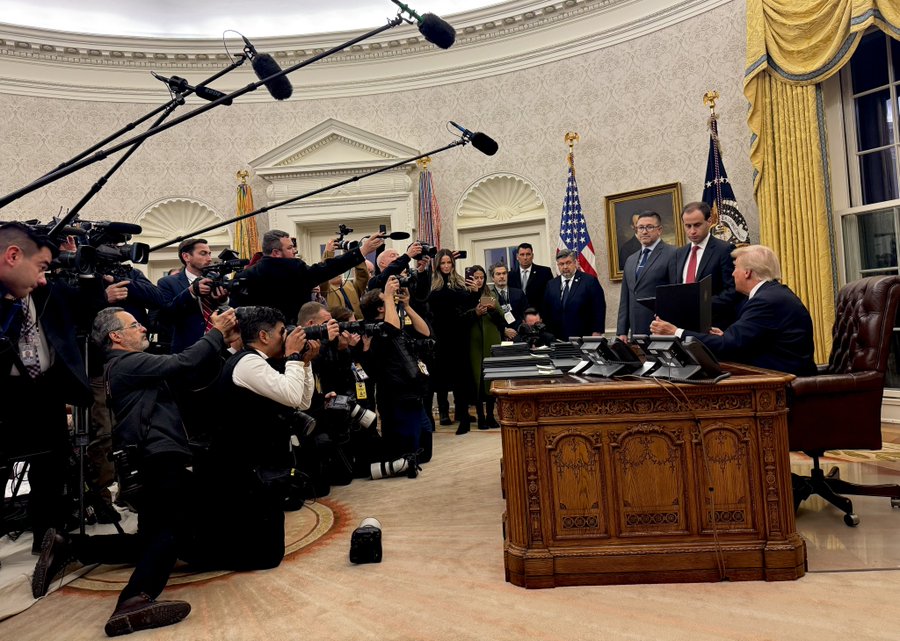
During the executive order signing event, President Trump took questions from the media. WATCH:
Between now and April 1st, each individual trade agreement will be evaluated with consideration for all facets of the cost for American companies to export to the evaluated nation. Direct tariffs, Value Added Taxes (VAT), state subsidies and non-monetary regulatory tariff barriers, will be determined for each nation. That nation will then be made aware of the tariff against each sector within their export system to the United States.
Effective April 2, 2025, President Trump will then have the tariff data provided by the USTR and Secretary of Commerce. President Trump will determine when the reciprocal tariff will be triggered and will likely engage in discussions with the leaders of the foreign nations.
These fireside chat-style impromptu pressers during executive order signings are awesome. The revolutionary change in government transparency and communication is, well, quite literally historic and stunning. The media can ask questions in real-time as the specific policy is implemented and explained, while simultaneously the ability of the media to shape an anti-Trump policy narrative is removed.
(Via ABC) – President Donald Trump on Thursday signed a memo calling on his administration to determine “the equivalent of a reciprocal tariff with respect to each foreign trading partner.”
“In other words, we’re going to customize the reciprocal tariff based on individual trading nations, and that will depend on their profile,” a senior administration official said on a call with reporters previewing the action.
This means the administration plans to impose tariffs on other countries that match the duties they impose on American products. The senior official says this allows the U.S. to “customize” the tariff to each trading partner based on their actions.
Trump previously announced tariffs on China, Mexico and Canada. While the 10% tariffs on China have been imposed, Trump paused the 25% tariffs on Canada and Mexico. Trump has also announced 25% tariffs on steel and aluminum that are expected to take effect next month.
Trump acknowledged “prices could go up somewhat short term” as a result of tariffs as he took reporters’ questions in the Oval Office. But he stressed Americans should expect jobs numbers to go up. “There could be some short-term disturbance, but long term, it’s going to it’s going to make our country a fortune,” he said.
An administration official outlined five types of actions it will take into account in determining the reciprocal tariffs for trading partners.
They include tariffs imposed on U.S. products; unfair, discriminatory or extraterritorial taxes imposed by trading partners, including a Value Added Tax; cost to United States businesses, workers and consumers, including subsidies and burdens and regulatory requirements; exchange rates; as well as any other practice that USTR determines is an unfair limitation.
Key players in this action will include the commerce secretary and United States Trade Representative, in consultation with the treasury secretary and Homeland Security secretary. Trump has nominated Cantor Fitzgerald CEO Howard Lutnick to lead the Commerce Department and attorney Jamieson Greer to be the U.S. Trade Representative. (read more)

 Centinel2012