Posted originally on CTH on March 23, 2026 | Sundance
This is one of those small stories that carries the potential for significant domestic economic gains.
As many are aware, the U.S. imports a lot of softwood lumber from Canada. Combined with the energy products the lumber sector represents the top two U.S. imports from Canada. With Venezuela now potentially positioned to replace the former, USDA Rural Development now stimulates domestic lumber development potentially positioned to replace the latter.
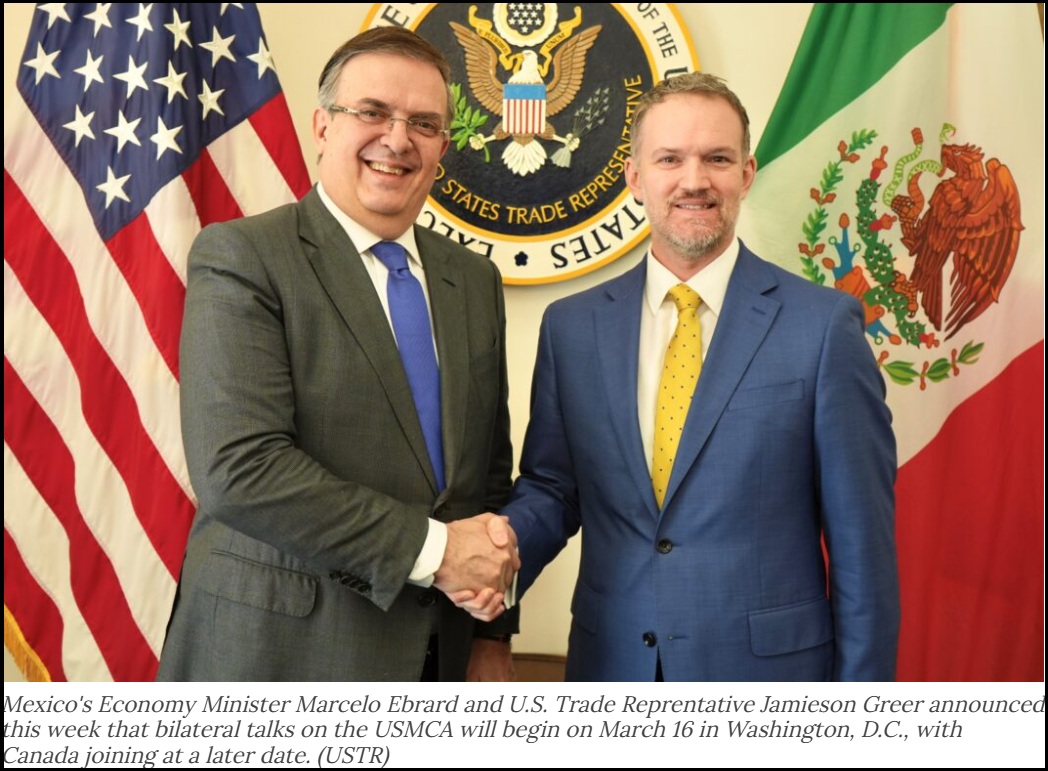
Taken as a whole, these two approaches significantly weaken the Canadian leverage that could be deployed in a Free Trade Agreement negotiation. Assuming, of course, the USMCA is dissolved in favor of two bilateral FTAs.
USDA Press Release – At the Advanced Bioeconomy Leadership Conference today, U.S. Department of Agriculture Administrator for the Rural Business and Cooperative Service J.R. Claeys announced the U.S. Department of Agriculture is guaranteeing $115.2 million across eight states through the Timber Production Expansion Guaranteed Loan Program (TPEP) to ensure sawmills and other wood processing facilities have the necessary funding to establish, reopen, expand, or improve their operations.
Today’s announcement includes recipients in the states of California, Idaho, Kansas, Louisiana, Maine, Oklahoma, Virginia, and Wisconsin.
These investments represent a commitment by the Trump Administration to expand American timber production by 25%, reduce wildfire risk, and save American lives and communities by strengthening domestic wood processing capacity.
“We cannot allow wildfires to devastate and destroy our rural communities,” said Administrator Claeys. “That’s why the USDA is taking bold action to stop the destruction of our forestlands by investing in sawmills and wood processing facilities that support sustainable timber harvesting. These actions strengthen local businesses, support rural prosperity, and create jobs for hardworking Americans.” (source)
This is not to say that expanded U.S. sawmill production would completely eliminate Canadian softwood lumber imports. However, it does create inventory and a stronger domestic supply chain that would diminish any applied leverage that Canadian trade negotiators would seek to deploy.
Without pipelines flowing East or West, Canada is stuck pumping their heavy oil south for processing. Nothing about that is likely to change in the next few years, even if Canada abandoned their climate change policy (highly unlikely).
Then comes the cross-border auto manufacturing industry, and the realization that -sans USMCA- both U.S. and Japanese automakers are likely to stick with the manufacturing center where their greatest customer base exists, the USA.
Now overlay softwood lumber, and you can see the top three economic dependencies of the U.S and Canada are slowly being uncoupled, simultaneous with the trilateral USMCA provisions being reviewed starting with the U.S. and Mexico having direct conversations.
Posted originally on CTH on March 23, 2026 | Sundance
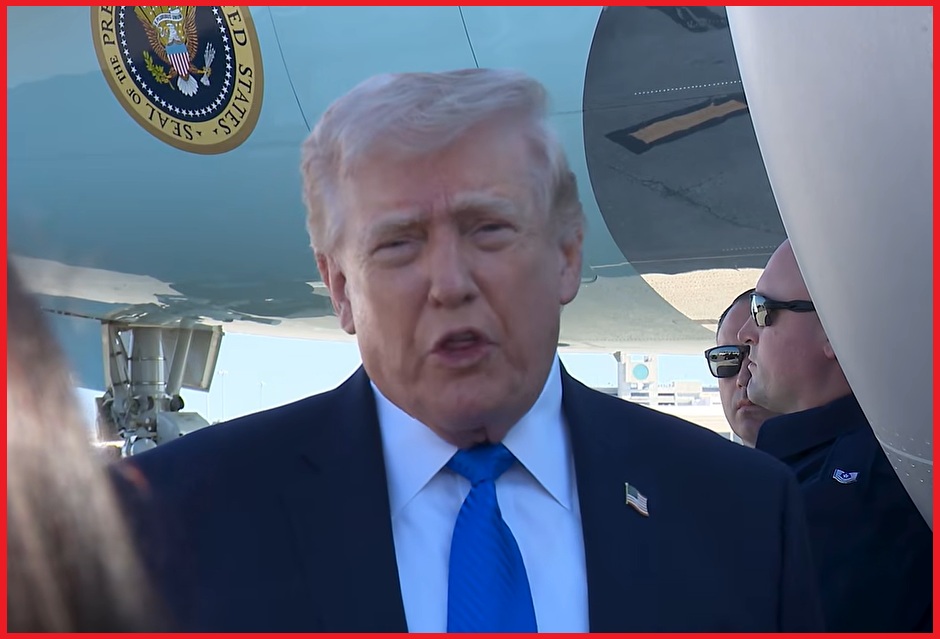
President Trump delivers remarks and takes questions from reporters in Palm Beach, Florida, before boarding Air Force One en route to Memphis, Tennessee. President Trump emphatically stated that continued negotiations with ‘leadership’ within Iran continues and reaffirms the conditions for a cessation of hostilities.
The military leadership within the Islamic Revolutionary Guard Corps. (IRGC), do not recognize any political representation over their military control of Iran. This fracture within the political structure of Iran is what seems to create the conflict with U.S. negotiations with political entities the IRGC refuses to recognize.
President Trump is confident the presentation of terms now being discussed with Iranian political leadership will be agreeable to both Israel and U.S. interests. Additionally, President Trump discusses the issue and circumstances around former NTSC Director Joe Kent and his view on the controversy that have flowed since Kent’s resignation. WATCH:
Posted originally on CTH on March 23, 2026 | Sundance
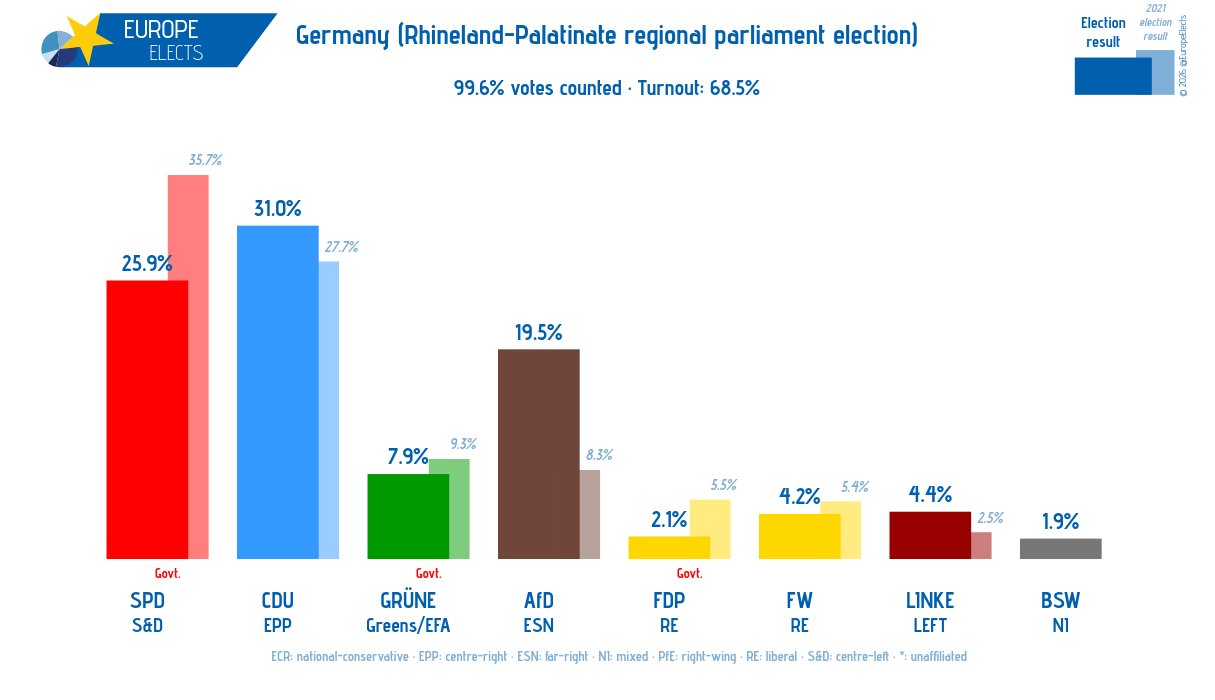
Within Germany the Rhineland-Palatinate regional parliament electionwas held yesterday. The region is the heart of the German industrial sector and home to the massively important auto-manufacturing sector.
Chancellor Friedrich Merz’s conservative party the Christian Democratic Union (CDU) won the biggest portion of the election, defeating the Social Democratic Party (SPD) who lost ground in the western area bordering France. However, the biggest electoral gains were for the Alternative for Germany (AfD) party, with gains that more than doubled its previous vote share.
There is intense interest throughout Europe on the ideological shift in political sentiment mostly driven by economic concerns as well as rising nationalistic sentiment against the elitist minds in Brussels. Essentially those being ‘ruled’ are increasingly fed-up by those doing the ‘ruling.’ The AfD party is akin to the pragmatic MAGA base more focused on economic nationalism than all the nonsense associated with multiculturalism, green energy programs and terrible immigration policy.
The ideological battle within Europe is ongoing, with some gains by nationalist parties over the collective mindset of the European elites. However, the European Commission doesn’t just have a finger on the scales, they have full control over the mechanics of the elections themselves. Yes, AfD more than doubled their share of votes to 20%, but CDU at 31% and the socialists at 26% is akin to mainstream corporate republicans and progressives respectively controlling 57% of the support base.
The biggest election to be held in Europe in the last decade or more, is going to be the election in Hungary which takes place April 12, next month.
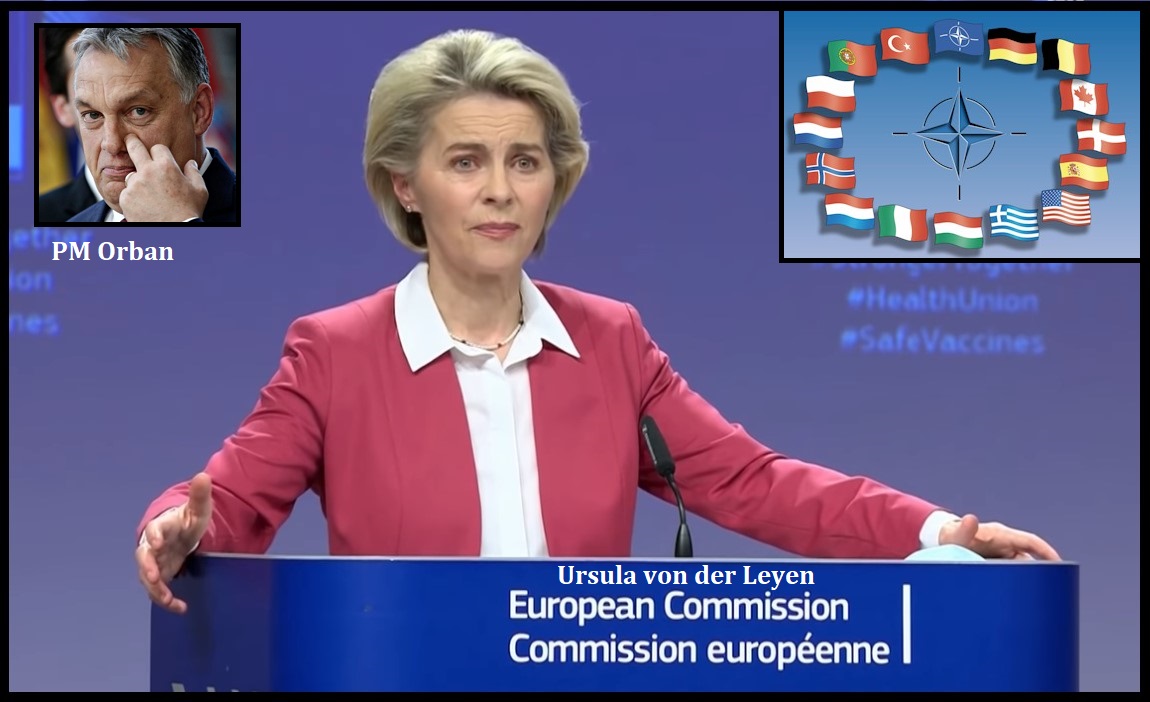
The European Commission is going all-in to try and manipulate the Hungarian voting base against Prime Minister Viktor Orban and the Fidesz party who is/are viewed by Brussels as standing in the way of their scheme to fund the ongoing war in Ukraine.
Orban’s reelection campaign has been under relentless assaults from restrictions on EU social media, to outright propaganda and financing for his opposition Péter Magyar and the Tisza party.
Prime Minister Orban is strongly supported by President Donald Trump and the Trump administration; however, the scale of opposition to both of them is intense.
Former leftist USAID Administrator Samantha Power spent time inside Hungary organizing the Tisza party to oppose Viktor Orban, and the totality of the European opposition to Orban cannot be underestimated.
Every element of every political construct within the Europe Union is aligned to try and defeat Orban and the Fidesz party. Additionally, the government of Ukraine is actively working all intelligence angles to defeat Orban due to the $90 billion EU loan scheme that Hungary is blocking.
Prime Minister Viktor Orban winning reelection this time in 2026 would be akin to Trump’s victory in 2016.
Do not underestimate the power of the U.K/European control system and the alignment of all their collective interests. Chancellor Friedrich Merz (Germany), President Emmanuel Macron (France), Prime Minister Keir Starmer (UK) along with the governing elites of Denmark, Finland, Sweden, Norway, Austria, Netherlands and many more, have all publicly taken positions against Hungary.
As we saw in Romania, Moldova and Georgia, it is not simply a matter of what the Hungarian voters want that will determine the outcome of the Hungarian election, the European Commission has many tools and techniques to shift the outcome.
This single small Hungarian election is the most critical election for the EU since Brexit.
Posted originally on CTH on March 23, 2026 | Sundance
The noise can seem overwhelming at times. There are those who say the U.S-Israeli joint military operation against Iran is a catastrophic miscalculation. There are those who say the operation is strategically succeeding. Many interests even appear to be cheering for the military operation to fail; others want the operation to escalate.
It is difficult to find pragmatic facts about the events without shaped information to promote specific narratives. However, accepting there is a psychological component to the information flow, it seems like the best option to listen to the experts who are conducting the operation.
Giving his first interview since Operation Epic Fury began, CENTCOM Commander Bradley Cooper outlines the current status of the conflict and the elements he notes are of most importance. According to Adm. Cooper, Iran is “operating in a sign of desperation… In the last couple of weeks, they’ve attacked civilian targets very deliberately, more than 300 times.”
“The Strait of Hormuz is physically open to transit,” he said. “The reason ships are not transiting right now is because the Islamic Republic is shooting at them with drones and missiles.” WATCH:
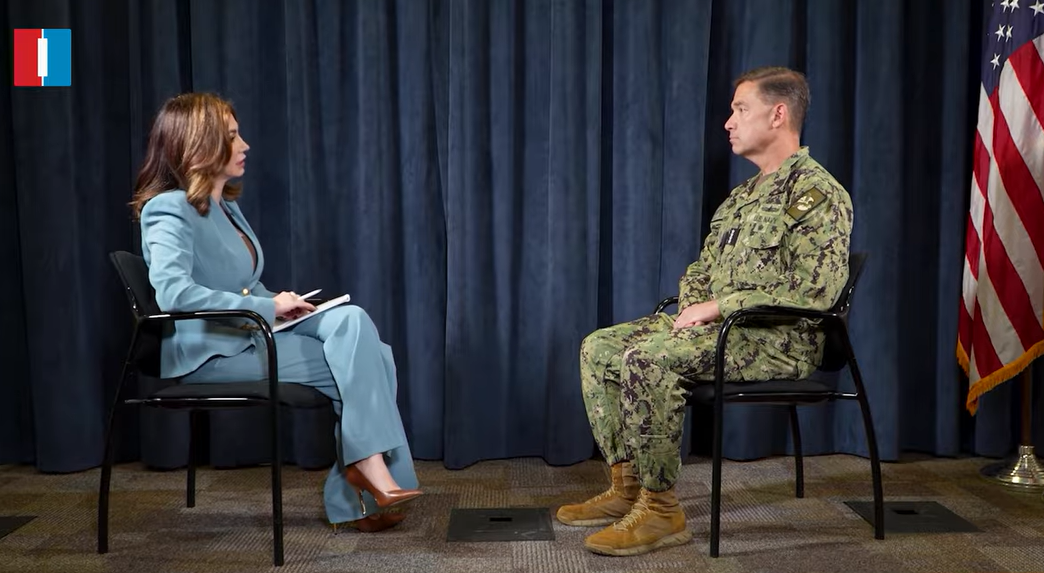
“I’d like everyone to note is I’ve watched this over the last week, this extraordinary contrast between the comfort and protection that you’re seeing with the senior generals in the Islamic Republic, at least those that are still alive, who are up in deep bunkers and facilities in and around Tehran. And contrast that with the soldiers who are down on the ground who are unprotected. The generals are protected. The soldiers are not protected.”
“They’re launching missiles and drones from populated areas and you need to stay inside for right now,” he said. “There will be a clear signal at some point, as the President has indicated, for you to be able to come out.”
Posted originally on CTH on March 22, 2026 | Sundance
Peter Thiel is well known for his PayPal startup and later Palantir tech investment. Most people now have a better understanding of exactly what Palantir software and AI interface are capable of. Palantir AI is now established as a core military system, and the suite of associated products have both military and commercial applications.
At its core, the Palantir product line is about interfacing AI with surveillance software; behavior stuff that permits surveillance and targeting systems through massive database cross referencing and actionable targeting. I’ll leave the rest of the explaining to those in the comments section who have followed the developing technology.
For his latest endeavor, Peter Thiel has now invested $2 billion in a New Zealand (think five-eyes) based company that assists cattle ranchers with their herds. “New Zealand-based Halter has secured funding at a $2 billion valuation from Peter Thiel’s Founders Fund, marking one of the highest-profile venture investments in agricultural AI to date. The startup, which manufactures AI-powered collars that autonomously manage cattle movement and behaviour, now operates across more than 5,000 farms globally.” (READ MORE) – AND WATCH:
“Peter Thiel just bet $2 billion on a collar that wraps around a cow’s neck. The company is called Halter and it has a proprietary algorithm that runs the entire operation. They actually trademarked the name for it and called it the Cowgorithm and here’s how it works.
A farmer opens an app, taps a button, and 600,000 cows across three countries start walking toward the milking station on their own. No farm dogs, fences or physical labor, it’s just a solar-powered GPS collar sending sound and vibration cues to each animal.”
“The collar does more than move cows around. It monitors digestion, fertility cycles, and health patterns in real time, 24 hours a day, using machine learning trained on the behavior of hundreds of thousands of animals.
Halter was founded by a rocket engineer who built spacecraft at Rocket Lab before deciding that farming was the bigger unsolved problem. US ranchers alone have already used the technology to build over 11,000 miles of virtual fencing, roughly the full perimeter of the continental United States, saving an estimated $220 million in physical fencing costs.
Halter’s previous funding round valued the company at $1 billion. This new round, led by Thiel’s Founders Fund, doubles that valuation to $2 billion before the new money even hits the account. And they charge farmers between $5 and $8 per animal per month on a subscription model, meaning the more cows they collar, the more locked-in the revenue becomes.
The most powerful venture capitalist on earth just decided that the future of food and farming runs through an algorithm named after a cow.” (SOURCE)
Peter Thiel’s prior developmental products are all based around human behavioral sciences. Geolocation, predictive analysis, consumer patterns, behavior patterns, targeting, and the streamlined assembly of mass surveillance systems such as Palantir facial recognition software connected to identity tracking and tracing.
Why would Peter Thiel be shifting to animal behavioral sciences. Yes, there is a strong marketable product that could ultimately make cattle ranching and cow farming much more efficient and productive.
However, overlay the Halter system on cows with the Palantir system on people. Replace the cow with a human.
Let me explain what a $2 billion “cow collar” actually is 👇
They put an AI collar on a cow. It tracks location. Health. Movement. Behavior. Every second of every day.
A farmer opens an app. Draws a line on a map. That line becomes a fence. No physical fence. No wall. Nothing visible.
When the cow gets close to the boundary.. the collar vibrates. The cow turns around. Within 10 days the animal doesn’t even test the boundary anymore. It just stays inside.
700,000 animals are already wearing them.
They called it a “cowgorithm.” They want you to laugh at it.
Now read the technology again without the word cow..
24/7 GPS tracking on every individual. Real time health and behavior monitoring. Invisible boundaries drawn from a phone. Movement controlled through vibration and sound. Subject learns compliance within days.
$2 billion. And guess who led the investment…
Peter Thiel. The same man who built Palantir. CIA backed surveillance from day one. The same man who just got a $10 billion Pentagon contract to run AI inside the military.
His entire career is building systems that track and control. Now he’s funding a collar that does exactly that.
They’re not investing in farming. The farming is the test. (SOURCE)
Where did the most aggressive testing of COVID-19 population control systems, and COVID-19 vaccination compliance take place? Australia and New Zealand. Five-Eyes countries.
Sound crazy?
So did this at the time:
Welcome to the future. Palantir is the gatekeeper for all your Facial Recognition permissions.
This is only a surprise to those who have not been paying close attention. The seed goes back to JD Vance. https://t.co/0IMK55V7GS
Posted originally on CTH on March 22, 2026 | Sundance
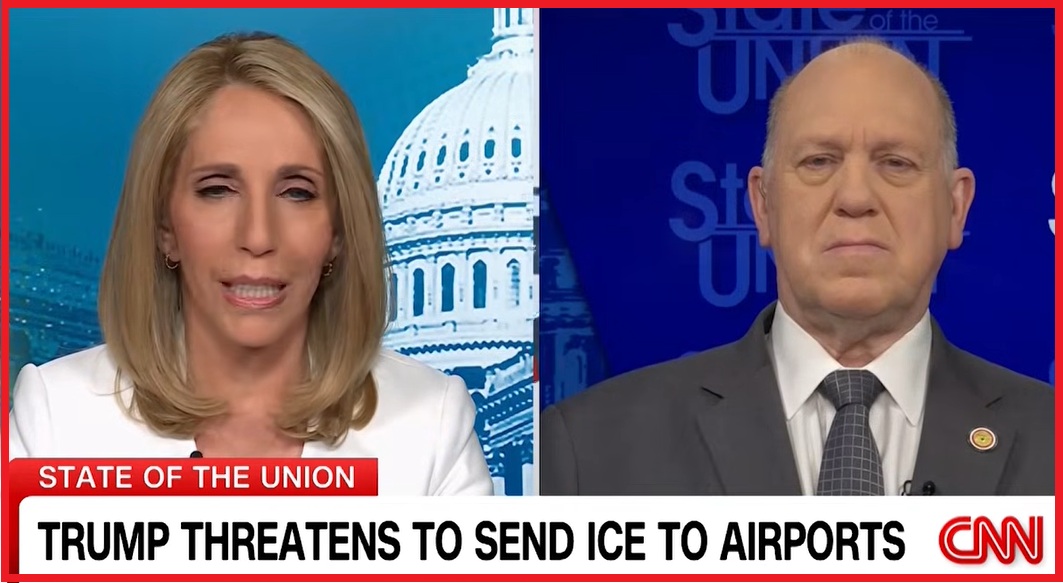
Apparently, CNN needs to play the game of pretending that Customs and Border Protection (CBP) as well as Immigration and Customs Enforcement (ICE) do not already operate in U.S. airports.
Airports are border checkpoints, and the “customs” part of both ICE and CBP are functions that happen as part of regular duty for CBP and ICE officials.
As Tom Homan notes, CBP/ICE already exist in airports and can assist Transportation Security Administration (TSA) officials in various duties including, customs checks, routine security, entrance/exit security as well as baggage and pre-boarding security checkpoints that do not involve the use of x-ray and scanning machines. In fact, more than half the functioning work of TSA agents can easily be handled/supported by ICE/CBP agents.
But CNN needs to build a narrative, so the reality of simple explanations works against their interests. WATCH:
Posted originally on CTH on March 22, 2026 | Sundance
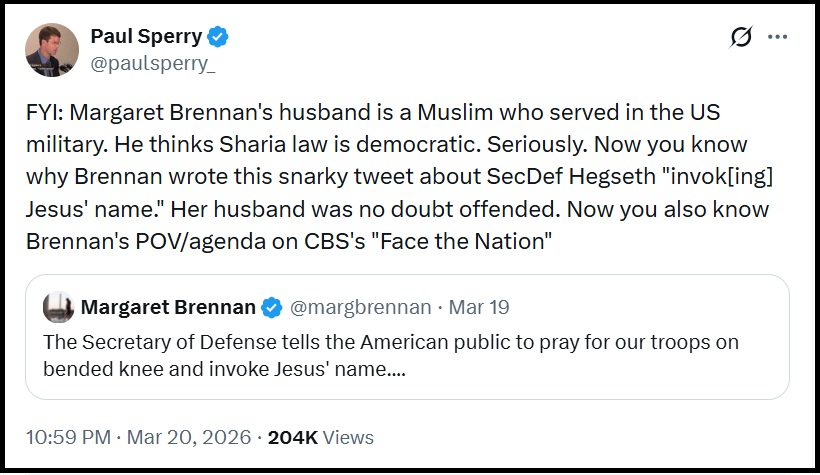
Margaret Brennan’s husband is a Syrian Muslim named Major Ali Iyad Yakub, who goes by the nickname ‘Yado’. He served in the U.S. military. Mrs. Brennan studied abroad at Yarmouk University in Irbid, Jordan, and Yakub’s sister, Samia Yakub, was her roommate. Mr. Yakub founded Y2 Global Advisory specializing in global intelligence, communications, and government relations. He also worked for Senator Joe Biden on the Senate Foreign Relations Committee. Margaret Brennan and Ali Iyad Yakub have two children together.
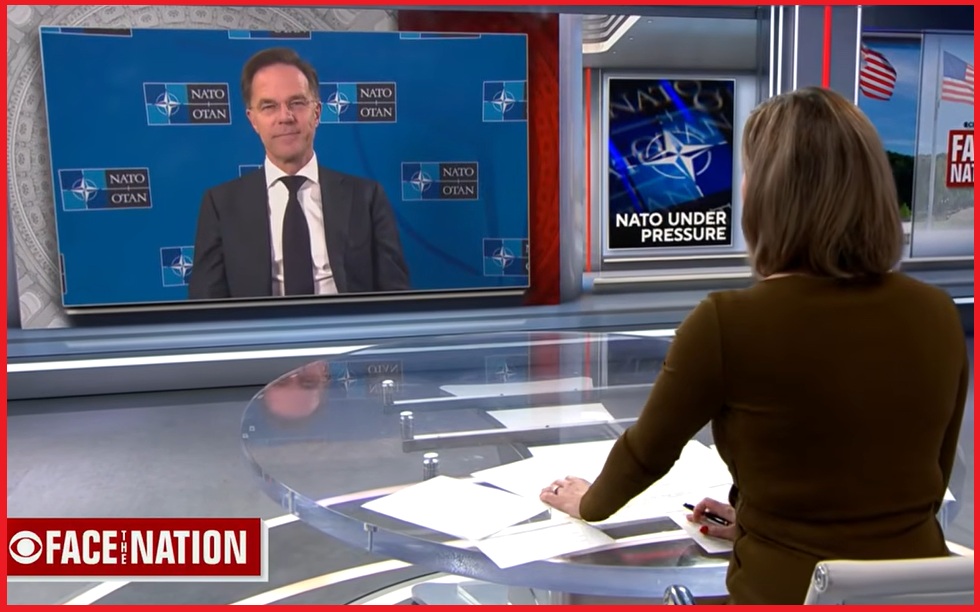
NATO General Secretary Mark Rutte appears on CBS Face the Nation to discuss the European opinion of the U.S. military operation against Iran, and outline how many countries within the NATO alliance are prepared to support the ongoing effort to eliminate the threat Iran represented. Video and Transcript Below:
[Transcript] – MARGARET BRENNAN: We turn now to NATO Secretary General, Mark Rutte, who joins us this morning from The Hague in the Netherlands. Welcome back to ‘Face The Nation.’
NATO SECRETARY GENERAL MARK RUTTE: Margaret, good to be back on the program. Good morning.
MARGARET BRENNAN: Good morning. We did see that Iran fired two missiles at Diego Garcia. That’s that island in the Indian Ocean, which houses a U.S. UK joint base. That was 4000 kilometers from Iranian territory, furthest Iran has ever gone. You just heard Ambassador Waltz say there might be a difference there in how Israel and the U.S. assess that capability Iran has in terms of what they fired. But Israel says these were intercontinental ballistic missiles that could hit Berlin, Paris and Rome. Does NATO share that Israeli assessment?
SECRETARY GENERAL RUTTE: We cannot confirm that at the moment, so we’re looking into that. But if this would be true, it is the more evidence that what the President is doing here, taking out the ballistic missile capability, taking out the nuclear capability from Iran, is crucial. And exactly as the ambassador just said, Ambassador Waltz, we have seen with North Korea, if we negotiate for too long, you might pass the moment where you can still get this thing done, and North Korea now has the nuclear capability. If Iran would have the nuclear capability, including, together with the missile capability, it will be a direct threat, a existential threat, to Israel, to the region, to Europe, to the stability in the world. So the president doing this is crucial, and I’ve seen the polling, but I really hope the American people will be with him, because he is doing this to make the whole world safer.
MARGARET BRENNAN: So but just to be clear at this hour, do you believe that Iran could bomb Berlin, Paris and Rome? Are they all within direct threat range?
SECRETARY GENERAL RUTTE: What we know for sure is that they are very close to having that capability, whether this case with the UK base, Diego Garcia, we are still assessing. But if it is true, it means they already have that capability. If it is not true, we know they are very close to having that capability. And that is exactly why I feel in Europe, that most politicians, it resonates with them. What the President is doing here, which is taking out- degrading Iran’s capability to be, again, an exporter of chaos, sheer chaos to the region, to the world.
MARGARET BRENNAN: Well, I’m sure the president appreciates your praise, but he has been very frustrated, and made that clear this week with NATO and the European allies. He called NATO quote a paper tiger without the US. He said they complain about high oil prices when they forced to pay but they don’t want to help open the Strait of Hormuz. Easy for them cowards. We will remember.
SECRETARY GENERAL RUTTE: I’ve been in several conversations this week with the president, and the good news is that, look, we had the U.S. for weeks planning for Epic Fury and for reasons of security and safety, they could not share with European allies and allies around the world and partner countries what they were doing, because that would have jeopardized the effect of the first- first attack–
MARGARET BRENNAN: –Or it would have allowed you to plan
SECRETARY GENERAL RUTTE: So it is only logical that European countries needed a couple of weeks to come together. But at this moment, the good news is this, that since Thursday, 22 countries, most of them NATO, but also Japan, Korea, Australia, New Zealand, Bahrain, the UAE, have come together to basically answer three questions, what do we need? When do we need it? And where do we need it? These three questions are now worked through to answer the president’s call, to make sure that we secure the free sailing through the Strait of Hormuz.
MARGARET BRENNAN: To be clear, the president has said four to six weeks for this war, that would put us in early April for an end to combat operations. But then he’s also sending troops. He’s also possibly asking Congress for more money. What’s the when part? When did he tell you your support from these European countries will be needed because from the sources I speak to, they are not willing to send in the midst of combat.
SECRETARY GENERAL RUTTE: Obviously, I cannot in a program which is aired around the world, and you have a lot of viewers, discuss with you what is discussed in secrecy, but I can assure you that, of course, and the UK is- is at the forefront of leading this effort of the 22 countries on the leadership of Prime Minister Starmer. I’ve been in the phone call this week with Prime Minister Starmer and President Macron, and again, this has led to 22 countries now signing up to this initiative. And indeed, one of the key questions is not only the what question and the where question, but also the when question. And this is why military planners are now working together to make sure that we are ready, to make sure that that street- that Strait of Hormuz, that we secure the free sailing there, which is crucial for the world economy.
MARGARET BRENNAN: The president seemed to say, though, that this will go beyond Iran in terms of the impact on his thinking about NATO and his willingness to help Europe. Take a listen to this.
[DONALD TRUMP SOT]
DONALD TRUMP: I think NATO is making a very foolish mistake. And I’ve long said that, you know, I wonder whether or not NATO would ever be there for us. So this is a this was a great test, because we don’t need them, but they should have been there.
[END SOT]
MARGARET BRENNAN: The president continues to frame this as sort of like a quid pro quo, and he’s also mentioned Ukraine in the same context, saying, I help Europe with Ukraine. Why aren’t they helping me? Are you worried that this is going to hurt NATO’s goals elsewhere?
SECRETARY GENERAL RUTTE: What I know is that we always come together. It was under President Trump’s leadership that we had the extremely successful Summit in the Hague where we agreed to spend 5% of our GDPs on defense, and therefore equalizing for the first time since Eisenhower. So this is quite some time- some time back in history, equalizing what the Europeans are spending and what Americans are spending, not only because it is fair that we all spend the same, and this was a wish from Trump 45 and now is Trump 47 he got this done, but also because we need it, because of the Russian threat and our other adversaries. Then on Ukraine, it is again the U.S. providing critical intelligence support and weapons flow, working together with Europeans to secure Ukraine’s fight against the Russians, making sure they have what they need. And now with Iran, I’m absolutely convinced, and I understand the president’s frustration that it takes some time, but again, I also ask for some understanding, because nations had to prepare for this, not knowing and for good reasons about the initial attack on Iran, but now coming together to make sure that we can be able to secure the Strait of Hormuz.
MARGARET BRENNAN: No but to be clear, I’ve spoken to some NATO members who say this is a defensive alliance, not an offensive one. We didn’t sign up to go do what the president is asking us to do. But on the Russia point you just made, the European Council president said the U.S. decision to lift sanctions on Russian oil exports. Is very concerning as it impacts European security. This is part of what President Trump’s doing to try to stop the spike in oil prices here at home, the Treasury Secretary says this means about $2 billion is going to Russia now, President Zelenskyy says it’s more like 10 billion. Doesn’t this benefit Vladimir Putin?
SECRETARY GENERAL RUTTE: Well, this is the thing the president has to balance all these different interests. I know that he is with his team, with Jared Kushner and Steve Witkoff and Marco Rubio. They are constantly working with the Ukrainians to put maximum pressure on the Russians to come to a deal. I know–
MARGARET BRENNAN: This isn’t maximum pressure.
SECRETARY GENERAL RUTTE: –I spoke an hour and a half with President Zelenskyy in London. He wants to get the deal done, and we have to make sure that we also take this to the Russians, to make sure that they are willing to play ball. It is the president putting that pressure together with the Europeans. But again, he has to balance all these different interests. So I’m not going to comment on each element of what is happening here, but his effort to bring the war in Ukraine to a successful end is crucial. He was the only one who was able to break the death lock with Putin when he made the first phone call in February last year, and he has consistently, with his team, done what is necessary to put that pressure, of course, on the Ukrainians, and they want to play ball. They show this. They want to end the war, and are also with the Russians.
MARGARET BRENNAN: Well, we’ll see if Vladimir Putin wants to play ball. Secretary General, thank you for your time, and we’ll be right back with a lot more ‘Face the Nation.’ Stay with us.
Posted originally on CTH on March 22, 2026 | Sundance
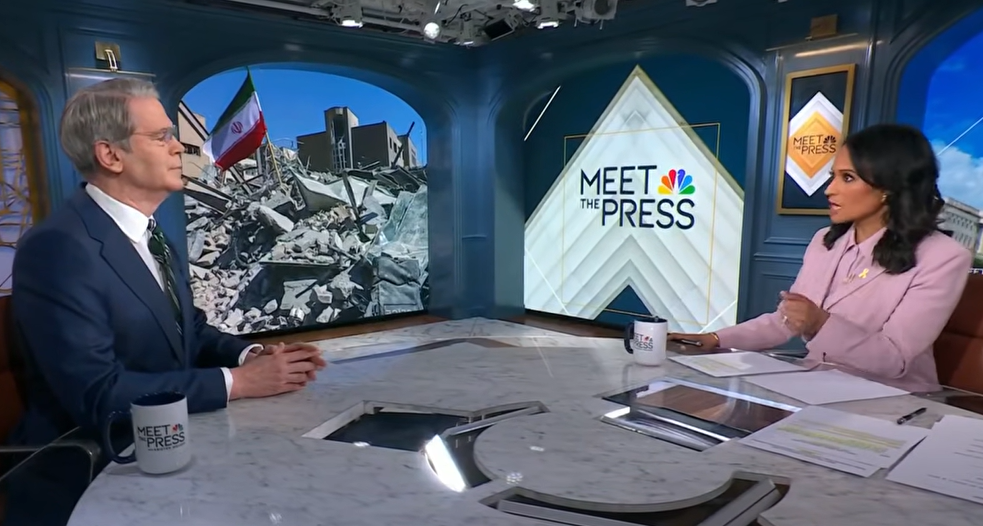
Treasury Secretary Scott Bessent appears on NBC News to outline the purpose and intents of the lifting sanctions as it pertains to Russian and Iranian oil shipments currently in transit. The video and transcript below:
[Transcript] – KRISTEN WELKER: And joining me now is treasury secretary Scott Bessent. Secretary Bessent, welcome back to Meet the Press.
SEC. SCOTT BESSENT: Kristen, good morning.
KRISTEN WELKER: Good morning. Good to have you back. I want to start with the latest of what we’re hearing from President Trump. Let me read you what he posted overnight. He says, “If Iran doesn’t fully open, without threat, the Strait of Hormuz within 48 hours from this exact point in time, the United States of America will hit and obliterate their various power plants, starting with the biggest one first.” Has the president changed his mind about winding down the war, as he said a day earlier, and instead plans to escalate?
SEC. SCOTT BESSENT: I think he said he could wind the war down at any time he wants. And, Kristen, this is the only language the Iranians understand.
KRISTEN WELKER: But this seems to be an escalation, a threat of escalation, and it seems to run counter to his statement that he, in fact, wants to wind down the war.
SEC. SCOTT BESSENT: Again, Kristen, the president’s been very clear from the beginning that the goals are: destroy the Iranian air force and the navy, to completely demolish their missile capabilities, demolish their ability to replenish those capabilities, make sure the Iranians cannot have a nuclear weapon and stop their ability to project power internationally. And the president will take whatever steps it takes to achieve those goals.
KRISTEN WELKER:
Well, you know, I was on the phone with President Trump a week ago. He told me allies were on the way to help secure the Strait of Hormuz. Has the Trump administration abandoned that strategy and now chosen to go it alone?
SEC. SCOTT BESSENT:
Again, what we have done there has been a campaign to -using military assets to soften up the Iranian fortifications along the strait. That’s going to continue until they are completely demolished. And, Kristen, let me tell you, whether it’s this network or the mainstream press, the American people do not have good framing what is going on here. If you were to read what is happening, and I’m sure when Senator Murphy is on, you know, he has come out and said we are losing the war. That is wrong. We have demolished the Iranian capabilities. Their air force is completely destroyed, navy destroyed. And every day we are taking out their missiles, their missile systems, and the factories that build those missiles. And now our- General Caine, Secretary Hegseth, are leading a campaign to destroy all the fortifications along the straits of Hormuz.
KRISTEN WELKER:
Just to put a fine point on this though, is the president in the process of winding down this war or escalating the conflict?
SEC. SCOTT BESSENT:
Again, they are not mutually exclusive. Sometimes you have to escalate to de-escalate, Kristen.
KRISTEN WELKER:
Okay. NBC News is reporting that President Trump is considering sending troops into Iran. Will the administration use troops to secure the Strait of Hormuz or for any other reason, Mr. Secretary?
SEC. SCOTT BESSENT:
Again, as President Trump said during the press break yesterday when he was going out to Marine One, he’s not going to give away what we’re going to do. As President Trump always does, he’s leaving all options on, on the table. We had a very successful bombing campaign against the military installations, Kharg Island, the nexus for all the Iranian oil supply. You know, what could happen with Kharg Island? We’ll see. And again, just to be clear, the command and control system of the Iranian regime is in chaos. This is Hitler’s bunker. Hitler’s dead. Himmler’s dead. Göring is dead. The-most of what you’re seeing are lone wolf activities. The mid-range ICBM that was shot off, these two missiles yesterday, that’s out of desperation, Kristen.
KRISTEN WELKER:
You bring up Kharg Island. I want to ask you about your statement. You said it could become a U.S. asset. What exactly does that mean? Could U.S. troops go into Kharg Island to secure it?
SEC. SCOTT BESSENT:
Again, as I said, all options are on the table.
KRISTEN WELKER:
Okay. So, that’s a possibility.
SEC. SCOTT BESSENT:
All options are on the table.
KRISTEN WELKER:
All right. Let me talk about your announcement this past week. On Friday, the Treasury Department lifted sanctions on Iranian oil stored on tankers, a move that would effectively allow Iran to get more than $14 billion of oil revenue.
SEC. SCOTT BESSENT: I, I –
KRISTEN WELKER: Hold on. Why is the U.S. helping to fund a country that it’s currently at war with, Mr. Secretary–
SEC. SCOTT BESSENT:
Again, Kristen, why don’t we have good facts here? That Iranian oil was always going to be sold to the Chinese. It was going to be sold at a discount. So, which, which is better, Kristen? The uh, which is better? If oil prices spike to $150 and they were getting 70% of that? Or oil prices below $100? It’s better to have them where they are now. And to be clear, we had always planned for this contingency. About 140 million barrels are out on the water. In essence, we are Jiu-Jitsuing the Iranians. We are using their own oil against them. We have a much better line of sight, to be clear, at Treasury, when this oil goes to — if it goes to Indonesia, if it goes to Japan, if it goes to Korea, we have a much better line of sight and are able to block accounts that the oil goes into. When it goes into China it completely gets recycled. So, to be clear, that 14 billion number is grossly overstated.
KRISTEN WELKER:
Let me unpack what you’re just saying. First of all, how much is it? And second of all, I don’t hear you disputing that Iran will get some of the money.
SEC. SCOTT BESSENT:
Iran alway–already gets a huge amount of the money because Iran is the largest sponsor of state terrorism and China has been funding them.
KRISTEN WELKER:
So was always part of the plan to un-sanction Iranian oil?
SEC. SCOTT BESSENT:
Again, we unsanctioned the –at Treasury we plan for all contingencies. We have break-the-glass plans. And to be able — this water — this oil is floating out in Asia, and it is mostly our Asian allies — the U.S. gets virtually no oil from the Gulf. We are energy sufficient. So, when we un-sanction this, rather than the oil going to China, it can go to Japan. It can go to Korea. It can go to Indonesia. It can go to Malaysia –
KRISTEN WELKER:
And it can go to Iran too. I mean, isn’t the point that the sanctions were in place to prevent Iran from getting any of the money. They will have access to some of the –
SEC. SCOTT BESSENT:
No, again–
KRISTEN WELKER:
– money now –
SEC. SCOTT BESSENT:
– Kristen, you’re missing the point. So, please listen to me. They were getting it from China anyway.
KRISTEN WELKER:
Alright. Let me talk about the real-world impact of this because you’re talking about 140 million barrels of Iranian oil, and that’s just a little bit more than what the world uses in one day. How much can that really change prices here at home –
Talk to consumers. How much will it change prices here at home?
SEC. SCOTT BESSENT:
Let me explain. 140 million barrels — about 20 million barrels a day — comes out of the Gulf. About five million has been the uh, repurposed by the Saudis, by the UAE. So, we’re at a 15 deficit. About 1.5 is Iranian oil that comes out. So, we are at between a 10 and 14 million deficit on a daily basis. So, the- if you think about 140 million barrels, that’s between 10 days and two weeks of supply. And one of the reasons, one of the reasons that prices in the U.S. of West Texas crude are below $100 — and we have not seen this massive spike as we did during the beginning of Russia/Ukraine — is because we are well supplied in the market, whether it is the Russian oil, whether it is the Iranian oil, or it is the largest the SPR release in history done by a coalition of 32 countries, 400 million barrels.
KRISTEN WELKER:
Alright. Let’s talk about the Russian oil, which you just raised. The administration did ease oil sanctions on Russia earlier this month. You had initially defended imposing those sanctions, calling Russian exports, quote, “Oil that funds the Russian war machine.” If the point of the sanctions was to stop funding the Russian war machine, why is the administration effectively rewarding Russia now?
SEC. SCOTT BESSENT:
Again, Kristen, you’re missing the point. Which, which is better? Does Russia get more money if oil goes to $150 and they get 70% of that — that’s $105 — or if oil stays below $100, so they’re getting less money? Our analysis shows-our analysis shows that the maximum extra amount that Russia could get would be $2 billion, which is which is one day of the Russian Federation’s budget.
KRISTEN WELKER:
Understood. But they wouldn’t have gotten any of –
SEC. SCOTT BESSENT:
No, no, no–
KRISTEN WELKER:
– that with the sanctions in place –
SEC. SCOTT BESSENT:
Kristen. Kristen, I don’t know, whoever’s –
KRISTEN WELKER:
But would they have gotten –
SEC. SCOTT BESSENT:
No, no, no –
KRISTEN WELKER:
– any of that in place –
SEC. SCOTT BESSENT:
Kristen, whoever does your research, you should get rid of because they were getting it. It was going into China. China was buying over 90% of the Russian oil, and it was –
KRISTEN WELKER:
–But what’s the point of sanctions if not to punish Russia, if not to punish countries?
SEC. SCOTT BESSENT:
Again, the uh, it–we had no ability to do that to China — if China wants to be a bad actor. But we were substantially able to degrade their exports. Their exports have dropped about 25% when the rest of the world isn’t buying it. So, exports are down, but there was a lifeline into China. Now we’ve opened up that to everyone else.
KRISTEN WELKER:
Okay. Just to be clear though. You did defend imposing those sanctions in the first place. Let me ask –
SEC. SCOTT BESSENT:
Just to be clear, it is a maximum of $2 billion. So let’s have good framing on this.
KRISTEN WELKER:
Okay. Let’s talk about the overall cost of this war. The administration’s asking Congress — poised to an additional $200 billion in additional funding for this war. Some Republicans who could cast key votes on this are expressing hesitation or outright opposition. Take a listen to them and then I want to get your reaction on the other side.
[BEGIN TAPE]
FEMALE REPORTER:
Are there any initial red flags for you?
SEN. RICK SCOTT:
No — maybe, it’s a lot of money. I’ll go through it, see what they need.
REP. LAUREN BOEBERT:
I am a no. I’ve already told leadership I am a no on any war supplementals. I am so tired of spending money elsewhere.
[END TAPE]
KRISTEN WELKER:
Should President Trump have gone to Congress on the front end of this war if he was going to ask for Congress’s help now for more funding?
SEC. SCOTT BESSENT:
Again, President Trump was within his authorities under the War Powers Act to initiate this action. And we, we actually now we have plenty of money to fund this war. What we are doing is this is supplemental. President Trump has built up the military, as he did in his first term, as he is now doing in his second term, and he wants to make sure that the military is well-supplied going forward.
KRISTEN WELKER:
Would the administration ever raise taxes in order to fund this war?
SEC. SCOTT BESSENT:
Again, Kristen, terrible framing. I think that the –
KRISTEN WELKER:
Well, it’s just a que– it’s a simple question that I think a lot of people have –
SEC. SCOTT BESSENT:
It’s a ridiculous question.
KRISTEN WELKER:
Well, but –Can you answer it?
SEC. SCOTT BESSENT:
Why would we do that? That the, that we-we have plenty. We have a trillion dollars in this year’s budget for the military. And President Trump, even before the conflict started, had said that he would like to further build out the military.
KRISTEN WELKER:
So, just–is raising taxes under consideration at all –
SEC. SCOTT BESSENT:
Not —
KRISTEN WELKER:
– if you’re saying you have plenty of money?
SEC. SCOTT BESSENT:
Not at all.
KRISTEN WELKER:
Okay. Let’s turn to how all of this is impacting consumers. United Airlines CEO Scott Kirby is now planning, he says, to cut flights and is planning for oil to go as high as $175 a barrel with prices potentially staying above $100 a barrel through 2027. This is according to him. All of this could potentially mean higher prices for consumers. What do you say to Americans who feel they were promised lower costs and now they’re getting the opposite?
SEC. SCOTT BESSENT:
Uh, Kristen, I think the American people understand that any 50 — I’m not going to put a time on it but let’s just pick 50 days of temporary elevated prices, prices will come off on the other side, for 50 years of not having an Iranian regime with a nuclear weapon. The American people are beginning to understand, thanks to President Trump, that there is no prosperity without security.
KRISTEN WELKER:
I heard you say 50 days. Are you saying that prices could start to come down –
SEC. SCOTT BESSENT:
No, no, no, no –
KRISTEN WELKER:
What’s the time frame –
SEC. SCOTT BESSENT:
I was just picking a point. I don’t know whether it’s going to be 30 days. I don’t know whether it’s going to be 50 days. I don’t know whether it’s going to be 100 days. But to have 50 years the, uh, of peace in the Middle East and know that the Iranian regime is defanged because, Kristen, what we had before was the illusion of security. Imagine this regime if they had had another year or two years to build out their missile capabilities. They would’ve built a shield around themselves and it would’ve been impossible to prevent them from getting a nuclear weapon.
KRISTEN WELKER:
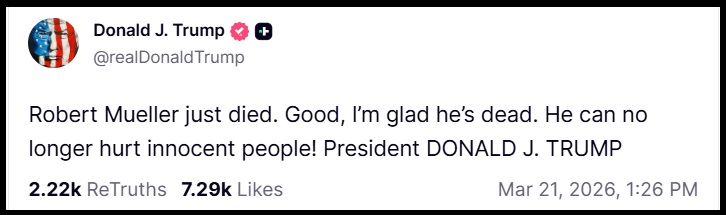
All right. I want to ask you on a different topic about a post by President Trump from yesterday responding to the death of former special counsel Robert Mueller. He posted this quote, “Robert Mueller just died. Good, I’m glad he’s dead. He can no longer hurt innocent people!” Do you think it’s appropriate for the president of the United States to celebrate the death of an American citizen, someone who’s a Bronze Star, Purple Heart recipient and who served in Vietnam?
SEC. SCOTT BESSENT:
Kristen, I was with the president in the green room at Davos and there was a video playing of the — what may have been an illegal raid on his home at Mar-a-Lago. They are going through his wife’s wardrobe. And I watched the look in his eye, and I think that neither one of us can understand what has been done to the president and to his family.
KRISTEN WELKER:
But to the question of the president’s post, I mean, Robert Mueller didn’t order that raid. Is it appropriate for the president to celebrate the death of any American citizen –
SEC. SCOTT BESSENT:
Again —
KRISTEN WELKER:
– Mr. Secretary –
SEC. SCOTT BESSENT:
I think that given what has been done to President Trump and his family it is impossible for either of us to understand what he has been through.
KRISTEN WELKER:
So, you don’t think that there’s anything wrong with the post, saying, “Good. Robert Mueller’s dead”
SEC. SCOTT BESSENT:
Again, I think that we should all have a little empathy for what has been done to him and his family.
KRISTEN WELKER:
All right. Treasury Secretary Scott Bessent, thank you as always for being here. Really appreciate it.
Posted originally on CTH on March 22, 2026 | Sundance
Recently when the Anthropic software and ideology conflict with the Pentagon surfaced as a result of limits placed by the provider, alternative provider Palantir’s CEO remarked that any AI developer who challenges the U.S. military application of the product was foolish because the U.S. government could just take control of the company under the claim of national security.
In essence, Palantir CEO Alex Karp was saying AI developers who contract with the govt ultimately become bound to the limits or lack thereof as determined by the govt. If software developers want to contract with the military, then fight the Pentagon over use of those software applications, they will lose.
In response to the Anthropic issue, the Pentagon withdrew from their purchase arrangements and blacklisted them from further federal contracts.
Now a report is highlighting that Palantir will take the lead position in providing the software, the Maven Smart System, for the core U.S. military functions.
As described, “Maven is a software platform that uploads information from drones, satellites, sensors, radar, and other battlefield intelligence sources. The system then analyzes battlefield data in real time, identifying and prioritizing potential targets — including buildings, enemy vehicles, and weapons and ammunition stockpiles — for intelligence analysts to review and act on.”
NEW YORK, March 20 (Reuters) – Palantir’s Maven artificial intelligence system will become an official program of record, Deputy Secretary of Defense Steve Feinberg said in a letter to Pentagon leaders, a move that locks in long-term use of Palantir’s weapons-targeting technology across the U.S. military.
In the March 9 letter to senior Pentagon leaders and U.S. military commanders, Feinberg said embedding Palantir’s Maven Smart System would provide warfighters “with the latest tools necessary to detect, deter, and dominate our adversaries in all domains”.
The decision is expected to go into effect by the close of the current fiscal year, which ends in September, according to the letter, which was reviewed by Reuters and has not been previously reported.
Maven is a command-and-control software platform that analyzes battlefield data and identifies targets. It is already the primary AI operating system for the U.S. military, which has carried out thousands of targeted strikes against Iran over the last three weeks. (read more)
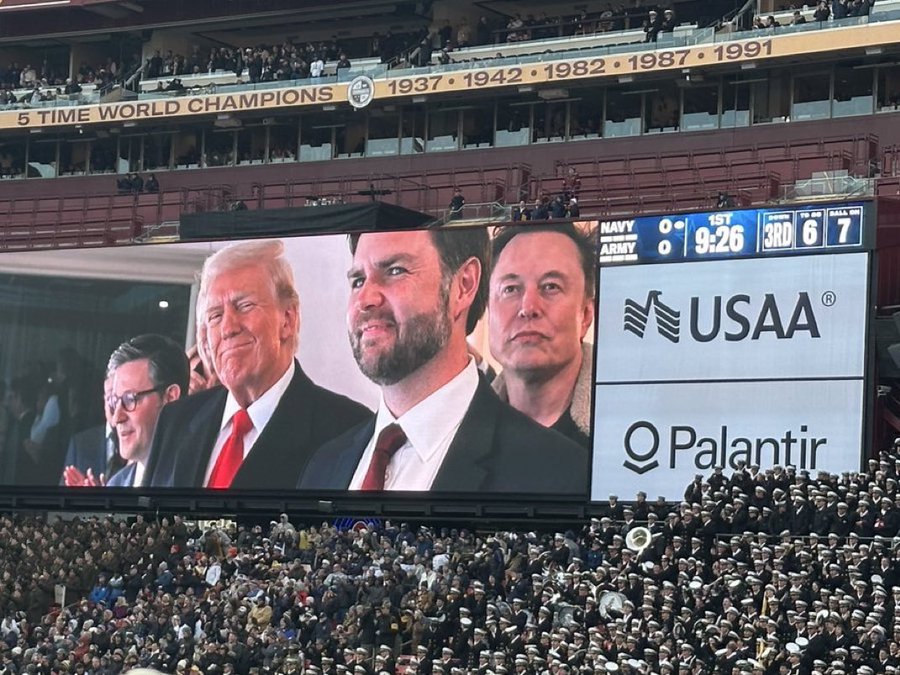
Elon Musk (Tesla, SpaceX) and Alex Karp (Palantir)
Posted originally on CTH on March 21, 2026 | Sundance
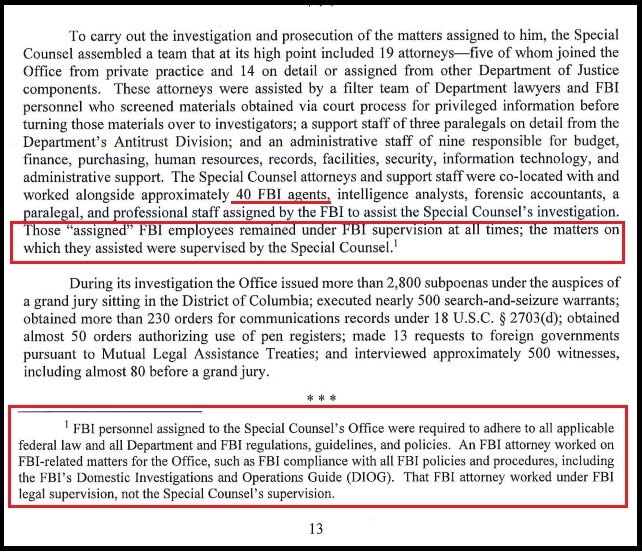
The Clinton exoneration FBI Team became the Trump investigation FBI Team (Crossfire Hurricane) – which then became the Robert Mueller FBI Team (exact same people, plus some additions) – which then became the J6 Investigation FBI Team (exact same people, plus some additions) – which then became the Jack Smith FBI Team (same exact people). Not only was it one long continuum, but it was also the EXACT SAME PEOPLE.
Before there was the obvious cognitive decline of Joe Biden, there was the obvious cognitive incapacity of Robert Mueller. However, both acuity compromises were ignored because the agenda the figureheads represented was more important than their obvious compromise. We talked about it throughout the special counsel timeframe that held his name.
Robert Mueller was a figurehead with no structural input or control over the Trump-Russia special counsel probe. Factually, Andrew Weissmann was in control over the special counsel investigation, albeit with daily support from the entire Lawfare network. President Trump’s notice about Robert Mueller’s death is understandable:
I’ve always said to pay attention to the people in Washington DC, specifically the republicans, who claimed Robert Mueller was an honorable figure. As soon as you hear that sentiment, you know that is a corrupt conniving bastard speaking.
Everyone in Washington DC knew what the role of Robert Mueller was during the first-term administration of Donald Trump. No one in Washington DC did not know. Anyone who says the Mueller motive was to investigate Trump-Russia is a deceptive liar. They all knew what the goal of Mueller was.
The 2017 Mueller Timeline:
♦Sunday May 14th – James Comey transmitted copies of Memos 2, 4, and 6, and a partially redacted copy of Memo 7 to Patrick Fitzgerald, who was one of Comey’s personal attorneys. Fitzgerald received the email and PDF attachment from Comey at 2:27 p.m. on May 14, 2017, per the IG report.
♦Monday May 15th, McCabe states he and Rosenstein conferred again about the Special Counsel approach. McCabe: “I brought the matter up with him again after the weekend.”
On this same day was when James Rybicki called SSA Whistleblower to notify him of Comey’s memos. The memos were “stored” in a “reception area” and in locked drawers in James Rybicki’s office.
♦Tuesday May 16th – Per the IG report: “On the morning of May 16, Comey took digital photographs of both pages of Memo 4 with his personal cell phone. Comey then sent both photographs, via text message, to his special government employee, Daniel Richman. Richman’a job was to use the memo to leak to media.
Back in Main Justiceat 12:30pm Rod Rosenstein, Andrew McCabe, Jim Crowell and Tashina Guahar are all part of this meeting. I should note that alternate documentary evidence, gathered over the years, supports the content of this McCabe memo. Including texts between Lisa Page and Peter Strzok:
[Sidebar: pay attention to the redactions; they were placed by DOJ officials in an effort to protect Rod Rosenstein for his duplicity in: (A) running the Mueller sting operation at the white house on the same day; (B) the appointment of Robert Mueller as special counsel, which was pre-determined before the Oval Office meeting.]
While McCabe was writing this afternoon memo, still May 16th, Rod Rosenstein took Robert Mueller to the ¹White House for a meeting in the oval office with President Trump and VP Mike Pence.
After six prior days of phone calls, emails and in person meetings, this visit to the White House was clearly Rod Rosenstein introducing Robert Mueller to the target of the investigation. Rosenstein already knew he was going to appoint Mueller; and Mueller, along with the small group in the FBI, already knew Mueller was going to be appointed.
Later that night (May 16th), following the Mueller visit, there was a debriefing session back at Main Justice. This evening meeting appears to be Lisa Page, Rod Rosenstein and Andrew McCabe; along with Tashina Gauhar again taking notes.
♦ Wednesday May 17th, 2017: Rod Rosenstein and Andrew McCabe go to brief the congressional “Gang-of-Eight”: Paul Ryan, Nancy Pelosi, Devin Nunes, Adam Schiff, Mitch McConnell, Chuck Schumer, Richard Burr and Mark Warner.
… […] “On the afternoon of May 17, Rosenstein and I sat at the end of a long conference table in a secure room in the basement of the Capitol. We were there to brief the so-called Gang of Eight—the majority and minority leaders of the House and Senate and the chairs and ranking members of the House and Senate Intelligence Committees. Rosenstein had, I knew, made a decision to appoint a special counsel in the Russia case.”
[…] “After reminding the committee of how the investigation began, I told them of additional steps we had taken. Then Rod took over and announced that he had appointed a special counsel to pursue the Russia investigation, and that the special counsel was Robert Mueller.” (link)
Immediately following this May 17, 2017, Go8 briefing, Deputy AG Rod Rosenstein notified the public of the special counsel appointment.
According to President Trump’s Attorney John Dowd, the White House was stunned by the decision. [Link] Coincidentally, AG Jeff Sessions was in the oval office for unrelated business when White House counsel Don McGahn came in and informed the group.
Jeff Sessions immediately offered his resignation, and Sessions’ chief-of-staff Jody Hunt went back to the Main Justice office to ask Rosenstein what the hell was going on.
RUSSIAGATE – THEY HAD NOTHING – This investigative ‘small group’ were the people inside Main Justice (DOJ) and FBI headquarters who redacted the Lisa Page and Peter Strzok text messages; removed messages and communication antithetical to their goals; kept key documents and information away from congress; stalled any effort to expose the unlawful aspects of “SpyGate’ and the fraudulent foundation behind the Carter Page FISA application; and undermined any adverse discoveries in the leak investigations (ex. James Wolfe).
The DOJ/FBI investigative small group didn’t change when Mueller arrived, they just reorganized the focus of their effort based on lawfare leadership from Andrew Weissmann and new objectives. Those same people who created the Trump-Russia collusion/conspiracy case of 2016, evolved into creating the Trump obstructing justice case of 2017, 2018 and 2019.
Everything Robert Mueller and Rod Rosenstein were doing in late 2017 and throughout 2018 was intended to drag-out the Russia conspiracy narrative as long as possible. There was really no Trump-Russia investigation taking place.
It was always the “obstruction” investigation that could lead to the desired result by Mueller’s team of taking down President Trump through evidence that would help Pelosi and Nadler achieve impeachment. The “obstruction case” was the entirety of the case they were trying to make from May 2017 through to March 2019.
SPYGATE – Just as the New York Times reported, in its final days in office, the Obama Administration expanded the power of the National Security Agency (NSA) to share globally intercepted personal communication with the government’s 16 other intelligence agencies before applying any privacy protections.
The new rules were issued under section 2.3 of Executive Order #12333 after approval by two Obama Administration officials: Attorney General Loretta Lynch and Director of National Intelligence Director, James Clapper.
The new rules, which were issued in an unclassified document titled: “Procedures for the Availability or Dissemination of Raw Signals Intelligence Information by the National Security Agency (NSA),” significantly relaxed longstanding limits on what the NSA may do with the information gathered by its most powerful surveillance operations.
These operations remain as largely unregulated by American wiretapping laws. Surveillances include collecting satellite transmissions, phone calls, and emails that cross network switches abroad, and messages between people abroad that cross domestic network switches.
The changes initiated by the Obama Administration in its waning days empowered far more government agents and officials to search through raw intelligence data. As a direct consequence of the change in policy, that the prospect of intel leaks grew exponentially.
Attorney General Loretta Lynch signed the new rules permitting the NSA to disseminate raw signals intelligence information on January 3, 2017 after Director of National Intelligence James Clapper signed them on December 15, 2016.
The targeting of Donald Trump required surveillance and spying.
The surveillance of Donald Trump never stopped.
The aspect that changed was the team extracting the information. Hence, (FBI) Raw NSA extraction => (FBI) Crossfire Hurricane => (FBI) Robert Mueller => (FBI) Impeachment => (FBI) Mar-a-Lago Raid => (FBI) Jack Smith.
My Thoughts…. Robert Mueller spent the last 8 years of his life slowly sliding into a very dark place. He lost his ability to think, he lost his ability to communicate, he lost his ability to take care of himself, he lost his ability to walk, he lost all joy and happiness, he lost his ability to live. His family was also dragged into a very dark and depressing place while they awaited his end-of-life process. It wasn’t a fast death. That sounds like hell.
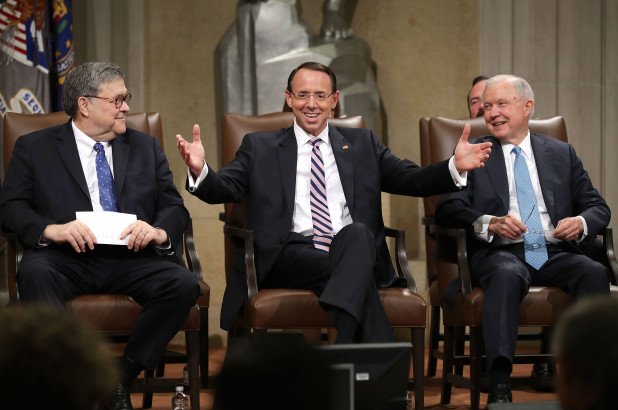
[FOOTNOTE: I have always wondered why no journalist has ever asked President Trump about the meeting with Robert Mueller, organized by Rod Rosenstein on the day before the special counsel was appointed. How did Trump feel about Rosenstein when he realized the meeting with Mueller was a ¹set up? (or did he realize it?).]
I have created this site to help people have fun in the kitchen. I write about enjoying life both in and out of my kitchen. Life is short! Make the most of it and enjoy!
This is a library of News Events not reported by the Main Stream Media documenting & connecting the dots on How the Obama Marxist Liberal agenda is destroying America










 Centinel2012