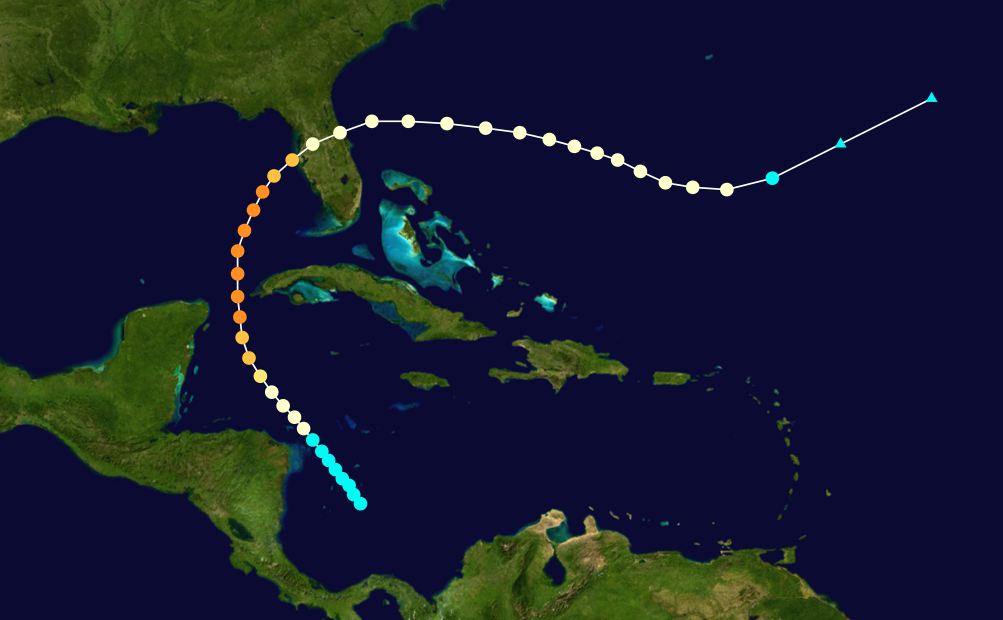
I want to thank everyone for sending in emails of concern with regard to Hurricane Michael. It is not likely to hit our area. However, the last bad hurricane to hit Tampa was in 1921 which was a Category 4 with 140 mph winds. It was an unusual storm like Michael which began in the Carribean during mid-October rather than in the Atlantic off the coast of Africa and normal. The storms that start in the Atlantic typically will not impact the West Coast. The storms that are most dangerous to this area are those that begin in the Carribean like Michael.
1921 TAMPA Category 4
The previous major hurricane was September 23–25, 1848 Category 4, which also formed in the Gulf of Mexico. There was also a lessor one in 1946 which was a Category 2, which also formed in the Gulf. The worst to hit the West Coast was Hurricane Charley in 2004 which hit as a Category 4. This one was an Atlantic storm which entered the Gulf and then turned right coming up the West Coast. The computer projections show a major one due in Tampa of a Category 4 to 5 probably in 2042-2043. That does not mean we will not see others of lesser intensity between 2018 and 2042/43.
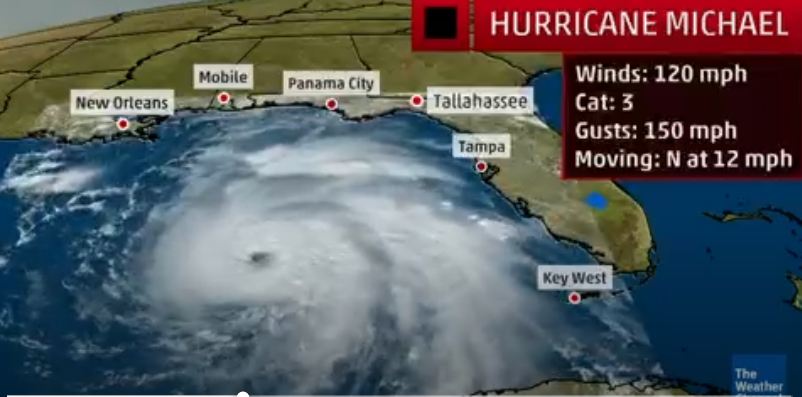
As anticipate Hurricane Michael is showing signs of continued strength with each update. Current wind speed 85mph. Rapid intensification is predicted. Current forecast is for a Category 3 (115+ mph) storm at landfall. If you are in the path you do not have much time to prepare. This storm is gaining forward speed as it strengthens.
[Hurricane Center] At 700 PM CDT (0000 UTC), the center of the eye of Hurricane Michael was located by a NOAA Hurricane Hunter aircraft near latitude 22.7 North, longitude 85.2 West. Michael is moving toward the north near 12 mph (19 km/h). A northward to north-northwestward motion at a slightly faster forward speed is expected through Tuesday night, followed by a northeastward motion on Wednesday and Thursday.
On the forecast track, the center of Michael will move over the southeastern Gulf of Mexico tonight, then move across the eastern Gulf of Mexico Tuesday and Tuesday night. The center of Michael is expected to move inland over the Florida Panhandle or Florida Big Bend area on Wednesday, and then move northeastward across the southeastern United States Wednesday night and Thursday.
Reports from the reconnaissance aircraft indicate that maximum sustained winds have increased to near 85 mph (140 km/h) with higher gusts. Steady to rapid strengthening is forecast during the next day or so, and Michael is forecast to become a major hurricane by Tuesday night. (read more)
For those in the cone of uncertainty, Florida Governor Rick Scott has provided an extensive update on state preparations – SEE HERE – More information is available on the Florida Emergency Website – SEE HERE.
Due to the speed of this storm, and the rapid intensification strength, all interests in the coastal area should immediate rush to completion their hurricane and storm preparation plans. Tuesday is likely the only day to prepare your property and personal effects. Do not delay. Pay attention to the warnings and guidance of local officials.
If you live in an evacuation zone be prepared to respond as soon as instructed. Take this storm seriously. Slight variations in the storm’s path can create major changes within any impacted region.
Coastal residents of Northern Florida (Panhandle), Alabama, Mississippi and Louisiana should keep an eye on tropical storm Michael. The storm is anticipated to become a Hurricane in the northern Gulf of Mexico sometime late Tuesday/Wednesday.
At 100 PM CDT (1800 UTC), the center of Tropical Storm Michael was located near latitude 19.2 North, longitude 86.9 West. Michael is currently stationary but is expected to resume a slow northward motion later today. A northward motion with some increase in forward speed is expected over the next few days. On the forecast track, the center of Michael will move near the northeastern tip of the Yucatan Peninsula Monday morning, and then across the eastern Gulf of Mexico late Monday through Wednesday morning.
Maximum sustained winds are near 40 mph (65 km/h) with higher gusts. Strengthening is forecast during the next several days, and Michael could become a hurricane by Tuesday night or Wednesday. (More from hurricane center)
They claim that all the world’s nations combined pumped nearly 38.2 billion tons of carbon dioxide into the air from the burning of fossil fuels such as coal and oil, according to new international calculations on global emissions published in the journal Nature Climate Change. That is 32 kilotons per day when one volcano Katla, which is a huge hidden volcano 650 feet beneath the ice cap in Iceland, is emitting 20 kilotons of C02 every day. There are only two volcanoes worldwide that are known to emit more CO2, and now scientists are concerned that Katla may be headed toward a major eruption. Obviously, the UN should be imposing a tax on Iceland for all this added Co2.
Katla has had about 20 eruptions in the last 1100 years. There were eruptions which have been documented in the years 920 and 1612, and from 1821 to 1823. These latter eruptions in the 19th century helped to cool the planet contributing to the mini ice age at that time. The last eruption that actually broke through the ice cap occurred in 1918. There have been subglacial flood events in 1955, 1999 and 2010-2011 that melted ice but it did not break the surface. These events do create flooding as the ice melts. Volcanic activity produced two eruptions in 2010 at Eyjafjallajokull, on March 20 and April 14. The second eruption created the giant ash cloud over Europe which diverted air traffic.
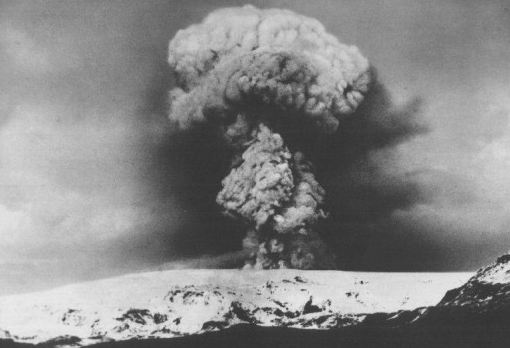
The 1918 ash plume was documented to have reached heights of 14 km. That event looked like a mushroom cloud from an atomic bomb. It is hard to draw a conclusive model since the majority of eruptions only melt ice beneath the surface. The best we can do with an approximation for the events that break through the surface puts it in 2020-2021 for the next ideal event. But the data series is not definitive on this event. It does appear that Katla has become active again since 2010 and is building to a climax. This could also be an event that contributes to global cooling as we saw during the 19th century
COMMENT: Good day Sir; How in the world do you do it? It is one thing to develop Socrates and assist clients, but yet another to keep up with and tie in the global events to the waves. I know you don’t sleep much Martin but I have not been dressed in a week and still I miss a couple things. If I’m getting this right various frequencies of currencies and prices are fixed and varied then Socrates somehow sorts all the waves, throws in a time factor that results in a cross of those market waves. Socrates seems to he can smell when the buyers reach that point of re-entry on a bear market or sellers during a bull. It’s extraordinary. It now seems crazy to think I will ever catch up to you without field experience. 4 years of reading/studying/back-checking your models/research/data is a bugger. Then you sens me back to the drawing board about once a month about another factor of the marketplace which didn’t occur to me. So off I go again into the unknown forest not knowing when I will reappear. I am pissed with myself that I am not yet comfortable. This quarter has been good because of a change in method that better resembles the market actions. Socrates is making sense more each day yet still I find pieces that need to fit somewhere. This is the coolest thing I’ve ever done. Working within the walls of a seemingly structured global marketplace I find it is handy to not only be a gentleman study but also know how to think like a thief, a murderer, a snake oil salesman, and a pick-pocket like Browder. Apologies for wasting your time. Lessons of simplicity… My father drew a small circle on the back of an envelope representing my entire knowledge base. I was maybe 15 or 16 so a small circle was appropriate. He said what is unknown to me lies on the outer perimeter of that circle.
The more I learn the larger the circle becomes, but correspondingly the outside perimeter of the unknown increases.
That’s my beef.
Thank you for opening the biggest can of worms.
RH
REPLY: Life is a journey that we are sent here to learn. You may not realize it, but you are what is truly a “genius” which most people do not understand what it even is. Indeed, some believe if we screw up we are sent back here again to try to get it right. Some believe Buda prayed that he could reach Nirvana and not have to come back here again. It is an interesting perspective on the purpose of life. But what is interesting is that I can agree that this is a journey about gaining knowledge. That is what keeps us both interested and young. If you have no interest in exploring, then you sit in your diapers in old age watching mindless TV shows waiting to be called home. Life ends, in my opinion, when there is nothing left to learn.
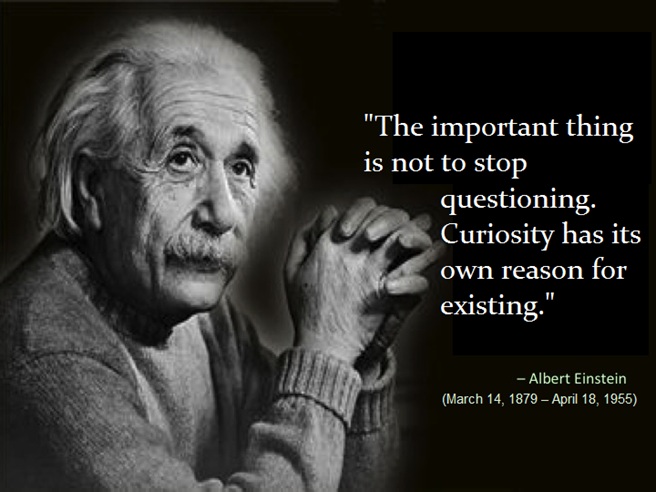
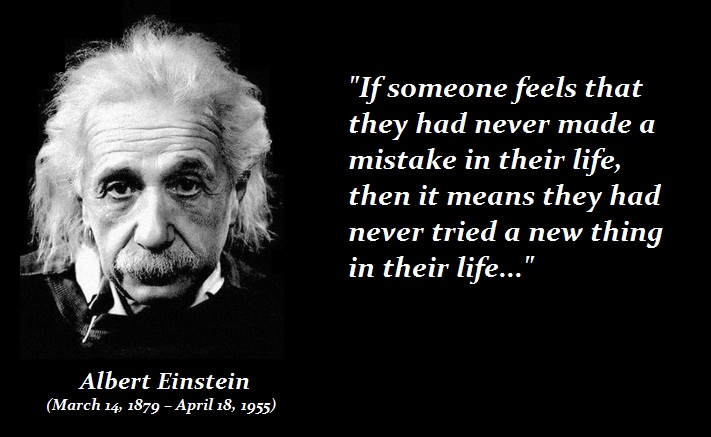
As long as you are on a journey toward enlightenment all is good. What else would you have in life that feeds your mind with the only food it really needs – curiosity and imagination. I did not know Einstein. But I knew a professor at Princeton where he taught who did know him. He shocked me one day and said I reminded him of Einstein. I was surprised and said I was not in his league or field. He told me I was. He explained that the common threat was not the subject matter by my curiosity. He told me that curiosity was the fuel for all advancement. As long as you are curious and have imagination, and try to figure out what makes things tick, that is the path to enlightenment.
There have been studies on what people call “genius” and they have revealed that all such people do poorly in school and tend to get in trouble. In the case of Einstein, his Munich schoolmaster wrote in Albert Einstein’s school report, “He will never amount to anything”, back in 1895. People who explore and test things rather than just regurgitate what they were taught are on the path to enlightenment. We will never advance as a society without exploring how things work. If you are curious and have an imagination, then you will explore new solutions. If you just memorize what the teacher says and get straight As, you will be a follower rather than a leader.
The school records of the young Winston Churchill revealed the future war leader was a “naughty child” the teachers said would amount to also to nothing. We have to understand what is really “genius” in order to nurture that in our children. It has NOTHING to do with the level of intelligence of knowing everything like some encyclopedia. Genius is all about dynamic thinking and methodology – seeing the interconnections. I have written before, if you read this blog, chances are you too fall into the category of being a “genius” for your thinking process demonstrates you are on a quest for knowledge.
The difference between a true genius and the majority of the world is that they are NOT content to walk around with blinders on like a horse pulling a carriage. The majority only can see directly what is in front of them. This is why A students work for C students, and B students work for the government. William Manchesterwrote in the Last Lion on the life of Winston Churchill:
“Studies at the University of Chicago and the University of Minnesota have found that teachers smile on children with high IQs and frown upon those with creative minds. Intelligent but uncreative students accept conformity, never rebel, and complete their assignments with dispatch and to perfection. The creative child, on the other hand, is manipulative, imaginative, and intuitive. He is likely to harass the teacher. He is regarded as wild, naughty, silly, undependable, lacking in seriousness or even promise.“
Video Player
00:00
01:22
So it is not that a genius knows everything, it is a person who seeks knowledge and thinks dynamically. You must avoid trying to reduce the world to a single cause and effect. It is always far more complex than just that. Look at all the people who dropped out of some university yet started major companies like Steve Jobs, Bill Gates, Mark Zuckerberg just to mention a few (see the list of top 10). The most VALUABLE lesson we can teach our children is HOW TO THINK – not what to think.
Why have I poured so much time into programming Socrates? First, it was never a project I could ever give to another to even attempt to code. As far as its model analysis, I have been the only programmer. It takes EXPERIENCE in the subject matter to write such a program. Everyone else codes the delivery system. This is why there is nothing else like it. You had to be a TRADER and a PROGRAMMER to even tackle such an endeavor. My objective was to clone myself. There are so many variables that are involved it quickly exceeds the capacity of any human to keep track of some much in their head and at the tip of their fingers instantly. This is not about writing some algorithm to produce a mean and lean trading machine. Those are one-dimensional systems that will never adapt to changes.
For example, everyone rushed into AI to create robot trading. It was assumed the UBS’s push into AI lead to “robots invading the trading world.” Then one year later, UBS was reported to be shutting down its robo-trading system said in a statement that, while it is “satisfied” with the commercial progress of the service, “at this time we believe the near-term potential is limited and have therefore decided to close our digital-only offering in the UK”.
You cannot hire programmers to write a trading platform because they can only plug is formulas that are one-dimensional and have a system that will be consistent over time. Long-Term Capital Management crashed after used the Black–Scholes model for which they won the Nobel Prize, yet it failed with volatility and time. They never saw the wave coming at them from currencies which swamped all markets and force funds to sell assets around the world to cover losses in Russia.
Even high-frequency trading cannot see the big waves coming from global events and they will shut down as soon as volatility rises. The biggest danger with such systems is they become trapped and cannot escape a financial tidal wave they are incapable of forecasting. It is like just watching gold and nothing else. Everything is connected and then to figure such a system out requires historical data. I have stated plenty of times, I have probably spent far more than a $100 million in today’s terms to collect a database to even train a system.
I am always still improving Socrates. As I said, it is my clone. Every trick of the trade I have learned I taught the system and I and always still learning so I had to write the code to allow Socrates to also learn as I have throughout life. The bottom line is rather simple. It does not make a mistake in forgetting to check something because it had a good night or some distracting argument. It is free of such human fralities we are all plagued with.
QUESTION: Mr. Armstrong; I have a hard time envisioning this age of knowledge some claim is behind cryptocurrencies and others claim is behind robots that necessitate a guarantee welfare system. Do you give any credence to these type of forecasts of the long-term future?
BG
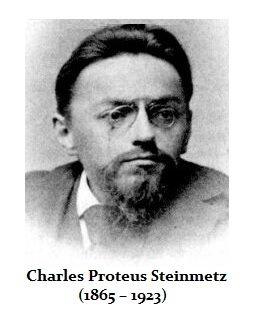
ANSWER: No. This idea that we advance to a higher state of knowledge is rather absurd. We evolve with technology, but it is not going to produce world peace. There was a German electrical engineer by the name of Charles Proteus Steinmetz who had made a dramatic forecast with the invention of electricity back in 1923. He said that by 2023, electricity would be doing all the hard work and people would not have to toil for more than four hours a day. Steinmetz also envisioned cities free of pollution and litter in a century’s time.
If we look at electricity, yes it is cleaner and would produce less pollution if you generated by solar or nuclear. He could not forecast in 1923 nuclear energy nor could he fathom the computer so we are not working less but can work even more from anywhere. The danger of trying to make long-term forecasts in technology is that the trend can be changed by a development in a parallel field. This is why in designing Socrates, I taught it how to analyze rather than create fixed rules. In this manner, it will evolve with technology. Who knows, perhaps they discover a way to get energy from Azuki beans that replaced everything.
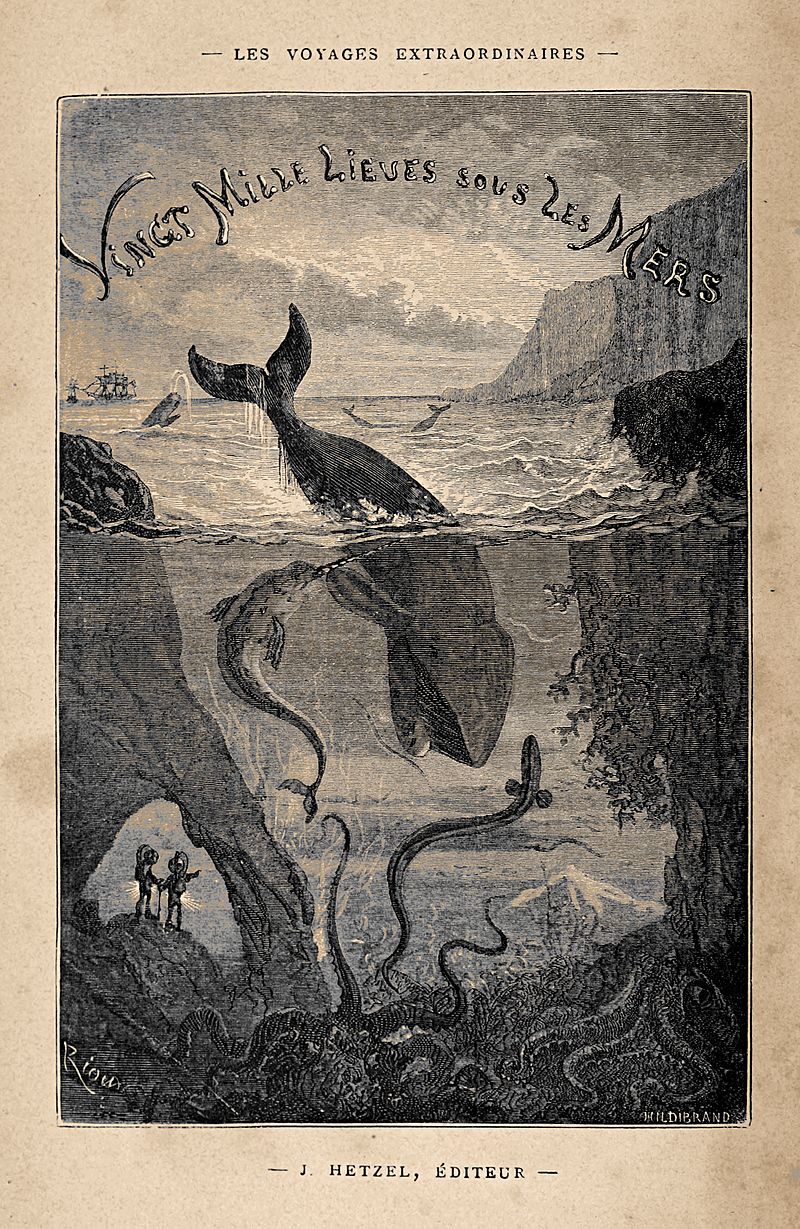
Nobody can know the discoveries that await us long-term. Who knows, perhaps we can one day create black holes and appear on the other side of the universe. It may sound like complete fiction today no down as traveling under the sea did to people who read 20th Thousand Leagues under the Sea by Jules Verne (1828–1905) in 1870.
It is best to just go with the flow. The markets pick up changes in technology. Just pay attention.
Several communities and towns within North Carolina have been completely cut-off by rising flood waters as a result of Hurricane Florence and the unprecedented amount of rain. The cities of Wilmington and Jacksonville, NC, are surrounded by flooding.
Pay attention to all local officials, and heed all notices to evacuate based on the advice from local and state officials. The threat is increasing in multiple regions throughout the state of North Carolina. Evacuations are ongoing with all resources deployed to assist stranded residents. FEMA, the national guard, the coast guard, and all state and federal resources are currently deployed for ongoing rescue efforts.
.
Florence has weakened to a tropical depression but forecasters warn the next few days could bring the most destructive round of flooding in North Carolina history. The National Hurricane Center says the effect is expected to be “catastrophic.”
NORTH CAROLINA – The city of Wilmington, North Carolina, has been completely cut off by floodwaters, and officials are asking for additional help from state law enforcement and the National Guard.
Woody White, chairman of the board of commissioners of New Hanover County, said Sunday that additional rainfall Saturday night made roads into the city impassable.
White said officials are planning for food and water to be flown to the county, although new distribution centers will have to be found because of all the rain in the northern part of the county.
Earlier Sunday, officials from the Cape Fear Public Utility Authority had said they were almost out of fuel for the water plant and might have to shut down. The utility later issued a release saying it had found additional fuel. (LINK)
The next advisory from the National Hurricane Center is 2:00pm today. President Trump delivers a strong message of caution and concern ahead of the storm’s arrival.
.
On the forecast track, the center of Florence will approach the coast of North Carolina or South Carolina in the hurricane warning area on Thursday and Friday and move slowly near the coastline through Saturday. Florence is still forecast to be an extremely dangerous major hurricane when it nears the U.S. coast.
Earlier this afternoon President Trump and Vice-President Mike Pence held a press briefing in the oval office along with FEMA Administrator Brock Long and DHS Secretary Kirstjen Nielsen to discuss concerns and preparation in advance of hurricane Florence.
Those in the forecast areas are strongly advised to pay close attention to local officials and heed all evacuation orders. Florence is projected to be a long-duration event for the eastern seaboard and mid-Atlantic region. Severe, possibly catastrophic, flooding is likely.
.
[Transcript] – Oval Office – 3:13 P.M. EDT – THE PRESIDENT: Okay, thank you very much. I’ve received a briefing from Secretary Nielsen, Administrator Long, and my senior staff regarding Hurricane Florence and other tropical systems that will soon impact the United States and its territories. The safety of American people is my absolute highest priority. We are sparing no expense. We are totally prepared. We’re ready. We’re as ready as anybody has ever been.
And it looks to me, and it looks to all of — a lot of very talented people that do this for a living, like this is going to be a storm that’s going to be a very large one — far larger than we’ve seen in perhaps decades. Things can change, but we doubt they will at this stage. It’s a pretty late stage. We doubt they’re going to be veering very far off course.
The places that are in the way and in the most jeopardy would be Virginia, North Carolina, South Carolina — that area. And again, they haven’t seen anything like what’s coming at us in 25, 30 years — maybe ever. It’s tremendously big and tremendously wet. Tremendous amounts of water.
So I’ve spoken with the governors of South Carolina, North Carolina, and Virginia. They’re prepared. We’re prepared. We’re working very well in conjunction with the governors.
I’d like to ask Brock Long, our Administrator, who’s done so well for us in Texas and Florida — we have something that could very well be very similar to Texas, in the sense that it’s tremendous amounts of water. Texas was the one that had, I would say, to this point, Brock, probably more water than we’ve ever seen in a storm or a hurricane. And it went out for seconds and thirds. We’ve never seen anything like it.
But FEMA, as you know, did a fantastic job, and a fantastic job also in Florida. And I’d like to ask Brock, if you would, to just say a few words to the media as to where it is now, what’s going to be happening, and how well prepared we are.
ADMINISTRATOR LONG: Thank you, Mr. President. Unfortunately, Hurricane Florence is setting out to be a devastating event to the Carolinas, and potentially Virginia as well.
So as you can see, they’re forecasting a major landfalling storm — Category 3 or 4 storm at landfall. The biggest hazard that we’re worried about is storm surge. That’s the primary driver of the evacuations that are underway by the states of North Carolina, South Carolina, and Virginia right now. But as this system comes in and makes landfall, during the weekend it’s forecast to stall out, lose its strength and its steering currents, and drop copious amounts of rainfall.
Unfortunately, the remnants of Gordon passed through the Mid-Atlantic over the weekend and dropped a lot of rain, saturating rivers. So, Hurricane Florence, as it comes in and puts anywhere between 20 and 30 inches more in isolated areas, could create a lot of inland flooding.
So, right now, sir, we’re supporting the governors with achieving their life safety evacuation and movements. We’re focused on mass care and sheltering. And then we’ll be focused on helping them to execute their response and recovery goals.
THE PRESIDENT: What are the chances that it veers off course and the hit won’t be so direct? What are the chances of that?
ADMINISTRATOR LONG: Unfortunately, I believe there’s quite a bit of certainty in the track forecast because the forward speed is picking up. It’s getting faster. And when systems do that, the track forecast becomes a lot more accurate. And I think the expectation needs to be set with the citizens in this area that, if you’ve been asked to leave, get out of the areas that are going to flood, and get into a facility that can withstand the winds.
Let’s set the expectations as well: This has an opportunity of being a very devastating storm. The power is going to be off for weeks. You’re going to be displaced from your home in the coastal areas. And there will be flooding in the inland areas as well.
So these are going to be statewide events. The hazards will be statewide.
THE PRESIDENT: Thanks. You wanted to show us this one then?
ADMINISTRATOR LONG: Yeah. This is a seven-day rainfall graphic. As you can see, the pink areas and the purple areas indicate 20 inches. That’s mean area rainfall; that’s an average rainfall amount. But you may see isolated amounts greater — into the 30-inch range — over Virginia, the central portions of Virginia and West Virginia. And these impacts are — they’re going to be through the Mid-Atlantic. So we’re coordinating not only with South Carolina, North Carolina, and Virginia, but other Mid-Atlantic states, all the way to Delaware.
THE PRESIDENT: Good. And it has been great coordination. I have to tell you, the states have been terrific. Everybody is working together. The governors and all of their representatives have been absolutely fantastic. And FEMA — there’s nobody like you people. I mean, what they’re doing is incredible.
Do you have any questions for Secretary Nielsen or for Brock Long, please? Anybody?
Q What lesson do we take from what happened in Puerto Rico? How do we apply the lessons we took from Puerto Rico?
THE PRESIDENT: Well, I think Puerto Rico was incredibly successful. Puerto Rico was, actually, our toughest one of all because it’s an island, so you just — you can’t truck things onto it. Everything is by boat. We moved a hospital into Puerto Rico — a tremendous military hospital in the form of a ship. You know that.
And I actually think — and the Governor has been very nice. And if you ask the Governor, he’ll tell you what a great job. I think probably the hardest one we had, by far, was Puerto Rico because of the island nature. And I actually think it was one of the best jobs that’s ever been done with respect to what this is all about.
Puerto Rico got hit not with one hurricane but with two. And the problem with Puerto Rico is their electric grid and their electric generating plant was dead before the storms ever hit. It was in very bad shape. It was in bankruptcy. It had no money. It was largely — you know, it was largely closed.
And when the storm hit, they had no electricity — essentially before the storm. And when the storm hit, that took it out entirely.
The job that FEMA and law enforcement and everybody did, working along with the Governor in Puerto Rico, I think was tremendous. I think that Puerto Rico was an incredible, unsung success.
Texas, we had been given A-plusses for. Florida, we’ve been given A-plusses for. I think, in a certain way, the best job we did was Puerto Rico, but nobody would understand that. I mean, it’s harder to understand. It was very hard — a very hard thing to do because of the fact they had no electric. Before the storms hit, it was dead, as you probably know.
So we’ve gotten a lot of receptivity, a lot of thanks for the job we’ve done in Puerto Rico. Puerto Rico was very important.
And, by the way, speaking of Puerto Rico, they’re going to be affected, pretty much, pretty soon by something else that’s on its way. Is that right?
ADMINISTRATOR LONG: Potentially, Hurricane Isaac right now is tracking south of the island, but we are — we have several thousand people inside Puerto Rico right now working on long-term recovery that have shifted to the response mode to monitor as Isaac passes to the south.
THE PRESIDENT: We do not want to see Hurricane Isaac hit Puerto Rico. That’s all we need. But we have a big hurricane out there, and it’s sort of skirting along Puerto Rico and the edge of Puerto Rico. That would not be good.
Q Mr. President, how much money do you think you’ll need for recovery efforts to this next hurricane? And do you have that already, or do you need to get it?
THE PRESIDENT: Well, we have it currently. Obviously, these are all unanticipated, so we’ll go to Congress. Congress will be very generous, because we have no choice. This is the United States. And whether it’s Texas or Florida or, frankly, if it’s Virginia — because Virginia, it’s looks like it’s very much in the path. Maryland, by the way, could be affected — very seriously affected — just to add. It’s a little bit outside of the path. And then, of course, South Carolina and North Carolina. I think that any amounts of money, whatever it takes, we’re going to do.
But we’re already set up. We have tremendous trucking systems, we have food systems. We have a lot of — a lot of contractors waiting. But for the most part, its been handled by FEMA, and also weve coordinated locally. We have food for days. We have emergency equipment and generators for many days. We should be in great shape.
Now, Ive also heard it could be 21 and 22 inches. If you can imagine what that is — 22 inches of rain. It is not something that weve had. Certainly, weve never had this on the East Coast. So — but I think were very well prepared and very well set up. Wouldnt you say?
ADMINISTRATOR LONG: Yeah. I think this storm right here is very similar to Hurricane Hugo and almost like a combination of Hurricane Hugo in 89 and Hurricane Floyd in 1999.
But look, successful disaster response and recovery is one that’s locally executed, state managed, and federally supported. So what FEMA is doing is pre-positioning the federal government’s assets to support each one of those governors that are about to be impacted with achieving their response and recovery goals. And thats the way emergency management and disaster response works best.
I also think — Id like to point out that what we learned last year is we have got to build a true culture of preparedness within our citizens here in America. This is a partnership, and it takes anything from neighbor helping neighbor all the way to the federal government when it comes to correctly responding and recovering.
Q Can we ask you about the (inaudible) and power outages? What things are right now to —
ADMINISTRATOR LONG: Thats a great question. So FEMA doesnt own the power grids in any one of these states. A lot of them are owned by the private industry. So what we have are business emergency operation center calls. Were concentrating with the private vendors to make sure that they have strong mutual aid programs in place. And we set up incident support bases to help stage power crews coming in from other states. And largely, its FEMAs job to get out of the way to make sure that the private power companies can get into these areas to set up their grid. We dont own it. We dont own it.
THE PRESIDENT: But unlike Puerto Rico, you have very strong power companies. Theyre very powerful, very well managed in the sense that they have — they have tremendous overcapacity. They are going to do a great job. They also have made contracts with other power companies that wont be affected, and theyre going to be coming in — just to answer your question, theyll be coming in to the various states that will be affected.
Theyre going to be coming in very strongly, and theyre already lining up. Theyll be here probably, for the most part, tomorrow, or shortly before the storm hits. So theyre going to be in great shape. These are, really, states that have very, very strong power authorities.
Q Whats your message, Mr. President, to people who might not have evacuated yet?
THE PRESIDENT: Well, thats very risky. I mean, again, weve never seen anything quite like this on the East Coast, at least. And if it turns out to be as bad — you know, we go out there; you have people that actually go fly through these storms. These are very brave people. But they fly through.
And from what Im hearing, the sites that they’re seeing have not been seen on the East Coast before. So I would say everybody should get out. I mean, you have to listen to your local authorities and — whether youre upland or downland. But depending on where you are, you have to listen and you have to get out. If they want you to get out — because its going to be impossible to have people get in there, whether its law enforcement or FEMA or anybody else. Once this thing hits, its going to be really, really bad along the coast. Okay?
Anything else?
Q Do you believe Rob Porter and Gary Cohns denials today?
THE PRESDIENT: Ah, well, you shouldnt be talking about that right now because it doesnt matter. But I really appreciate their statement. Their statement was excellent. And they both said that beautiful, which shows that the book is just a piece of fiction.
Thank you very much. I think were very well prepared. And thank you all very much. Appreciate it.
Q Do you mind giving us an update on the trade talks?
THE PRESIDENT: Trade talks are coming along very well. Were dealing with China, as you know. Weve taken a very tough stand on China, I would say, to put it mildly. And with Canada, they want to make a deal very much. Me? If we make it, thats good. And if we dont make it, thats okay too. Canada wants to make a deal. Well see if we can get them into the deal we already have with Mexico. I think the deal with Canada is coming along very well, and weve all been dealing in good faith. Okay?
[National Hurricane Center] At 500 PM AST (2100 UTC), the center of the eye of Hurricane Florence was located by satellite near latitude 27.5 North,
longitude 67.1 West. Florence is moving toward the west-northwest near 17 mph (28 km/h). A motion toward the west-northwest and northwest is expected through early Thursday. Florence is expected to slow down considerably by late Thursday into Friday.
On the forecast track, the center of Florence will move over the southwestern Atlantic Ocean between Bermuda and the Bahamas through Wednesday, and approach the coast of North Carolina or South Carolina in the hurricane warning area on Thursday and Friday.
Maximum sustained winds have increased to near 140 mph (220 km/h) with higher gusts. Florence is a category 4 hurricane on the Saffir-Simpson Hurricane Wind Scale. Further strengthening is forecast tonight and Wednesday. While some weakening is expected on Thursday, Florence is forecast to be an extremely dangerous major hurricane through landfall. (link)
COMMENT: Just to let you know, already we have a record-breaking cold here in Minnesota. It did not even wait for Labor Day.
DT
REPLY: Yes I know. Things are changing and we really should stop this global warming nonsense and begin to actually investigate what is unfolding. Granted, this may not produce more taxes from the government. But the purpose of governments is not to tax the people, but to protect them. A reader sent in this video link on explaining the dynamics of the earth. It is just 20 minutes, but it is fascinating to watch. You may begin to comprehend that the planet just may be more powerful than we think we are
I have created this site to help people have fun in the kitchen. I write about enjoying life both in and out of my kitchen. Life is short! Make the most of it and enjoy!
This is a library of News Events not reported by the Main Stream Media documenting & connecting the dots on How the Obama Marxist Liberal agenda is destroying America



 As long as you are on a journey toward enlightenment all is good. What else would you have in life that feeds your mind with the only food it really needs – curiosity and imagination. I did not know Einstein. But I knew a professor at Princeton where he taught who did know him. He shocked me one day and said I reminded him of Einstein. I was surprised and said I was not in his league or field. He told me I was. He explained that the common threat was not the subject matter by my curiosity. He told me that curiosity was the fuel for all advancement. As long as you are curious and have imagination, and try to figure out what makes things tick, that is the path to enlightenment.


 Centinel2012